
Easy Listening: Spreading and the Role of the Ear in Debating
DOI: https://doi.org/10.59350/f1x7n-zjs89
As I write, my institution, the University of Denver, is gearing up to host the first of the 2012 Presidential Debates. The debate promises a polite and eloquent exchanging of reasons on matters of public concerns. This image of “the good man [sic] speaking well,” roughly represented by Obama and Romney, pervades popular culture representations of debate. While there are certainly some forms of debate that stress public reason, like Worlds style debate, most other competitive styles of debate, look and sound very different.
American “Policy Debate,” the type of debate I will explore today, is a high school and collegiate competitive activity where two-person teams argue the merits of governmental legislation. In every round there is an affirmative that advocates an action and a negative defending the status quo, or some alternative. The debate prompts, or resolutions, change yearly and produce research collections comparable to a master’s thesis. But, it is not the research that captures newcomers’ attention. No, it is the velocity that information travels. Indeed, highly successful debaters transform their voice into a high-speed information weapon, sometimes speaking up to 400 words per minute (wpm).
Nobody really knows who decided that speaking quicker than her/his opponents would be a viable strategy. Some allege that David Seikel and Mike Miller, a dominant team from the University of Houston in the late 1960s invented the strategy. However, Miller denies this fact, insisting that the practice of speaking quickly, or “spreading,” predated their success by a couple years. While it is difficult to pin down exactly when talking becomes spreading, studies indicate passive comprehension has a threshold of around 210 wpm. Simply put, spreading is a vocal practice that propagates more arguments than an opponent can rebut, forcing the opposing team into a strategic choice of conceding and/or inadequately responding to some positions.

Almost immediately after its introduction, spreading became a polarizing issue. While some alleged that speed undermined communicative argumentation, others applauded its ability to foster critical thinking. Rate of delivery became a site for what Douglas Ehninger called in 1958 the debate about debate: should debate be concerned with public reason or technical proficiency? Spreading figured prominently in these discussions because it circumscribed debate to the technical sphere, the quick pace precluding lay comprehension. As a site for cultivating what argumentation theorists Ron Greene and Darrin Hicks call “the ethical attributes required for democratic citizenship” (101), debate operates as an ideal problem space to inquire about the relationship between listening and judgment that underwrite argumentative exchanges.
Extracting meaning from a spread requires a trained ear that can delineate the nuance of tone, rhythm, code, and breathing, while translating these sounds into symbols that are then recorded onto a “flow” (a document where participants keep notes of the debate). This technical sphere of argumentation, then, requires what cultural historian Jonathan Sterne calls in The Audible Past: Cultural Origins of Sound Reproduction an “audile technique,” or a set of culturally defined listening practices. Here, spreading denotes not just rate of delivery, but encompasses a range of other practices that attend to the debate. Yoking velocity with technical proficiency, spreading requires an audile technique that attunes the ear to speed, while calibrating the viscera to quickly appraise each position espoused. Extending Sterne’s observations into an embodied theory of listening, I argue that spreading entrains visceral judgment that organizes expertise under the banner of “exchange-value,” instead of its veracity. Reflecting what Jodi Dean calls in Blog Theory: Feedback and Capture in the Circuits of Drive capitalism’s communicative style, I contend, audition in this case privileges flow over content.
Today, debaters are much faster than their 1960s counterparts. Take for example the championship round of this year’s (2012) National Debate Tournament (NDT). The 2012 topic debated the merits of the United States’ democracy assistance in the Middle East.
Finals – NDT 2012 Northwestern BK v Georgetown AM – 1AC + CX
In the speech linked to above, dubbed the first affirmative constructive (1AC), the speaker’s first words are easily audible, but as the seconds expire, the affirmative’s words increase in velocity; syllables collide and contort. The speaker pushes through, taking a split second to take a short, fast breath (called a clutch) before he begins his next word. To the seasoned ear, the voice is instructive; a slower, deeper tone signifying an assertion. also known as a “tag,” and a faster tempo indicating evidence. Out of this buzz, debaters’ are able to discern distinct phrases, like “Arab Spring,” “economic down turn,” and “nuclear war.” In 9 minutes the speaker outlined his advocacy, consisting of multiple scenarios for planetary extinction.
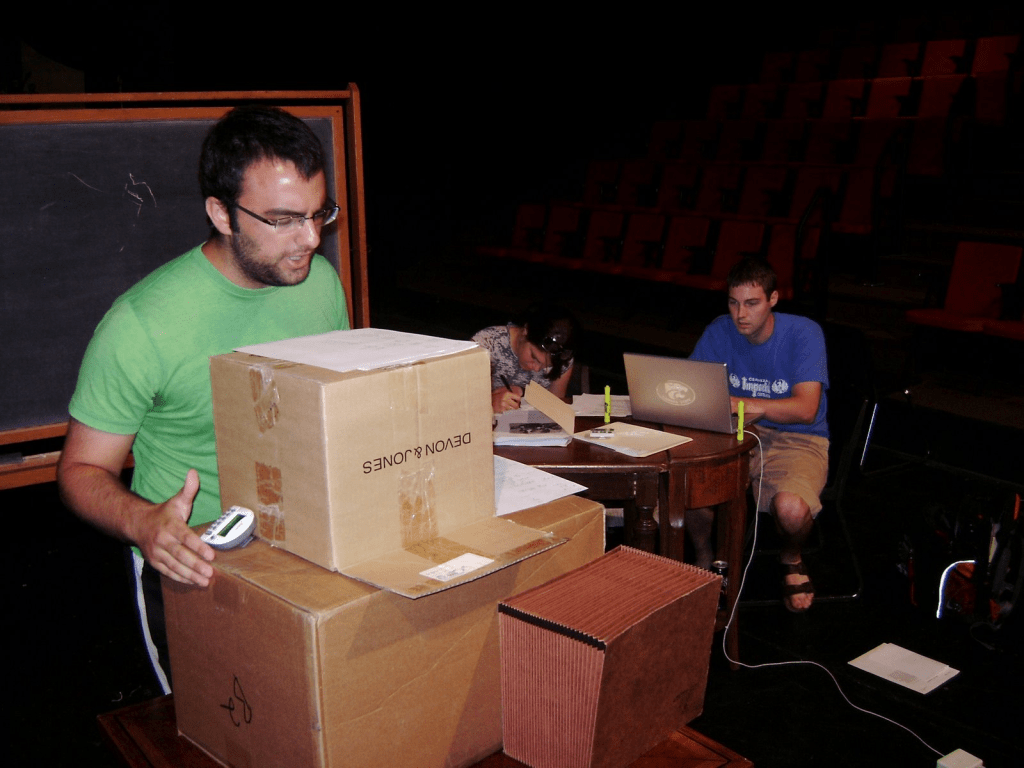
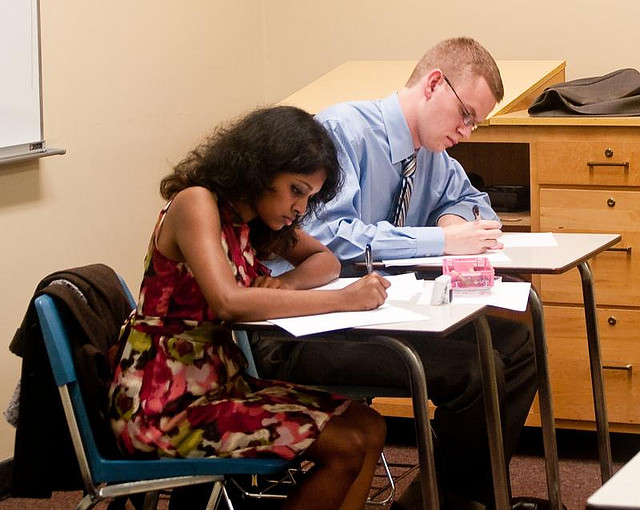
During the 1AC, the negative team is carefully listening, gathering the affirmative’s evidence, and translating the speech into symbolic shorthand, termed flowing. In addition to its purely functional use—to keep track of positions—the flow also provides third party adjudicator(s) a document to evaluate the debate.
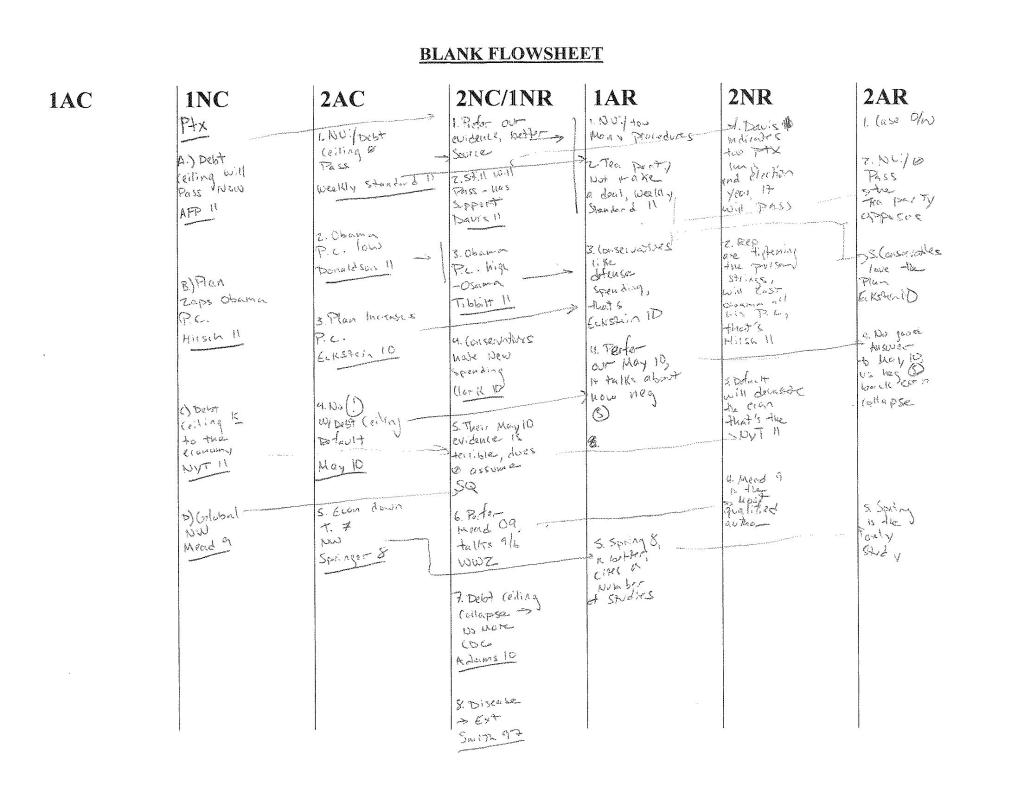
After a period of questioning, the first negative speaker, linked to below, elaborates his positions: a procedural concern that the affirmative is outside the confines of the resolution; two philosophical objections (or critiques); two alternative courses of action that resolve the affirmatives exigencies, while conserving the president’s political capital, so Obama can push for Jackson-Vanik legislation; and finally direct responses to the affirmative position.
Finals – NDT 2012 Northwestern BK v Georgetown AM – 1NC + CX
Coupled with the “burden of rejoinder,” which dictates a conceded argument is a true argument, speed becomes a strategic weapon. The more positions, the more likely one will be missed, granting the other team an advantage. For example, failure to address the negative’s concerns about the Jackson-Vanik legislation means that the affirmative position would result in a US-Russian nuclear war culminating in extinction and probably losing the affirmative the debate. Even less dire claims exert force in the round. For instance, missing the relatively innocuous claim that Obama does not have political capital abrogates the negative’s whole Jackson-Vanik position. After all, what would be the point of Obama conserving capital, if he has none to begin with?
Debating thus requires a refined ear capable of quickly determining a argument’s merit, while allotting the proper amount of attention. If a claim is deemed irrelevant, the debater can focus on a more relevant position, keeping her/his ear piqued for beginning of the next position.
This confluence of speed, evidence, time constraints, and a burden of rejoinder cultivates an instrumental relationship to expertise. Media theorist Jayson Harsin suggests in “The Rumour Bomb: Theorising the Convergence of New and Old Trends in Mediated US Politics” that these “conditions encourage a relationship of viewer to text (slogan, soundbite, fragment) which is essentially fiduciary, based on trust, not critical understanding”(101). Indeed, time constraints coupled with a proliferation of positions, produces a sound to listener relationship, where the veracity is assumed and significance is dictated by strategies, not the least of which is vocal. This is because there is simply not enough time to evaluate the credibility of each piece of evidence read. Patrick Speice and Jim Lyle, two debate coaches, explain that “Debaters have to be focused on the arguments being offered, have to be able to understand them very quickly, and they have to be able to discern which arguments are of the greatest significance for the round.” Evidence, then, is reorganized along a strategic continuum—the more likely an argument may help or hinder a team’s chances of winning, the more important it becomes. This can precipitate a “race to the margins,” where one side tries to find an obscure argument to beat back more probable analysis. This is not to say that one kind of argument is better than the other. But, the rationality used to organize the evidence relegates veracity to the epiphenomenal. This fosters an epistemic leveling, indexing expertise according to its exchange-value.
The repetitive nature of debate inscribes these listening habits into the body, shaping future interaction. Writing on the pious ear, cultural anthropologist Charles Hirschkind explains in The Ethical Soundscape: Cassette Sermons and Islamic Counterpublics, “patterns of sensory attunement configured through continuous practice of such a listening constitute an intensifying perceptual background for […]ethical agency and public reason”(28). Similarly, the practice of listening to debate rounds, along with the movement of the hands, quickness of thought, and so on are burned into an affective substrate, defining the horizons of future action. That is, through the repetition of debates, audile technique is entrained into motor memory, residing just below the conscious register of thought, acting as a potentiality. Most often, this listening technique is activated in the next debate round, the spread’s distinctive sound generating an anamnestic effect, activating the policy debate ear.
In sum, spreading proffers an audile technique concerned with the exchange-value of evidence, where the “best claim” is the one that wins the round. It entrains a technical mode of audition, aiding the debater in making quick decisions. This listening style underwrites a knowledge economy, where expertise becomes just another commodity that is bought, sold, and traded to support pre-formulated opinions. “Under communicative capitalism,” Jodi Dean writes, “an excess of polls, surveys, and assessments circulates, undercutting not only the efficacy of any particular poll or survey but the conditions of possibility for knowledge and credibility as such. There is always another survey, done by another group or association with whatever bias and whatever methodology, displacing whatever information one thought one had” (103).
—
Justin Eckstein is a doctoral candidate and former director of debate at the University of Denver. His work explores the intersection of listening, affect, and argumentation. Justin’s writing has appeared in Argumentation & Advocacy, Relevant Rhetoric, and Argumentation in Context. Currently, he is writing his dissertation on the micropolitics of podcasting in the post-deliberative moment.
—
Share this:

Audio Culture Studies: Scaffolding a Sequence of Assignments

Developed to explore the relationship between sound and learning, our fall forum on “Sound and Pedagogy” blends the thinking of our editors (Liana Silva), recruited guests (D. Travers Scott), and one of the winners of our recent Call For Posts (Jentery Sayers) to explore how listening impacts the writing process, the teachable moment, and the syllabus (and vice versa). If you need a make-up assignment for the first post by D. Travers Scott, click here, or for last week’s post by Liana Silva, click here. Otherwise, get ready to take some furious notes, because today’s post from Jentery Sayers offers a generously revealing—and unprecedented—glimpse inside the development of his audio culture course over several years. Chock full of suggestions, prompts, unique assignments, and troubleshooting tips, Sayers’s offering is refreshingly frank about the unique challenges facing sound studies scholars in the classroom. As in most classes, information this deep may need some time to settle in and effect some change, so we’ll check back with you in spring with a Sound and Pedagogy “refresher course.” It’s already on our syllabus.–JS, Editor in Chief
—

DOI: https://doi.org/10.59350/kyyzr-5hq42
This semester, I am teaching my fourth course in audio culture studies. Since students and faculty in the humanities rarely have the opportunity to intensively examine sound in the context of higher education, thus far I have learned that—even for teachers who are well-versed in sound studies—planning and structuring work in an audio culture course is more difficult than it may at first appear. For instance, to what degree should an audio culture course intersect with visual culture studies? What cultural assumptions about sound inform how students learn about it, not to mention how instructors teach it? When engaging histories of sound reproduction, how might students combine knowing and doing, or composing about and with sound? And how should work in an audio culture course be assessed? Through what sorts of learning outcomes? With what forms of student preparation and self-reflexivity in mind?
In the following paragraphs, I engage these questions by unpacking a portfolio-based assignment sequence from an undergraduate course I taught at the University of Washington-Bothell in 2010: “Technologies of Expression: Sound Reproduction Studies.”
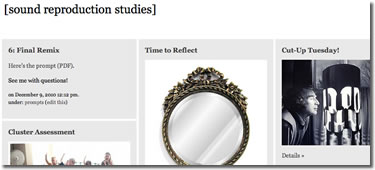
As I prepare for my “Audio Culture Studies” undergraduate course at the University of Victoria this semester, the above questions are guiding my lesson plans as well as my revisions of previous teaching materials. Yet more importantly, I imagine they—or variants of them—resonate with other instructors invested in sound studies, and I hope this post will spark a conversation about how to continue developing sound studies curricula in higher education. In one sense, such curricula should be and are distinct from work anchored in visual culture, print, film, and e-text studies. Nevertheless, there are a variety of suggestive intersections across these fields, and my approach to audio culture courses often builds upon them, especially since my training is in literary and cultural studies.
To begin “Sound Reproduction Studies” (heretoafter “205”) at the University of Washington-Bothell, I told students to let me know (in writing) how they were going to record sound during the course. After all, I did not know what technologies they could access, and I wanted to make sure that—with help from the University’s library and digital media services—recording equipment was available to them. I also informed them that, throughout the course, we would be focusing on basic recording and editing but not high fidelity techniques or post-production. In other words, I was not expecting them to gain competencies common in sound art and audio engineering, and my humanities-oriented assessment of their audio work would privilege content and composition over the aesthetics of recording and playback. For a course anchored primarily in cultural studies, they were welcome to use everyday audio equipment intended for consumers and amateurs, and fortunately that equipment was available on loan through the University.
After that request, I asked them to “crowdsource” a brief history of sound reproduction using SIMILE’s Exhibit 2 framework. While I have my reservations about crowdsourcing, for the purposes of the class—especially at the beginning of the quarter—it was appropriate. As the prompt suggests, I wanted to survey what students already knew about audio, together with where their interests in sound tended to constellate.
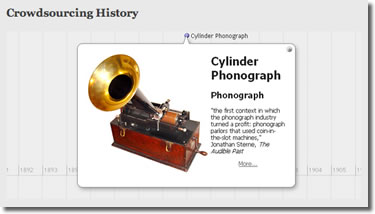
From the start of the course, I also wanted to situate visual and audio cultures in the same space, encouraging students to think about the tensions and intersections between them as well as the epistemologies and affects they enable. Here’s a screen grab of what students produced in a week (between two class meetings):
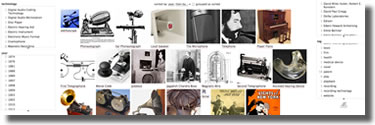
I used this crowdsourced exhibit as the basis for an introductory lecture on the vexed legacies of sound reproduction. It helped me identify gaps in student knowledge while also underscoring what was familiar to them (e.g., Edison’s phonograph, the turntable, and auto-tune). The exhibit became a handy vehicle for posing questions to explore for the balance of the course: How is noise defined differently over time, by whom, and for whom? How is sound naturalized, and to what effects on critical inquiry? How is sound embodied, and why is it so often associated with emotion, affect, and immersion? When studying the history of sound reproduction, what roles do old technologies and media play in our research? How has the composition and playback of audio changed from decade to decade?
In other words, the exhibit was a low-stakes launching pad into the course material. I found it instilled a bit of confidence in students by giving them some sense of authority over the material. And it gave them a concrete sense of what I meant by “audio culture” (as opposed to, say, “music history”). Early in the course, I also appreciated the opportunity to highlight the deep and rich history of sound reproduction, a history which no doubt informs contemporary obsessions with all things digital. Where I failed as an instructor was by not returning to the exhibit later in the quarter. In future courses, I’ll give them an opportunity to add, revise, and even remove content where appropriate. Such a gesture would add a layer of self-reflexivity and iterative knowledge-making to the learning process, premised on questions like: “Now that you’ve studied audio for seven weeks, how would you revise your contributions to the crowdsourced exhibit you helped compose earlier in the course? How has your perception of audio’s history changed and why?”
After the crowdsourced exhibit of sound reproduction, the students in 205 shifted toward composing with audio, exploring ways to combine knowing and doing sound studies. For this shift, I relied on another low-stakes assignment: the “audiography.”
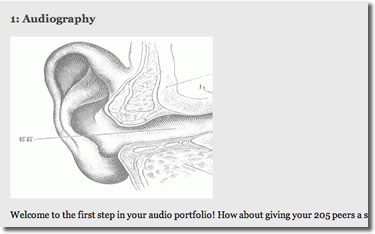
Here, students had the opportunity to share “playlists” of sounds typical to their everyday lives. However, the ultimate motivation of the exercise was twofold: (1) for them to closely attend to those common soundscapes, organize them (around a theme of some sort), and record them; and (2) for them to develop some basic competencies in the free audio editor and recorder, Audacity (based on a workshop conducted during class). Although the very notion of a “soundscape” was likely new to them, and even though most of them had never recorded audio, the concept of a playlist was personal and familiar enough to make the assignment approachable. It also stressed the fact that, like images and texts, people design and structure arguments through sound. A playlist of everyday sounds involves rhetorical strategies not entirely distinct from, say, an academic essay or television broadcast.
For the audiography (as well as every other audio composition in 205), the students were given constraints (e.g., “no narration,” “no effects,” and “eight to fifteen recordings only”) similar to guidelines for academic essays. And once the audio files were composed, the students uploaded them to our class audio blog (using a WordPress theme that unfortunately is no longer supported or maintained). The benefit of the blog was that everyone in the course could hear everyone else’s audio work. Additionally, I could play student audio during class meetings, treating it as an object of inquiry for discussion. In so doing, I made sure that—during the quarter—we discussed every student’s audio work at least once.
Audiographies are great for getting at cultural assumptions about sound, especially when students are able to respond to them through repurposing, voice-over, or a similar strategy. For the “re: audiography” prompt, I asked students to do just this.
They downloaded a peer’s audiography (from the class audio blog), edited it, produced a story through it (including voice-over tracks), and circulated the final product. While, quite obviously, this exercise became a gateway into studying montage, cut-up, turntable, DJ, and laptop practices, it also gave students an opportunity to assess how an audience member might interpret their audio work, the soundscapes with which they are familiar, and the rhetorical strategies motivating their compositions. “Re: audiography” relies on re-situating audio in a new context, as it demands thinking about how setting, history, and ideologies all affect interpretation. In so doing, it also requires significant consideration of the risks, play, warrants, and claims involved in an audio composition relying heavily on existing work. As an instructor, I was sure to remind students that such play is not innocent; it is quite serious, and—in the context of 205—it was not intended to offend or mock another student’s work, interests, or background. Consequently, adding this line to the prompt was key: “Don’t be rude to them and recognize that they worked hard to make their audiographies. What’s more, the sounds involved mean something to them.”
As I plan for my audio culture studies course at the University of Victoria, I am revising the “re: audiography” prompt to make it more concrete, with clear parameters. In particular, Step 5 in the instructions is too vague; it lacks sufficient focus, without being anchored in a particular genre or example to which students can refer. As such, during 205 I ultimately worried that the flexibility in the prompt induced student anxiety. Without a genre in mind, they had too many avenues to explore, even if all of those avenues afforded ways of engaging cultural assumptions about sound.
After the audiography prompts in 205, I assigned students two “found sound” exercises, which furthered the combination of knowing and doing through a line of research. Both exercises were scaffolded toward the production of an audio documentary that was academic in character.
The first “found sound” prompt asked them to gather a series of historical audio clips related to a particular medium and begin formulating a research question about them.
The audio piece that resulted included not only the audio clips but also the student’s initial thoughts, questions, and concerns about the research. One significant benefit of this exercise was that it acted in conversation with other strategies for academic argumentation, namely how arguments involving actual audio differ from and intersect with arguments devoid of audio. In other words, it introduced students to the very notion of multimodal argumentation, including the ways in which audio functions in scholarly communications. Students also had to consider what it means for an argument to be heard, not read.
As an instructor, I find that I still tend to map norms for text- and image-based argumentation onto audio work. For instance, the language of the “found sound” prompt resonates with a prompt I would write for a text-based “thought piece.” It is a translation of modes, without much consideration for how audio-based arguments might actually serve distinct and perhaps divergent aims—aims premised on, say, affect or non-sequential arrangement. For future iterations of this prompt, I plan to highlight such possibilities, brushing against my own proclivities for validating audio-based arguments through text- and image-based conventions.
Comparable to the “re: audiography” prompt, the students in 205 responded to each other’s “found sound” exercises, this time through “re: found sound.”
Rather than repurposing or sampling a student’s work, in this case students recorded verbal feedback, which essentially acted as a form of peer review. Perhaps above all else, this exercise allowed students to articulate an understanding of how to structure and evaluate audio compositions, preparing them for the audio documentary. Yet one of the most effective components of the prompt is this request: “Identify at least one thing (but preferably more) that you think your peer is overlooking or not considering. This thing can be a concept (e.g., ‘speaking with’), an example work (e.g., film, audio recording, or text), or a perspective (e.g., conflicting opinions on the topic). When you make this gesture, explain why it’s relevant to not only his or her audio documentary, but also the history of sound reproduction.” From my perspective as an instructor, this intervention in a peer’s work is difficult yet rewarding. It is a response that demands its own research, as it asks the reviewer to more or less deconstruct what is being heard.
“Re: found sound” also requires students to meticulously consider how they are saying what they are saying when critiquing someone else’s work. For instance, tone, inflection, and dialogic gestures are foregrounded. To be sure, students make similar decisions when responding through text. Nonetheless, the shift in modality affords a learning experience arguably rare in higher education humanities.
For future iterations of “re: found sound,” I will ask students to submit written feedback in tandem with the audio, not only for accessibility purposes but also to stress correspondences between the media. Again, one of my ongoing concerns in audio culture courses is that I will—in a reactionary fashion—privilege speaking and listening over seeing, reading, and watching. Such reactionary approaches risk dividing critical approaches when they can instead be suggestively blended through interdisciplinary research.
The two “found sound” prompts guided students in 205 toward an audio documentary, which was steeped in a specific historical issue and informed largely by cultural studies approaches to audio technologies and media.
To prepare students for this genre, I provided example documentaries, and we also conducted several workshops on how to make and critique those documentaries. In the end, these documentaries were a real pleasure to hear, and one of the biggest difficulties is listening and re-listening to them closely. After all, the evaluation of audio operates through a different temporality than text, and often times it lends itself to focusing too much on production and post-production (rather than, in this case, the actual content of the audio documentary). Requesting transcripts, and even the original AUP files (or a similar format), can facilitate fair and thorough evaluation. I also try to listen to each documentary at least twice, with and without headphones. Finally, as an instructor I have learned that audio documentaries will always take students twice as long as I assume they will. Despite popular assumptions about the speediness and ease of digital production, the genre is labor-intensive and layered with samples, effects, voice-over, and transitions. It is also often new to students in higher education.
Even though the documentary was the most involved piece of the students’ audio portfolios in 205, it was not the final submission. In a self-reflexive fashion, the students were asked to submit a final remix of their work (PDF).
At its core, the final remix intersected audio theory, practice, and history. Intended for educated, non-expert audiences beyond the course, it asked students to provide specific examples of how they fulfilled particular outcomes in the course. Among other things, the samples in the remix were intended to demonstrate an awareness of: (1) audience, (2) the technocultural history of sound, (3) a theory of listening, (4) audio composition and post-production, (5) constructive, audio-based peer review, and (6) persuasive media strategies for audio-based argumentation.
Perhaps quite obviously, this reflective remix borrows from a long history in writing studies. And I have found it quite effective for identifying what and how students learned from the course. That said, what I enjoy most about it is how it requires thinking about sound as matter: its arrangement and manipulation, its existence in various iterations and formats, its function as tangible, audible evidence. For, when returning briefly to those questions in the first paragraph of this piece, I tend to think the greatest challenge facing sound studies curricula and pedagogy is the challenge of sound’s materiality. As sound studies scholars, how do we foster spaces and opportunities where people can learn about the history of sound as an object with its own fluctuations, politics, aesthetics, and material particulars? How do we teach audio culture as that which can be simultaneously inhabited and examined from a distance? As a thing, a mode of composition, and a way of thinking, feeling, and acting?
—
Featured Image “Burn Station @ inSIRACJE festival” by Flickr User Paula Rey
—
Jentery Sayers is an Assistant Professor of English at the University of Victoria, where he teaches cultural studies, digital humanities, and 20th-century U.S. fiction. His writing has appeared in Kairos: Rhetoric, Technology, and Pedagogy; The New Work of Composing; Computational Culture; The New Everyday; Writing and the Digital Generation; Off Paper; Collaborative Approaches to the Digital in English Studies; and ProfHacker. Among his other work involving audio, his current book project is a cultural history of magnetic recording. He’s grateful to Jennifer Stoever at Sounding Out! for feedback on drafts of this piece.
—
Share this:




Current Top Posts





April 2021

January 2020

November 2019

October 2019

August 2019

April 2014

November 2017

March 2015

December 2017

October 2015


Recent Comments