
Tape Hiss, Compression, and the Stubborn Materiality of Sonic Diaspora

DOI: https://doi.org/10.59350/wq79t-x3184
In an article for Pitchfork, music critic Adam Ward reminisces about digital music files that sound as if they’re “being played through a payphone,” and calls the extreme compression of the low-quality MP3 “this generation’s vinyl crackle or skipping CD.” The crackles, hisses, and compression that characterize such sound files are what I term “encoded materiality.” Focusing on the encoded materiality of the digital helps us to reconfigure our approach to sonic media, understanding how the compression of early MP3s and tape hiss remind us not only of lost fidelity, but also of the richness of exchange. These warm and stubborn sonic impurities, having been encoded in our digital listening formats and thus achieving repeatability and variability, act as persistent reminders that we can think diaspora beyond melancholy and authenticity, sidestepping the questions of purity and loss that so often characterize dialogues in the field of diaspora studies.
In Mechanisms, his work on electronic textuality, Matthew Kirschenbaum proposes a “material matrix governing writing and inscription in all forms” composed of four elements: “erasure, variability, repeatability, and survivability” (xiii). The defects of sonic technology that become encoded in digital files are one such type of inscription. Tape hiss and other recording accidents–such as Casey Kasem ruining your attempt to tape record the first Western song you fell in love with after leaving Hong Kong by fading the outro and butting in with his banter–achieve repetition and survival during the digital encoding process, becoming a welcome reminder of time and place. Such materiality helps us to better understand the politics of diaspora. It clues us in to how the elements of textual encoding (erasure, variability, repeatability, and survivability) become embedded within diaspora’s complex logic.
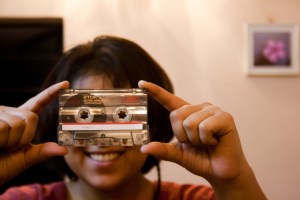
To think through these complex moments of exchange, let me offer a story about my experience with tape hiss. I grew up listening to music touched by this particular sonic grain: a ground level of noise upon which my sonic experiences were built. After I received my first iPod in 2005, I connected a tape player to the input of my computer, recorded a stack of tapes, and then manually split them into MP3s—pseudo-piracy committed in earnest. A few weeks ago, I dug up these same files and put them on my phone, once again returning the buried albums to their former glory on a constant rotation playlist. I keep returning to these particular files, rather than finding the now easily available digital versions, because I admire the survivability of their materiality. The materiality of these tracks allowed me to trace the complexity of my own history—the tape hiss is just as much a part of this history as the songs themselves.
After first moving to Canada from Hong Kong, my family and I established ourselves by unswervingly performing the same routine each weekend. We would have late lunch at our favorite dim sum restaurant, drive around for a bit, and then relax at home; there wasn’t much to do in the ex-urbs of Toronto. On those drives, we listened to selections from a stack of cassette tapes in the glovebox of our old Pontiac Bonneville. Sally Yeh’s 1987 album Blessing was on constant rotation and received its fair share of wear. This was one of the tapes I recorded to my computer, destined for digitization.
Because I hit the record button a few seconds early, my MP3 of Sally Yeh’s Blessing begins with a few seconds of silence. It’s enough to trick me into thinking that the song isn’t playing. In a quiet enough spot, I can hear that it’s actually tape hiss. No matter where I am, on the road or in the shower, my mind fills in the blank with the thick ker-chunk of the cassette entering that Pontiac stereo right before that familiar tape hiss would fill the car, always giving us a few sometimes-needed, sometimes-awkward moments of silence before the music started. The sonic texture of that tape stems from its material nature as plastic and metal. The hiss itself is due to the size of the magnetized particles on the plastic. Because of these sounds, the song tells its own story. It recalls our shared sonic and material experience as I migrate it from device to device.
Before Blessing made its way into our car, it was one of the few cassette tapes that my parents carefully packed into a dozen cardboard boxes and shipped by sea to Canada in the late 1980s. This was in the midst of the countrywide protests in China that led to the events at Tiananmen Square. That insistent ker-chunk of plastic on metal that my brain inserts every time I play the MP3s keeps my experience of the music grounded in this earlier history, too. Strange that a fluffy pop song would remind me of the serious political strife taking place on the doorstep of a Hong Kong nervously awaiting its “handover.” This sonic anchor’s ability to recall to me these snippets of history, both personal, national, and transpacific has been crucial in the development of my own diasporic identity. Listening to this particular recording of Blessing helps me to keep track of my self and my history.
Ker-chunk.
The act of withdrawal that many of us perform in order to interface with our sonic technologies, as Alexander Weheliye shows in his reading of Ralph Ellison’s Invisible Man in Phonographies, can play a powerful role in understanding one’s own racial subjectivity. Weheliye focuses on the scene in which the titular narrator-protagonist retreats to a subterranean cave-like space to listen to Louis Armstong’s recorded, disembodied voice in complete solitude. He asserts that the narrator builds his own subjectivity through a recognition of the self by projecting that self onto Louis Armstrong’s “vocal apparatus,” that is, his voice coming through a phonograph (143). “The phonograph’s ability to disconnect the singing voice from its face, or rather to replace it with a technological visage, further heightens its materiality, which impels the protagonist to imbue Armstrong’s voice with a surplus of signification” (Weheliye 145).
More than a black and white photo or a stern historical lecture from the elders, the “heightened materiality” of the digital format, a type of “technological visage” cathects my own diasporic history most forcefully to the sonic anchor of tape hiss because it acts as a “voice without a face” in the same way as the phonographic Armstrong. But despite the privacy of the phonographic listening act in this scenario, Weheliye suggests that
the phonographic listening modality also bears the traces of sociality… since the listening subject is drawn out of him/herself by encountering the technologically mediated sounds of other subjects—we might even go so far as to suggest that the phonograph itself functions as a subject, especially in its interfacings with various humans. (165)
So it is with similar sonic technologies that can encourage the “eschewing [of] the social” such as iPhones, CDs, and, yes, cassette tapes. Like Ellison’s narrator interfacing with the mechanical apparatus that conveys Armstrong’s voice, the insistent “defects” kept on the digital file keep the mechanism of its delivery at the fore, allowing me first to understand that diasporic feeling of dis-ease—and to imagine beyond it.
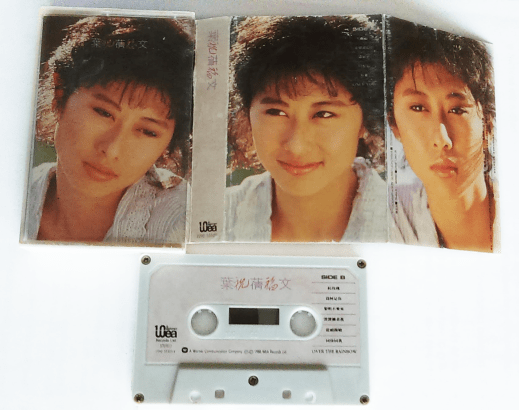
What I gain from the digital yet still stubbornly material tape of Blessing is not any overt lyrical or thematic gesture to a diasporic subjectivity on the artist’s part, but rather an induction into what Giorgio Agamben calls, “the idea of an inessential commonality, a solidarity that in no way concerns an essence” (18), or perhaps a community based on “belonging itself” (84). Likewise, Weheliye’s “diasporic citizenship coarticulate[s] the national and transnational instead of playing a zero-sum game with political identification” (369). If diaspora is defined by the perpetual desire to seek an imagined originary point of true identity that inevitably leads to melancholy, as psychoanalysis maintains, tape hiss and other encoded materialities turn the gaze away from the mists of origin, validating instead the development of diasporic identity in the aftermath of emigration. Of course, loss and melancholy are legitimate psychic aspects of the diasporic experience, as persuasively demonstrated by scholars such as David Eng, Shinhee Han, Anne Anlin Cheng, but they neither define the whole experience nor are they mutually exclusive to it. It is in this way that we can think of diaspora as a community of belonging by becoming.
A consideration of the stubborn ways that materiality is encoded in the digital helps us to think of diaspora as more than psychic fait accompli—it is also a ‘coming community’ characterized by the process of belonging. Kirschenbaum’s matrix provides the right foundation for a study which considers how material inscriptions are related to our diasporic lives. The inscription that defined my diasporic becoming came from the cassette tape that travelled across the ocean in a boat for five weeks, escaped erasure, survived repeated playings, became digital, and lives on now as a hissing reminder of our history of emigration. What else may we find about our own becoming and belonging if we attune our ears to the encoded materialities of sonic diaspora?
–
Featured image “Decayed Cassette” by darkday @Flickr CC BY.
–
Chris Chien is a Ph.D. candidate in the Department of English at the University of Southern California working variously in the areas of sound, diaspora and transpacific studies, all with a distinctly queer bent. He completed his M.A. in English Literature at Loyola Marymount University and his Honors B.A. in English Literature and Latin at the University of Toronto. Chris has presented papers on angelic gender fluidity in John Milton’s Paradise Lost and post-colonial affect in the work of Herman Melville and Amitav Ghosh at the Rocky Mountain MLA and South Atlantic MLA conferences respectively. He is currently developing a paper that examines the performativity of diaspora, masculinity, and the capitalist ethos in Eddie Huang’s memoir Fresh Off the Boat and its adaptation as an ABC sitcom.
–

REWIND! . . .If you liked this post, you may also dig:
Pushing Play: What Makes the Portable Tape Recorder Interesting?—Gus Stadler
SANDRA BLAND: #SayHerName Loud or Not at All — Regina N. Bradley
Listening (Loudly) to Spanish-language Radio — Dolores Inés Casillas
Brasil Ao Vivo!: The Sonic Pleasures of Liveness in Brazilian Popular Culture — Kaleb Goldschmitt
—
Share this:

Mediated Sexuality in ASMR Videos

DOI: https://doi.org/10.59350/hpkcn-sr240
“Why does it feel so good when someone else is touching you?” she asks, fluttering her fingers up her forearm in demonstration. The cheerful blond woman smiles brightly. “Is it because of the physical contact itself? Or is there something else going on?”
This YouTube celebrity is Olivia Kissper, and she is about to demonstrate 40 different sounds that act as “triggers” for ASMR, or Autonomous Sensory Meridian Response. ASMR is a term coined by the community of internet users who experience a particular tingling sensation in response to certain auditory, visual, or haptic stimuli. The sensation often originates in the scalp and travels down the spine and is reported to be immensely pleasurable, as well as relaxing. “ASMRtists” now flood YouTube with a steady stream of high definition videos designed to trigger this sensation for viewers, either by whispering or making other sounds with the mouth, by tapping, crinkling, or scratching various household objects, or through role-play scenarios (which often incorporate some or all of the above). In answer to Olivia’s question, I suggest that ASMR “feels so good” because the technology affords listener-viewers the opportunity to imagine alternative sexualities outside of the dominant Western paradigm of heterosexual, two-bodied, genital, orgasmic, reproductive intercourse.
However, the online ASMR community vehemently asserts that there is nothing sexual about ASMR. Of course, that is not to say that NSFW ASMR doesn’t have a strong following on Reddit, or that there haven’t been strident debates on the topic (such as the one sparked by comedian Russell Brand earlier this year). But it does mean that the vocal majority of ASMRtists and their listeners perceive this experience as intensely pleasurable, yet outside the regime of sexuality. It seems that positioning ASMR as distinct from sexual fetishes is an effort to destigmatize what may otherwise be viewed as deviant or unhealthy sexual behavior.
The problem at hand, then, is not that ASMR may in fact be sexual, but that pervasive definitions of sexuality pertain to very narrow set of actions and gestures among a very narrow set of bodies and pertaining to a very narrow set of moralistic qualities. I argue that ASMR videos broaden the scope of what we understand as “sexuality” and provide a means for bodies to gain access to certain other bodies in particular ways, and thus serve as an outlet for people to enjoy those (sexual) pleasures alongside of what is deemed appropriate in the mainstream. By analyzing this video phenomenon, specifically through the videos of ASMRtist Olivia Kissper, I consider what is “real” about this mediated intimacy, and how this mediated intimacy can help us to reimagine sexuality.
Pleasure
If ASMR is described by those who experience it as intensely pleasurable and relaxing, and if ASMRtists craft their videos with the deliberate intention of producing this automatic, visceral, pleasurable sensation, then it is indisputable that ASMR is, above all, concerned with the production of pleasure. In this way, it is not difficult to note the parallels between ASMR videos and pornography—another “body genre” (to borrow the term from Linda Williams) that employs genre-specific techniques with the intention of producing an automatic, visceral, pleasurable sensation in the viewer. Bearing this in mind, it should not be overlooked that most of the bodies interacting with the objects in these videos are young, conventionally attractive, white women. As art historian Joceline Andersen notes, ASMR often “relies on the heteronormative gender roles of care” (685). In other words, the popularity of an ASMRtist (with few exceptions) seems to be directly related to her sexual appeal and the degree to which she upholds Western standards of beauty.
Despite the fact that these videos may not be pornographic in the traditional sense, they are certainly sensual, if not sexual. This is exemplified by the way in which these ASMRtists attempt to evoke the sensation of contact with the viewer. ASMR is triggered not only by sound, but also by touch, and many ASMRtists strive to create perfect illusions of tactile sensation through the expert manipulation of visual and aural components. These are the kinds of videos that Olivia Kissper produces most often, such as “This FEELS SO REAL! Binaural ASMR SCALP MASSAGE with head massager, cicadas & WHISPERING.”
The tabloid-headline-esque style of the video’s title exemplifies the common practice of wordy titles for ASMR videos, so that viewers can tell at a glance if the video contains the specific triggers they are looking for, in this case tactile role-play and the auditory triggers of whispering and binaural recording. The quality of ASMR videos has steadily improved over the last couple of years, and most successful ASMRtists use high definition binaural microphones that record from two different “ear” locations, so that when the listener uses headphones, it produces the immersive effect of “3D” sound.
At the beginning of this video, Olivia asks, “are you ready for the most blissful experience?” then leans in close to whisper: “Are you ready to treat your senses a little bit today?” She speaks very softly and slowly, her voice intonated by her Czech accent. She punctuates her speech with graceful, twirling hand movements, and she shows off her long fingers and perfectly groomed fingernails as she displays the head massager and taps on the different materials it is made of in order to display its texture.
As a rule, ASMR videos deliberately engage with texture: if not of objects, then of the voice and the mouth, sibilance and saliva amplified sensuously through binaural recording. ASMR, then, is exemplary of Eve Kosofsky Sedgwick’s claim in Touching Feeling that, “what [texture and affect] have in common is that at whatever scale they are attended to, both are irreducibly phenomenological” (21). Here, the pleasurable affect manifests in the phenomenological tingles across the listener-viewer’s skin as Olivia taps her fingers along “your” hairline, runs her fingers through your hair, massages your scalp with her fingertips, and pushes the tines of the wire head massager down your head. If all goes well, you will feel like Kissper really is touching, stroking, and caressing you, and the experience will trigger “the tingles.” Performances such as Kissper’s produce the sensation of proximity, and are able to do so specifically through the digital technology that allows for the perfect storm of amplified aural, visual, and haptic stimulation. Here, the ASMRtist’s performance evinces the sensation of proximity and even direct contact with another body. As sound studies scholar Joshua Hudelson has described, in ASMR media, “sound is transduced into touch, and the taut membranes of the listener’s headphones become coterminous with his own skin.” The pleasure of these role-play videos derives not only from the physiological response to the mediated contact, but from the “personal attention” trigger (one of the top five most popular ASMR triggers according to a recent survey), as established through the use of second-person address. The demand for this element of intimacy is also growing in porn, according to Ela Darling, whose new website vrtube.xxx (NSFW) features virtual, one-on-one 3D cam sessions.
Intimacy
Mediated intimacy is at play in all ASMR videos, in the sense that they are produced for personal use. ASMR videos that use binaural recording techniques must be listened to with headphones, which means that each individual among the hundreds of thousands of viewers of these performances experiences an intimate encounter with the ASMRtist. But that intimacy is turned up even higher in role-play scenarios, as in one of Olivia’s earliest videos, “❀ Whispering, HAIR BRUSHING, Braiding & card reading ASMR ❀.”
This video takes place in a softly lit bedroom, with eye level low enough to suggest that the viewer-listener is sitting on the bed. Olivia is dressed casually in a plaid shirt, which is, not incidentally, unbuttoned rather low. She begins the video by addressing the viewer-listener directly as “friend,” and providing some expository dialogue indicating that the relationship is one of good friends who have not seen each other for a long time. She tells the viewer-listener she wants to braid her hair, but before she does that, she wants to:
start with acknowledging you because I’ve realized recently that I don’t tell you certain things and I just don’t want to put it off anymore. And I’m gonna whisper it to you, um, because it is really important for me that you really get that, yeah?
However, despite the platonic relationship established in the expository introduction, the boundary-crossing proximity of Olivia’s neck and hair in the viewer-listener’s field of vision erotically charges the banal acknowledgements she whispers.

It is clear that the intimacy that I experienced with Olivia is mediated—the hair she is braiding is not my own, for example, I cannot actually touch the objects she offers me, nor would she recognize me if I met her walking down the street—but does mediation necessarily imply inauthenticity? If intimacy is affective (pleasurable) and phenomenological (tingly), then doesn’t my experience with the mediated Olivia count as “real” intimacy? Dominic Pettman has suggested that love itself is a technology in “Love in the Time of Tamagotchi,” and points to the fact that intimacy is often done better through digital simulation:
[W]ith the current technology, simultaneous eye-contact is not possible. […] The video-chatter has the choice of staring at the image of their interlocutor, or straight into the camera, but not both at the same time. […] In 2012, simulated avatars already have an advantage over other humans on video-chat, since they can better simulate such a vital interactional presence, precisely by better simulating this eye-to-eye event (110).
Although Pettman provides the example of a digital avatar in a game, I think the same could be said of ASMR videos, and that Olivia’s eye contact is equally effective and affective. Olivia herself believes this to be true, asserting on her personal website that, “Because of our emphatic [sic] human connection and mirror neurons, our brain cannot tell the difference between a face-to-face interaction and online roleplay.”
Care
The authenticity of the encounter between the ASMRtist and her listener-viewer is paramount in Olivia’s work, especially when it comes to the concept of healing. It is no coincidence that spa treatments and medical exams are two of the most popular genres of ASMR role-play: both appeal to the pleasure of being cared for. Indeed, for Olivia, her videos are not just about producing pleasure for her viewers, but about healing them. This has become more evident in her recent videos, which belie her interest in science fiction, Eastern medicine and spirituality, New Age and metaphysical therapies, and what she calls “transpersonal healing.” One of her more unique videos, “FUTURISTIC TINGLES! Binaural ASMR exam and transpersonal healing role play with binaural beats,” exemplifies this philosophy. “FUTURISTIC TINGLES!” is quite different from the typical ASMR video in that it is less about stimulating particular senses or simulating particular experiences, and much closer to the abstraction of meditation exercises. It is not realistic, nor is it trying to be. But it is still acutely concerned with the phenomenological effect on the listener-viewer’s body.
This unique video, replete with computerized special effects, opens with a quote that draws connections between the placebo effect and the role of “caring attention” in healing. The viewer-listener is then led through a complex scenario in which Olivia, as a virtual cyborg healer, examines them through their computer screen, and then leads them through a healing meditation involving trippy visual sequences and binaural beats intended to trigger different, relaxing brain wave states. While the medical tests conducted in the first half of the video set the scene (and appeal to popular tropes within the ASMR genre at large), the second half is intended to produce actual healing effects within the body, not just simulate them. Olivia’s point is not that alternative therapies such as binaural beats and ASMR could be supported by Western research if only the scientists would study them; on the contrary, her performances embrace the healing potential of those phenomena that cannot be substantiated by Western research.
But although Olivia advocates for the alternative healing qualities of ASMR, her most popular videos are still about spas and medical offices, not reiki, palm reading, or ayahuasca, although she does have videos on all of those topics. The reason these two scenarios—doctor’s offices and salons—are so much more popular than, say, scenes in which the viewer is ill or tired and being cared for by a lover or a parent is because we are more likely to already have access to those forms of intimacy in our day-to-day lives. But although our doctors and aestheticians may know our bodies more intimately than most people in our lives, they are still considered strangers, and interactions with them must therefore follow strict protocol, particularly regarding sexual encounter. We may not articulate the pleasures we enjoy at the doctor or the salon because sexuality is understood as necessarily genital, and definitively relegated to specific relationships only. Similar to Anderson’s point that ASMR videos are productive of a “queer intimacy” (697), this essay shows how ASMR videos exemplify that there are alternative pleasures in these caring intimacies, and provide an outlet for enjoying those intimacies alongside of what is deemed appropriate in the mainstream.
Conclusion
Bearing these three components of Olivia’s videos in mind—pleasure, intimacy, and care—what interests me about ASMR is that they really do touch us: the mediation of the digital recording allows the vibrations produced by Olivia’s vocal cords and finger nails to literally penetrate my ear and resonate within my body. In this way, the technological mediation of ASMR videos facilitates, rather than hinders, contact between the performer and the viewer-listener, a point that speaks to the appeal of ASMR role-play videos in particular. ASMR refers not just to “the tingles” but to the affective conglomeration of physiological tingles and psychical pleasure and relaxation, as produced by the touch of the ASMRtist. And similarly, as Teresa Brennan suggests in The Transmission of Affect, even my internal chemistry may literally be affected by “body movements and gestures, particularly through the imitation of rhythms (effected by sight, touch, and hearing)” (70). While the sexuality of this resonance is implied by the (problematically) gendered performances of ASMRtists such as Olivia Kissper, I suggest, somewhat provocatively, that ASMR is not just like sex, but is sex.

As “sex” is increasingly acknowledged as referring to a wide range of activities outside of penetrative, heterosexual, genital intercourse, it seems inevitable that its bounds will continue to expand, blur, and reconstitute themselves. Sexuality, therefore, should not be defined by the concrete gestures that constitute “sex” in a given time and place. Rather, sex could be understood as any embodied technique of pleasure, intimacy, and care, while sexuality could refer to an infinite scope of techniques within that category. In this way, by asking what sex does to the body rather than what it means for the subject, we may be able to cast aside sexuality’s moralistic conundrums and better attend to its affective aspects. What the current, dominant, Western definitions of sexuality often restrict, are the socially sanctioned opportunities for certain bodies to touch other bodies and, it follows, the ability to see the benefit of a multiplicity of intimacies. ASMR performances may be one means of transgressing the interdictions on when and how bodies may access one another, sowing the seeds for cultivating alternative, pleasurable, intimate, and caring modes of life.
–
Image “In the Pink” by Koppenbadger @Flickr CC BY-NC-ND.
–
Emma Leigh Waldron is a Ph.D. student in the Performance Studies Graduate Group at the University of California, Davis and a graduate of the MA Performance Research program at the University of Bristol. She is also Co-Editor-in-Chief at the online journal, Analog Game Studies.
Emma’s research focuses on affective communities that coalesce around intimate performances of touch. She is currently researching the mediated intimacy of ASMR videos on YouTube, and how sex is represented in larp (live-action role-playing games). She is especially interested in how definitions and manifestations of sexuality are negotiated, reified, and transformed through these practices. Her work lies at the intersection of performance studies and media studies, and questions the role of embodiment in sexuality, intimacy, and touch. Her work is informed by feminist theory, queer theory, affect studies, and phenomenology. You can find Emma online at www.emmaleighwaldron.com.
—

REWIND! . . .If you liked this post, you may also dig:
Listening to Whisperers: Performance, ASMR Community, and Fetish on Youtube — Joshua Hudelson
Enacting Queer Listening, or When Anzaldúa Laughs — Maria P. Chaves Daza
Live Through This: Sonic Affect, Queerness, and the Trembling Body — Airek Beauchamp
—
Share this:




Current Top Posts





April 2021

January 2020

November 2019

October 2019

August 2019

April 2014

November 2017

March 2015

December 2017

October 2015


Recent Comments