
Fade to Black, Old Sport: How Hip Hop Amplifies Baz Luhrmann’s The Great Gatsby
DOI: https://doi.org/10.59350/0yr4q-wc611
When I heard of people flocking to recreate “Gatsby Dress” costumes for Halloween 2013, I couldn’t help but ponder the seemingly-perpetual cultural allure of F. Scott Fitzgerald’s The Great Gatsby, particularly its latest cinematic incarnation in spectacular Baz Luhrmann-style. More than a little of the momentum of the recent revival, however, had everything to do with the film’s soundtrack–executive produced by Jay-Z (who also executive produced the film)–that drew heavily on hip-hop. This sonic move was not without controversy, however, sparking intense debate when the film was released in May 2013. Take this line from Vice Magazine’s UK music blog Noisey (from a post snarkily entitled “Who Let The Great Gatsby Soundtrack Happen?”) that describes Kanye West and Jay-Z’s Watch the Throne album, from which many of the film’s songs are taken, as “a record that couldn’t be further removed from West Egg than a pauper trying to gain access to a Gatsby soiree.” This statement reveals more about this particular listener than it does about either the record or the film, which are intimately connected through the labor of Jay-Z and what I theorize here as a “sonic hip hop cosmopolitanism.”
I’ll admit that when I was first hip to The Great Gatsby my junior year of high school, I thought it was boring and couldn’t stand Tom or Daisy Buchanan or their rich white folk problems. I rooted for Jay Gatsby but couldn’t for the life of me understand why he was so sprung over Daisy, who wanted her daughter to be a “beautiful little fool” (17). But as I got older, I found myself returning to the novel time and time again, coming back to Gatsby like a forlorn lover and reconsidering what Jay Gatsby’s character represents: unrequited love, American idealism, (capitalistic) hustle, and (white) masculine performance. However, I’ve always been part of the camp that secretly hoped Gatsby was a black man passing for white, yearning for a life – and a woman – out of his grasp no matter how much “new money” he acquired.
It was not until Baz Luhrmann’s film adaptation of Gatsby that I realized how hip (hop) Gatsby really could be.

Luhrmann’s modernization of classic literary texts is not new; Romeo + Juliet (1996) got me through high school readings of Shakespeare’s play in ways Sparknotes could not. While Shakespeare’s words remained intact, the scenery and aura of the play burst to life on the big screen. Luhrmann uses in that film sonic cues of contemporary (youth) popular culture to make Shakespeare’s characters relatable. Verona is a hip, urban hub of violence that vibrates to grunge and pop artists such as Garbage, Everclear, and Quindon Tarver instead of mandolins and harps. The grittiness of grunge rock signifies the grittiness of Verona street life while Quindon Tarver’s angelic voice signifies the innocence and vulnerability of (first) love.
But Luhrmann’s Gatsby takes it up a notch, looking to hip hop culture as a bridge between the roar of the 1920s and the noise of the present. Aside from the literal presence of hip hop sound – mostly snippets from Jay-Z and West’s Watch the Throne – the materiality of hip hop sound also serves to update the Gatsby narrative. Consider how Gatsby’s parties are loud and bass-filled with a live jazz band. The loudness of the party and “surround sound” stereo sound of the film amplifies the vibrancy of the Jazz era while drawing in the audience with a contemporary interpretation of live parties seen and heard in contemporary hip hop culture. “The question for me in approaching Gatsby was how to elicit from our audience the same level of excitement and pop cultural immediacy toward the world that Fitzgerald did for his audience?” Luhrmann told Rolling Stone. “And in our age, the energy of jazz is caught in the energy of hip-hop.”
.
The film itself is stunning: vividly colored with panoramas and ground shots of New York City, Luhrmann’s film draws in an audience possibly unfamiliar with Fitzgerald’s novel. The film utilizes the more traditional jazz aesthetic that captures the novel’s initial element, but invokes hip hop to span a generational divide and update the (black) cool factor of the film. Indeed, both jazz and hip hop best signify black cool and its commodification into mainstream white America. For example, Norman Mailer’s discussion of the white hipster and Jazz aficionado as a “white Negro” is also tantalizingly useful in thinking of Gatsby as a black man passing for white. His affinity for Jazz and throwing jazzy parties incites the probability of Gatsby’s racial and social background. The film uses sound to create a hybrid of timeless black cool, while highlighting the presence of African Americans’ contributions to American culture. Hip hop’s birthplace and the portal for many immigrants into America, New York is arguably America’s most mythological city, grounded in both white and African American culture memory as such. Jay-Z’s own mythic rise to fame, wealth, and power in New York City–exemplified in some lines from 2009’s “Empire State of Mind,” “Yeah I’m out that Brooklyn, now I’m down in TriBeCa/ Right next to De Niro, but I’ll be hood forever/ I’m the new Sinatra, and since I made it here/I can make it anywhere, yeah, they love me everywhere”– grounds the film’s rags-to-riches mystique.
In addition to such extradiegetic associations, the film’s soundscape itself enthralls, with brassy, lively instrumented notes of jazz – which carried the sonic narrative of the 1920s – sounds of the hustle and bustle of urban spaces, particularly New York City, and hip hop. The film’s soundscape presents a hybrid of sonic black identities – jazz and hip hop – and uses their blended aesthetics to speak to the continued framework of black popular culture as a gauge of Americanism. In other words, the marginalized perspective is used to decide whether or not something is authentically American or not.

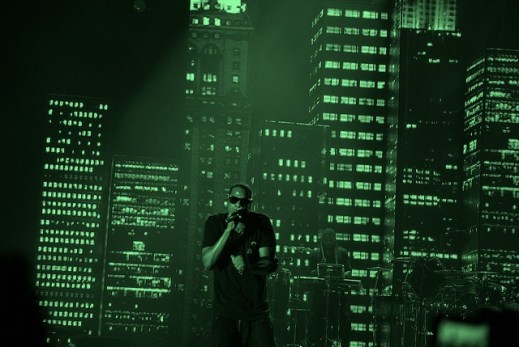
Columbus, Ohio, w/ Bruce Springsteen, Image by Flickr User Becker1999
Hip hop aesthetics bridge old New York with the current New York as a foundation of Americanness. Gatsby bridges the old adage of New York as a space of opportunity with the familiar New York adage that Harlem-born and Mt.-Vernon-raised P. Diddy drops in Jermaine Dupri’s “Welcome to Atlanta,” “if you can make it here, you can make it anywhere,”a call back to Sinatra’s “New York, New York” that is also echoed by Jay-Z that forms a foundational trope of the film and the novel. A particular striking example of the merging of these adages is a scene in the novel where Nick and Gatsby are on their way to the city. They pass a car with black passengers and a white chauffeur:
As we crossed Blackwell’s Island a limousine passed us, driven by a white chauffeur in which sat three modish negroes, two bucks and a girl. I laughed aloud as the yolks of their eyeballs rolled toward us in haughty rivalry.
“Anything can happen now that we’ve slid over this bridge,” I thought; “Anything at all” (69).
While the novel does not describe a sonic accompaniment to Carraway’s observation of the black folks in the limousine, there is an inherent understanding of the “modish” fashion of the black folks as jazzy, as cool. In the film, there is an audible sound associated with the black folks. They are sipping champagne and listening to Watch the Throne. Although visibly symbolic of the 1920s – dressed in zoot suits and flapper dresses – the aural blackness associated with the scene suggests a merger of jazz and hip hop cool and cosmopolitanism.

In order to understand how hip hop updates the struggle for realness, entitlement, and respectability in the Gatsby film, it is important to return to the major sonic influence of the literal hip hop sound in the film: Jay-Z and Watch the Throne. Jay-Z’s work on the album raises questions of how hip hop culture impacts not only the American dream but the aspirations of mogul-dom seen and heard in the film and novel. Christopher Holmes Smith’s discussion of hip hop moguls in Social Text (Winter 2003) is particularly useful in teasing out the implications behind the hip hop mogul and such figures’ social-cultural responsibility to their respective communities. Holmes Smith argues:
The hip-hop mogul bears the stamp of American tradition, since the figure is typically male, entrepreneurial, and prestigious both in cultural influence and wealth. The hip-hop mogul is an icon, therefore, of mainstream power and consequently occupies a position of inclusion within many of the nation’s elite social networks and cosmopolitan cultural formations (69).
Jay-Z’s status as a hip hop mogul – serving both as a creative talent and corporate backer – lends credence to thinking about hip hop as a space of entitlement and a site of struggle to attain that entitlement. It is from this perspective that I think of Gatsby as a hip hop figure/mogul: his working class background, hyper-performance of white privilege, materialistic pursuit of wealth for visibility, and desperate need for approval as “authentic.” To borrow from rapper Drake, Gatsby “just wanna be successful.”
Mark Anthony Neal’s discussion of Jay-Z as a hip hop cosmopolitan figure in Looking for Leroy (2013) further enables an understanding of how Jay-Z lends his (sonic) hip hop cosmopolitanism to sonically navigate between hip hop’s working class aesthetics and his own sense of entitlement because of the way he mobilized those working class experiences to become wealthy. While the film does have performances by artists who are not considered hip hop – i.e. Lana Del Rey, Jack White, and Florence+the Machine – Jay-Z’s use of his own raps, including tracks from the Kanye West collaboration Watch the Throne suggests a “sonic hip hop cosmopolitanism” complements any sense of the film as a case study of white entitlement. Tracks like “100$ bill,” “No Church in the Wild,” and “Who Can Stop Me” both prop up and tear down Luhrmann’s visual rendition of Fitzgerald’s critique of the uppercrust of America as corruptibly entitled.
.
Baz Luhrmann’s adaptation of The Great Gatsby is an intriguing and useful tool through which to analyze the (in)consistencies of race and cultural authenticity in the United States. Both jazz and hip hop exist in the interstitial spaces that lie between black cultural expression and white entitlement to those expressions. Luhrmann uses hip hop’s sonic and cultural aesthetics to pump up the capitalistic and all-American narrative of “pull yourself up by the bootstraps” narrative in Gatsby by also declaring, “get yours by any means necessary.”
—
Featured Image adapted from Flickr User kata rokkar
—
Regina Bradley recently completed her PhD at Florida State University in African American Literature. Her dissertation is titled “Race to Post: White Hegemonic Capitalism and Black Empowerment in 21st Century Black Popular Culture and Literature.” She is a regular writer for Sounding Out!
—

REWIND! . . .If you liked this post, you may also dig:
“‘I’m on my New York s**t’: Jean Grae’s Sonic Claims on the City”— Liana Silva
“I Like the Way You Rhyme, Boy: Hip Hop Sensibility and Racial Trauma in Django Unchained“– Regina Bradley
“The Victoria’s Secret Fashion Show and the Soundtrack of Desire“— Marcia Dawkins
—
Share this:

The Sounds of Selling Out?: Tom Zé, Coca-Cola, and the Soundtrack to FIFA Brazil 2014
DOI: https://doi.org/10.59350/m7zjr-2ww67
Welcome back to our summer series on “Sound and Sport.” In today’s post, Kariann Goldschmitt discusses the gamechanging controversy over Brazilian musician Tom Ze’s commercial for Coca-Cola’s FIFA 2014. For an instant replay of July’s post click Josh Ottum‘s “Sounding Boards and Sonic Styles: The Music of the Skatepark” or of June’s post, click Tara Betts‘s “Pretty, Fast, and Loud: The Audible Ali.” For May’s post, click Melissa Helquist‘s “Goalball: Sport, Silence, and Spectatorship.” This Thursday’s grand finale will continue our discussion of Brazil, with a podcast by Andrea Medrado entitled “The Sounds of Rio’s Favelas: Echoes of Social Inequality in an Olympic City” AND keep you on the edge of your seat with a bonus Olympic doubleheader post excerpted from David Hendy‘s recent Noise broadcasts for BBC Radio 4 on the sounds of Olympic crowds. And now. . .the sounds of FIFA’s sponsors. —J. Stoever, Editor-in-Chief
—
Tensions in Brazil have been running high as the the country ramps up preparations for next year’s FIFA World Cup. Brazil’s economy is one of the world’s strongest, but its middle class has suffered as economic growth has stagnated amid rapidly rising costs of living. Yet, FIFA demands that Brazil’s government spend large amounts of money to renovate stadiums and further bolster tourism-based services at the expense of everything else. This last June, news of another hike in transit fees was the final straw for many citizens and they took to the streets to protest corruption and the routing of public funds to tournament preparations while basic services suffered. Protesters argue that the country is burnishing its international brand on the backs of its citizens. It is thus no surprise that much of the Brazilian public is fed up with FIFA and its multinational partners. As a consequence, musicians who participate in World Cup-related ad campaigns risk damaging their relationship with the public.
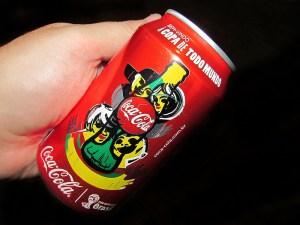
In Spring 2013, the Facebook page of one of Brazil’s most eccentric musical iconoclasts, Tom Zé, was bombarded by negative comments. Unforgivably to some of his most ardent fans, Zé had lent his vocal talents to a Coca-Cola commercial that sought to connect Brazil’s oft-mythologized cultural diversity to the universals of the World Cup and Coca-Cola’s alleged populism. Zé inflected his delivery of the ad copy with an especially musical speaking cadence and rhythm. It was a peculiar take that drew on his signature vocal eclecticism.
The ad opens with Zé stating,
Muita gente se pergunta como vai ser a copa
A coca-cola vai falar como ela não vai ser
[Many people are asking themselves what this cup will be like
Coca-Cola is going to tell you what it won’t be like]
as the shot features a group of people smoothing out a giant kite with the Brazilian flag. There is a strong syncopated rhythm to Zé’s voice that matches the carnival samba drums (especially the caixa) that accompany the ad throughout. As it continues, the imagery matches what Zé describes, in either stills or brief shots, often recalling the frenzy surrounding world cups of the past. In a rapid cadence, he says:
não vai ser só a copa de vuvuzela, do vidente, da celebridade
da menina bonita, do jogadores com cabelo da moda…”
[it won’t be the Cup of the vuvuzela, the psychic, nor of celebrity
of beautiful women, nor of players with fashionable hair]
The synchronization of Zé’s rapidly rhythmic delivery over archetypal images of Brazil’s tournament excitement is crucial to the ad’s message. This passage mentions two icons of the 2010 tournament, the vuvuzela and the psychic (vidente) octopus, with accompanying images. In under four seconds, the camera jumps from a man holding a celebrity magazine (celebridade), a woman cheering (menina bonita), some player figurines (jogadores) and a boy with an elaborate buzz cut. By aligning himself with an official sponsor of the upcoming tournament through ad copy that valorizes Brazil’s present, Zé also lent the sound of his voice to the sports-industrial complex, thereby opening himself up to accusations that he was a “sell-out” (vendido).
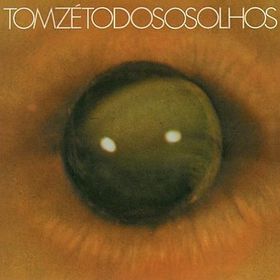
Zé is famous for taking part in the tropicália of the late 1960s – a cultural movement that was most effective through popular music. Tropicália musicians bucked Brazilian musical conventions by blending imported rock ‘n’ roll with national music protest songs during a period when musical taste often indicated one’s support or disapproval of the military dictatorship. While most involved in tropicália eventually became Brazilian musical mega-stars (Caetano Veloso, Gilberto Gil, Gal Costa, Os Mutantes, and Mara Bethânia), Zé drifted to obscurity by rejecting many of the machinations of the record industry. He only found an international audience when David Byrne’s Luaka Bop Records released some of his music in the 1990s, the most successful of which was Fabrication Defect [Com Defeito de Fabricação] (1998). Due to his peculiar status, Zé disrupted fan expectations and threatened his brand when he embraced a corporate power so intricately connected to an increasingly unpopular athletic tournament.
The controversy surrounding the Coca-Cola ad took a turn towards farce when, on April 22nd, 2013, Zé released a free 5-song EP on his website titled Tribunal do Feicebuque – a clear play on the way that Brazilians tend to pronounce “Facebook.” Accompanying the songs was a parody of tribunal orders listing the performing and collaboration credits along with lyrics to the songs. Zé’s actions exposed how the incident was a different kind of sonically-driven sports spectacle – this time it was played out over social media, in Brazil’s most influential newspaper, in Tribunal references and fights with fans during his shows at Rio’s famed Circo Voador, and in the ensuing blog reviews of his shows.
The chaotic structure of the EP’s title track, while typical of Zé catalog, disrupts his fans’ claims of “selling out.” He employs a variety of sonically disjunct approaches, opening with the startup sound for Microsoft’s Vista OS before jumping into a psychedelic samba-rock tune with a staccato guitar and a brass section. Zé recorded his vocals over multiple tracks, at times simultaneously sung/spoken at a low pitch and sung at a high pitch. The first half is familiar – the voices trade between Zé and a female companion in something sounding like a duet over a samba-rock beat. The lyrics directly reference infamous moments when Brazilian audiences have turned on their musical icons thought to be too involved in international business influences.
Vendido, vendido, vendido!
A preço de banana
Já não olha mais pro samba
Tá estudando propaganda
[Sell-out, sell-out, sell-out!
The price of a banana
He no longer looks to samba
He’s studying advertising]
At the mid-point, rock gives way to a serious march and more voices enter (including famed São Paulo hip-hop artist Emicida) making the song’s structure more like a trial, complete with competing arguments, before returning to samba-rock under Emicida’s rapping. The song is creative and fun, but it is far from Brazil’s top-40 fare which often favors smoother genre blends and urban pop hits.
Given all of the attention paid to musicians’ efforts to supplement their meager income from digital sales and streaming royalties by forging partnerships with a variety of multinational corporations, it is a little surprising that Tom Zé’s participation in a Coca-Cola commercial would be this controversial. It is difficult to find a musician in Brazil that hasn’t benefitted from some kind of corporate sponsorship. Most artists accept funding from a granting arm of a national corporation (oil company Petrobras, major bank Itaú), license music to national ad campaigns, or embark on a more direct co-branding effort from the likes of mobile phone providers and skin care companies.
One of the hallmarks of the recent changes that have affected the music industry is that musicians rarely refuse opportunities for their music to be used as the soundtrack for mainstream audio/visual entertainment and advertisements. The practice is so common that one of the best-regarded music industry survival books explains possible changes to a musician’s brand when they participate in the advertising of other products. Instead of “don’t license your music,” musicians should license their music in a way that will benefit their brand. It is rare for a song’s success among World Cup spectators to harm musicians; anthems that reflect well on the host nation(s) and express the energy of cheering crowds are a central feature of the tournament. Shakira’s “Waka Waka” actually bolstered her credibility among music fans across the African continent because it sampled Golden Sounds’ hit “Zamina Mina,” a popular song among hip-hop artists in Camaroon and Senegal. In Zé’s case, he misjudged how the tournament and its corporate sponsors were being read by the Brazilian public just weeks before tensions exploded in protest. Indeed, as compared to other Brazilian artists who have recorded potential 2014 World Cup anthems, the reaction to Zé is unique.
As others have noted, television advertising played an important role in the June protest soundtrack. Protesters appropriated the song from a Fiat commercial (released just weeks after Zé’s Facebook episode) that explicitly connects cheering soccer crowds in the street to a new car.
The meaning of “torcer,” a common expression for “cheer” in both advertisements’ copy, is transformed back to its original meaning to wrench or twist thereby exposing the conflicts that have been exacerbated by Brazil’s preparations for the tournament and the sports industrial complex.
These crowds twisted an ad’s soundtrack to challenge the role of multinational agencies and corporations in Brazil’s skewed socio-economic priorities. Indeed, as Leo Cardoso wrote in Sounding Out! a year ago, some of these priorities include regulating sound in Brazil’s largest cities.
For both of these cases involving sonic responses to advertisements that explicitly seek to capitalize on excitement for the soccer tournament, their original intended meaning was twisted and wrenched, forcing musicians to re-evaluate their publics. In the current political climate, Zé found that musical sounds can be aligned with the FIFA World Cup, so long as they are about celebrating sport rather than its multinational sponsors.
—
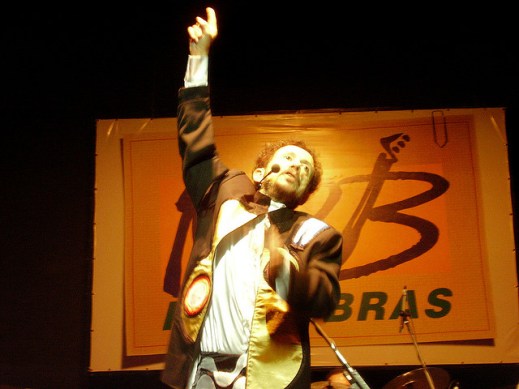
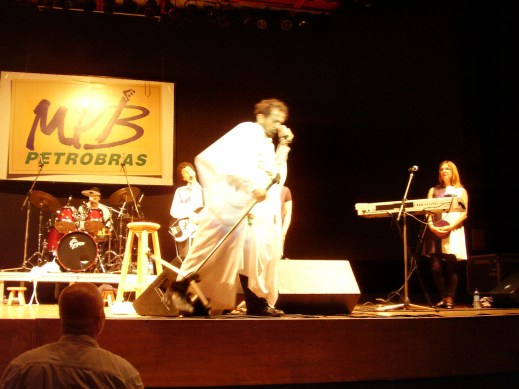
Featured Image: Tom Zé in 2008 performing in front of a Petrobras sign, photo used by CC license, Neto Silveira
—
—
REWIND! . . .If you liked this post, you may also dig:
“Sound-politics in São Paulo, Brazil”–Leonardo Cardoso
Quebec’s #casseroles: on participation, percussion and protest–Jonathan Sterne
Hello, Americans: Orson Welles, Latin America, and the Sounds of the “Good Neighbor”–Tom McEnaney
—
Share this:




Current Top Posts





April 2021

January 2020

November 2019

October 2019

August 2019

April 2014

November 2017

March 2015

December 2017

October 2015


Recent Comments