
Echo and the Chorus of Female Machines

DOI: https://doi.org/10.59350/ap7j3-sw607
Editor’s Note: February may be over, but our forum is still on! Today I bring you installment #5 of Sounding Out!‘s blog forum on gender and voice. Last week Art Blake talked about how his experience shifting his voice from feminine to masculine as a transgender man intersects with his work on John Cage. Before that, Regina Bradley put the soundtrack of Scandal in conversation with race and gender. The week before I talked about what it meant to have people call me, a woman of color, “loud.” That post was preceded by Christine Ehrick‘s selections from her forthcoming book, on the gendered soundscape. We have one more left! Robin James will round out our forum with an analysis of how ideas of what women should sound like have roots in Greek philosophy.
This week Canadian artist and writer AO Roberts takes us into the arena of speech synthesis and makes us wonder about what it means that the voices are so often female. So, lean in, close your eyes, and don’t be afraid of the robots’ voices. –Liana M. Silva, Managing Editor
—
I used Apple’s SIRI for the first time on an iPhone 4S. After hundreds of miles in a van full of people on a cross-country tour, all of the music had been played and the comedy mp3s entirely depleted. So, like so many first time SIRI users, we killed time by asking questions that went from the obscure to the absurd. Passive, awaiting command, prone to glitches: there was something both comedic and insidious about SIRI as female-gendered program, something that seemed to bind up the technology with stereotypical ideas of femininity.

Speech synthesis is the artificial simulation of the human voice through hardware or software, and SIRI is but one incarnation of the historical chorus of machines speaking what we code to be female. Starting from the early 20th century Voder, to the Cold-War era Silvia and Audrey, up to Amazon’s newly released Echo, researchers have by and large developed these applications as female personae. Each program articulates an individual timbre and character, soothing soft spoken or matter of fact; this is your mother, sister, or lover, here to affirm your interests while reminding you about that missed birthday. She is easy to call up in memory, tones rounded at the edges, like Scarlett Johansson’s smoky conviviality as Samantha in Spike Jonze’s Her, a bodiless purr. Simulated speech articulates a series of assumptions about what neutral articulation is, what a female voice is, and whose voice technology can ventriloquize.
The ways computers hear and speak the human voice are as complex as they are rapidly expanding. But in robotics gender is charted down to actual wavelength, actively policed around 100-150 HZ (male) and 200-250 HZ (female). Now prevalent in entertainment, navigation, law enforcement, surveillance, security, and communications, speech synthesis and recognition hold up an acoustic mirror to the dominant cultures from which they materialize. While they might provide useful tools for everything from time management to self-improvement, they also reinforce cisheteronormative definitions of personhood. Like the binary code that now gives it form, the development of speech recognition separated the entire spectrum of vocal expression into rigid biologically based categories. Ideas of a real voice vs. fake voice, in all their resonances with passing or failing one’s gender performance, have through this process been designed into the technology itself.
A SERIES OF MISERABLE GRUNTS

The first voice to be synthesized was a reed and bellows box invented by Wolfgang Von Kempelen in 1791 and shown off in the courts of the Hapsburg Empire. Von Kempelen had gained renown for his chess-playing Turk, a racist cartoon of an automaton that made waves amongst the nobles until it was revealed that underneath the tabletop was a small man secretly moving the chess player’s limbs. Von Kempelen’s second work, the speaking machine, wowed its audiences thoroughly. The player wheedled and squeezed the contraption, pushing air through its reed larynx to replicate simple words like mama and papa.
Synthesizing the voice has always required some level of making strange, of phonemic abstraction. Bell Laboratories originally developed The Voder, the earliest incarnation of the vocoder, as a cryptographic device for WWII military communications. The machine split the human voice into a spectral representation, fragmenting the source into number of different frequencies that were then recombined into synthetic speech. Noise and unintelligibility shielded the Allies’ phone calls from Nazi interception. The Vocoder’s developer, Ralph Miller, bemoaned the atrocities the machine performed on language, reducing it to a “series of miserable grunts.”

In his history of the The Vocoder, How to Wreck a Nice Beach, Dave Tompkins tells how the apparatus originally took up an entire wall and was played solely by female phone operators, but the pitch of the female voice was said to be too high to be heard by the nascent technology. In fact, when it debuted at the 1939 World’s Fair, only men were chosen to experience the roboticization of their voice. The Voder was, in fact, originally created to only hear pitches in the range of 100-150 HZ, a designed exclusion from the start. So when the Signal Corps of the Army convinced President Eisenhower to call his wife via Voder from North Africa, Miller and the developers panicked for fear she wouldn’t be heard. Entering the Pentagon late at night, Mamie Eisenhower spoke into the telephone and a fragmented version of her words travelled across the Atlantic. Resurfacing in angular vocoded form, her voice urged her husband to come home, and he had no problem hearing her. Instead of giving the developers pause to question their own definitions of gender, this interaction is told as a derisive footnote of in the history of the sound and technology: the punchline being that the first lady’s voice was heard because it was as low as a man’s.
WAKE WORDS

In fall 2014 Amazon launched Echo, their new personal assistant device. Echo is a 12-inch long plain black cone that stands upright on a tabletop, similar in appearance to a telephoto camera lens. Equipped with far field mics, Echo has a female voice, connected to the cloud and always on standby. Users engage Echo with their own chosen ‘wake’ word. The linguistic similarity to a BDSM safe word could have been lost on developers. Although here inverted, the word is used to engage rather than halt action, awakening an instrument that lays dormant awaiting command.
Amazon’s much-parodied promotional video for Echo is narrated by the innocent voice of the youngest daughter in a happy, straight, white, middle-class family. While the son pitches Oedipal jabs at the father for his dubious role as patriarchal translator of technology, each member of the family soon discovers the ways Echo is useful to them. They name it Alexa and move from questions like: “Alexa how many teaspoons in a tablespoon” and “How tall is Mt. Everest?” to commands for dance mixes and cute jokes. Echo enacts a hybrid role as mother, surrogate companion, and nanny of sorts not through any real aspects of labor but through the intangible contribution of information. As a female-voiced oracle in the early pantheon of the Internet of Things, Echo’s use value is squarely placed in the realm of cisheteronormative domestic knowledge production. Gone are the tongue-in-cheek existential questions proffered to SIRI upon its release. The future with Echo is clean, wholesome, and absolutely SFW. But what does it mean for Echo to be accepted into the home, as a female gendered speaking subject?
Concerns over privacy and surveillance quickly followed Echo’s release, alarms mostly sounding over its “always on” function. Amazon banks on the safety and intimacy we culturally associate with the female voice to ease the transition of robots and AI into the home. If the promotional video painted an accurate picture of Echo’s usage, it would appear that Amazon had successfully launched Echo as a bodiless voice over the uncanny valley, the chasm below littered with broken phalanxes of female machines. Masahiro Mori coined the now familiar term uncanny valley in 1970 to describe the dip in empathic response to humanoid robots as they approach realism.
If we listen to the litany of reactions to robot voices through the filters of gender and sexuality it reveals the stark inclines of what we might think of as a queer uncanny valley. Paulina Palmer wrote in The Queer Uncanny about reoccurring tropes in queer film and literature, expanding upon what Freud saw as a prototypical aspect of the uncanny: the doubling and interchanging of the self. In the queer uncanny we see another kind of rift: that between signifier and signified embodied by trans people, the tearing apart of gender from its biological basis. The non-linear algebra of difference posed by queer and trans bodies is akin to the blurring of divisions between human and machine represented by the cyborg. This is the coupling of transphobic and automatonophobic anxieties, defined always in relation to the responses and preoccupations of a white, able bodied, cisgendered male norm. This is the queer uncanny valley. For the synthesized voice to function here, it must ease the chasm, like Echo: sutured by a voice coded as neutral, but premised upon the imagined body of a white, heterosexual, educated middle class woman.
22% Female

My own voice spans a range that would have dismayed someone like Ralph Miller. I sang tenor in Junior High choir until I was found out for straying, and then warned to stay properly in the realms of alto, but preferably soprano range. Around the same time I saw a late night feature of Audrey Hepburn in My Fair Lady, struggling to lose her crass proletariat inflection. So I, a working class gender ambivalent kid, walked around with books on my head muttering The Rain In Spain Falls Mainly on the Plain for weeks after. I’m generally loud, opinionated and people remember me for my laugh. I have sung in doom metal and grindcore punk bands, using both screeching highs and the growling “cookie monster” vocal technique mostly employed by cismales.
Given my own history of toying with and estrangement from what my voice is supposed to sound like, I was interested to try out a new app on the market, the Exceptional Voice App (EVA ), touted as “The World’s First and Only Transgender Voice Training App.” Functioning as a speech recognition program, EVA analyzes the pitch, respiration, and character of your voice with the stated goal of providing training to sound more like one’s authentic self. Behind EVA is Kathe Perez, a speech pathologist and businesswoman, the developer and provider of code to the circuit. And behind the code is the promise of giving proper form to rough sounds, pitch-perfect prosody, safety, acceptance, and wholeness. Informational and training videos are integrated with tonal mimicry for phrases like hee, haa, and ooh. User progress is rated and logged with options to share goals reached on Twitter and Facebook. Customers can buy EVA for Gals or EVA for Guys. I purchased the app online for my iPhone for $5.97.
My initial EVA training scores informed me I was 22% female; a recurring number I receive in interfaces with identity recognition software. Facial recognition programs consistently rate my face at 22% female. If I smile I tend to get a higher female response than my neutral face, coded and read as male. Technology is caught up in these translations of gender: we socialize women to smile more than men, then write code for machines to recognize a woman in a face that smiles.
As for EVA’s usage, it seems to be a helpful pedagogical tool with more people sharing their positive results and reviews on trans forums every day. With violence against trans people persisting—even increasing—at alarming rates, experienced worst by trans women of color, the way one’s voice is heard and perceived is a real issue of safety. Programs like EVA can be employed to increase ease of mobility throughout the world. However, EVA is also out of reach to many, a classed capitalist venture that tautologically defines and creates users with supply. The context for EVA is the systems of legal, medical, and scientific categories inherited from Foucault’s era of discipline; the predetermined hallucination of normal sexuality, the invention of biological criteria to define the sexes and the pathologization of those outside each box, controlled by systems of biopower.
Despite all these tools we’ll never really know how we sound. It is true that the resonant chamber of our own skull provides us with a different acoustic image of our own voice. We hate to hear our voice recorded because suddenly we catch a sonic glimpse of what other people hear: sharper more angular tones, higher pitch, less warmth. Speech recognition and synthesis work upon the same logic, the shifting away from interiority; a just off the mark approximation. So the question remains what would a gender variant voice synthesis and recognition sound like? How much is reliant upon the technology and how much depends upon individual listeners, their culture, and what they project upon the voice? As markets grow, so too have more internationally accented English dialects been added to computer programs with voice synthesis. Thai, Indian, Arabic and Eastern European English were added to Mac OSX Lion in 2011. Can we hope to soon offer our voices to the industry not as a set of data to be mined into caricatures, but as a way to assist in the opening up in gender definitions? We would be better served to resist the urge to chime in and listen to the field in the same way we suddenly hear our recorded voice played back, with a focus on the sour notes of cold translation.
—
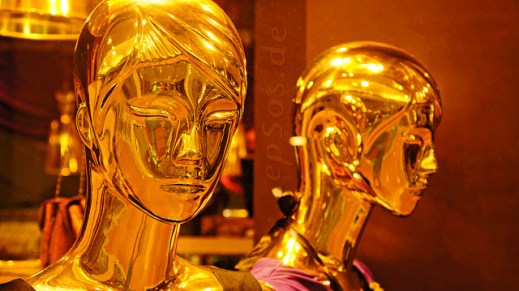
Featured image: “Golden People love Gold Jewelry Robots” by Flickr user epSos.de, CC BY 2.0
—
AO Roberts is a Canadian intermedia artist and writer based in Oakland whose work explores gender, technology and embodiment through sound, installation and print. A founding member of Winnipeg’s NGTVSPC feminist artist collective, they have shown their work at galleries and festivals internationally. They have also destroyed their vocal chords, played bass and made terrible sounds in a long line of noise projects and grindcore bands, including VOR, Hoover Death, Kursk and Wolbachia. They hold a BFA from the University of Manitoba and a MFA in Sculpture from California College of the Arts.
—

REWIND!…If you liked this post, you may also dig:
Hearing Queerly: NBC’s “The Voice”—Karen Tongson
On Sound and Pleasure: Meditations on the Human Voice—Yvon Bonefant
I Been On: BaddieBey and Beyoncé’s Sonic Masculinity—Regina Bradley
—
Share this:

Sounds of Science: The Mystique of Sonification


DOI: https://doi.org/10.59350/ck7z1-sqv57
Welcome to the final installment of Hearing the UnHeard, Sounding Out!‘s series on what we don’t hear and how this unheard world affects us. The series started out with my post on hearing, large and small, continued with a piece by China Blue on the sounds of catastrophic impacts, and Milton Garcés’ piece on the infrasonic world of volcanoes. To cap it all off, we introduce The Sounds of Science by professor, cellist and interactive media expert, Margaret Schedel.
Dr. Schedel is an Associate Professor of Composition and Computer Music at Stony Brook University. Through her work, she explores the relatively new field of Data Sonification, generating new ways to perceive and interact with information through the use of sound. While everyone is familiar with informatics, graphs and images used to convey complex information, her work explores how we can expand our understanding of even complex scientific information by using our fastest and most emotionally compelling sense, hearing.
– Guest Editor Seth Horowitz
—
With the invention of digital sound, the number of scientific experiments using sound has skyrocketed in the 21st century, and as Sounding Out! readers know, sonification has started to enter the public consciousness as a new and refreshing alternative modality for exploring and understanding many kinds of datasets emerging from research into everything from deep space to the underground. We seem to be in a moment in which “science that sounds” has a special magic, a mystique that relies to some extent on misunderstandings in popular awareness about the processes and potentials of that alternative modality.
For one thing, using sound to understand scientific phenomena is not actually new. Diarist Samuel Pepys wrote about meeting scientist Robert Hooke in 1666 that “he is able to tell how many strokes a fly makes with her wings (those flies that hum in their flying) by the note that it answers to in musique during their flying.” Unfortunately Hooke never published his findings, leading researchers to speculate on his methods. One popular theory is that he tied strings of varying lengths between a fly and an ear trumpet, recognizing that sympathetic resonance would cause the correct length string to vibrate, thus allowing him to calculate the frequency. Even Galileo used sound, showing the constant acceleration of a ball due to gravity by using an inclined plane with thin moveable frets. By moving the placement of the frets until the clicks created an even tempo he was able to come up with a mathematical equation to describe how time and distance relate when an object falls.

There have also been other scientific advances using sound in the more recent past. The stethoscope was invented in 1816 for auscultation, listening to the sounds of the body. It was later applied to machines—listening for the operation of the technological gear. Underwater sonar was patented in 1913 and is still used to navigate and communicate using hydroacoustic phenomenon. The Geiger Counter was developed in 1928 using principles discovered in 1908; it is unclear exactly when the distinctive sound was added. These are all examples of auditory display [AD]; sonification-generating or manipulating sound by using data is a subset of AD. As the forward to the The Sonification Handbook states, “[Since 1992] Technologies that support AD have matured. AD has been integrated into significant (read “funded” and “respectable”) research initiatives. Some forward thinking universities and research centers have established ongoing AD programs. And the great need to involve the entire human perceptual system in understanding complex data, monitoring processes, and providing effective interfaces has persisted and increased” (Thomas Hermann, Andy Hunt, John G. Neuhoff, Sonification Handbook, iii)
Sonification clearly enables scientists, musicians and the public to interact with data in a very different way, particularly compared to the more numerous techniques involving vision. Indeed, because hearing functions quite differently than vision, sonification offers an alternative kind of understanding of data (sometimes more accurate), which would not be possible using eyes alone. Hearing is multi-directional—our ears don’t have to be pointing at a sound source in order to sense it. Furthermore, the frequency response of our hearing is thousands of times more accurate than our vision. In order to reproduce a moving image the sampling rate (called frame-rate) for film is 24 frames per second, while audio has to be sampled at 44,100 frames per second in order to accurately reproduce sound. In addition, aural perception works on simultaneous time scales—we can take in multiple streams of audio data at once at many different dynamics, while our pupils dilate and contract, limiting how much visual data we can absorb at a single time. Our ears are also amazing at detecting regular patterns over time in data; we hear these patterns as frequency, harmonic relationships, and timbre.
But hearing isn’t simple, either. In the current fascination with sonification, the fact that aesthetic decisions must be made in order to translate data into the auditory domain can be obscured. Headlines such as “Here’s What the Higgs Boson Sounds Like” are much sexier than headlines such as “Here is What One Possible Mapping of Some of the Data We Have Collected from a Scientific Measuring Instrument (which itself has inaccuracies) Into Sound.” To illustrate the complexity of these aesthetic decisions, which are always interior to the sonification process, I focus here on how my collaborators and I have been using sound to understand many kinds of scientific data.
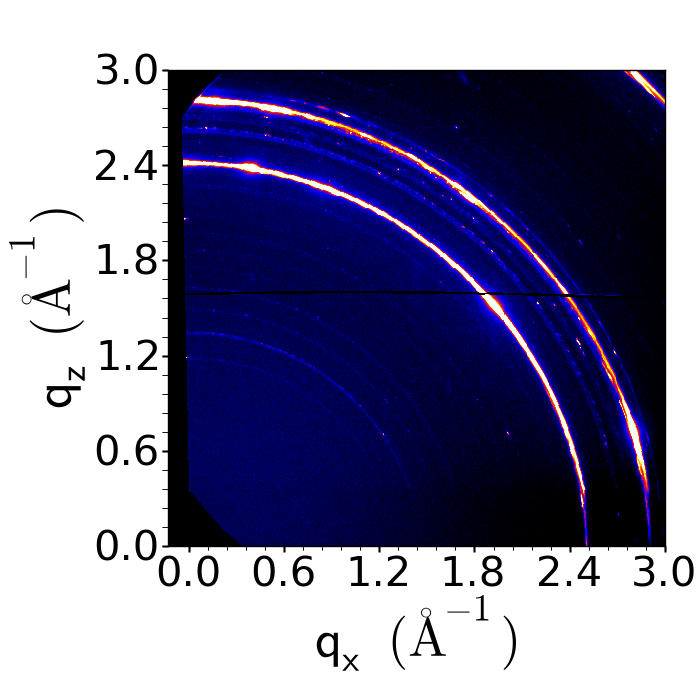
My husband, Kevin Yager, a staff scientist at Brookhaven National Laboratory, works at the Center for Functional Nanomaterials using scattering data from x-rays to probe the structure of matter. One night I asked him how exactly the science of x-ray scattering works. He explained that X-rays “scatter” off of all the atoms/particles in the sample and the intensity is measured by a detector. He can then calculate the structure of the material, using the Fast Fourier Transform (FFT) algorithm. He started to explain FFT to me, but I interrupted him because I use FFT all the time in computer music. The same algorithm he uses to determine the structure of matter, musicians use to separate frequency content from time. When I was researching this post, I found a site for computer music which actually discusses x-ray scattering as a precursor for FFT used in sonic applications.
To date, most sonifications have used data which changes over time – a fly’s wings flapping, a heartbeat, a radiation signature. Except in special cases Kevin’s data does not exist in time – it is a single snapshot. But because data from x-ray scattering is a Fourier Transform of the real-space density distribution, we could use additive synthesis, using multiple simultaneous sine waves, to represent different spatial modes. Using this method, we swept through his data radially, like a clock hand, making timbre-based sonifications from the data by synthesizing sine waves using with the loudness based on the intensity of the scattering data and frequency based on the position.
We played a lot with the settings of the additive synthesis, including the length of the sound, the highest frequency and even the number of frequency bins (going back to the clock metaphor – pretend the clock hand is a ruler – the number of frequency bins would be the number of demarcations on the ruler) arriving eventually at set of optimized variables.
Here is one version of the track we created using 10 frequency bins:
.
Here is one we created using 2000:
.
And here is one we created using 50 frequency bins, which we settled on:
.
On a software synthesizer this would be like the default setting. In the future we hope to have an interactive graphic user interface where sliders control these variables, just like a musician tweaks the sound of a synth, so scientists can bring out, or mask aspects of the data.
To hear what that would be like, here are a few tracks that vary length:
.
.
.
Finally, here is a track we created using different mappings of frequency and intensity:
.
Having these sliders would reinforce to the scientists that we are not creating “the sound of a metallic alloy,” we are creating one sonic representation of the data from the metallic alloy.
It is interesting that such a representation can be vital to scientists. At first, my husband went along with this sonification project as more of a thought experiment rather than something that he thought would actually be useful in the lab, until he heard something distinct about one of those sounds, suggesting that there was a misaligned sample. Once Kevin heard that glitched sound (you can hear it in the video above), he was convinced that sonification was a useful tool for his lab. He and his colleagues are dealing with measurements 1/25,000th the width of a human hair, aiming an X-ray through twenty pieces of equipment to get the beam focused just right. If any piece of equipment is out of kilter, the data can’t be collected. This is where our ears’ non-directionality is useful. The scientist can be working on his/her computer and, using ambient sound, know when a sample is misaligned.

It remains to be seen/heard if the sonifications will be useful to actually understand the material structures. We are currently running an experiment using Mechanical Turk to determine this kind of multi-modal display (using vision and audio) is actually helpful. Basically we are training people on just the images of the scattering data, and testing how well they do, and training another group of people on the images plus the sonification and testing how well they do.
I’m also working with collaborators at Stony Brook University on sonification of data. In one experiment we are using ambisonic (3-dimensional) sound to create a sonic map of the brain to understand drug addiction. Standing in the middle of the ambisonic cube, we hope to find relationships between voxels, a cube of brain tissue—analogous to pixels. When neurons fire in areas of the brain simultaneously there is most likely a causal relationship which can help scientists decode the brain activity of addiction. Computer vision researchers have been searching for these relationships unsuccessfully; we hope that our sonification will allow us to hear associations in distinct parts of the brain which are not easily recognized with sight. We are hoping to leverage the temporal pattern recognition of our auditory system, but we have been running into problems doing the sonification; each slice of data from the FMRI has about 300,000 data points. We have it working with 3,000 data points, but either our programming needs to get more efficient, or we have to get a much more powerful computer in order to work with all of the data.
On another project we are hoping to sonify gait data using smartphones. I’m working with some of my music students and a professor of Physical Therapy, Lisa Muratori, who works on understanding the underlying mechanisms of mobility problems in Parkinsons’ Disease (PD). The physical therapy lab has a digital motion-capture system and a split-belt treadmill for asymmetric stepping—the patients are supported by a harness so they don’t fall. PD is a progressive nervous system disorder characterized by slow movement, rigidity, tremor, and postural instability. Because of degeneration of specific areas of the brain, individuals with PD have difficulty using internally driven cues to initiate and drive movement. However, many studies have demonstrated an almost normal movement pattern when persons with PD are provided external cues, including significant improvements in gait with rhythmic auditory cueing. So far the research with PD and sound has be unidirectional – the patients listen to sound and try to match their gait to the external rhythms from the auditory cues.In our system we will use bio-feedback to sonify data from sensors the patients will wear and feed error messages back to the patient through music. Eventually we hope that patients will be able to adjust their gait by listening to self-generated musical distortions on a smartphone.
As sonification becomes more prevalent, it is important to understand that aesthetic decisions are inevitable and even essential in every kind of data representation. We are so accustomed to looking at visual representations of information—from maps to pie charts—that we may forget that these are also arbitrary transcodings. Even a photograph is not an unambiguous record of reality; the mechanics of the camera and artistic choices of the photographer control the representation. So too, in sonification, do we have considerable latitude. Rather than view these ambiguities as a nuisance, we should embrace them as a freedom that allows us to highlight salient features, or uncover previously invisible patterns.
__
Margaret Anne Schedel is a composer and cellist specializing in the creation and performance of ferociously interactive media. She holds a certificate in Deep Listening with Pauline Oliveros and has studied composition with Mara Helmuth, Cort Lippe and McGregor Boyle. She sits on the boards of 60×60 Dance, the BEAM Foundation, Devotion Gallery, the International Computer Music Association, and Organised Sound. She contributed a chapter to the Cambridge Companion to Electronic Music, and is a joint author of Electronic Music published by Cambridge University Press. She recently edited an issue of Organised Sound on sonification. Her research focuses on gesture in music, and the sustainability of technology in art. She ran SUNY’s first Coursera Massive Open Online Course (MOOC) in 2013. As an Associate Professor of Music at Stony Brook University, she serves as Co-Director of Computer Music and is a core faculty member of cDACT, the consortium for digital art, culture and technology.
—
Featured Image: Dr. Kevin Yager, data measured at X9 beamline, Brookhaven National Lab.
—
Research carried out at the Center for Functional Nanomaterials, Brookhaven National Laboratory, is supported by the U.S. Department of Energy, Office of Basic Energy Sciences, under Contract No. DE-AC02-98CH10886.
—

REWIND! ….. If you liked this post, you might also like:
The Noises of Finance–N. Adriana Knouf
Revising the Future of Music Technology–Aaron Trammell
A Brief History of Auto-Tune–Owen Marshall
—
Share this:




Current Top Posts





April 2021

January 2020

November 2019

October 2019

August 2019

April 2014

November 2017

March 2015

December 2017

October 2015


Recent Comments