
The Queerness of Wham’s “Last Christmas”

DOI: https://doi.org/10.59350/6ahzd-w2062
Christmas pop songs tend to revolve around just a few basic topics: 1) Jesus, 2) Santa, 3) Did you notice it’s winter?, and 4) Love. These aren’t mutually exclusive categories, of course. For instance, the overlap between the second and fourth category produce a sub-genre I’d call Santa Kink, exemplified by “Santa Baby” and “I Saw Mommy Kissing Santa Claus.” And the overlap between the first and fourth categories—between Jesus songs and Love songs—is, I would argue, complete overlap. The dominance of Christian ideology in the United States means that even when Christmas pop songs don’t explicitly say anything about Christianity, they are reenforcing dominant Christian ideology all the same. That’s how hegemonies work: hegemonic ideas are always already implicit in a variety of discourses whether those discourses are closely or remotely related to that ideology. So while pop stars may shy away from Christmas songs about Jesus because they don’t want to seem too religious, any song with Christmas as its theme will inherently fold back onto Christian ideology regardless of an artist’s intentions.

So, what does it mean when Love and Jesus overlap in Christmas songs? It’s quintessentially heteronormative: a man, a woman, and a baby who will rescue humanity’s future. But hegemonies aren’t totalizing, so while they dominate discourse, it is possible to craft ontologies that map out other ways of being. Here, I’m going to engage the queerness of “Last Christmas”—the original Wham! version (1984)—and a 2008 Benny Bennasi remix of the original song. What each have in common is a failure to achieve heteronormativity that, in turn, undermines the Love/Jesus trope of Christmas pop songs; this failure orients us toward queer relationalities that plot alternatives to Christian heteronorms.
Looking back at those four categories of Christmas pop songs, three of them make lots of sense for a Christmas song topic: Jesus, Santa, and winter. But why love? In part, it’s because most pop music boils down to love in some way. Beyond that, though, a love song in the context of Christian heteronormative ideology yields what Lee Edelman calls “reproductive futurity”:
terms that impose an ideological limit on political discourse as such, preserving in the process the absolute privilege of heteronormativity by rendering unthinkable, by casting outside the political domain, the possibility of a queer resistance to this organizing principle of communal relations.
In other words, the heteronormative imperative of reproducing and then protecting (white) Children is embedded so deeply in politics that it isn’t even up for debate. It is, instead, the societal framework within which debate happens, and anything outside that framework resonates as queer.

Pivoting back to Christmas, it’s instructive to contemplate the nativity scene. It can be built with a variety of details, but at its center every time is Jesus, Mary, and Joseph—baby, mom, and dad. In a reproductive futurist society, recurring images like the nativity scene underscore the normalcy of the nuclear family, regardless of how utterly abnormal the details of the story surrounding the nativity scene might be. The heteronormativity of the nativity scene “impose[s] an ideological limit” on the discourse of Christmas love songs: every cuddle next to the fireplace, each spark under the mistletoe, all coercive “Baby, it’s cold outside”s are a reproduction of the christian Holy Family (baby, mom, and dad). What on the surface is simply Mariah Carey’s confession that all she wants for Christmas is you becomes miraculously pregnant with a dominant religio-political ideology that delimits queerness and manufactures White Children. That’s why pop stars sing Christmas love songs when they don’t want to sing about Jesus or Santa or winter; it’s because the love songs buttress a Christian ideology that squares comfortably with dominant political discourse even when they don’t explicitly mention religion.
The texture of my “Last Christmas” analysis is woven from a few theoretical strands. Jack Halberstam’s queer failure and Sara Ahmed’s queer phenomonology each orient us to queer relationalities that emerge from getting heteronormativity wrong. Hortense Spillers’ vestibular flesh and Jayna Brown’s utopian impulses tune us to the vibrations of alterity buzzing just beyond hegemony’s earshot. Taken together, these theories open space for hearing how a Christmas pop song about love might resonate queerly even in the midst of heteronormative dominance. Instead of rehearsing the nativity scene, a queer Christmas pop song might undo, sidestep, detonate, or otherwise fail to recreate the nativity. A queer analysis of Christmas pop songs looks and listens for moments of potential disruption in the norm.

In a reproductive futurist world, Wham!’s “Last Christmas” is a nightmare: heartbreak, disillusionment, and loneliness. Lyrically, the hook tells us that this year our singer has found someone special, but the verses betray the truth: he’s still hung up on last year’s heartbreak and has already started hoping that, actually, maybe next year will be the one that works out for him. I think we can push deeper than this lyrical message of hope (strained though it is) and find something a little Scroogier in the structure of the song, a denial of fulfilled desire that projects a queer, non-reproductive future:
Intro (8 measures) (0:00)
Chorus (16 measures) (0:15)
Post-Chorus (8 measures) (0:53)
Verse 1 (16 measures) (1:11)
Chorus (1:47)
Post-Chorus (2:23)
Verse 2 (2:41)
Chorus (3:17)
Post-Chorus (with partial lyrics from Verse 2) (3:53)
Post-Chorus (4:11)
There’s a reason we all know the chorus so well: it’s a double chorus that happens three times. That is, from “Last Christmas” to “someone special” is only 8 measures long, but that quatrain is repeated twice for a 16 measure chorus. So that’s six different times we hear George Michael summarize what happened last Christmas, and it becomes easy to recognize that this is less a celebration of having someone special than it is an attempt to convince oneself of something that isn’t true. When we compound the double chorus with the percussion part, which hits a syncopated turnaround every four measures (the turnaround signifies moving on to a new part; by repeating the same one every four measures in the middle of lyrical monotony, the song suggests a failure to really move on), the effect is one of extreme repetition. We rehearse, over and again, the failure of last Christmas, the failure to hetero-love, the failure to reproduce anything but, well, failure.
What I’ve labeled the Post-Chorus is a bit of an oddity here, a musical interlude played on festive bells that separates Chorus from Verse. The work it performs is best understood in conjunction with the music video. In the video, a group of friends meet to enjoy a getaway at a ski lodge; the character played by George Michael is here with this year’s girlfriend, and last Christmas’s girlfriend brings this year’s boyfriend. Intrigue! The visual narrative matches the song. In the same way the jolly instrumental seems largely unaware of Michael’s downer lyrics, the group of friends seem oblivious to the furtive, hurt glances between last Christmas’s lovers. This structural oddity, the Post-Chorus, proves key to the visual narrative. There’s a Scrooge in this story, and the Post-Chorus will visit him in the night.
The first Post-Chorus is the ghost of Christmas present. As the friends crowd into a ski lift that will take them to their lodging, the first bell hits right as last year’s girlfriend is center screen (0:53 in the video above), and we watch as the friends arrive at their getaway, the final two measures playing over a wide-angle shot of a ridiculously large cabin. The second Post-Chorus is the ghost of Christmas past. Here, as everyone gathers around a feast, all holly and jolly, the bells (2:23) strike at the moment Michael catches sight of the brooch he gave last Christmas’s girlfriend. He broods. The payoff comes in the second half of Verse 2 (2:59), when we see a flashback to the happy couple the year before, when they frolicked in the snow, lounged by the fire, and exchanged fabulous 80s jewelry. Finally, the third Post-Chorus is the ghost of Christmas future. This time the bells strike as the group is hiking back to the ski lift, returning to the point where they began. We hear the Post-Chorus twice this time, and the first instance (3:53) is accompanied by lyrics pulled from the flashback section of Verse 2, where Michael describes himself and the heartless way he’s been treated. This time, though, instead of finishing the line with “now I’ve found a real love, you’ll never fool me again,” Michael can only offer a breathy “maybe…next year.” In this third Post-Chorus, we have future (maybe next year) overlapping with past (the flashback lyrics) accompanied by visuals that close the narrative circle – a return on the same ski lift we see during the first Post-Chorus. In other words, Michael’s character can sing about someone special all he wants, but the song knows last year’s failure to reproduce will repeat again and again. The fourth Post-Chorus hammers this repetition home: as the friends debark from the lift and the screen fades, we hear this Christmas ghost haunting, lingering at the edges, reproducing heteronormative failure ad infinitum (the fade in the music suggests there’s no definitive ending point).
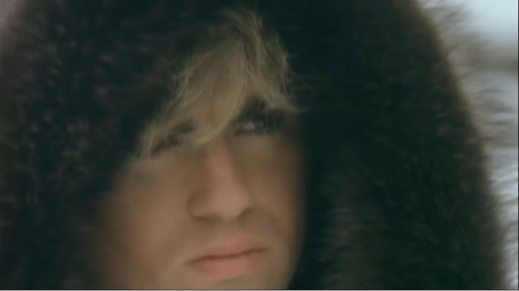
George Michael, of course, was publicly closeted for a long time. It’s unsurprising that we see some horror motifs in this heterofest. The wide-angle shot of the isolated cabin, the close up of a brooding, tortured hero…There may well be a queerness in the absence of gendered pronouns and in the visual aesthetic of the music video. But the real disruption, I think, comes in the structural repetition, the rehearsal of the singer’s failure to reproduce each year at the moment that reproduction is most central. If Christmas love songs circulate in a framework of reproductive futurity, “Last Christmas” Scrooges its way onto the airwaves every year and projects an utter failure of a future.
Most Christmas pop songs come and go. The drive to fill the airwaves with a genre of music that is only functional for 6-8 weeks of the year yields heaps of treacly sonic detritus. Christmas pop songs are, by nature, ephemeral. A few of these songs, though, become classics that artists return to and cover or remix over and again. “Last Christmas” is one of these classics, settling onto November and December playlists in its original form and the myriad cover versions that have piled up over the years. Benny Benassi’s “Last Christmas” remixes the Wham! song in a way that maintains the original’s queerness even as it flips the idea of looping failures.
Benassi’s “Last Christmas” revolves around two main sections: a driving techno beat (A) and a reworking of Wham!’s chorus (B).
A (48 measures)
B (48 measures) (1:25)
A’ (24 measures) (2:22)
B’ (56 measures) (3:04)
A” (32 measures) (4:15)
The A sections include a voiceover from a computerized voice affected so that it sounds like some dystopic transmission. “We would like to know if something does not sound quite right,” the voice starts, and then preps the entry of section B with “to guarantee safety to your perfect celebration, be sure – when playing this tune at maximum volume level – to chant around like everybody else is.” It’s hard to be more on-the-nose than this: an android voice instructing us how to fit in at our reproductive futurist holiday gatherings. “You know, just…I don’t know, just do what the others are doing?”
The B sections are each a sequence of three “Last Christmas” choruses (B’ includes an extra eight measures of the third in the sequence). The first is a sped-up but otherwise unaltered Michael singing about last Christmas. It’s a jarring entry, as the cool machinery of Benassi’s beat suddenly gives way to shimmery 80s pop. The second time through that familiar double chorus, we can hear Benassi’s groove faintly in the background and growing louder and fuller toward the end. It’s a straightforward remix technique: here’s the thing, here’s the thing mixed with my beat, and now here’s what I’m really getting at.
It’s the third sequence (1:53), then, where Benassi really crafts his own “Last Christmas.” Here, the beat we heard when the android told us how to fit in combines with Michael’s chorus as Benassi stutters and clips not only the lyrics but the instrumental, too: nothing is stable. Michael can’t finish a sentence (“La-a-as-a-ast, I gave you my gave you my hear-. Thiii-i-i-i-is year to save me from save me from, I’ll give it to someone, I’ll give it to someo-o-one.”), and the beat can’t get a firm start. While Wham!’s “Last Christmas” uses the Post-Chorus to form a closed loop where past and future circle back around to each other, Benassi’s “Last Christmas” denies reproductive futurity by chopping off the beginnings and ends of phrases. Built on a simple two-measure loop that otherwise motors smoothly through the song, Benassi’s “Last Christmas” can’t loop in the third sequence of the B section because there’s nothing to latch onto.

While Wham! loops queer failures in their overarching forms, Benassi’s version of the song queerly fails to loop. Both versions of “Last Christmas” bah and humbug at reproductive futurism. They’re Scroogey reminders each year to listen for disruptions of nativity, refusals of politically delimited desires that are queerly vibrating through our earbuds.
_
Featured image: “GOOD BYE and THANK YOU” by Flickr user fernando butcher, CC BY 2.0
_
Justin aDams Burton is Assistant Professor of Music at Rider University. His research revolves around critical race and gender theory in hip hop and pop, and his book, Posthuman Rap, is available now. He is also co-editing the forthcoming (2018) Oxford Handbook of Hip Hop Music Studies. You can catch him at justindburton.com and on Twitter @j_adams_burton. His favorite rapper is one or two of the Fat Boys.
_

REWIND! . . .If you liked this post, you may also dig:
Benefit Concerts and the Sound of Self-Care in Pop Music–Justin Adams Burton
Audio Culture Studies: Scaffolding a Sequence of Assignments– Jentery Sayers
“Hearing Queerly: NBC’s ‘The Voice’”– Karen Tongson
—
Share this:

The Sound of Feminist Snap, or Why I Interrupted the 2018 SEM Business Meeting
DOI: https://doi.org/10.59350/5ez67-g1c04
I begin this essay with an apology, addressed to the Society for Ethnomusicology President Gregory Barz:
I am sorry that I interrupted your opening remarks at least year’s SEM Business meeting. In the moment that I chose to make my intervention, I underestimated the pain that it has clearly caused you. Furthermore, I have come to realize that it was unskillful of me to locate my frustration and anger with you as an individual. The affective release of my voice in that moment could have been better directed towards positive change in a time of great need for many of us. I fully intend to work towards doing better in the months to come, urging anyone who occupies the office of President of this organization to use the power and standing inherent in this position office to take direct steps to address the harms many of its members are experiencing.
Because my intervention arose so quickly and unpredictably—for readers outside of the Society for Ethnomusicology who may not know, I stood up and yelled “You’re a hypocrite!” then left the meeting—it seems worthwhile to explore my actions in a more thoughtful space of written discourse. I want to clarify that my sonic interruption was not premeditated; as I explain below, it arose out of a deep anger and longing for justice. As SEM 2019 convenes in November in Bloomington, Indiana on November 7th, I hope that my disruptive event can be better understood as a call to collective inquiry into the structural factors that constrain our Society from functioning in a healthy way.
Indeed, I am already encouraged by steps that have been taken since the meeting—by President Barz and others—to address some of these concerns. And in the aftermath of this intervention, I have been heartened by the positive and supportive responses I have received from friends and colleagues. Although I had to leave the room in that moment, something meaningful remained just outside.
***
Some backstory: This was the first time I had attended a business meeting; at previous conferences, they had always seemed like a formality that did not concern me. Serving on the Committee for Academic Labor, the Ethics Committee, and as Chair of the Improvisation Section, however, helped me to understand the importance of these formal structures and rituals for the health of our Society. I attended in 2018, therefore, with a sense of curiosity and a longing for positive change, particularly in regard to some of the work coming out of the committees on which I was serving. This longing also arose from a sense of frustration at the lack of receptivity to new ideas by Board leadership—as experienced through a pattern of poor communication around implementation of this work between committees and Board—as well as what I perceived to be a lack of transparency and accountability among Board leadership.
Much of this frustration stemmed from the Board’s failure to implement a minor procedural proposal put forward by the Ethics committee nearly two years prior: that the committee be restructured to be elected rather than appointed. After the first deadline to put the amendment to the full membership passed without comment from the Board, we had to expend a great deal of energy even to receive acknowledgement that our proposals had been received. By the time the committee met again, we had been through over a year of exhausting back-and-forth by email with nothing actually getting done.
Then, in the weeks leading up to the 2018 meeting, a member publicly came forward about experiences of sexual abuse by a now-deceased ethnomusicologist who had served as a senior member of SEM during his lifetime. As a member of the Ethics Committee, I witnessed the email exchange in which her requests for space to address this at the 2018 meeting were first accommodated, then revoked at the last minute; she was finally allowed space to speak in a confusing, unmoderated, ad-hoc session to which the Board assented only after the conference was already underway.
So, when President Barz chose to begin his opening remarks with a paean to civility, lamenting how conflict over social media was causing us to lose our ability to engage in healthy discourse as a unified Society, I became concerned. Many in the audience were aware that both the sexual assault allegation and another credible allegation of ethical misconduct by SEM leadership had been circulating on Facebook in previous months. I heard President Barz’s remarks as a use of his prominent position in SEM to categorize these complaints as “noise.” As Mark Brantner points out in his thoughtful critique of John Stewart’s 2010 “Rally to Restore Sanity,” the idea that sanity operates through “indoor voices” is a deeply ingrained assumption for many.
But in the wake of recent upheavals in the status quo, catalyzed by movements like #blacklivesmatter and #metoo, many hear these “indoor voices” as signifiers of an oppressive status quo. Others have written about the problems inherent in invoking civility in the face of dissent: In a recent piece for The Atlantic, Vann Newkirk argues that in many cases, “the demands for civility function primarily to stifle the frustrations of those currently facing real harm” (2018). In Vox, Julia Azari points out that “Civility is not an end on its own if the practices and beliefs it upholds are unjust” (2018). In these cases, calls for civility came in response to calls by those whose voices are met with silence by the prevailing order.
And allow me to state in no uncertain terms: many of us in the field are currently facing real harm. Since earning my doctorate in Ethnomusicology just over a year ago, I spent eight months without health insurance and now qualify for the federal Supplemental Nutrition Assistance Program. I’ve strongly considered leaving the Society many times over the past year.

I’m also aware that my personal experience is only the tip of the iceberg: so many peers and colleagues have left the Society altogether because of sexual harassment, abuse of power by senior members or advisors, and economic precarity, experienced alone or in horrific combination. These harms are also compounded for my peers who do not share my positionality as a heterosexual, cisgender, white-presenting man with a U.S. passport and a bourgeois class background.
As President Barz continued to speak, my concern—which had lodged itself as a feeling of discontent somewhere in my stomach area—began to rise into my chest as anger, particularly when President Barz began to invoke his authority as a champion of democratic practice within the Society to justify his call to civility. If he truly believed in consensus-building and democracy, I thought, certainly he wouldn’t have opposed an effort to increase democratic accountability on the Ethics Committee. This contradiction generated my experience of what woman of color feminist Sara Ahmed calls “feminist snap” in 2017’s Living a Feminist Life. She described “feminist snap” like this in a May 2017 blogpost:
It is only when you seem to lose it, when you shout, swear, spill, that you have their attention. And then you become a spectacle. And what you brought out means you have to get out. When we think of such moments of snap, those moments when you can’t take it anymore, when you just can’t take it anymore, we are thinking about worlds; how worlds are organised to enable some to breathe, how they leave less room for others. You have to leave because there is nothing left; when there is nothing left.
In other words, I noticed that I seemed to be losing it. In that moment, I drew on my background as an improvising musician to decide how to relate to this intense energy. After exchanging incredulous glances with two colleagues sitting nearby, I decided that I couldn’t sit quietly and let my toxic feeling fester throughout the meeting—I needed to leave, but I didn’t want to leave without registering to people in the room why I had to leave, and there was no space in the official meeting to do so. At the same time, I was aware of the risks inherent in this strategy—especially because I have witnessed how the sound of my voice—a man’s—snapping like this can itself be a trauma trigger for anyone who has been shouted down in a meeting, or otherwise. Thus, the material nature of the spectacle here was different from that described by Ahmed in that it carried with it a timbre of patriarchal violence. Oddly enough, the worlds that I felt were being organized to make it difficult to breathe still afforded me the air for this particular form of breathed expression: a fiery shout. And that sound brought unintended consequences.

I had wanted there to be no doubt that my departure was a response to President Barz’s remarks, but the power arrangement in the room meant that it would have been difficult to offer a lengthy articulation of my reasoning, given that any utterance would have been received as disruptive and that I did not have access to sound amplification in the large room. (I am reminded here of R. Murray Schafer’s point in The Soundscape : “A man with a loudspeaker is more imperialistic than one without because he can dominate more acoustic space” (1977:77). Schafer’s sexist assumption that only men speaking through loudspeakers is worth noting—as I see it, both men’s and women’s voices could transmit imperialistic sound in this way, but a “snap response” would also be gendered.)
Within a few seconds, I settled on the form my move would take: stand up, shout something concise, and leave the room. The words “You’re a hypocrite!” flowed spontaneously from there—words grounded in my direct experience of the disconnect between Dr. Barz’s present remarks and previous actions. Immediately upon leaving the room, an adrenaline rush flowed out of my body and I staggered towards a nearby bench, where I collapsed to catch my breath.
Again, I regret that these remarks focused on President Barz as an individual. Had I more time to think through what I would have stated, perhaps “This is unacceptable,” “These actions are hypocritical,” or “Please don’t ignore us” would have been what came out. And yet, by this point, the sound of this intervention had already been determined by the immediate constraints of the situation: had I chosen to sound in a way that was coded as “civil”, I literally would not have been heard by more than a few people in the room.

Even after this intense incident, my experience of the conference in Albuquerque was very positive overall. SEM is full of brilliant emerging scholars asking extremely important questions; it was especially encouraging to see more attention being brought to the imperatives of decolonization and anti-racism. At the same time, in order for these inquiries to be truly productive, we still need to turn our analysis towards the ways in which the status quo of our governance practices unintentionally reproduce systems of oppression and create harm. Tamara Levitz, in her recent article “The Musicological Elite,” sheds light on how this has been the case within an adjacent academic organization, the American Musicological Society. She writes, “My premise is that musicologists need to know which actions were undertaken, and on what material basis, in building their elite, white, exclusionary, patriarchal profession before they can undo them.” (2018:43). Despite some evident wishful thinking to the contrary, SEM reproduces harm in similar ways and would benefit from similar institutional self-reflection.
By yoking itself to the project of the North American university system, the Society for Ethnomusicology has created strong incentives for members to go along with what Abigail Boggs, Eli Meyerhoff, Nick Mitchell, and Zach Schwartz-Weinstein call the “Modes of Accumulation” of these institutions. We must urgently turn towards critical institutional self-examination to consider how we can change our practices to resist complicity with these forms of professionalized domination and control.
In order to do so, we need better mechanisms for dissent and communication, especially when we have the rare opportunity for face-to-face communication. We must address what seems like an increasing tension between preserving the institutions of tenure-track music academia and the broader needs of the Society’s full membership. Crucially, Ahmed turns to listening as a key methodological practice for locating “feminist snap”:
To hear snap, one must thus slow down; we also listen for the slower times of wearing and tearing, of making do; we listen for the sounds of the costs of becoming attuned to the requirements of an existing system. To hear snap, to give that moment a history, we might have to learn to hear the sound of not snapping. Perhaps we are learning to hear exhaustion, the gradual sapping of energy when you have to struggle to exist in a world that negates your existence. Eventually something gives.
In this case, listening for the silences—and silencing—that preceded this instance of “snap”may be useful. To my ear, they index the “sound of not snapping”: the unanswered emails, averted eye contact, unreturned phone calls—these are the sounds of a snap to come. These silences are empowered by our collective reliance on a discourse of “civility,” propped up by formal procedures like Robert’s Rules of Order, that deems certain types of sounds and communication to be out of bounds. Indeed, as Hollis Robbins has observed, “Under Robert’s Rules, silence equals consent.” Listening for feminist snap would require a commitment to naming these silences—and allowing space for them to be spoken into.

I sincerely hope that my moment of becoming a spectacle can spark more productive conversations and deeper listening. Still, the magnitude of the challenges that we face to align our governance practices with shared institutional values will require creative solutions. I am confident that our experience and training as listeners can bring us to a fuller engagement with democratic processes—and that this can lead us towards productive solutions. This work is already being done by many groups and individuals within the Society, such as the Committee for Academic Labor, the Crossroads Committee, the Disability and Deaf Studies Special Interest Group, the Diversity Action Committee, the Ethics Committee, the Gender and Sexualities Task Force, the Gertrude Robinson Networking Group, the Section on the Status of Women, and many others. I am confident that members of these groups are actively working to build spaces that allow for us to listen into the structural and cultural changes we desperately need.
In the meantime, I remain committed to seeking out collaborative solutions to the challenges we face. Please feel free to reach out to me by email with any feedback you feel compelled to share. Furthermore, if you would like to contact the Ethics Committee about any issues of ethical import to the Society, you may do so here. Anonymous submissions are also possible through this portal.
I’d like to close this essay with an apology, as well—addressed to all of my peers who have experienced harm or abuse through their involvement with SEM: I am truly sorry that I have not done more to work towards redress for the harms that you have experienced. I am also deeply sorry that I have not done more to examine how my own desire to see projects through in this community has led me to ignore signs of harm taking place. I’ve had the good fortune of being able to express this to a few of you in person, and I am tremendously grateful for the opportunity. For anyone else who would like to reach out, I will commit to listening. For us to do better, I need to do better.
Thank you for taking the time to read this statement—I look forward to continuing our work together to create a sustainable future for the practice of ethnomusicology.
—
Featured Image: “I Broke a String” by Flickr User Rowan Peter (CC BY-SA 2.0)
—
Alex W. Rodriguez is a writer, improviser, organizer, and trombonist. He holds a PhD in Ethnomusicology from UCLA, where his research was based on fieldwork conducted in Los Angeles, California from 2012-2016, Santiago, Chile from 2015-2016, and Novosibirsk, Siberia in fall 2016. Alex is currently based in Easthampton, Massachusetts, USA.
—

REWIND! . . .If you liked this post, you may also dig:
My Music and My Message is Powerful: It Shouldn’t be Florence Price or “Nothing” –Samantha Ege
becoming a sound artist: analytic and creative perspectives–Rajna Swaminathan
Sounding Out Tarima Temporalities: Decolonial Feminista Dance Disruption–Iris C. Viveros Avendaño
On Whiteness and Sound Studies–Gustavus Stadler
Canonization and the Color of Sound Studies –Budhaditya Chattopadhyay
—
Share this:




Current Top Posts



April 2021

January 2020

November 2019

October 2019

August 2019

April 2014

November 2017
March 2015

December 2017

October 2015


Recent Comments