
SO! Reads: Jace Clayton’s Uproot


DOI: https://doi.org/10.59350/zcng1-v6y23
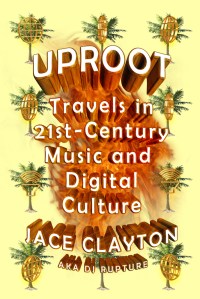
“Music has always confounded value,” writes interdisciplinary artist and writer Jace Clayton in Uproot: Travels in 21st-Century Music and Digital Culture (FSG Originals, 2016, 22). Recounting his extensive international travels performing as DJ /rupture, Clayton presents a flow of cosmopolitan musical experiences that illustrate complex collisions between music and value around the world. Whether writing about homemade sound-systems in tropical clubs in Brooklyn, or about shellac preservation at the Arab Music Archiving and Research Foundation in Beirut, Clayton considers the technologies by which we make — and place value on — musical sounds in “a world where worth is created in radically different ways from what the market teaches us” (24).
Uproot is a narrative about the ways working musicians experience globalization. “Our music seems to sound the way global capital is — liquid, international, porous, and sped up,” the author writes (16). This homology between sound and economic processes echoes the theories of sociologists like Anthony Giddens and the late Zygmunt Bauman, both of whom argue that modern life is characterized by fluidity and fragmentation: employment is precarious, experience is mediated, and ethical decisions are full of ambiguity. These ideas clearly inspire Clayton’s narrative; that said, Uproot is not an academic publication. As Atossa Araxia Abrahamian writes at the Nation, the book evades genre, “at once travelogue and cultural ethnography, pop philosophy and memoir, a guide to contemporary music and a fanzine.”
The book begins with a discussion of the history of Auto-Tune. While Clayton’s claim that Auto-Tune was the “first truly new sound effect of the internet era” might be overstated, his distinction between “corrective Auto-Tune” and “cosmetic Auto-Tune” is useful, the first of many moments of clarity in parsing the ways we use and mis-use musical media today. “The robot voice signifies differently everywhere you go,” he writes, an observation that becomes central to the book (49). By refusing to take a deterministic stance toward technology, Clayton empowers the musicians he writes about, acknowledging the ways in which artists mold trends to their own regional and local purposes. Of collaboration with a violinist in Morocco, Clayton writes: “We may have thought similarly, yet our ‘default settings’ were so far apart as to be almost incompatible” (185).
Uproot offers intimate insights into a range of tools and techniques of production, such as compression artifacts, “refixes,” and dozens of music-making interfaces, including Clayton’s own “music software-as-art project,” Sufi Plug Ins.
.
Even language itself is conceived as a form of technological mediation, as when Clayton compares Arabizi — a phonetic spelling of colloquial Arabic — to the hybrid sounds of mahraganat music that the language is used to describe. Of these “wandering genealogies” that emerge from international conversations, Clayton suggests that any hybrid genre we can imagine likely already exists: “Accordions and African techno? It’s called funaná” (102). The book describes at least a dozen other music traditions and microgenres–some very old, some just coalesced–from dabke to zar, each the product of a unique fusion of vocabularies.
Clayton on Mazaher (182): “Umm Sameh, Umm Hassan, and Nour el Sabah: these three women are some of the only people in Egypt keeping zar alive.”
Clayton’s own prose style, replete with metaphor and fluent in informal language, mirrors the ethos of music production he explores in the book: eclectic, energetic, and bursting with detail. What better way to describe Auto-Tune’s effect than as liquification of sound into a “bright neon stream, as if a dial-up modem and a river have fallen in love” (53)? Clayton’s technological travelogue extends beyond aural sensation alone. This is a story of “sidewalk vendors, radios, mosque loudspeakers,” (106) but it is just as much about “jerk chicken, fish tea, goatskin soup” (73). When Clayton describes his surroundings, we can touch the orange blossoms and smell the cigarettes.
The book’s recurrent question is how DJ practices in different locations are both constrained and inspired by financial flows. In any context, Clayton argues, “[m]oney runs to the people with the least imagination” (24). Early on, he establishes this view that musical experience is priceless, more valuable than any profit derived from rhythms of supply and demand, which reward the wrong people. That said, Clayton isn’t naive about musicians’ inevitable need for income, and throughout the text, readers are asked to inhabit ethical dilemmas that artists encounter throughout the world. At one point, Clayton describes his own moral quandary when asked to perform in front of a giant Red Bull logo, a “glowing lump of techno-fascist DJ furniture.” Later, Clayton critiques the hegemony of “Red Bull patronage” and similar systems of support for artists who are desperate for funding (121). He makes clear his disdain for corporate sponsors, companies that “appear generous as they let us know that our music is literally worthless to them” (123).
A tradeoff emerges between pragmatism and idealism. Clayton pokes holes in the empty rhetoric of “authenticity” that marketers encourage and exploit, even as we sense that he hasn’t yet relinquished his belief in something essentially good about the human spirit. Listening is a powerful social practice that, in Clayton’s view, gives true meaning to music in a global economy that otherwise undervalues it. “The heavier the workaday grind to escape from, the more a party transports us” (73), he writes, suggesting that listeners extract their own surplus value.
At times, Clayton’s observations could benefit from an engagement with ethnographic methods that can help mitigate fieldwork biases. For example, although the book does involve open discussions of gendered inequalities, they are limited in scope. At one point Clayton calls attention to “macho wrangling over propriety and womanhood” among managers and producers in Agadir, Morocco (52); he describes his own futile attempt to acquire a frank interview with female singers amid the patriarchal structure there. But despite Clayton’s awareness of gendered power dynamics, he does not critique the male musicians and producers who propagate such imbalances.
When female figures do appear, they are often treated as side characters. Rihanna, for example, is presented as exemplary of the business model of “singer as mouthpiece” (50), a person for whom others do the work. Clayton isn’t wrong to call attention to the large networks of employees that work behind any celebrity brand, but it is risky to do so at the expense of female workers, especially in the midst of a book that elsewhere describes women as decoration for the musical environments in which men perform what are presumably more important tasks. “Naked girls on pedestals [who] got their bodies painted” (19), “photoshopped young women” (49) and “demure girls” (49) all set scenes for tales of male creativity. This is not to critique how some women may choose to participate in music scenes, but rather to point out that women’s concerns and perspectives are not Clayton’s focus in these passages, nor in much of the book.
On Berber Auto-tune star Saadia Tihihit (49-50): “Like Justin Beiber or any child groomed to be a media star, Saadia Tihihit occupies a place at least initially defined more by the commercial strategies of those around her than by any desire for artistic autonomy.”
Comparably, Clayton’s conception of music and global inequality is sometimes uneven. Drawing stark divisions between the “civilized” and otherwise, he resorts to clichéd language when he writes of “backwater Uzbekistan” (31) and “war-torn Africa” (81). When he describes towns and villages near Casablanca where “ancient rhythms of life still hold sway” (33), he reproduces exoticizing tropes of African music. Elsewhere in the book, Clayton addresses musical accusations of fetishism, stating: “I know that Africans and blacks have been fetishized for centuries now, perhaps millennia. Who cares? You simply exist in all your complexity and let them deal with it. Fetishism is so vague” (84). He also critiques what he calls the “spectacle of a so-called ancient culture” (99) that is often at the heart of “world music” scenes, but then describes Appalachian musical performance as “the old-timey way with banjos and fiddles and washtub percussion” (32), opposing these practices against technological advancement, a false dichotomy that ethnomusicologists work to complicate, if not avoid.
Clayton brings these issues to a head during the book’s extensive discussion of “world music” as a marketing category. His commentary on the conundrums of appropriation surrounding figures such as Paul Simon, M.I.A., and Moby feels familiar, but he surpasses the usual analysis of these common case studies with more personal insights into “world music,” beginning with crate-digging excursions at record shops with deep international selections, such as the now-defunct RRRecords in Lowell, Massachusetts. Clayton contrasts his own on-foot exploration of foreign sounds with what he calls “World Music 2.0,” an internet-driven network of musical discovery based around the commodification of information and attention, in which middlemen reign supreme. His ambivalence is exemplified by this claim: “At its worst, World Music 2.0 offers the clubland equivalent of a package vacation. At its best, it propels some of the most exciting music in the world” (104-105).
The book’s ideas occasionally undermine themselves, but there is no question that the author ultimately intends to advocate for people on the margins. As Max Pearl has noted at the LA Times, Clayton consistently defends lo-fi, lo-tech, and lo-res sonic expression — that which is “distorted, homespun, libidinous” (80) — as valuable in its own right. Further, Sukhdev Sandhu has suggested at the Guardian that the book’s attention to homologies between “the movement of sounds and of migrant bodies” serves to recognize the struggles of global refugees and affirm their humanity.
Among Uproot’s many mentions of transport, readers never receive a clear statement about what, precisely, the relationship between music and motion is, or how exactly value emerges from that pairing. Rather than a weakness of the book, however, maybe such equivocation should be taken as an accurate reflection of the nebulous circumstances in which many of us find ourselves — creators and listeners who are regularly uprooted, usually at the mercy of those whom the money follows. Faced with this precarity, let Clayton’s enthusiasm for all sounds ground you.
Uproot is accompanied by an online Listening Guide that includes audio and visual examples of music from the book: http://www.uprootbook.com.
—
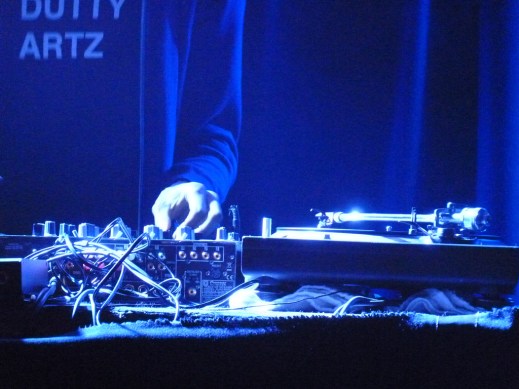
Featured Image: DJ /rupture performing at the Fórum Eletronika de Mídias Expandidas 2005 by Flickr user Brayhan Hawryliszyn (Attribution-NonCommercial 2.0 Generic (CC BY-NC 2.0)
—
Elizabeth Newton is a doctoral candidate in musicology. She has written for The New Inquiry, Tiny Mix Tapes, Real Life Magazine, the Quietus, and Leonardo Music Journal. Her research interests include musico-poetics, fidelity and reproduction, and affective histories of musical media. Her dissertation, in progress, is about “affective fidelity” in audio and print culture of the 1990s.
—

REWIND!…If you liked this post, you may also dig:
SO! Reads: Dolores Inés Casillas’s ¡Sounds of Belonging!–Monica De La Torre
SO! Reads: Roshanak Khesti’s Modernity’s Ear–Shayna Silverstein
Lokananta: Sounds of Crisis and Recovery from Indonesia’s National Record Company — Ian Coss
—
Share this:

Coconut Clops and Motorcycle Fanfare: What Sounds Medieval?

DOI: https://doi.org/10.59350/gp570-dp633
Until the nineteenth century, very little medieval music had been rediscovered, and what little was known was known mainly to specialists. However, the nineteenth-century fascination with the Middle Ages, the Gothic Revival in art and literature, inspired composers to write symphonic works and operas using medieval stories and themes. By the time twentieth-century musicologists began decoding and publishing music from the medieval past, a general consensus as to “what sounds medieval” had already been established in the minds of educated listeners familiar with European art music (see Annette Kreuziger-Herr’s 2005 article “Imagining Medieval Music: A Short History”). Ideas of the medieval constructed in the 19th century via medievalist works of art persisted well into the twentieth, and eventually the imagined medieval sound of Romantic music turned out to be incompatible with the newly discovered historical record.
While Early Music performers in the 1970s and 1980s based their performance styles on historical research, their artistic work was inevitably conceived in relation to existing concert repertoires and standards of performance, as well as ideas about the Middle Ages known by them and by their audiences. A general goal was to create performances that audiences could feel were convincingly accurate to how the music would have sounded in the past. But a sense of authenticity depends not just on the performers’ historical accuracy, but on a complex interaction of experiences and expectations on the part of the audience.

Two films, Monty Python and the Holy Grail and Knightriders, play directly with the clash between romantic interpretation of the Middle Ages and historically informed performances of music, for comedic effect. In Music in Films on the Middle Ages: Authenticity vs. Fantasy, John Haines examines six tropes of music in medievalist films: bells, horn calls and trumpet fanfares, court and dance music, minstrels, chant, and warriors on horseback. Haines mentions Monty Python and the Holy Grail several times, but does not discuss any of its music; he does not discuss Knightriders, likely because of its modern setting.
This essay examines the way these two films used music to highlight issues of the real, the historical, and the existence of competing medievalisms central to the understanding of medieval music in modern times. In the director’s commentary for the film Monty Python and the Holy Grail (1975), writer/performer/director Terry Jones had this to say about the film’s music:
Neil Innes had originally written the music for the entire film, and when we showed it, it didn’t really seem to work… we’d all agreed that Neil should go for a very authentic sound, and authentic instruments. The trouble is, it sounded quaint, and when we went to do the read-up I realized that actually you needed kind of mock-heroic music. But of course at that stage, we couldn’t afford to go and record some more music, so the only thing I could do was to go to a music library – I went to DeWolfe’s [a music library that licenses stock music] in London, and spent sort of weeks going through their discs, and sorting out bits of music to put on to it, to give it that sort of … it was just that we realized that if you had sort of music that sounded slightly quaint, because it was on original instruments, and you had all these silly goings-on, it looked comic, the music, instead of actually looking, um, real….
They wanted an “authentic sound,” but what they got didn’t seem real: here is the problem of conflicting expectations in a nutshell. Jones likely meant that the newly composed music, including the sounds of pre-modern instruments, was consciously reminiscent of older music as it was beginning to be known. The song sung by Sir Robin’s minstrels is likely a survival of Innes’ “authentic” score. The singer – Innes himself – sings a minor-mode melody reminiscent of a Tudor-era tune (think “Greensleeves”), accompanied by recorders, some reed instrument, and drum beats. The terms “original instruments” or “authentic instruments” don’t just refer to antique instruments (or copies of antique instruments), they were code for a particular approach to the performance of old music, an approach that was becoming very popular in 1970s Britain (for more on the British Early Music revival, see The Art of Re-Enchantment: Making Early Music in the Modern Age by Nick Wilson).
Jones characterized the pre-existing stock music chosen at De Wolfe’s as “mock Heroic,” but there’s really nothing mock about it per se— it’s genuinely heroic-sounding orchestral music, in the romantic post-Wagnerian style of Hollywood film scores, probably written in the 1950s or 1960s. There are brass fanfares when the company sights Camelot in the distance, angelic choirs for the vision of God who speaks to Arthur from the clouds, and especially, there is the wonderful music used when the company is galloping with coconuts. Here they are, approaching the castle of Gui de Lombard
The music for the galloping horses is heard several times during the film, and the contrast between its epic majesty and the sight of King Arthur and his knights not riding horses but rather banging two halves of coconuts together to simulate the sound of hoofbeats enhances the sight gag. The melody consists of four repetitions of the same melody, a strong rhythmic fanfare. The melody itself is made up of two almost identical phrases that each rise and then return down. The rhythm both emphasizes the steady pace and, through its mixture of long and short durations (a so-called “dotted rhythm”), suggests the gait of galloping horses. First we hear percussion, the high-frequency snare drums and lower booming tympani, then the low brass play the melody, harmonized. Higher trumpets join in for the second repeat, with flutes doubling the melody at a higher octave for added brilliance. That combination plays the third repeat, with strings joining for the fourth repeat. The tympani play faster, approaching the fanfare’s final cadence, but it becomes an anti-climax as Patsy, played by Terry Gilliam, can’t really play his long herald’s trumpet. A very knowing joke, as onscreen Hollywood heralds are frequently accompanied by the sound of modern valved trumpets playing chromatic phrases impossible to play on the visible long trumpets.
[The whole piece can be heard here; the part heard repeatedly in the film begins at 1:27:]
In its instrumentation, especially the use of brass and percussion, and the dotted rhythms (long, short, long, short, etc.) suggesting hoofbeats, this fanfare draws on a long tradition of music written to suggest galloping horses, whether ridden by medieval knights or other hunters or warriors. The most famous example is probably the finale to the “William Tell” Overture by Gioachino Rossini (1839). That galloping music influenced many film scores featuring knights on horseback, and it is likely that Terry Jones recognized the style from films he could have seen since the 1950s, such as MGM’s Knights of the Round Table (1953), starring Mel Ferrer as King Arthur and the very wooden Robert Taylor as Sir Lancelot which features music by Miklós Rózsa (1907-1995), who wrote similar music for both medieval knights and Roman charioteers, including trumpets to suggest fanfares and uneven rhythms to suggest hoofbeats.
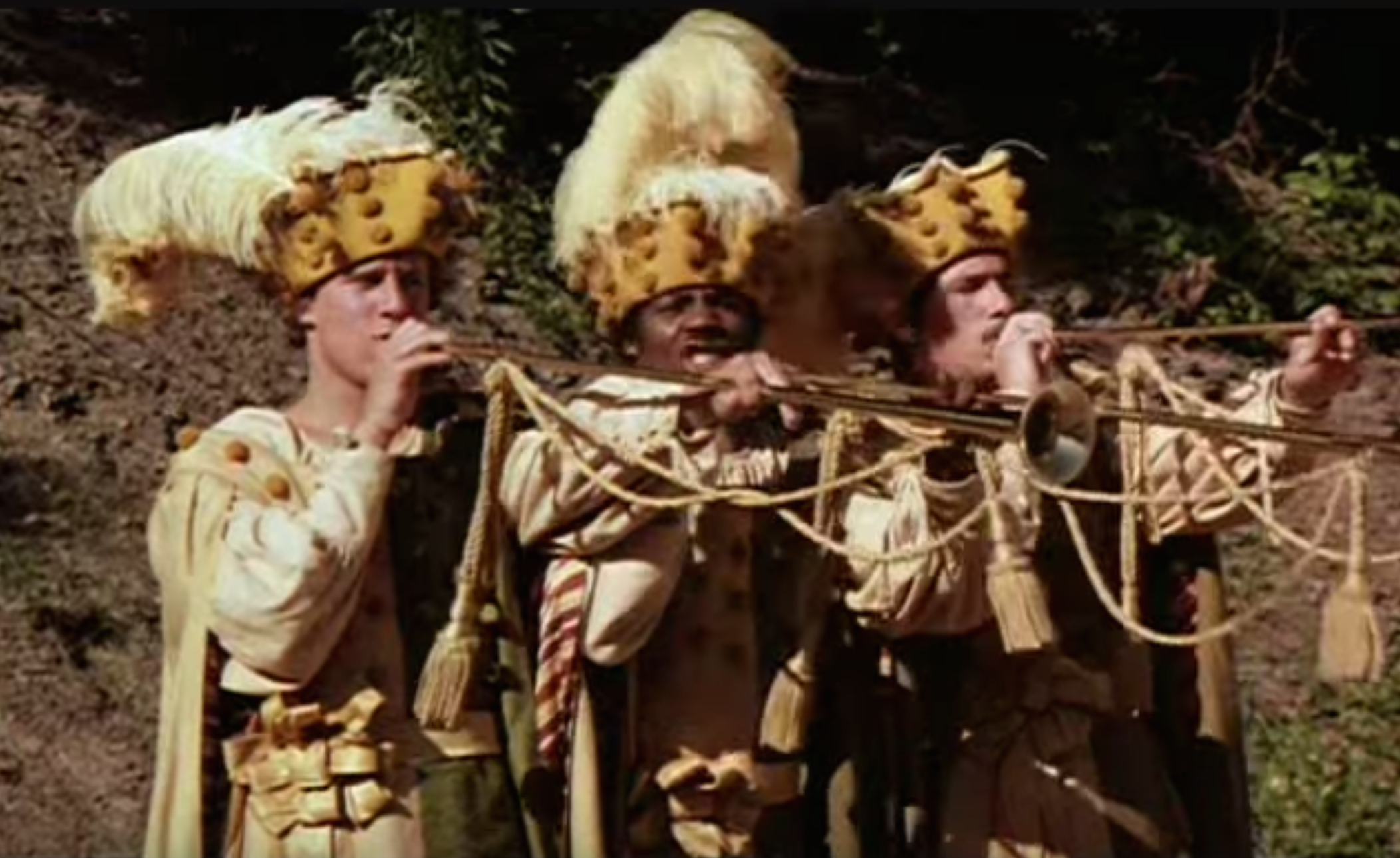
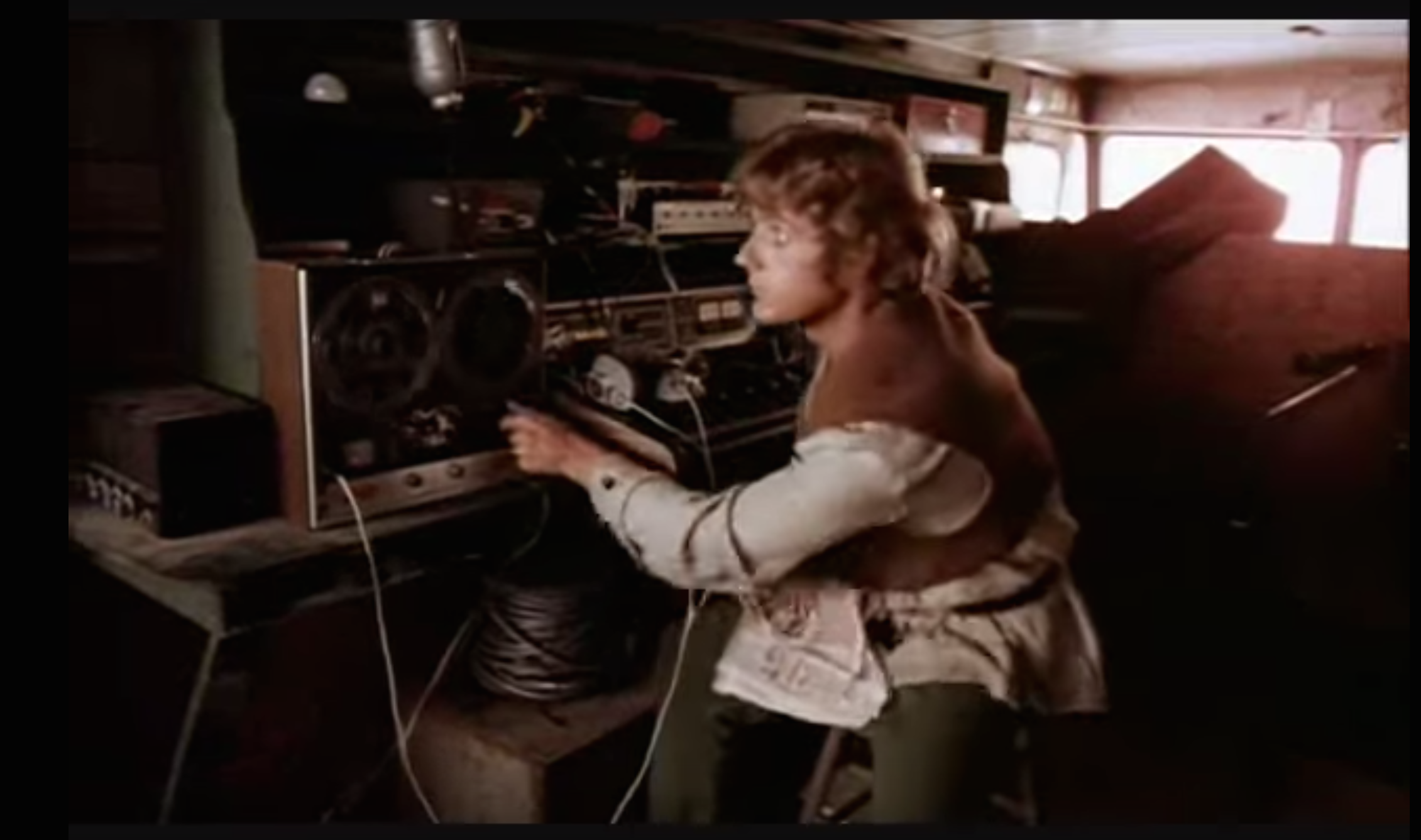
The music in my second example deals directly with the clash between then and now. The 1981 film Knightriders was written and directed by George A. Romero, better known for his horror films (he invented the modern zombie film with 1968’s Night of the Living Dead). Knightriders follows the adventures of a traveling Renaissance-faire troupe of actors who stage jousting tournaments while riding motorcycles; the interactions between the actors come to parallel Arthurian stories. The film revolves around the conflict between modern reality and the desire to live one’s life according to (a modern understanding of) medieval chivalric virtues. This scene shows the troupe’s act: the action is straightforward, but the music is complicated, with the score by Donald Rubenstein using five distinct kinds of music in a theoretically sophisticated manner. In order, we hear: live music played on-screen by visible performers, recorded music played onscreen, and then three musically distinct flavors of underscore music. Watch for a yet another knowing gag about the technical capabilities of heralds blowing straight trumpets, as well as a cameo appearance by the writer Stephen King as a scornful man eating a sandwich.
The music performed on-screen functions as part of the scene. The painfully amateur band of minstrels plays a tune from Handel’s oratorio “Judas Maccabeus” (1746), probably known to the squeaky violinist from its use as a Suzuki teaching piece. We can imagine that these musicians are playing the oldest piece of music they know, and in response the audience—both onscreen and offscreen—is led to believe that the rest of the show will be similarly amateurish. The professionally recorded trumpet fanfare demonstrates again how their (and our) musical associations for medieval scenes, especially tournaments, come so strongly from Hollywood. The actors can’t begin to play their instruments, but everyone knows that the heralds and their fanfares are crucial for the scene they’re trying to set.
When King William and Linet take their thrones, we hear underscore music—guitar and fiddle—for the first time; the shift from source music to underscore is done with great subtlety. This music has the informal flavor of folk music, which connects it to the little onscreen band, but now played professionally. The cue is extremely short, but serves as a transition from the real world of the tacky Ren-fest to the imagined world of chivalry and knighthood in some mythical past enacted by the modern-day warriors. The spectacular motorcycle stunts are underscored by more folk-sounding music: again fiddle and guitar, this time playing a fast jig. This music is exciting, as befits the action, but the specific sounds, reminiscent of Irish folk music, do more than just underscore excitement: they begin to move us backwards in time. Folk music reads as traditional, as old, but not ancient. The folk music sounds inhabit an intermediate place, a remembered past between the present and the imagined distant past of the middle ages.
When the individual jousts begin, the underscore music changes again, first to the heroic type of “Hollywood Knights” music, prompting the audience to equate the “real” riders onscreen with their fictional (and filmic) knightly counterparts. This kind of orchestral music, with prominent strings, is used throughout the film for moments of almost magical transformation, suggesting that for believers, such transformation is indeed possible. For the second and third jousts the underscore changes one last time, to trombones playing very archaic-sounding music. Here at last in 1980 is the sound of “authentic instruments” that Terry Jones eschewed back in 1974, and it doesn’t sound quaint at all here, it sounds real. These riders aren’t (just) carnival performers, they are knights at a tournament, risking bodily injury in their quest for personal excellence.

The music in this sequence plays with a basic distinction in film music and film music scholarship: is the music diegetic, that is, part of the film’s story, or nondiegetic, that is, as Robynn J. Stilwell describes in “The Fantastical Gap between Diegetic and Nondiegetic,” in Beyond the Soundtrack, “an element of the cinematic apparatus that represents that world?” (184). The terms were first used by Claudia Gorbman in her pioneering study, Unheard Melodies: Narrative Film Music (1987), and have been a major focus of film music scholarship ever since.
In this sequence, the amateur musicians and the taped fanfare, count as diegetic music, while everything else is nondiegetic. Stilwell points out that border crossings between these two categories are common, but meaningful; she coined the term “fantastical gap,” the gap between what we see and hear and what we hear without seeing, to discuss the liminal (conceptual) space between the two (185-187). Stilwell describes movement from diegetic to nondiegetic as a “trajectory [that] takes on great narrative and experiential import. These moments do not take place randomly; they are important moments of revelation, of symbolism, and of emotional engagement within the film and without” (200). The Knightriders tournament sequence, already liminal as a “play within the play” of the film, traverses the fantastical gap in a way that dramatizes a central question for the performance of Early Music: what happens when modern performances are historically informed, but emotionally unsatisfying? For George Romero, as for Terry Jones, the answer is to give priority to the emotional, drawing on their and their audiences’ expectation for “Hollywood Knights” soundtrack music. Early Music performers in the 1980s made similar choices, merging familiarity and unfamiliarity in exciting ways that unfortunately left them open to criticism that their performances were “inauthentic,” an advertising claim they found themselves defending.
The modern performance of surviving pieces of medieval music, recorded in notation, will always enact a kind of medievalism, involving the creative use of material survival from the past. But to understand the goal for the performance of medieval music as historical accuracy alone is to miss an important point. Medievalisms, the creative use of historical material, create meanings for modern audiences, meanings that then help to shape further understanding of the historical past.
The decades since these two films were made and released saw great growth in both artistic approaches to Early Music, and in the skill of performers in playing old instruments and singing in newer, non-Classical styles. Professional recordings enjoyed real commercial success as a sub-genre in Classical music starting in the 1980s, accelerating audiences’ familiarity with the novel sounds of old music re-vivified. The 1990s saw “new age” music and Celtic folk-music sounds added to the mix, while performers in the 2000s have drawn inspiration from Greek Orthodox chant, and continental folk musics. “What sounds medieval” will always be conditioned by what modern performers and listeners imagine “the medieval” to be, and how “the medieval” is understood to be different from later times. As those imaginings are themselves constantly changing, so will their representations in music.
—
Featured Image: “Monty Python Coconuts” by Flickr User Mark Turnauckus
—
Elizabeth Randell Upton is Associate Professor of Musicology at UCLA and the author of Music and Performance in the Later Middle Ages (“The New Middle Ages” series, Palgrave Macmillan, 2013), which examines late fourteenth and early fifteenth century vocal music to discover evidence for the experiences of performers and listeners in the medieval past, recorded in surviving musical notation. Her next book will explore mid-twentieth century Early Music revivals in the UK and US, moving beyond the usual focus on musicological scholarship and classical music traditions to examine Early Music’s interactions with both folk music revivals and popular music.
—

REWIND!…If you liked this post, you may also dig:
Sounding Out! Podcast #54: The Sound of Magic-K.A. Laity
Mouthing the Passion: Richard Rolle’s Soundscapes–Christopher Roman
EPISODE LI: Creating New Words from Old Sounds–Marcella Ernest, Candace Gala, Leslie Harper, and Daryn McKenny
—
Share this:




Current Top Posts





April 2021

January 2020

November 2019

October 2019

August 2019

April 2014

November 2017

March 2015

December 2017

October 2015


Recent Comments