
Listening to the Beautiful Game: The Sounds of the 2018 World Cup

DOI: https://doi.org/10.59350/d1hab-pjx27
I heard them before I saw them. Walking to my apartment in Moscow’s Tverskoy District, I noticed a pulsating mass of sound in the distance. Turning the corner, I found a huge swath of light blue and white and—no longer separated by tall Stalinist architecture—was able to clearly make out the sounds of Spanish. Flanked by the Izvestiia building (the former mouthpiece for the Soviet government), Argentinian soccer fans had taken over nearly an entire city block with their revelry. The police, who have thus far during the tournament been noticeably lax in enforcing traffic and pedestrian laws, formed a boundary to keep fans from spilling out into the street. Policing the urban space, the bodies of officers were able to contain the bodies of reveling fans, but the sounds and voices spread freely throughout the neighborhood.
Moscow is one of eleven host cities throughout Russia for the 2018 FIFA World Cup, which runs from June 14 to July 15. Over one million foreign fans are expected to enter the country over the course of the tournament, and it is an important moment in Vladimir Putin’s attempt to reassert Russia’s power on the global stage. Already, it has been called “the most political tournament ever,” and discussions of hooliganism, safety concerns, and corruption have occupied many foreign journalists in the months leading up to the start. So gloomy have these preambles been that writers are now releasing opinion pieces expressing their surprise at Moscow’s jubilant and exciting atmosphere. Indeed, it seems as though the whole world is not only watching the games, but also listening attentively to try to discern Russia’s place in the world.

Thus it comes as no surprise that the politics of sound surrounding the tournament have the potential to highlight the successes, pitfalls, and contradictions of the “beautiful game.” Be it vuvuzelas or corporate advertising, sound and music has shaped the lived experience of the World Cup in recent years. And this tournament is no exception: after their team’s 2-1 win over Tunisia on June 18, three England fans were filmed singing anti-semitic songs and making Nazi salutes in a bar in Volgograd. That their racist celebrations took place in Volgograd, formerly known as Stalingrad and the site of one of the bloodiest battles of World War II, added historical insult and even more political significance. The incident has shaped reception of England’s fans and their sounds across the country. As journalist Alec Luhn recently tweeted, police cordoned off singing England supporters in Nizhny Novgorod after their victory over Panama, ostensibly keeping the risk of hooliganism at bay. The incident stands in stark contrast with the police barrier around the Argentina fans, who were being protected not from supporters of other nationalities, but rather from oncoming traffic.
England fans in Russia sing songs…behind a line of police. Part of the reason there hasn’t been any hooligan violence pic.twitter.com/RwXz8XtLHf
— Alec Luhn (@ASLuhn) June 23, 2018
More than anything, however, sound has facilitated cultural exchange between fans and spectators. In recent years, historians and musicologists have paid more attention to the multivalent ways musical exchanges produce meaningful political and social understandings. Be it through festivals, diplomatic programs, or compositional techniques, music plays a powerful role in the soft power of nations and can cultivate relationships between individuals around the globe. More broadly, sound—be it organized or not—shapes our identity and is one of the ways by which we make meaning in the world. Sound, then, has the potential to vividly structure the experience of the World Cup—a moment at which sound, bodies, individuals, and symbolic nations collide.
At the epicenter of all of this has been Red Square, Moscow’s—and perhaps Russia’s—most iconic urban space. The site of many fan celebrations throughout the World Cup, Red Square’s soundscape brings together a wide variety of national identities, socio-economic considerations, and historical moments. To walk through Red Square in June 2018 is to walk through over five-hundred years of Russian history, emblematized by the ringing bells and rust-colored walls of the Kremlin; through nearly eighty years of Soviet rule, with the bustle and chatter of curious tourists waiting to enter Lenin’s tomb; and through Russia’s (at times precarious) global present, where fans from Poland join with those from Mexico in chants of “olé” and Moroccan supporters dance and sing with their South Korean counterparts. The past, present, and an uncertain future merge on Red Square, and the sonic community formed in this public space becomes a site for the negotiation of all three.

In the afternoon of June 19, I walked through Red Square to listen to the sounds of the World Cup outside the stadium. At the entrance to Red Square stands a monument to Grigory Zhukov, the Soviet General widely credited with victory over the Nazis in World War II. Mounted upon a rearing horse, Zhukov’s guise looms large over the square. In anticipation of that evening’s match between Poland and Senegal at Moscow’s Spartak Stadium, Polish fans were gathered at the base of Zhukov’s monument and tried to summon victory through chants and songs (Poland would end up losing the match 2-1.) Extolling the virtues of their star player, Robert Lewandowski, the fans played with dynamics and vocal timbres to assert their dominance. Led by a shirtless man wearing a police peaked cap, the group’s spirit juxtaposed with Zhukov’s figure reiterated the combative military symbolism of sporting events. Their performance also spoke to the highly gendered elements of World Cup spectatorship: male voices far outnumbered female, and the deeper frequencies traveled farther across space and architectural barriers. The chants and songs, especially those that were more militaristic like this one, reasserted the perception of soccer as a “man’s sport.” Their voices resonated with much broader social inequalities and organizational biases between the Women’s and Men’s World Cups.
From there, I walked through the gates onto Red Square and was greeted by a sea of colors and hundreds of bustling fans. Flanked by the tall walls of the Kremlin on one side and the imposing façade of GUM (a department store) on the other, the open square quickly became cacophonous. Traversing the crowds, however, the “white noise” of chatter ceded to pockets of organized sound and groups of fans. Making a lap of the square, I walked from the iconic onion domes of St. Basil’s cathedral past a group of chanting fans from Poland, who brought a man wearing a Brazil jersey and woman with a South Korean barrette into the fold. Unable to understand Polish, the newcomers were able to join in on the chant’s onomatopoeic chorus. Continuing on, I encountered a group of Morocco supporters who, armed with a hand drum, sang together in Arabic. Eventually, their song morphed into the quintessential cheer of “olé,” at which point the entire crowd joined in. I went from there past a group of Mexico fans, who were posing for an interview while nearby stragglers sang. The pattern continued for much of my journey, as white noise and chatter ceded to music and chants, which in turn dissipated either as I continued onward or fans became tired.
Despite their upcoming match, Senegalese fans were surprisingly absent. Compared to 2014 statistics, Poland had seen a modest growth of 1.5% in fans attending the 2018 World Cup—unsurprising, given the country’s proximity to Russia and shared (sometimes begrudgingly) history. Meanwhile, Senegal was not among the top fifty countries in spectator increases. That’s not to say, of course, that Senegalese supporters were not there; they were praised after the match for cleaning up garbage from the stands. Rather, geography and, perhaps, socio-economic barriers delimited the access fans have to attending matches live as opposed to watching them from home. With the day’s match looming large, their sounds were noticeably missing from the soundscape of Red Square.
Later that evening, I stopped to watch a trio of Mexico fans dancing to some inaudible music coming from an iPhone. Standing next to me was a man in a Poland jersey. I started chatting with him in (my admittedly not great) Polish to ask where he was from, if he was enjoying the World Cup so far, and so on. Curious, I asked what he thought of all the music and songs that fans were using in celebrations. “I don’t know,” he demurred. “They’re soccer songs. They’re good to sing together, good for the spirit.”
Nodding, I turned back toward the dancing trio.
“You are Russian, yes?” The man’s question surprised me.
“No,” I responded. “I’m from America.”
“Oh,” he paused. “You sound Russian. You don’t look Russian, but you sound Russian.”
I’d been told before that I speak Polish with a thick Russian accent, and it was not the first time I’d heard that I did not look Russian. In that moment, the visual and sonic elements of my identity, at least in the eyes and ears of this Polish man, collided with one another. At the World Cup, jerseys could be taken off and traded, sombreros and ushankas passed around, and flags draped around the shoulders of groups of people. Sounds—and voices in particular—however, seemed equal parts universal and unique. Emanating from the individual and resonating throughout the collective, voices bridged a sort of epistemological divide between truth and fiction, authenticity and cultural voyeurism. In that moment, as jubilant soccer fans and busy pedestrians mingled, sonic markers of identity fluctuated with every passerby.
I nodded a silent goodbye to my Polish acquaintance and, joining the crowd, set off into the Moscow evening.
—
Featured Image: “World Cup 2018” Taken by Flickr User Ded Pihto, taken on June 13, 2018.
—
Gabrielle Cornish is a PhD candidate in Musicology at the Eastman School of Music. Her research broadly considers music, sound, and everyday life in the Soviet Union. In particular, her dissertation traces the intersections between music, technology, and the politics of “socialist modernity” after Stalinism. Her research in Russia has been supported by the Fulbright Program, the Glenn Watkins Traveling Fellowship, and the Cohen-Tucker Dissertation Research Fellowship from the Association for Slavic, East European, and Eurasian Studies. Other projects include Russian-to-English translation as well as a digital project that maps the sounds and music of the Space Race.
—

REWIND! . . .If you liked this post, you may also dig:
Cauldrons of Noise: Stadium Cheers and Boos at the 2012 London Olympics–David Hendy
Goalball: Sport, Silence, and Spectatorship— Melissa Helquist
Sounding Out! Podcast #20: The Sound of Rio’s Favelas: Echoes of Social Inequality in an Olympic City–Andrea Medrado
—
Share this:

Coconut Clops and Motorcycle Fanfare: What Sounds Medieval?

DOI: https://doi.org/10.59350/gp570-dp633
Until the nineteenth century, very little medieval music had been rediscovered, and what little was known was known mainly to specialists. However, the nineteenth-century fascination with the Middle Ages, the Gothic Revival in art and literature, inspired composers to write symphonic works and operas using medieval stories and themes. By the time twentieth-century musicologists began decoding and publishing music from the medieval past, a general consensus as to “what sounds medieval” had already been established in the minds of educated listeners familiar with European art music (see Annette Kreuziger-Herr’s 2005 article “Imagining Medieval Music: A Short History”). Ideas of the medieval constructed in the 19th century via medievalist works of art persisted well into the twentieth, and eventually the imagined medieval sound of Romantic music turned out to be incompatible with the newly discovered historical record.
While Early Music performers in the 1970s and 1980s based their performance styles on historical research, their artistic work was inevitably conceived in relation to existing concert repertoires and standards of performance, as well as ideas about the Middle Ages known by them and by their audiences. A general goal was to create performances that audiences could feel were convincingly accurate to how the music would have sounded in the past. But a sense of authenticity depends not just on the performers’ historical accuracy, but on a complex interaction of experiences and expectations on the part of the audience.
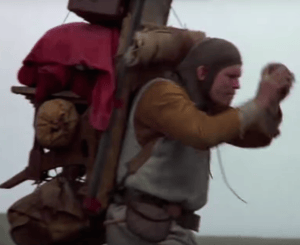
Two films, Monty Python and the Holy Grail and Knightriders, play directly with the clash between romantic interpretation of the Middle Ages and historically informed performances of music, for comedic effect. In Music in Films on the Middle Ages: Authenticity vs. Fantasy, John Haines examines six tropes of music in medievalist films: bells, horn calls and trumpet fanfares, court and dance music, minstrels, chant, and warriors on horseback. Haines mentions Monty Python and the Holy Grail several times, but does not discuss any of its music; he does not discuss Knightriders, likely because of its modern setting.
This essay examines the way these two films used music to highlight issues of the real, the historical, and the existence of competing medievalisms central to the understanding of medieval music in modern times. In the director’s commentary for the film Monty Python and the Holy Grail (1975), writer/performer/director Terry Jones had this to say about the film’s music:
Neil Innes had originally written the music for the entire film, and when we showed it, it didn’t really seem to work… we’d all agreed that Neil should go for a very authentic sound, and authentic instruments. The trouble is, it sounded quaint, and when we went to do the read-up I realized that actually you needed kind of mock-heroic music. But of course at that stage, we couldn’t afford to go and record some more music, so the only thing I could do was to go to a music library – I went to DeWolfe’s [a music library that licenses stock music] in London, and spent sort of weeks going through their discs, and sorting out bits of music to put on to it, to give it that sort of … it was just that we realized that if you had sort of music that sounded slightly quaint, because it was on original instruments, and you had all these silly goings-on, it looked comic, the music, instead of actually looking, um, real….
They wanted an “authentic sound,” but what they got didn’t seem real: here is the problem of conflicting expectations in a nutshell. Jones likely meant that the newly composed music, including the sounds of pre-modern instruments, was consciously reminiscent of older music as it was beginning to be known. The song sung by Sir Robin’s minstrels is likely a survival of Innes’ “authentic” score. The singer – Innes himself – sings a minor-mode melody reminiscent of a Tudor-era tune (think “Greensleeves”), accompanied by recorders, some reed instrument, and drum beats. The terms “original instruments” or “authentic instruments” don’t just refer to antique instruments (or copies of antique instruments), they were code for a particular approach to the performance of old music, an approach that was becoming very popular in 1970s Britain (for more on the British Early Music revival, see The Art of Re-Enchantment: Making Early Music in the Modern Age by Nick Wilson).
Jones characterized the pre-existing stock music chosen at De Wolfe’s as “mock Heroic,” but there’s really nothing mock about it per se— it’s genuinely heroic-sounding orchestral music, in the romantic post-Wagnerian style of Hollywood film scores, probably written in the 1950s or 1960s. There are brass fanfares when the company sights Camelot in the distance, angelic choirs for the vision of God who speaks to Arthur from the clouds, and especially, there is the wonderful music used when the company is galloping with coconuts. Here they are, approaching the castle of Gui de Lombard
The music for the galloping horses is heard several times during the film, and the contrast between its epic majesty and the sight of King Arthur and his knights not riding horses but rather banging two halves of coconuts together to simulate the sound of hoofbeats enhances the sight gag. The melody consists of four repetitions of the same melody, a strong rhythmic fanfare. The melody itself is made up of two almost identical phrases that each rise and then return down. The rhythm both emphasizes the steady pace and, through its mixture of long and short durations (a so-called “dotted rhythm”), suggests the gait of galloping horses. First we hear percussion, the high-frequency snare drums and lower booming tympani, then the low brass play the melody, harmonized. Higher trumpets join in for the second repeat, with flutes doubling the melody at a higher octave for added brilliance. That combination plays the third repeat, with strings joining for the fourth repeat. The tympani play faster, approaching the fanfare’s final cadence, but it becomes an anti-climax as Patsy, played by Terry Gilliam, can’t really play his long herald’s trumpet. A very knowing joke, as onscreen Hollywood heralds are frequently accompanied by the sound of modern valved trumpets playing chromatic phrases impossible to play on the visible long trumpets.
[The whole piece can be heard here; the part heard repeatedly in the film begins at 1:27:]
In its instrumentation, especially the use of brass and percussion, and the dotted rhythms (long, short, long, short, etc.) suggesting hoofbeats, this fanfare draws on a long tradition of music written to suggest galloping horses, whether ridden by medieval knights or other hunters or warriors. The most famous example is probably the finale to the “William Tell” Overture by Gioachino Rossini (1839). That galloping music influenced many film scores featuring knights on horseback, and it is likely that Terry Jones recognized the style from films he could have seen since the 1950s, such as MGM’s Knights of the Round Table (1953), starring Mel Ferrer as King Arthur and the very wooden Robert Taylor as Sir Lancelot which features music by Miklós Rózsa (1907-1995), who wrote similar music for both medieval knights and Roman charioteers, including trumpets to suggest fanfares and uneven rhythms to suggest hoofbeats.
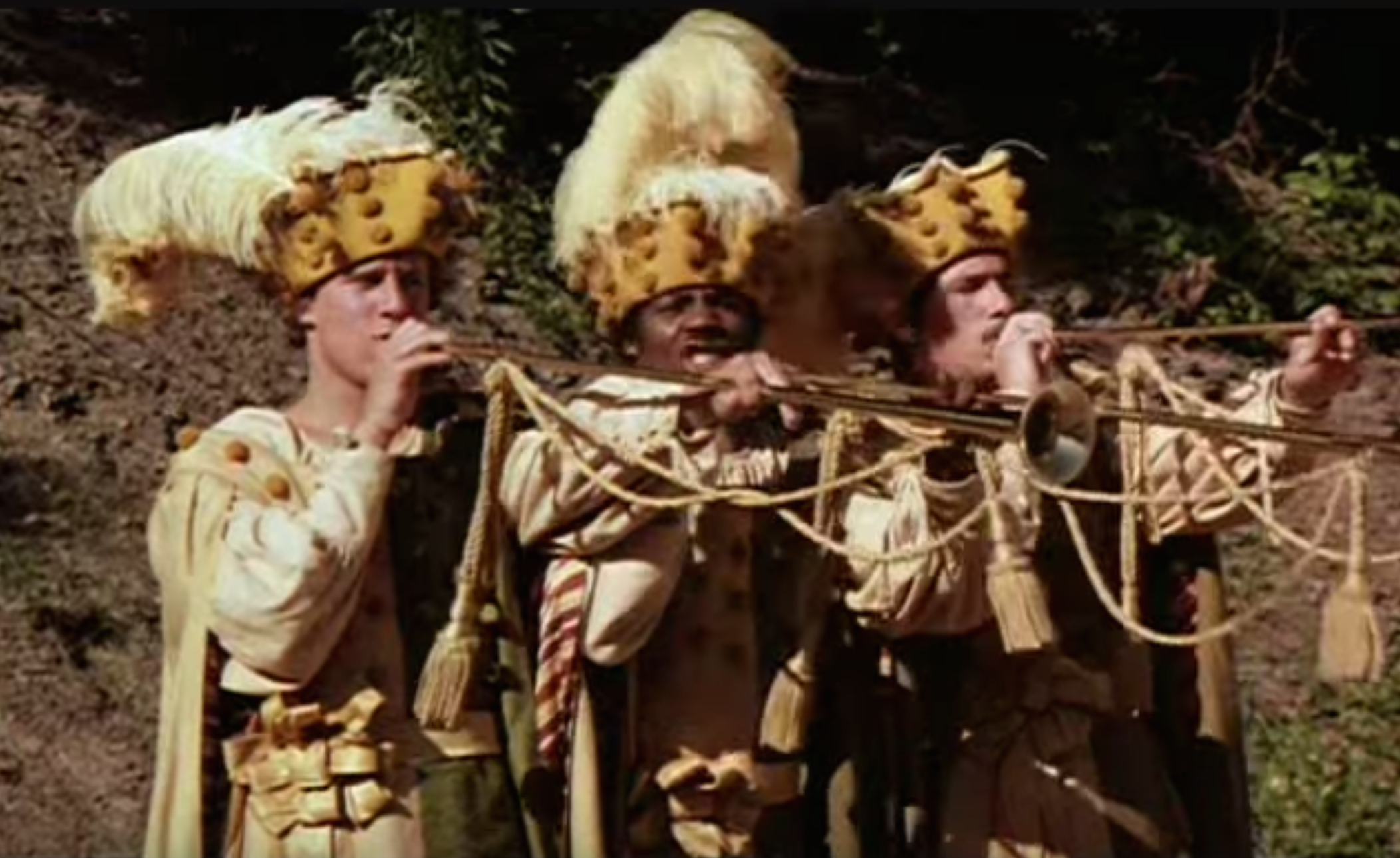
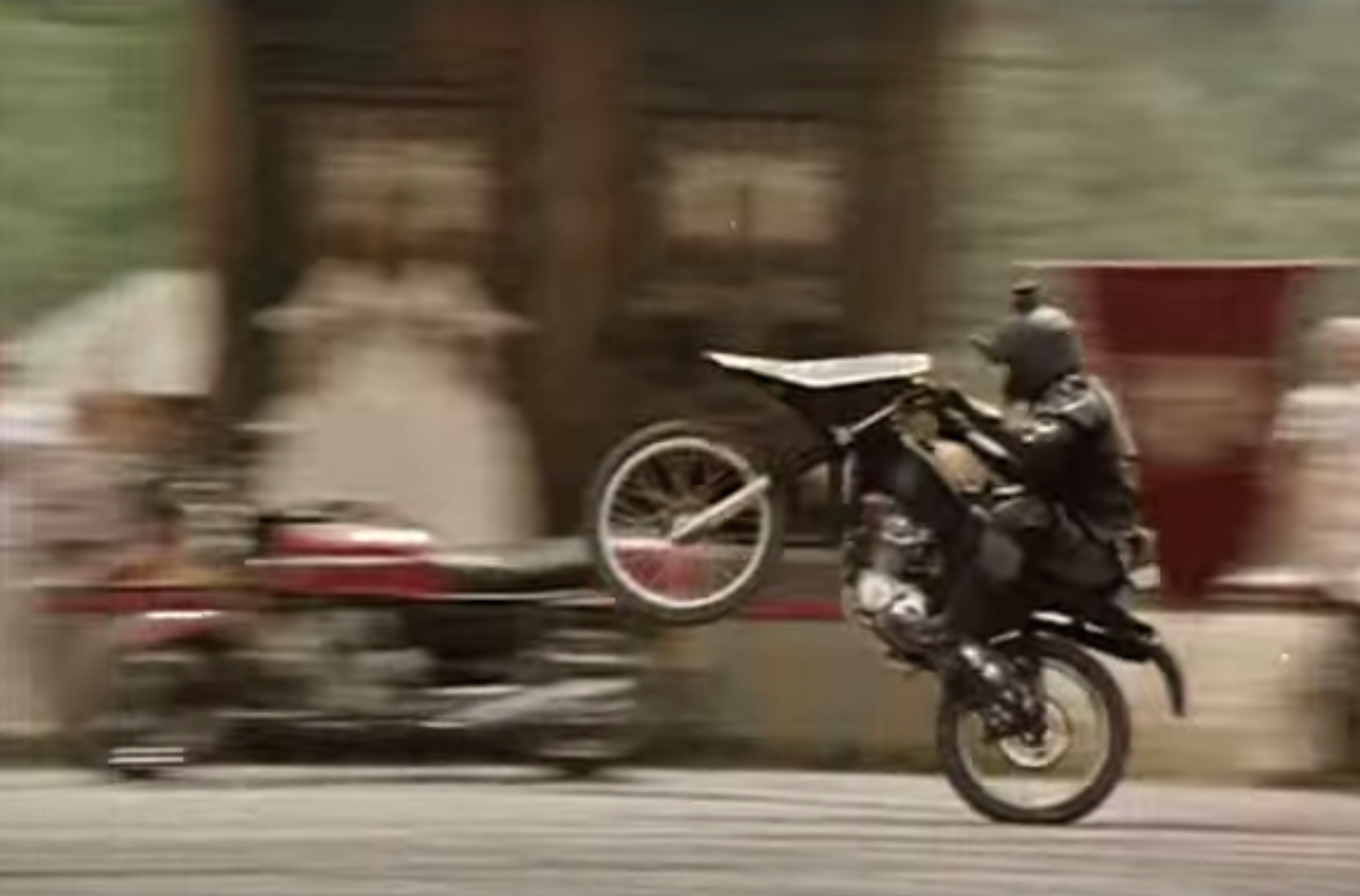
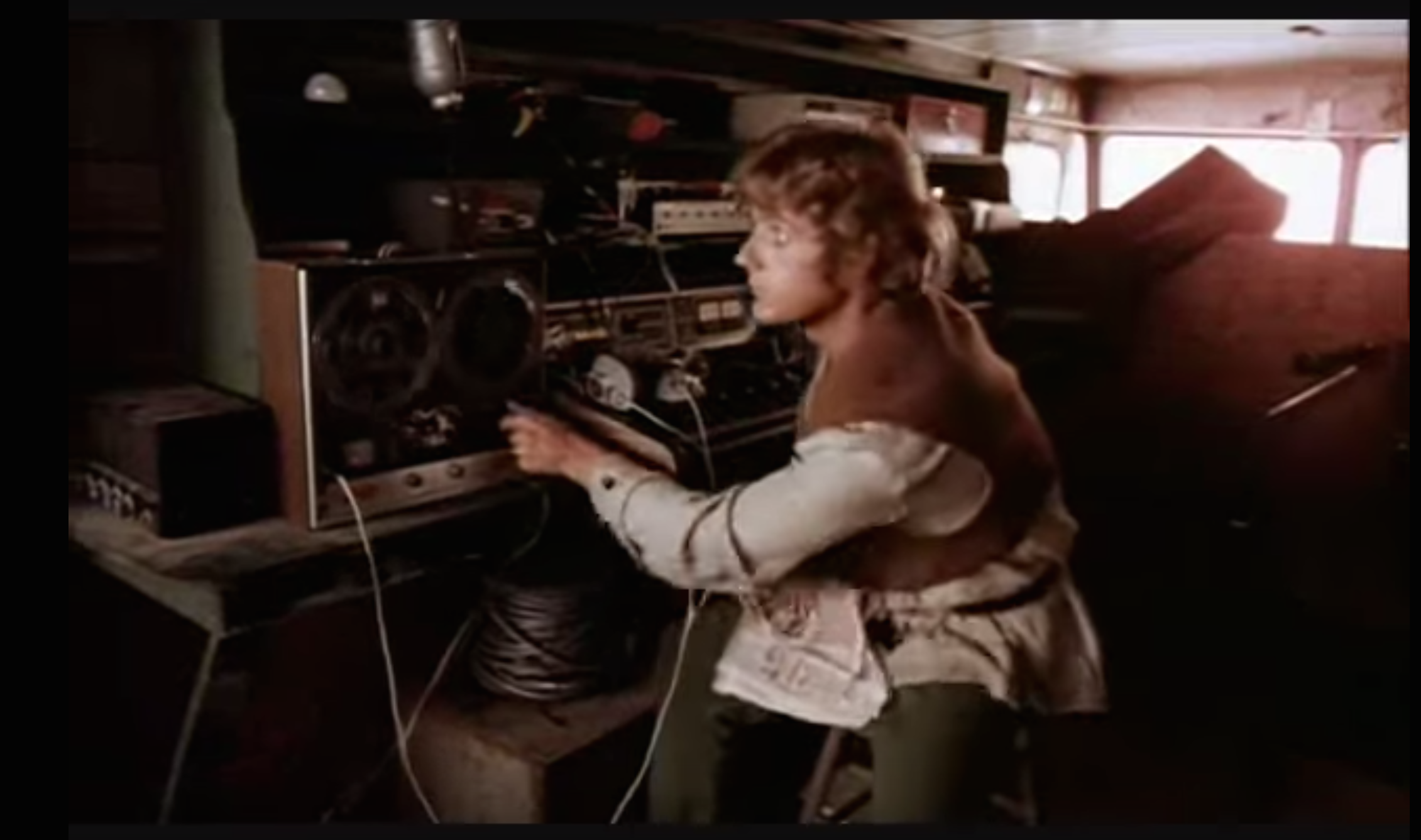
The music in my second example deals directly with the clash between then and now. The 1981 film Knightriders was written and directed by George A. Romero, better known for his horror films (he invented the modern zombie film with 1968’s Night of the Living Dead). Knightriders follows the adventures of a traveling Renaissance-faire troupe of actors who stage jousting tournaments while riding motorcycles; the interactions between the actors come to parallel Arthurian stories. The film revolves around the conflict between modern reality and the desire to live one’s life according to (a modern understanding of) medieval chivalric virtues. This scene shows the troupe’s act: the action is straightforward, but the music is complicated, with the score by Donald Rubenstein using five distinct kinds of music in a theoretically sophisticated manner. In order, we hear: live music played on-screen by visible performers, recorded music played onscreen, and then three musically distinct flavors of underscore music. Watch for a yet another knowing gag about the technical capabilities of heralds blowing straight trumpets, as well as a cameo appearance by the writer Stephen King as a scornful man eating a sandwich.
The music performed on-screen functions as part of the scene. The painfully amateur band of minstrels plays a tune from Handel’s oratorio “Judas Maccabeus” (1746), probably known to the squeaky violinist from its use as a Suzuki teaching piece. We can imagine that these musicians are playing the oldest piece of music they know, and in response the audience—both onscreen and offscreen—is led to believe that the rest of the show will be similarly amateurish. The professionally recorded trumpet fanfare demonstrates again how their (and our) musical associations for medieval scenes, especially tournaments, come so strongly from Hollywood. The actors can’t begin to play their instruments, but everyone knows that the heralds and their fanfares are crucial for the scene they’re trying to set.
When King William and Linet take their thrones, we hear underscore music—guitar and fiddle—for the first time; the shift from source music to underscore is done with great subtlety. This music has the informal flavor of folk music, which connects it to the little onscreen band, but now played professionally. The cue is extremely short, but serves as a transition from the real world of the tacky Ren-fest to the imagined world of chivalry and knighthood in some mythical past enacted by the modern-day warriors. The spectacular motorcycle stunts are underscored by more folk-sounding music: again fiddle and guitar, this time playing a fast jig. This music is exciting, as befits the action, but the specific sounds, reminiscent of Irish folk music, do more than just underscore excitement: they begin to move us backwards in time. Folk music reads as traditional, as old, but not ancient. The folk music sounds inhabit an intermediate place, a remembered past between the present and the imagined distant past of the middle ages.
When the individual jousts begin, the underscore music changes again, first to the heroic type of “Hollywood Knights” music, prompting the audience to equate the “real” riders onscreen with their fictional (and filmic) knightly counterparts. This kind of orchestral music, with prominent strings, is used throughout the film for moments of almost magical transformation, suggesting that for believers, such transformation is indeed possible. For the second and third jousts the underscore changes one last time, to trombones playing very archaic-sounding music. Here at last in 1980 is the sound of “authentic instruments” that Terry Jones eschewed back in 1974, and it doesn’t sound quaint at all here, it sounds real. These riders aren’t (just) carnival performers, they are knights at a tournament, risking bodily injury in their quest for personal excellence.
The music in this sequence plays with a basic distinction in film music and film music scholarship: is the music diegetic, that is, part of the film’s story, or nondiegetic, that is, as Robynn J. Stilwell describes in “The Fantastical Gap between Diegetic and Nondiegetic,” in Beyond the Soundtrack, “an element of the cinematic apparatus that represents that world?” (184). The terms were first used by Claudia Gorbman in her pioneering study, Unheard Melodies: Narrative Film Music (1987), and have been a major focus of film music scholarship ever since.
In this sequence, the amateur musicians and the taped fanfare, count as diegetic music, while everything else is nondiegetic. Stilwell points out that border crossings between these two categories are common, but meaningful; she coined the term “fantastical gap,” the gap between what we see and hear and what we hear without seeing, to discuss the liminal (conceptual) space between the two (185-187). Stilwell describes movement from diegetic to nondiegetic as a “trajectory [that] takes on great narrative and experiential import. These moments do not take place randomly; they are important moments of revelation, of symbolism, and of emotional engagement within the film and without” (200). The Knightriders tournament sequence, already liminal as a “play within the play” of the film, traverses the fantastical gap in a way that dramatizes a central question for the performance of Early Music: what happens when modern performances are historically informed, but emotionally unsatisfying? For George Romero, as for Terry Jones, the answer is to give priority to the emotional, drawing on their and their audiences’ expectation for “Hollywood Knights” soundtrack music. Early Music performers in the 1980s made similar choices, merging familiarity and unfamiliarity in exciting ways that unfortunately left them open to criticism that their performances were “inauthentic,” an advertising claim they found themselves defending.
The modern performance of surviving pieces of medieval music, recorded in notation, will always enact a kind of medievalism, involving the creative use of material survival from the past. But to understand the goal for the performance of medieval music as historical accuracy alone is to miss an important point. Medievalisms, the creative use of historical material, create meanings for modern audiences, meanings that then help to shape further understanding of the historical past.
The decades since these two films were made and released saw great growth in both artistic approaches to Early Music, and in the skill of performers in playing old instruments and singing in newer, non-Classical styles. Professional recordings enjoyed real commercial success as a sub-genre in Classical music starting in the 1980s, accelerating audiences’ familiarity with the novel sounds of old music re-vivified. The 1990s saw “new age” music and Celtic folk-music sounds added to the mix, while performers in the 2000s have drawn inspiration from Greek Orthodox chant, and continental folk musics. “What sounds medieval” will always be conditioned by what modern performers and listeners imagine “the medieval” to be, and how “the medieval” is understood to be different from later times. As those imaginings are themselves constantly changing, so will their representations in music.
—
Featured Image: “Monty Python Coconuts” by Flickr User Mark Turnauckus
—
Elizabeth Randell Upton is Associate Professor of Musicology at UCLA and the author of Music and Performance in the Later Middle Ages (“The New Middle Ages” series, Palgrave Macmillan, 2013), which examines late fourteenth and early fifteenth century vocal music to discover evidence for the experiences of performers and listeners in the medieval past, recorded in surviving musical notation. Her next book will explore mid-twentieth century Early Music revivals in the UK and US, moving beyond the usual focus on musicological scholarship and classical music traditions to examine Early Music’s interactions with both folk music revivals and popular music.
—

REWIND!…If you liked this post, you may also dig:
Sounding Out! Podcast #54: The Sound of Magic-K.A. Laity
Mouthing the Passion: Richard Rolle’s Soundscapes–Christopher Roman
EPISODE LI: Creating New Words from Old Sounds–Marcella Ernest, Candace Gala, Leslie Harper, and Daryn McKenny
—
Share this:




Current Top Posts





April 2021

January 2020

November 2019

October 2019

August 2019

April 2014

November 2017

March 2015

December 2017

October 2015


Recent Comments