
Regulating the Carceral Soundscape: Media Policy in Prison
DOI: https://doi.org/10.59350/x21y1-jvz14
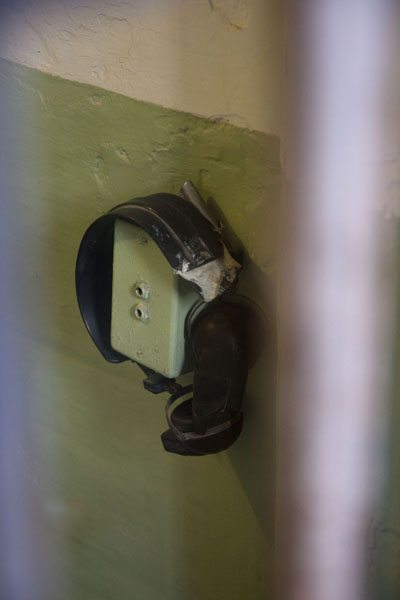
The first thing I noticed about 4-block was the silence. It was so quiet that every time I sat on my bunk I fell asleep. The Reformatory was always one continuous roar, musicfrom radios and televisions, noise from guys shouting to one another up and down the block, it seemed to never end. But in Jackson it was very, very different. The daytime hours you could hear typewriters and the closing of cell doors, the phone at the guards desk ringing but that was it. And after 9:00 PM you heard absolutely nothing …” –“Chet” (qtd. in Music Behind Bars: Liberatory Musicology in Two Michigan Prisons, 66-67)
Film and television usually portray prison as the loudest place on earth, filled with nonstop clanking and shouting and slamming, the noise reverberating sharply off its hard, flat surfaces. Actually, prison is much more likely to be a binary soundscape: either too loud or, at times, inhumanly quiet.
In fact, the manipulation of the sonic environment behind bars is part of the punishment mechanism itself, imposing or withholding different kinds of sound from different kinds of prisoners. There is a long history of prison music and prison radio, often within the context of education and activities aimed at recreation and rehabilitation, but here I’m talking about the mundane sounds of closing gates, locking doors, intrusive PA announcements, whirring fans, banging buckets, clattering garbage cans, and of course the human voice at any and all hours and volume levels: the inescapable sounds of quotidian prison life. The denial of the inmates’ ability to control that soundscape for themselves—or the compulsion that they do—thus becomes an issue not just of penal policy, but, interestingly, of media policy as well.
Indeed, the most fascinating questions in media policy these days are arising not at the FCC or OFCOM, but in places where policy scholars don’t usually look: schools, cinemas, and prisons. The state may have a lock on binding legislation, spectrum allocation, and international trade agreements, but it is the everyday policymakers on the school board or in the guard tower who directly affect more lives. With their pronouncements on which media forms may be used by whom, in what ways, and for what purposes, such accidental policymakers seek to regulate behavior through culture. Therefore, it is crucial to consider: which behaviors? which culture? and with which understandings of the relationship between the two?
One such instance of vernacular policymaking came last year when the Bureau of Prisons began testing the use of mp3 players in federal prisons, a technological update on rules that already allowed radios, televisions, and portable cassette or CD players. The move opens up new vistas of choice and control for the prisoners, who are no longer limited to the 20-30 cassette tapes or CDs for their Walkmen that cell space allows, nor dependent on the spotty radio reception in the rural areas where many prisons are located (a spatial impact which itself is an effect of multiple layers of ideology, policy, and control). Unsurprisingly, the players have become many prisoners’ most prized commodity, though the control they may exercise is far from absolute. The song selection is vetted by authorities (no “Cop Killer” in the Penitential Jukebox, don’t you know) and a remote kill switch allows the warden to brick the player should an inmate’s privileges be revoked, or in the case of theft or barter (trading goods and services is almost always a no-no in prison, a prohibition only slightly more effective, one guesses, than the ban on masturbation).

The introduction of mp3 players reveals not just the power and problems of local policymaking but the ways in which sound functions within a carceral system. For authorities, sound is “noise” when it interferes with security and a disciplinary tool when it doesn’t. As Robert Powitz’s article, “A Simple Primer on Jail Noise Control” reminds readers of American Jails, the trade publication for the prison industry, “Good security practices dictate that we want to hear certain sounds, particularly those associated with malfunctioning mechanical systems such as ventilation and plumbing, and more importantly, we need to hear a correctional officer’s call for help, an inmate in distress, and even seditious conversation” (Sep./Oct. 2007, 104). While it is surprisingly nice that Powitz threw “an inmate in distress” in the article, he otherwise presents an exclusively top-down rationale for separating sound from noise; Michel Foucault’s emphasis on the visual panopticon notwithstanding, which several scholars have critiqued, aural surveillance is equally important to the well functioning disciplinary institution and the production of docile bodies.
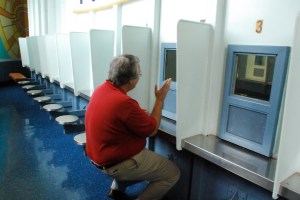
Sound that American Jails would not classify as “noise”— i.e. sound that doesn’t interfere with security operations—is not merely incidental ambience, however, as the well-regulated soundscape produces its own disciplinary effects. The tortuous sensory deprivation of solitary confinement commonly includes the removal of sonic stimulation: silence as punishment. Already in the 1830s Alexis de Tocqueville critiqued the cruel silence imposed on prisoners in the U.S., and contemporary research repeatedly confirms the mentally destabilizing effects of sonic deprivation (see e.g. here and here). Total sonic deprivation is merely an extreme, however; there is an array of situations involving sound management. For example, conversations with visitors often occur through soundproof glass; obviously the surveillance function of this setup is paramount, but the distanciating filtration of the telephone adds further punishment through physical denial of the unmediated sound of a loved one’s voice. The raucous cacophony of the daytime cell block, meanwhile, acts efficiently as population control of another kind: as an incentive to self-regulate so as to enjoy the perks that enable one to escape the noise. The routines of prison policy intersect with the technologies of media policy to turn the chaotic soundscape into good behavior, through the mechanism of a prisoner’s desire for a pair of earbuds and some familiar tunes. (Media policies also turn that soundscape into a profit center: tracks on the prison’s version of iTunes cost between $1.29 and $1.99, obviously more than the going rate on the outside.)
Via the regulation of the aural environment, the authorities’ “sound”—the elements of the sonic environment that they impose or, at least, see no need to reduce or eliminate—thus becomes the prisoners’ “noise,” while prisoners’ “sound” can be either provided or withheld as part of the disciplinary and economic logic of the carceral system as a whole. As one prisoner, “Marcos,” summarized the system:
They pacify us with these so-called liberties, such as personal TVs, personal radios, personal guitars, tapes, cable TV, a complete store like the free world. And plenty of sports! Why–they call this our rights. In actuality it’s a break down in our system” (qtd. in Elsila, 56).
Such are the effects of so-called “personal” media for such an impersonal environment, for individuals who have been turned into social non-persons: media policy disguised as personal liberty rather than mass prisoner control. This disguise often fools the “throw away the key” law-and-order types who object to coddling criminals with the current Kenny Chesney track; for them, it is worth mentioning that the computers where prisoners download songs for their mp3 players are appropriately called—no joke—“Music Wardens.”
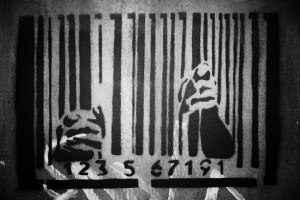
Foucault’s great metaphor for the disciplinary society—the prison as a template of surveillance and control that has been adapted to all spheres of modern life—becomes punishingly literal behind bars, but that is merely where it is most visible or, often, audible. As I explain to my students, media policymakers claim merely to regulate gadgets, physics, and economic relations, but in fact they are always and inevitably also regulating bodies and ideas. The production of the prison soundscape reveals the relation of policy to conduct, a relation that in everyday life often remains cloaked behind scientific and legal discourses.
A final point: equally punishingly literal is the notion of media effects held by those policymakers in the prisons. Inveterate behaviorists, they imagine–and then attempt to manipulate–a direct causal relationship between media consumption and action, between sound and deeds. Those manipulations, however, are a broken media policy for a broken system. As Marcos put it, speaking of the many entertainment options available to the docile inmate: “Even before I ever could imagine I was going to end up in prison, never in my wild imagination could I expect it to be this easy. Yes I said easy. We have no serious form of rehabilitation. . .Why does the state spend more on activities than education?”
—
Thanks to Genevieve Spinner for invaluable research assistance on this project.
—
Bill Kirkpatrick is Assistant Professor of Media and Cultural Studies in the Communication Department at Denison University. His ongoing research and teaching interests include media history and cultural policy; impacts of popular culture on American public life; theories, practices, and future of citizen-produced media; and media and disability. He is also co-producer of Aca-Media, a monthly podcast that presents an academic perspective on media. You can find out more at www.billkirkpatrick.net.
—

REWIND! . . .If you liked this post, you may also dig:
Prison Music: Containment, Escape, and the Sound of America—Jeb Middlebrook
SO! Reads: Jonathan Sterne’s MP3: The Meaning of a Format–Aaron Trammell
Pushing Play: What Makes the Portable Cassette Recorder Interesting?-Gus Stadler
—
Share this:

Chicana Radio Activists and the Sounds of Chicana Feminisms
DOI: https://doi.org/10.59350/8j6z6-mty25
The power of hearing Chicana voices on the air is loud and clear. Indeed, when I heard Chicana feminist scholar Gloria Anzaldúa discussing her theory of hybridity and borderlands on the program The Mexican American Experience (1977) I was not only moved by the sound of Anzaldúa’s voice, but also by my intimate interaction with this influential feminista made possible through analog radio and digital technologies. Such experiences made me want to trace my own genealogy and find other Chicanas involved in radio production. I began to listen for Chicana radio activism on the airwaves, and document when, where and how Chicanas utilize radio not just as a tool for the transmission of sound, but also as a feminist community-building platform.
My entry into radio came about when I joined Soul Rebel Radio—a radio collective composed of college students, environmentalists, musicians, comics, poets, and community activists in the Los Angeles area. A youth-centered radio program, Soul Rebel Radio airs monthly on KPFK 90.7 FM in Los Angeles and focuses on themes—such as the environment, war, and young women’s issues—and current events through comedy, youth voices, opinion pieces, editorials and interviews. With no prior radio or production experience, I joined the collective in October of 2007 hoping to fulfill my life long ambition of being on the radio. This experience of collective collaboration, which is both inspiring and challenging, became a cornerstone in my thinking about the empowering nature of media making, especially community radio. I cultivated the power of my voice through my participation in Soul Rebel Radio by learning how to write, edit and produce radio segments.
Now, as a Chicana feminist scholar and community radio practitioner, I am interested in collective, community-centered research projects that help transform the neoliberal, corporate institutionalization of media production and higher education. Although the content of my research is rooted in analog technologies, I work to ground the analysis of Chicana/o radio production through a digital Chicana feminista praxis, which includes the use of digital tools such as radio, digital film and open source software. This digital Chicana feminista theory and method may help uncover the ways in which community radio production constitutes an epistemological soundtrack to Chicana feminist activism, asking what are the sounds Chicana feminisms? Who are the Chicana activists of the 1970s and 1980s that utilized radio to build community, while incorporating an important aural element to their activism?
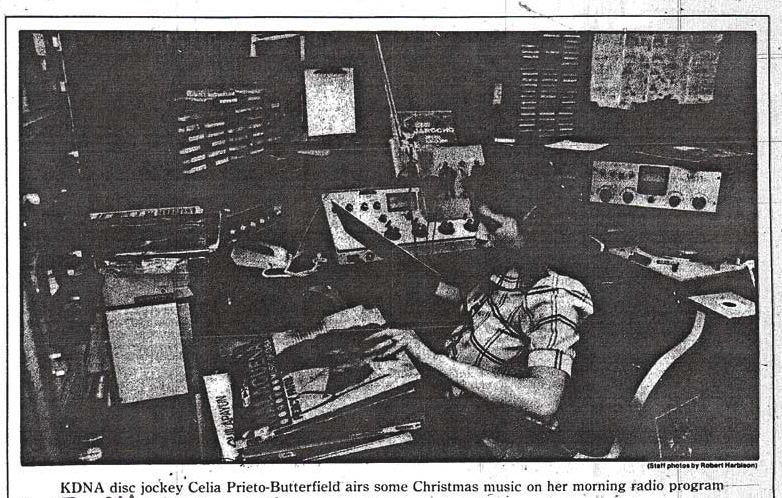
In answering these questions, I explore the ways in which digital tools can be utilized to uncover and reclaim subjugated knowledges. However, I am in no way suggesting that digital technologies should supersede or replace face-to-face community building. In fact, my current project—from which this blog post is drawn—documents and creates an archive of Chicana radio activists, including radio station managers, producers, news directors and on-air hosts. I discuss how community radio production provides Chicanas and other marginalized groups the space to harness digital technologies and engage in the process of producing traveling sounds that speak back to discriminatory and oppressive practices. While my methods include digital film production, online archive building and curation, my writing here focuses on oral history collection, particularly my documentation of Radio KDNA.
Radio KDNA
On December 19, 1979, Radio KDNA (pronounced cadena, meaning chain) transformed the airwaves becoming the first full-time Spanish-language, non-commercial radio station in the United States (Radio Bilingüe KBBF 89.1 FM, in Santa Rosa, founded by farmworkers and Sonoma State undergraduates, was the first bilingual radio station, going on air in 1973). Located in Granger, WA, Radio KDNA’s goal was to utilize the accessibility of radio to build community while serving as a resource for the mostly Mexican and tejano migrant farm workers in the Yakima Valley. The founders of Radio KDNA believed radio was an accessible tool for Mexican and Latino farm worker communities who had little access to other media. Beginning in 1942, Mexican workers entered the United States under the Bracero Program whereby mostly agribusinesses contracted Mexican workers in response to labor shortages of World War II, which in turn caused the lowering of wages. Thus, many Mexican American and tejano farmworkers migrated to places such as Idaho, Oregon and Washington. With a growing population of a Mexican Spanish-speaking community, Radio KDNA used its Spanish-language radio platform to reflect the sociopolitical needs of this shifting demographic.

The oral history I conducted with Rosa Ramón—the only female co-founder of Radio KDNA who served as the station manager from 1979 to 1984—uncovers the radio station’s historical significance within community radio production, specifically as a site of Chicana feminist activism. Rosa’s testimonio reveals the process by which many Mexican-American, and specifically tejano families migrated from the Southwest to the Northwest in search jobs, many ending up in Washington’s Yakima Valley, an area in need of labor to harvest its crops. The migration of Mexican and tejano families served not only as a vital labor force in Yakima’s fields, it also created a community that needed and greatly benefitted from a radio station that addressed the needs of this community, both in content and language. Although Rosa was born in Arizona, her Mexican mother and tejano father decided to migrate north, stopping in Arizona and California before settling down in Eastern Washington where her family purchased a small farm. As Erasmo Gamboa illustrates in his monograph Mexican Labor and World War II, “After 1948, northwestern farms used fewer braceros as they stepped up the recruitment of Mexican Americans from the Southwest” (123). Rosa’s family is one of many families that migrated to the Northwest, a region that needed and greatly benefited from their labor.

Although the small community where Rosa grew up was mostly comprised of Mexican and tejano families, she experienced and witnessed racism and discrimination, especially at school where she was reprimanded for speaking Spanish and mocked for eating tacos instead of bologna sandwiches. Rosa was only one of four Latinos that graduated from Grandview High School. These early experiences of marginalization and her family history served as an impetus for Rosa to work in non-profits that benefitted her community, including Northwest Rural Opportunities, a community based organization set up in 1968 to provide services to seasonal and migrant farm workers in Washington state. Here she met Ricardo Garcia, another co-founder of Radio KDNA.
In an effort to bring Spanish language radio programming to the Pacific Northwest, in particular for the migrant farm workers in Eastern Washington, Rosa and Ricardo, along with Daniel Roble, and Julio Cesar Guerrero, worked tirelessly for five years to obtain a broadcasting license for a community radio station in the Yakima Valley. However, Radio Cadena was producing radio content even before opening the doors of their Granger, Washington studio in 1979. In 1975, Northwest Rural Opportunities began a training program for farm worker youth to learn radio production skills in Linden, Washington. They also began an educational training program for Spanish-speaking individuals who were learning English. In May of 1976, Radio Cadena began broadcasting on a subcarrier signal provided by Seattle-based community radio station KRAB FM, with the assistance of its station manager Chuck Reinsch. The use of this signal meant that listeners could only tune in through a special home receiver, which limited the number of people who could actually tune-in to Radio Cadena’s programming.
Ramón’s oral history reveals the importance and central role women played in the founding and development of this station, particularly in its focus on programming for, by, and about women. Her family’s migratory trajectory is an example of how Mexican and tejano communities who moved to the Yakima valley to work in the fields established a community that needed and benefited from community radio. Radio Cadena is an example of the ways in which the migration of people created the conditions for the founding of a community radio station that traversed sonic borders and infused its airwaves with stories of resistance.
Mujer(es)
As part of its community building activities, Radio KDNA trained women, especially farmworker women, to produce radio content. As Rosa shared with me during her oral history, Radio KDNA and the show Mujer (woman) were instrumental in centering women within the radio production process, by playing music by women like Mercedes Sosa and Lydia Mendoza, interviewing local women, creating news content, and training women to actually produce radio programs. Indeed, this model of Chicana radio production was instrumental in the founding and day-to-day activity of Radio KDNA, and it represents a vital technological component of the Chicano Movement era. Chicanas such as station manager Ramón, producer Estella del Villar, and news director Berenice Zuniga, not only held positions of power at KDNA, but they also produced Mujer, which aired weekly and whose goal was to provided farm worker women with news stories, music and other informative pieces addressing their distinct subjectivities. These female producers and their audience demonstrate the transformative power of community radio production and the role of women in a movement that often downplays their contributions.
By deploying Chicana historian Emma Pérez’s concept of the decolonial imaginary within Radio and Sound Studies to uncover the hidden voices of Chicanas within radio production, I document stories that compel scholars to conceive of a new framework that listens to the sound migrations of Chicana media activism, the third spaces and technological tools of the Chicano Movement not just in the Pacific Northwest, but throughout the country. The historical significance of Radio KDNA as the first full-time, Spanish language non-commercial radio station in the United States recasts Chicana/os as technologically adept and as active participants in the development of community radio. Moreover, Rosa Ramón’s oral history provides another example of the ways in which Chicana feminist activism emerged in conjunction with other social justice movements, further challenging the idea that Chicanas came to feminism after their white or African American counterparts. My historical analysis of Chicana radio production contextualizes current participation in media making, as radio can provide women of color and other marginalized groups the space to harness digital technologies to speak back and broadcast their concerns. When remixed with other components of Chicana feminisms, the sounds of Chicana radio activism constitute yet another track of resistance to the narratives that seek to silence these movements..
—
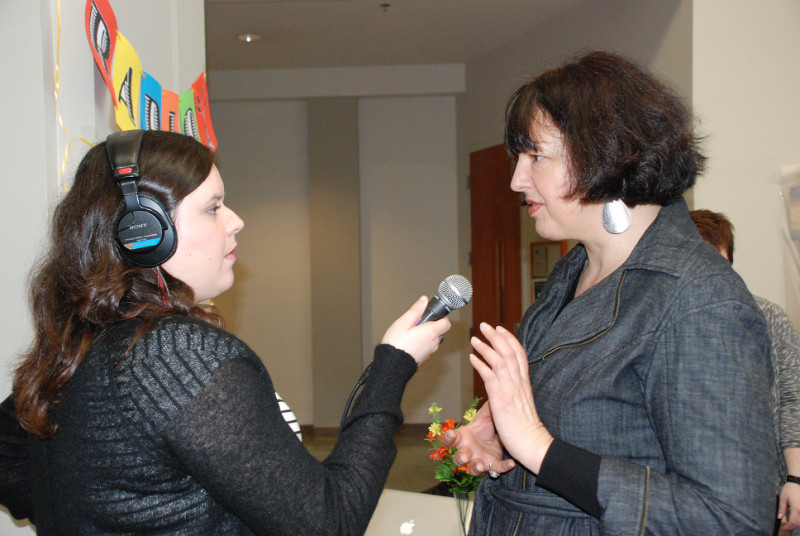
Featured Image by Angelica Macklin: Monica De La Torre interviews J. Kehaulani Kauanui at the radio kiosk, No. 2, Women Who Rock 2011 conference, Seattle University Pigott Building, February 18, 2011, From the Women Who Rock Collection, University of Washington Libraries, Special Collections Division, University of Washington Digital Libraries.
—
Monica De La Torre is a doctoral student in the Department of Gender, Women and Sexuality Studies at the University of Washington. Her scholarship bridges New Media and Sound Studies by analyzing the development of Chicana feminist epistemologies in radio and digital media production. A member of Soul Rebel Radio, a community radio collective based in Los Angeles, Monica is specifically interested in the ways in which radio and digital media production function as tools for community engagement. She is an active member of the UW Women of Color Collective and the Women Who Rock Collective. Monica earned a B.A. in Psychology and Chicana/o Studies from University of California, Davis and an M.A.in Chicana/o Studies from California State University, Northridge; her master’s thesis was entitled “Emerging Feminisms: El Teatro de las Chicanas and Chicana Feminist Identity Development.” Monica received a 2012 Ford Foundation Predoctoral Fellowship, which recognizes superior academic achievement, sustained engagement with communities that are underrepresented in the academy, and the potential to enhance the educational opportunities for diverse students.
—
REWIND! . . .If you liked this post, you may also dig:
Eye Candy: The Absence of the Female Voice in Sports Talk Radio–Liana Silva
Listening to the Border: “’2487’: Giving Voice in Diaspora” and the Sound Art of Luz María Sánchez–Dolores Inés Casillas
Yellow Rain and The Sound of the Matter: Kalia Yang’s Sonorous Objection to Radiolab–Justin Eckstein
—
Share this:




Current Top Posts





April 2021

January 2020

November 2019

October 2019

August 2019

April 2014

November 2017

March 2015

December 2017

October 2015
 Sounding Out!
Recent Comments