
Beyond the Grandiose and the Seductive: Marie Thompson on Noise

Dr. Marie Thompson is currently a Lecturer at the Lincoln School of Film and Media, University of Lincoln. Her new book Beyond Unwanted Sound: Noise, Affect and Aesthetic Moralism has just been published by Bloomsbury. We’ve been following each other on Twitter for a while(@DrMarieThompson and @AbstractTruth) and I have become very interested in her ideas on noise. I’m David Menestres, double bassist, writer, radio host, and leader of the Polyorchard ensemble (“a vital and wonderfully vexing force of the area’s sonic fringes”) currently living in the Piedmont region of North Carolina.
—
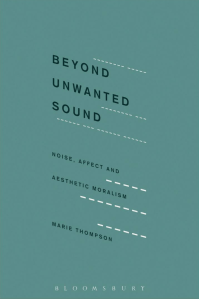
Cover of “Beyond Unwanted Sound Noise, Affect and Aesthetic Moralism,” By Dr. Marie Thompson
In her new book, Dr. Thompson covers a wide variety of ideas from Spinoza to Michel Serres’s cybernetic theory, acoustic ecology and the politics of silence to the transgressiveness of noise music, and many other concepts to show how we are affected by noise. Thompson is also the co-editor of Sound, Music, Affect: Theorizing Sonic Experience (Bloomsbury, 2013). Here is a conversation we had over email in February 2017 about Beyond Unwanted Sound.
David Menestres (DM): Why now? Why did you feel compelled to write this book? What do you hope this book will accomplish?
Marie Thompson (MT): I think my ‘academic’ interest in noise began as an undergraduate music student – I was interested in thinking ‘beyond’ distinctions of avant-gardism and popular culture and noise, as something that traverses such separations became an evermore appealing concept. So I’ve been circling some of these ideas for quite a while.
I felt compelled to write the book partly due to what I perceived as a gap between some of my ‘everyday’ experiences of noise and how noise was represented in discourse – particularly noise’s representation as an essentially negative phenomenon; or as a shocking, sublime, radical, overwhelming, transgressive force. Noise seems to be one of those topics that makes ordinarily quite progressive thinkers revert to quite uncritical and reactionary tropes – there’s something about it that ‘touches a nerve’. Consequently, much of the discourse around noise is underlined by an often-unacknowledged conservatism. I’ve always found the grandiose rhetoric of noise comparatively quite seductive but at the same time, more often than not, noise is quotidian and banal rather than overwhelming or sublime (which isn’t to say it can’t also be those things). Likewise, I felt like this grandiose rhetoric resulted in an amplification of certain sonic arts practices, while silencing others. I guess I was compelled by a desire to expand the (material and discursive) universe of noise while also trying to maintain some consistency in definition.
Quite simply, I hope the book will contribute something helpful to the recent discussions around noise in media theory, acoustic ecology and music.
DM: What is the difference between a subjective-oriented definition of noise vs. an object-oriented definition and how do both lead to the ethico-affective approach that you champion in the book?
MT: When I refer to subject- and object-oriented definitions I’m referring, quite simply, to noise being defined either in relation to the ear of the beholder, or in relation to the sound-itself. [MT also defines her “ethico-affective approach” as a perspective that “recognises the entanglement of the ethical and the affective: affective relations are also ethical relations.” –ed.]
What I think is useful about a subject-oriented definition is that it remains open to what noise might be, what form it might take – it might be your neighbour hoovering, it might be a fellow travelers mobile phone, or it might be a buzzing wasp. However, subject-oriented definitions of noise are typically wedded to liberal notions of subjectivity and the politics that carries. Noise becomes an issue of personal taste – one person’s music is another’s noise etc. Subject-oriented definitions also struggle to account for noise that isn’t ‘unwanted’, ‘bad’, ‘negative’, and so on; and for noise that might not be perceptible, or noticeable.

Noise as Negative. Sound Cancelling
Object-oriented definitions which treat noise as a type of sound are helpful insofar as there is a consistency of definition and it does not assume noise to be a solely negative phenomenon; however, to my mind, they risk losing sight of context: a particular sound is noise irrespective of how it is heard, what it does.
The ethico-affective approach I develop can be understood to maintain aspects of both these definitional approaches. It maintains the separation created by an object-oriented definition of noise between noise and negativity, so that noise’s ‘unwantedness’ becomes secondary and contingent. It also maintains the contextual focus of a subject-oriented definition, so that noise is not tethered to particular types of sound or sound sources.
DM: I’ve been very interested in the idea of noise as a weapon: the use of sound cannons to silence and sicken protestors, the use of the “Mosquito” device (which produces high frequency pitches thought to be audible only to teenagers in order to keep them from loitering), or the use of classical music to annoy young people.
You talk in one section about the noise of neighbors and the “policed silence of the suburbs.” I am also interested in the use of noise as protest. At the Women’s March in Raleigh on January 21, there were so many fascinating sounds: the sounds of thousands of voices bouncing off tall buildings, drummers, people leading chants with the crowd shouting back, the singing of classic protest songs (“A Change is Gonna Come,” “This Land Is Your Land,” etc.).
What do you think the role of noise will be in our current political climate? I can definitely see noise being used as a weapon by both sides: the government trying to use it as a weapon against the people and the people using noise to amplify their voice against the government. But there is a stark difference between these two sides: the use of sound weapons is clearly for their intended negative affect on people (both the physical effects of sound weapons and the psychological effects of the endless noise that comes from Trump’s press conferences and general bullshit), but I see the protestors intending to use sound in a positive way, to amplify their message, to make sure those in charge hear their voices, to ensure the message arrives intact.
MT: As a concept, noise seems evocative of much about our current political climate: be it the ‘noise’ of ‘fake news’, and ‘alternative facts’ (how does one determine ‘signal’ from ‘noise’, and who gets to determine that distinction); be it the ‘white noise’ of the Trump campaign administration (I recently saw a performance lecture with Barby Asante which effectively performed the ‘tuning out’ the noise of recently-bolstered white supremacy); or be it the collective noise of protest against the brutality of borders, white supremacy and police-state violence.
That noise can be both a force of domination and resistance is revealing of its ambiguity more generally – what I refer to as the ‘both-and’ of noise. Of course, that is not to conflate these uses of sonic force. One of the ways in which I’ve thought about this ethico-political difference in sonic forces is through the Spinozist distinction of power-over/power-to. The ethico-political entangles ethical questions (good-bad) with political questions (power over/power to).
So, when sound is weaponized to exert authority, to bring people into line, by diminishing their capacity to act and do, then this can be thought of as an exertion of power-over. Likewise, when sound becomes a means of collective resistance, or of connectivity (I’m thinking partly here of various ‘noise-protests’ at prisons and detentions centres, where sound is used to traverse walls and borders) then it might be understood as an expression of ‘power-to’ – a (collectivized) body’s capacity to act, to be, to do.
DM: You talk in the book of the “conservative politics of silence.” How does this conservativism affect both how people perceive sound and how we relate to it? Is there something at the other end of the scale, a “liberal politics of silence” so to speak?
MT: To my mind, the conservative politics of silence informs a number of assumptions that are frequently made about what are ‘good’ and ‘bad’ sonic environments; it relates to a preference for the simple over the complex, sameness over difference, past over present, predictability over unpredictability, the ‘synthetic’ over the ‘natural’ (whatever that might mean) and, ultimately, quietude over noise. This ideological framework underlines much ‘common sense’ about auditory experience, however it frequently remains unacknowledged.
We might consider a liberal politics in opposition to this conservative politics of silence, which recognises responses to sonic environments as ‘personal’ and therefore refuses overarching moral judgements about ‘good’ and ‘bad’ sound. However, I’m also wary of endorsing a politics that treats the individual, autonomous subject as the primary site of the political. Indeed, the conservative politics of silence that we see in the work of figures such as R. Murray Schafer is often indebted to a liberalism that prioritises control and the freedoms and rights of the individual – I’m thinking here of Schafer’s complaint that you can rid your private property of a physical intruder but not an aural one: “A property-owner is permitted by law to restrict entry to his private garden or bedroom. What rights does he have against a sonic intruder?” (1993, 214)
DM: One of the sections I particularly liked was the “What does noise do?” section where you delved into information theory through the work of Claude Shannon to show how noise was an essential part of a communications system, how noise can be a necessary, amplifying presence, needed to successfully transmit a message (voice over phone lines, data packets over the internet, etc.), how noise can enrich a system. I found myself thinking about this section a lot, often in relation to R. Murray Schaffer’s Platonic ideal state of silence. (“a Platonic, transcendent realm of a pure and ideal sonority, which paradoxically exists as undisturbed and eternal silence”).

Cosmic Radiation from the Big Bang- Sound Makes Up Our Universe
I was also thinking about Cosmic Microwave Background radiation, the residual signature of the Big Bang, the background noise that carried all the information that formed our universe. It seems like noise is an intrinsic part of our world, both human made and naturally occurring, and fighting against it seems like such a waste of energy.
MT: It strikes me that when Schafer and other acoustic ecologists talk about fighting noise, they’re fighting a symptom rather than a cause. In these discourses, there is much talk of noise and environmental destruction but very little on how these processes relate to capitalism and settler-colonialism. In that regard, while I don’t think fighting against noise in absolute terms is futile, I do maintain that there are still fights to be had against high levels of noise. While I am critical of liberal notions of privacy and control and the ‘right’ to silence, I do also recognise that noise can feel oppressive in some contexts. That said, more often than not high levels of noise is a symptom of bigger social and political problems – for example, of poor quality housing, and a lack of economic choice over where one lives.
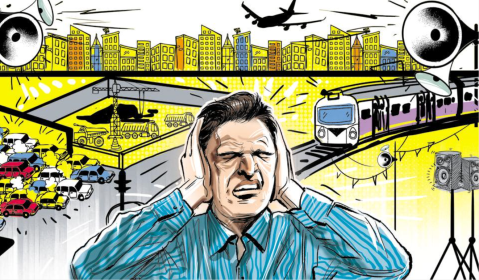
Noise Pollution, Sociological Restrictions, Sound Intrusion. From the Hindustan Times
DM: One of the themes explore in the book is the idea of the parasite, based on the work of Michel Serres. How does the parasite relate to your idea of noise?
MT: I take from Serres’ figure of the parasite the idea of noise as a relational, transformative and ambiguous in its necessity. In Serres’ reading, the parasite changes things, for better or for worse. Either way, the parasite does something, it adds something to the mix. In other words, it is affective. And yet, there is no ‘mix’ without it. Parasitic noise is the ‘excluded middle’ that must be included: it is the necessary ‘third term’, which pertains to the necessity of the material medium/milieu. From this perspective, there is no original state of calm, which is then broken by noise. If there is mediation there is noise, if there is the relation there is the parasite.
DM: Could you talk some about “the poetics of transgression” as you call it? How does this “transgression” relate to your ethico-affective approach?
MT: The poetics of transgression refers to the centrality of ‘line-crossing’ narratives in accounts of noise’s use in the sonic arts and art more generally. It’s predicated on what Henry Cowell calls the ‘time-honoured axiom’ that noise and music are opposites. Bringing noise into music, or music into noise relies on the crossing of boundaries, of material and discursive borders. This ‘line-crossing’ is often accompanied by a rhetoric of extremity and radicalism, shock and awe.
While different notions of transgression have certainly been influential for various noise music practitioners, I seek to decentre it as a way rather than the way of understanding noise’s use as an artistic resource. I argue that the dominance of the poetics of transgression has risked reducing noise music to its most ‘extreme’ manifestations. In light of the ethico-affective approach to noise that I develop throughout the book, which understands noise as a transformative force and necessary component of mediation, I suggest that noise music can be understood as an act of exposure, which, rather than bringing noise into music (or vice versa) exposes, extends and foregrounds the noise that is within the techno-musical system so as to generate new sonic sensations. With this approach, I hope to make more space for noise music practices that do not fit comfortably with the poetics of transgression and its aesthetics and rhetoric of extremity.
—
Featured Image: Noise Music
—

REWIND! . . .If you liked this post, you may also dig:
Sounding Out! Podcast #60: Standing Rock, Protest, Sound and Power (Part 1)–Marcella Ernest
The Noises of Finance–N. Adriana Knouf
Learning to Listen Beyond Our Ears: Reflecting Upon World Listening Day–Owen Marshall
Share this:

The Love Below (the Mason Dixon Line): OutKast’s Rejection at the 1995 Source Awards

During his acceptance speech at 2017’s Golden Globe awards, actor and rapper Donald “Childish Gambino” Glover thanked the black people of the city of Atlanta for “being alive,” and the Atlanta trap rap group Migos for their single “Bad and Boujee.” As the camera panned out into the crowd, it showed dominantly white faces full of confusion and polite yet uncomfortable laughter. These audience members seemed unfamiliar with Migos and with categorizing a “black” Atlanta (and South) separate from the pop culture hub we know as Atlanta today. Glover’s speech re-affirmed the sentiments of Outkast’s Andre “3000” Benjamin over twenty years’ prior at the 1995 Source Awards, that the (black) South got something to say.
As I’ve argued previously, Andre and Big Boi’s acceptance speech at the Source Awards was the springboard for what I call the “hip hop south,” the social-cultural experiences that frame southern blackness after the Civil Rights Movement. The declaration “the South got something to say”—and the booing that ensued—is important to engaging how southerners see and hear themselves in a contemporary landscape. The Source Award’s dominantly New York audience booing both jolts the ear and affirms hip hop’s hyper-regional focus in the early to mid 1990s. The booing crowd identifies hip hop as northeastern, urban, and rigidly masculine, an aesthetic that was a daunting task for non-northeastern performers to try and break through. Even celebrated west coast artists like Snoop Dogg, who menacingly and repeatedly asked the crowd “you don’t love us?” during the show, struggled with the challenge of being recognized – and respected – by northeast hip hop enthusiasts.

The 1995 Source Awards proved to be the climax of the beef instigated by both West Coast Death Row Records and East Coast Bad Boy Records, the bitter lyrical and personal battle between Tupac Shakur and Notorious B.I.G., and OutKast, a Southern act, chosen as “Best New Rap Group.” The crowd’s increasingly despondent sonic rejection of hip hop outside of New York foregrounds my reading of OutKast’s acceptance speech as blatant and unforgiving southern black protest, a rallying cry that carves a space for the hip hop south to come into existence.
A recap of that night, in which Christopher “Kid” Reid and Salt-N-Pepa presented OutKast their award. Upbeat and playful, Kid says “ladies help me out” to announce the winner, but there is a distinctive drop in their enthusiasm when naming OutKast the winner of the category. The inflection in their voices signifies shock and even disappointment, with Kid quickly trying to be diplomatic by shouting out OutKast’s frequent collaborators and label mates Goodie Mob. The negative reaction from the crowd was immediate, with sharp and continuous booing.
Big Boi starts his acceptance speech, dropping a few colloquial words immediately recognizable as proper hip hop – “word” and “what’s up?” Over a growingly irritated crowd, Big Boi acknowledges that he is in New York, “y’alls city,” and tries to show respect to the New York rappers by crediting them as “original emcees.” Big Boi recognizes he is an outsider, his southern drawl long and clear in his pronunciation of “south” as “souf,” yet attempts to be diplomatic and respectful of New York. There is also a recognition that where he is from, Atlanta, is also a city: his statement, “y’alls city,” is not only a recognition of his being an outsider but a proclamation that he, too, comes from a city—except it’s a different city.
Big Boi’s embrace of Atlanta as urban challenges previous cultural narratives of southerners as incapable of maneuvering within an urban setting. Because of a long-standing and comfortable assumption that the American south was incapable of anything urban (i.e. mass transit, tall buildings, bustling neighborhoods and other forms of communities), beliefs about southerners’ perspectives remained aligned with rural – read ‘country’ and ‘backward’ – sensibilities incapable of functioning within an urban cultural setting. These sensibilities often played out in longhand form via literature or in popular black music, with focus on dialect and language standing in as a signifier of regional and cultural distinction.

Big Boi still repping ATL in 2012, Outside Lands Music Festival, San Francisco, CA, Image by Flickr User Thomas Hawk, (CC BY-NC 2.0)
Consider Rudolph Fisher’s southern protagonist King Solomon Gillis from the short story “City of Refuge” (1925). Fisher’s characterization of Gillis, a black man from rural North Carolina, is one of naiveté and awe for not only New York and its sounds, but the premise of city life in general. In the opening of the story Fisher describes Gillis’s ride on the subway as “terrifying,” with “strange and terrible sounds.” References to the bang and clank of the subway doors and the close proximity of each train as “distant thunder” is particularly striking, a subtle sonic nod to Gillis’ rural southernness and his inability to articulate the subway system outside of his limited southern experiences. The references to “heat,” “oppression,” and “suffocation” also lend premise to southern weather, a well as the belief of the American south as an unending repetition of slavery and its effects.
It is important to point out that Gillis certainly isn’t a fearful man in the literal sense: his reason for migrating to Harlem was out of necessity and desperation after shooting a white man back home to avoid being lynched. Yet Fisher’s attention to sound presents Gillis as an outsider. Further, Fisher describes Gillis as “Jonah emerging from the whale,” both a biblical allusion to triumph over a difficult situation as well as a rebirth, the possibility of a new life and new purpose. This can be connected to the biblical reckoning of southern black folks migrating out of the south for social-economic change and advancement.
Still, southern black folks emerging in the city is not an easy transition, with Gillis’ train ride and his discomfort with the sounds it produces symbolizing the move from one difficult landscape to another. Although Gillis ultimately is confronted with the brutality he was trying to avoid in North Carolina, his repetitive proclamation, “they even got cullud policemans!” amplified his southernness and naiveté. Fisher’s intentional use of written dialect enhances the repetitiveness of the impact of seeing black police officers, which blots out the characteristic of region but not white supremacy as a whole. Gillis’s acceptance of black police officers blurred the binaries of the Great Migration as a testament to black folks not only looking for social-economic change outside of the American South, a terroristic space for blacks, but the unfortunate anxiety of those deciding to remain in the south, complacent in the lack of social equality.

Panel 35 of Jacob Lawrence’s Migration Series, documenting Black Americans’ move to Northern Urban Centers : “They Left the South in Great Numbers. They Arrived in the North in Great Numbers.” Photo by Flickr User Ron Cogswell, (CC BY-NC 2.0)
Seventy years later Big Boi, a Georgian, returns to New York with the confidence of both rural and southern sensibilities outside of the immediately recognizable urban trope embodied by New York. Big Boi’s full embrace of being “cullud,” in both the linguistic and cultural elements that Fisher’s long-hand dialect represented as authentic southernness, is jarring because his intentional embrace of southern blackness as othered anchors his approach to rap music. Big Boi does not posture the south as a space or place in need of escape or reposturing. Rather, the hyper-awareness from both Big Boi and Andre in front of the dominantly New York crowd ruptures the accepted narrative of the south as needing saving by non-southern counterparts. Big Boi’s speech forces the audience to de-romanticize their notions of northeastern supremacy and recognize the south as capable of hip hop. Their direct booing is a sonic representation of that discomfort.
From this perspective, André’s now iconic remarks from the acceptance speech further emphasized Big Boi’s departure from reckoning with northeastern hip hop as the standard. He stumbles in his speech, possibly because of nerves or irritation, and, like Big Boi, must talk over the crowd. André speaks about having the “demo tape and don’t nobody wanna hear it,” a double signifier of not only being rejected for his southernness but also the difficulty of breaking into the music industry. André’s frustration with being unheard as a southerner can also be extended into the actual production of the tape by OutKast’s production team Organized Noize, who drew from southern musical influences like funk, blues, and gospel to ground their beats. Andre’s call-to-arms, “the south got something to say,” rallied other southern rappers to self-validate their own music. It is important to note that André’s rally called to the entire south, not just Atlanta. This is significant in thinking about southern experiences as non-monolithic, the aural-cultural possibilities of multiple Souths and their various intersections using hip hop aesthetics.

OutKast at the Pemberton Music Festival, CREDIT MARK C AUSTIN(CC BY 2.0)
OutKast moves past their rejection at the Source Awards via their second album ATLiens (Atlanta aliens), which offered an equal rejection of hip hop culture’s binaries. The album’s use of ‘otherworldly’ sonic signifiers i.e. synthesizers and pockets of silence that sounded like space travel – embodied their deliberate isolation from mainstream hip hop culture. Still, OutKast didn’t forget their rejection, sampling their acceptance speech in the final track from their third album Aquemini titled “Chonkyfire.” The brazen and hazy riffs of an electric guitar guide the song, with the recording from the source appearing at the end of the track. There is a deliberate slowing down of the track, with both the accompaniment and the recording becoming increasingly muddled. After André’s declaration “the south got something to say,” the track begins to crawl to its end, a sonic signifier of not only the end of the album but also the end of OutKast’s concern with bi-coastal hip hop expectations. Sampling their denial at the Source Awards was a full-circle moment for their music and identities. It was a reminder that the South was a legitimate hip hop cultural space.
In this contemporary moment, there is less focus and interest in establishing regional identities in hip hop. The dominance of social media collapses a specific need to carve up hip hop spaces per physical parameters. Sonically, there is an intriguing phenomenon occurring where rappers from across the country are borrowing from southern hip hop aesthetics, whether it be the drawl, bass kicks, or lyrical performance. Although our focus on social media has seemingly collapsed the physical need to differentiate region and identity, geographical aesthethics remain central to our listening practices. With this in mind, OutKast’s initial rejection from then mainstream hip hop in favor of sonic and cultural reckonings of southern blackness keep them central to conversations about how the Hip Hop South continues to ebb and weave within and outside the parameters of hip hop culture. Their rejection of hip hop’s stage solidified their place on it.
—
Featured Image “Big Boi I” by Flickr user Matt Perich (CC BY 2.0)
—
Regina N. Bradley, Ph.D is an instructor of English and Interdisciplinary Studies at Kennesaw State University. She earned her Ph.D in African American Literature at Florida State University in 2013. Regina writes about post-Civil Rights African American literature, the contemporary U.S. South, pop culture, race and sound, and Hip Hop. Her current book project explores how critical hip hop (culture) sensibilities can be used to navigate race and identity politics in this supposedly postracial moment of American history. Also known as Red Clay Scholar, a nod to her Georgia upbringing, Regina maintains a blog and personal website and can also be reached on Twitter at @redclayscholar.
—
REWIND! . . .If you liked this post, you may also dig:
Caterpillars and Concrete Roses in a Mad City: Kendrick Lamar’s “Mortal Man” Interview with Tupac Shakur—Regina Bradley
I Been On: BaddieBey and Beyoncé’s Sonic Masculinity — Regina Bradley
The (Magic) Upper Room: Sonic Pleasure Politics in Southern Hip Hop—Regina Bradley
Share this:


Current Top Posts





April 2021

January 2020

November 2019

October 2019

August 2019

April 2014

November 2017

March 2015

December 2017

October 2015
 Sounding Out!
Recent Comments