i begin with an acknowledgement of the myriad of organizers, scholars, artists, and teachers that have shaped and continue to shape the way that i think and write. Édouard Glissant, Christina Sharpe, Lucille Clifton, Saidiya Hartman, Fred Moten, Sylvia Wynter, Katherine McKittrick, Dionne Brand, June Jordan, and Audre Lorde. it is through their profound reflections on questions of Blackness, place, belonging, earth, and love, that i have found meaning in and context for what follows.
—
in the context of the rapid rise of big tech in san francisco, california, the perspective of land as perpetually exploitable is ever-present. tech-sponsored development projects are always framed by the city as being motivated by care and consideration for residents, and sometimes as being motivated by environmentalism. in reality, the displacement and destruction that results from projects like these falls primarily on poor people of color, and their homes, gardens, businesses, community spaces, and schools. similarly, large-scale development projects more often than not have devastating impacts on the land – whether it’s the land that’s being built over or the sacrifice zone elsewhere. perhaps the electric cars of san francisco are thought to represent clean energy and a healthy modern city, but the manufacturing of these cars is predicated upon extensive mining and exploitative and extractive labor outside far outside the city’s borders. and these cars drive over flattened creeks and sand dunes turned to asphalt—through gentrified neighborhoods on stolen land of the Ramaytush Ohlone, people who are still alive and fighting for sovereignty on their traditional territory, and who remain stewards of the land.
these disparities are present in the sounds of the bay area. sound, quite literally, does not exist in a vacuum. the presence of sound thus implies the presence of something outside of that sound; in every sound we hear, there is also information about the context that surrounds it. and the sounds that we do hear say something about the value of the sounds that we don’t. however, i want to argue for a soundwalking praxis that does not settle for the sounds that most easily reach the ear, as in the freeway noise or the planes passing above or the white people on the street, but that reaches beyond to listen for the negative sonic space that is always present and creating itself in the spaces between what weperceive as audible. in my understanding, this is a practice of giving life to that which capitalism/white supremacy/colonialism renders dead, a practice of centering the life that is otherwise stepped on, forgotten, discarded, silenced. listening for the ecologies of the dispossessed. for proof of life, insisting. this is a decolonial soundwalk praxis.
Allie Martin describes “decolonial soundwalk praxis” as a way of listening that disrupts and disturbs dominant western understandings of sound and space, in “Hearing Change in the Chocolate City: Soundwalking as Black Feminist Method” (2019). to me, it also involves cultivating an embodied practice of centering that life which dominant pedagogies deem less than, exploitable, and extractable. in the specific geographies of the bay area, it has meant that my primary orientation while soundwalking has been to listen for the creek that runs through the land—even when the water runs dry, even when all we can see is an intersection.
following lobos creek, this and all remaining images by the author
the creeks i followed were mostly routed underground, culverted to run under parking lots, freeways, shopping malls, grocery stores, and other urban sites of development. the prioritizing of urban development/renewal/gentrification in the bay area over tending to the ecologies of its creeks points to the place that the land is seen to hold in so-called modern society: as a resource available to exploit as desired, as is convenient for the logistics of capitalist expansion and development. to listen in such a way, for the creek and for other forms of life forced underground and to the margins, requires methods perhaps alternative to the traditional soundwalk. we must renegotiate the categories of sound that are implied in western colonial pedagogies. we must reevaluate what constitutes a “creek sound” or a “nature sound” in the first place.
to listen for the creek when it is covered by concrete necessitates that we reach beyond thinking of a creek as something which exists in and of itself, in isolation.
∼∼∼might the sound of a creek be more than just trickling water falling through rocks? can it not be heard still in the place where it meets the ocean?∼∼∼
clip from lobos creek soundwalk, recorded at the point where the creek meets the pacific ocean.
∼∼∼or in the rustling of the trees who drink from the same groundwater?∼∼∼
clip from garden soundwalk, recorded at the head of the eggplant bed, by the marigolds, looking out at the southeast mulberry tree. strawberry creek runs alongside the garden and though it is in an underground tunnel, i like to think of it as feeding the plants.
.
∼∼∼couldn’t a creek be heard in a voice that speaks of it, as in a prayer, or a promise, or a song?∼∼∼
clip from pinole creek soundwalk. a white man approaches me and talks about how sick pinole creek is, but he also says that he walks along it often.clip from lobos creek soundwalk. Joel points out that lobos creek is visible. brushing past the foliage, i press my face against the fence that encloses it to get a look.
.
if we understand space as relational, as Nigel Thrift offers in “Space: The Fundamental Stuff of Human Geography” (96), then perhaps we can reach an imagining of a creek as finding its life everywhere where water is sacred, running freely through the bodies of those that know it is there.
acknowledging the body as the point of contact between the self and the environment is an important part of a decolonial soundwalk praxis. “place is involved with embodiment” Thrift says (103), and in fact, when we truly acknowledge the body, the very boundary between the body and the environment begins to dissipate, because the body itself is constantly a part of place-making processes. if sound is a dimension through which we can understand place, then, similarly, listening for the life insisting in a place is not separate from listening for the people who are in relationship with it.
in my soundwalks, i leaned into the fact that i was experiencing every place principally through my body, and as i became more comfortable recording, i gave myself more permission to allow my experience to be subjective. what i realized is that my subjectivity, my specific presence to my body’s relationship with the places i was in, was an important orientation to be able to embody a decolonial soundwalk praxis – to be able to hear the sounds that otherwise may have been neglected.
∼∼∼while walking along lobos creek trail, for example, i noticed, growing out of the sand, plants that were familiar to me, that i had relationships with. the house finches were chirping, and my footsteps were clear∼∼∼
clip from lobos creek soundwalk, sounds of walking
.
∼∼∼but the plants i recognized were not – could not be – audible to me until i spoke their names and touched their seed pods.∼∼∼
clip from lobos creek soundwalk, identifying the wild coastal lupine that grows near the water, and noticing that it had gone to seed.
.
∼∼∼i pulled a few pods off a branch and holding them near the microphone i cracked them open, letting the seeds fall into my hands. i listened to the pods split down the middle and drop the seeds, and in their snapping i heard how much tension they were holding.∼∼∼
clip from lobos creek soundwalk, cracking open the seed pods
.
i felt how much strain it must be to make and carry all those seeds, how much release it must be to crack open and spill out of yourself, and i was grateful to bear witness. i held the seeds in my hand and some time later, i gave them to the creek. in allowing myself the trust to follow my body’s intuitive relationship with the given place, i found sounds that i otherwise would not have heard. ultimately, i found a depth of connection to and intimacy with a place that before listening to in this way, i was a stranger to.
the work of giving attention to the sounds that go unheard is necessarily an embodied exercise. it demands relationship and it demands entanglement. it demands crawling inside a mossy culvert to hear the creek talk.
clip from bushy dell creek soundwalk
curious to hear how the creek sounded differently in the tunnel, i went off the trail at piedmont park to climb inside the section where the culvert begins. with the dripping, there was a nuance to its rhythm distinct from its sounds outside of the tunnel. i was able to hear, but only by coming inside and joining the creek. we sat there together, in the dark, for a while.
it also meant sawing down a 20-foot-tall agave in order to save the seeds after the 30-something-year-old plant finally bloomed—with bright yellow flowers on branches shaped like coral—and then began to dry out and lean precariously. to keep the other plants safe, and to release some pressure from the agave, we cut its stalk and from it saved its branches, seed pods, and seeds. the pods are now hanging around the garden at the Land of Disturbance and Defiance as art.
clip from cracking of pods audible in garden soundwalk
i am principally interested in sound because i am interested in love, and when i imagine a decolonial soundwalk praxis, intimacy is surely at the center. this perspective offers a way of learning place from the position of a being who is co-creating it – not as a scientist but as a steward. a decolonial soundwalk praxis complicates traditional soundwalking’s aversion to the body. we cannot exist separate from the sonic space around us anymore than we can exist separately from the ecologies woven into our lives. to touch is to alter, and so the work here is to lean into the inevitability of connection, the impossibility of objectivity. a decolonial soundwalk praxis rejects the extraction of sound as data, pushing us instead to open our bodies/hearts/minds to receive the sounds of a place as the place is receiving us. how might we use sound to remove ourselves from the perspective of the observer? and what kind of responsibility to place does this open up? if we are a part of the places we are in and listening to, then surely we owe them reciprocity, love, conversation, patience; we must listen as we would a relative, a lover, or a friend.
altar at the garden, image by author
i chose to record my final soundwalk at the garden on walnut and virginia street in berkeley, california, because it is a place that i know well and love dearly and i hoped to center that. the north side of the garden runs alongside strawberry creek.
rather than imposing a plan/route through the garden upon arriving, i allowed my relationship with the land to guide my movement through it. in my final mix, i layered pieces from this soundwalk together with selected excerpts from a meeting i attended with two fellow members of A.G.A.V.E., or Aspiring Gardeners Affirming Vibrant Ecologies (also Aspiring Gardeners Against Violent Extraction).in which we were trying to synthesize a manifesto using notes from previous conversations, itself a process of collective and layered creation. i chose to include portions of our conversation centered around ideas of relationship and care grounded in land, and i chose sounds from the walk that i feel hold in them intimacy and history:
∼∼∼the crows, who we feed every day and who plant seeds for us∼∼∼
clip from garden soundwalk
∼∼∼the lock, which only those who know the land can open∼∼∼
clip from garden soundwalk
∼∼∼and the marigolds, which we grow every year and which we harvest for offerings∼∼∼
clip from garden soundwalk
.
these sounds are proof of relationship. small sounds that are easy enough to forget to hear, but that are important to remember – and so i try, as i would for an invisible creek.
if a decolonial soundwalk praxis is anything, it is that love is listening, and so, my promise to invisible creeks (and all quiet[ed] sounds) everywhere is to lean a little closer,
and feel your whisper on my neck,
and to listen well,
and to take notes,
and to remember,
and to conspire.
full lobos creek soundwalk.
—
Featured Image: “California Pepper Tree” by Flickr user baird,CC BY-SA 2.0
—
ameia camielle smith (they/she) is an aspiring gardener, dancer, and writer based in the san francisco bay area (Ohlone land). they are of mixed Afro-Indian ancestry and are greatly shaped by the seeds/shells/lives that exist at the intersection of these diasporas. ameia’s work is anchored in cultural ecologies and Black feminist geographies, and they are most inspired by stories of survival and collaboration between people and plants.
ameia received their B.A in geography from the university of california berkeley in may 2024. they are currently traveling through the southern united states where they are exploring maroon swamp geographies, tracing the steps of Zora Neale Hurston, and listening to the swampy cicada sounds of their childhood in north-central florida.
—
REWIND! . . .If you liked this post, you may also dig:
Part of this surge in scholarly attention and artistic projects is premised on the idea that sound and sound recordings are important additions to cultural heritage in documenting histories and personal evidence, and yet, they are often viewed as supplementary adjuncts to more physical or visual archival artefacts. This subjugation to the primacy of the visual extends to the arts, humanities, and social sciences, but this is beginning to change as scholars across these fields increasingly argue that sound (with its attendant listening) is an especially critical medium for cultivating different modes of attention, forging affective relations, producing alternative knowledges, revealing hidden narratives, and attuning to neglected pasts.
Two digital sound archival projects created in response to the pandemic, The Pandemic SensoryArchive and#StayHomeSounds, are especially instructive in thinking about sound as a key medium for engaging with the monumental a/effects of the present and as important contributions to cultural history. Like other pandemic digital sound archival projects, these two projects sought to document the present for the future – creating a “past” in real time, based on the underlying assumption that sound – as a material-discursive apparatus – can offer particularly generative possibilities in this context. The methods, scope, and presentation design employed by these two web-based archival platforms generates a sense of intimacy, proximity, andcollectivity in otherwise surreal, secluded, uncertain, detached, and disconnected situations, much like in radio and podcasting though in this case with different infrastructure and interactivity.
In these online, mediated spaces where worlds intensely collide and conflate, and users become flattened out and disembodied, new configurations of intimacy, subjectivities, and world-building emerge through alternative forms of affective archival engagement. This was (and still is) particularly important and complex during COVID-19, which is marked not only by a series of indefinite lockdowns and uneven distribution of intervention measures, but an affective logic whereby life is completely reconfigured and capacities within the world are diminished and redistributed. Part of making mass sound archives usable relies on the medium for circulation, the presentation for users, and what user participation empowers for these living histories, as Fabiola Hanna makes clear. These two projects generate what Hanna identifies as a particular orientation in digital humanities projects through a politics of listening that necessitates an active mode of participation that is not simply one-directional but a two-way engagement.
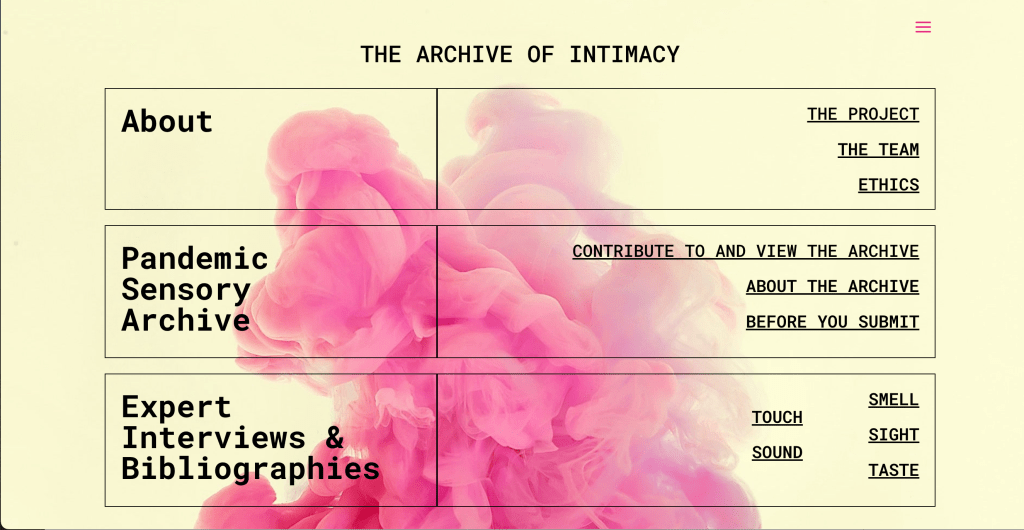
The Archive of Intimacy, later renamed The Pandemic Sensory Archive (PSA), wascreated by professors William Tullett (Associate Professor in Sensory History, Anglia Ruskin University, U.K.) and Hannah McCann (Senior Lecturer in Cultural Studies, University of Melbourne, Australia) with the goal of exploring the senses through a digital platform and to act as an open data bank of contributions from the public. Their open call for contributions asks for a response that considers two questions: What smells, sights, sounds, touch, and/or tastes do you associate with the pandemic? Has your experiences of the senses (smell/sight/hearing/touching/taste) changed at all as a result of the pandemic? Contributors are then asked to drop a pin on the map (though this is not a typical Google Maps rendition of a specific locale, but a sort of simplified graphic representation of sensory input/output waves) and follow the prompts to anonymously submit. The digital map is divided among the five senses and features the entries that contain a title and brief response, such as:
Quiet where there should not be quiet: “Being in my flat in the centre of town on my own with nobody else around on a Saturday. Everything weirdly, eerily, quiet.”
Birdsong: “Hearing birdsong in the garden having not noticed it before, no longer drowned out.”
You’re on mute! “Did the conversation in meetings become less robust as we all sit there on mute, politely waiting for our turn to speak?”
Less sound, more sound: “Blissfully quiet at night as curfew curtails the normal constant traffic roars, far more voices in the early morning and through the day as people‘exercise together’ to socialize in the park”
Complimenting this map, which may seem limited in scope but allows users to engage without having to sift through an overwhelming amount of content, is the Sound category page, where four interviews are embedded with “sensory experts on sound during the Covid-19 pandemic,” including Shoshana Rosenberg, Andrew Mitchell, Martin Stewart, and Stephen Sullivan. One interview considers how the pandemic clarified the immensely relational dimension of artistic sound practice and that the lack of access to intimacy during lockdown instigated a radical reformatting and questioning of what it means, more broadly and now, to be intimate and close in creating sound art. For them, what the pandemic spelled out is that intimacy is fragile and valuable, and that this delicate balance and fluctuating ratio has come to the fore during this time.
The initial designation for the platform, “the archive of intimacy,” is worth meditating on to consider the particular forms of intimacy in this context, perhaps through Lauren Berlant’s “intimate publics” – a concept that captures the affective and collective dimensions of intimacy among strangers. The notion lends itself to understanding the mediated social intimacy in these spaces and the different affective experiences they invite in varying capacities through sound.The connection between imagined publics and community through sound has, of course, been conceptualized by scholars who do historical work on radio and podcast studies, but it can also be extended to these digital, affective, pandemic sound archives. Evidenced in the submission prompts and interview data, the emphasis on the distinct shifts and palpable changes resulting from this new situation, and its accompanying affective logic, can be read as a strategy for cultivating intimacy and connection because attending to these changes may render their intensities as less alarming.
“Listening” by Flickr User Silvia Siri, April 4, 2020CC BY-NC 2.0 DEED
Through the descriptions and dialogues of these new affective environments grounded in sound, some users might feel a sense of camaraderie, connection, and affinity to these novel experiences and how it relates or compares to one’s own (or the sense of not being so alone), especially in the personalized, diaristic, idiosyncratic tone in the short text extracts and longer interview forms. According to Tizian Zumthurm and Stefan Krebs (2022), digital spaces enable this type of “self-affirmation: by contributing and following the contributions of others, users are assured that they are not alone in whatever they experienced” (492). They also point out that as a result crowdsourced archives, particularly related to traumatic events, have a curative function.
Although the PSA may not be what likely comes to mind when thinking about a digital sound archive, presumably composed exclusively of musical or field recordings, it provides an entry point into a confluence of concerns to grapple with some of the key questions and issues related to sound, intimacy, and affect during the pandemic. In particular, diversity in form – between short excerpts and lengthier conversations, creates different engagement options for users based on preference and capacity (quick snapshots of the sonic changes in daily life or deeper explorations concerning sonic worlds), and across sensory inputs. Moreover, interviews add an oral history aspect to the project, which some scholars argue is more empowering and intimate than other modes of telling or sharing history. As a historically feminist practice, oral history has the potential to expose ignored topics and present diversified perspectives on traumatic pasts (like the 1918 pandemic) which is also especially important considering the research areas and professional backgrounds among the interview experts.
#StayHomeSounds is part of a larger project led by UK-based sound artist Stuart Fowkes, who created Cities and Memories in 2014, which Milena Droumeva describes as a “one-of-a-kind sonic portal dedicated to the exploration of place, sound and memory” (147). The website boasts being the largest sound project in the world with over 5000 sound recordings from over 1000 different contributors across 100 territories worldwide. It encompasses field recordings, sound art, and sound mapping, and each location features two sounds: the original field recording of that place and a reimagined sound that presents that place and time as somewhere, something else. The listener can explore sites through their actual sounds or the reimagined versions, flipping between the two different sound worlds. #StayHomeSounds is one of the latest ongoing sub-projects on the site and it is a collection of recordings during the pandemic from all over the world mostly done using cell phone recordings.
Bari lockdown sound recorded by Roberto Lippolis.
Although there is a wide range of quality and content, #StayHomeSounds offers a glimpse into the everyday sonic realities of quarantine life that cut across geography, life, and circumstances. The immensely mundane soundscapes and sheer multitude of recordings across cities and regions allows us to listen comparatively and try to notice the striking sonic cultures of different places even in lockdown. Those submitting sounds are required to provide a reflective text, and an elective representative image, to accompany their recording which details the changes in the soundscape as well as any a/effects that change has produced on other aspects of life.
An entry from Vancouver reads “Their chorus runs day and night and is a most pleasant soundtrack to both fall asleep with and wake up to. In this clip the background birds have joined in to add their avian melody to the amphibian bass line.”
Another from the Greek island of Crete, “after a heavy rain last night, the chirping of the birds woke me up this morning. It was such a powerful sound, like waking up from a sweet dream or a bad nightmare. I think that due to quarantine measures the nature’s sounds are more clear than even before.”
Athens, Greece lockdown sound recorded by Stamatis Mitrou.
In New Orleans, “I’m thankful for my quiet spot out here on the edges of town, but I worry about how the city can recover and for all those sick, out of work, or unable to stay home.”
New Orleans lockdown sounds recorded by Elizabeth Joan Kelly.
The objectives of the project, as described by Fowkes in the online text, are largely affective or affectively oriented, that is, to establish a sense of connection in the present, “how it feels at this unique moment,” by being able to discover new relations to place, to others, and to our sentient selves, through these sonic recordings and texts. In an interview with the Thomson Reuters Foundation, Fowkes said, “(You can) see what other people are hearing around the world and also read their stories and see that actually people are feeling similarly… hopefully that helps to make us feel a little bit more connected.” The breadth of contributions in terms of different locations and number of entries helps build this sense of connection, increasing the possibility of similar experiences to be seen and heard.
Lockdown sound from Lagos, Nigeria recorded by Ibukun Sunday.
By attending to personal struggles, observations, and speculations in relation to sound, these two digital sound archival projects gesture towards the intersections of intimacy, memory, and world-building, and alleviate and mediate some of the dominant and pervading affects that marked lockdown and remote life. In undertaking this project, I found pleasure in the informality of the responses and both the fresh insights and shared resonances, creating an experience that was jointly intimate (feeling seen and validated) and expansive (an opening to alternative experiences). In cultivating openness and a space for difference, and making the reflections and recordings publicly available, so that we can listen together but apart, the projects cultivate new forms of intimacy, empathy, collectivity, and nostalgia.
Dhaka, Bangladesh lockdown sound recorded by youKnowWho.
But, of course, the potential affective experience with the entries and recordings is not a given, much like with any critical scholarly intervention or artwork that attempts to raise awareness (in this case, to both the grave and minute effects of the pandemic) and resist dominant narratives (that the pandemic is under-control, over, or effects only one’s respiratory system), there is no guarantee that the intended experience will transpire in every engagement, but the possibility to do so – to cultivate intimacy and world-building at a time of profound uncertainty and physical distance – is nonetheless still valuable. Much like the diversity in responses, undoubtedly there are varying degrees and types of resonances, perceptions, and impacts within each visit.
Using an open access, crowdsourced approach, the PSA and #soundsathome construct participatory, community archives, creating and remediating documents and recordings for collective access and engagement on behalf of a global community that underwent monumental change, disruption, and loss. Calling explicit attention to palpable sensory shifts and disruptions is a central way to track, record, and make sense of the immense changes in this historical moment, and to illuminate the inequalities in environments and experiences that have been exacerbated by the (lack of) responses by governments and policy. The very existence of these projects and their participation through listening marks a resistance to the discourses of a “return to normalcy” or that we are on the other end of the pandemic. Because affects live in the body and are not often considered as objects of knowledge, the ongoing presence, use, and discussion of these two projects amplifies the a/effects, and a resistance to the affective logic of the pandemic, that they seek to produce. By considering COVID as an unprecedented, deeply affective, traumatic event, these online spaces operate to archive this moment in time and its myriad sonic dimensions, bringing these affective worlds into dialogue through an intimate exchange and assemblage between different bodies, experiences, and locations.
—
Emily Collins is an interdisciplinary researcher, writer, educator, and PhD Candidate in Cinema and Media Studies at York University in Tkaronto (Toronto) whose work draws on sound studies, feminist theory, critical disability studies, and cultural theory to examine sonic social relations and materiality through entanglements of resistance and care within contemporary artworks and creative practices. As a cultural worker and active member in the arts community, Emily has worked at diverse film, visual arts, and digital media organizations, institutions, and research networks within Canada and abroad, including Archive/Counter-Archive, PUBLIC Journal, VUCAVU, Festival Scope (Paris), the Toronto International Film Festival, and the Walter Phillips Gallery at Banff Centre for Arts and Creativity.
—
REWIND! . . .If you liked this post, you may also dig:




















 Sounding Out!
Recent Comments