
Canonization and the Color of Sound Studies

Last December, a renowned sound scholar unexpectedly trolled one of my Facebook posts. In this post I shared a link to my recently published article “Beyond Matter: Object-disoriented Sound Art (2017)”, an original piece rereading of sound art history. With an undocumented charge, the scholar attacked me personally and made a public accusation that I have misinterpreted his work in a few citations. I have followed this much-admired scholar’s work, but I never met him personally. As I closely read and investigated the concerned citations, I found that the three minor occasions when I have cited his work neither aimed at misrepresenting his work (there was little chance), nor were they part of the primary argument and discourse I was developing.
What made him react so abruptly? I have enjoyed reading his work during my research and my way of dealing with him has been respectful, but why couldn’t he respect me in return? Why couldn’t he engage with me in a scholarly manner within the context of a conversation rather than making a thoughtless comment in public aiming to hurt my reputation?
Consider the social positioning. This scholar is a well-established white male senior academic, while I am a young and relatively unknown researcher with a non-white, non-European background, entering an arena of sound studies which is yet closely guarded by the Western, predominantly white, male academics. This social divide cannot be ignored in finding reasons for his outburst. I immediately sensed condescension and entitlement in his behavior.
 This is not new to me. Both my artistic work and a number of my scholarly works have been purposely ignored or undermined in previous occasions, perhaps due to my non-white, non-European background and epistemology. During the assessment of my doctoral dissertation in a well-known Scandinavian University, for example, the three-member committee harshly attacked the very foundations of my project because of my claim that case studies in Indian cinema could produce important new knowledge in the field of sound studies, media art and film history. However, Indian cinema, the largest producer of films in the global industry, is equally a part of world cinema as European and American cinemas, and studying its sound production would indeed add dimensions to the field of sound studies. Their resistance towards my object of study implied that choosing European cinema would immediately make my hypotheses acceptable.
If we take the field of sound studies as both a context for such objection and a case for observation, notable works such as The Oxford Handbook of Sound Studies (2012), The Sound Studies Reader (2012), and Keywords in Sound (2015) have been canonized in the global community of sound researchers by the sheer amount of citations and reviews but have a negligible number of non-White, non-Western contributors. Furthermore, there is a serious lack of representation from the non-White, non-Western scholars and researchers in the bibliographic resources and reference list of these works, which are now considered classics.
 In his essay “On Whiteness and Sound Studies,” Gustavus Stadler lamented that scholars of sound studies are overwhelmingly white, and this racial conservatism is limiting the fields’ research as well as social outreach. It is indeed an act of complacent ignorance not to engage with African and Asian thinkers regarding their sonically rich cultures; indeed, many of their works are available, such as in the Harvard Oriental Series. John Stuart Mill noted, “He who knows only his own side of the case, knows little of that.”
I am inspired by my fellow colleagues and peers (of all colors) and personally grateful to some of them for their sympathetic ears, but as a young researcher I cannot help but be concerned about an unfair social divide upheld in sound studies that I feel must be addressed. In my work, both as a sound artist and sound researcher, I have endeavored to bridge this gap in my capacity. Much work needs to be made in pushing the horizons and shifting the perspectives of the field of sound studies. However, the untoward resistances my kind of young scholars from “other” cultural and intellectual traditions met make it difficult to be read widely, let alone be canonized.
I am discussing here my experiences as a case for critical observation. Throughout the development of my doctoral project, “Audible Absence” in the aforementioned Scandinavian university, I had to face a recurring question in most departmental meetings and seminars: what’s the point in supporting my project in the context of European knowledge production? I suspect this constant questioning of an original research contribution comes from a disdain for a non-Western subject. Also, more often than not, in many scholarly gatherings, I observed a tendency by the white-Western scholars to pigeonhole my work as “southeast Asian studies” or “Indian studies,” identifying it only with mere cultural background, therefore deeming it ancillary to the larger fields of Arts and Humanities within which my research aspires for a general and more universal recognition.
Such divisive and sectarian attitude towards my work has perhaps been aiming to impose identity politics so that an overt sense of difference is underscored. This deliberate production and proliferation of difference has been the tool to marginalize the voice of the “other” in the realm of knowledge formation, which, in actual practice, is yet enjoyed and protected mostly for a certain class, color, and/or race. These social and prejudicial borders have been built on the politics of inclusion and exclusion by what cultural theorist Kandice Chuh calls “avoiding engagement with ‘difference,’ and especially with racialized difference.”

In a recent interview, the renowned professor of psychology at Harvard Steven Pinker has argued that “identity politics is the syndrome in which people’s beliefs and interests are assumed to be determined by their membership in groups, particularly their sex, race, sexual orientation (…) when it spreads beyond the target of combatting discrimination and oppression, it is an enemy of reason and Enlightenment values.” No wonder, the resistance to accepting the scholarly perspectives from non-White scholars and non-Western intellectual traditions has perhaps made the field of sound studies insular to the formation and practicing of new knowledge. The protectionism embedded in encouraging and practicing color and racial difference is a great disservice to humanistic scholarship and enemy of an equal knowledge sharing. With the excuse of tradition and community, the safeguarding of certain groups while ignoring others based on their racial identities has resulted in grave ignorance.
How to engage with such an institutionalized and well-fed “White Canon” coming from outside of it? How to intervene substantially and fruitfully so that the color bias of scholarship is destabilized and there is equal recognition and interest for all intellectual traditions irrespective of color, race, culture and nationality?

Cymatics, Speaker vibrations through milk, Stock Image
As some historians have argued, this so-called “White Canon” is a social and political construct to push the non-White scholarship and knowledge production on the margin. Claimed to be a child of reason and Enlightenment values, the European intellectual tradition was deliberately posed with a “holier than thou” attitude for the imperialist and colonial (mis)adventures Europe had been making in the non-West. In his seminal work Provincializing Europe: Postcolonial Thought and Historical Difference renowned historian Dipesh Chakrabarty states: “In the social sciences, these are invariably thinkers one encounters within the tradition that has come to call itself ‘European’ or ‘Western.’ I am aware that an entity called “the European intellectual tradition” stretching back to the ancient Greeks is a fabrication of relatively recent European history.”
The European intellectual tradition has been a fabrication of a recent history, as Professor Chakrabarty notes. Many postcolonial scholars like Chakrabarty have argued that the writing of this history had deep political and hegemonic implications, which was hard to avoid following the colonization of many part of the non-West by Europeans with violent oppression of other thoughts. Philosopher Bryan W. Van Norden, in his new book Taking Back Philosophy: A Multicultural Manifesto (2017), have claimed that the general disdain, disrespect and ignorance most European scholars have shown to their non-Western counterparts, demonstrates that the European intellectual tradition, which is so obsessed with its communal whiteness and paranoid about the other (non-West), is narrow-minded, unimaginative, and even xenophobic.
Indeed, the most remarkable privilege that white European scholars enjoy—besides, of course, an empowered access to better jobs in the universities and institutional funding–is the entitlement to universal identification and canonization of their work in the respective fields of work, while non-white scholars are all too often pushed into the margins on the excuse of their racial, cultural or mere national identities. The scholars of postmodern studies have stated that the body of scholarship in the Arts and Humanities is biased because the traditional focus of academic studies of Western culture and history has predominantly been on works produced by Western white men. It is no surprise, philosopher Jay Stevenson argues: “[t]raditional literature has been found to have been written by ‘dead white males’ to serve the ideological aims of a conservative and repressive Anglo hegemony […] In an array of reactions against the race, gender, and class biases found to be woven into the tradition of Anglo literature.” Non-white scholars find it much harder to posit their research in the universal canonical consideration; if these scholars are also women-identified and/or queer, it’s even more difficult. This is not only an astoundingly unfair position, but also a dangerous bias.

White acoustic ceiling, image by Flickr User Will Taylor (CC BY-NC-ND 2.0)
In the field of sound studies such biases can be found if looked through the lens of an outsider. The awkward silences in response to a new publication, lack of reviews, reluctance to include in canonized reading lists, repeated refusals by western publishing houses, and a lack of citation in mainstream publications, add to this the sporadic incidents of trolling such as the one that I described in the beginning of this piece – all these that I, and many other scholars who come from other background and intellectual traditions, constantly face, act against the foundation of knowledge production, sharing and scholarship.It is not difficult to observe that this vision has major contradictions with the very reason and Enlightenment values from where the tradition claims to originate. This is a serious charge, but one that tries to explain why the rich philosophical traditions of China, India, Africa, and the Indigenous peoples of the Americas are ignored by almost all philosophy departments in Europe and the larger West.
As my story shows, the paranoia with which the other voices are greeted in the white canonized community reveals how new voices capable of talking in ‘their’ language freak them out. Heard from this perspective, the social media outburst of the scholar mentioned earlier is not surprising. It is a question of privilege that bothers many of the Eurocentric and white-obsessed scholars, who don’t seem to like–or feel that they even have to acknowledge–that the other voices from outside of the protected areas aim to enter the field and eat the proverbial “cake.”My work–among many other (re)emerging Asian, African and other non-Western researchers–does not seek to snatch part of this same limited “cake,” however, but rather aims to build an improved and larger plate and a wider table altogether, capable of hosting a multiplicity of tastes, colors, and splendors, and holding great pleasure in sharing knowledge among ever-curious and open minds.
—
Featured Image: White Baffling Material, Stock Image
—
Budhaditya Chattopadhyay is an Indian-born media artist, researcher, and writer, with a PhD in sound studies from Leiden University, The Netherlands. Prior to his PhD, Chattopadhyay has graduated from the national film school of India specializing in sound, and received a Master of Arts degree in new media from Aarhus University, Denmark researching on sound art. Focussing on sound as his primary medium, Chattopadhyay produces works for installation and live performance broadly dealing with contemporary issues such as climate crisis, human intervention in the environment and ecology, race and migration. Chattopadhyay has received numerous fellowships, residencies and international awards, and his works have been exhibited, performed or presented across the globe. Chattopadhyay has an extensive list of scholarly publication in the areas of contemporary media, cinema and sound studies in leading peer-reviewed journals.Chattopadhyay will be joining the American University of Beirut from 30 August 2018 as a Mellon Postdoctoral Fellow in sound studies.
—
 REWIND! . . .If you liked this post, you may also dig:
My Music and My Message is Powerful: It Shouldn’t be Florence Price or “Nothing”–Samantha Ege
becoming a sound artist: analytic and creative perspectives–Rajna Swaminathan
SO! Amplifies: Mendi+Keith Obadike and Sounding Race in America
Gendered Soundscapes of India, an Introduction –Praseeda Gopinath and Monika Mehta
Share this:

My Music and My Message is Powerful: It Shouldn’t be Florence Price or “Nothing”
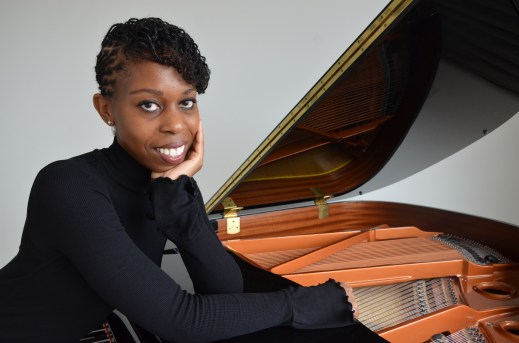
Flashback to the second day of the recent Gender Diversity in Music Making Conference in Melbourne, Australia (6-8 July 2018). In a few hours, I will perform the first movement of the Sonata in E minor for piano by Florence Price (1887–1953). In the lead-up, I wonder whether Price’s music has ever been performed in Australia before, and feel honored to bring her voice to new audiences. I am immersed in the loop of my pre-performance mantra:
My music and message is powerful, my music and message is powerful.
Repeating this phrase helps me to center my purpose on amplifying the voice of a practitioner who, despite being the first African-American woman composer to achieve national and international success, faced discrimination throughout her life, and even posthumously in the recognition of her legacy.
In Price’s time, there were those in positions of privilege and power who listened to her music and gave her a platform. One such instance was Frederick Stock of the Chicago Symphony Orchestra and his 1933 premier of her Symphony in E minor. But there were times when her musical scores were met with silence. For example, when she wrote to Serge Koussevitzky of the Boston Symphony Orchestra requesting that he hear her music, the letter remained unanswered. There was a notable intermittency in how Price was heard, which continues today. It seems most natural for mainstream platforms to amplify her voice in months dedicated to women and Black history; any other time of the year appears to require more justification. And so, as I am repeating this mantra—my music and message is powerful—I am attempting to de-centre my anxieties, and center my service to amplifying Price’s voice through an assured performance.
I applied to the conference a few months ago. I was keen to bring my research to new audiences. Upon seeing that the conference was in Australia, I knew this would be a fantastic opportunity to gain transnational insight into the ongoing work around representation and inclusion in music. Fast-forward to July: here I am, in Australia for the first time. The venue is unfamiliar and I have not met anyone here before this visit. However, this is what I do know: I have fifteen minutes for my performance; hence, I have only prepared the first movement of the sonata. Looking in the program, I noticed there will be a paper taking place at the same time as my performance, given by an academic who identified himself in his printed abstract as “a white, old, straight man with power and privilege.”
The title of his paper? “I Have Nothing to Say.” While gender diversity was the overarching theme of the conference, the goal towards inclusion negated the fact that not all platforms are created equal. The speaker’s proposed topic advertised the ease with which the dominant voice may access a space for its mere presence, regardless of what will be said. Conference logistics then set this voice and its contribution against the radically diverse sounds of our time slot. In addition to my lecture and performance, there are several other events taking place simultaneously. The subjects include: mentoring women composers, creative realizations of parenthood in composition, gender balance in Australian jazz, interpretative approaches to the music of Kaija Saariaho, music as a vehicle for navigating the challenges around non-binary and transgender identity, and a cis-gendered white man’s exploration of ceding power and listening.
I remember a casual conversation the night before in which the joke arose of the speaker being “the token white man.” Of course it was a joke; the very notion is absolutely ridiculous. I remember reflecting on tokenization earlier that day and tweeting to that effect:
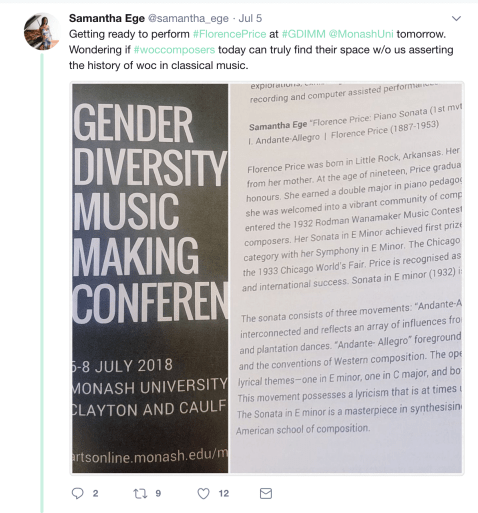
I knew the joke was light-hearted, but there is nothing light-hearted about being a token, nothing light-hearted about knowing your excellence, yet wondering if it will even factor into the decisions around your involvement. Anyway, I did not want to prioritize thoughts about the token white man over my purpose at the conference because that would take up time, space and energy, and in my pre-performance rituals, that time, space and energy belongs exclusively to the women that I seek to honour.
When it is time to perform, I bow, then sit, then sink into the first sound, which is this rich e minor chord that engages almost all of my fingers. I relish the rich tones in the grandeur of the introduction. But as the first theme comes in, conjuring up the soundworld of plantation songs, I calm the mood down to ensure that the lyricism of the top melody really sings.
My music and message is powerful.
The performance is followed by a presentation where I talk more about the sonata, who Price was, and what she achieved. I make sure to highlight her Arkansan roots and her Chicago successes, particularly around the Symphony in E minor. I speak about the influence of the spirituals within the classical frameworks of her compositions. I also speak about the privilege and the incredibly moving significance of being able to present and perform her music for an audience, largely of African descent, at the Chicago Symphony Center.
I play excerpts from the rest of the sonata off my recent album Four Women on Spotify and struggle to find the best time to pause the track because there is so much that I want the audience to hear: from the development of spiritual themes in the second movement, to the virtuosic whirlwind that is the final movement.
A dynamic discussion ensues, weaving in the narratives of Nina Simone, African-American folk tradition and my passion for this repertoire. I elaborate upon the ways in which exploring classical music by women has been an empowering personal journey. I articulate how the perception of men achieving “firsts” renders them gods while women achieving “firsts” are miracles that were never supposed to happen, that may never happen again. I express my role as a musicologist-pianist as demonstrating a long and rich history of women music-makers and, therefore, evidencing precedents—her-stories—for the creative contributions of women now. My time comes to an end and I am left feeling proud to have represented Price’s music and legacy here, today.
After my performance, I tweeted the following thought-through (but clearly not proof-read) thread expressing my disappointment:
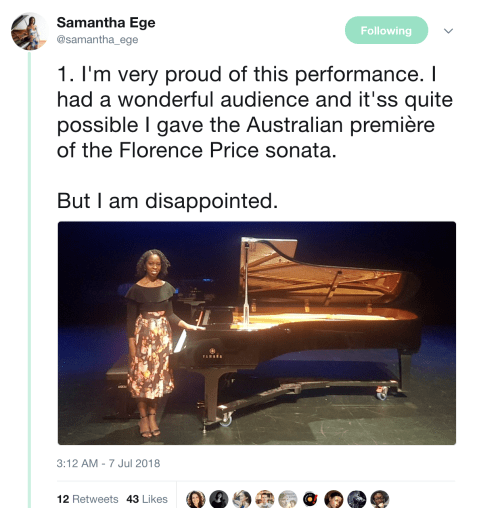
My goal with this post was to juxtapose this paper with Price’s music and career, spotlighting the implications of uneven power and access therein.
3. His talk was called “I have nothing to say.”
Some people therefore chose to listen to a man who has “nothing to say” over the music of an African American woman composer who has historically been silenced and is barely heard in this current day.
Let that sink in.
— Samantha Ege (@samantha_ege) July 7, 2018
Wrapped up in my post was the criticism of the fact that, being a university professor, the speaker of “I Have Nothing to Say,” has access to this kind of platform year-round, while marginalised voices only get amplified in the specific and limited spaces that society has carved out for them.
My critique is not about the individual, but about the systemic and institutionalized undermining of underrepresented voices, even at a conference designed to amplify them. The fact that such a work was placed on such a program evidences the extent to which we are so conditioned to ensuring the most powerful and privileged voice speaks in every single space, even when they acknowledge they have nothing to say.
Since posting that evening to both Twitter and Facebook, I have received a backlash on the latter, one that is, at present, unaffiliated with the organisers of the event. It has, however, attempted to derail the conversation. Apparently I was only upset because my program faced competition from other papers. Maybe I should have looked into the scheduling to make different arrangements. Or I should have found out what the speaker’s talk was about because there is a chance that I would have enjoyed it. Repeatedly, the onus was placed on me to reach out to the “token white man” and better understand his position. I also learned something new: passing judgement on a presentation because of its title is no better than passing judgement on a composer because of their gender. However, I was under the impression that the paper title was a choice and that Price’s identity as a black woman was not.
Anyway, I did not judge by the title. I judged by the abstract:
When one of the organisers of this conference suggested in a Facebook exchange on someone else’s post that I should submit an abstract for a paper, I was surprised. And a little frightened. What could I possibly contribute to such an event? I am the problem. I am a white, old, straight man with power and privilege. Surely my voice could only be heard by others as a violence in this context. Surely, my job is to get out of the way, to shut up, to not be heard. Surely, the only thing I could ethically and honourably bring to this is my listening. But then I felt that this is what needs to be said. I am and old straight white man who says that the job of people like me is to actively get out of the way, actively cede power and authority, actively be told, actively shut the fuck up. So I decided to use the occasion to practice a way of speaking that does those things, gets out of the way, cedes power and authority, gets told, shuts the fuck up. To practice speaking which listens. A listening-speaking. So that’s what I am trying to do in this paper. To enact a listening-speaking that gets out of the way, cedes power and authority, gets told, shuts the fuck up.
The speaker’s participation was invited and his proposal both encouraged and evidently accepted by the organizers. The abstract presents a sense of knowing better. “Surely my voice could only be heard by others as a violence in this context.” Yes. “Surely, my job is to get out of the way, to shut up, to not be heard.” Yes. “Surely, the only thing I could ethically and honourably bring to this is my listening.” Yes! “But…”
Ultimately, what needed to be said, actually needed to be done. The enacting of a listening-listening with neither platform nor audience would have been a powerful statement, quietly powerful, but powerful nonetheless. To reiterate, not all platforms are made equal—could I, realistically, have told him to shut the fuck up? How would that have sounded? How would I have sounded?
The derailing responses I have received pointedly ignore how the very presence of this paper disrupted the multiple and intersectional conversations happening in that moment. It distracted from the rarity of these subjects and their platform, and quite materially, culled an audience who could and should have been doing the very listening the abstract advertises. Scheduling this paper restored the speaker’s position to the center, and re-centered his power and authority to speak about everything and “nothing.” His privilege remained intact. In the midst of the most diverse and pertinent themes was the voice that has, both historically and to this day, spoken over the top of so many others.

“Trocadero Piano Player” by Flickr User Pierre Metivier (CC BY-NC 2.0)
I chose not to reach out directly to the institution nor its organisers because of the emotional labor this would entail. To put the issue forward in a quiet behind-the-scenes way that is sensitive to those who created the issue, is to chip away at my voice and its power. On the otherhand, to project the issue with a loud “shut the fuck up” is to perform a type of power and privilege on a platform that I do not have. I enact a public conversation here via Sounding Out! so that this experience may inform wider work towards diversity and representation. I enact this conversation in order to progress definitions of inclusion to a point where the choice to engage the dominant voice factors in a listening-listening as an exceedingly valuable contribution to the narratives offered by lesser heard voices.
I have since received a written acknowledgement from the organizers of this problematic programming, with a formal apology for the impact. But I must bring to light the important action of two allies, in particular, who recognised the emotional work required of me to bring this forward institutionally. They offered to continue the conversation on my behalf. We talked about the way in which the ensuing discussion must center listening. We shared that the process towards inclusivity may result in mistakes being made along the way. We discussed that while compassion and sensitivity can be important parts of the dialogue, I cannot afford to extend that compassion and sensitivity without becoming emotionally drained. And so, they wrote to the institution with the message of actively learning and making efforts towards change. I am so grateful for that allyship because while I knew that my voice would be heard, I could not guarantee how it would be heard. After all, if there is one take away to be had from this experience, it is that regardless of intention—and regardless of occasion—the dominant voice is very much conditioned to speak up, and speak over. And the dominant ear cannot help but listen.
So, how do I move forward?
My music and my message is powerful.
—
Featured Image: Courtesy of Author
—
 Samantha Ege is a British musicologist, pianist and teacher based in Singapore. She is a Ph.D. candidate in Music at the University of York, UK. Her research focuses on the aesthetics of Florence Price. As a pianist, her focus on women composers has led to performances in Singapore (supported by the British High Commission and International Women’s Day), and lecture-recitals at the University of York, the Chicago Symphony Center and the Women Composers Festival of Hartford, USA. Her album Four Women: Music for Solo Piano by Price, Kaprálová, Bilsland & Bonds reflects her journey into a rich and unrepresented repertoire.
She would like to thank Deborah Torres Patel for the gift of this mantra.
—
 REWIND! . . .If you liked this post, you may also dig:
Spaces of Sounds: The Peoples of the African Diaspora and Protest in the United States–Vanessa Valdes
becoming a sound artist: analytic and creative perspectives–Rajna Swaminathan
Sounding Out Tarima Temporalities: Decolonial Feminista Dance Disruption–Iris C. Viveros Avendaño
Gendered Soundscapes of India, an Introduction –Praseeda Gopinath and Monika Mehta
On Whiteness and Sound Studies–Gustavus Stadler
Share this:


Current Top Posts





April 2021

January 2020

November 2019

October 2019

August 2019

April 2014

November 2017

March 2015

December 2017

October 2015
 Sounding Out!
Recent Comments