
The Queer Sound of the Dandiya Queen, Falguni Pathak


co-edited by Praseeda Gopinath and Monika Mehta
Our listening practices are discursively constructed. In the sonic landscape of India, in particular, the way in which we listen and what we hear are often normative, produced within hegemonic discourses of gender, class, caste, region, and sexuality. . . This forum, Gendered Soundscapes of India, offers snapshots of sound at sites of trans/national production, marketing, filmic and musical texts. Complementing these posts, the accompanying photographs offer glimpses of gendered community formation, homosociality, the pervasiveness of sound technology in India, and the discordant stratified soundscapes of the city. This series opens up for us the question of other contexts in India where sound, gender, and technology might intersect, but, more broadly, it demands that we consider how sound exists differently in Pakistan, Sri Lanka, the Maldives, Bangladesh, Bhutan, Nepal, and Afghanistan. How might we imagine a sonic framework and South Asia from these locations? —Guest Editors Praseeda Gopinath and Monika Mehta
For the full introduction to the forum, click here.
To read all of the posts in the forum, click here.
—
The late 1990s was a pivotal time for activism around queerness in India. The violent response of the Hindu right to Deepa Mehta’s Fire (1998), a film portraying a romantic and sexual relationship between two women, prompted widespread debate on the question of censorship generally and of sexual-minority rights in particular. By rendering homosexuality explicit in its visuals and dialogues, and charting a linear trajectory of queerness—the protagonists move from unhappiness to happiness, denial to acceptance—Fire valorizes “coming out.” In the film, as in liberal strands of LGBT activism, it matters not only that one is out, but that one is seen as such. The premium placed on visibility in this formulation is undercut by the “queer” figure of Falguni Pathak. A tomboyish singer with a high-pitched voice, Pathak shot to fame with her debut album Yaad Piya Ki Aane Lage in the same year that Fire was released in India. Her performances mobilize disparate, even contradictory, signs of gender and sexuality at once, inviting us to examine the relationship between visuality and aurality in constructing queerness.
Falguni Pathak’s stardom is typically understood in the context of economic liberalization and the reconfiguration of Indian public culture that followed. The 1990s boom in the music industry was facilitated by the spread of satellite television, which gave non-film singers a new platform and a new set of audiences. Pathak’s “cute” and catchy love songs circulated endlessly on television countdown shows, turning her into an unlikely sensation. I say “unlikely” because Pathak’s apparent tomboyishness seemed at odds with the hyper-femininity and heteronormativity of the narratives in her music videos. Romantic quests, schoolgirls giddy with love, feminine bonding over make-up and men—these are standard features of Pathak’s videos, as is her own smiling presence as the singer-narrator. Through her gestures and lyrics, she comments on the lovesick teen’s plight and steps in occasionally to comfort or help the young girl, as in her first hit, “Chudi.”
For instance, in “Maine payal hai chhankai” (“The tinkling of my anklets,” 1999) she cheers on a group putting on a dance and puppet show for a school function. In songs like “Chudi/Yaad piya ki aane lagi” (“Bangles/I remember my lover,” 1998), “O piya” (“O beloved,” 2001), and “Rut ne jo bansi bajai” (“The music of the weather,” 2012) she is portrayed as a pop star.
The singer-as-pop-star was a common trope in early Indipop music videos (Kvetko). But Pathak dressed very differently than other pop stars. Whether on or off screen, she was (and is) always in men’s clothing, with a short, unfussy haircut and little make-up. Pathak’s style was mirrored on occasion by a minor character in her music videos. (“Chudi” includes a tomboyish school girl who struggles with the dance moves her friends choreograph.) Thus, Pathak’s visible presence in her videos brushed against the pitch, timbre, and style of her singing, which together articulated a hyper-feminine pop sensibility.
This sense of a “mismatch” (Fleeger) continues in Pathak’s contemporary performances. She is the most sought-after vocalist for Navratri festivities in Mumbai each year. On each night of this nine-day long Hindu festival, the “Queen of Dandiya” appears on stage dressed in a brightly colored kurta, vest, and trousers, and sings traditional Gujarati songs and hymns. The women in her audience dress more conventionally and more elaborately, in saris, salwaar kameez, and ghaghra-cholis. They dance in circles, performing recognizable garba moves. Meanwhile, Falguni Pathak saunters around the stage, engaging cheerfully with her fellow musicians and fans. Neither Pathak’s clothes nor her unfeminine dance moves bother the revelers as they dance the night away. For example, note how Pathak sways and rocks to the beat 34 seconds into this lively 2012 stage performance of Suneeta Rao’s hit song “Pari hun mein.”
Falguni Pathak’s temple performances at other times of the year are similar. They draw huge crowds unconcerned with the apparent mismatch between sound and image in her star persona. She tends to be as immersed in the devotional songs she sings as her audience. But her movements, plain clothes, and floppy hair-style make her look more like the male percussionists who accompany her, rocking and whipping their heads from side to side as they keep the beat, than the middle-class women clapping and singing along.
Performative traditions of mimicry and cross-dressing abound in India. But Pathak’s gender performance does not align with those religious, folk, and filmic traditions (and tropes) because it never registers as masquerade. The very casualness of her look, the fact that she dresses in t-shirt and trousers in all of her public appearances, suggests that this is not a temporary or theatrical adoption of a gender role. When asked in interviews why she eschews traditionally feminine clothing, Pathak always responds that she never has worn anything other than pants and t-shirts and is comfortable as she is. There were certainly other pop stars in the 1990s whose musical performances had masculine elements to them. Recall, for instance, Shweta Shettty’s suited look in “Johnny Joker” (1993). But none of Pathak’s peers sported a butch look as consistently and nonchalantly as she did—and none of them sang in as saccharine a voice. After six decades of Lata Mangeshkar’s vocal hegemony in Hindi cinema, such a “sweet,” contained, and unadorned voice has come to represent ideal Indian femininity. Pathak sounds charming and benign in her songs and interviews, but she does not dress the part.
 Pathak’s challenging of conventional gender norms through her appearance and through the fact that she has never been married raises the specter of queerness in public discourse. But even that is difficult to pin down. Popular commentators and fans sometimes suggest that she looks like Kiran Bedi, a high-ranking (retired) police officer who enjoys celebrity status, making it hard to read the masculine details of Pathak’s persona as “gay.” Even as she is a queer icon (Giani), Pathak never comments on her sexuality or love life. She either evades questions about relationships or simply states that she is single. Where some celebrities come out publicly or keep alive innuendoes about their sexuality (Singh), she treats it as a non-issue. All in all, what we get in Falguni Pathak’s music videos and star persona is a queerly gendered performance that seems both utterly “natural” (because it seems comfortable and casual) and profoundly mismatched.
To be clear, my argument is not so much that Falguni Pathak looks or sounds queer. The latter point is as hard to prove as the former is easy. If, for just a second, we manage to shut out of our mind’s eye the image of Pathak singing, her voice sounds thoroughly conventional. She sings in a traditional idiom, of traditional themes. No matter how intently I listen, no “queer timbre” (Bonenfant, Chaves Dasa), no “butch throat” (Glasberg) reaches out to touch me. Thus on the one hand, Pathak, like the other “mismatched women” Jennifer Fleeger writes about, confounds heteronormative expectations about gender and sexuality. On the other, her voice eludes “queer listening” (Bonenfant). What do we do with a queer figure who doesn’t sound queer? How might we understand her voice vis-à-vis queerness in Indian public culture? How do her live performances today continue to disrupt the emphasis on visibility in queer studies and politics—that is, the fixation on visual representations and “coming out” of the closet? Finally, how might Pathak’s “vocalic body” (Connor) help us conceive of the intersection of aurality and queerness in South Asian public culture?
Falguni Pathak intervened in a cultural field that was just beginning to deal with LGBT visibility. This becomes apparent when we remember that the 1990s was a period not just of economic liberalization but of vibrant queer activism as well. Pathak’s non-feminine image was startling for a pop star, but her voice was familiar and “good.” Her safe sound allowed her to push the boundaries of desire in televisual representations of the time. But it did more than that, too. The disjuncture between her feminine voice and butch look was critical to the complex landscape of desire her music videos evoked. It created space for ambiguity and incongruity amid charged debates about alternative sexual identities.
In “Main teri prem diwani/Indhana winva” (“I am madly in love with you,” 2001), Pathak stars as the neighbor to whom the protagonist turns for advice in matters of love. In an amazingly campy move, Pathak urges the young woman to seduce her lover by donning outfits inspired by Moulin Rouge (2001), specifically the song “Lady Marmalade” (00:36-00:55), and The Mummy Returns (2001) (1:59-2:03). Queerness is also writ large in “Meri chunnar udd udd jaye” (My scarf flies away, 2000), where Pathak appears as the beloved friend of a young girl in exile. The girl misses her friend intensely and attempts to recreate the dance moves and games she played with her older friend, this time with another mysterious woman who steps out of a painting.
Men’s roles in this and other Falguni Pathak music videos are ambiguous at best (Giani). Thus, despite the happy ending to the teen love stories, what lingers is Pathak’s simultaneous disruption and enabling of straight romance. This is why she is remembered fondly as a queer icon, even as the music scene in India has moved on from the “cuteness” of the 1990s. She offered LGBT audiences a way to read and revel in non-normative desires (Giani), without completely unseating “traditional” ways of living and loving.
The broader lesson in Falguni Pathak’s performances is that we cannot think of visuality apart from aurality, and vice versa. No matter how hard NBC’s “The Voice” tries to convince us (Tongson), we cannot in fact understand the sound of a singer’s voice as separate from the image of her as a performer and the contexts in which she emerges on the scene. It is not Pathak’s tomboyish appearance so much as the apparent disjuncture between that look and her voice that is key. What is queer about her voice is the look of it.
—
Featured Image: Falguni Pathak’s classic pose.
—
Pavitra Sundar is Assistant Professor of Literature at Hamilton College, where she teaches courses on global film and literature. Her scholarly interests span the fields of cinema studies, sound studies, postcolonial literary and cultural studies, and gender-sexuality studies. She is currently completing a book manuscript on the politics of Bollywood film sound and music. Her work has been published in journals such as Meridians, Jump Cut, South Asian Popular Culture, and Communication, Culture, and Critique, as well as in anthologies on South Asian and other cinematic traditions.
—
 REWIND!…If you liked this post, you may also dig:
Ritual, Noise, and the Cut-up: The Art of Tara Transitory—Justyna Stasiowska
Moonlight’s Orchestral Manoeuvers: A duet by Shakira Holt and Christopher Chien
If La Llorona Was a Punk Rocker: Detonguing The Off-Key Caos and Screams of Alice Bag–Marlen Rios-Hernández
Share this:

Hardcore as “Home”: An Etymology of CORE through Chicana Punk Sound

 For the full intro to the forum by Michelle Habell-Pallan, click here. For the first installment by Yessica Garcia Hernandez click here.
The forum’s inspiring research by scholars/practioners Wanda Alarcón, Yessica Garcia Hernandez, Marlen Rios-Hernandez, Susana Sepulveda, and Iris C. Viveros Avendaño, understands music in its local, translocal and transnational context; and insists upon open new scholarly imaginaries. . .
Current times require us to bridge intersectional, decolonial, and gender analysis. Music, and our relationship to it, has much to reveal about how power operates within a context of inequality. And it will teach us how to get through this moment. –MHP
—
Chicana punk is a Chicana feminist punk rock subculture within a subculture and a countercultural formation. Although ‘Chicana’ identity is typically thought of as a politicized Mexican-American woman shaped by Chicana/o politics, I recognize that there are varying participants that constitute this subculture, its scenes, and/or communities. Punk is in constant movement and formation, especially as its participants come in and out of the scene, contributing to and reshaping the subculture. The same can be said about Chicana punk.

ATRAKO live @ The Smell–by Susana Sepulveda
Chicana/o and Latina/o studies cultural theorist Michelle Habell-Pallán notes in Loca Motion: The Travels of Chicana and Latina Popular Culture that punk is a “site of possibility” (150), a mode in which Chicanas and Latinas challenge the status quo and “disrupt fixed notions of Chicana identity framed by the dominant culture” (153). Thus, Chicana punk is constituted through different subjectivities, experiences, and imaginings (specifically Chicanisma, or Chicana feminist ideologies and consciousness formations rooted in the Chicana Feminist Movement) that continue to be pertinent for young women in punk today.
In this post, I explore an etymology of “core” and the relationship of this term to Chicanas and Latinas immersed in hardcore punk. I ask: How is “core” theorized as a conception of “home” within Chicana punk? Drawing from Chicana feminist theorist Gloria Anzaldúa’s notion of “making face, making soul” and the sound and performance practice of Los Angeles based Latina/o hardcore punk band ATRAKO, I frame core as home, while considering how a Chicana punk listening practice of hardcore emerges.
ATRAKO is Samahara (Vocals), Irvin (Guitar/vocals), Suzy (Bass), and Cindee (Drums). Although ATRAKO was made up of both Chicanas and non-Chicana Latina/os in 2012, their participation in Chicana punk spaces, events, and adoption of Chicana feminist ideologies help to constitute Chicana punk subcultures more broadly. ATRAKO illustrates this through their performance on Feburary 27, 2015 at Xicana Punk Night. This was to be one of their last shows before their split on July 5, 2015 at the Riot Grrrl Carnival annual musical fundraiser event held at The Smell, an all-ages-volunteers-run, do-it-yourself art and music space. Xicana punk night was a community fundraiser event for Nalgona Positivity Pride, “a Xicana-Brown [and] Indigenous project that focuses on intersectional body positivity, eating disorders awareness and cultural affirmation.” ATRAKO’s lyrics also address issues of gender, racial, and environmental violence; and resonate with Chicana feminist critiques. Moreover, they exemplify how Chicana subjectivities are reconfigured and ‘sounded out’ through hardcore.
Hardcore is a style of punk music and aesthetics that arose in the early 1980s in varying urban geographies including Southern and Northern California, Washington D.C. and New York City, with intensified musical characteristics that differ from the 1970s punk movement. Hardcore is characterized by its aggressive aesthetics typically depicted by its fast sonic tempos, short song lengths, and gritty confrontational vocals. Despite the queer Chicana/o influences on the sound of hardcore by punk artists such as Alice Bag and Kid Congo Powers, it has remained predominantly represented by white, heterosexual, masculine figures of middle class suburbia, epitomized by Keith Morris, Henry Rollins, and Ian MacKaye. But what happens when Chicanas and Latinas engage hardcore? By focusing on the relationships Chicanas and Latinas forge through hardcore, especially in relation to Chicana punk subcultural formations, I argue we can reconfigure hardcore narratives. It is also important to note that not all participants that engage Chicana punk necessarily identify as Chicanas. Yet non-Chicana/o identified Latina/os are entangled and implicated within Chicana punk subculture through their participation and co-production of Chicana punk spaces.
To theorize Chicanas’ and Latinas’ participation in hardcore, I consider an etymology of core–specifically its articulation as ‘heart’ and as ‘coring,’ that is, “the act of removing a core or of cutting from a central part.” These meanings help me to conceptualize core, and by extension, hardcore as home. As early hardcore punks began to distinguish themselves from 1970s punk, they formed new punk scenes, subjectivities, and sound. These new social formations offered new generations of punks another mode, or set of tools, to contest the status quo and articulate new social conditions, like for instance, Reaganism in the 1980s. But more than anything else, hardcore was the result of a new generation of punks creating a niche for themselves, that is, a “home,” within the broader punk movement. Thus, the formation of hardcore was an act of “coring” that produced a new site of belonging. I view these articulations of “core” further, alongside Anzaldúa’s framework and metaphor “making face, making soul” (i.e. making heart). This framework enables me to theorize hardcore as home in Chicana punk.
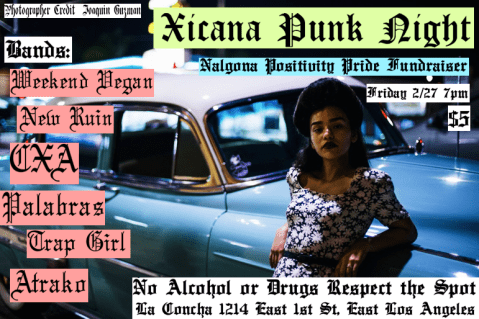
Xicana Punk Night Flyer– by Gloria Lucas, NPP
Making ‘core’
In Making Face/Making Soul, Anzaldúa writes, “‘making faces’ is my metaphor for constructing one’s identity” (xvi). In Light in the Dark/Luz en lo Oscuro, she extends this idea stating “The heart es un corazón con razón, with intelligence, passion, and purpose, a ‘mind-full’ heart with ears for listening, eyes for seeing, a mouth with tongue narrowing to a pen tip for speaking/writing” (153). Within Anzaldúa’s theorizations, “heart” is rendered a part of one’s conocimiento, a self-reflective awareness of how one is cultivating an identity and generating consciousness formations. But through this self-reflective process, one is also creating notions of home and belonging.
Through the notion of coring, self-reflective processes become about de-hearting, decentering and/or disrupting what is presumed to be foundational (i.e. what is central/core), in order to refashion. In other words, coring is a process of making anew. Hardcore demonstrates “coring” in its formation, as it emerged from the early punk movement yet reconfigured its notion of punk sound, style, and identity. In a way, punk ripped out its heart to start anew as hardcore. Similarly, Chicana punk has cored and reconfigured notions of punk and hardcore sound, style, and identity. For instance, ATRAKO offers a queer Chicana feminist representation that disavows dominant hardcore punk portrayals. They spit out lyrics in Spanish only, and use metaphorical language and visuals in their lyrics and album covers addressing gendered violence in relation to environmental abuse. Furthermore, while embodying hardcore’s “traditional” characteristics, ATRAKO dramatizes hardcore sound by performing a more melodic dissonance. The music compliments the lyrical narrations and arguably enacts a call-and-response to the sung lyrics posing its own sonic narration.
The song “Madre” (2014), which translates as “mother,” exemplfies this as the guitarist begins with a lamenting introductory verse, followed by thumping drums and a grito reminicent of a battle cry. In the first chorus Samahra blurts out:
ya es tiempo de entender
quien te dio la vida
es la muxer la encarnación
la esencia de la tierra
ya es tiempo de entender
quien te dio la vida
es la muxer quien tiene el poder. (Madre, 2014)
As Samahra is singing, the drums, guitar, and bass sound out a response to the chorus’s statements. This sonic accompaniment articulates a “coring” of hardcore music through the queer brown bodies animating this sonic experience, the exclusively Spanish lyrics and narrative, which centralize women and their relations to the natural world through the figure of mother, as well as a spiritual activism–what Anzaldúa called “a spirituality for social change” (323). In other words, the song presents all things that are not typically represented in American hardcore. ATRAKO tears up hardcore to make it anew and to speak to their experiences, politics, and identities, creating a “home” for themselves in hardcore.
In addition, Chicana punk reconfigures Chicana feminist politics, experiences, and subjectivities. Punk artists and bands such as ATRAKO articulate, or rather (re)articulate, Chicana feminist discourses through the platform of punk, and more specifically, hardcore. ATRAKO demonstrates a reconfiguration of Chicana feminisim through their sonic expression which shapes a listening practice of Chicana feminist theory and praxis through a “coring” of hardcore. As ATRAKO presents Chicana feminist discourse through non-traditional avenues and hardcore style, they bring visibility to Chicana feminist experiences and subjectivites within punk subcultures. Moreover, given the ethnic heterogeneity of the band, ATRAKO demonstrates how Chicana feminist politics is engaged by non-Chicana Latinas, particulatly punks, who help shape these politics just as much as they are impacted by them. ATRAKO’s hardcore sound reveals how Chicana and Latina punks engage and reconfigure Chicana feminist discourses, positing the political potentiality punk offers Chicana feminism. In considering the conceptual framework of making heart, or rather making ‘core,’ Chicana punk, as exemplified by ATRAKO, sounds out a process of deconstruction and reconstruction.
Additionally, these continuous processes of reconstruction in punk and more specifically Chicana punk, are made possible though the cultivation of practices and cultural productions of its active participants. For instance, ATRAKO’s sound stems from a variety of musical influences that might not necessarily be typically associated to or rendered Chicana or Chicana affiliated (such as metal, punk, and hardcore). Yet, their coring practices reconstruct hardcore as a Chicana genre. In addition, events such as Xicana Punk Night illustrate how Chicana punk subculture is constituted by varying participants who enact and identify with Chicana feminist politics in one way or another. ATRAKO’s participation at this show, as well as other non-Chicana Latina attendees, highlights how a Chicana punk space and genre is generated through a structure of feeling that extends across ethno-national identities. It might be suggested that the term “Latino punk” may best describe this structure of feeling; however, the fact that participants continue to specify the genre and spaces as “Chicana” or “Xicana” punk complicates such general descriptions.
Future Developments
The theoretical basis I have presented here is a stepping-stone for thinking about Chicana punk listening practices and what can be imagined through Chicana punk sound. Considering the etymology of “core” through the context of hardcore, I have argued that one way of imagining Chicana punk sound is through a reconfiguration and articulation of home. ATRAKO offers a new way to conceptualize how Chicana punk subculture and sound is constituted through varying Latina/o identities and non-Chicana subjectivities, and how it is also a site of home, belonging, and community for such participants, culminated through the act of listening. Listening is performative here, in the sense that it is a part of the “coring” process of hardcore, as Chicana feminist praxis is enacted through hardcore sound. The connection between “core” and listening practices in Chicana punk echoes a structure of feeling and political potentiality that emanates from the scene, music, and sound, exceeding their subcultural formations. Participants engage this structure of feeling, shaped by processes of making anew, that functions as a site of belonging that speaks to new Chicana subjectivities, politics, and experiences in hardcore.
—
Featured Image: ATRAKO live–via https://atrakopunx.bandcamp.com
—
Susana Sepulveda is a PhD Student in the Department of Gender and Women’s Studies at the University of Arizona. Her developing dissertation project engages Chicana feminist studies, cultural studies, subcultural studies, and sound studies. She focuses on consciousness and subject formations in Chicana punk subcultures, emphasizing the importance of punk for understanding Chicana identities, subjectivities, consciousness, politics, and representations. Susana’s research has received support from the Barnard Library, the American Association of University Women (AAUW) of Arizona, the Women Studies Advisory Council (WOSAC), as well as numerous conference associations including the American Studies Association, the Cultural Studies Association, the National Women’s Studies Association, and Feminisms & Rhetorics. She earned her M.A. in Gender and Women’s Studies at UA, and her B.A. in Feminist Studies and Latin American and Latino Studies at the University of California, Santa Cruz. In addition to her scholarship, Susana is the founder and organizer of the annual music fundraiser event Riot Grrrl Carnival, a punk musician in the Los Angeles based punk band Las Sangronas y El Cabron, zinester, and creator of the zine series “La Sangrona.”
—
 REWIND! . . .If you liked this post, you may also dig:
G.L.O.S.S., Hardcore, and the Righteous White Voice – Chris Chien
If La Llorona Was a Punk Rocker: Detonguing The Off-Key Caos and Screams of Alice Bag – Marlen Ríos-Hernández
Riot-Grrrl, Punk and the Tyranny of Technique – Tamra Lucid
An Evening with Three Legendary Rebel Women at Le Poisson Rouge, January 27, 2017: Margot Olavarria, Bibbe Hansen, and Alice Bag –Elizabeth K. Keenan
Share this:




Current Top Posts





April 2021

January 2020

November 2019

October 2019

August 2019

April 2014

November 2017

March 2015

December 2017

October 2015
 Sounding Out!
Recent Comments