
Look Who’s Talking, Y’all: Dr. Phil, Vocal Accent and the Politics of Sounding White
From the first time Phillip C. McGraw, Ph.D.—better known as “Dr. Phil”—appeared on the Oprah Winfrey Show in 1998, dropping lines like, “My dad used to say, boy, don’t let yer alligator mouth overload yer hummin’ bird ass,” I was hooked. That accent! That no-nonsense, Southern sauce! From what fount of otherworldly knowledge did Phil drink? An insecure teen, gnawing and thrashing my way through high school’s convoluted social milieu (not to mention the murky waters of multiraciality), Dr. Phil’s frank, accented approach to life’s difficulties appeared as a god-send. It didn’t matter much what Dr. Phil was actually saying or whether his words when strung together formed logical thoughts, it was more the way he said things that affected me so. His deep, sing-songy lilt—preachy and avuncular—brought to mind a grandpappy smoking a pipe, whose wisdom was drawn from a hard day’s farmin’, not a god-forsaken textbook.
With Oprah’s endorsement, the Cult of Phil grew fast and strong. Dr. Phil became a national figure–the corporate media’s version of a public intellectual and my own personal hero. His daytime talk show provided him with a regular platform from which to dispense more of that golden, “Texan-dipped” advice, as The New York Times put it. Selling over 2 million copies, his 2003 classic Self Matters began the onslaught of McGraw-family oeuvre, including several by his wife, Robin, and son, Jay–the face of Phil’s teen self-help brand. Not just a sage, Dr. Phil’s commitment to the McGraw family brand let us know he walked the walk. As evidenced by Dr. Phil’s opening credits, which feature behind-the-scenes glimpses of Mr. and Mrs. McGraw canoodling and his smiley next of kin, this family was for real. They loved and laughed together while cross-promoting each other’s book projects. Teenage Me wondered, did white people get better than this?

Screen capture from the opening credits to Dr Phil
Today, Dr. Phil’s star, and my admiration for him, have faded significantly, but one thing remains the same. Ever since I can remember, my older sister and I have communicated almost exclusively via over-the-top, celebrity impersonations and Dr. Phil became a particular mainstay; even now, we religiously observe the maintenance of the Phil “voice.” Pre-Phil, I can recall my sister addressing me in a raspy, befuddled tone startlingly akin to the Keanu Reeves of yesteryear. Not soon after Bill and Ted’s Excellent Adventure became a permanent piece of our home VHS library, Reeves’ trademark method of delivering lines amidst staggered, nonsensical pauses became an obsessive, sisterly tick. “Dude, shut the door when you pee” she might say, staring blankly at me and cocking her head abruptly to the side.
The use of certain impersonations shifted with the ebb and flow of popular culture’s somewhat predictable tide, depending on whose video was “TRL’s” most requested or whose face most frequently graced the cover of TV Guide. I rehearsed George Herbert Walker Bush’s famous “thousand points of light” campaign ad in front of the stained glass mirror adjacent to the family room television; after that, it was all about Phil Hartman’s witty and endearing impersonation of Bill Clinton.
https://screen.yahoo.com/clinton-mcdonalds-000000491.html
It went on that way until Dr. Phil’s shit blew up, and everything became solidified–as if, finally, my sister and I had found our one true voice. With age, I came to understand that Phil wasn’t the prophetic genius I’d hoped he was and that our compulsive Phil-talk was an oddity, to say the least. I began to wonder why, even as adults, we continued to embarrass ourselves in public and take such pains to text each other in mock-“Texan” (thank goodness for smart phones’ “add word” function).
It’s actually quite common for people to adopt alternate voices or speech patterns. Take, for example, child-directed speech (“babytalk”) or pet-directed speech. Both are customized forms of vocal communication or “prosodic modification,” which, while differing dramatically from normative adult speech in their intonation and grammatical structure, are considered customary forms of address. In fact, cross-linguistic studies show that babytalk and pet-directed speech are common across other European languages, Japanese and Mandarin Chinese. As such, parents and pet owners can rest well knowing that prosodic modification of the child and dog varieties are nearly universal human ticks. Unfortunately, research into child- and pet-directed speech didn’t provide much insight into the unique phenomenon of “Phil-talk.” I had hoped to find other accounts in the literature, a history of similar episodes that might lift the shroud of tomfoolery, explain it away as all too common or evidence of psychological disorder x, y or z, something treatable with an esoteric name.
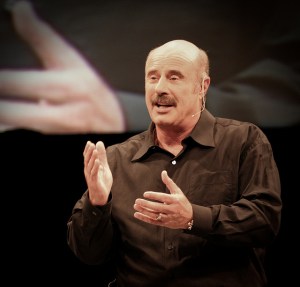
“Dr. Phil in Jacksonville” by Flickr user Craig ONeal, CC BY-NC-ND 2.0
While at this point in my life Phil-talk is more or less an asinine charade, it continues to function as a key component of our familiar vernacular. Interestingly, when re-visiting the many impersonations that have come to define our adolescent years (the Keanu years, the Bush Sr. years, the Phil years), one thing becomes clear: all the voices we’ve adopted have been those of white, male, cultural standard-bearers (Ironically, Keanu Reeves also happens to be Hapa, though I never knew as much. His breakout role as “Ted” helped to popularize the “California dude” archetype). Additionally, I should note, that at no time did any female impersonations enter my repertoire. If you’re going to gain a voice, better make it a male one, no? The racial and gender dissonance that Phil-talk begets drives the urge to perform it.

The author’s mother, with the author’s sister and the author. Picture is property of the author.
From an early age, my mother would tell me tales of her sacrifice—how hard she worked when she came to this country and how difficult life could be in 1960s post-war South Korea—all in a voice with barely a shred of mispronunciation or foreign intonation. My father, a second-generation Swiss-Italian American, scrupulously corrected her syntactical missteps and any other vocal nuances that sounded un-American. It was important to my mother to succeed as an American, and most importantly, that her children succeed too. The pressure I felt to make her content was borderline unbearable. When I started doing the voices, it made my mother happy. She sometimes tried joining in, attempting to mimic key Phil phrases like, “You have gawt to get reee-al,” but to no avail. “You do it better than me,” she’d say, “…my accent.”
When I was young, people looked at me and asked, “what are you?” OR “where are you from?” “America,” I would say. “I’m an American.” These questions were provoked by the racial ambiguity of my mixed-race heritage–the hint of Asianness that marked me as something else. I could not change the shape of my eyes, the contour of my cheeks or the fact that my mother was Korean. But, I could try my hardest to act and sound like an American. Phil-talk became a way to obscure the Asianness, to prove beyond a shadow of a doubt that I did, in fact, belong.
Rather than being merely a childhood performance of celebrity impersonations, I have come to think these various chapters were actually an attempt to perform sonic whiteness. Whether it was Keanu’s California dude cadence, George Bush Senior’s waspy nasality, or Phil’s prolonged Texan twang, I tried to perform in what Aja Martinez defines as “white voice” in her article “‘The American Way’: Resisting the Empire of Force and Color-Blind Racism” (593). She talks about Latino/a students using a “white voice” at school because they equate it with the voice of higher education, but I am really using it here as an explicit racial performance. As a a half Korean, half Euro-American teen girl (now woman) who decides to very literally adopt the voice of a White, 50-something, Texan, TV psychologist, “white voice” was the name of the game, and people loved it–especially my Korean immigrant mother.
For Asian Americans in particular, a people whose national belonging has been culturally questioned and legally denied, accents substantiate and make audible what the eye sees as un-American. In Shilpa Dave’s recently published Indian Accents: Brown Voice and Racial Performance in American Television and Film, she explores accents as they relate to cultural citizenship, national belonging and “the allocation of power.” Someone with an accent is “designated as an outsider to the dominant culture,” writes Dave. In contradistinction to “foreign” sounding accents, Southern accents are a classic symbol of American cultural belonging, like apple pie for the ears.
Would Phil’s wisdom sound as powerful or palatable without the accent? His appeal stems not only from his sometimes entertaining “Phil-isms” (e.g. “You can’t hide the sunrise from a rooster”), but from all that he and his voice signify. A white, male doctor giving advice on TV is hardly noteworthy, but Phil’s recognizably Southern accent separates him from the pack and softens the blow of his often severe advice.
![Angela George [CC-BY-SA-3.0 (http://creativecommons.org/licenses/by-sa/3.0)], via Wikimedia Commons](https://soundstudiesblog.com/wp-content/uploads/2014/11/philmcgrawhwofmay2013.jpg?w=300&h=243)
Angela George [CC-BY-SA-3.0 (http://creativecommons.org/licenses/by-sa/3.0)%5D, via Wikimedia Commons
Constantly searching for ways to be seen, heard, and accepted within an American system of racial binarism that privileges whiteness, denigrates blackness, and locates yellowness somewhere in a No Man’s Land of racial categorization, sound’s flexibility has always seemed to me like a means to belonging. Furthermore, as a multiracial, Korean/White woman, even no man’s land can seem out of reach. As Michael Omi notes in the Introduction to The Sum of Our Parts: Mixed-Heritage Asian Americans, within the historical and political context of the United States, (the “one-drop rule,” eugenic fears of racial intermixing, anti-miscegenation laws, etc.) multiracial identities have consistently been “contained, disregarded, [and] denied.” Multiraciality disorients and confuses insofar as it can discredit entrenched signifiers which make race perceptible to the eye and ear.
Previously on Sounding Out!, I discussed my identification with Nas and the rap world as both a move towards color and the formation of an authentic, multiracial self. A move in the opposite direction, experimenting with “white voice,” functions as another attempt to navigate America’s system of racial identification, albeit in a much more problematic vein. After years of Phil-talk and vocal impersonations of the white male variety, I am finally putting a stop to the charade. However earnest (or subconscious) an attempt to belong, the loss of time spent mimicking Phil represents an era of racial silencing that is somewhat difficult to stomach. Despite the amusement it has brought to friends and family, I am putting the voice to rest in service of getting real.
—
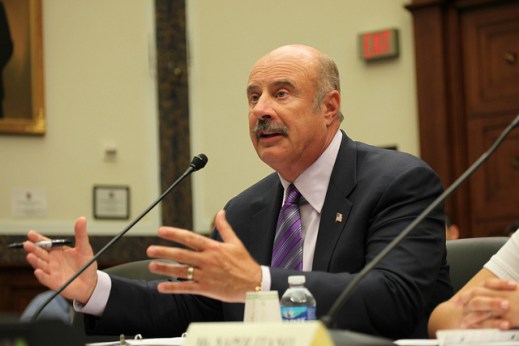
Featured image: “Dr. Phil” by Flickr user House Committee on Education and the Workforce Democrats, CC BY-NC-ND 2.0.
—
Christie Zwahlen is the Assistant Director at Binghamton University’s Center for Civic Engagement, where she has worked for four years to develop, expand and promote community engagement opportunities for students, faculty and staff. Previously, Christie worked for two years as an AmeriCorps VISTA, designing Service-Learning courses in conjunction with faculty at Thiel College and as the Coordinator of the Bridging the Digital Divide Program at Binghamton University. Christie earned her Master’s Degree in English and a Graduate Certificate in Asian & Asian American Studies from Binghamton University in 2009. She is currently enrolled in the English PhD program at Binghamton University.
Share this:

Beyoncé’s New Weave Swing, or How to Snatch Wigs With Hair Choreography
 This September, Sounding Out! challenged a #flawless group of scholars and critics to give Beyoncé Knowles-Carter a close listen, re-examining the complex relationship between her audio and visuals and amplifying what goes unheard, even as her every move–whether on MTV or in that damn elevator–faces intense scrutiny. Last week, Regina Bradley (writer, scholar, and freelance researcher of African American Life and Culture) introduced us to the sonic ratchetness of Baddie Bey; the week before you heard our Beyoncé roundtable podcast featuring our first two writers, Priscilla Peña Ovalle (English, University of Oregon) and Kevin Allred (Women and Gender Studies, Rutgers)–as well as Courtney Marshall (English, University of New Hampshire) and Liana Silva (Editor, Women in Higher Education, Managing Editor, Sounding Out!), who will close out our series next week. Today, madison moore gives us not only great face but killer hair choreo. Mic drop. Hair flip.–Editor-in-Chief Jennifer Stoever
—
“Which Beyoncé are you trying to do?,” a sale associate at Beauty Full, the largest beauty supply house in Richmond, Virginia, asked me. It was a good question, because the shop had whole rows of wigs and ponytails that conjured Beyoncé enough for what I needed to do. Choosing just one would be tough.
“This one is very Beyoncé,” he said, pointing to a style reminiscent of the huge, teased out curly Afro Beyoncé worked in the early 2000s. I wasn’t really feeling this particular style but I could tell my sales guy was living it. “It’s not fierce enough!” I told him. “I need something that really moves!” I’d been invited to give an hour-long lecture on Beyoncé at a university, one of my first gigs, and I was out at the last minute shopping for a wig to wear during my talk so that I could give the children a little sip of Beyoncé. That’s when I saw it: a long, black and dark brown two-toned wig with curls for eternity that I knew would look great on stage. Come on, wig!
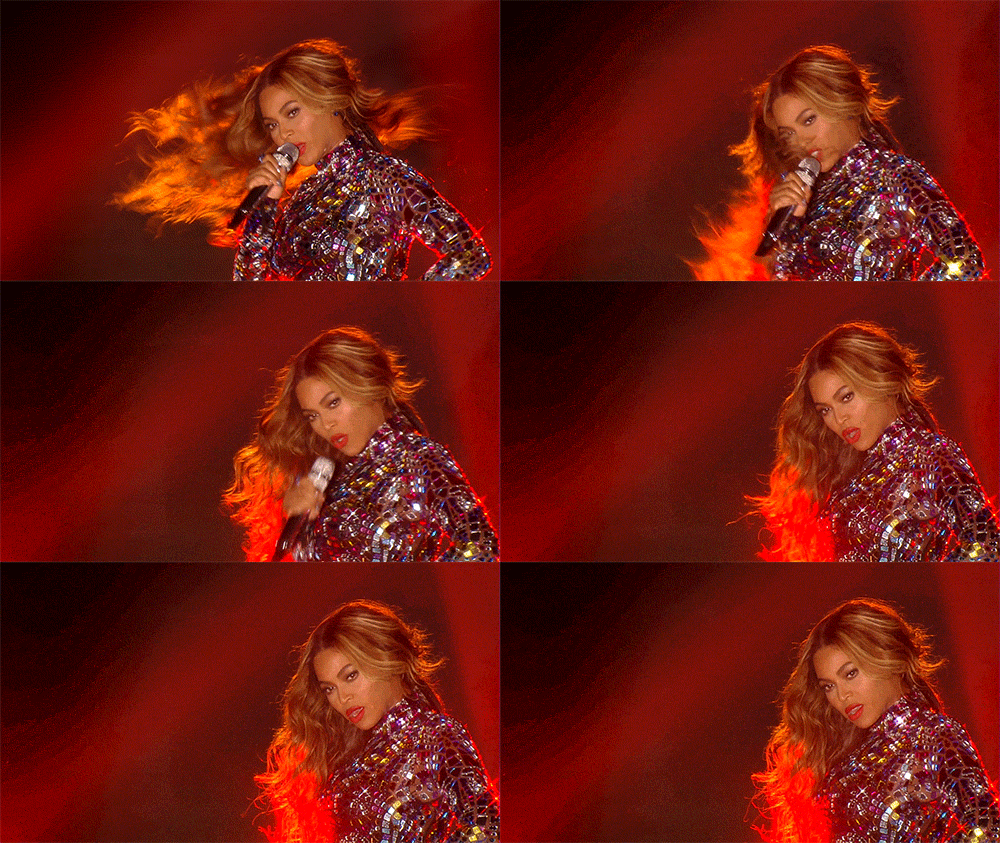
 I wanted to wear a wig “that really moves!” during this talk to demonstrate what I feel is the creative genius of Beyoncé’s performance persona: what I call “hair choreography.” Not unlike dance moves intended for the body, “hair choreography” is a mode of performance that uses hair to add visual drama to the overall texture of sound and it’s the special genius of Beyoncé’s stagecraft. On one occasion some friends and I were drinking wine and downing live Beyoncé videos on YouTube when one of us was like “I am living for her hair choreography!” I’m not sure we invented the concept but the phrase “hair choreography” has certainly stuck with me. Hair choreography is one of the secret weapons of the pop diva, those places in a live performance where she flips and whips her hair in exactly the right point, using “haircrobatics” to punctuate a moment, a feeling, raising the stakes, the sex appeal, and even the energy in the audience.
Hair choreography is exciting because it tells a story, but even more than telling a good story in performance “hair choreography” punctuates everything else happening on stage: the lights, the dance moves, the glitter, the sequins, the music. In this way, “hair choreography” becomes part of the spectacular offering of stage presence; a type of magnetism that, despite everything else happening on stage, draws us into a single performer – the star – whose single energy needs fill up the whole space. “Hair choreography” occurs in those moments of a live performance where the hair is flipped, whipped, dipped, spun and amplified during the most exciting, emotion-filled sounds and dance moves.
Even though many scholars still often approach them as separate practices, sound and motion are so fluidly entangled, as Jennifer Stoever has revealed. In this way, “hair choreography” builds on performance studies scholar Imani Kai Johnson’s call for the “aural-kinesthetic.” The “aural-kinesthetic” is not a method or a theory but simply a way for scholars to think about how music and movement happen at the same time. “Hair choreography” is about the relationship between sound, body and movement, and how each of those comes together to leave a visceral impact on an audience.
One video that shows the importance of hair choreography to Beyoncé’s package is her medley “If I Were A Boy/You Oughta Know,” a mélange of the soft hard rock her own track coupled up with the aggressive rock of Alanis Morissette’s iconic break-up jam of the same title. In the clip, as Beyoncé segues from “If I Were A Boy” into “You Oughta Know” the wind machines appear to blow her hair faster, and with every emotional note or beat she knocks her head to the side with attitude, forcing her straight hair with it. By the time Beyoncé sings “And I’m here, to remind you…,” the most emotional (and recognizable) transition of the song, the hair is already going full blast. Guitars and drums go off while strobe lights engulf the stage in a frenzy of chaos.
At “You, you, you oughta know” she falls to her knees and performs a choreographed head bang while sliding across the floor using only her knees. It’s important to note here that the singing has stopped because this is a moment of “hair choreography,” a transition indicating an impending change in mood.
Everyone loves Beyoncé’s hair. In her will the late comedian Joan Rivers requested “a wind machine so that even in the casket my hair is blowing just like Beyoncé’s.” There are countless YouTube tutorials showing young girls how they too can achieve that Beyoncé look with weaves, wigs and lace fronts. Even the comedian Sommore, who stared in the 2001 film Queens of Comedy , had something to say about Beyoncé’s hair:
Beyoncé is a bad motherfucker. Oh this bitch bad. Let me tell ya’ll how bad this bitch is. I went to see her concert in Atlantic City after she had her baby. I sat in the second row – this bitch was flawless. I mean I’m talking about the bitch was flawless. Only problem I had with Beyoncé…she had on too much hair! This bitch came out she had at least 18 packs of hair on. She came out I thought the bitch was the cowardly lion from The Wiz. I’m sitting there in awe of this bitch neck, I’m like, “This bitch neck is strong as a motherfucker!”
All jokes aside, the mystery of Beyoncé’s hair-–and all of the technologies involved in keeping it moving–is part of the genius of her brand image, particularly because it works to make her ethnically ambiguous.. Having various types of hairstyles allows her creole body to infinitely play with race, and this makes her marketable to nearly everyone. Is she black? Is she Spanish? Is she biracial? Could she be Brazilian or from Latin America? Yes. In this way, her hair choreography not only punctuates her sound, but it shapes the very way it is heard, enabling her to morph into more personalities and fit into more demographics than even Lady Gaga or Madonna. It’s why she’s able to sound sexy or inspirational, “hood” or “classy,” vampy or masculine, vocal or dance-y. Look at a video like “XO,” to me the most mass-marketable song on BEYONCE. First of all she looks fabulous, but I think it’s hard to watch that video and not feel like it’s specifically pitched to 15-year-old white girls in Connecticut. Everything about the video, especially her sweeping hair flourishes, positions Beyoncé as relatable to teenage girls all over the US.
As dance studies scholar Melissa Blanco Borelli sees it the mulatta body engages with a practice she calls “Hip(g)nosis,” or a type of hypnosis enacted by the yellow-bodied performer on fascinated audiences. This type of hypnotics, via the hips, “exposes the male gaze” by thinking through the “pleasure and consumption of the mulatta…” (She Is Cuba, forthcoming, Oxford University Press). Through hip(g)nosis Beyoncé has learned to use her ambiguous skin color and hair optics to her (monetary) advantage as a way to slide in and out of ethnic categories. Indeed, what does the fact that she is the lightest member of Destiny’s Child and also the groups’ most successful member have to do with her celebrity? The irony in all of this race play is that she was recently awarded the Michael Jackson Video Vanguard Award after her jaw-dropping 15-minute performance at the MTV Video Music Awards, and she is one of the few contemporary black pop singers who can play with race in the same way Michael Jackson did.
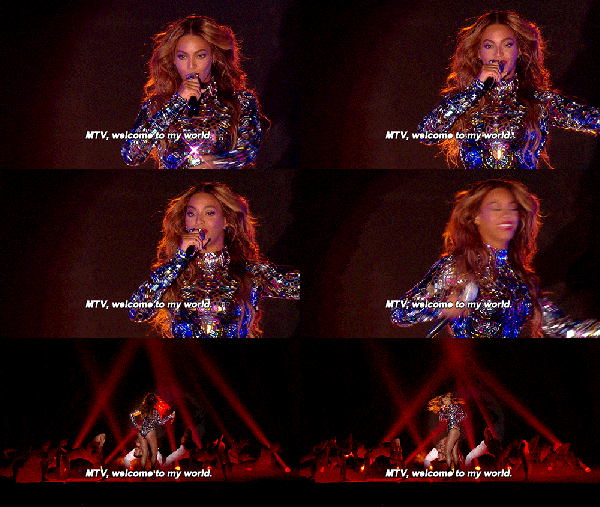 When I watched her recent MTV VMA performance I screamed a lot during her show, but the one moment I remember specifically, and still keep rewinding back to, happened right at the end of “Mine,” to me the best track on BEYONCE. She vamps “MTV, Welcome to My World,” and quickly spins and flips that hair back around baby, giving face to the camera, making millions of queens all over America scream YAASSS!!! at the top of their lungs. Beyoncé herself nodded back to queer performance and performers during a performance of “XO” this year on February 28th 2014 at the O2 Arena in London, after one overzealous fan threw a wig at Beyoncé as she sauntered off the stage and into the crowd (3:17).
When she turned around to pick the wig up she ad libbed “You got me snatching wigs, snatching wigs” into her microphone, knowing perfectly well that “Beyoncé snatching wigs” is one of the most popular fan-created Internet memes. In black gay male performance culture people often talk about “snatching wigs” or “coming for your wig,” and to this end scholars like E. Patrick Johnson and Marlon Bailey have done important work in theorizing the interplay between black gay colloquialisms and performance. If you’re “snatching wigs” then you’re performing better than everybody else while completely eradicating the competition. You’re seemingly indefatigable. Snatching a wig means a particular performance was highly effective or unique, and a snatched wig implies how an audience might surrender itself to a strong performer, as was the case with the aforementioned wig thrower. Beyoncé definitely understands the power of stage presence; a type of magnetism that, despite everything else happening on stage, draws us into a single performer – the star – whose single energy needs fill up the whole space. Filling up an empty stage with a single body is a lot of space to fill if you think about it. And making an audience focus on you when there are 10,000 other things are happening around you is an even more challenging task.
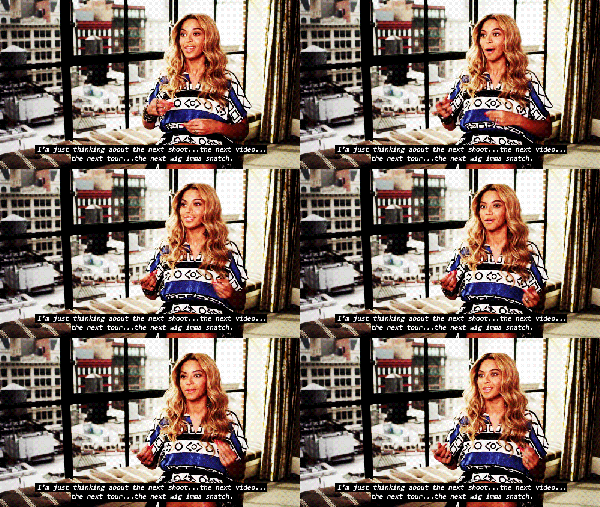 But “snatching wigs” can also mean you’re revealing someone’s deepest secrets, something you know they’re hiding. What’s underneath a wig but a secret – your real hair texture, a bald spot you don’t want anyone else to know about. A snatched wig can mean a break of the illusion. When I wore that wig during my Beyoncé talk to demonstrate hair choreography everyone knew it was fake – I put it on in front of them – but if the wig came off the illusion would have been broken nonetheless.
Part of Beyoncé’s monumental fame has to do with the fact that while she synchronizes, punctuates, captivates, and performs, she never lets us see underneath her wig. She just lets it whip.
—
madison moore (Ph.D., American Studies, Yale University, 2012) is a research associate in the Department of English at King’s College London. Trained in performance studies and popular culture, madison is a DJ, writer and pop culture scholar with expertise in nightlife culture, fashion, queer studies, contemporary art and performance, alternative subcultures and urban aesthetics. He is a staff writer at Thought Catalog, Splice Today, and his other writing has appeared in Vice, Interview magazine, Art in America, Dancecult: Journal of Electronic Dance Music Culture, the Journal of Popular Music Studies and Theater magazine. He is the author of the Thought Catalog original e-book How to Be Beyoncé. His first book, The Theory of the Fabulous Class, will be published by Yale University Press.
—
–
 REWIND!…If you liked this post, check out:
Karaoke and Ventriloquism: Echoes and Divergences–Karen Tongson and Sarah Kessler
– Yvon Bonefant
“New Wave Saved My Life*”-Wanda Alarcon
Share this:




Current Top Posts





April 2021

January 2020

November 2019

October 2019

August 2019

April 2014

November 2017

March 2015

December 2017

October 2015


Recent Comments