
SO! Amplifies: The Electric Golem (Trevor Pinch and James Spitznagel)

—
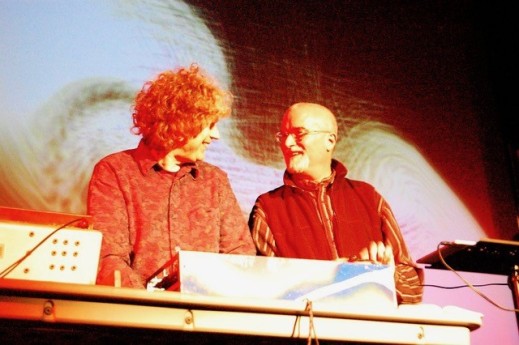
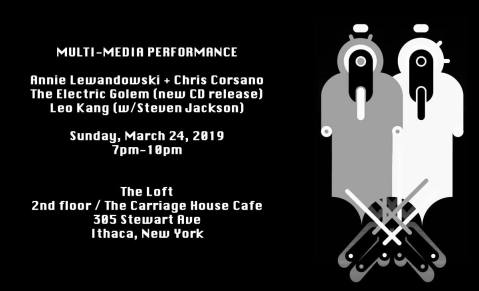
On March 24th, 2019 the record release party for The Electric Golem’s 6th CD Golemology was held at the Loft in Ithaca, New York. The Electric Golem is an avant-garde synthesizer duo featuring Trevor Pinch and James Spitznagel, that has been in existence for about ten years.
Trevor Pinch is a local sound artist and professor at Cornell University. He is an STS (Science and Technology Studies) and Sound Studies scholar. As a key thinker of STS, Trevor is the coproducer of theories about Sociology of Scientific Knowledge, Social Construction of Technology (SCOT), and the role of users in technological history and innovation. However, Trevor’s interest in dates back much farther; he built his first modular synthesizer when he was a physics student in London in the 1970s.
The other half of The Electric Golem, James Spitznagel, is a multi-media artist who uses the iPad as a musical instrument and to create digital paintings. While he has played many roles in the music and culture industries—guitarist in a rock band, record store owner, art gallery and guitar shop investor, and even business manager for the Andy Warhol Museum—he moved to Ithaca to focus on producing abstract art: digital paintings and experimental, improvisational music. Being an energetic and enthusiastic person who has unrestrained fantasies, James finds that everything around him can be his inspiration.
Pinch and Spitznagel formed the group after Spitznagel read Analog Days: The Invention and Impact of the Moog Synthesizer (by Trevor Pinch and Frank Trocco) and realized Pinch also lived in Ithaca. Spitznagel simply looked his name up in the phone book and called him up: “I go, ‘is this Trevor Pinch?’ He said, ‘yes.’ I said, ‘well, you don’t know me, but I just read your book and I love it.’” And then they got together for a beer and have been best friends and collaborators ever since. Once Spitznagel heard about Pinch’s homemade synthesizer, he asked Trevor to try to make something together and it turned out to be a fascinating mixture of analog–Trevor’s synth, Moog Prodigy, and a Minimoog–and James’s digital instruments.
Building from this first moment of discovery, The Electric Golem’s music is electronic, experimental, and totally improvised. Typically, the pieces of music last twenty minutes to half an hour and expresses their interaction with the machines and with each other in the studio. James is much more controlling of the tone and rhythm, and patches the sound as he goes along, whereas Trevor is much more about making spontaneous weird sounds. They complement each other and the creation process is usually by random and spontaneous, as Spitznagel describes: “I didn’t tell Trevor what to do or what to play, but I said, here’s the piece of music I’ve written. He just instinctively knew what add to it.” Reciprocally, “he might just play something that I go, oh, I can weave in and out of the ambient sound he’s putting there.”
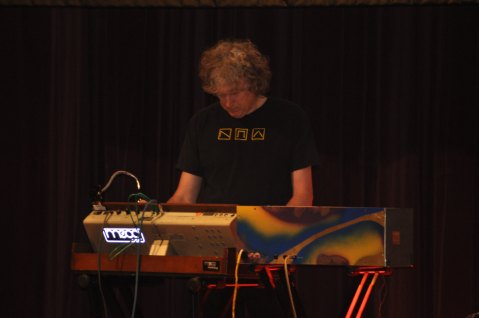
Trevor Pinch, Electric Golem at Elmira College, 2012
For the duo, the process of producing music becomes a shared experience with their listeners. The music is ever changing and evolving. In addition, unexpected drama adds vitality to the palette. “The iPad might freeze up or synthesizer might break somehow,” Spitznagel notes, “that’s happened to us, but we carry on. Like Trevor looks at me and says, it’s not working there. Or, I look at him and go, I have to reboot my computer, it’s not working. But, those times actually inspire us to try new things and go beyond what we are doing.” James explained. Their inspiration comes from the unknown, which just emerges from their practice. “Generally, this sort of music is completely unique to Electric Golem.” Trevor concluded.
The name “Electric Golem” comes from a series of books with Golem in the titles that Trevor collaborated on with his mentor Harry Collins. “The golem is a creature of Jewish mythology,” Pinch and Collins wrote in The Golem, What You Should Know about Science, “it is a humanoid made by man with clay and water, with incantations and spells. It is powerful, it grows a little more powerful every day. It will follow orders, do your work, and protect you from the ever threatening enemy. But it is clumsy and dangerous. Without control, a golem may destroy its masters with its flailing vigour” (1). Noting Trevor’s association with the concept of the Golem, Spitznagel added the “Electric” twist not just as a metaphor for their sound but also because “it’s kind of like a retro name.” The Electric Golem mushroomed from there, and in the past decade they have had many invitations and bookings to play out, receiving the first recording contract from the Ricochet Dream label, and have played with a bunch of notable musicians, such as Malcolm Cecil of Tonto’s Expanding Head Band, Simeon of Silver Apples, and “Future Man” (aka Roy Wooten), and they haven’t stopped there.
According to Pinch, the key feature of The Electric Golem’s music is its ability to encompass different moods. “I think Electric Golem has become good at one thing: its changing and transitioning from one sort of mood of music to another. And we have become quite good at those transitions. I think people would say that’s what they kind of like about us.” These sorts of slow transitions construct a unique texture of sound that can be quite cinematic, so much so that in 2012, the Electric Golem performed the accompaniment to the silent movie A Trip to the Moon, a special Cornell cinema event. Overall, as improvised experimental music, it is sometimes challenging to listen to, with no regular rhythm or reliable melody. Trevor produces warm, rich drones from the analog side that contrast with the sharper digital rhythms that James programs. In short, the Electric Golem varies between these two affects but the music goes far beyond the representation of emotional states; sometimes it conjures up the feeling of the vastness of space and time.
Experimental music, is a collaboration and negotiation process between instruments and their users. No matter if analog or digital, instruments have autonomy; they are non-human actors with their own agency to some extent. As Trevor Pinch intimates, “I understand the general sort of sound that can be produced, but the particular details of how it will work out, you don’t really know, that’s much more spontaneous, you have to react to that.” Instruments can often be uncontrollable–making their own sounds—so that Electric Golem must respond in kind. “So, it’s sort of like higher level meta-control versus actually doing what you’re doing in response to the instrument that combines together,” Trevor describes, “which I think is the secret to controlling these sorts of instruments.” It is incredible that Pinch and Spitznagel know each other so well—and each know their instruments so well–that they can improvise for long periods with no trouble. Trevor says: “Follow the use of these instruments! Follow the instruments! They are not essentialized. They are just stabilized temporarily.”
On the whole, The Electric Golem shows an artistic form which breaks the traditional paradigm, deconstructs and then reconstructs it, seeking to free sound from the instruments. Their music is beyond pure melody and rhythm, beyond the expression of existence, expressing more of an aesthetic state of transcendence. They challenge what music is, and what musical instruments are; they challenge divisions between the identities of engineer and musician. Electric Golem’s music co-constructs art and technology and binds them together; art, for them, is a mode of presenting technology, and vice versa, technology is a pathway through which art can flourish.
My favorite Electric Golem piece is called “Heart of the Golem.” What is the heart of the Golem? According to Pinch, “It is a mystery, a process of unfolding and discovery. It is somewhere where analog and digital sound meet, and an improvisation.” What the magic is remains unknown and unlimited, just like the future of the Electric Golem.
—
Featured Image: Courtesy of The Electric Golem
—
Qiushi Xu is a PhD candidate in the subject of Philosophy of Science and Technology in Tsinghua University, Beijing and in a joint PhD program in the Department of Science and Technology Studies in Cornell University, working with Prof. Trevor Pinch. Her research areas are Sound Studies, STS, Cultural Studies and Gender Studies. Her current research focuses on the sociology of piano sound and the negotiation and construction of piano sound in the recording studio (PhD dissertation), gender issues in recording industry, experimental music, auscultation and sound therapy. She holds an MA in Cultural and Creative Industries from King’s College London; a BA in Recording Arts and a BA in Journalism and Communication from the University of China, Beijing. She is also an amateur pianist, writer, and traditional Chinese painter. As a multiculturalist, she is am fascinated by different forms of art and culture in different cultural contexts.
Share this:

Femmes Fucking the Camera: Listening to the Sonics of Boudoir Photography

Pictured above areRaven Von Scrumptious (right) an Sepia Jewel (left), two burlesque dancers from San Diego, California. Raven and Sepia started “eye fucking” in burlesque classes with Coco L’Amour and later they transferred these gestures to the photo studio and the stage, gestures that as Juana Maria Rodriguez notes, “dance, flirt and fuck” (2014). “Eye fucking” is transmitting tease, a play with your audience that is coquettish. Eye fucking entails going beyond the gaze of the audience into a realm where you meet your inner erotic, your inner gaze. Eye fucking creates arousal, homosociality, agency, femme desire, confidence, and a queer space with a lot of glitter. As Smiley LaRose—the name I chose to take on as my student burlesque name—I have learned to “fuck the camera lens” from these two women and the burlesque community in San Diego, who encourage me to embrace what Celine Parreñas Shimizu calls “productive perversity.”
In this post, I reflect on the sonic intimacies between burlesque and boudoir photography. I am sharing part of a larger film project titled #GlitterBabes, where I tell a story of how burlesque as a recreational practice empowers women to engage their sensual selves. The film came about when I signed up for a Soloist Workshop and my burlesque stage persona Smiley LaRose was born. I tell this story through Glitter Tribe Studio, the first studio dedicated to the art of burlesque in San Diego.
In fact, both the dance and photography studios I write about here have an intimate relationship. The film starts with Smiley’s curiosity about how her classmates and teachers engaged the art of tease and navigated all the different aspects of it. As a fat performer, I was particularly interested in the way that my burlesque sisters and myself would navigate topics of body confidence, sensuality and stripping. As it turned out, these practices require a practice of listening to the details of our bodies and its engagement with musicality, the rhythm of our tease(s), and our awareness for how the camera can capture our corporeal erotic wavelengths both on and off stage.
In other words, I engage in ‘dirty listening’ to describe the sonics of boudoir photography and the erotic sounds that go into capturing sensuality in its most intimate ways. In their qualitative study of erotic photographers, Wentland and Muise found that in order to have a successful shoot it was crucial to create “relaxing and comfortable” spaces for femmes. A common practice among the photographers was to have “constant dialogue with their clients, both at the beginning and during the photo shoot, in order to help their clients relax.” They allowed femmes to have control over the shoot and explained every step along the way. In fact, as photo shoots progressed, several clients “requested shots that were more revealing than what they had initially discussed” (106). The findings by Wentland and Muise share many commonalities with the way photographers in San Diego also engage the practice of Boudoir, particularly the understanding that agency is experienced along a continuum and photographers support their clients by accommodating different techniques that can silence their negative self-talk.
At Bad Kitty Photography, where both Raven and Sepia had their shoots, a layer enabling femmes to get into an affective state of sensual comfort is music. To prepare for shoots, Bad Kitty asks their clients to think about their favorite music to set the mood. On their website, they list creating a music playlist as a recommendation to prepare for the shoot. This recommendation intrigued me and aroused an intellectual sonic orgasm. As a scholar of music, sound, and sexuality, their suggestion reminded me of a post by Robin James, where she argues that “we can understand the physical pleasures of listening to music, music making, and music performance as kinds of sexual pleasure.” In Modernity’s Ear: Listening to Race and Gender in World Music, Roshanak Khesti has described the erotic aspects of aurality, and has described the ear, as an ‘invaginated organ’ that penetrates the body with pleasure-in-listening. Here, music is consumed in a femme-centered space to get the model and its photographer to a state of intoxicating perversity.
Beyond the music recommendation, the photographer who worked with me also used sonic techniques to help me get relaxed and comfortable. Ashley Rae, aka “My Bomb Ass photographer,” no longer works at Bad Kitty, but her impact there particularly with other women of color clients is remembered. While we were choosing my outfits, I shared with Ashley, how nervous I was about not being able to make sexy faces. She looked at me and said, “It’s easy! All you have to do is pronounce ‘juice.’” She later asked me to look at the mirror while I practiced. The trick in the exercise was how slow I said “juice” the slowness and softness or my pronunciation created a shape in my lips that unconsciously also influenced the way my eyes moved. After juice she told me to pronounce “prune.” Ppppp-rrrr-uuuuuuu-nnnnnn—ee.
I look at my photos and I see the effect it created. “vocal utterances function as another kind of embodied gesture – opening the mouth and projecting sounds, words, and breath imprinted by the unique physical qualities of our inhabited bodily instruments,” as she points out in Sexual Futures, Queer Gestures, and other Latina Longings (124).

She spoke dirty to me and I liked it.

“Give me more bootyhole,” Ashley said.
Rodriguez asks, “what happens when I talk dirty to you? How does the address of speech transform the performative gesture of its utterance?” (125). Dirty talk– how my photographer engaged me in dialogue – contributed to my afloje (looseness) as the shoot progressed. The address of her speech, along with her gestures, made me get lost in her camera. Witnessing the way she touched herself–and the way she wanted me to touch my body–formed a collective vision of sensuality, one where all femmes of color could feel like goddesses. It was her dirty talk, the tone of her voice, and the power of her Black Femme gaze that helped me get there. Following Audre Lorde’s vision for the power of the erotics, we imaged a different world with her camera, a world where femmes eye fuck each other, and for each other, constantly displacing the male gaze. Her foreplay allowed me to listen to how my Eyes Talked, My Eyes Teased, My Eyes Fucked.
Beyond the shoot, the boudoir photos that she took of me would capture forever the fat perversity that she inspired in me. The energy we created inside that studio lingers in my skin. I remember her dirty talk and when we pose, my friends who have also gone through her spell also say, “give me more bootyhole” Like that, my remix yells “si, metete con mi Cucu!”



As a fat student of burlesque, my dirty talk, my dirty listening, is inspired by other women of color, fat performers, and porn stars. I gaze upon them for inspiration, guidance on eye fucking, and poses. On March 9, 2018, I participated in the second annual Plus Size Art Show at Meseeka Art studio in San Diego, California. I submitted 20 pieces of boudoir photography to the show that celebrated the bodies of five women of color plus-size burlesque performers from San Diego. They included Buttah Love, Raven VonScrumptious, Lucy May, Sepia Jewel and Smiley LaRose. The other art pieces in the show also centered fat perversity by presenting women in shibari, bikinis, nude, and boudoir.

Photographed by Ahnyung Nadine
The all-women DJ collective Chulita Vinyl Club de San Diego played at the show while people danced, drank, and viewed the live fat artwork in formation. Listening to the charlas in the room, you could hear fat women share the power they felt from seeing other fat women feeling sexy. One of the participants approached Sepia and Smiley to ask us if we were also exhibited in the artwork. We both pointed at our images, celebrating each other by complementing our sexy poses. She told us that it was her first time ever taking photos in lingerie, and that playing with the shoot was empowering. We both agreed, because as burlesque dancers and students, stripping to nakedness has had multiple effects on the way we viewed our bodies, and their sensuality. Can you listen to how we use boudoir, erotic art and burlesque to create a visual archive of fat-sex-positivity?
Although Raven was not able to attend the opening of the show, she saw it through Buttah’s Instagram story. When I texted Raven, she told me she almost cried from seeing her photos framed on the wall. Raven was art, a fat femme was art. But even though she was not there, her photos transmitted energy and a fat perversity: her fat eyes talked, her fat eyes teased, her fat eyes fucked us.

Prrruuuuuu-nnnnnnneeeeee
We moan.
—
All images courtesy of the author.
—
Yessica Garcia Hernandez is a doctoral candidate and filmmaker in the Department of Ethnic Studies at the University of California San Diego. Her scholarship bridges fan studies, sound studies, women of color feminisms, fat studies, girl studies, and sexuality/porn studies to think about intergenerational fans of Mexican regional music. Yessica earned her B.A. in Chicanx Studies from University of California, Riverside and an M.A. in Chicanx and Latinx Studies at California State University Los Angeles. She has published in the Journal of Popular Music, New American Notes Online, Imagining America, Journal of Ethnomusicology, and the Chicana/Latina Studies Journal. Her dissertation entitled, “Boobs and Booze: Jenni Rivera, the Erotics of Transnational Fandom, and Sonic Pedagogies” examines the ways in which Jenni Rivera fans reimagine age, gender, sexuality, motherhood, and class by listening to her music, engaging in fandom, and participating in web communities. She explores the social element of their gatherings, both inside and outside the concert space, and probe how these moments foreground transmissions of Latina power. Yessica’s broader research interests includes paisa party crews, Banda Sinaloense, Contestaciones, and Gordibuena/BBW erotics. She is a co-founder and member of the Rebel Quinceañera Collective, a project that utilizes art, music, photography, creative writing, filmmaking, and charlas to activate spaces for self-expression and radical education by and for youth of color in San Diego.
—
 REWIND!…If you liked this post, check out:
Unapologetic Paisa Chingona-ness: Listening to Fans’ Sonic Identities–Yessica Garcia Hernandez
Freedom Back: Sounding Black Feminist History, Courtesy the Artists– Tavia Nyong’o
Mediated Sexuality in ASMR Videos–Emma Leigh Waldron
Share this:




Current Top Posts





April 2021

January 2020

November 2019

October 2019

August 2019

April 2014

November 2017

March 2015

December 2017

October 2015


Recent Comments