
Slow, Loud, and Bangin’: Paul Wall talks “slab god” sonics
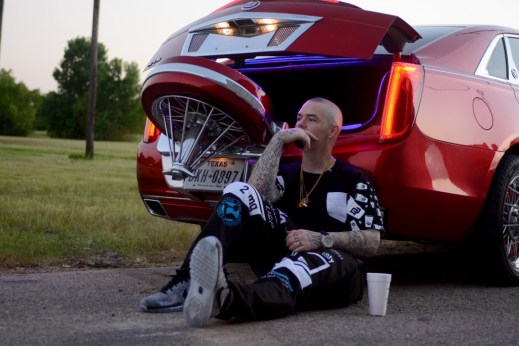
slab god, Paul Wall’s latest project, surpasses many recent rap releases via its stripped down sound, minimalistic in a non-trendy, monastic sort of way. Sonically, slab god is solemn, thoughtful and surprisingly provocative, especially in the context of Wall’s entire discography (his early material with the Color Changin’ Click, for example, was much more lighthearted and playful). Wall professed, “it’s just something that I wanted to do differently. All the music in Hip Hop right now sounds the same and I wanted to do something that didn’t sound like what was coming out right now, so that’s why I came with this.” Unlike many of Wall’s projects based mostly on freestyles, Slab god took several years to produce.
 As soon as Wall recorded “Swangin’ in the Rain,” the first song arranged for slab god back in 2010, he wanted to make the whole album sonically in line with the single: “music to put in the car and bump and ride to.”
SLAB= Slow, Loud, AND BANGIN’, see: Houston Car Culture
In 2012, Wall embarked on his second beginning by releasing No Sleep ‘Til Houston, his first mixtape as an independent artist again, after departing from his eight year relationship with Atlantic Records. For Wall, that was his opportunity to get back to his roots. Committed to this conviction, he disregarded his mainstream momentum in order to “make music not tainted with outside influence from the music industry.” So, pursuant to the title No Sleep ‘Til Houston, Wall followed this self-prescribed antidote until he reintroduced himself to the city where he started, Houston, Texas.
After Wall felt reconnected, he dropped #Checkseason in 2013. Like many of Wall’s projects, it was about getting money; Wall said, “it was meant to be like a motivation mixtape. When you are on your hustle you pop it in.” And in 2014, Wall dropped Po Up Poet, which was according to Wall, titled after “a nickname one of my boys gave me because I’m always talkin’ ‘bout drankin’, po-in’ up, and leanin’.” To Wall, “the lean culture has taken over globally. There’s Brazilian rappers talking about lean. There’s German rappers talking about lean.” [ed.’s note to Paul Wall: Sounding Out! has talked about lean. See Kemi Adeyemi’s “Straight Leanin’: Sounding Black Life at the Intersection of Hip-hop and Big Pharma” (Sept. 2015)]. As a response, Wall released Po Up Poet, “to claim something for Houston.”
I met up with the enterprising Paul Wall while he was in New York City promoting slab god and had the opportunity to “grill” Wall about his new slab sonics for Sounding Out!. In what follows, Wall explains the oral transmission of slab culture, the sonic tension between regionalism and globalism, and Houston Hip Hop. Wall explored some fascinating concepts, namely, how the stimuli for slab god consisted of a jambalaya of subtropical weather and hyper-local Houston folklore along with the pursuit of fun, money, and aesthetics. He also explains how his new sound makes clear that he is a full-on “slabagogue.”
Douglas Doneson: This album took you several years to make. You recorded “Swangin’ in the Rain” in 2010.
Paul Wall: When we did the song “Swangin’ in the Rain,” immediately, it was special to me. It is my favorite song that I have ever personally made.
Another thing is that there has never been a song about rain and slabs or anything screwed up related with rain. Sometimes when it rains the radio plays the rain mix, where all the songs have a rain theme. In L.A., I recorded “Swangin’ in the Rain,” [and] it rained, and of course it never rains in L.A. I just remember thinking, man it’s a blessing these artists don’t even realize because they get free radio play every time it rains. You know what I am saying? So I was like it would be dope if there was a rap song, especially like a Houston type of themed rap song having to do with rain because it rains all the time in Houston. So shit, you get lucky with a jamming song about rain in Houston, there is going to be a lot of radio play.
After I made the song, I was like man I am going to make a whole album like this. So I went to the studio and [it] went to a folder. I have a few different types of folders. I have one where it is songs about money, another folder where it is mostly songs about drank and syrup, and another where it is mostly songs about cars, because that is what I rap about the most, getting money, driving cars, jewelry, and lean. So those are my different folders.
When “Swangin’ in the Rain” came out, I wanted to make a whole album like that: music for the car, music to put in the car and bump and ride to. If you have a journey or you have to ride across town or ride home from work or wherever, this is something I’ll want to put in. It is riding music.

Paul Wall and the Houston Skyline, Photo by Mike Frost
DD: Who are some of the featured artists?
PW: On slab god some of the features I got are definitely a lot of H-Town collaboration on there, starting off with my boy Dead End Red, Sosa Man, Le$, Devin the Dude, Curren$y, Burner, and Snoop Dogg.
DD: I was surprised to see DJ Chose on there. Tell me more about that collaboration.
PW: I met him a while back and I did a song with him before for one of his projects. You see the passion in him; he really looks at what he is doing as art. I ain’t going to lie; we all looked at it like it was a hustle. We didn’t look at it from an artistic aspect of music; we all looked at it like this is something we do for fun and we are going to go hustle it and make some money off of what we do for fun. But with DJ Chose, you could see the way he records; his style is artistic and a little different. I had wanted to work with him for a while. This is one of those things where you’ve got to get him on the right song. You get him on the right song and he’s going to kill it. That’s what he did.
DD: As far back as I can remember, even back in the Color Changin’ Click days, your rhymes have generally been lighthearted and playful, but slab god, especially your verse on “Crumble the Satellite” is confrontational. A line that stuck out to me the most is, “and just because your shirt say it, that don’t make you trill.” What’s going on here?
PW: Well, number one, I wanted to drop some bars, some quotables, where you’ve got to rewind it, [and ask] “what he say,” “he said what?” You know, some of them type of quotables. It took a little time because that’s not stuff you freestyle, that’s something you think about because it’s got to be said right and wording has to be right. It’s more work and I’m not scared of hard work. It’s more time in the studio perfecting things and getting it right.
I ain’t going to lie, I did my verse first, and I didn’t know where to take the song. I just knew the beat was jamming. When I heard the beat it kind of reminded me of “Still Tippin’” with the bass, the drums, and I always remember my boy T Farris telling me when we did “Still Tippin,’” “go in there and freestyle.” So I heard that in the back of my head and it sounded like “Still Tippin,’” so I went in there and did a little freestyle and I was talking about a bunch of random shit. My verse wasn’t a 12 or a 16 bar verse. It was like a 24 bar verse. Originally, it was going to be just me and I wasn’t even going to put a hook on it. I was going to leave it like a freestyle. But at the end when I said, “crumble the satellite,” I said you know what I’m going to call it that and then I sent it to Curren$y and Devin to jump on and both of them boys came right on with it.
DD: The title of your newest album is slab god. What is a slab god?
PW: I was going to call it Slab Life. I wanted to call it something slab related and I didn’t want to call it Slab King, because Lil’ Keke and Corey Blount are Slab Kings, so I didn’t want to say that like I was trying to take their throne. Someone gave me the nickname, they said, “you are the slab god.” I was like, you ain’t lying, I am. I done had over 20 slabs, so shit. I kept [god] with a lower case “g” because I didn’t want to be blasphemous. People are still like, “you are going to hell for that.” I’m like man, shit. I didn’t make nothing difficult. I’m not saying I’m the almighty God. I am also not saying I am the slab god. I am one of several slab gods. There are lots of other people in Houston who are slab gods. We are carrying on the culture, carrying on the torch for the slab. We are just trying to hold it down.
DD: You mentioned Lil’ Keke is a Slab King. On the song “Checklist” with Lil’ Keke off of slab god, you break down the elements of a slab. What are some of the features of a slab?
PW: It is a fluid list. It is always changing. New technologies come, [now] there are new Halo Oracle headlights you can get installed, but three years ago you couldn’t get that. Same with the Ghost Lights on the door; when you open the door up and the lights shine on the ground. They weren’t available two years ago. The checklist keeps getting bigger.
You’ve got to make it your own. That’s the other thing about a slab, is it’s your personal upgrade. There are definitely a few must haves like, you’ve got to have the Texan Wire Wheels Swangas, the ‘84s; there are several different sizes and variations. But you’ve got to have Swangas and you’ve got to have Vogue tires. If you don’t have Vogue tires and you just have regular black tires or something than nah, it’s no deal. You’ve got to have candy paint on it, music in the trunk, some people put tint on it, some people leave it without tint, and a front grill in the front—that’s a must.
On the older cars you put a hood ornament on it like a woman in the front or something. But on the newer cars you don’t really do that too much. We also put a fifth wheel on the back, which is just a spare tire or rim on the back, but you can’t use it, it’s not for practical purposes, it’s for decoration. We put hydraulic pumps on the fifth wheel and on the trunk, so when you hit the switch, the trunk opens up and you got neon lights showing in there with a word or phrase. You’ve [also] got [to have] speakers in there, and that’s pretty much it. Some slabs have convertible, some have a sun roof, and maybe the other thing about slabs is you’ve got to bang Screw. You’ve got to jam Screw in the slab.
DD: It seems like a lot of slab culture is passed down by oral tradition through the O.G.s and Slab Kings such as Corey Blount. In your song “Top Diine” off of slab god, you say, “Texas Ed taught me how to drive extra patient.” Who is Texas Ed?
PW: Man! He going to LOVE that you said that! [Laughs]. That’s my boy [who] I went to elementary, junior high, and high school with. “Top Diine,” I did with Happy Perez. He produced that track and we did that song four years ago or maybe five years ago, so that’s a nice one that we’ve been sitting on for a while [that] we’ve been waiting to put out. But, Texas Ed is my homeboy. We grew up together. He lived in a neighborhood next to mine. When I was in high school, he was one of the ones riding slab, so he was one of the forefathers before me who showed me how to do it.
DD: On your song “Forever Hustle” off of slab god, each line in your verse is like a new phrase ripe for Houston Hip Hop adoption. Drop a few of your favorite lines and talk to me about them.
PW: With that song I wanted to do a flip on word play. First of all, I thought that beat was just jamming so hard and I was like whatever I do to this, I better not fuck up this jamming beat. That’s really what I was thinking. But other than that it, the hook kept coming to me. I don’t know what I was going through at the time, but I heard Slim Thug say one time in a rap, “man I’m going to do this for 10 more years, I ain’t never falling off.” So, shit, that made me realize that as long as there are things I want, [and] as long as I want these things, then I’m going to have to hustle for them. There is no lottery ticket, where you never have to work again. As long as Cadillac makes cars, I’m going to want one. That’s my dream car. My dream car is whatever the newest Cadillac is. As long as they got Swangas and Vogues to put on them I’m going to be putting them on. You know what I’m saying? [Laughs].
I really wanted to do a word play- “I’ma sip mud, ‘til I’m in the mud,” “I’ma sip syrup, until I’m in the dirt.” The rhyme scheme wasn’t a normal bar for bar rhyme; I broke it up in halves and did different shit. “I’ma let the trunk wave, ‘til I’m in the grave,” and “I’ma bang Screw, ‘til I join him,” all that man, shit. It was just something different I wanted to do.
DD: Tell me about your special connection to Slab culture.
PW: For one, it is something that is ours in Houston. There are other places like Austin [and] we generally say Texas, but there’s a lot of places in Texas where they don’t ride slab. There’s not too many people in Dallas that ride slabs, maybe outside Austin, maybe San Antonio, and maybe a few other places; a couple of people in Madisonville, and some of the smaller towns, but as a whole, we try to say Texas, but it is really more of a Houston thing.
The greatest things to me in the world are the most local things. You know when you go to certain areas of the world and they got that cuisine? There is nothing like eating a cheese steak in Philly, there is nothing like going to Louisiana and eating some creole food or Cajun food, and there is nothing like going to Texas and eating some Tex-Mex. With these types of things the localized aspects of it are always the best. It’s something that we got that’s our own and the fact that the rest of the world don’t ride makes it even more special to me because if everyone else did I wouldn’t want to because it was just be something everybody else is doing. That sense of Texas pride is instilled in you when you come from Texas. Texas history from when you were in school, to “everything is bigger in Texas,” to all the companies that come from Texas that are so Texas proud like Blue Bell, and stuff like that. Everybody is so Texas proud. They just teach you that sense of pride in Texas, so our car culture is no different.
The Screw music is another thing that’s ours that came from Texas so, it’s part of that culture and goes right along with the slab culture, so it’s like something I take a lot of pride in because its comes from where we are from, so I want to represent it that much more, you know what I am saying?
Sometimes I might be riding somewhere and there might be somebody, like an old person who don’t like my car and they might give me a dirty look or something and that makes me smile because it reminds me that this is not for everybody and this is something that is just ours. Like my album, I know this album is jamming, so if somebody says they don’t like it then hey it might not be their type of music, or maybe they hate it, or maybe they listened to the wrong album, but I know it’s not because I ain’t do my thing right. Same thing with my car, I know my car looks good. I’m not saying that it’s the best. There are definitely things I should improve, but I know my shit is clean. So if someone else don’t like it then that just means it’s not for them, or they are just a hater, or whatever, but that’s cool because it’s for me, you know what I’m saying?

“Paul Wall Texas Longhorns,” photo by Mike Frost
DD: In an interview you recently did with Devi Dev on KHOU Houston, Texas, you state, “the best artists ever in the world have always been true to their local culture, local style, and local sound.” However, a lot of music critics claim that one reason Houston artists have a hard time popping off is because they won’t let go of their close connection to their culture, isolating themselves from audiences outside of Texas. How has this so-called language barrier affected you?
PW: What the critics have said has been one of the main obstacles of Texas artists achieving super main stream success. We’ve achieved mainstream success but not to a level of a Jay-Z or where Lil’ Wayne is now. We got to where Lil’ Wayne was 10 years ago, you know what I’m saying? We all made it to that level. But none of us made it to the level where Lil’ Wayne is at now! Partially, they are right because [of] Texas culture, a lot of people don’t have any clue what we are talking about. Therefore, when they hear us talking about it, its gibberish or it’s another language, so people are ignorant to what we are saying, when really we might be dropping some hella-fied metaphors, and similes, and bars that are real lyrical. People don’t take it like that because they hear the accent; they hear the slang references, or the culture references that are different than their culture so they just look at it as being bullshit. For instances, if Tupac came out right now and was rapping Russian, I don’t think he’d be looked at as the greatest rapper ever because most people wouldn’t understand what he was saying. But since he spoke in English, we understood what he was saying. So our culture is like speaking Russian.
DD: I love how you brought that up. You transport the Houston sound to other regions. I’m fascinated with your trip to Poland to work with Kazcor. How’d that come about?
That’s dope you asked me about that. Kazcor will be excited about that. This is my dream job. Growing up in Houston, a lot of us never left the neighborhood. I have friends who still, have never left the North Side of town or the South Side of town. You don’t drive past the Galleria, the Galleria is as far as you go. [DD note: Gu raised his hand and indicated he rarely leaves his neighborhood. Everyone laughs] The first time he left the South Side is probably when we went out of town somewhere. There’s a lot of people like that so, that’s how we are brought up in Houston. We just stick to our own area and that’s it and the only reason we’d travel to the other side of town is to go to AstroWorld or something.
The Polish flag and the Texas flag are a lot similar. The only difference I think is the star. So I always wondered if my fan base in Poland was big because the flag is kind of similar. We find excuses or reasons to associate with people for whatever reason. So anyway, a guy I know grew up in Russia, but he moved to Chicago, then he moved to Milwaukee, and then when the recession hit, he and his family moved back to Poland. They went to their family business, which was the slaughter house business and he was just homesick one year for Christmas and was like man, “I am homesick and you were my favorite rapper, so I am going to bring you to Poland and do a concert.” He wasn’t a concert promoter or nothing like that. He wanted to have a dope concert and he was homesick. So I went out there and for me being able to travel around the world to different places like that is a once in a lifetime opportunity, especially when I’m going to these places and literally, I know people who haven’t crossed I-10 in their life; the only time they crossed I-10 was to go downtown to court.
Poland is dope. Some parts of Europe, they speak English, but in Poland, nobody spoke English. It was not an English speaking country; English wasn’t their first language, English wasn’t their second language, [and] English wasn’t their third language. But man, I was inspired by their Hip Hop scene over there. The first time I went, Kazcor, had beef at the time with another rapper, and he performed right before me, and his whole performance was like 50 Cent at Summer Jam, bringing out a blow up doll, doing skits, all related to his beef with another Polish rapper. I was like damn; the beef history of Hip Hop is traveling. I was inspired by that.
They had their own producers out there; rappers, rap scene, rap culture, and DJs and none of them were at all familiar with what was going on in America. It’s not like you know, when Texas is popping now its popping out there, if Atlanta music is popping, its popping out there. It’s not even like if it’s popping, a few months later it’ll be popping there. No man, whatever was going on in America, they didn’t even know who they were. When I would talk to people, I’d be like [have you] heard of this person or that person? They’d say, “nope.” I was inspired that they were completely out of touch with what was going on in Hip Hop in America but, yet and still Hip Hop in Poland was thriving, healthy, and they had their own award shows.
DD: Another example of you bringing the Houston sound to another region is you Screwed and Chopped the album Haunted Cities, by California based rock-rap group The Transplants. Whose idea was that?
PW: I met Skinhead Rob and Travis Barker in the Atlantic offices right when I signed to Atlantic. Of course I knew who Blink 182 was, but I met both of them and they were both cool as a fan. After that, I started researching more of their music and got familiar with it and it was dope.
Skinhead Rob was the one who was like, “man, why don’t you do a Screwed and Chopped version of this? There never been anything like this done before.” First of all, if something has never been done, I’m already like “yep, I’ll do it.” And it was also jamming, so we were on the same level. It was easy to do. So when Skinhead Rob put that play in motion, I was like, hell yes. I am proud of that one, man.
DD: On slab god you mention Jacka. I was wondering who that is and if you feel comfortable talking about him.
PW: For sure. He’s a rap artist from the Bay. He was in a group called the Mob Figaz. My boy Husalah is on the album too, he’s in the group Mob Figaz. Jacka got killed a few months ago, this year. He was a real close friend of mine. Before I had even met him, I was a big fan of him. Matter of fact, my boy Skinhead Rob turned me onto him. Skinhead Rob turned me on to a lot of underground music. He turned me on to Mac Dre, Andre Nikatina, the Mob Figaz, Jacka, Husalah, Mitchy Slick, and to a lot of West Coast artists.
But, Jacka, I still remember meeting him, when the All Star Game was in Houston, 2006 Super Bowl. I remember meeting Jacka; somebody in the club saying in the microphone, “shout out to the Jacka, Mob Figaz in the house.” I was like, “what? Where is he at? I got to meet him.” I just asked somebody who I knew from the Bay, I was like, “bro, is Jacka in here? Where he at?” He said that’s him over there. So I went up to him and was like, “bruh, I fuck with your shit.” Because I really did jam his music like that. I think he was taken back like, “man are you for real or are you just like saying this?” And I said, “nah, bruh.” I was quoting lyrics and quoting lines, dropping bars, like I really fuck with you. He was literally one of my favorite rappers, especially at the time and still now.
I get stuck in my personal zone where I only listen to a few artists, and he was one of them for sure. He just was a good person and that’s how we met [and] over the years we did other things, shows, songs, we got an album together, it hasn’t come out yet, but we’ve been working on that. We really have two albums together.
Something I always admired about him was how he preached gems in his music. In his music, he’ll drop a spiritual gem that will make you reevaluate your relationship with God and in his raps he would inspire people to be better. And one thing that I always loved about him, anytime I ever would be with Jacka he would always have me feeling like I could conquer the world. He was a hell of a pep talker and a lot of people I know who knew him say the same thing. That was my boy. He got killed [and] I just wanted to do a song for him, dedicate it for him, let the whole world know, and more specifically, put people in Texas on to him because he reminds me of a Z- Ro type of artist. Z- Ro will say God related things or spiritual things to help better yourself sometimes [and] you’ll be like damn this boy Z- Ro is deep. And that’s just kind of how the Jacka is.
DD: Is there anything else you want to share with us?
PW: slab god is in stores now. Houston Oiler is on the way.
—
Featured Image: Paul Wall, his slab, and the white cup, Photo by Mike Frost
—
Douglas Doneson writes about Houston rap music. He has written for The T.R.O.Y. Blog, Complex, Noisey, and God is in the TV.
—
 REWIND!…If you liked this post, check out:
“This is Your Body on the Velvet Underground“–Jacob Smith
“The (Magic) Upper Room: Sonic Pleasure Politics in Southern Hip Hop“–Regina Bradley
Culture Jamming and Game Sound: An Interview with foci + loci–Skot Deeming and Martin Zeilinger
Share this:

Culture Jamming and Game Sound: An Interview with foci + loci
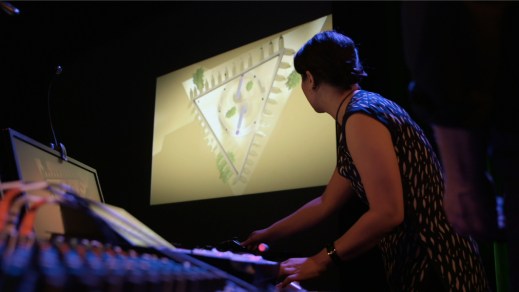
 Guest Editors’ Note: Welcome to Sounding Out!‘s December forum entitled “Sound, Improvisation and New Media Art.” This series explores the nature of improvisation and its relationship to appropriative play cultures within new media art and contemporary sound practice. Here, we engage directly with practitioners, who either deploy or facilitate play and improvisation through their work in sonic new media cultures.
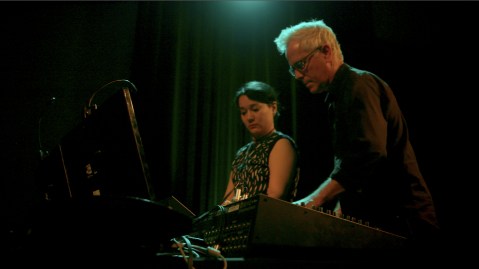
For our second piece in the series, we have interviewed New York City based performance duo foci + loci (Chris Burke and Tamara Yadao). Treating the map editors in video games as virtual sound stages, foci + loci design immersive electroacoustic spaces that can be “played” as instruments. Chris and Tamara bring an interdisciplinary lens to their work, having worked in various sonic and game-related cultures including, popular, electroacoustic and new music, chiptune, machinima (filmmaking using video game engines), and more.
As curators, we have worked with foci + loci several times over the past few years, and have been fascinated with their treatment of popular video game environments as tools for visual and sonic exploration. Their work is highly referential, drawing on artistic legacies of the Futurists, the Surrealists, and the Situationists, among others. In this interview, we discuss the nature of their practice(s), and it’s relationship to play, improvisation and the co-constituative nature of their work in relation to capital and proprietary technologies.
— Guest Editors Skot Deeming and Martin Zeilinger
–
1. Can you take a moment to describe your practice to our readers? What kind of work do you produce, what kind of technologies are involved, and what is your creative process?
foci + loci mostly produce sonic and visual video game environments that are played in live performance. We have been using Little Big Planet (LBP) on the Playstation 3 for about 6 years.
When we perform, we normally have two PS3s running the game with a different map in each. We have experimented with other platforms such as Minecraft and we sometimes incorporate spoken word, guitars, effects pedals, multiple game controllers (more than 1 each) and Game Boys.
Our creative process proceeds from discussions about the ontological differences between digital space and cinematic space, as well as the freeform or experimental creation of music and sound art that uses game spaces as its medium. When we are in “Create Mode” in LBP, these concepts guide our construction of virtual machines, instruments and performance systems.
[Editor’s Note: Little Big Planet’s has several game modes. Create Mode is the space within the game where users can create their own LBP levels and environments. As player’s progress through LBP’s Story Mode, players unlock and increasing number of game assets, which can be used in Create Mode.]
2. Tell us about your background in music? Can you situate your current work in relation to the musical traditions and communities that you were previously a part of?
 CB: I have composed for film, TV, video games and several albums (sample based, collage and electronic). Since 2001 I’ve been active in the chipmusic scene, under the name glomag. Around the same time I discovered machinima and you could say that my part in foci + loci is the marriage of these two interests – music and visual. Chipmusic tends to be high energy and the draw centers around exciting live performances. It’s immensely fun and rewarding but I felt a need to step back and make work that drew from more cerebral pursuits. foci + loci is more about these persuits for me: both my love of media theory and working with space and time.
TY: I’m an interdisciplinary artist and composer. I studied classical piano and percussion during my childhood years. I went on to study photography, film, video, sound, digital media and guitar in college and after. I’ve primarily been involved with the electroacoustic improv and chipmusic scenes, both in NYC. I’ve been improvising since 2005, and I’ve been writing chipmusic since 2011 under the moniker Corset Lore.
My work in foci + loci evolved out of the performance experience I garnered in the electroacoustic improv scene. My PS3 replaced my laptop. LBP replaced Ableton Live and VDMX. I think I felt LBP had more potential as a sonic medium because an interface could be created from scratch. Eventually, the game’s plasticity and setting helped to underscore its audiovisual aspect by revealing different relationships between sound and image.
3. Would you describe your work as a musical practice or an audio-visual performance practice?
FL: We have always felt that in game space, it is more interesting to show the mechanism that makes the sound as well as the image. These aspects are programmed, of course, but we try to avoid things happening “magically,” and instead like to give our process some transparency. So, while it is often musical, sound and image are inextricably linked. And, in certain cases, the use of a musical score (including game controller mappings) has been important to how our performance unfolds either through improvisation or timed audiovisual events. The environment is the musical instrument, so using the game controller is like playing a piano and wielding a construction tool at the same time. It has also been important in some contexts to perform in ‘Create Mode’ in order to simply give the audience visual access to LBP‘s programming backend. In this way, causal relationships between play and sound may be more firmly demonstrated.
4. There are many communities of practice that have adopted obsolete or contemporary technologies to create new, appropriative works and forms. Often, these communities recontextualize our/their relationships to technologies they employ. To what extent do you see you work in relation to communities of appropriation-based creative expression?
CB: In the 80s-90s I was an active “culture jammer,” making politically motivated sound montage works for radio and performance and even dabbling in billboard alterations. Our corporate targets were selling chemical weapons and funding foreign wars while our media targets were apologists for state-sanctioned murder. Appropriating their communications (sound bites, video clips, broadcasting, billboards) was an effort to use their own tools against them. In the case of video game publishers and console manufacturers, there is much to criticize: sexist tropes in game narratives, skewed geo-political subtexts, anti-competitive policies, and more. Despite these troubling themes, the publishers (usually encouraged by the game developers) have occasionally supported the “pro-sumer” by opening up their game environments to modding and other creative uses. This is a very positive shift from, say, the position of the RIAA or the MPAA, where derivative works are much more frequently shut down. My previous game-related series, This Spartan Life, was more suited to tackling these issues. As for foci + loci, it’s hard to position work that uses extensively developed in-game tools as being “appropriative,” but I do think using a game engine to explore situationist ideas or the ontology of game space, as we do in our work, is a somewhat radical stance on art. We hope that it encourages more players to creatively express their ideas in similar ways.
TY: Currently, the ‘us vs. them’ attitude that characterized the 80s and 90s is no longer as relevant as it once was because corporations are now giving artists technology for their own creative use. However, they undermine this sense of benevolence by claiming that consumers could be the next Picasso if they buy said piece of technology in their marketing—as if the tool is more important than the artist/artwork. Little Big Planet is marketed this way. On the whole, I think these issues complicate artists’ relationships with their media.
Often our work tends to be included in hacker community events, most recently the ‘Music Games Hackathon’ at Spotify (NYC), because, while we don’t necessarily hack the hardware or software, our approach is a conceptual hack or subversion. At this event, there were a variety of conceptual connections made between music, hacks and games; Double Dutch, John Zorn’s Game Pieces, Fluxus, Xenakis and Stockhausen were all compared to one another. I gave a talk at the Hackers on Planet Earth Conference in 2011 about John Cage, Marcel Duchamp, Richard Stallman and the free software movement. In Stallman’s essay ‘On Hacking,’ he cited John Cage’s ‘4’33″‘ as an early example of a music hack. In my discussion, I pointed to Marcel Duchamp, a big influence on Cage, whose readymades were essentially hacked objects through their appropriation and re-contextualization. I think this conceptual approach informs foci + loci’s current work.
[Editors’ note: Recently celebrating its 10th anniversary, This Spartan Life is a machinima talk show that takes place within the multiplayer game space of the First Person Shooter game Halo. This Spartan Life was created by Chris Burke in 2005. The show has featured luminaries including Malcolm McClaren, Peggy Awesh, and many more.]
 5. You mention the ontological differences between game spaces and cinematic spaces. Can you clarify what you mean by this? Why is this such as important distinction and how does it drive the work?
CB: We feel that there is a fundamental difference in the way space is represented in cinema through montage and the way it’s simulated in a video game engine. To use Eisenstein’s terms, film shots are “cells” which collide to synthesize an image in the viewers mind. Montage builds the filmic space shot by shot. Video game space, being a simulation, is coded mathematically and so has a certain facticity. We like the way the mechanized navigation of this continuous space can create a real time composition. It’s what we call a “knowable” space.
6. Your practice is sound-based but relies heavily on the visual interface that you program in the gamespace. How do you view this relationship between the sonic and the visual in your work?
TY: LBP has more potential as a creative medium because it is audiovisual. The sound and image are inextricably linked in some cases, where one responds to the other. These aspects of interface function like the system of instruments we (or the game console) are driving. Since a camera movement can shape a sound within the space, the performance of an instrument can be codified to yield a certain effect. This goes back to our interest in the ontology of game space.
7. Sony (and other game developers) have been criticized for commodifying play as work – players produce and upload levels for free, and this free labour populates the Little Big Planet ecology. How would you position the way you use LBP in this power dynamic between player and IP owner?
CB: We are certainly more on the side of the makers than the publishers, but personally I think the “precarious labor” argument is a stretch with regard to LBP. Are jobs being replaced (International Labor Rights definition of precarious work)? Has a single modder or machinima maker suggested they should be compensated by the game developer or publisher for their work? Compensation actually does happen occasionally. This Spartan Life was, for a short time, employed by Microsoft to make episodes of the show for the developer’s Halo Waypoint portal. I have known a number of creators from the machinima community who were hired by Bioware, Blizzard, Bungie, 343 Industries and other developers. Then there’s the famous example of Minh Le and Jess Cliffe, who were hired by Valve to finish their Half-Life mod, Counterstrike. However, compensating every modder and level maker would clearly not be a supportable model for developers or publishers.
Having said all that, I think our work does not exactly fit into Sony’s idea of what LBP users should be creating. We are resisting, in a sense, by providing a more art historical example of what gamers can do with this engine beyond making endless game remakes, side-scrollers and other overrepresented forms. We want players to open our levels and say “WTF is this? How do I play it?” Then we want them to go into create mode and author LBP levels that contain more of their own unique perspectives and less of the game.
[Corset Lore is Tamara Yadao’s chiptune project.]
8. What does it mean to improvise with new interfaces? Has anything ever gone horribly wrong during a moment of improvisation? Is there a tension between improvisation and culture jamming, or do the two fit naturally together?
CB: It’s clear that improvising with new interfaces is freer and sometimes this means our works in progress lack context and have to be honed to speak more clearly. This freedom encourages a spontaneous reaction to the systems we build that often provokes the exploitation of weaknesses and failure. Working within a paradigm of exploitation seems appropriate to us, considering our chosen medium. In play, there is always the possibility of failure, or in a sense, losing to the console. When we design interfaces within console and game parameters we build in fail-safes while also embracing mechanisms that encourage failure during our performance/play.
In an elemental way, culture jamming is a more targeted approach, whereas improvisation seems to operate with a looser agenda. Improvisation is already a critical approach to the structures of game narrative. Improvising with a video game opens up the definition of what a game space is, or can be.
—
All images used with permission by foci + loci.
—
foci + loci are Chris Burke and Tamara Yadao.
Chris Burke came to his interest in game art via his work as a composer, sound designer and filmmaker. As a sound designer and composer he has worked with, among others, William Pope L., Jeremy Blake, Don Was, Tom Morello and Björk. In 2005 he created This Spartan Life which transformed the video game Halo into a talk show. Within the virtual space of the game, he has interviewed McKenzie Wark, Katie Salen, Malcolm McLaren, the rock band OK Go and others. This and other work in game art began his interest in the unique treatment of space and time in video games. In 2012, he contributed the essay “Beyond Bullet Time” to the “Understanding Machinima” compendium (2013, Continuum).
Tamara Yadao is an interdisciplinary artist and composer who works with gaming technology, movement, sound, and video. In Fall 2009, at Diapason Gallery, she presented a lecture on “the glitch” called “Post-Digital Music: The Expansion of Artifacts in Microsound and the Aesthetics of Failure in Improvisation.” Current explorations include electro-acoustic composition in virtual space, 8-bit sound in antiquated game technologies (under the moniker Corset Lore), movement and radio transmission as a live performance tool and the spoken word. Her work has been performed and exhibited in Europe and North America, and in 2014, Tamara was the recipient of a commissioning grant by the Jerome Fund for New Music through the American Composers Forum.
—
REWIND! . . .If you liked this post, you may also dig:
Improvisation and Play in New Media, Games, and Experimental Sound Practices — Skot Deeming and Martin Zeilinger
Sounding Out! Podcast #41: Sound Art as Public Art — Salomé Voegelin
Sounding Boards and Sonic Styles — Josh Ottum
Share this:


Current Top Posts





April 2021

January 2020

November 2019

October 2019

August 2019

April 2014

November 2017

March 2015

December 2017

October 2015
 Sounding Out!
Recent Comments