
You Got Me Feelin’ Emotions: Singing Like Mariah

Mariah Carey’s New Year’s Eve 2016 didn’t go so well. The pop diva graced a stage in the middle of Times Square as the clock ticked down to 2017 on Dick Clark’s Rockin New Year’s Eve, hosted by Ryan Seacrest. After Carey’s melismatic rendition of “Auld Lang Syne,” the instrumental for “Emotions” kicked in and Carey, instead of singing, informed viewers that she couldn’t hear anything. What followed was five minutes of heartburn. Carey strutted across the stage, hitting all her marks along with her dancers but barely singing. She took a stab at a phrase here and there, mostly on pitch, unable to be sure. And she narrated the whole thing, clearly perturbed to be hung out to dry on such a cold night with millions watching. I imagine if we asked Carey about her producer after the show, we’d get a “I don’t know her.”
These things happen. Ashlee Simpson’s singing career, such as it was, screeched to a halt in 2004 on the stage of Saturday Night Live when the wrong backing track cued. Even Queen Bey herself had to deal with lip syncing outrage after using a backing track at former President Barack Obama’s second inauguration. So the reaction to Carey, replete with schadenfreude and metaphorical pearl-clutching, was unsurprising, if also entirely inane. (The New York Times suggested that Carey forgot the lyrics to “Emotions,” an occurrence that would be slightly more outlandish than if she forgot how to breathe, considering it’s one of her most popular tracks). But yeah, this happens: singers—especially singers in the cold—use backing tracks. I’m not filming a “leave Mariah alone!!” video, but there’s really nothing salacious in this performance. The reason I’m circling around Mariah Carey’s frosty New Year’s Eve performance is because it highlights an idea I’m thinking about—what I’m calling the “produced voice” —as well as some of the details that are a subset of that idea; namely, all voices are produced.
I mean “produced” in a couple of ways. One is the Judith Butler way: voices, like gender (and, importantly, in tandem with gender), are performed and constructed. What does my natural voice sound like? I dunno. AO Roberts underlines this in a 2015 Sounding Out! post: “we’ll never really know how we sound,” but we’ll know that social constructions of gender helped shape that sound. Race, too. And class. Cultural norms make physical impacts on us, perhaps in the particular curve of our spines as we learn to show raced or gendered deference or dominance, perhaps in the texture of our hands as we perform classed labor, or perhaps in the stress we apply to our vocal cords as we learn to sound in appropriately gendered frequency ranges or at appropriately raced volumes. That cultural norms literally shape our bodies is an important assumption that informs my approach to the “produced voice.” In this sense, the passive construction of my statement “all voices are produced” matters; we may play an active role in vibrating our vocal cords, but there are social and cultural forces that we don’t control acting on the sounds from those vocal cords at the same moment.
Another way I mean that all voices are produced is that all recorded singing voices are shaped by studio production. This can take a few different forms, ranging from obvious to subtle. In the Migos song “T-Shirt,” Quavo’s voice is run through pitch-correction software so that the last word of each line of his verse (ie, the rhyming words: “five,” “five,” “eyes,” “alive”) takes on an obvious robotic quality colloquially known as the AutoTune effect. Quavo (and T-Pain and Kanye and Future and all the other rappers and crooners who have employed this effect over the years) isn’t trying to hide the production of his voice; it’s a behind-the-glass technique, but that glass is transparent. Less obvious is the way a voice like Adele’s is processed. Because Adele’s entire persona is built around the natural power of her voice, any studio production applied to it—like, say, the cavernous reverb and delay on “Hello” —must land in a sweet spot that enhances the perceived naturalness of her voice.
Vocal production can also hinge on how other instruments in a mix are processed. Take Remy Ma’s recent diss of Nicki Minaj, “ShETHER.” “ShETHER”’s instrumental, which is a re-performance of Nas’s “Ether,” draws attention to the lower end of Remy’s voice. “Ether” and “ShETHER” are pitched in identical keys and Nas’s vocals fall in the same range as Remy’s. But the synth that bangs out the looping chord progression in “ShETHER” is slightly brighter than the one on “Ether,” with a metallic, digital high end the original lacks. At the same time, the bass that marks the downbeat of each measure is quieter in “ShETHER” than it is in “Ether.” The overall effect, with less instrumental occupying “ShETHER”’s low frequency range and more digital overtones hanging in the high frequency range, causes Remy Ma’s voice to seem lower, manlier, than Nas’s voice because of the space cleared for her vocals in the mix. The perceived depth of Remy’s produced voice toys with the hypermasculine nature of hip hop beefs, and queers perhaps the most famous diss track in the genre. While engineers apply production effects directly to the vocal tracks of Quavo and Adele to make them sound like a robot or a power diva, the Remy Ma example demonstrates how gender play can be produced through a voice by processing what happens around the vocals.
Let’s return to Times Square last New Year’s Eve to consider the produced voice in a hybrid live/recorded setting. Carey’s first and third songs “Auld Lang Syne” and “We Belong Together”) were entirely back-tracked—meaning the audience could hear a recorded Mariah Carey even if the Mariah Carey moving around on our screen wasn’t producing any (sung) vocals. The second, “Emotions,” had only some background vocals and the ridiculously high notes that young Mariah Carey was known for. So, had the show gone to plan, the audience would’ve heard on-stage Mariah Carey singing along with pre-recorded studio Mariah Carey on the first and third songs, while on-stage Mariah Carey would’ve sung the second song entirely, only passing the mic to a much younger studio version of herself when she needed to hit some notes that her body can’t always, well, produce anymore. And had the show gone to plan, most members of the audience wouldn’t have known the difference between on-stage and pre-recorded Mariah Carey. It would’ve been a seamless production. Since nothing really went to plan (unless, you know, you’re into some level of conspiracy theory that involves self-sabotage for the purpose of trending on Twitter for a while), we were all privy to a component of vocal production—the backing track that aids a live singer—that is often meant to go undetected.

The produced-ness of Mariah Carey’s voice is compelling precisely because of her tremendous singing talent, and this is where we circle back around to Butler. If I were to start in a different place–if I were, in fact, to write something like, “Y’all, you’ll never believe this, but Britney Spears’s singing voice is the result of a good deal of studio intervention”–well, we wouldn’t be dealing with many blown minds from that one, would we? Spears’s career isn’t built around vocal prowess, and she often explores robotic effects that, as with Quavo and other rappers, make the technological intervention on her voice easy to hear. But Mariah Carey belongs to a class of singers—along with Adele, Christina Aguilera, Beyoncé, Ariana Grande—who are perceived to have naturally impressive voices, voices that aren’t produced so much as just sung. The Butler comparison would be to a person who seems to fit quite naturally into a gender category, the constructed nature of that gender performance passing nearly undetected. By focusing on Mariah Carey, I want to highlight that even the most impressive sung voices are produced, and that means that we can not only ask questions about the social and cultural impact of gender, race, class, ability, sexuality, and other norms may have on those voices, but also how any sung voice (from Mariah Carey’s to Quavo’s) is collaboratively produced—by singer, technician, producer, listener—in relation to those same norms.
Being able to ask those questions can get us to some pretty intriguing details. At the end of the third song, “We Belong Together,” she commented “It just don’t get any better” before abandoning the giant white feathers that were framing her onstage. After an awkward pause (during which I imagine Chris Tucker’s “Don’t cut to me!” face), the unflappable Ryan Seacrest noted, “No matter what Mariah does, the crowd absolutely loves it. You can’t go wrong with Ms. Carey, and those hits, those songs, everybody knows.” Everybody knows. We didn’t need to hear Mariah Carey sing “Emotions” that night because we could fill it all in–everybody knows that song. Wayne Marshall has written about listeners’ ability to fill in the low frequencies of songs even when we’re listening on lousy systems—like earbuds or cell phone speakers—that can’t really carry it to our ears. In the moment of technological failure, whether because a listener’s speakers are terrible or a performer’s monitors are, listeners become performers. We heard what was supposed to be there, and we supplied the missing content.

Sound is intimate, a meeting of bodies vibrating in time with one another. Yvon Bonenfant, citing Stephen Connor’s idea of the “vocalic body,” notes this physicality of sound as a “vibratory field” that leaves a vocalizer and “voyages through space. Other people hear it. Other people feel it.” But in the case of “Emotions” on New Year’s Eve, I heard a voice that wasn’t there. It was Mariah Carey’s, her vocalic body sympathetically vibrated into being. The question that catches me here is this: what happens in these moments when a listener takes over as performer? In my case, I played the role of Mariah Carey for a moment. I was on my couch, surrounded by my family, but I felt a little colder, like I was maybe wearing a swimsuit in the middle of Times Square in December, and my heart rate ticked up a bit, like maybe I was kinda panicked about something going wrong, and I heard Mariah Carey’s voice—not, crucially, my voice singing Mariah Carey’s lyrics—singing in my head. I could feel my vocal cords compressing and stretching along with Carey’s voice in my head, as if her voice were coming from my body. Which, in fact it was—just not my throat—as this was a collaborative and intimate production, my body saying, “Hey, Mariah, I got this,” and performing “Emotions” when her body wasn’t.
By stressing the collaborative nature of the produced voice, I don’t intend to arrive at some “I am Mariah” moment that I could poignantly underline by changing my profile picture on Facebook. Rather, I’m thinking of ways someone else’s voice is could lodge itself in other bodies, turning listeners into collaborators too. The produced voice, ultimately, is a way to theorize unlikely combinations of voices and bodies.
—
Featured image: By all-systems-go at Flickr, CC BY-SA 2.0, via Wikimedia Commons
—
Justin Adams Burton is Assistant Professor of Music at Rider University, and a regular writer at Sounding Out! You can catch him at justindburton.com.
—

REWIND! . . .If you liked this post, you may also dig:
Gendered Sonic Violence, from the Waiting Room to the Locker Room-Rebecca Lentjes
I Can’t Hear You Now, I’m Too Busy Listening: Social Conventions and Isolated Listening–Osvaldo Oyola
One Nation Under a Groove?: Music, Sonic Borders, and the Politics of Vibration-Marcus Boon
Share this:

If La Llorona Was a Punk Rocker: Detonguing The Off-Key Caos and Screams of Alice Bag


Image of Alice Bag used with her permission (thank you!)
For full intro and part one of the series click here. For part two, click here. For part three click here. For part four click here.
Our Punk Sound series implicitly argues that sound studies methodologies are better suited to understanding how punk works sonically than existing journalistic and academic conversations about musical genre, chord progressions, and/or genealogies of bands. Alexandra Vasquez’s sound-oriented work on Cuban music, for example, in Listening in Detail (2014) opens up necessary conversations about the “flashes, moments, sounds” in music that bear its meanings and its colonial, raced, classed, and gendered histories in material ways people can hear and feel. While retaining the specificity of Vasquez’s argument and the specific sonic archive bringing it forth, we too insist on “an ethical and intellectual obligation to the question: what do the musicians sound like” (12) and how do folks identifying with and through these musical sounds hear them?
In this series, we invite you to amplify varied historicized “details” of punk sound–its chunk-chunk-chunk skapunk riffs, screams, growls, group chants, driving rhythms, honking saxophones–hearing/feeling/touching these sounds in richly varied locations, times, places, and perspectives: as a pulsing bead of condensation dripping down the wall of The Smell in Downtown LA (#savethesmell), a drummer making her own time on tour, a drunk sitting too near the amp at a backyard party, a queer teenager in their bedroom being yelled at to “turn it down” and “act like a lady[or a man]”. . .and on and on. In today’s essay Marlen Rios-Hernandez discusses how all the politics of punk sound, queer chicana identity, and feminism can be found in the scream.
SOUND!
–Aaron SO! (Sounding Out!) + Jenny SO! (Sounding Out!)
—
Mexican cultural theorist Carlos Monsiváis looked at various aspects of Mexican youth subcultures in the early 80s and revealed how youth relied on “caos” or chaos as a way to attain pleasure within disruption, spontaneity, and noise (68-79). How does the scream emerge through caos as a instrument of resistance? Alongside scholars like Fred Moten, I argue that the scream ruptures caos and allows us to glimpse the pleasure of resistance. In Alice Bag’s scream we find this medley of pleasure, interruption, and spontaneity. Bag explains, “once the Bags hit the stage and the music started, ego checked out and id took over, channeling my libido, my inner rage, whatever… I was free to be myself with no holds barred. It was the ultimate freedom” (221). These elements epitomize what I consider a queer Chicana feminist exorcism of tonality.
As explained in Bag’s memoir, particular to punk, there is a general reliance on informal/community-based ear training where musicians teach each other (183). European traditions of musical analysis both negate the horizontal learning central to punk while also normalizing the historical colonial presence within the Borderlands. In order to reveal how Bag’s scream exorcises these Eurocentric traditions, I consider her performance of “Violence Girl” at the Whiskey (1978), footage of “Gluttony” from The Decline of Western Civilization Part 1 (1981), and a brief clip of The Bags’ “Survive” in What We Do is Secret (2007). Because of how the scream disrupts formal analysis, there is an urgency to understand how it works against the grain.
In the face of Chicana women being politically silenced by the Chicano Movement and Women’s Movements during the late 70s and 80s, it was important for Chicanas to speak up for increased autonomy and access to space. Thus, Alice Bag’s caos is informed by an intersectional ethic of Chicana feminism. At the time queer Chicanas were largely absent from Chicano nationalist organizing. Between the Chicano Movement and unruly Chicana punks, the screaming voice became a multi-layered instrument of protest and empowerment necessary to invert normative gender and sexual politics within punk, the Chicano movement, and second wave feminism. The ability of the Chicana scream to contest oppression is not new. Such a linage can be drawn from La Llorona–– the villanized folkloric mother that drowns her children and haunts Mexico’s shores by wailing in the night.
Drawing on Latinx scholarship and a sonic reimagining of La Llorona’s wailing (as a feminist cry and public display against patriarchy), this post reimagines Alice’s scream as simultaneously resistance and pleasure. This aligns with Gloria Anzaldúa’s notion of deslengualidad. Suturing Anzaldúa’s concept of deslengualidad (detonguing)–which I define as Chicanas speaking with an orphan tongue–with caos shows how Chicanas can claim visibility through the scream. Deslengualidad and caos account for colonial interventions within the Chican@ identity, they demand the preservation and celebration of the mestiza language and help to provide visibility to Chican@ art.
Though the voice has been rendered repeatedly as a gendered instrument, usually legible via lyrics, and always harmonic, some examples tell us otherwise. For example, Alice’s scream is interrupted by her microphone malfunctioning in her performance of “Violence Girl” at the Whiskey (1978). This multi-layered recording with it’s already grainy inaudible features, helps us to understand the scream as a stand alone act of caos. Although the scream is interrupted by multiple forms of dissonance, it also persists as a public gesture of empowerment. The quality of the recording is poor and in it Alice experiences technical issues on stage. These distortions lead Alice to artfully perform a sonic delengualidad by making use of silence, inaudible screaming, and the body. She continues to move, interrupt, and most importantly still is accompanied by stable beat of the Bags despite singing without a microphone. Yet, in the absence of aurally decipherable lyrics (like the absence of a singular Chicana language) a lyrical analysis here wouldn’t serve any other purpose than to organize that which is on its own refuses order––her voice.
The seminal footage of “Gluttony” in The Decline of Western Civilization Part 1 (1981), features an aural scream. It helps us think about how the Chicana scream goes beyond mere aurality. Michelle Habell-Pallán’s notion of “el grito,”–the shout–relates to Alice’s shriek in “Gluttony.” Both punctuate emotional drama and harken back to Ranchera music. I suggest, however, that Bag’s shriek in “Gluttony” also signifies a growing concern with the homogeneity of white suburban beach punks who had infiltrated the scene. In her memoir Bag shares, “as I looked out into the audience, I could see that the once quirky men and women artists who prized originality above all else were being replaced by a belligerent, male dominated mob…playing for a belligerent group of individuals can be quite satisfying. What I didn’t like was the sameness” (308). Pushing back against the scene’s homogeneity, Bag does not end “Gluttony with a full closed cadence. Rather, she ends abruptly, leaving the listener with a sense of incompleteness.
The combination of repeated interruptions throughout “Gluttony” and the inability to conclude pushes the listener to a place of discomfort, where they are left yearning for some kind of ending. The musicologist Susan McClary argues that the absent cadences in Carmen signify how the cadence represents a return to normality and a satisfying feeling of closure. By withholding a full cadence in “Gluttony” and using her “grito” to celebrate difference, Bag enacts caos by rejecting the emerging uniformity of the scene. Much like Bag’s performance of “Violence Girl” at The Whiskey, the scream is less about being musical and ordered but instead a gesture to making do with what one has, a similar manifestation of deslengualidad.
The brief sound clip of the Bags’ “Survive” in What We Do is Secret (2007) illustrates how Alice’s scream offers a genealogy of caos via her disruption of the story of L.A. punk. The Bag’s “Survive” for the duration of a few seconds plays in the background during a scene in which fans are getting ready to watch The Germs perform at The Masque. In this clip, Alice’s voice isn’t immediate because of how it resonates within the background music. Hence, her voice refuses containment by emanating from the periphery. Alice’s voice emerges as delengualidad within the film precisely because women are written out of the story of L.A. punk. They are depicted as secondary players in the film. Fred Moten’s In The Break reminds us that the site “where shriek turns speech turns song–– remote from the impossible comfort of origin–– lies the trace of our descent.” Within the shriek also lies our resistance tactics as Chicanas. The map of our survival through loudness–though heavily stereotyped–is a testament to the unwavering and inherited conocimiento that silence has never protected us. It is the task of women of color to interrupt, archive, and preserve their roles in the L.A. scene.
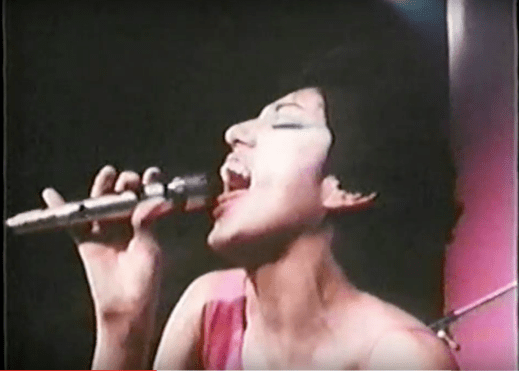
Screenshot from Alice Bag Band’s video “Gluttony.” Image used for purposes of critique.
Within Bag’s screaming from the Whiskey performance, Decline, to What We Do is Secret are snapshots or sonic/visual testimonios of queer Chicana women during the early 80s. These sonic snapshots/testimonios speak to the severely gendered and racialized repression of queer Chicana youth while still reconfiguring what empowerment looked like in the aftermath of the major socio-political movements of the 60s and 70s. In a casual conversation with Alice in a panel I guest moderated, she mentioned that watching “Gluttony” today was irksome to her because she was off-key. Perhaps, being off-key is one way that Chicana feminisms audibly reject neoliberal (and gendered) state repression. When we are surrounded by noise, we must remain enveloped in its infinite shape and simply listen. In noise we can resist, interrupt, and move away from orthodoxy and order. In today’s political climate, we need this framework now more than ever.
The return to Alice’s voice in this current moment is no coincidence. In preparation for this piece, I reflected on my brother’s deployment to Iraq during George W. Bush’s term. I was in community college taking a music appreciation course and I was searching for a paper topic that would be palatable to me as both a newly politicized queer Chicana and a former regular in the South Gate punk scene. It was through an interview with Teresa Covarrubias of The Brat and Alice Bag in an issue of Los Angeles Magazine that I heard Alice’s scream for the first time. It was the description of these women’s careers that led me to look up Chicana punk and come across the Whiskey performance of “Violence Girl.” To this day, Alice’s voice reminds us that if “Alice Bag was born from chaos” (310) then the Chicana punk voice remains a testament to punk’s resilience in the face of political uncertainty.
–
Featured image “Alice Bag Performing at Club Lingerie with the Cambridge Apostles” (CC BY 2.0)
–
Marlen Ríos-Hernández is a Ph.D. Candidate in the Ethnic Studies Department at the University of California, Riverside. Her current research revolves around queer Chicana/Mexicana punks in Mexico and Los Angeles from 1977-early 2000s respectively. Her dissertation aims to theorize and argue how Alice Bag, an innovator of the 1970s Los Angeles punk scene alongside other Mexicana punks, utilized noise to correlate the systemic disenfranchisement of womxn of color with the desire for transformational change integral to the survival of Mexicanas and first generation Chicana womxn especially during the Reagan and Bush Administrations. Via Ethnic Studies as her area of study along with her humanities and arts training as a Musicologist, Marlen investigates the relationship between unruly Chicana/Mexicana performing bodies and bisexuality, swapmeets, police brutality, photography, and film as instruments of noise-making.
–
 REWIND! . . .If you liked this post, you may also dig:
G.L.O.S.S., Hardcore, and the Righteous White Voice – Chris Chien
Feeling Through the Keen and Grind: Team Dresch’s Personal Best – Gretchen Jude
Riot-Grrrl, Punk and the Tyranny of Technique – Tamra Lucid
Share this:


Current Top Posts





April 2021

January 2020

November 2019

October 2019

August 2019

April 2014

November 2017

March 2015

December 2017

October 2015
 Sounding Out!
Recent Comments