
Listening to Robots Sing: GarageBand on the iPad
 I recently had the opportunity to fool around with the iPad2’s new GarageBand suite. Enticed by the intuitive touch interface I soon found myself lost within the device’s labyrinthine architecture. Every poke, prod and press brought me to a new screen with a bevy of exciting options. A touch to create a drum loop, a tickle to evoke some reverb, and a brush to strum a guitar. I was one with the machine; it was a truly cybernetic, kinesthetic moment. This may sound naïve, but I had never realized how many tools were available to electronic musicians, or how intuitive using these tools could be. As digital tools to create music become more accessible and more intuitive, what is the role of the human in understanding their use? Further, what strategies can we adopt when listening to these creations?
This question may seem a bit outdated to those who have been researching post-humanist phenomena since the digital boom in the mid-nineties. Often conflicting perspectives regarding the negotiation of the human and the digital have been considered in the last decade or so. Some like Donna Haraway, Pierre Lévy, and even Ray Kurzweil offer particularly optimistic readings of the post-human (although for radically different reasons). While scholars like Nancy Baym and Jaron Lanier have offered decisively more sober readings of the problematic. They argue that splits between the human and post-human, or analog and digital are false dichotomies. Truth be told, none of the theorists above adequately address my feelings on this topic. Producing music with a digital audio suite makes me defensive of my humanism and it is by its very nature a project of preservation.
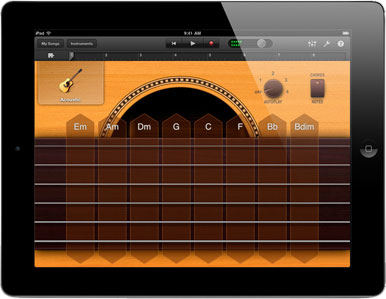 The algorithmic tools packaged within digital audio suites encourage a sense of aesthetic preservation. Tools like GarageBand’s Smart Guitar, Smart Drums, Smart Bass, various arpeggiators and Appleloops encourage the user to program music on a high level where the nuance of serendipity and improvisation play second fiddle to the overall sonic contours of a piece. Although the user is provided the tools to intervene and program music in a very specific way, it is by default a distinctly different experience than that of playing a guitar or piano. The ghost of the algorithm haunts such performances; reminding the user that these acts of spontaneous creation are no longer the default but deliberate…. This sense of deliberate improvisation forces me into a reflexive space where I am acutely aware of the mediations occurring within my performance. Succinctly, I must defend a sense of self within my creation. If I yield to the algorithms that seek to help me compose, I destroy all sense of the human within my work. Simply turning on robots and watching them sing.
For this reason, I propose an aesthetic of preservation as a way to understand the ways in which we listen to works created by digital audio suites. As algorithmic aids become more advanced and commonplace in music, the human becomes a less essential aspect of the form. Understanding what has been deliberately included in spite the seductive algorithmic environment is ultimately a project that seeks to recover the human in the machine; perhaps even, a project doomed from the start, as we grow ever closer to the means of our artistic production.
AT
Magnasanti – Check out the results of my collaboration with Colin Germain on GarageBand!


Share this:

Head Games?: The Strategic View of Liveness and Performance
When I tell people that I am an economist and a musician, they usually have one of two reactions. Either they tell me that I must be crazy, or conflicted—that the two things can’t possibly go together—or they immediately start talking about ticket prices, drops in CD sales, 360 deals. I however, refuse both stances. The connection that I see between what I study as an economist and how I perform as a musician is the element of strategy.
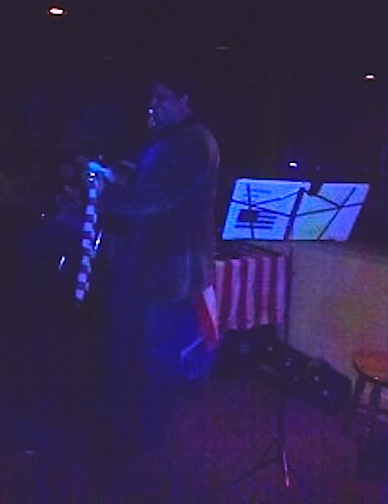
Andreas Pape performs at The Beef, Binghamton, NY, 10/16/10
Performance, in my view, is the willful construction of a series of events to create a particular mental state for the witnesses. This is the strategic view of performance. I am a game theorist, and game theory is the foundation of the strategic view. Game theory is based on the idea that games are a metaphor for human interaction generally. It is essentially the study of strategy: the chess player imagines different actions he can take, and imagines how his opponent will respond in each case, and uses those forecasts to make his original choice; that’s strategic thinking. In “Singing to my Imagined Listener,” I describe rehearsal as playing to an imagined audience member, judging her response, and adjusting accordingly. That is exactly the strategic view.
I got the opportunity to explore this synergy between live musical performance and economics in an intimate and visceral way a couple of weeks ago—February 9th, 2011, to be exact—when I was asked to speak to a small group of students at Binghamton University who study live performance in an English course called “Representation and Popular Music” taught by Jennifer Stoever-Ackerman. I thought I would reproduce some of that talk here, via video clips, in order to breathe elements of aurality and liveness into the words that follow, which meditate on strategic differences between liveness and recording in the game that we call music.
But first, a song.
In this clip, I play the guitar and harmonica and sing a song of mine called “Sittin’ on the Mailtrain.” I strategically start off with a song that has a jarring chord in each line: my intent is to make the audience feel a bit uncomfortable with this shared live experience, so that they are more inclined to look at it with fresh eyes. At minute 7:45, I point out that I am giving a live performance to those in the room, and recording to those in the future. That’s you. As I say at minute 8:07: “There’s an audience here, in the room, and there is an audience out there in the future, who are experiencing this, but clearly in a different way than you are experiencing it.”
And, I think that you are. Even now. However self-aware and live-esque, this recorded object cannot reproduce the physicalness and immediacy of performance.
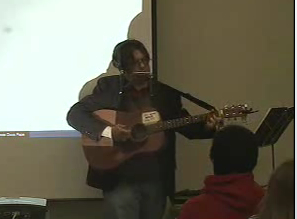
Performance is standing in front of people, feeling nervous or confident, holding a guitar, forming words, reading faces, projecting to the back of the room or getting quiet. Performance is hitting taut strings pulled across a wooden box at specific times and with a certain speed, vibrating vocal chords in a certain way, holding ones hands out to make a point, or inhaling a wail out of a blues harp. It is a series of events that are a part of a human life, in the sense that life is a series of physical moments. Agency in that visceral present moment is the essential difference between live performance and recording. Like Kathleen Hanna (frontwoman of Bikini Kill, Julie Ruin, and Le Tigre) wrote in “On Not Playing Dead” in 1999, “[O]ne thing I do as a performer is to stay physically present on stage, and that means being in the now. (Oh my god, I sound like such a hippie.)”
Halfway through my talk, however, my computer interjects with a pre-programmed dialogue that complicates Hanna’s claims. Watch here:
“Excuse me, I’d like to make a point,” my computer says aloud, for all to hear. “I felt it was important to point out that this is not exactly a live event. This is a recording, in some way.”
“Sure,” I reply, according to script.
“You typed this in to simulate this conversation that you’re having right now.”
“Yes,” I reply, “it’s scripted. Did anyone not know this was scripted?” I look questioningly at the students assembled in front of me.
“But this [lecture],” my computer points out, “is basically a recording. It’s an encoding of a particular process. So [the] physical body and mind [of the performer] decodes this script into a process, just like the CD player decodes the CD into a process! So how is this performance not a recording?”
“A recording encodes a performance, and a performance decodes a recording,” I say.
There is a strong way that any “live” performance has a recorded aspect to it and vice versa. The decoding of a CD is a performance, akin to my live performance. My computer worked from a script in the computer science sense—a set of essentially English-language commands that it followed to reconstruct a set of sounds. That is not a traditional recording, in that it is not direct storage of sound waves in magnetic tape or record grooves. However, it is functionally a recording: the user presses a button and a predictable and pre-specified series of sounds emerge.
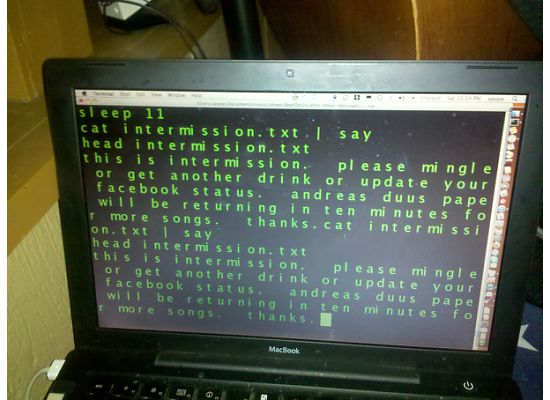
The Computer Performs its Script, The Beef, Binghamton, NY, October 16, 2010
If we agree that this computer script is a recording in this sense, then we are compelled to accept the next step—that if I, a human, am following a script, that I, too, am simply decoding a recording. That is, I had an idea about how “Sittin’ on the Mailtrain” would go and this idea was necessarily encoded in my mind; then I unpacked this encoding by arranging physical objects, namely my fingers and my voice, to create a song. The song followed an encoding in my head, like when you put a CD in a CD player. The encoding is unpacked, and ultimately results in the same thing: some vibrating object that vibrates the air which then vibrates the audience’s ears in a relentlessly physical way.
The future of performance lies in acknowledging the interrelationship of liveness and recording and further blurring the boundaries between them. The podcasts produced by the lo-fi movement are a key part of this new relationship. I am part of this artistic movement, which asserts the primacy of performance over recordings while also using recording technology to foster and promote liveness. Lo-fi’s hallmarks are: smaller numbers of performers in groups (often solo acts), an emphasis on live recordings complete with audience noise, low production quality (“Background hiss”), and a large number of recordings that often include many versions of the same song. The primacy of performance means the definitive versions of lo-fi songs are not located in recordings that live performances then try (and often fail) to recreate. Rather, the most recently performed version is the “master.” The performance you just watched of the song “Sittin’ on the Mailtrain” for example, was the most definitive version on February 9th. Today just may bring a new definitive version.
Lo-Fi Picture of Pape performing at The Beef, Binghamton, NY 10/16/10
In the aesthetics of the lo-fi movement, the life of the performer is treated not as a series of objects, but rather a series of events, which can be attended or subscribed to, like a podcast. No doubt, each episode is recorded, and the audience receives it as a recording. However, these recordings are meant to be listened to once or twice and let go; they are intended to be ephemeral. A podcast, when viewed as a process over time rather than a possession, is no doubt a performance; the audience can respond from one episode to the next via comments, email, Twitter, etc. and the performer can react. What you are reading and viewing here is simultaneously a lo-fi recording event and a lo-fi performance. This. This blogpost, you reading it, the videos you can watch and listen to, my comments on it here, your comments below that you can post, you sharing it on Facebook or Twitter. You can even follow the traces of this performance through my own Twitter feed.
Strategically, I think the podcast model is the next logical step in the Lo-fi aesthetic. Standup comedy (one of my favorite kinds of live performance) is making this transition as we speak. The old model for the young comedian was to develop “an act” that one (hopefully) toured with, perhaps releasing a comedy CD or landing a role on a sitcom. The new model is a couple of comics releasing a conversational podcast once a week, responding to their biggest fans, giving a raw, intimate, unpolished performance of improvisational humor and riffing, and convincing their fans to become members; a membership that occasionally awards the listener with additional content, but more often only a sense of satisfaction that one gets from supporting something one loves. See, for example, the podcast “empire” of Jesse Thorn at maximumfun.org which includes live comedy podcasts, or the political humor of wearecitizenradio.com, which is also member-supported. What’s interesting, here, is that a pure donation podcast model is enough for some comics to make a living. Ironically, using recording to give primacy to performance, serves the artist. Yesterday’s recording can be taken away from the artist, but tomorrow’s performance cannot.
As for my own future? My own “tomorrow’s performance”? On February 25, 2011, at the Eastern Economics Association Meetings, I will perform a similar event, called this time “Rhetoric, Choice Theory, and Performance.” I will perform music and discuss the strategic view. Economists are not used to thinking seriously about performance nor are they used to thinking seriously about sound. I intend to change that, one strategic moment at a time.
Additional footage in which I define strategy and game theory, and discuss what the strategic view of performance has to say about my references to Dylan and Guthrie:

Share this:


Current Top Posts





April 2021

January 2020

November 2019

October 2019

August 2019

April 2014

November 2017

March 2015

December 2017

October 2015
 Sounding Out!
Recent Comments