
Remixing Girl Talk: The Poetics and Aesthetics of Mashups
DOI: https://doi.org/10.59350/f6qpv-xb974
Peter DiCola’s analysis of Girl Talk is astute, on point, and insightful. So instead of quibbling with him about arcane or subjective matters, I’ll try to add a bit of aesthetic and cultural analysis to his legal and procedural observations.
Improvising vs. Composing
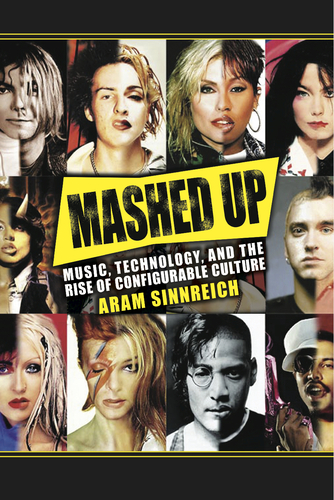
First of all, it’s important to point out that Girl Talk is not a typical mashup artist, and in fact many of the DJs I interviewed for my book Mashed Up: Music, Technology, and the Rise of Configurable Culture (University of Massachusetts Press, 2010) don’t really view him as one of their own. This isn’t simply because he exceeds the standard, 2-song “A plus B” technique that serves as a basic template for the form; after all, Osymyso was mashing together hundreds of songs at a time back in the early 2000s, and he’s downright canonical. Rather, it’s because Girl Talk is more improvisatory, and less formalistic, than most other mashers.
Of course, improvisation has been a central element of DJing at least since Kool Herc first started beat juggling between two decks. And some contemporary mashup DJs, like Z-Trip and TradeMark G, are rooted in live, on-stage improvisation. But these are the exceptions, not the rule. If sample-based music describes a spectrum between what we traditionally think of as performance and composition, the vast bulk of mashup artists tend to see themselves on the composition side of the fence. They assemble the mashup in the studio, then play it “as is” in the club, just as they would play any other record. As DJ Earworm told me, “a good mashup artist is a good composer. Because, you know, you’re moving these parts around and giving it new form.” While Girl Talk certainly lives up to this description on albums such as “All Day,” his live, improvisatory performances are something else altogether.
Mashup vs. Cut-up
An interesting point DiCola raises is the prevalence of what he calls the “name-that-tune” critique of the mashup aesthetic, the claim that they “have no intertextuality or deeper meaning.” Not only is this claim unjustified, it completely misses the point. The problem is, these critics think of mashups as simply another example of paper-thin postmodernism. This couldn’t be further from the truth; in fact, you could call mashups post-postmodern.
To illustrate my point, let’s take a look at an earlier art form that looks a lot like mashup at first glance: the cut-up. Cut-ups were a kind of literary collage popular among avant-garde writers like William Burroughs and Brion Gysin in the mid-20th century. As the technique’s name suggests, writers would cut existing, finished texts into pieces, and then tape them back together in random fashion, thus generating surprising and provocative new juxtapositions and grammatical logics. The cut-up was the very essence of postmodernism: it aimed to disrupt the “master narrative” of linear thought and force the reader to confront its limits head-on. In other words, it was a reaction to, and an inoculation against, high modernism.
Mashups use similar techniques to achieve the opposite effect. We no longer live in a modern world, in which all information is forced to hew to a single, objectified model of reality. Postmodernism has not only successfully exposed and disrupted the hidden power dynamics of the master narrative, but produced a cultural environment in which an endless parade of symbols float unmoored in a sea of chaos and contradiction. The role of the mashup is to restore some semblance of order to this maelstrom, by stitching together the disparate symbols with a genealogical thread. Every sample in a mashup means something, and brings its entire cultural history trailing behind it. Thus, while the cut-up is named for its ability to sever signifier from signified, the mashup is named for its power to suture them back together (albeit in different combinations and permutations). This is the point that critics miss: the mashup isn’t an expression of postmodern nihilism, but an argument against it.
Whither Originality?
The final point of DiCola’s I’ll touch upon is the concept of originality, as it applies to a cultural form that consists entirely of “borrowed” work. As he observes, the question of whether a given mashup is original or not is almost moot when it comes to questions of transformativity and “fair use”; the very fact that people argue about it demonstrates that creative forces are at work.
Yet it’s also interesting to look at how the originality arguments play out. I devote an entire chapter of Mashed Up to exploring the various techniques DJs employ to differentiate between innovative and derivative work, as well as the ways in which they’ve moved beyond the distinction altogether. Commonly cited markers of originality in mashups include: how well a DJ selects his source materials; how the samples are arranged, both spatially and temporally; how the samples are transformed using digital processing techniques; and even textual interplay between the lyrics of the songs he’s chosen. In combination, these factors can describe a given DJ’s “signature” style, as distinctive as a saxophonist’s phrasing and tone, or a rapper’s rhyme and flow.
One could spend countless hours dissecting the mashup aesthetic and debating its legalities, and having done so myself, I can attest that it’s time well spent. Ultimately, however, the form’s significance outstrips even these weighty dimensions of analysis. What makes the mashup most interesting to me isn’t the question of what an individual work means, or whether it’s legitimate in the eyes of the copyright office, but rather how it’s produced (and reproduced) in the first place.
Our mode of musical production is always a harbinger of social changes to come, and the mashup has a lot to say about what lies in store for us as a globally connected, digital society. By blurring the lines between artist and audience, original and copy, the mashup fundamentally rejects the atomistic assumptions that undergird our legal, economic and political institutions. The millions of people who participate in the process of re-imagining a song comprise a kind of “collective subjectivity” as cohesive and amorphous as a storm cloud, and like a cloud, their actions only have meaning in aggregate.
This is why analyses that focus on a DJ like Girl Talk as though he’s a radical innovator or lone copyright renegade always tend to leave me cold. As Girl Talk himself would be the first to admit, his work neither begins or ends on his laptop; at best, he’s a highly entertaining conduit for an infinitely larger and more complex process. Or, to use his words (as I did in the epigraph to Mashed Up), “This shit is not about me, it’s about all of us, ’cause we’re the same motherfuckin’ person.”
—
Aram Sinnreich
—
Share this:

Can You Hear Me Now?

DOI: https://doi.org/10.59350/zc0jb-kgr76
And Gil-Scott Heron thought the revolution would not be televised.
The past few weeks the world has been watching the protests in Egypt. We have not just watched, but we have also tuned in. This is history in the making, especially considering that many of the information we are getting of this protest movement come from the ground, from the protesters themselves, and their requests have gone viral on Youtube and Twitter.
Earlier this week, I was watching CNN and its coverage of the protesters at Tahrir Square after Mubarak’s statement that he would not step down. On several occasions the broadcasters on CNN asked viewers to listen to protesters. The grainy images of the mobile crowds had been playing in the background all afternoon, a reminder of what was going on while the broadcasters offered information and analysis. But at times the broadcasters stopped speaking so viewers could listen to the crowds. The grainy images emitted a dull roar, the combination of all of the cries and statements from the protesters. The cameras followed people down streets, but the roar was constant. It struck me how often the plea to listen came up during the broadcast. On Friday, when Mubarak resigned, I tuned in online (from work) to CNN, MSNBC, and BBC America. The broadcasters made the same requests: let’s tune in to the crowds at Tahrir Square. See early in this MSNBC video where Brian Williams encourages viewers to listen to the protesters:
The newsmedia seemed to offer the sounds to its viewers, but what is at stake when that happens? How are the sounds being coded? Mark Branter’s post on sound and sanity in the context of the Rally to Restore Sanity (which took place on October 30th 2010), reminds us that oftentimes noise and screaming is connected to “irrationality and fear.” He points out, “Public noise is senseless sound, while rational debate is meaningful sound.” In this context, the constant plea from newscasters for the American public to “listen in” to the crowds at Tahrir Square takes a different spin. Are we insiders looking at the Other scream and shout? When the newscasters ask us to tune in to the pleas and screams coming from the Egyptian crowds I wonder if the newscasts frame them as senseless crowds because of the way that they present these sounds. In any instance, this presentation of sound is not innocent. Some may argue that it is just a request from Western media to pay attention to what the crowds are saying, but I believe that we cannot truly listen to their cries on Tahrir Square when we still hold in place this analogy of “sound/noise::rationality/irrationality.” Many agreed that Mubarak should listen to the pleas of the crowds, but are we listening to them as well?
The coverage of the Egyptian protests shows us how complicated listening is. The protesters are not just seen but heard (only when the network wants the viewers to listen, mind you) by viewers. The sonic aspect of this movement is reinforced when we think of the “Speak-to-Tweet” service, set up to allow Egyptian protesters to tweet when the Egyptian government turned off all internet communication. We could read AND hear what the protesters were saying.
When media outlets choose to tune in to the protests in Egypt, this is an example of how important sound is to narratives. Visuals are not the only story, is what I get from the protest coverage. (And letting the world hear the protesters is a step in the right direction.) The coverage and its inclination toward the audio of the protesters tells me that it’s not just a matter of shock value but it’s also a statement of the role of audio in the news. It’s supposed to be a reflection of what is going on at the moment, like taking the temperature of the crowds. As others have said on this blog (for example, Priscilla Peña Ovalle) sound is usually linked to the visual, and the hierarchy of senses in our society always has the visual as the most important. Listening is important, but we must also think about how we listen, and what filters the sounds we listen to.
Liana Silva
Share this:




Current Top Posts





April 2021

January 2020

November 2019

October 2019

August 2019

April 2014

November 2017

March 2015

December 2017

October 2015


Recent Comments