
Me & My Rhythm Box

I’m fortunate to have quite a few friends with eclectic musical tastes, who continually expose me some of the best, albeit often obscure, sources for inspiration. They arrive as random selections sent with a simple “you’d appreciate this” note attached. Good friends that they are, they rarely miss the mark. Most intriguing is when a cluster of things from different people carry a similar theme, converging to a need on my part for some sort of musical action.
The Inspiration
A few years back I received a huge dump of gigabytes of audio and video. Within it were some concert footage and performances this friend and I had been discussing; I consumed those quickly in an effort to keep that conversation going. Tucked amidst that dump however, was a copy of the movie Liquid Sky. I asked the friend about it because the description of the plot–“heroin-pushing aliens invade 80’s New York”–led me to believe it wasn’t really my thing (not a big fan of needles). Although my friend insisted I’d enjoy it, it took me several months if not a whole year before I finally pressed play.
Even though Liquid Sky was not my favorite movie by any measure, it was immediately apparent to my ears why my friend insisted I check it out. The film’s score was performed completely on a Fairlight CMI, capturing the synthesized undercurrent of the early 80’s New York music scene, more popularly seen in the cult classic Downtown 81, starring Jean Michel Basquiat. While the performances in that movie are perhaps closer to my tastes, none of them compare to one scene from Liquid Sky that I fell in love with, instantly:
The song grabbed me so much, I quickly churned out a cover version.
Primus Luta “Me & My Rhythm Box (V1)”
While felt good to make, there remained something less than satisfying about it. The cover had captured my sound, but at a moment of transition. More specifically, the means by which I was trying to achieve my sound at the time had shifted from a DAW-in-the-box aesthetic to a live performance feel, one that I had already begun writing about here on Sounding Out! in 2013. Interestingly, the inspiration to cover the song pushed me back to my in-the-box comfort zone.
It was good, but I knew I could do more.
As I said, these inspirations tend to group around a theme. Prior to receiving the Liquid Sky dump, I had received an email out of the blue from Hank Shocklee, producer and member of the Bomb Squad. I’ve been a longtime fan, and we had the opportunity to meet a few years prior. Since then he’s played a bit of a mentoring role for me. In the email he asked if I wanted to join an experimental electronic jazz project he was pulling together as the drummer.
I was taken aback. Hank Shocklee asking me to be his drummer. Honestly, I was shook.
Not that I didn’t know why he might think to ask me, but immediately I started to question whether I was good enough. Rather than dwell on those feelings, though, I started stepping up my game. While the project itself never came to fruition, Shocklee’s email led me to building my drmcrshr set of digital instruments.
 A year or so later, I ran into Shocklee again when he was in Philadelphia for King Britt’s Afrofuturism event with mutual friend artist HPrizm. By this time I had already recorded the “Me and My Rhythm Box” cover. Serendipitously, HPrizm ended up dropping a sample from it in the midst of his set that night. A month or so later, HPrizm and I met up in the studio with longtime collaborator Takuma Kanaiwa to record a live set on which I played my drmcrshr instruments.
Not too long after, I received an email from NYC-based electronic musician Elucid, saying he was digging for samples on this awesome soundtrack. . .Liquid Sky.
The final convergence point had been hanging over my head for a while. Having finished the first part of my “Toward a Practical Language series on Live Performance” series, I knew I wanted the next part to focus on electronic instruments, but wasn’t yet sure how to approach it. I had an inkling about a practicum on the actual design and development of an electronic instrument, but I didn’t yet have a project in mind.
As all of these things, people, and sounds came together–Liquid Sky, Shocklee, HPrizm, Elucid–it became clear that I needed to build a rhythm box.
The History
What stands out in Paula Sheppard’s performance from Liquid Sky is the visual itself. She stands in the warehouse performance space surrounded by 80’s scenesters posing with one hand in the air, mic in the other while strapped to her side is her rhythm box, the Roland CR-78, wires dangling from it to connect to the venue’s sound system. She hits play to start the beat launching into the ode for the rhythm machine.
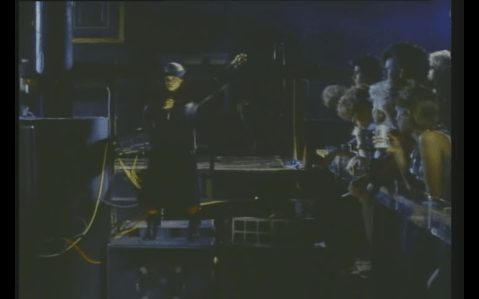
Contextually, it’s far more performance art than music performance. There isn’t much evidence from the clip that the CR-78 is any more than a prop, as the synthesizer lines indicate the use of a backing track. The commentary in the lyrics however, hone in on an intent to present the rhythm box as the perfect musical companion, reminiscent of comments Raymond Scott often made about his desire to make a machine to replace musicians.
My rhythm box is sweet
Never forgets a beat
It does its rule
Do you want to know why?
It is pre-programmed
Rhythm machines such as the CR-78 were originally designed as accompaniment machines, specifically for organ players. They came pre-programmed with a number of traditional rhythm patterns–the standards being rock, swing, waltz and samba–though the CR-78 had many more variations. Such machines were not designed to be instruments themselves, rather musicians would play other instruments to them.
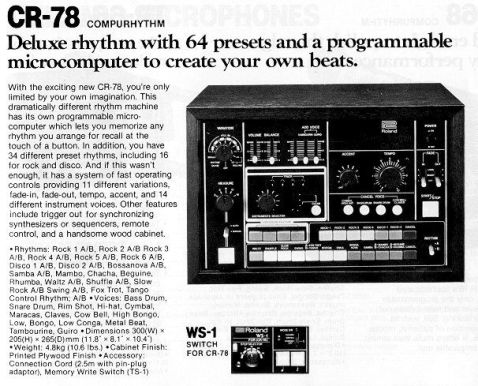
In 1978 when the CR-78 was introduced, rhythm machines were becoming quite sophisticated. The CR-78 included automatic fills that could be set to play at set intervals, providing natural breaks for songs. As with a few other machines, selecting multiple rhythms could combine patterns into new rhythms. The CR-78 also had mute buttons and a small mixer, which allowed slight customization of patterns, but what truly set the CR-78 apart was the fact that users could program their own patterns and even save them.

TR-808 (top) and TR-909
By the time it appeared in Liquid Sky, the CR-78 had already been succeeded by other CR lines culminating in the CR-8000. Roland also had the TR series including the TR-808 and the TR-909, which was released in 1982, the same year Liquid Sky premiered.
In 1980 however, Roger Linn’s LM-1 premiered. What distinguished the LM-1 from other drum machines was that it used drum samples–rather than analog sounds–giving it more “real” sounding drum rhythms (for the time). The LM-1 and its predecessor, the Linn Drum both had individual drum triggers for its sounds that could be programmed into user sequences or played live. These features in particular marked the shift from rhythm machines to drum machines.
In the post-MIDI decades since, we’ve come to think less and less about rhythm machines. With the rise of in-the-box virtual instruments, the idea of drum programming limitations (such as those found on most rhythm machines) seems absurd or arcane to modern tastes. People love the sounds of these older machines, evidenced by the tons of analog drum samples and virtual and hardware clones/remakes on the market, but they want the level of control modern technologies have grown them accustomed to.
Controlling the Roland CR-5000 from an Akai MPC-1000 using a custom built converter
The general assumption is that rhythm machines aren’t traditionally playable, and considering how outdated their rhythms tend to seem, lacking in the modern sensibility. My challenge thus, became clearer: I sought out to build a rhythm machine that would challenge this notion, while retaining the spirit of the traditional rhythm box.
Challenges and Limitations
At the outset, I wanted to base my rhythm machine on analog circuitry. I had previously built a number of digital drum machines–both sample and synthesis-based–for my Heads collection. Working in the analog arena allowed me to approach the design of my instrument in a way that respected the limitations my rhythm machine predecessors worked with and around.
By this time I had spent a couple of years mentoring with Jeff Blenkinsopp at The Analog Lab in New York, a place devoted to helping people from all over the world gain “further understanding the inner workings of their musical equipment.” I had already designed a rather complex analog signal processor, so I felt comfortable in the format. However, I hadn’t truly honed my skills around instrument design. In many ways, I wanted this project to be the testing ground for my own ability to create instruments, but prior experience taught me that going into such a complex project without the proper skills would be self defeating. Even more, my true goal was centered more around functionality rather than details like circuit board designs for individual sounds.
To avoid those rabbit holes–at least temporarily, I’ve since gone full circuit design on my analog sound projects–I chose to use DIY designs from the modular synth community as the basis for my rhythm box. That said, I limited myself to designs that featured analog sound sources, and only allowed myself to use designs that were available as PCB only. I would source all my own parts, solder all of my boards and configure them into the rhythm machine of my dreams.
Features
The wonderful thing about the modular synth community is that there is a lot of stuff out there. The difficult thing about the modular synth community is that there’s a lot of stuff out there. If you’ve got enough rack space, you can pretty much put together a modular that will perform whatever functionality you want. How modules patch together fundamentally defines your instrument, making module selection the most essential process. I was aiming to build a more semi-modular configuration, forgoing the patch cables, but that didn’t make my selection any easier. I wanted to have three sound sources (nominally: kick, snare and hi-hat), a sequencer and some sort of filter, which would all flow into a simple monophonic mixer design of my own.
For the sounds I chose a simple kick module from Barton, and the Jupiter Storm unit from Hex Inverter. The sound of the kick module was rooted enough in the classic analog sound while offering enough modulation points to make it mutable. The triple square wave design of the Jupiter Storm really excited me as It had the range to pull off hi-hat and snare sounds in addition to other percussive and drone sounds, plus it featured two outputs giving me all three of my voices on in two pcb sets.
Filters are often considered the heart of a modular set up, as they way they shape the sound tends to define its character. In choosing one for my rhythm machine the main thing I wanted was control over multiple frequency bands. Because there would be three different sound sources I needed to be able to tailor the filter for a wide spectrum of sounds. As such I chose the AM2140 Resonant Filter.
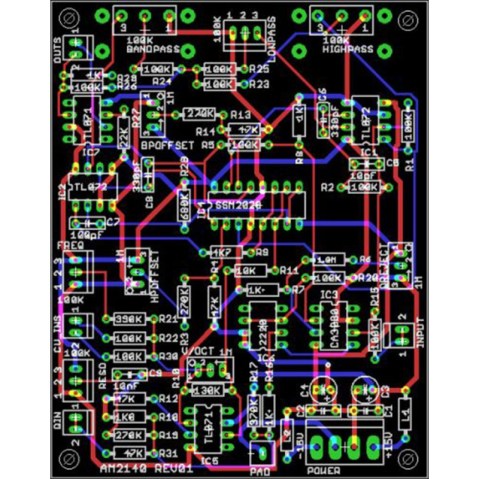
I had no plans to include triggers for the sounds on my rhythm machine so the sequencer was going to be the heart of the performance as it would be responsible for any and all triggering of sounds. Needing to control three sounds simultaneously without any stored memory was quite a tall order, but fortunately I found the perfect solution in the amazing Turing Machine modules. With its expansion board the Turing machine can put out four different patterns based on it’s main pattern creator which can create fully random patterns or patterns that mutate as they progress.
The Results
I spent a couple of weeks after getting all the pcb’s parts and hardware together, wiring and rewiring connections until I got comfortable with how all of these parts were interacting with each other. I was fortunate to happen upon a vintage White Instruments box, which formally housed an attenuation meter, that was perfect for my machine. After testing with cardboard I laid out my own faceplates, which and put everything in the box. As soon as I plugged it in and started playing, I knew I had succeeded.
Early test of RIDM before it went in the Box
I call it the RIDM Box (Rhythmically Intelligent Drum Machine Box). I’ve been playing it now for over two years, to the point where today I would say it is my primary instrument. Almost immediately afterward I built a companion piece called the Snare Bender which works both as a standalone and as a controller for the RIDM Box. That one I did from scratch hand wired with no layouts.
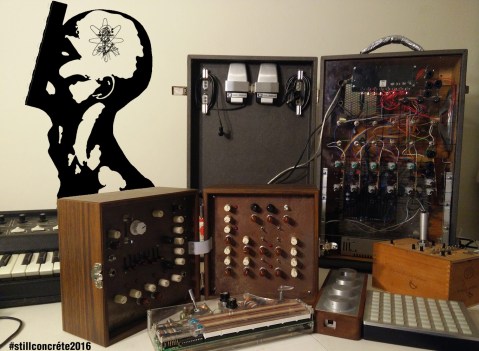
While this is by no means a standard approach to modern electronic instrument design (if a standard approach even exists), what I learned through the process is really the value of looking back. With so much of modern technology being future forward in its approach, the assumption is that we’re at better starting positions for innovation than our predecessors. While we have so many more resources at our disposal, I think the limitations of the past were often more conductive to truly innovative approaches. By exploring those limitations with modern eyes a doorway opened up for me, the result of which is an instrument like no other, past or present.
I will probably continue playing the two of these instruments together for a while, but ultimately I’m leaning toward a new original design which takes the learnings from these projects and fully flushes out the performing instrument aspect of analog design. In the meantime, my process would not be complete if I did not return to the original inspiration. So I’ll leave you with the RIDM Box version of “Me & My Rhythm Box”—available on my library sessions release for the instrument.
—
Primus Luta is a husband and father of three. He is a writer and an artist exploring the intersection of technology and art, and their philosophical implications.
—
 REWIND!…If you liked this post, you may also dig:
Heads: Reblurring The Lines–Primus Luta
Into the Woods: A Brief History of Wood Paneling on Synthesizers*–Tara Rodgers
Afrofuturism, Public Enemy, and Fear of a Black Planet at 25—andré carrington
Share this:

From “listening” to “filling in”: where “La Soeur Écoute” Teaches Us to Listen


Editor’s Note: Welcome to the second installment in the “DH and Listening” blog series for World Listening Month, our annual forum that prompts readers to reflect on what it means to listen. This year’s forum considers the role of “listening” in the digital humanities (DH, for short). We at Sounding Out! are stoked to hear about (and listen to) all the new projects out there that archive sound, but we wonder whether the digital humanities engage enough with the the notion of listening. After all, what’s a sound without someone to listen to it?
Next week Fabiola Hanna will be reflecting upon what DH means when it talks about participatory practices. Jacqueline Wernimont from the Vibrant Lives team shared with us last week about the ethics of listening to 20th century sterilization victims’ records. Today, Emmanuelle Sonntag introduces us to a figure from a long time ago, “la soeur écoute,” a nun whose was responsible for sitting in and listening when another nun had a visitor. As she reflects on this nun’s job, she senses her notion of listening (especially in the context of the digital) change.
Sit down, fade into the background, and listen closely. Mother Superior will want all the details.–Liana Silva, Managing Editor
—
Who is she?
At the beginning of my doctoral research on listening, while I looked in French dictionaries for the word “écoute” I came upon, almost systematically, the expression “soeur écoute.” For example, this dictionary says “soeur écoute” is a nun who, in a monastery, accompanies in the parlor room another nun who gets visited.
This is how I met this cloistered nun called “la soeur écoute” (literally, “the sister listening”, or “sister listen”, if a literal translation has any sense here). The term is “vieilli” (outdated), as written in the dictionaries, but strangely, they insist on mentioning her again and again, even in 2016 editions. She is a listener, just as you would say, “I’m a librarian”. However I prefer to say “she is listener”, without the “a”, even if it is not proper English. In French, elle est écoute, and believe me, this resonates amazingly. To me, the “soeur écoute” is a fascinating woman because her activity has ceased to exist in monasteries, allowing me to imagine her experience, behavior, life and occupation as a cloistered nun.
Here she is at work. A visitor is knocking on the monastery’s door — can you hear it? The “soeur écoute” welcomes the visitor and leads him/her through the place until they reach the parlor. The room is divided in two spaces by a metal or wooden grille, the sacred one and the secular one. The “soeur écoute” has the visitor sitting in front of the grille, on the secular side of the room. On the other side, the nun who is being visited is already sitting, waiting for the “soeur écoute” to pull aside the curtain that hides the grille. The “soeur écoute” then sits next to the visited nun, slightly in the background. During the conversation, she neither speaks nor moves nor takes any notes. She just listens. When the session is finished, she closes the curtain and leads the visitor to the exit. Later, she promptly reports what she heard to the mother abbess.
The word “écoute” has three moments in its evolution over time (of course with some overlapping). In order: someone, somewhere, something. “Someone” refers to the 12th century (“écoute,” as a person, is attested in France at the beginning of this century), and “somewhere” to the 15th (meaning the place from where you listen). Then, listening considered as “something” (the “thing” you must have to be able to hear attentively) goes back the 19th. In our common comprehension of what listening is, we are now entirely in the “something” part, with no overlapping at all. For my research, the minute I started to look at my “object” as a “person,” my thinking shifted. The “soeur écoute” rung a bell: we are in the “something” timeframe of the notion of listening, and this could blind us in our comprehension of what listening in 2016 really is.
Listening Behind Bars
Firstly, the “soeur écoute” is also called, in some sources, “auscultatrice.” For example, I found a mention (with a missing “t”) of such nuns in a primary source of 1705 concerning the Ursulines de la Congrégration de Paris. The document tells neither how the “auscultatrice” should behave, nor the technical rules to apply, such as the distance between the grille and the visited nun, or the distance between the “auscultatrice” and the visited nun. But it does indicate how the visited nun should behave with her. In the section called “De la manière dont les Religieuses se doivent comporter au Parloir” (How nuns must behave in the parlor), we read:
 Règlemens des religieuses Ursulines, 1705, p. 95.
“They will be humble and reserved in their behavior. They will avoid inappropriate gestures, as well as the distraction of sight, bursts of laughing, speaking loudly or impetuously, although they always are expected to speak in an intelligible way, so that the auscultatrice can hear them” (my translation).
The term “auscultatrice” is reminiscent of the very roots of the word “écoute,” the Latin auscultare, a combination of “(…)auris, a word that gives the first part of the verb auscultare,” and “a tension, an intention and an attention, which the second part of the term marks’, as the French philosopher Jean-Luc Nancy explains.
In the case of the Ursulines, it is a paradox, as the word “écoute” had been used since the 12th century, and the expression “soeur écoute” commonly used since the end of the Middle Ages. I suspect a marketing reason here: “auscultatrice” sounds much more strict and in-depth than “soeur écoute,” providing the idea of a pure and original listening, if not conservative.
Second, the “soeur écoute” is part-time. A primary source dating of 1628, in a 1876 book, mentions 25 nuns interviewed about their occupations inside the Sainte-Praxède monastery. Seven among them claim to be or to have been “auscultatrice” (p. 52–54, 193, 198, 212, 234). All of them double it up with another job, such as nurse or organist. Some of them also claim being “auscultatrice de la porte” (auscultatrice of the door) or “auscultatrice du parloir” (auscultatrice in the parlor). The grille, the door and her body (when she strides along the monastery), are her work instruments, her listening prostheses.
Third, the “soeur écoute” appears to have amazing skills. In the Dictionnaire françois, by Pierre Richelet (1680), she is called “tierce”, meaning she is the third element in the triangle of the setting in the parlor, hence, a mediation :
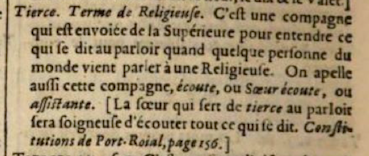
Dictionnaire françois, 1680, p. 448
Also, the plural “ÉCOUTES“ (written in capital, as to demonstrate a precedence on the singular form) : “this word is used to designate people placed to listen and to discover what is happening” (my translation).
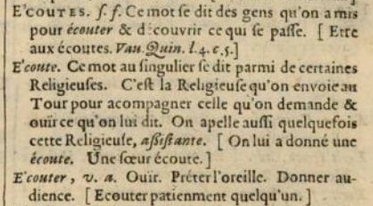
Dictionnaire françois, 1680, p. 265
She indeed has an ability to discover what is happening, by watching, observing, monitoring, keeping an eye, but also by aggregating the data she is collecting.
The parlor in motion
As I was writing a few pages devoted to the “soeur écoute” for my dissertation, I stumbled upon an oral history documentary,funded by the Illinois Humanities Council, called Chosen (Custody of the Eyes). As Abbie Reese describes on her website, it is “a collaborative documentary film — a portrait made with and about a young woman transitioning into a cloistered religious community that follows an ancient rule.” Reese explains:
The severity of their lives is striking. During the four visits permitted each year, the nuns and their loved ones are separated by a metal grille and are not supposed to reach through the bars to touch one another.
Today, this order, as others, uses “extern sisters” to provide the link with the outside world.
Intrigued by this grille, reminiscence of the “soeur écoute,” I watched the 8-minute demo and was stricken by two moments. The first one, at 2:20, shows Abbie Reese in the parlor, with a computer, in front of the metal grille. Behind it, one of the cloistered nuns reaches the computer through the bars in order to plug in a cable. At 07:55, this time from the point of view of the Poor Clare nuns, we see the parlor with the grille covered by a green curtain. A nun walks in, pulls aside the curtain. Then, at 08:02, from the secular side again, a nun closes the curtain while saying : “you can turn it off!”.
What did we just witness? A cloistered contemplative nun reached through a metal grille to transfer some video files into a computer. It is here, around this gesture, that I see digital humanities coming into the picture along with listening. Of course I’m not building a case on the cable itself, or on the video files. It is the gesture more than anything else that draws my attention: the exact moment where the nun reaches the computer through the bars.
A surveilled sequence of events
As it comes from the outside world, by definition a visit to the monastery disturbs the extremely scheduled sequence of events and rules giving rythm to the monastery’s life. From this point of view, the “soeur écoute” is the only one, in the enclosure of the monastery, in power of keeping watch (“épier”) on what is around her. In All Ears: The Aesthetics of Espionage (English edition to be released in December 2016), Peter Szendy evokes the “écoute” (as a person) as the one whose job is to practice an auditive surveillance (“celui ou celle qui pratique la surveillance auditive”). Yet here, with this listening nun, we are reaching a listening that is much more than aural.
What does she do as a job? Surveillance? Espionage? I would rather say that her listening is a lookout (“affût”), a sentinel (“sentinelle”) as well as a watch (“guet”) — I have to say here the English language lacks in qualifying precisely those notions. In this regard, Kate Lacey’s explorations around “listening in”, “listening out” and “mediated listening” is, to my understanding, an indication of the difficulty to define “the act of listening.” However, there is another aspect in which the “soeur écoute” appears as unbeatable : her ability to report. I suppose the relevance of the report depended on the visitor, so the nun had to decide whether or not to report to the abbess.
In French, there is a word to designate those who report: “rapporteur/rapporteuse.” When I was a kid, in a French school somewhere in France, being a “rapporteuse” was an insult. As I’m writing this, I suddenly remember the litany that was sung through the school’s playground against the poor one who was accused (I use the feminine here in order to relate with the nun, but it could be a boy of course). It was always “delivered” with the same few music notes and tone, by three, four, five kids, arm in arm, sweeping the playground with this human singing barrier of accusation:
Elle est une rapporteuse ♪ ♫ ♬ Elle est une rapporteuse ♪ ♫ ♬ Elle est une rapporteuse ♪ ♫ ♬ — (She is a tattletale ♪ ♫ ♬ She is a tattletale ♪ ♫ ♬ She is a tattletale ♪ ♫ ♬)
All this to say that the “soeur écoute” reminds us that listening is linked to the act of reporting. In Listen: A History of Our Ears, Peter Szendy underlines listening as being not at all benevolent, the kindly meaning being a very late one in the long evolution of the notion. Quite the contrary, argues the French philosopher and musicologist, listening holds a great amount of perversity. When observing the “soeur écoute”, this is what we see: a woman whose listening is not kind.
She is a tattletale ♪ ♫ ♬ She is a tattletale ♪ ♫ ♬ She is a tattletale ♪ ♫ ♬
Reaching through the bars of the grille
Let us revisit the video at 02:20: observing, again and again, the gesture of the nun with the camera cable. Her body and the grille. Her face and attitude. What she says. How she tries to plug the cable. Her hands and arms. Her fingers. Her way to deal with the grille. The nun is in movement between (and with) those technological objects, digitally ensuring the mediation between both worlds. In Listen, Szendy argues (in an ironic passage of the book, hence difficult to quote) that listening is “a matter of touching.” He stands up for “listening with our fingertips” (in the French edition, slightly different: “l’écoute au bout des doigts”). While doing so, Szendy plays wonderfully with the word “digital.” In French it has two meanings : “digital” refers to the fingers, but also to the digital, like the one of the digital technologies (although more often translated as “numérique”). The “digital” intervention of “sister listener” then takes a new dimension, between fingers and technology.
She is a tattletale ♪ ♫ ♬ She is a tattletale ♪ ♫ ♬ She is a tattletale ♪ ♫ ♬
In All Ears, Szendy highlights listening as a kind of intelligence activity, “activité de renseignement” in French. Yet, “renseignement” also means filling in a metadata, or, if you prefer, a field that describes a digital object. Like the nun trying to plug in the cable. The “soeur écoute” then appears as a figure of a “filling in” processes and practices : while listening, she also informs, and in-forms.
The grille and the grid
I just read the fascinating story around a visit in a cloistered monastery close to my home in Montréal. Again a grille. Again a green curtain. This time though, the nuns reach easily through the bars, shaking hands. Nuns have the internet. They know how to catch the rumor of the world, if they wish to.
My partner told me recently: “it seems you are building a case on someone whose job does not exist anymore to reflect on something very contemporary, the digital.” Yes, it is exactly that. This is what is so liberating with the “soeur écoute.” And no, it is not exactly that, my dear: I’m not sure she does not exist anymore. What if a little bit of a “soeur écoute” would be in all of us? In other other words, what if the way she listens would inform how we listen today, making the connection between listening as person (the “someone”), listening as place (the “somewhere”), and listening as object (the “something”)?
I see the “soeur écoute” as a reading grid, or framework, which forces to rethink listening and its role. Reaching through the bars, she helps expand the study of listening beyond its sonorous contours. She encourages to consider listening in order to include the non-sonorous aspects of “keeping watch” and “sentineling”. Going from one world to another, from one side to another, pulling aside curtains, she urges us, “researchers of listening”, being “tierce” and part-time in our methods and attitudes. Even if it has to go such as far as considering listening as a counterpoint to sound. After all this, maybe, starting to auscultate the relationship between listening and digital humanities.
I have to go. I have put Listening under custody. I have a cable to plug, and a report to write.
I am a tattletale ♪ ♫ ♬ I am a tattletale ♪ ♫ ♬ I am a tattletale ♪ ♫ ♬
Featured image: FreeImages.com/Michael P***
—
Emmanuelle Sonntag defines herself as a “knowledge organizer.” She offers consultancy services in communication, education, curriculum design, information management and knowledge mobilization while pursuing her PhD in Sociology on… Listening at Université du Québec à Montréal. She tweets on listening, sounds, stories and other noises @lvrdg.
—
REWIND!…If you liked this post, you may also dig:
Reflective Sound Gathering via the New England Soundscape Project–Daniel Walzer
“HOW YOU SOUND??”: The Poet’s Voice, Aura, and the Challenge of Listening to Poetry–John Hyland
“An Ear-splitting Cry: Gender, Performance, and Representations of Zaghareet in the U.S.“-Meghan Drury
Share this:


Current Top Posts





April 2021

January 2020

November 2019

October 2019

August 2019

April 2014

November 2017

March 2015

December 2017

October 2015
 Sounding Out!
Recent Comments