
The Sounds of Obsession: Subtle Menace in the Music of Yash Chopra’s “Darr”
DOI: https://doi.org/10.59350/d7npv-9gn02
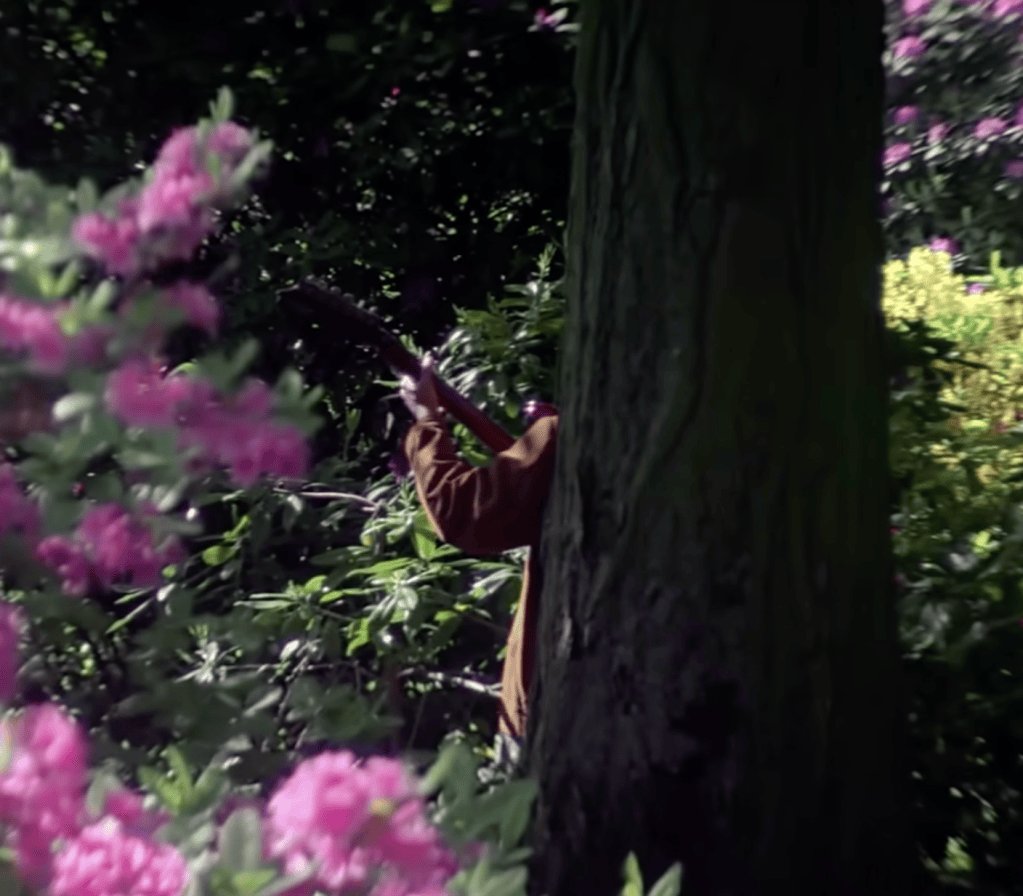
The classic Hindi film, Darr (1993), directed by Yash Chopra, is the story of the stalker Rahul, played by Shah Rukh Khan, wreaking havoc on the lives of the innocent lovers, Kiran and Sunil (played by Juhi Chawla and Sunny Deol respectively). As Rahul stalks Kiran, declaring his love for her, the audience is shown a window into the derangement of his psyche: the loss of his mother at a young age, unsent love letters during college, a shrine filled with pictures of Kiran, carving her name into his chest with a knife. His obsessive love turns to violence toward Sunil, and the lovers try to evade his sinister advances as Rahul chases them across the planet.
Originally advertised as “a violent love story” on its movie poster, the film largely follows the conventions of 1990s Bollywood, but Chopra and screenwriter, Honey Irani, create distortions of genre expectation through Shah Rukh Khan’s character. One of said genre conventions is the inclusion of original song sequences, composed by Pt. Shivkumar Sharma and Pt. Hariprasad Chaurasia (as the duo “Shiv-Hari”), with lyrics by Anand Bakshi. Despite their non-threatening surface exteriors, various musical devices combine with the filmmaking to give the songs a layer of menace that elevate them above the standard fare of contemporaneous Hindi film music. This creates a multi-tiered listening dynamic wherein the pleasant becomes grotesque in context.
The songs of Darr have become classics in the world of ’90s Bollywood film songs. But, behind the catchiness and fulfillment of industry expectation lies a multi-layered psycho-drama created by the songs’ interactions with Darr’s story and characters. This interaction exists not solely in lyrical concerns but also in the subtle musical gestures crafted by the minds of Shiv-Hari. At a surface level, listening to the film’s soundtrack is enjoyable; there are catchy melodies, lush orchestrations, and timeless performances by now-legendary singers. However, the deeper one listens with an analytical focus, the more disturbing, intriguing, and artistically edifying the songs become.
While the film begins with an idyllic, romantic tone, the music soon introduces an element of the sinister. After a brief introductory scene of Kiran, who is seen alone reading a letter from her fiance Sunil (although Yash Chopra already hints at Rahul’s presence in this scene), we find her with her friends at their school. We hear “Kiran, I love you” announced through the school’s public address. The music of “Jaadu Teri Nazar” (roughly “Your look is magic”) then begins diegetically, sung by Shah Rukh Khan’s Rahul (unbeknownst to Kiran).
By today’s standards, the early lyrics contain a definite romantic red flag in the lines “Tu haan kar, ya naa kar / Tu hai meri Kiran” (“whether you say yes or no, you are mine Kiran”), but in the world of early 1990’s Bollywood, this type of courtship is nothing out of the ordinary. However, Shiv-Hari’s orchestration implies something more sinister, ending the song with a repetition of the line “tu hai meri Kiran” with aggressive orchestral chords.
The actual nature of the song and truly the thesis statement of the entire film is then revealed. Kiran is seen on a train which enters a tunnel and becomes pitch black. We hear a voiceover say the words “Pyaar jab had se guzar jaae to pooja ban jaata hai, aur pooja bhatak jaae to junoon” (“when love crosses a boundary it becomes worship, and when worship goes astray it becomes obsession”). Upon emerging from the tunnel, “Jaadu Teri Nazar” begins again non-diegetically featuring more obviously sinister lyrics, such as “bekhabar meri taqdeer hai tu / tu kisi aur ki ho na jaana / kuch bhi kar jaaonga main deewaana” (“unaware, you are my destiny / don’t you become someone else’s / I am crazy and will do anything”). With this, “Jaadu Teri Nazar” becomes a cipher for the film’s stated theme of love turning into obsession.
Another thematically important part of Darr‘s soundtrack that directly connects to “Jaadu Teri Nazar” is an instrumental track labeled “Obsession (Dance Music)” on the film’s commercial soundtrack release. After proceeding to terrorize the lives of Kiran and Sunil in various episodic scenes, we see Rahul in his apartment, playing the melody of “Jaadu Teri Nazar” on his harmonica. Chopra then cuts to a fantasy sequence scored by “Obsession (Dance Music).” We see Kiran dancing in a shapeless void, assumedly in Rahul’s imagination.
Shiv-Hari’s music starts out calmly, almost entirely with percussion instruments. The fervor of the percussion increases, as does the intensity of Kiran’s dance and the rate of cuts in the visuals. Frenzied imagery and intense music combine to reflect Rahul’s increasingly spiraling self-control. Kiran’s titillating movements to the music in Rahul’s mind further showcase his derangement. The inclusion of the melodic material of “Jaadu Teri Nazar” in “Obsession (Dance Music)” helps to create the idea in the listener’s mind that this melody represents Rahul’s obsession over Kiran. After a brief guitar interlude, the music grows to a climax characterized by wordless choir singing and crashing percussion. At its highest dramatic point, the men in the choir sing the same melody as the line “tu hai meri Kiran” from “Jaadu Teri Nazar” three times before the music ends with Kiran standing in the rain with open arms.
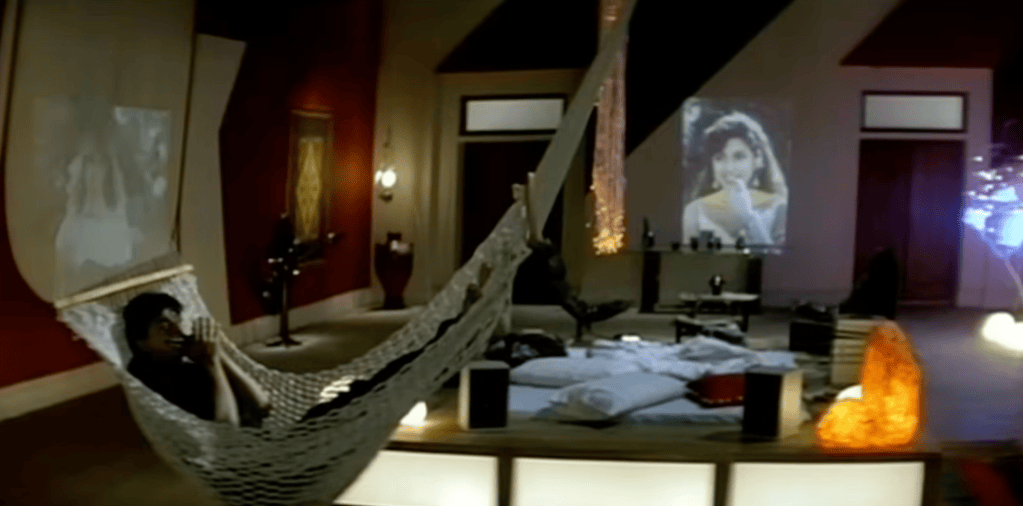
Yash Chopra zooms in towards Kiran as the sound of Rahul’s harmonica playing “Jaadu Teri Nazar” intercedes into the audio of the film, signaling the end of Rahul’s fantasy. Screenwriter Honey Irani’s choice of the harmonica for Rahul’s instrument further clarifies his character. Its sound is tied to classic cinematic images of loneliness. The 1975 Hindi film, Sholay, sees Amitabh Bachchan’s character Jai playing the harmonica while observing Radha (Jaya Bachchan). In Sholay, Radha is a widow—for her to remarry would be a social taboo. Jai’s circumstances have forced him into a life of crime for survival—his playing the harmonica while simultaneously falling into a love that is doomed from the start is paralleled in a contorted way in Darr‘s Rahul. Sholay is one of, if not the most, famous film in the history of Indian cinema—such a comparison would likely occur to contemporary viewers of Darr. This association is triggered sonically through the harmonica’s strained timbre. The instrument even at a physical level could represent Rahul’s frame of mind: it is a rare instrument where one has to both exhale and inhale in order to produce sound. The song “Tu Mere Saamne” echoes this action as it features Rahul heavily breathing in and out at a menacing cadence.
“Tu Mere Saamne,” the final song in the film, sees a dangerous evolution in Rahul’s obsession. It occurs after Sunil and Kiran steal away to Switzerland for their honeymoon, where Rahul finds them and befriends them, as they have never seen his face. His now face-to-face intervention in their lives triggers another fantasy of Kiran in his mind. Despite being a love song on its surface, Shiv-Hari begin the song with forceful orchestral bombast and men’s chorus (which precede the aforementioned heavy breathing), akin to the ending of “Jaadu Teri Nazar” and parts of “Obsession (Dance Music).” Anand Bakshi’s lyrics draw parallels between Rahul and Sunil. “Tu Mere Saamne” (“You are in front of me”) is eerily close to the first words heard in the entire film: Sunil’s words in Kiran’s mind as she reads the love letter he had sent to her (“Jaan, main tumse door hoon. Lekin, tum mere saamne ho.” This translates to “Love, I am far from you. But you are in front of me.”). Sunil’s love is true, but Rahul’s love has crossed the threshold.
Rahul’s early fantasy of Kiran picturized in “Obsession (Dance Music)” did not include Rahul in her presence. This new fantasy changes that dynamic. The line “Tujhko dekhoon ke pyaar karoon” (“Should I gaze at you or make love to you?”) is intermingled with lyrics indicating disbelief yet confirmation that Kiran is now his possession. “Jaadu Teri Nazar” stated “Tu hai meri, Kiran”–simply “You are mine.” The iteration of this sentiment in “Tu Mere Saamne” reaches a point of completion with the line “Tu meri ho gayi”–literally, “You have become mine.” The mukhda (a term that translates literally to “face” that refers to the initial memorable portion of a song) finishes with the line “Kaise main aitbaar karoon” (“How can I trust [this reality]?”). Udit Narayan’s vocals, as well as the contour of the melody line, are fairly simple, unadorned, reflecting the single-minded arrested development at play in Rahul’s psyche (the same could be said for Narayan’s vocals in “Jaadu Teri Nazar”).
Lata Mangeshkar’s vocals in the next stanza overlap with the ending of Udit Narayan’s stanza with considerable echo effects added. This adds to the dream-like, imagined quality of the song—Rahul’s brain at the height of delusion. Mangeshkar’s vocals are shallow with an almost child-like lilt, fitting the simplistic melody. Shiv-Hari composed a tune paralleling the simplistic logic at play with Rahul’s derangement. The Kiran that sings in the song is a cheap imitation—a tulpa in Rahul’s mind. His imagined Kiran sings “Toot gayi tootke main choor ho gayi / Teri zid se majboor ho gayi / Tera jaadu chal gaya…” (“I am broken, I am shattered / Your persistence has compelled me / Your magic has worked”)—a twisted and delusional perspective on romance befitting a murderous stalker.

The danceable, but somewhat menacing instrumental interludes of the song also connect with the earlier sequence set to “Obsession (Dance Music).” The use of a prominent clarinet solo, an uncommon occurrence in Bollywood film songs, adds to the phantasmagorical quality of the song by introducing a foreign timbre. The visual is that of a strange liminal space, a place with no coherent scenery but with raining rose petals. Rahul plays piano as Kiran writhes suggestively. This particular visual shows that Rahul has now placed himself next to her in his own fantasy as opposed to just seeing her. He is no longer simply declaring that she is his—she has become his.
(The following two paragraphs contains significant spoilers)
Throughout the finale of the film, where Rahul is found out and killed by Sunil, Shiv-Hari’s background score is dominated by a particular theme that had been first introduced earlier, always connected to Rahul’s fixation with Kiran. It is characterized by two notes constituting a rising major sixth interval which morphs into a rising perfect fifth interval before deteriorating into a winding chromatic melody that eventually loses intelligibility. The first mentioned interval, the major sixth, traditionally has a romantic quality, especially at its iterated tempo in Darr–a soaring, almost Wagnerian yearning. The second interval, the perfect fifth, is acoustically at rest. But, with the pitch level at which it is presented in relation to the earlier major sixth, it is contorted–it implies a different musical key, an incompatibility. This particular interval happens to be the same as the beginning of “Jaadu Teri Nazar.” This theme’s association with Rahul indicates its mirroring of his emotional incapacity. What he views as love, in this case represented by the major sixth, becomes contorted into his obsession with Kiran, the perfect fifth that connects to “Jaadu Teri Nazar.”
The melody that succeeds these two intervals is simultaneously chaotic and tragic—chaotic in light of his murderous actions, tragic as Rahul’s final end symbolizes a human life wasted on mental derangement. At the end of the film, Shiv-Hari use the theme to paint this tragedy, iterating it twice, first with a subdued muted trumpet, then with a wordless female chorus, as Rahul utters his last words. Yash Chopra reiterates the overarching theme of the entire film one more time by playing an a cappella version of “Jaadu Teri Nazar” over one final shot of Rahul’s lifeless body.
Both the songs and background score of Darr showcase an approach to soundtracking wherein the sonic content not only operates in close coordination with the mood and atmosphere of the film, but with the characters, storyline, themes, and intrinsic reference points orchestrated by Yash Chopra and his crew. Shiv-Hari’s music is not simply color and vibe, but multi-faceted content that rewards close listening just as repeat viewings of the film can illuminate the finer nuances of the plot. It is music that contains a sub-surface circuitry that, even when the listener is unaware of its complexities, creates a richer artistic statement than music that has a similar surface (a similar color and vibe) without the same profound approach to its unseen infrastructure. Shiv-Hari’s soundtrack’s rich subterrain integrating with and projecting onto the visual and narrative elements of Darr creates a rare cinematic totality.
—
Featured Image: Still from “Jaadu Teri Nazar” by SO!
—
Zane Merritt is a composer, guitarist, teacher, and scholar. He holds a PhD in music composition from the University at Buffalo (SUNY). His recent activities include designing and teaching a course on Bollywood and its music, collaborations with Nepali poets, setting their recitations to original music, and releasing a classical guitar album that places arrangements of Indian film music alongside the western classical canon.
—

REWIND! . . .If you liked this post, you may also dig:
“Gendered Soundscapes of India, an Introduction“–Monika Mehta and Praseeda Gopinath
The Queer Sound of the Dandiya Queen, Falguni Pathak–-Pavitra Sundar
“Out of Sync: Gendered Location Sound Work in Bollywood“—Priya Jaikumar
“So Jao”: Sound, Death and the Postcolonial Politics of Cinematic Adaptation in Vishal Bhardwaj’s “Haider” (2014)—Abhipsa Chakraborty
Share this:

The Absurdity and Authoritarianism of Now: My Chemical Romance’s The Black Parade Resonates Queerly, Anew
DOI: https://doi.org/10.59350/g8byn-fea85
My Chemical Romance fans are speculating about new music after the band wiped their X account clean and wrapped up the Latin America leg of their tour this month. Whether another album is on the way or not, MCR’s magnum opus – The Black Parade – continues to endure two decades later. The sound now resonates through MCR’s commentary on fascism, critiquing the nation while holding the crowd accountable for our participation or passivity.
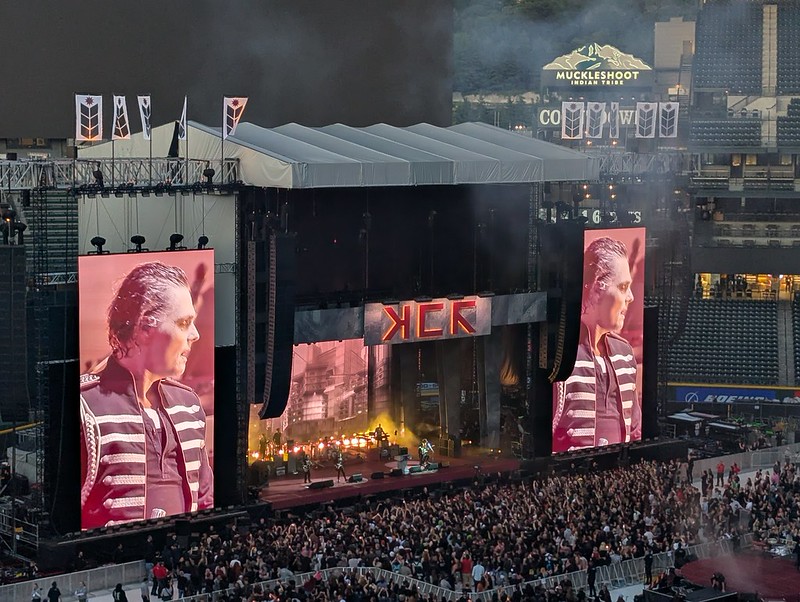
As the band tours The Black Parade for its 20th anniversary, the members have rejected nostalgia in favor of a new storyline, playing alter-ego characters who have been conditioned to perform for a dictator. The plot, slightly shifting night to night, encourages fans to follow along.
In the first run of the tour, each concert paused midway for an “election.” Four hooded figures walked out to the center stage. Nearby, an army official watched. Singer Gerard Way asked the audience to vote: Support these candidates or reject them? Each person in the crowd had a sign. One side: YEA. The other side: NAY.
“Now we need to hear you,” Way says. The audience roars, jeering and cheering.
No matter the spectators’ will, the result is the same: execution.
The warped election – and the sound of The Black Parade – reflects the absurdism of authoritarianism. Here is a democracy that ends in death, regardless of how you vote. Viewers log into livestreams to watch the fanfare repeat.
MCR’s commentary echoes the ramping authoritarianism and upheaval in the United States:
- The Supreme Court cleared the way for immigration agents to use race as a reason to stop and check someone’s citizenship documents. Daily ICE arrests reached a decade high last year. 2025 also marked the deadliest year for people in ICE custody in two decades.
- Protests have swept the nation, with outrage further increasing after federal agents killed two Minneapolis demonstrators this January.
- Cuts and changes to Medicaid and SNAP are on their way. The longest government shutdown also ended without extending subsidies for health care.
- The Epstein files were released, showing ties between powerful leaders and sex offender Jeffrey Epstein.
- The Department of Governmental Efficiency, named after an outdated Internet meme (DOGE), has resulted in the elimination of at least 290,000 jobs.
- The U.S. withdrew from the Paris Agreement and World Health Organization. The country also pulled out of 66 international organizations.
- Trump continues to enact steep tariffs after a Supreme Court ruling against his policy.
- Layoffs soared past 1.1 million job cuts in 2025, the highest since 2020’s COVID-19 shutdown.
This list represents a fraction of stories and executive orders in 2025; a “flood the zone” strategy overwhelmed the news cycle. Despite censorship efforts – such as the federal defunding of NPR and PBS – much of this information is available to us at the click of a button. State-sanctioned propaganda even encourages the spectacle. Just take a look at footage of ICE raids on the WhiteHouse’s TikTok account, set to songs and images of pop stars:
Yet fatigue and fearmongering keep many complacent; looming economic crises also draw our attention and time. I do not mean to diminish people’s efforts of resistance. But I am interested in the way technology has expanded our potential to witness violence, without ever requiring us to act – as well as the power of entertainment to distract.
So I turn back to MCR’s spectacle, which twists and mirrors this descent into fascism. Up against the tour’s faux-executions, the boos and the cheers of the crowd collapse into a cacophony. I locate the sound of our times within these screams, where dissent seems to go unheard and melds into the chorus of support.
The Black Parade is full of these bombastic wails, but the most intense of them are in “Mama,” a song that balloons into an extended eight-minute performance in the Long Live the Black Parade Tour. Within “Mama,” I try to make some sense of these screams, finding queer resonance with the present moment.
With my analysis, I ask: How might we hold fascist figures to account without squirming out of our own role in the daily exchange of authoritarianism? I argue My Chemical Romance’s 2025-2026 performance of “Mama” highlights structures of violence but also criticizes our participation within them.
In “Mama,” the indulgence of sin is contagious. It’s loud. It’s repeated: “Mama, we all go to hell.” This refrain, set to a polka beat, creates an abject intimacy around our shared fate. Queer listeners have interpreted this song as an angry anthem against the rejection we face from our families and dogmatic religion. For those of us who have heard, “You’re going to hell,” the response, “We all go to hell,” serves as a relief. Verses like “You should’ve raised a baby girl, I should’ve been a better son” have been reclaimed by transgender fans.
Other fans have taken issue with these interpretations, arguing queer attachments distract from the “true” meaning of the song. Indeed, “Mama” tells the story of a soldier writing from the trenches of war, while his mother judges him from afar. But I argue that by placing a queer reading in tandem with the canonical narrative, generative meanings emerge. Queer theory provides tools to understand the role of the mother here. Mama is the title of the song. Mama is pervasive. Mama is mean. Mama is on his mind. But she is also almost entirely absent, avoiding accountability for her son’s violence and instead blaming him: “She said, ‘You ain’t no son of mine.’”
The soldier finds that the trenches are not just his domain, but also his mama’s: “Mama, we’re all full of lies…And right now, they’re building a coffin your size.” His plea to his mother helps us wonder: What about the culture that birthed this violence? In this metaphor, critiquing the mother extends to critiquing the nation.
At the climax of the song, these sentiments come through screams: 30 seconds of an extended, “AHHHHHH” and a crying out of, “Mama, Mama, Mama.” In these wails, I find a soldier begging to share responsibility with his motherland, even as he contends with his own role in the violence. The cries puncture the polka, demonstrating “Mama” is not a celebration, after all.
Mama only sings one line back, through the voice of theater icon Liza Minnelli: “And if you would call me a sweetheart/I’d maybe then sing you a song.” Minnelli’s voice connects the song’s sound to her role in Cabaret, a musical which mixes together queer aesthetics and indulgent decadence with a foreboding rise of fascism. This allusion to Cabaret, as well as the tour performance, serve as a reminder: pleasure and entertainment does not always equal resistance.
In the extended version of “Mama” on tour, these lines are sung by an opera singer, whose voice, too, serves the dictator. Preceding her performance, the song briefly opens up a space for resistance. A new section of the song, debuted on the tour, includes the lyrics:
A dagger, a dagger
Please fetch me a dagger
A tool for our treasonous needs…
With tears in our eyes we collapse on the crosses
And said death be the son of us all
This war is the son of us all.
Even as Gerard Way’s character plots treason against the dictator, these new lyrics make clear: this “death” and “war” is “the son of us all.” Though we might want to pin fascism on one figure, many Americans have participated in the creation of this “death/war.” There are fatal consequences for our collective actions – or our passivity.
Ultimately, the dramatics of this song, delivered like a sinister weapon, critique violence, while ironically trapping us in its pleasures. If prayer is crying out to our father who art in heaven, “Mama” is yelling back at our mother to bring her to where she belongs: the hell in which we both exist. Given the stakes of our political moment, I argue we need to scream louder, with purpose and strategy, against our motherland.
—
Featured Image: “My Chemical Romance Live at T-Mobile Park 6/11/25,” Image by Flickr User Laura Smith CC BY-ND 4.0
—
Max Lubbers (he/she) is a first-year PhD student in the American Studies and Ethnicity department at the University of Southern California. His research centers on transgender affects and sounds. Max earned a bachelor’s degree in Journalism and Gender and Sexuality Studies from Northwestern University, with a senior thesis on butch affect. She previously worked as a journalist, with pieces in Chicago’s NPR station, Colorado Public Radio, and Windy City Times.
—

REWIND!…If you liked this post, check out:
The Sounds of Equality: Reciting Resilience, Singing Revolutions–Mukesh Kulriya
Vocal Anguish, Disinformation, and the Politics of Eurovision 2016–Maria Sonevytsky
“To Unprotect and Subserve:” King Britt Samples the Sonic Archive of Police Violence —Alex Werth
Share this:




Current Top Posts





April 2021

January 2020

November 2019

October 2019

August 2019

April 2014

November 2017

March 2015

December 2017

October 2015
 Sounding Out!
Recent Comments