
Sonic Spirituality: Meditations on Eminem’s “Beautiful” and “My Darling”

Guest writer Marcia Alesan Dawkins’s new book on rapper Eminem, Eminem: The Real Slim Shady is now available. We here at Sounding Out! are thrilled, so for this week’s post we asked Dr. Dawkins to give us a glimpse into a side of the notorious rapper that few may have heard: the intersection between artist and spirituality. This comes just in time too, considering Kanye West’s latest release, Yeezus, not to mention Touré’s recent biography of Prince, I Would Die 4 U: Why Prince Became an Icon (2013), which examines the confluence of celebrity and spirituality for a generation of Prince fans. Without further ado, give it up for Dr. Dawkins! Pump it up pump it up pump it up! —Liana M Silva-Ford, Managing Editor
Eminem caught my ear a year before The Slim Shady LP hit record stores in 1999, when I came across a single released by Rawkus Records called “5 Star Generals” (1998) on which he made a guest appearance. I would later learn that this was an old track the rapper recorded for cash while he was unsigned and then forgot. Nevertheless, Em’s first lines about sinning boldly, shooting nuns in Bible class, and damning hell itself hit me like a ton of bricks. I knew that lines like his, which were sure to enrage anyone within earshot, would make him (in)famous.
To my surprise, I learned a year later that my 89-year-old Cuban American grandfather, a poet and a reverend, had been listening to Eminem too. This struck me as strange for two reasons. First, my grandfather wasn’t fluent in English. Second, he’d never expressed much interest in rap music other than commenting that he noticed kids rapping in the parks near his house in Hollis, Queens every now and then. Of course, I knew that many of those boom-box-toting kids were now superstars like Run-DMC and LL Cool J, but my Grandfather didn’t.
When I entered the living room to the sound of Slim Shady, my grandfather sat transfixed. After the song ended, I asked him if he knew what he was hearing. Sitting up in his blue La-Z-Boy recliner he said, “I’m listening to some guy who calls himself Eminem. I can tell he’s probably a heathen and I don’t care. I love what he’s doing with his words.” I was shocked. My grandfather went on to tell me that despite the obvious language and experiential barriers that stood between him and Eminem, he was in awe of the way the rapper was using his voice and his words as instruments. What really got me was when my grandfather said that Eminem’s unapologetic tone reminded him of many preachers’ fiery delivery over the years. I could not believe it. Grandpa’s encounter with Eminem was not just sonic. It was spiritual.
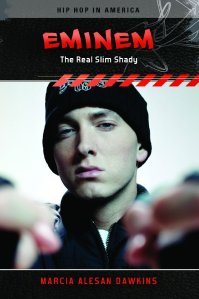 Fifteen years later I am still listening for what my grandfather heard. In the process, my ears have been captivated by Eminem’s sonic spirituality, open to its every sound. So open, in fact, that I dedicated three chapters in my forthcoming book to understanding how his music can be seen as a dynamic sphere of spiritual activity in terms of guilt-purification-redemption, love-hate, and relationship-awareness. While paying attention to Eminem’s sonic spirituality began as a personal exercise, it now represents an important part of understanding how spirituality operates culturally and is just like sound: recognizable, uncontainable and elusive.
In other words, I’ve finally understood what my grandfather was trying to tell me — how, rather than simply what, he heard in Eminem’s music. Here’s the revelation: sonic spirituality is a listening attitude, a personalized relationship with music that allows us to mark time, experience the intangible, track movement, engage otherness and, in the end, encounter more honest versions of ourselves. Sonic spirituality, then, might be characterized as open instead of closed, exploratory and experimental rather than static. Eminem’s spiritual themes play out in terms of solidarity with the supernatural, a mistrust of organized religion due to its inherent hypocrisy, a desire for redemption from guilt through purification, and an intense personal battle between love and hate. Following are two potent examples of what I’ve found in Eminem’s oeuvre from 2009’s Relapse: Refill, examples that showcase the development of his sonic spirituality over the decade since my grandfather first introduced it to me.
In “Beautiful” (2009), Eminem poses a powerful question: What would you think if you saw someone important, like a government official or celebrity, digging around in the trash? The answer: you’d probably think that this kind of behavior was suitable for beggars only and certainly not for yourself or someone very important. But this is exactly what the rapper does in “Beautiful.” He looks for himself, others, and their fallen world or Eden (aka Detroit, Michigan) and finds everyone and everything in the garbage. In this way, “Beautiful” is a lovely parable. As with any parable, its objective is to illustrate a moral or a spiritual lesson using a simple human relation. The lesson in this case is looking for something or someone that has been lost. In Eminem’s parable, there are seven ideas expressed about how to find what we have lost and develop our spiritual selves along the way: loss (the starting point of humanity’s spiritual condition), light (a force created through words), movement (standing in another person’s shoes), discovery (finding what’s lost in low places), salvation (anyone can be redeemed), connection (exchange traditional religion for a new culture of communication with the supernatural), and celebration (that everyone can be made beautiful again).
These seven images are evoked by the lyrics and music. The slow and deliberate beat invites listeners to connect the subject and object; the song and themselves, the song and the rapper. The release provided as Eminem sings the chorus doesn’t just change the course of the song, but converts the shared loss into an opportunity for discovery, salvation, connection and celebration. Just as the discovery begins, the drums suddenly increase in volume; the bass and guitar begin to cry out as a background harmony in a major key builds and adds to the intensity. The sounds remind us even if we choose to shield our eyes, we cannot shield our ears from the plight of our fellows and that this is a call to action, salvation and celebration. In “Beautiful” Eminem listeners become aware of others’ oppression while remembering that they are no stronger or more beautiful than anyone else. In this way listeners are engaged not just with the sounds, but also with the spirits of the people who produce them in active relationship.
The experiences and encounters inherent in Eminem’s alternative spiritual portrait, “My Darling” (2009), still emphasize the same spiritual themes I pointed out earlier: personal struggles between light and darkness, finding a purpose in suffering, and seeing a connection between societal and supernatural powers. Only this time, the supernatural power belongs to the Devil. Yet, unlike other songs in which Eminem does battle with the Devil or suffers for his sins through eternal damnation, “My Darling” is about a soul living in hell on earth. In this way, “My Darling” is both a lamentation and a dark parable whose moral complements that of “Beautiful.” Eminem shares this moral in “My Darling” through six ideas about what happens when a person is losing his or her battle with the demons he or she carries inside. These ideas are uncertainty (never being sure about redemption), possession (selling one’s soul), darkness (force maintained by the absence of words), harm (effects of love turning to hate), wholeness (spiritual relationships based on labor and exchange rather than on salvation and forgiveness), and lament (mourning one’s losses of self and loved ones).
As in “Beautiful,” the lyrics and the music evoke spiritual elements. The song is set to a minor key, which communicates penitential lamentation, intimate conversation with the Devil, and echoes with sighs of disappointment, divorce and disillusion. Possession, darkness and harm are communicated through call and response between Eminem and the Devil, who hears and accepts Eminem’s invitation and appears in his mirror where he whispers seductively for Eminem to draw close. The increasing intensity and harm of the spiritual exchange between Mathers and the Devil is reflected in their verbal back-and-forth. Their “souls, minds and bodies” are increasingly connected as they exchange more and more words. And the words become more desperate and cruel. At the end of the song, Eminem submits. Listeners come to understand that Eminem and the Devil are one and whole as the Devil’s final solo becomes the pair’s solemn duet. The two have become one spirit through a relationship of exchange and possession.
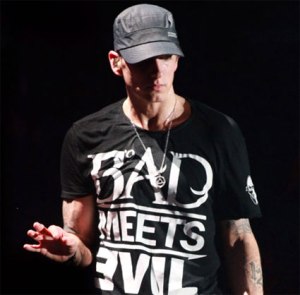
“Eminem, Lil Wayne Named ‘Gods Of Rock’ By GQ” by Flickr usermp3waxx.com, CC-BY-NC-SA-2.0
The recurrence of spiritual themes in Eminem’s soundscape suggests that music is a way to communicate with the other who is both present and hidden. Sometimes the other is God. Sometimes the other is the Devil. Sometimes the other is other people. Sometimes the other is the other within. The tones, rhythmic patters, key changes, intensity and release patterns combine with Eminem’s lyrics to create an experience within which listeners can be still, in which their souls can take refuge, and the other can be encountered. However, though sonic spirituality exists in Eminem’s music, and rumors abound regarding his “born again” status, it cannot be argued that Eminem adheres to a particular religion. Rather, the sonic spiritual element suggests that Eminem communicates a genuine awareness of supernatural powers, guilt-redemption-purification and love-hate that allows him to relate to the world at large. In this way Eminem is one of many artists whose pop culture content carries a strong spiritual dimension that is sonic, confirming results of Chris Rojek’s study, entitled “Celebrity and Religion,” which argues that “celebrity culture is secular society’s rejoinder to the decline of religion and magic” (393).

“DJ Hero party – Eminem 2” by Flickr user monsieurlam, CC-BY-NC-SA-2.0
As “Beautiful” and “My Darling” demonstrate, the spiritual reflections heard in Eminem’s music are not just harmonic, they are also discordant, revealing how conflicted we often are about ourselves and the supernatural. Just as Eminem walks with God in “Beautiful” and dances with the Devil in “My Darling,” audiences listening to his music are able to escape from their own worlds and find temporary refuge in sonic spirituality. This idea didn’t start with Eminem, or with the Judeo-Christian tradition, as many faiths across time and space utilize the power of music to evoke higher powers and acquire spiritual insight through prayers, storytelling, meditation, chanting, mantras, singing, silent vows, etc. But Eminem has added his own unique touch by using his personas Slim Shady and Marshall Mathers to speak with demonic and godly authority, respectively. As Peter Ward writes in Gods Behaving Badly, the spiritual power of Eminem’s music for audiences lies in its representations of a “conflicted and complex self clothed in the metaphors of the divine and reflected back to us” (107). In other words, sonic spirituality is about engaging with something beyond the world around us while grappling with the personas and situations into which we’re immersed. As the music plays we are challenged to develop a listening heart.
The popularity of Eminem’s music supports the conclusion that his brand of sonic spirituality is set to the same rhythm as the hearts of fans that buy and listen to his messages. But his work can also speak to those who consider themselves spiritually committed, even if that commitment is often not manifested in traditional religious activities. In this way the dynamic nature of sonic spirituality manifests as a way of listening that allows for communication and communion through music and language. If the above is true, then we can take Eminem’s claim, expressed via tweet, that “music has the power to heal” as a spiritual declaration. And we can also take a fan’s response to this tweet as an Amen: “All Eminem songs has [sic] a spiritual connection… you have to have the ear to find that for yourself.”
—
Featured Image: “Slim Shady” by Flickr user Walt Jabasco, CC BY-NC-ND 2.0
—
Marcia Alesan Dawkins, PhD is an award-winning writer, speaker, educator, and lecturer at the University of Southern California’s Annenberg School for Communication and Journalism. She is the author of Clearly Invisible: Racial Passing and the Color of Cultural Identity (Baylor UP, 2012) and Eminem: The Real Slim Shady (Praeger, 2013).
Marcia writes about racial passing, mixed race identities, media, popular culture, religion and politics for a variety of high-profile publications. She earned her PhD in communication from USC Annenberg, her master’s degrees in humanities from USC and NYU and her bachelor’s degrees in communication arts and honors from Villanova. Contact: www.marciadawkins.com
—
 REWIND! . . .If you liked this post, you may also dig:
The Victoria’s Secret Fashion Show and the Soundtrack of Desire–Marcia Alesan Dawkins
Love and Hip Hop: (Re)Gendering The Debate Over Hip Hop Studies–-Travis Gosa
“I Love to Praise His Name”: Shouting as Feminine Disruption, Public Ecstasy, and Audio-Visual Pleasure—Shakira Holt
Share this:

Pretty, Fast, and Loud: The Audible Ali

 Aaaaaaaaaaaaand NOW. . .in SO!‘s corner. . .writing for this month’s “Sound and Sport,” we have the scholar. . .the poet . . .the “Wordsmith of the Web” Taaaaaaaaaara Betts! In today’s post, she shares how listening influences her creative process AND knocks us out with an analysis of the importance of Muhammad Ali’s voice to his sports career and historical legacy. For an instant replay of last month’s post, click Melissa Helquist‘s “Goalball: Sport, Silence, and Spectatorship.” Next month’s rematch will feature Josh Ottum‘s research on sound and skateparks. But now, let’s get ready to ruuuuuuuummmbbble! —J. Stoever-Ackerman, Editor-in-Chief
Plap of glove against glove
Shush of scuffle and slide.
Rebuildin’, repeatin’, rebuildin’
All this repeatin’, getting’ up again & again
Discipline, routine and I keep
doing new things to prepare
my mind, my body, so my pretty
mouth keeps up with all my rhymes.
–Tara Betts, from “Repeatin’” (scene 8, The GREATEST!)
The recent Peggy Choy Dance Company production of “The GREATEST!: A Hip Dance Homage to Muhammad Ali” in April 2013 gave me cause to rethink the key events in Muhammad Ali’s life, particularly his burgeoning political awareness in the 1960s. As I wrote the libretto for the performance—which combined athletic dance performance with images, poems, and quotes from Ali—I kept thinking about how Ali had one of the most recognized, quoted, and distinct voices ever heard in the boxing world.
 In the libretto, I tried to capture the nuances of black vernacular and the southern hallmark of Ali’s hometown, Louisville, Kentucky (he was sometimes referred to as the “Louisville Lip”), vocal sounds that signify an African American experience. Is there a southern drawl? A bass-filled bravado? There are certain words that sound fuller and cut short based on the vernacular that was spoken during the time period of Cassius Clay and well into his evolution as Muhammad Ali. While many of the materials that I visited for inspiration and historical context were books, to capture the look, feel, and speech of the 1960s and 1970s, I had to crate-dig for some vinyl.
A copy of a 1963 spoken word album I Am The Greatest!: Cassius Clay and the 1997 documentary film When We Were Kings served as two such sources. Both recordings represent an audible Ali, at once a man whose iconic voice sounded as familiar to me as people who I’ve known personally and a historical figure whose vocal grain content embodied his shifts in political consciousness. The difference between Clay’s 1964 recording and the samples woven into the When We Were Kings soundtrack is more than the changes that gradually developed over time. These recordings reveal how Ali’s confidence is constructed around creating an affirming, critical identity, rather than merely promoting his athletic prowess. At first, he merely sounds cocky; later he sounds as if he is fighting for a group of people that he wants to inform, serve, celebrate, protect, and uphold. My libretto was deeply impacted both by the sonic continuities in Ali’s voice across time and space, as well as its audible shifts.
The champ ain’t nobody but me!
Pretty, fast & loud, I’ll shake the world,
with a lion’s might.
My children will lift
their fists and fight
–Tara Betts, from “‘By Any Means necessary: If they met in Harlem’’” (transition from scene 14, The GREATEST!)
Before Cassius Clay joined the Nation of Islam and changed his name to Muhammad Ali, he recorded a spoken word album on the Sony label in 1963. I Am The Greatest! was released in 1964 before Clay’s two key fights with Sonny Liston and Ali’s eventual victory for the heavyweight crown. The album included original liner notes from modernist poet Marianne Moore and New York Post sports journalist Milton Gross, but it was telling that comedy writer Gary Belkin and Cassius Clay were the co-authors of the spoken word material—which is more comedy than poetry or interviews. Belkin was a comedy writer for well-known comedians such as Carol Burnett and Sid Caesar, and the comedy show Car 54, Where Are You? So, Belkin was clearly accustomed to writing sketch comedy, but Clay was used to being humorous outside of a recording studio with a staged audience.

Overall, Clay’s delivery seems to be slower–both less fluid and more staged– than his impromptu recitations at boxing-related events outside the recording studio. Clay seems to anticipate that sound effects such as roaring crowds and clanging bells will be inserted into the tracks, so he over-enunciates and pauses. Each track begins with a bell ringing as if boxing round is about to begin, and there are eight “rounds,” probably because Clay insisted that any fight with Liston would be shorter than eight rounds. As I listened, I wondered if Ali was comfortable recording this album or if he considered it simply another way to promote and market one of the world’s best known boxers? To my ear, it lacked some of the speed and ease I associate with Clay’s speech in other settings. In the boxing world, his speeches mentally challenged his opponents and entertained crowds. The recording studio left less room for spontaneity, fluidity, and even the visual interplay of sound with his quick motion.

Cassius Clay in the studio recording I Am the Greatest! with Sam Cooke, Image from newblackman.blogspot, courtesy of Michael Ochs Archives/Getty Images
The eight rounds/comedic sketches lean heavily on Ali’s signature boisterous braggadocio in his loud, deliberate voice, using canned laughter and other voices setting up Clay to talk about his excellence. Otherwise, they are a grab bag of influences and sound effects. These other voices and sounds create an artificial environment that is not the same as being surrounded by boxers, trainers, and others in the athletic arena. In fact, these sounds and the sources sound quite different from Clay himself. “Round 1: I Am The Greatest” and “Round 2: I Am The Double Greatest” are accompanied by violins that sound more like a serenade than a classical composition. In “Round 4: ‘I Have Written A Drama,’ He Said Playfully,” a lute plays in the beginning that hints at a spoof of a Shakespearean-style drama about defeating dragons complete with affected British accents, including one actor speaking with the theatrical lisp. The knight “Cassius of Clay” enters with the audible clanking of armor.
Clay reveals a shift in tone when he sings on the last two tracks. He begins with “Stand By Me”–a cover of Ben E. King’s classic song/then recent hit–with fervor. In the last song, “The Gang’s All Here,” Clay follows some of the words of Tin Pan Alley lyricist Theodora Morse set to Sullivan’s tune from Pirates of Penzance.
Clay tries to pick up the energy lost by his less-than-enthusiastic singing. “Is Memphis with me? Is Louisville with me? Is Houston with me. Ain’t I purty?” Each question is answered with a crowd enthusiastically shouting a “Yeah!” Here Ali relies on his enthusiastic, improvised rhymes, departing from the song’s traditional lyrics to include himself in a song that does not come from an African American writer or the Black experience.
The same country that refuses to let people eat
or use the bathroom in the same places
wants ME to go and get killed?
What does THAT sound like?
—-Tara Betts, from “The Same Country” (scene 15, The GREATEST!)
Almost 35 years later, there are clear sonic differences between Cassius Clay’s debut on Sony and the soundtrack to When We Were Kings, the 1997 documentary of the 1974 heavyweight championship between George Foreman and Muhammad Ali. This retrospective record is decidedly more centered on black experiences and black voices that speak musically, politically, and spiritually, particularly about the Black presence in Islam. There are no comedic monologues, sketches or Greek choruses; it sonically represents Ali after his conversion to orthodox Islam, after his friendship with and separation from Malcolm X, and after his opposition to Vietnam. Every spoken part on this album affirms the multiplicities of a Black presence in blues, R&B, and songs recorded live on the African continent; the huffs and rhymes are cheered for by a live African audience. As I listened to When We Were Kings, I could hear Ali’s comfort and his freedom of movement, audibly in contrast with his other album.

When We Were Kings records his time in Kinshasa, Zaire where he trains and eventually fights George Foreman. It does not simply focus on Ali’s voice, but is sonically rich with music, interviews with people who witnessed that fight and those who knew Ali personally; the soundtrack reflects these interconnections in its continuous uninterrupted flow. The role of these sounds endeavors to document what was heard in Zaire in 1974, but it also includes Ali in the surrounding sonic environment as one person who becomes a focal point for the musicians and speakers who also articulate black identity on the record.
The first thing I heard was Ali’s voice:
I’m gonna fight for the prestige, not for me, but to uplift my little brothers who are sleeping on concrete floors today in America, black people who are living on welfare, black people who can’t eat, black people who don’t know no knowledge of themselves, black people who don’t have no future. I want win my title and walk down the alleys and sit on the garbage cans with the wineheads…
This opening sample of Ali sets the soundtrack’s tone, and kicks off the only hip hop song on the album, a sonic shift that signals a new generation/genre in black music in 1997, more than 30 years after Ali’s spoken word album as Cassius Clay. Ali’s quote also informs listeners that the emphasis of this album has little do with comedy, especially since the soundtrack draws from nonfiction, rather than setting Clay/Ali in fictionalized sketches. The focus is on black people and their struggles.
In the first song, emcees look back and tell the story of “The Rumble in the Jungle” but the verses also hail Ali as a hero. When The Fugees, A Tribe Called Quest, and Busta Rhymes rap over a fairly standard bassline, their presence on this soundtrack is an important signal of Ali’s influence and the recurring engagement between artists and Ali during his athletic heyday such as James Brown. In Jeff Chang’s Can’t Stop, Won’t Stop (2005), Afrika Bambaataa points out repeatedly how Brown became a consistent presence in hip hop when New York radio stations simply refused to play his music, particularly in the 1970s. After decades of infusing a variety of soul singers and Brown’s stylistic turns on “the one” and messages of black pride into the genre of hip hop, the presence of “The Rumble in the Jungle” on this soundtrack completely makes sense. As more than a wellspring for samples throughout the large, growing body of hip hop music, Brown was also embodying and representing black consciousness in music with a Black voice, much in the same way that Ali utilized Black speech. In some ways, Ali’s couplets predate rap lyrics and perform in a similar manner; Bambaattaa cites him as an influence, along with Malcolm X.
James Brown and many others flow seamlessly into the event and its soundtrack in a way that reflects the immediacy and proximity of these events. The “Black Woodstock” of the Zaire 1974 music festival that accompanied Ali and Foreman’s fight set the tone and soundtrack in real life, not just in the documentary. In fact, the festival itself was documented in the 2008 release Soul Power directed by Jeff Levy-Hinte. At this point, it’s clear that there is a continuum for hearing the connections between black voices across oceans and continents.
Following “Rumble in the Jungle,” the record samples Ali and Drew “Bundini” Brown (Ali’s assistant trainer and cornerman), snippets taken directly from the documentary footage. Brown is a slower, more deliberate speaker; he uses rhyme like Ali. He talks about the fruit returning to the root and Ali claiming his crown back home. For African Americans to return to Africa post-slavery, this trip and clip sonically reinforce the cultural significance of Ali’s trip. Such pilgrimages fortify the idea that black people have a homeland, a continent, and a cultural continuum, much in the same way that this soundtrack constructs.
“Ali, Bombaye!” in a sea of faces just like mine,
my brothers, my parents, my cousins.
I want to go home and tell the people
in the streets this is what we come from,
what we could be.
—-Tara Betts, from “The Hard Road to Zaire’” (scene 21, The GREATEST!)
When African girls chant to celebrate Ali’s arrival, they reassert how this is a homecoming for Ali, a welcome and a reconnection that fuels Ali’s determination. The chants seem to encourage the first sample of Ali when he issues his threat: “When I get to Africa we gon’ get it on cause we don’t get along. I’m gonna eat him up…” This sample segues into James Brown’s “The Payback” as it was performed before the fight, then another chant performed by Mobütu, named after Zaire’s controversial leader, Mobutu Sese Seko.
When Ali concludes the soundtrack, he interrupts chants of “Ali, Bombaye!” with huffs and a brief exhortation of knocking you out, “sucker.” These last words fade into a snippet of African chant. This constructs a very different narrative that looks back at Ali’s career, long after the younger Clay established part of his image with hyperbolic bravado. Ali has cultivated a Pan African, global, political awareness that includes black people in America from his hometown in Louisville, KY to across the globe.
Hearing Clay and Ali–their continuities and their differences–gave me an insight into the familiar voices of some of my older relatives (and their blues records), and it also helped me channel that voice in poems of my own. It allowed me to imagine how hyperbole helped encourage Ali to energize and cheer himself on, so much that others began rooting for him as well. It did not matter what arena he was in, Ali would use his voice, his fists, and his will to conquer it. As I wrote the libretto, I thought about how I might unearth that determination in a way that respectfully embodied his tone, cadence, vocabulary, and ebullience. One of the definitions of greatness relates to the defeat of time and distance, and in the words that I wrote about Ali, I found that listening to him, and hearing his significance grew over time, helped him transcend both.
Every mile, every turn of the rope brings
me closer to telling him he’s nothing.
I hate every minute of training,
but I say
Don’t quit.
Suffer now
and live your life
as a champion.
I am a myth, and a man,
of my own making.
–Tara Betts, from “The Hard Road to Zaire” (scene 21, The GREATEST!)
—
Tara Betts is the author of the poetry collection Arc and Hue, a Ph.D. candidate at Binghamton University, and a Cave Canem fellow. Tara’s poetry also appeared in Essence, Bum Rush the Page, Saul Williams’ CHORUS: A Literary Mixtape, VILLANELLES, both Spoken Word Revolution anthologies, and A Face to Meet the Faces: An Anthology of Contemporary Persona Poetry. Her research interests include African American literature, poetry, creative writing pedagogy, and most recently sound studies. In the 1990s, she co-founded and co-hosted WLUW 88.7FM’s “The Hip Hop Project” at Loyola University while writing for underground hip hop magazines, Black Radio Exclusive, The Source, and XXL. She is co-editor of Bop, Strut, and Dance, an anthology of Bop poems with Afaa M. Weaver. In April 2013, she published the libretto “THE GREATEST!: An Homage to Muhammad Ali” (Winged City Press) written for the live performance directed by Peggy Choy.
—
REWIND! . . .If you liked this post, you may also dig:
They Do Not All Sound Alike: Sampling Kathleen Cleaver, Assata Shakur, and Angela Davis–Tara Betts
SO! LA: Sounding the California Story–Bridget Hoida
Freedom Back: Sounding Black Feminist History, Courtesy the Artists—Tavia Nyong’o
Share this:


Current Top Posts





April 2021

January 2020

November 2019

October 2019

August 2019

April 2014

November 2017

March 2015

December 2017

October 2015
 Sounding Out!
Recent Comments