
Prison Music: Containment, Escape, and the Sound of America
We used our voices, whistles, and blow horns to make contact with those on the inside… Prisoners flickered the lights in their cells on and off throughout the building, banged on windows, and we could see the shadows of many of those on the inside waving and pumping fists. — Activists outside the Metropolitan Corrections Center, NYC, July 8, 2011
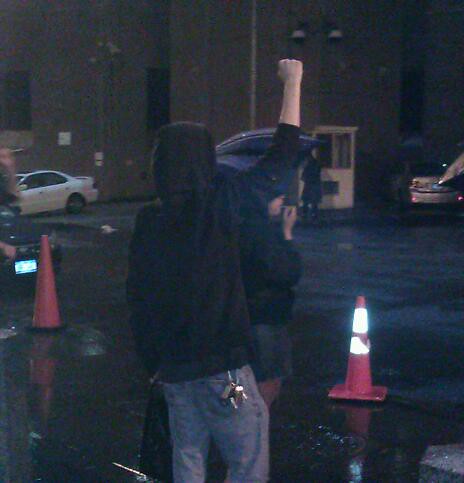
Activists outside Metro Corrections Center, NYC, 7/8/11
Noise demonstrations, like the one described above, occurred outside jails, detention centers, and prisons in cities like New York City, St. Louis, Oakland, Los Angeles, Montreal and Kitchener, Ontario throughout the weekend following July 4th, 2011. Activists rallied by playing music, chanting, launching flares and fireworks, and banging pots and pans– communicating their solidarity with the Pelican Bay Hunger Strike, and their demand for justice for prisoners in each city. The noisy international demonstrations “connected local struggles against dehumanization to the California hunger strike and the conditions of the Pelican Bay Security Housing Unit, as well as both the U.S. and Canada’s prioritization of policing and imprisonment over social welfare.” (San Francisco Bayview, 2011).
If music can be understood as “the organization of noise” (Attali, 1977), these audible signs of solidarity across prison walls would certainly be considered a form of music: prison music, perhaps. Prison has been a form of political organization for the United States, at least since the beginning of the 19th century; music (or organized noise) from or about prisons helps trace this history of containment sonically. Prison music also points to the possibilities of sonic and political escape from this carceral state.
The beginnings of the history of prison music in the United States can be traced to the War of 1812. A poet named Francis Scott Key met with British officers aboard a ship off the coast of Maryland to negotiate the release of American prisoners. He was detained overnight, having gained knowledge of the position of British military units and their plan to soon attack Baltimore. From detention in a ship floating on the Atlantic, Key watched the Battle of Baltimore at Fort McHenry and reported at dawn to the prisoners below deck that he was still able to see the American flag waving.

"To Anacreon in Heaven" by J.S. Smith
He chronicled the experience in a poem titled, “In Defence of Fort McHenry,” and later put it to music with John Stafford Smith’s “To Anacreon in Heaven.” The title of Key’s poem changed in October of 1814 when a Baltimore actor performed the song in public and called it “The Star-Spangled Banner.” In 1889, the Secretary of the Navy designated “The Star Spangled Banner” as the official tune to be played at the raising of the U.S. flag, and in 1916 the song was declared the national anthem of the United States. Key’s experience in detention along with other American prisoners in the middle of the Atlantic was memorialized as the U.S. anthem, but it is rare, if ever, that the country’s ode to freedom is understood as its opposite – as an ode to unfreedom, as prison music. Set against contemporary examples of organized noise across prison walls, as well as examples of prison themes in U.S. popular music and culture, the U.S. national anthem can be understood as a beginning point for an American tradition of prison music.
Jimi Hendrix’s guitar version of “The Star Spangled Banner” allows us to see this dimension of the American anthem. Offering a scathing and raucous rendition of the national anthem at the 1969 Woodstock Festival off the heels of his song “Purple Haze,” Hendrix blurred the lines between a drug-induced delirium and the reality of U.S. containment, at home and abroad. Hendrix improvised on Smith and Key’s tune, allowing the notes and sounds to escape the page, and signified on the sonic and political constraints the song represented: major chords, patriotic lyrics, “American freedom.” In riffing on the national anthem, Hendrix perhaps released what was being held behind these classic American “bars”: the pain, the chaos, the possibility. Note the intervals bending from major to minor to major (harmony to disharmony and back again); the (song) structure being destroyed, re-formed, rebuilt anew; the reduction of the refrain to organized noise— sonic escapes in the forms of cries, screams, explosions. Here Hendrix’s performance fits into a trajectory of U.S. prison music by retooling the U.S. national anthem as a song of unfreedom, or perhaps, a different kind of freedom.
The relationship between prison and music in the United States can be heard most clearly through Black soundings of voice, tools, instruments, technology. Hendrix’s music, for example, represented another transnational trajectory of prison music arriving on U.S. shores from ships in the Atlantic, the genealogy of Black music. What began as tribal African songs remixed over plantation work in slavery conditions became field hollers, gospel, chain gang songs, work songs, the blues, jazz, country, rock, hip-hop. It is here that “logics of U.S. white supremacy”: slavery/capitalism, genocide/colonialism, Orientalism/war (Andrea Smith, 2008) coalesce and are rendered illogical, problematic, and questionable, simply (or not so simply) by their audibility. Take the following song, “Early in the Mornin’,” sung by Black prisoners in a 1940′s Mississippi work farm, as another example.
In this example of prison music, one hears sounds that confound the work that is being performed. The music makes the work illogical. It sounds like the work is not productive, at least not for the bodies performing it. This is destructive, or more precisely deconstructive, physical and sonic work: breaking down (song) structures, bodies, minds in the process. It is a sonic protest against imprisonment, even as prison labor is being performed. This is the sound of prison music, simultaneous containment and escape, and helps explain why prison (music) is so popular in the United States. Prison is a necessary function of white supremacist patriarchal capitalism– a necessary warehousing of surplus (bodies) for exploitation or elimination. Prison music is a documentation of this process. Listening to, and perhaps playing, prison music is our attempt to hear ourselves survive within these dehumanizing systems.
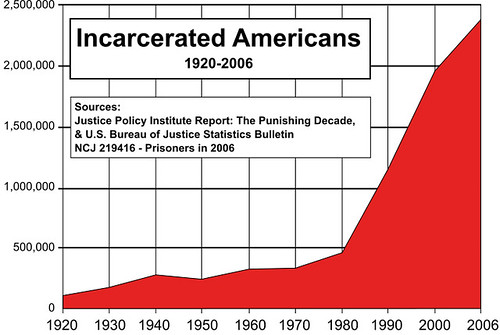
Incarceration in the U.S., 1920-2006
Prisons are popular in the United States, and not just in music (from anthems to work songs to blues to country to rock to hip-hop, imbued with the sounds and sights of prison). It’s the popularity and predominance of actual prisons, and the increasing rate of incarceration of U.S. residents, that undergirds the general public’s simultaneous aversion to, and fascination with, these literal echo chambers. Prisons in the United States are hyper-inaudible/invisible, and simultaneously hyper-audible/visible. The location of U.S. prisons behind distant, opaque, and quiet walls, sits strangely against the reality of prison as an increasingly intimate, transparent, and loud source of entertainment for the general public– think Cops (23 seasons), Law & Order (20 seasons), CSI (12 seasons), and Lockup (11 seasons), below.
Regrettably, sounds (musical or otherwise) from those incarcerated are rarely audible above the din of the prison spectacle in popular music, culture and policy. Jacques Attali wrote, “Music is a herald, for change is inscribe in noise faster than it transforms society…. Listening to music is listening to all noise.” The question is: when prisoners make noise, will we hear their music?
—
Jeb Middlebrook holds a Ph.D. in American Studies and Ethnicity from the University of Southern California, and is a Lecturer in Race, Social Movements, and Popular Culture at USC, University of Colorado–Colorado Springs, Loyola Marymount University, and People’s University, an online, low-cost college for first-time and returning students. He can be reached at jeb@solidarityinstitute.org and on Facebook and Twitter.


Share this:

It’s Our Blog-O-Versary 2.0!

..........Click the Cassette Tape to Download Our Free Blog-O-Versary 2.0 Mix!........ (Image by miss_rogue; tunes suggested by our writers and editors!)
Happy Blog-O-Versary 2.0 to our amazing community of writers, readers, and listeners! Sounding Out! has finished an incredible second year of growth, exploration, and accomplishment. ‘Scuse us while we blow our own vuvuzela a bit:
· We Got Organized: Can we re-introduce you to our editorial collective: Jennifer Stoever-Ackerman (Editor-in-Chief and Guest Posts Editor), Liana Silva (Managing Editor), and Aaron Trammell (Multimedia Editor)? Thanks!
· We Got Regular: Every Monday @ 9:00 EST, you’ll see a new post up on the site. You’ll also notice two new regular contributors on our rotation, Osvaldo Oyola Ortega, and Andreas Duus Pape.
· We Hosted Guests: This year Sounding Out! began dedicating the last Monday of each month to guest writers from across the field and the globe (shoutout to Binaural in Lisbon, Portugal!). SO! has worked hard to recruit the finest work from a variety of voices— artists, professors, graduate students, sound practitioners like singers and radio voices —as well as introducing you to the up-and-coming scholars in the field. You know that special sound studies issue of American Quarterly (edited by Josh Kun and Kara Keeling) that you can’t wait to get your hands on? We can’t either, but until September rolls around, read postings from four of the contributors on Sounding Out! : Tara Rodgers, Nina Sun Eidsheim, Dolores Inés Casillas, and our own Jennifer Stoever-Ackerman. To see the full line-up of our bad ass writing roster, click here. We couldn’t be more thrilled with our guests and we look forward to more.
· We’ve Been Linked: Not only have we been added to many excellent blogrolls, like Designing Sound, Weird Vibrations, Preservation Sound, and Hear is Queer, but posts from Sounding Out! have been mentioned in Media Watch, Pandagon, threadbared, Sonic Terrain, Blogging Ethnomusicologists, Parallax View, Pullquote, The Long Harvest, True Chip Till Death, and Game Culture.
· We Pushed Our Coverage: Thanks to the brilliant work (and excellent prose) of our writers, we sounded out even more audio-cultural terrain this year in the contexts of queer studies, politics, hip-hop, television, film, sound art, sound walks, comics, and audio technologies both digital (ipad, video games) and analog (tape recording, synthesizers). We even dabbled briefly into the sound of #tigerblood but we swear we can stop at any time.
· We’ve Had Beef: You wanted head-to-head posts debating the cultural meaning of Bob Seger? Girl Talk and Mash-Up Culture? Classical Music? The Sounds of the Southern Black Church? Yeah, we hosted all that.
· We Were There: Editor-In-Chief Jennifer Stoever-Ackerman scoured the programs of the national meetings of three major academic organizations (the American Studies Association, the Modern Language Association, and the Society for Cinema and Media Studies) to give you the freshest picks in sound studies research presentations. Look for expanded coverage (and more live-tweeting!) in the upcoming year.
· We Became More Searchable: Hey, folks, our soundwalk is a marathon, not a sprint. Dedicated more than ever to becoming your long-term go-to guide for emerging thought in sound studies, our Managing Editor Liana Silva has been working hard to preserve Sounding Out!’s back catalogue by keeping older posts current with our newer categories so you can always find everything that you need.

Awesome Sounds From a Future Boombox (photo by Katie Dureault)
· We Listen to You!: Never content to ride out the same groove, Sounding Out! wants to bring it even harder in year 3.0. That’s why we are passing the mic to you, Dear Listeners, and asking you to complete our (very brief) Survey Monkey survey to find out how our site has been resonating with you and what we can do to fine-tune the vibe even more. Think of our killer Blog-O-Versary 2.0 mix, “Awesome Sounds from a Future Boombox” as a thank you bonus for your time as well as the soundtrack for what is already shaping up to be another great year together. Let’s rock on into the future with our bad selves.
Click here for Sounding Out!‘s Blog-O-Versary Survey
Click here for Sounding Out!‘s Blog-O-Versary 2.0 mix with track listing
(Just in case you missed last year’s party–and mix–click here)


Share this:


Current Top Posts





April 2021

January 2020

November 2019

October 2019

August 2019

April 2014

November 2017

March 2015

December 2017

October 2015
 Sounding Out!
Recent Comments