
Garageland! Authenticity and Musical Taste
DOI: https://doi.org/10.59350/ze2a3-9pe94
Today’s post is a bit of a confessional. Reflecting on Andreas Duus Pape’s post a few weeks back, Building Intimate Performance Venues on the Internet, I can not help but admire how closely Andreas relates podcasting with intimacy, and therefore; authenticity. Although it would be simple to critique this point as a case of circular reasoning (Podcasts are intimate because they are authentic. Podcasts are authentic because they are intimate.), I cannot help but wonder if there is something deeply honest and deftly earnest about this claim. Speaking as a musician, I believe that authenticity is a quality that cannot be conjured. It, like a feedback loop or proof of will, seeks only itself. But, how does the desire to be authentic shape performance? Does it affect what we listen for and who we listen to?
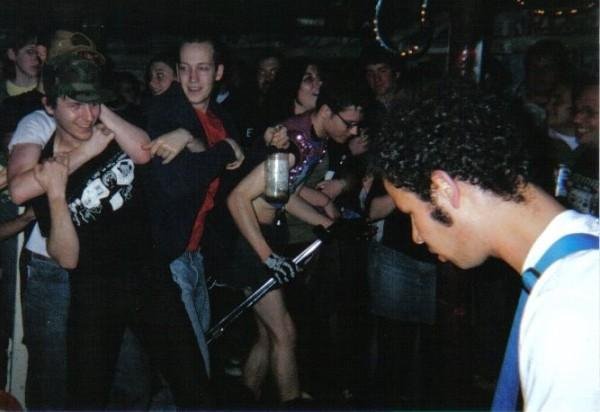
My adventures as a musician started in high school with a second hand guitar and a lot of free time. It only took a year before my pastime became something more like an obsession. First was my high school band: The Nosebleeds. The Nosebleeds played revved up versions of 50s and 60s rock and roll while all the other kids were covering Blink 182 and Operation Ivy. We were cool – really! Even at this early stage it was clear to me, authentic rock bands played old-school rock music. Even my punk guitar heroes from the 1970s like Mick Jones and Captain Sensible knew how to cop a Chuck Berry riff and Little Richard groove. After 3 years of humid Jersey shore dive bars and fluorescent high school talent shows we called it quits. Honestly, we just got bored. Also, our ace repertoire of fifteen songs was beginning to wear a little thin. . .
After The Nosebleeds came The Carpetbaggers. This was a sea-change in compositional direction. Instead of playing punky renditions of Twist and Shout, we affected a country twang and sang songs about travel and broken hearts. If you caught us on a good night, we would even throw a bit of Sonic Youth into the mix and evoke a wall of feedback out from silence. We played in New Brunswick basements and central Jersey bars and recorded an EP on an abandoned Tascam 1” reel to reel. Buzz words being thrown around at the time were: rootsy, alternative and raw. I had pulled the covers back from a revved up Chuck Berry only to find a wonderland of Americana – washboards, harmonicas, and acoustic guitars – waiting. This was, of course, what those rocker’s back in the day were inspired by – right? If The Carpetbaggers weren’t the real thing, who was?
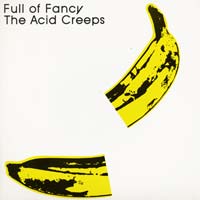
When The Carpetbaggers broke up I joined one last band, The Acid Creeps. At this point, there would be no turning back from my descent into nostalgia. We aimed to resurrect the late sixties go-go bar house band. Taking care to acquire vintage Fender amplifiers, vintage reissue guitars, and even a knockoff Vox Continental organ. If that wasn’t enough, my sister sewed us matching orange paisley shirts which complimented our skinny black ties and sunglasses. We imagined ourselves as a period perfect garage band, exactly the sort we had seen in movies. We covered everything from Iggy Pop’s, I Wanna Be Your Dog, to The Sonic’s, Psycho, and the Detroit Wheels version of Little Latin Lupe Lu (which we all preferred). Only in our mid-twenties, we were experts (or snobs, depending on your perspective) at defining and defending what authentic garage music was, and what it was not. Before breaking up, we created a yellow 7” vinyl tomb to forever keep our music. It was named “The Bananna Split EP,” and at the moment it all seemed perfect. Authenticity, sold for five dollars at a show.
Reflecting, five years later, on these three epochs of music making – it is hard not to blush. Not only did I, for at least a year, consider each band the singular most authentic band ever; authenticity, as an ideal, began subtly to change the way I viewed myself. I transformed from Aaron the Weird Al Yankovic fan to Aaron, the garage rock expert in about 8 years. Wherever I looked for authenticity, I found it, and it was real. Not only that, but at the bar, we convinced ourselves and our friends of this notion. Conversations about which bands got it, and which did not, were frequent – if not mandatory. The answers became standard too: The Exploding Hearts, The Murder City Devils, The Misfits? They all got it. Bands like Metallica; for the most part, they did not. These conversations forever led us to equate the authentic with the obscure; a rabbit hole that twists and darts endlessly.
Authenticity in music is like feedback: powerful, seductive and dangerous. It is a very real, yet elusive concept that invites imitation and when left unchecked, can spread like a contagion. Although I love revisiting the music of my old bands, I cannot help but hear them now as a set of key moments in a greater life narrative. Iterations of myself left behind in an ongoing dialogue about authenticity. A dialogue, which, to this day, affects what music I choose to listen to, and what music I choose to avoid. Although none of my bands were truly “the real-deal,” it would be odd to claim that any were not authentic. Rather, this concept, authenticity animated each band – it kept us all going, and brought our music to life. My bands were authentic because I believed in them. I believed in my bands, because they were authentic.
AT
–
Aaron Trammell is co-founder and multimedia editor of Sounding Out! He is also a Media Studies PhD student at Rutgers University.
—
Share this:

Prison Music: Containment, Escape, and the Sound of America
DOI: https://doi.org/10.59350/r3xqx-qrv76
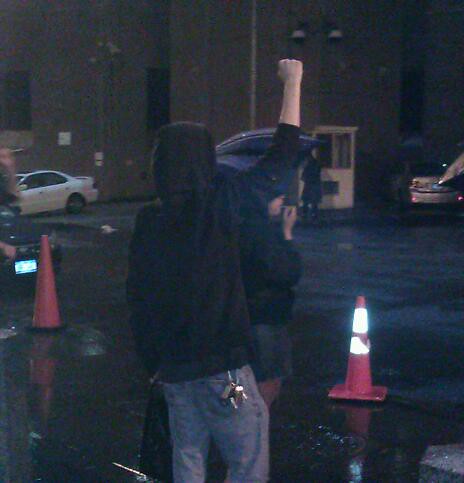
We used our voices, whistles, and blow horns to make contact with those on the inside… Prisoners flickered the lights in their cells on and off throughout the building, banged on windows, and we could see the shadows of many of those on the inside waving and pumping fists. — Activists outside the Metropolitan Corrections Center, NYC, July 8, 2011
Noise demonstrations, like the one described above, occurred outside jails, detention centers, and prisons in cities like New York City, St. Louis, Oakland, Los Angeles, Montreal and Kitchener, Ontario throughout the weekend following July 4th, 2011. Activists rallied by playing music, chanting, launching flares and fireworks, and banging pots and pans– communicating their solidarity with the Pelican Bay Hunger Strike, and their demand for justice for prisoners in each city. The noisy international demonstrations “connected local struggles against dehumanization to the California hunger strike and the conditions of the Pelican Bay Security Housing Unit, as well as both the U.S. and Canada’s prioritization of policing and imprisonment over social welfare.” (San Francisco Bayview, 2011).
If music can be understood as “the organization of noise” (Attali, 1977), these audible signs of solidarity across prison walls would certainly be considered a form of music: prison music, perhaps. Prison has been a form of political organization for the United States, at least since the beginning of the 19th century; music (or organized noise) from or about prisons helps trace this history of containment sonically. Prison music also points to the possibilities of sonic and political escape from this carceral state.
The beginnings of the history of prison music in the United States can be traced to the War of 1812. A poet named Francis Scott Key met with British officers aboard a ship off the coast of Maryland to negotiate the release of American prisoners. He was detained overnight, having gained knowledge of the position of British military units and their plan to soon attack Baltimore. From detention in a ship floating on the Atlantic, Key watched the Battle of Baltimore at Fort McHenry and reported at dawn to the prisoners below deck that he was still able to see the American flag waving.

He chronicled the experience in a poem titled, “In Defence of Fort McHenry,” and later put it to music with John Stafford Smith’s “To Anacreon in Heaven.” The title of Key’s poem changed in October of 1814 when a Baltimore actor performed the song in public and called it “The Star-Spangled Banner.” In 1889, the Secretary of the Navy designated “The Star Spangled Banner” as the official tune to be played at the raising of the U.S. flag, and in 1916 the song was declared the national anthem of the United States. Key’s experience in detention along with other American prisoners in the middle of the Atlantic was memorialized as the U.S. anthem, but it is rare, if ever, that the country’s ode to freedom is understood as its opposite – as an ode to unfreedom, as prison music. Set against contemporary examples of organized noise across prison walls, as well as examples of prison themes in U.S. popular music and culture, the U.S. national anthem can be understood as a beginning point for an American tradition of prison music.
Jimi Hendrix’s guitar version of “The Star Spangled Banner” allows us to see this dimension of the American anthem. Offering a scathing and raucous rendition of the national anthem at the 1969 Woodstock Festival off the heels of his song “Purple Haze,” Hendrix blurred the lines between a drug-induced delirium and the reality of U.S. containment, at home and abroad. Hendrix improvised on Smith and Key’s tune, allowing the notes and sounds to escape the page, and signified on the sonic and political constraints the song represented: major chords, patriotic lyrics, “American freedom.” In riffing on the national anthem, Hendrix perhaps released what was being held behind these classic American “bars”: the pain, the chaos, the possibility. Note the intervals bending from major to minor to major (harmony to disharmony and back again); the (song) structure being destroyed, re-formed, rebuilt anew; the reduction of the refrain to organized noise— sonic escapes in the forms of cries, screams, explosions. Here Hendrix’s performance fits into a trajectory of U.S. prison music by retooling the U.S. national anthem as a song of unfreedom, or perhaps, a different kind of freedom.
The relationship between prison and music in the United States can be heard most clearly through Black soundings of voice, tools, instruments, technology. Hendrix’s music, for example, represented another transnational trajectory of prison music arriving on U.S. shores from ships in the Atlantic, the genealogy of Black music. What began as tribal African songs remixed over plantation work in slavery conditions became field hollers, gospel, chain gang songs, work songs, the blues, jazz, country, rock, hip-hop. It is here that “logics of U.S. white supremacy”: slavery/capitalism, genocide/colonialism, Orientalism/war (Andrea Smith, 2008) coalesce and are rendered illogical, problematic, and questionable, simply (or not so simply) by their audibility. Take the following song, “Early in the Mornin’,” sung by Black prisoners in a 1940′s Mississippi work farm, as another example.
In this example of prison music, one hears sounds that confound the work that is being performed. The music makes the work illogical. It sounds like the work is not productive, at least not for the bodies performing it. This is destructive, or more precisely deconstructive, physical and sonic work: breaking down (song) structures, bodies, minds in the process. It is a sonic protest against imprisonment, even as prison labor is being performed. This is the sound of prison music, simultaneous containment and escape, and helps explain why prison (music) is so popular in the United States. Prison is a necessary function of white supremacist patriarchal capitalism– a necessary warehousing of surplus (bodies) for exploitation or elimination. Prison music is a documentation of this process. Listening to, and perhaps playing, prison music is our attempt to hear ourselves survive within these dehumanizing systems.
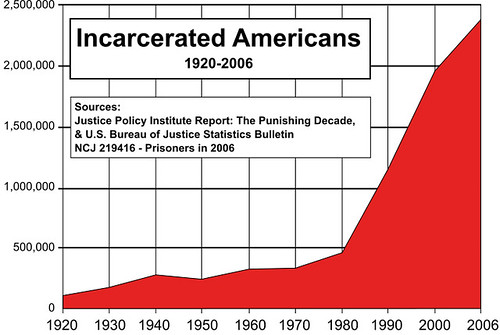
Prisons are popular in the United States, and not just in music (from anthems to work songs to blues to country to rock to hip-hop, imbued with the sounds and sights of prison). It’s the popularity and predominance of actual prisons, and the increasing rate of incarceration of U.S. residents, that undergirds the general public’s simultaneous aversion to, and fascination with, these literal echo chambers. Prisons in the United States are hyper-inaudible/invisible, and simultaneously hyper-audible/visible. The location of U.S. prisons behind distant, opaque, and quiet walls, sits strangely against the reality of prison as an increasingly intimate, transparent, and loud source of entertainment for the general public– think Cops (23 seasons), Law & Order (20 seasons), CSI (12 seasons), and Lockup (11 seasons).
Regrettably, sounds (musical or otherwise) from those incarcerated are rarely audible above the din of the prison spectacle in popular music, culture and policy. Jacques Attali wrote, “Music is a herald, for change is inscribe in noise faster than it transforms society…. Listening to music is listening to all noise.” The question is: when prisoners make noise, will we hear their music?
—
Jeb Middlebrook holds a Ph.D. in American Studies and Ethnicity from the University of Southern California, and is a Lecturer in Race, Social Movements, and Popular Culture at USC, University of Colorado–Colorado Springs, Loyola Marymount University, and People’s University, an online, low-cost college for first-time and returning students. He can be reached at jeb@solidarityinstitute.org and on Facebook and Twitter.
—
Share this:




Current Top Posts





April 2021

January 2020

November 2019

October 2019

August 2019

April 2014

November 2017

March 2015

December 2017

October 2015


Recent Comments