
Benefit Concerts and the Sound of Self-Care in Pop Music
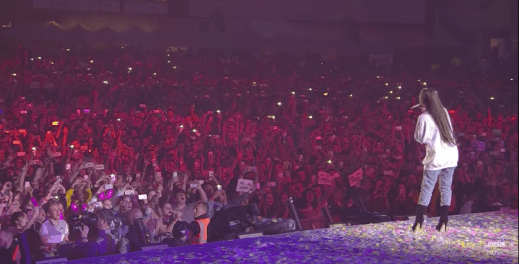
Less than two weeks after a suicide bombing killed 22 people at the Manchester Arena following an Ariana Grande concert, the singer was back on stage in the city. She capped her three-hour One Love Manchester benefit concert with the 2015 single, “One Last Time,” which had found its way back into the UK Singles chart in the days following the blast. It was technically a solo performance, but Grande was joined on stage by the many artists who had already held the mic that day. At one point she was too overwhelmed to sing, and the audience took over for her. Grande’s occasional loss of voice is moving to watch. Throughout the concert, she would frequently struggle to speak, mostly sticking to short introductions of singers and a variation of “Thanks for being here; I love you so much,” her voice often cracking or sounding uncharacteristically pinched, the tears barely held at bay. Until “One Last Time,” she could always find her full voice through song, but as dusk settled on the city and the concert drew to a close, Grande could no longer sing through the weight of the moment, so the community she’d called together so she could “see and hold and uplift” them lifted her.
Benefit concerts and the products surrounding them—as well as the critiques that target them—have become familiar fare since the 1984 Band Aid recording of “Do They Know It’s Christmas” spun off to form 1985’s Live Aid, a multi-site concert event complete with commemorative souvenirs and the performance of the USA For Africa single, “We Are the World.” Skeptical accounts of benefit concerts fall like crumbs from Marx’s beard: they’re capitalism deployed as band-aids on problems capitalism created; they’re opportunities for celebrities to enhance their brands; they’re colonial; they’re neo-colonial; they’re exaggerated performances of wokeness intended to absolve people of their complicity in systems of violence. As communal rituals in response to tragedy, though, benefit concerts also function as metaphorical keystones that hold the tension of competing emotions, politics, and sounds. Listening to music emerges as a form of self-care, but that act may not sound the same for different people. Looking at the case of Grande’s One Love Manchester, I will map self care in the context of this contemporary moment by filtering the Manchester concert through Cheryl Lousley’s feminist analysis of benefit concerts (2014). Specifically, in order to highlight what’s different about One Love Manchester, I’ll start with Lousley’s attention to the way feminized compassion is performed through benefit concerts as an outward-facing love. Here, Grande performs the same kind of feminized compassion but shifts the focus of the benefit to an inward self-care. But not all selves experience care or self-care the same way. I’ll end by listening to Grande’s “One Last Time” alongside Solange Knowles’s “Borderline” (2016) in an effort to situate those sounds in contemporary politics that shape who has access to what kind of care.

Screenshot from 1984’s Band Aid song, “Do They Know It’s Christmas?”
Cheryl Lousley, in “With Love from Band Aid: Sentimental Exchange, Affective Economies, and Popular Globalism,” grants that benefit concerts aren’t just about fake feeling, but she doesn’t lose sight of capitalist and imperialist critiques. For her, benefit concerts are events “where feeling is validated, where space is made for feeling.” For her, if we allow that participants (whether organizers, performers, audiences) can be aware of the capitalism-fueled problems of benefit concerts but choose to be involved with them anyway, then we can access further dimensions of cultural analysis. In Lousley’s case, that includes gender and emotion, as she keys in on how the performance of feminized compassion and love creates an “affective economy” of “feeling too much.” When confronted with tragedy enormous enough to press the limits of the social imaginary, society looks for somewhere to put their big feelings and turn them into some kind of action. Benefit concerts like Live Aid invoke a moral imperative to give of one’s own wealth to someone who needs it, a public moral activism Lousley grounds in feminized emotional labor, a gendered compassion that extends to the entire nation. She demonstrates that public Anglophone discourse surrounding the Ethiopian famine leading up to Live Aid revolved around domestic scenes of feminized affect performed across gender boundaries. The affect of Live Aid, then, included a gendered performance of love and compassion turned outward, and this has been the template for numerous benefit concerts since, including Farm Aid (1985), Concert for New York City (2001), and Hope for Haiti Now (2010), among others.
 The announcement of Ariana Grande’s One Love Manchester echoes Lousley’s idea of the benefit concert as a gendered performance of love and compassion. A skim of her Twitter post (which is a picture of a message longer than 140 characters) announcing the event reveals emotive terms and phrases throughout. Grande offers sympathy, compassion, admiration, solidarity, and, importantly, music, the latter in the form of a concert where she and her fans can feel too much together. What’s different about Grande’s benefit concert, though, is that it’s pitched not as an outward demonstration of compassion for others, but as an inward compassion for one’s self, what I call here “self-care”:
From the day we started putting the Dangerous Woman tour together, I said that this show, more than anything else, was intended to be a safe space for my fans. A place for them to escape, to celebrate, to heal, to feel safe and to be themselves…[The bombing] will not change that.
At the concert we can hear Grande model self-care for her audience as she struggles to maintain her composure and then gathers it through song, performing for herself the same kind of care she wants concert attendees to extend to themselves and their city.
Analyses and critiques of self-care generally start with Audre Lorde’s A Burst of Light quote, “Caring for myself is not self-indulgence, it is self-preservation, and that is an act of political warfare,” then contextualize how this quote functions for Lorde, a queer woman of color, differently than it does for the white women who have become the faces and consumers of #selfcare. Caring for one’s self when the world wishes to marginalize and destroy you is, indeed, warfare. And while white women suffer at the hands of the patriarchy, the long history of feminist movements also reveals that white women not only have access to privilege and resources unavailable to women of color, but also that they have wielded that privilege in ways that further marginalize and harm women of color. In other words, self-care means something different based on who the self is and—and Sara Ahmed has outlined this in characteristically brilliant terms—who else will show up to care for you. Intersectionality shows us that queer people and women of color and people with disabilities often must perform self-care because the world is not organized to care for them. “For those who have to insist they matter to matter,” Ahmed writes, “self-care is warfare,” a necessity for survival. What I want to explore below is how self-care can sound different based on who the self is and whether that self must “insist they matter to matter.”
 Ariana Grande’s performance of “One Last Time” at One Love Manchester presents self-care for a self who also receives support from others. Here, Grande mirrors the collaborative nature of Live Aid by performing alongside other pop stars whose presence—confirmed relatively last-minute, almost certainly with a degree of effort to rearrange busy schedules, and without the usual compensation for their performance—tells Manchester and those harmed by the bombing that they matter. For “One Last Time,” many voices join together to provide “a safe space for [Grande’s] fans” to take care of themselves, and they, in turn, are able to take care of Grande when her voice escapes her. The underlying theme of many critiques of white feminist self-care is that it is frivolous, a market-driven excuse to indulge, a selfish pursuit of happiness for happiness’s sake. And sure, as with benefit concerts, capitalism is a big problem here, and sometimes we call something self-care when it really is just self-indulgence. But I’d like to suggest we can make a finer distinction that doesn’t require the oversimplification that comes with divvying up some actions or products as care and others as indulgence (or: Schick’s self-care marketing of a razor may be exploitative at the very same time the razor actually functions as a form of self-care for some), and this is one reason I find the One Love Manchester concert compelling. Manchester and the survivors of the blast and Ariana Grande and her touring team could absolutely use the safe space the concert is trying to create. As Lousley reminds us, the performed compassion of benefits isn’t simply fake feeling; the trauma Grande and the city and her fans experienced was real, and it’s especially audible in the moments Grande’s voice is pinched off mid-lyric. Let’s consider others who could use the safe space One Love Manchester is trying to create: victims of bombings and terror throughout the world. The music industry isn’t as eager to remind them that they matter. Self-care, it turns out, is easier for some to perform because the world is literally willing to invest in the care of those selves.
By contrast, Solange Knowles’s “Borderline (An Ode to Self-Care)” (from her 2016 album A Seat At The Table) is lyrically rooted in the black feminist work of community organizing and activism. The singer explains to her lover that she needs a night off so that she can have the resolve to go back out to the “borderline” and fight again. Self-care as warfare, indeed. The singer’s self-care has more than one purpose: it’s a time to remind herself that she matters, and it’s a time to restore the energy needed to go out and insist that her community matters. Instead of a bevy of pop stars lending their voices to create a safe space for her or an audience of adoring and grateful fans ready to take over if she can’t, Solange’s “Borderline” calls forth a more intimate setting. She multitracks her voice so that she collaborates and harmonizes with herself, with a faint doubling on the hook from Q-Tip, who is turned down in the mix and following Solange’s lead. “Borderline” is a mostly solo act of self-preservation that enables the singer to go out and create safe spaces for others.
This inward-to-outward focus of self-care is evident in the instrumentation. After a smooth piano-and-bass duet in the introduction, the kick drum enters at the 0:28 mark, overblown and rough around the edges. The effect sounds like oversaturation, where the signal’s gain is driven so that we lose some of the fidelity of its lower frequencies. This effect gives the kick a brighter timbre as the higher frequency overtones shine through and also muddies the lower frequencies so that they sound as if you’ve blown your car speakers and are getting noise in the mix that isn’t supposed to be there. The drum kit also includes a white noise sound (think “tsshhh”) that hits on the upbeat of the first, third, and fourth beats of each measure, joining the kick drum in creating a generally rough texture. This texture stands out because it sounds imperfectly mixed, like a sound engineer who messed something up. I hear in this a sonification of what Solange describes in her lyrics – a world that has frayed her edges, a world at war with her, a world disinterested at its best and hostile at its worst to the idea of her preservation. Hence, she pleas to retreat and preserve her own self.
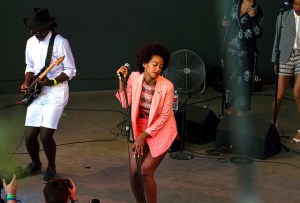
“Solange” by Flickr user Greg Chow, CC BY-NC-ND 2.0
The interlude that follows “Borderline” is the immediate payoff of this, as Solange sings with Kelly Rowland and Nia Andrews that she has “so much [magic], y’all, you can have it.” Then comes “Junie,” a fresh and energetic funk track that finds the singer back out on the activist grind after the night off that made it possible for her to return to the borderline.
As self-care proliferates in so many different practices performed by different selves, and as the term is emptied of meaning one hashtag at a time, one way we might track how power circulates through self-care is to listen to sonic representations of self-care. In Grande’s “One Last Time” performance at One Love Manchester we hear self-care staged and protected by cultural icons and government officials who assure attendees that their selves matter, while in Solange’s “Borderline” we hear self-care as an intimate, closed act that makes self- and community-preservation possible even when cultural icons and government officials refuse to participate in that preservation. In “One Last Time” we hear a community who shows up to help a singer when the world is hard, while in “Borderline,” we hear a singer having to reassure her own self that it’s okay to step away for a moment when the world is hard. By listening carefully in these moments, we can hear which selves are more readily recognizable as worthy of care—a chorus of voices surrounded and kept safe by heightened police presence—and which selves are more likely to have to perform care for themselves quietly or privately, for fear of retribution. Sound, in this instance, calls our attention to details that can let us more firmly hold onto a concept like self-care—a concept and series of practices that have been fundamental to the survival of black and queer women in a hostile world—that otherwise threatens to slip from our grasp. But hold on tight, and we just might make it back out to the borderline.
—
Featured image: Screenshot from Youtube video “Ariana Grande – One Last Time (One Love Manchester)” by user BBC Music
—
Justin Adams Burton is Assistant Professor of Music at Rider University. His research revolves around critical race and gender theory in hip hop and pop, and his book, Posthuman Rap, is available for pre-order (it drops October 2). He is also co-editing the forthcoming (2018) Oxford Handbook of Hip Hop Music Studies. You can catch him at justindburton.com and on Twitter @j_adams_burton. His favorite rapper is one or two of the Fat Boys.
—
REWIND! . . .If you liked this post, you may also dig:
Unlearning Black Sound in Black Artistry: Examining the Quiet in Solange’s A Seat At the Table-Kimberly Williams
Trap Irony: Where Aesthetics Become Politics-Justin Burton
Listening to Sounds in Post-Feminist Pop Music-Robin James
Share this:

SO! Reads: Damon Krukowski’s The New Analog

 Analog revival has gained traction across many media in recent years, but perhaps nowhere so strikingly as in sound. The shifting formats and fortunes of a digitally reshaped music industry invite, for many, the counterposition of a bright nostalgic picture. Yet artists and engineers whose work has spanned the transition from analog to digital sound find that the romanticization of the former can have a weird overreach. For example, when Dave Grohl produced a digital-decrying documentary on the LA studio Sound City, engineer Larry Crane was bemused that “Grohl seems to be attributing the arc of his career to the magic in a Neve console.” Recordists like Crane find themselves in between the Scylla and Charybdis of digital-era music: on one side, the embrace of new tools that are as entangled with corporate control structures as they are convenient; on the other, a skepticism that overshoots its mark, fetishizing old technologies and cementing a previous generation’s in-crowd as gatekeepers. Decades after digital media triggered one of the most momentous transitions in sound recording, the debate around their use is anything but settled. Tied up in this contest are questions of how and what pre-digital media will be preserved, but also problems like whose use of technology in music-making constitutes authentic talent and who has authority in the determination.
 When Damon Krukowski steers into these waters with The New Analog: Listening and Reconnecting in a Digital World (The New Press: 2017), he is quick to qualify that his memorializing of pre-digital practices “is hardly a Luddite’s call” (12). Noting the “all-or nothing response” that “dominates popular discussion of the many anxieties provoked by the digital revolution” (9), Krukowski contrasts the disruption-embracing “clean break” with life on the “technological island” (8) of confining one’s practice to outmoded materials. Addressing a reader who lives more or less contentedly in a contemporary media world, he speaks as a kind of expatriate of the analog island. He, too, lives in the digital present, but he sees it through the lens of decades spent working with and listening through analog machines. His project of defending analog listening practices takes inspiration from the efforts of urbanist Jane Jacobs, who labored to turn back the tide of redevelopment and suburbanization by celebrating the organic functionality of city life. His central argument for preservation is that “what we are losing in the demolition of analog media is noise” (197, emphasis original). Noise becomes a character in The New Analog akin to the city block in Jacobs’s work: a wrongly maligned figure that has quietly formed the basis of experience and utility in the old mode.
Though Krukowski’s definition of noise is flexible in some ways, he casts the digital as its uncompromising antithesis. This position precludes what could make the book more forward-looking in its aim: a consideration that noise might become a new kind of character in the digital realm rather than disappearing at its edge. Noise shows up in analog media as buzzing undercurrents and as modes of distortion when electrical signals exceed their ranges; digital media, while lacking these, are replete with moments of failure when a system is fed the wrong kind of information or pushed beyond its intended bounds. In their repetition, these moments of error become a new kind of noise that, just like analog noise, forms an unremovable layer of our experience in mediated environments. By declining to look for digital noise and instead focusing so squarely on noise as something lost to the digital transition, Krukowski misses a chance to center a more significant linkage with Jacobs: many of the problems he sees in digital-era sound are not due to the inherent nature of digital media but rather to the same motives of control and segregation underpinning the drive toward suburbanization.
Yet his original and thoughtfully cast historical route points us toward these culprits, even when the language drifts toward a more technologically deterministic stance. It is thus that his book still provides a vibrant body of historical consideration we can leverage in using noise to reshape our digital ways of listening. The moments when Krukowski lets technology stand in for the human motives that construct it give unfortunate cover to what should be the targets of such a critique. But his real concern toward the digital era arises from specific changes in the landscape of aural awareness, and he ultimately succeeds in the task of elevating his argument above the cliché of deterministic digital-bashing by setting its true focus not on the digital but on the era.

headphones by Flickr user Chris, (CC BY-NC-ND 2.0)
Readers might be surprised, for instance, to discover that The New Analog’s first chapter covers a development in sound — the transition from mono to stereo — that has nothing to do with digitization at its outset. The chapter narrates the release of Pink Floyd’s The Dark Side of the Moon as a critical moment in consumer audio’s treatment of headphones as the ideal listening space. This movement toward individualized experience becomes a crucial part of setting the stage for the actual entrance of the digital. The design of digital media, Krukowski demonstrates, has not just carried forward this trend but absorbed it as a guiding principle, and has effected the same transformation not just in listening to music but across all kinds of daily situations. “The stream of digital information can put each of us in a different space than the others, even as we hurtle together through a tunnel on fixed tracks,” (49) Krukowski observes of the changed social experience of riding a subway. The comment makes an easy metaphoric return to music: digital design is now funneling sonic experience into a small number of streaming platforms, each promoted on the appeal of moving out of a collective listening space into one of personal curation. Claiming that a dangerous disorientation can arise in the separation of such neatly personalized spaces from their messier surroundings, the chapter closes with a cautionary tone: bad things can happen when we follow along with the digital logic of turning a once noisy situation into “a stream that is signal only” and when we stop “paying attention to noise.” (51, emphasis original).
Noise closes out each chapter, constituting the shared floor on which the book’s arguments stand. This construction calls for scrutiny, because noise is a notoriously slippery figure. As Marie Thompson notes in her recent interview with SO!, subjective and objective definitions both lay claim to noise, bringing along problems of politicized value judgment and erased context. At the same time, the term’s many meanings (electrical, legal, musical, etc.) serve as useful bridges. In Sound Ideas: Music, Machines, and Experience, Aden Evens uses noise as a primary example when he suggests a “productive ambiguity” can prompt connections that help different disciplines approach meeting points. Krukowski would, it seems, endorse this idea. He couples his formulation of noise to that of analog — an analog medium is identifiable by its noisiness, and noise is the substrate by which meaning takes hold in an analog medium.
Is it fair, though, to chain the figure of noise so tightly to analog recording that we must say it is wholly lost in the move to digital? In arguing that digitally mediated communication lacks the analog mode’s quality of perceivable distance, Krukowski lists perceptual coding — the application of “psychoacoustic research to digital sound processing” (75) — as one culprit. Jonathan Sterne, in MP3: The Meaning of a Format, points to perceptual coding’s advent as a moment when noise was domesticated. Where engineers had long sought to minimize noise, perceptual coding meant that “communication engineering exhibited a new attitude toward noise. Once you can use signal to hide noise, the game is up. Noise ceases to matter as a perceptual category.” This change in noise’s status does not eradicate it or lessen its importance, though. According to Sterne, this domestication made noise more available as a site for artistic exploration and subversion. But if noise is a key foundation on which we find meaning through listening, as Krukowski compellingly argues, and noise has been subjected to a great domestication, what does that say about the forces at work upon our listening?
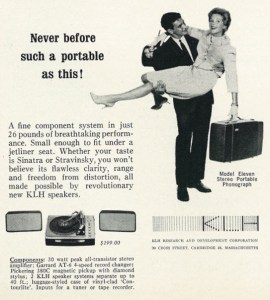 A fascinating answer emerges in a thread that pops up multiple times across Krukowski’s anecdotes: the relationship between patriarchal domesticity and the shaping of digital sound. In the chapter on stereo, he includes an ad from a 1962 Playboy issue where a man carries a woman as if across a threshold; she, in turn, holds a stereo set in its portable case. The ad pairs the stereo and the wife as two laudable choices in the man’s domestic assemblage. Both are manageable enough for him to carry home, yet both promise to extend his control — Krukowski notes that such marketing material touted stereo products as letting their owners occupy “the producer’s chair” (28) by granting listeners new agency over the mix. That focus on idealized male consumers echoes still through gendered suppression in musical exchange: as Elizabeth Newton writes, “Though women have collected vinyl since the inception of the medium, female collectors, like the women musicians being collected, often lack representation in public space that is commensurate with their actual involvement.”
True to the analogy with Jane Jacobs’s struggle against the developer Robert Moses, the patriarchal force that has ingrained itself so thoroughly in digital audio is also a suburbanizing one, keyed to a politics of racial segregation that frequently cites noise as a justification. In “‘Just Be Quiet Pu-leeze’: The New York Amsterdam News Fights the Postwar ‘Campaign against Noise,’” Jennifer Stoever documents how “white press discourse on Puerto Rican migration firmly attached ‘noise’ to the voices, bodies, and neighborhoods of Puerto Rican migrants — portraying white flight to the suburbs as a justifiable escape to suburban refuges of peace and quiet and targeting urban areas such as Harlem in ‘antinoise’ campaigns” (PAGE). Regina Bradley traces this “connection between whiteness and quiet” through to a contemporary moment in her SO! post “Fear of a Black (in the) Suburb.” The history of racially targeted noise ordinances intersects Krukowski’s narration of the proto-digital movement toward private listening. He quotes LL Cool J’s “I Can’t Live Without My Radio” as a noise-ordinance-defying affirmation of boombox listening, the antithesis of headphones and their sonic compartmentalization. Dwelling on the song’s line “Terrorizing my neighbors with the heavy bass,” he points to the artist’s intentional use of noise as a political implement, bound up jointly in his listening and his music making.
For Krukowski, the song is noteworthy in demonstrating a practice lost to the wave of noise-eradicating digital development in sound. If we approach it with the consideration that noise might not have been lost but rather domesticated, however, it serves more as a guidepost. Were he looking to LL Cool J’s example as one in need of a digital-era parallel, Krukowski might arrive at a different treatment of Kanye West’s post-release revisions of his album The Life of Pablo than he gives later in the book. Rather than describing West’s changes as “art severed from its own history” (169), he could instead credit the album’s uniquely digital instability as a moment of usurping the corporate platform as the arbiter of a record’s final version — an instance of harnessing digital noise within a digital environment to reorient its assumed parameters of authority and a prompt for listeners to consider their own role in deciding what version of the text should prevail.
Though Krukowski declines to bring it to the forefront, the involvement of a domesticating and segregating force lends further weight and precision to The New Analog’s historical argument. Returning to his invocation of Jane Jacobs, Krukowski analogizes the dichotomy of street and home with that of analog and digital. “Noise has a value of its own—the value of shared space and time,” he writes. “The urban spaces we occupy are built on that commonality. The street is a noisy place. And the street has value, as Jane Jacobs pointed out” (207, emphasis original). The contrast between analog street and digital home reaches back to rescue the book from the flawed pronouncement that digital tools themselves are the problem. We are left to consider a much richer historical argument about the alarming success that efforts of domestication and power-consolidation have found in intertwining themselves with digital media.
In that light, readers looking for an actionable takeaway from The New Analog shouldn’t just unsubscribe from streaming services and start (or resume) buying vinyl records. They should redirect their attention toward the very thing of whose existence Krukowski seems skeptical: digital noise. Even though the digital home is built to confine, there are new noisy streets outside it to be explored. Krukowski recounts how the band Can endeavored to let their recording studio “compose on its own” and to become an activating, curating conduit for the sounds of tape machines. “In Can’s studio technique,” he writes, “noise and signal are equally significant materials…. the noises in it are no less human than the signals” (138). If we look for digital noise, we will see that it bears no less potential for meaning and beauty than Can’s analog noise, as artists are already proving with techniques like glitch and sampling. We as listeners can do more to help realize that aim by celebrating digital noise, by recognizing what it reveals and critiques. For a project that with less care could have steered off into the welcoming terrain of nostalgic grievance, The New Analog offers a surprising amount to point our way forward.
Holly Herndon’s “Home” uses sonic and visual sampling to turn the surveillant gaze of an intimate digital space back on itself.
—
Featured image: “Scenes From The Recording Studio” by Flickr user G. Dawson, CC BY-NC-ND 2.0
—
Andy Kelleher Stuhl is a writer, sound artist, and software developer focused on creative infrastructures and the politics of mediated sonic exchange. His work looks to musicians for inspiration and aims to apply musical creativity as a model for new paths in such domains as digital humanities and the critique of technology. His research has investigated the phenomenon of analog fetishism from the perspective of sound engineer communities and, more recently, the process and aspirations behind interactive musical works. He holds a master’s degree in Comparative Media Studies from the Massachusetts Institute of Technology and a BA in Science, Technology, and Society from Stanford University.
—
REWIND! . . .If you liked this post, you may also dig:
SO! Reads: Susan Schmidt Horning’s Chasing Sound: Technology, Culture and the Art of Studio Recording from Edison to the LP— Enongo Lumumba-Kasongo
SO! Reads: Jonathan Sterne’s MP3: The Meaning of a Format–Aaron Trammell
Digital Analogies: Techniques of Sonic Play–Roger Moseley
Evoking the Object: Physicality in the Digital Age of Music–-Primus Luta
Share this:


Current Top Posts





April 2021

January 2020

November 2019

October 2019

August 2019

April 2014

November 2017

March 2015

December 2017

October 2015
 Sounding Out!
Recent Comments