
Re-orienting Sound Studies’ Aural Fixation: Christine Sun Kim’s “Subjective Loudness”
 Editors’ note: As an interdisciplinary field, sound studies is unique in its scope—under its purview we find the science of acoustics, cultural representation through the auditory, and, to perhaps mis-paraphrase Donna Haraway, emergent ontologies. Not only are we able to see how sound impacts the physical world, but how that impact plays out in bodies and cultural tropes. Most importantly, we are able to imagine new ways of describing, adapting, and revising the aural into aspirant, liberatory ontologies. The essays in this series all aim to push what we know a bit, to question our own knowledges and see where we might be headed. In this series, co-edited by Airek Beauchamp and Jennifer Stoever you will find new takes on sound and embodiment, cultural expression, and what it means to hear. –AB
—
A stage full of opera performers stands, silent, looking eager and exhilarated, matching their expressions to the word that appears on the iPad in front of them. As the word “excited” dissolves from the iPad screen, the next emotion, “sad” appears and the performers’ expressions shift from enthusiastic to solemn and downcast to visually represent the word on the screen. The “singers” are performing in Christine Sun Kim’s conceptual sound artistic performance entitled, Face Opera.
The singers do not use audible voices for their dramatic interpretation, as they would in a conventional opera, but rather use their faces to convey meaning and emotion keyed to the text that appears on the iPad in front of them. Challenging the traditional notions of dramatic interpretation, as well as the concepts of who is considered a singer and what it means to sing, this art performance is just one way Kim calls into question the nature of sound and our relationship to it.
Audible sound is, of course, essential to sound studies though sound itself is not audist, as it can be experienced in a multitude of ways. The contemporary multi-modal turn in sound studies enables ways to theorize how more bodies can experience sound, including audible sound, motion, vibration, and visuals. All humans are somewhere on a spectrum between enabled and disabled and between hearing and deaf. As we grow older most people move farther toward the disabled and deaf ends of the spectrum. In order to experience sound for a lifetime, it is imperative to explore multi-modal ways of experiencing sound. For instance, the Deaf community rejects the term disabled, yet realizes it is actually normative constructs of hearing, sound, and music that disable Deaf people. But, as Kim demonstrates, Deaf people engage with sound all of the time. In this case, Deaf individuals are not disabled but rather, what I identify as difabled (differently-abled) in their relationship with sound. While this term is not yet used in disability scholarship, it is not completely unique, as there is a Difabled Twitter page dedicated to, “Ameliorating inclusion in technology, business and society.” Rejection of the word disabled inspires me to adopt difabled to challenge the cultural binary of ability and embrace a more multi-modal approach.
Kim’s art explores sound in a variety of modalities to decenter hearing as the only, or even primary, way to experience sound. A conceptual sound artist who was born profoundly deaf, Kim describes her move into the sound artistic landscape: “In the back of my mind, I’ve always felt that sound was your thing, a hearing person’s thing. And sound is so powerful that it could either disempower me and my artwork or it could empower me. I chose to be empowered.”
For sound to empower, however, cultural perception has to move beyond the ear – a move that sound studies is uniquely poised to enable. Using Kim’s art as a guide, I investigate potential places for Deaf within sound studies. I ask if there are alternative ways to listen in a field devoted to sound. Bridging sound studies and Deaf studies it is possible to see that sound is not ableist and audist, but sound studies traditionally has suffered from an aural fixation, a fetishization of hearing as the best or only way to experience sound.
Pushing beyond the understanding of hearing as the primary (or only) sound precept, some scholars have begun to recognize the centrality of the body’s senses in sound experience. For instance, in his research on reggae, Julian Henriques coined the term sonic dominance to refer to sound that is not just heard but that “pervades, or even invades the body” (9). This experience renders the sound experience as tactile, felt within the body. Anne Cranny-Francis, who writes on multi-modal literacies, describes the intimate relationship between hearing and sound, believing that “sound literally touches us,” This process of listening is described as an embodied experience that is “intimate” and “visceral.” Steph Ceraso calls this multi-modal listening. By opening up the body to listen in multi-modal ways, full-bodied, multi-sense experiences of sound are possible. Anthropologist Roshanak Kheshti believes that the differentiation of our senses created a division of labor for our senses – a colonizing process that maximizes the use-value and profit of each individual sense. She reminds her audience that “sound is experienced (felt) by the whole body intertwining what is heard by the ears with what is felt on the flesh, tasted on the tongue, and imagined in the psyche” (714), a process she calls touch listening.
Other scholars continue to advocate for a place for the body in sound studies. For instance, according to Nina Sun Eidsheim, in Sensing Sound, sound allows us to posit questions about objectivity and reality (1), as posed in the age-old question, “If a tree falls in the forest and no one is there to hear it, does it make a sound?” Eidsheim challenges the notion of a sound, particularly music, as fixed by exploring multiple ways sound may be sensed within the body. Airek Beauchamp, through his notion of sonic tremblings, detaches sound from the realm of the static by returning to the materiality of the body as a site of dynamic processes and experiences that “engages with the world via a series of shimmers and impulses.” Understanding the body as a place of engagement rather than censorship, Cara Lynne Cardinale calls for a critical practice of look-listening that reconceptualizes the modalities of the tongue and hands.

Vibrant Vibrations by Flickr User The Manic Macrographer (CC BY 2.0)
As these scholars have identified, privileging audible sound over other senses reinforces normative ideas of communication and presumes that individuals hear, speak, and experience sound in normative ways. These ableist and audist rhetorics are particularly harmful for individuals who are Deaf. Deaf community members actively resist these ableist and audist assumptions to show that sound is not just for hearing. Kim identifies as part of the Deaf community and uses her art to challenge the ableist and audist ideologies of the sound experience. Through exploring one of Christine Sun Kim’s performance pieces, Subjective Loudness, I argue that we can conceptualize sound studies in the absence of auditory sound through the two concepts Kim’s piece were named for, subjectivity and loudness.
In creating Subjective Loudness, Kim asked 200 Tokyo residents to help her create a musical score. Hearing participants were asked to use their bodies to replicate sounds of common 85 dB noises into microphones. The sounds Kim selected included: the swishing of a washing machine, the repetitive rotation of printing press, the chaos of a loud urban street, and the harsh static of a food blender. After the list was complete, Kim has the sounds translated into a musical score, sung by four of Kim’s closest friends. The noises then become music, which Kim lowers below normal human hearing range for a vibratory experience accessible to hearing and non-hearing individuals alike; The result is music that is not heard but rather felt. As vibrations shake the walls, windows, and furniture audience members feel the music.
Kim’s performance expands upon current understandings of the body in sound by incorporating multiple materialities of sound into one experience. Rather than simply looking at an existing sound in a new way, she develops and executes the sound experience for her participants. Kim types the names of common 85 dB sounds, what most hearing people may call “noise” on an iPad – a visual representation of the sound.
By asking participants to use their bodies to replicate these sounds – to change words into noise – Kim moves visual representation moves into the audible domain. This phase is contingent on each participant’s subjective experience with the particular sound, yet it also relies on the materiality of the human body to be able to replicate complex sounds. The audible sounds were then returned to a visual state as they were translated into a musical score. In this phase, noise is silenced as it is placed as musical notes on a page. The score is then sung, audibly, once again shifting visual into audible. Noise becomes music.
Yet even in the absence of hearing the performers sing, observers can see and perhaps feel the performance. Similar to Kim’s Face Opera, this performance is not just for the ear. The music is then silenced by reducing its volume beyond that of normal hearing range. Vibrations surround the participants for a tactile experience of sound. But participants aren’t just feeling the vibrations, they are instruments of vibration as well, exerting energy back into the space that then alters the sound experience for other bodies. The materiality of the body allows for a subjective experience of sound that Kim would not be able to as easily manipulate if she simply asked audience members to feel vibrations from a washing machine or printing press. But Kim doesn’t just tinker with the subjectivity of modality, she also plays with loudness.

Christine Sun Kim at Work, Image by Flickr User Joi Ito, (CC BY 2.0)
In this performance Kim creates a think interweaving of modalities. Part of this interplay involves challenging our understanding of loudness. For instance, participants recreate loud noises, but then the loud noise is reduced to silence as it is translated into a musical score. The volume has been dialed down, as has the intensity as the musical score isolates participates. The sound experience, as the score, is then sung, reconnecting the audience to a shared experience. Floating with the ebb and flow of the sound, participants are surrounded by sound, then removed from it, only to then be surrounded again. Finally, as the sound is reduced beyond hearing range, the vibrations are loud, not in volume but in intensity. The participants are enveloped in a sonorous envelope of sonic experience, one that is felt through and within the body. This performance combats a long-standing belief Kim had about her relationship with sound.
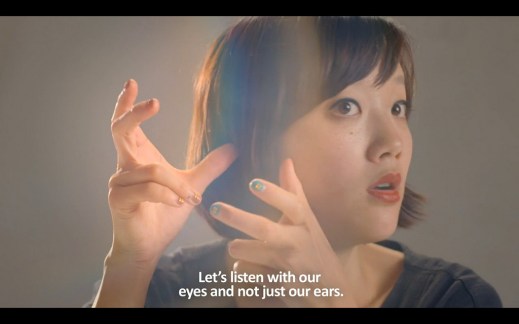
As a child, Kim was taught, “sound wasn’t a part of my life.” She recounted in a TED talk that her experience was like living in a foreign country, “blindly following its rules, behaviors, and norms.” But Kim recognized the similarities between sound and ASL. “In Deaf culture, movement is equivalent to sound,” Kim stated in the same talk. Equating music with ASL, Kim notes that neither a musical note nor an ASL sign represented on paper can fully capture what a music note or sign are. Kim uses a piano metaphor to make her point better understood to a hearing audience. “English is a linear language, as if one key is being pressed at a time. However, ASL is more like a chord, all ten fingers need to come down simultaneously to express a clear concept in ASL.” If one key were to change, the entire meaning would change. Subjective Loudness attempts to demonstrate this, as Kim moves visual to sound and back again before moving sound to vibration. Each one, individually, cannot capture the fullness of the word or musical note. Taken as a performative whole, however, it becomes easier to conceptualize vibration and movement as sound.

Christine Sun Kim speaking ASL, Image by Flickr User Joi Ito, (CC BY 2.0)
In Subjective Loudness, Kim’s performance has sonic dominance in the absence of hearing. “Sonic dominance,” Henriques writes, “is stuff and guts…[I]t’s felt over the entire surface of the skin. The bass line beats on your chest, vibrating the flesh, playing on the bone, and resonating in the genitals” (58). As Kim’s audience placed hands on walls, reaching out to to feel the music, it is possible to see that Kim’s performance allowed for full-bodied experiences of sound – a process of touch listening. And finally, incorporating Deaf and hearing individuals in her performance, Kim shows that all bodies can utilize multi-modal listening as a way to experience sound. Kim’s performances re-centers alternative ways of listening. Sound can be felt through vibration. Sound can be seen in visual representations such as ASL or visual art.
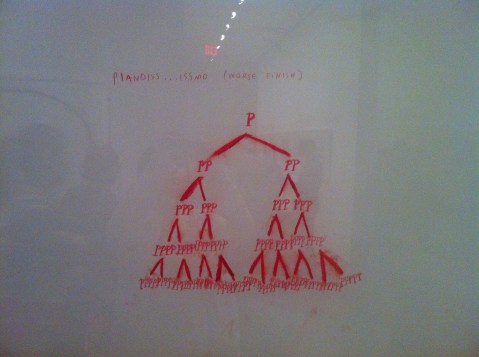
Image of Christine Sun Kim’s painting “Pianoiss….issmo” by Flickr User watashiwani (CC BY 2.0)
Through Subjective Loudness, it is possible to investigate subjectivity and loudness of sound experiences. Kim does not only explore sound represented in multi-modal ways, but weaves sound through the modalities, moving the audible to the visual to the tactile and often back again. This sound-play allows audiences to question current conceptions of sound, to explore sounds in multi-modalities, and to use our subjectivities in sharing our experiences of sound with others. Kim’s art performances are interactive by design because the materiality and subjectivity of bodies is what makes her art so powerful and recognizable. Toying with loudness as intensity, Kim challenges her audience to feel intensity in the absence of volume and spark the recognition that not all bodies experience sound in normative ways. Deaf bodies are vitally part of the soundscape, experiencing and producing sound. Kim’s work shows Deaf bodies as listening bodies, and amplifies the fact that Deaf bodies have something to say.
—
Featured image: Screen capture by Flickr User evan p. cordes, (CC BY 2.0)
—
Sarah Mayberry Scott is an Instructor of Communication Studies at Arkansas State University. Sarah is also a doctoral student in Communication and Rhetoric at the University of Memphis. Her current research focuses on disability and ableist rhetorics, specifically in d/Deafness. Her dissertation uses the work of Christine Sun Kim and other Deaf artists to explore the rhetoricity of d/Deaf sound performances and examine how those performances may continue to expand and diversify the sound studies and disability studies landscapes.
—
 REWIND! . . .If you liked this post, you may also dig:
Introduction to Sound, Ability, and Emergence Forum –Airek Beauchamp
The Listening Body in Death— Denise Gill
Unlearning Black Sound in Black Artistry: Examining the Quiet in Solange’s A Seat At the Table — Kimberly Williams
Technological Interventions, or Between AUMI and Afrocuban Timba –Caleb Lázaro Moreno
“Sensing Voice”*–-Nina Sun Eidsheim
Share this:

Beyond the Grandiose and the Seductive: Marie Thompson on Noise

Dr. Marie Thompson is currently a Lecturer at the Lincoln School of Film and Media, University of Lincoln. Her new book Beyond Unwanted Sound: Noise, Affect and Aesthetic Moralism has just been published by Bloomsbury. We’ve been following each other on Twitter for a while(@DrMarieThompson and @AbstractTruth) and I have become very interested in her ideas on noise. I’m David Menestres, double bassist, writer, radio host, and leader of the Polyorchard ensemble (“a vital and wonderfully vexing force of the area’s sonic fringes”) currently living in the Piedmont region of North Carolina.
—
Cover of “Beyond Unwanted Sound Noise, Affect and Aesthetic Moralism,” By Dr. Marie Thompson
In her new book, Dr. Thompson covers a wide variety of ideas from Spinoza to Michel Serres’s cybernetic theory, acoustic ecology and the politics of silence to the transgressiveness of noise music, and many other concepts to show how we are affected by noise. Thompson is also the co-editor of Sound, Music, Affect: Theorizing Sonic Experience (Bloomsbury, 2013). Here is a conversation we had over email in February 2017 about Beyond Unwanted Sound.
David Menestres (DM): Why now? Why did you feel compelled to write this book? What do you hope this book will accomplish?
Marie Thompson (MT): I think my ‘academic’ interest in noise began as an undergraduate music student – I was interested in thinking ‘beyond’ distinctions of avant-gardism and popular culture and noise, as something that traverses such separations became an evermore appealing concept. So I’ve been circling some of these ideas for quite a while.
I felt compelled to write the book partly due to what I perceived as a gap between some of my ‘everyday’ experiences of noise and how noise was represented in discourse – particularly noise’s representation as an essentially negative phenomenon; or as a shocking, sublime, radical, overwhelming, transgressive force. Noise seems to be one of those topics that makes ordinarily quite progressive thinkers revert to quite uncritical and reactionary tropes – there’s something about it that ‘touches a nerve’. Consequently, much of the discourse around noise is underlined by an often-unacknowledged conservatism. I’ve always found the grandiose rhetoric of noise comparatively quite seductive but at the same time, more often than not, noise is quotidian and banal rather than overwhelming or sublime (which isn’t to say it can’t also be those things). Likewise, I felt like this grandiose rhetoric resulted in an amplification of certain sonic arts practices, while silencing others. I guess I was compelled by a desire to expand the (material and discursive) universe of noise while also trying to maintain some consistency in definition.
Quite simply, I hope the book will contribute something helpful to the recent discussions around noise in media theory, acoustic ecology and music.
DM: What is the difference between a subjective-oriented definition of noise vs. an object-oriented definition and how do both lead to the ethico-affective approach that you champion in the book?
MT: When I refer to subject- and object-oriented definitions I’m referring, quite simply, to noise being defined either in relation to the ear of the beholder, or in relation to the sound-itself. [MT also defines her “ethico-affective approach” as a perspective that “recognises the entanglement of the ethical and the affective: affective relations are also ethical relations.” –ed.]
What I think is useful about a subject-oriented definition is that it remains open to what noise might be, what form it might take – it might be your neighbour hoovering, it might be a fellow travelers mobile phone, or it might be a buzzing wasp. However, subject-oriented definitions of noise are typically wedded to liberal notions of subjectivity and the politics that carries. Noise becomes an issue of personal taste – one person’s music is another’s noise etc. Subject-oriented definitions also struggle to account for noise that isn’t ‘unwanted’, ‘bad’, ‘negative’, and so on; and for noise that might not be perceptible, or noticeable.

Noise as Negative. Sound Cancelling
Object-oriented definitions which treat noise as a type of sound are helpful insofar as there is a consistency of definition and it does not assume noise to be a solely negative phenomenon; however, to my mind, they risk losing sight of context: a particular sound is noise irrespective of how it is heard, what it does.
The ethico-affective approach I develop can be understood to maintain aspects of both these definitional approaches. It maintains the separation created by an object-oriented definition of noise between noise and negativity, so that noise’s ‘unwantedness’ becomes secondary and contingent. It also maintains the contextual focus of a subject-oriented definition, so that noise is not tethered to particular types of sound or sound sources.
DM: I’ve been very interested in the idea of noise as a weapon: the use of sound cannons to silence and sicken protestors, the use of the “Mosquito” device (which produces high frequency pitches thought to be audible only to teenagers in order to keep them from loitering), or the use of classical music to annoy young people.
You talk in one section about the noise of neighbors and the “policed silence of the suburbs.” I am also interested in the use of noise as protest. At the Women’s March in Raleigh on January 21, there were so many fascinating sounds: the sounds of thousands of voices bouncing off tall buildings, drummers, people leading chants with the crowd shouting back, the singing of classic protest songs (“A Change is Gonna Come,” “This Land Is Your Land,” etc.).
What do you think the role of noise will be in our current political climate? I can definitely see noise being used as a weapon by both sides: the government trying to use it as a weapon against the people and the people using noise to amplify their voice against the government. But there is a stark difference between these two sides: the use of sound weapons is clearly for their intended negative affect on people (both the physical effects of sound weapons and the psychological effects of the endless noise that comes from Trump’s press conferences and general bullshit), but I see the protestors intending to use sound in a positive way, to amplify their message, to make sure those in charge hear their voices, to ensure the message arrives intact.
MT: As a concept, noise seems evocative of much about our current political climate: be it the ‘noise’ of ‘fake news’, and ‘alternative facts’ (how does one determine ‘signal’ from ‘noise’, and who gets to determine that distinction); be it the ‘white noise’ of the Trump campaign administration (I recently saw a performance lecture with Barby Asante which effectively performed the ‘tuning out’ the noise of recently-bolstered white supremacy); or be it the collective noise of protest against the brutality of borders, white supremacy and police-state violence.
That noise can be both a force of domination and resistance is revealing of its ambiguity more generally – what I refer to as the ‘both-and’ of noise. Of course, that is not to conflate these uses of sonic force. One of the ways in which I’ve thought about this ethico-political difference in sonic forces is through the Spinozist distinction of power-over/power-to. The ethico-political entangles ethical questions (good-bad) with political questions (power over/power to).
So, when sound is weaponized to exert authority, to bring people into line, by diminishing their capacity to act and do, then this can be thought of as an exertion of power-over. Likewise, when sound becomes a means of collective resistance, or of connectivity (I’m thinking partly here of various ‘noise-protests’ at prisons and detentions centres, where sound is used to traverse walls and borders) then it might be understood as an expression of ‘power-to’ – a (collectivized) body’s capacity to act, to be, to do.
DM: You talk in the book of the “conservative politics of silence.” How does this conservativism affect both how people perceive sound and how we relate to it? Is there something at the other end of the scale, a “liberal politics of silence” so to speak?
MT: To my mind, the conservative politics of silence informs a number of assumptions that are frequently made about what are ‘good’ and ‘bad’ sonic environments; it relates to a preference for the simple over the complex, sameness over difference, past over present, predictability over unpredictability, the ‘synthetic’ over the ‘natural’ (whatever that might mean) and, ultimately, quietude over noise. This ideological framework underlines much ‘common sense’ about auditory experience, however it frequently remains unacknowledged.
We might consider a liberal politics in opposition to this conservative politics of silence, which recognises responses to sonic environments as ‘personal’ and therefore refuses overarching moral judgements about ‘good’ and ‘bad’ sound. However, I’m also wary of endorsing a politics that treats the individual, autonomous subject as the primary site of the political. Indeed, the conservative politics of silence that we see in the work of figures such as R. Murray Schafer is often indebted to a liberalism that prioritises control and the freedoms and rights of the individual – I’m thinking here of Schafer’s complaint that you can rid your private property of a physical intruder but not an aural one: “A property-owner is permitted by law to restrict entry to his private garden or bedroom. What rights does he have against a sonic intruder?” (1993, 214)
DM: One of the sections I particularly liked was the “What does noise do?” section where you delved into information theory through the work of Claude Shannon to show how noise was an essential part of a communications system, how noise can be a necessary, amplifying presence, needed to successfully transmit a message (voice over phone lines, data packets over the internet, etc.), how noise can enrich a system. I found myself thinking about this section a lot, often in relation to R. Murray Schaffer’s Platonic ideal state of silence. (“a Platonic, transcendent realm of a pure and ideal sonority, which paradoxically exists as undisturbed and eternal silence”).
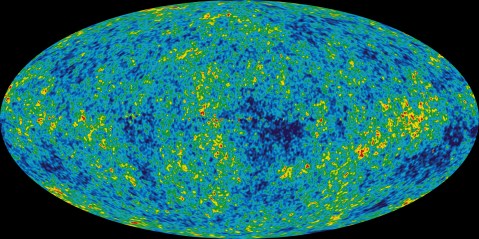
Cosmic Radiation from the Big Bang- Sound Makes Up Our Universe
I was also thinking about Cosmic Microwave Background radiation, the residual signature of the Big Bang, the background noise that carried all the information that formed our universe. It seems like noise is an intrinsic part of our world, both human made and naturally occurring, and fighting against it seems like such a waste of energy.
MT: It strikes me that when Schafer and other acoustic ecologists talk about fighting noise, they’re fighting a symptom rather than a cause. In these discourses, there is much talk of noise and environmental destruction but very little on how these processes relate to capitalism and settler-colonialism. In that regard, while I don’t think fighting against noise in absolute terms is futile, I do maintain that there are still fights to be had against high levels of noise. While I am critical of liberal notions of privacy and control and the ‘right’ to silence, I do also recognise that noise can feel oppressive in some contexts. That said, more often than not high levels of noise is a symptom of bigger social and political problems – for example, of poor quality housing, and a lack of economic choice over where one lives.
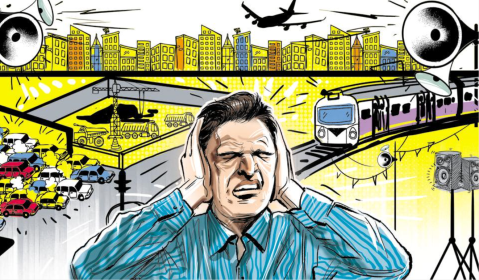
Noise Pollution, Sociological Restrictions, Sound Intrusion. From the Hindustan Times
DM: One of the themes explore in the book is the idea of the parasite, based on the work of Michel Serres. How does the parasite relate to your idea of noise?
MT: I take from Serres’ figure of the parasite the idea of noise as a relational, transformative and ambiguous in its necessity. In Serres’ reading, the parasite changes things, for better or for worse. Either way, the parasite does something, it adds something to the mix. In other words, it is affective. And yet, there is no ‘mix’ without it. Parasitic noise is the ‘excluded middle’ that must be included: it is the necessary ‘third term’, which pertains to the necessity of the material medium/milieu. From this perspective, there is no original state of calm, which is then broken by noise. If there is mediation there is noise, if there is the relation there is the parasite.
DM: Could you talk some about “the poetics of transgression” as you call it? How does this “transgression” relate to your ethico-affective approach?
MT: The poetics of transgression refers to the centrality of ‘line-crossing’ narratives in accounts of noise’s use in the sonic arts and art more generally. It’s predicated on what Henry Cowell calls the ‘time-honoured axiom’ that noise and music are opposites. Bringing noise into music, or music into noise relies on the crossing of boundaries, of material and discursive borders. This ‘line-crossing’ is often accompanied by a rhetoric of extremity and radicalism, shock and awe.
While different notions of transgression have certainly been influential for various noise music practitioners, I seek to decentre it as a way rather than the way of understanding noise’s use as an artistic resource. I argue that the dominance of the poetics of transgression has risked reducing noise music to its most ‘extreme’ manifestations. In light of the ethico-affective approach to noise that I develop throughout the book, which understands noise as a transformative force and necessary component of mediation, I suggest that noise music can be understood as an act of exposure, which, rather than bringing noise into music (or vice versa) exposes, extends and foregrounds the noise that is within the techno-musical system so as to generate new sonic sensations. With this approach, I hope to make more space for noise music practices that do not fit comfortably with the poetics of transgression and its aesthetics and rhetoric of extremity.
—
Featured Image: Noise Music
—
REWIND! . . .If you liked this post, you may also dig:
Sounding Out! Podcast #60: Standing Rock, Protest, Sound and Power (Part 1)–Marcella Ernest
The Noises of Finance–N. Adriana Knouf
Learning to Listen Beyond Our Ears: Reflecting Upon World Listening Day–Owen Marshall
Share this:


Current Top Posts





April 2021

January 2020

November 2019

October 2019

August 2019

April 2014

November 2017

March 2015

December 2017

October 2015
 Sounding Out!
Recent Comments