
That Infernal Racket: Sound, Anxiety, and the IBM Computer in AMC’s Mad Men
[Warning: Spoilers Ahead for Folks Not Caught Up with Season 7, Episode 5!]
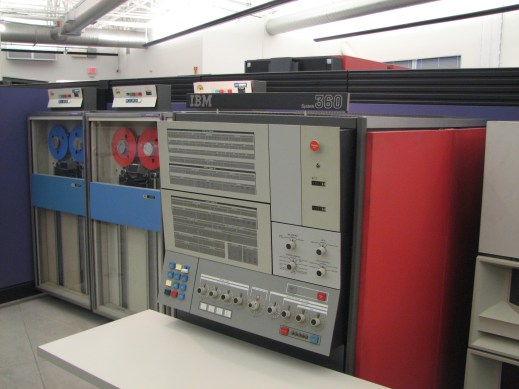
In one of the more memorable – and squirm-inducing – scenes of this season of AMC’s Mad Men, brilliant but eccentric copywriter Michael Ginsberg (Ben Feldman) presents his colleague, agency copy chief Peggy Olsen (Elisabeth Moss) with his own severed nipple, placed carefully in a gift box. Ginsberg explains to the understandably horrified Peggy that the gift is both a token of his affection and a means of relieving pressure caused by the arrival of Sterling, Cooper & Partners’ (SC&P) newest acquisition: a humming, room-sized IBM System/360 mainframe computer. Explaining his enmity for the machine and his increasingly erratic behavior, Ginsberg tells Peggy that the “waves of data” emanating from the computer were filling him up, and that the only solution was to “remove the pressure” by slicing off his “valve.”
The arrival of the IBM 360 in the idealized 1960s office space inhabited by Mad Men is obviously an unsettling presence – and not only for Ginsberg. Since its debut in Episode 4, commentators (e.g. WaPo’s Andrea Peterson, Slate’s Seth Stevenson) have meditated on the heavy-handed symbolism surrounding the machine – both in terms of its historical significance and its implications for plot and character development. Typically cued through noise (or lack thereof), it is worth reflecting upon the role of sound in establishing the computer as a source of disruption. Between the pounding and screeching of installation and the drone of the completed machine’s air conditioner and tape reels, the sonic motifs accompanying the computer underline tensions between (and roiling within) SC&P staffers grappling with the incipient digital age. Likewise, the infernal racket produced by the installation and operation of the IBM 360 adds an important dimension to the tensions resulting from its presence, which can be read as allegories for the complexities and contradictions of our relationship with technology.
.
The tone of the conflict is set even before we meet the IBM 360 toward the end of Episode 4: The Monolith – a reference to Kubrick’s 1968 classic 2001: A Space Odyssey (Slate’s Forrest Wickman ably discusses the references). Like the unnerving silence used with such great effect in that film, the absence of sound frames our first encounter with the computer – or at least its promise. Early in the episode, Don Draper (Jon Hamm), newly rehabilitated from his forced exile from the agency, arrives one morning at SC&P to find the office deserted. The ghostly sequence is clearly meant to symbolize Draper’s detachment from the firm. But as the episode progresses and tensions mount over the possibility that the IBM 360 will render jobs obsolete, the desolate office suggests a more ominous meaning – a once lively space muted by cold, impersonal automation.
In following scenes, successive stages of mainframe installation are marked by convergences of conflict and cacophony. First, there is the din of the creative team as they evacuate their beloved lounge – now earmarked as computer space – and during which a distraught Ginsberg projects his indignation onto art director Stan Rizzo, who appears more accepting. “They’re trying to erase us!” Ginsberg exclaims bitterly. Later, Draper lounges on his office couch as a clop clopping of hammers outside signifies tangible change. As if this weren’t enough of a distraction, two men in the corridor begin to chat loudly over the noise. Going out to investigate, Draper strikes up a conversation with one of the men, Lloyd Hawley, installation supervisor and founder of a small technology company competing with IBM. “Who’s winning?” Draper asks innocently, “who’s replacing more people?” Clearly irritated by Draper’s tone, Harry Crane – SC&P media director and the computer’s lead cheerleader – offers Draper a condescending apology for the loss of his “lunchroom,” assures him the change was “not symbolic.” “No, it’s quite literal,” Draper retorts. Unabated, the pounding and screeching of construction work emphasizes his point.
For the remainder of the episode, the raucous noise of construction acts as a leitmotif underscoring tensions between characters – between Peggy and Lou Avery (Draper’s priggish replacement at creative director), and between Draper and the interloper Lloyd. Finally, the end of construction is punctuated by a return to silence, as Peggy arrives one morning to see workers glide mainframe components noiselessly into the office.
Mad Men Logo. Used under the auspices of fair use for identification and critical commentary.
With this emphasis on technology as a source of symbolic, physical, and sonic disruption, Matthew Weiner and the creators of Mad Men draw upon a rich literary tradition. A relevant example contemporaneous with the show’s “present,” is literary critic Leo Marx’s 1964 text The Machine in the Garden, which examines the complicated relationships between a “pastoral ideal” and technological progress within American literature and popular imagination. Marx’s analysis reveals that sound is often used to convey the disruptive presence of technology within the bucolic landscape of the American continent. In Hawthorne’s Sleepy Hollow for example, it is the interrupting shriek of a locomotive whistle that breaks the author’s harmonious reverie: “Now tension replaces repose: the noise arouses a sense of dislocation, conflict, and anxiety” (15). In the decidedly un-pastoral modern office space, the noise of the computer installation nevertheless signifies a momentous social change and irrevocable loss. Picking out these tensions has always been one of the show’s strengths – whether it is the computer, Draper’s double identity, or the quiet endurance of women to the misogyny of midcentury work and domestic life.
Change, however, has significant consequences for Ginsberg, the young copywriter and Holocaust survivor who, as CBS’s Jessica Firger observes, has been deteriorating psychologically for some time. The proximity of the IBM 360, and the incessant drone of its mind-controlling waves eventually puts him over the edge. As Draper and Peggy enter the office early in Episode 5, Ginsberg glowers into the room housing the IBM 360. “Stop humming, you’re not happy!” he explodes. As Peggy attempts to soothe her colleague, our perspective shifts to look out at them from inside the glass-encased computer room. From here, the mainframe’s ambient noise muffles Peggy’s words, suggesting isolation between human and non-human. This play of speech and silence reoccurs later in the episode as Ginsberg, working alone on a Saturday with tissues wedged in his ears, spies Lou Avery and SC&P partner Jim Cutler inside the computer room, their voices made inaudible by the droning computer in a delicious homage to 2001 (see Vulture’s amusing gif). But the noise is clearly affecting Ginsberg. “It’s that hum at the office! It’s getting to me!” he tells Peggy later that evening. He even claims the computer has affected his sexuality.
Ginsberg’s noise complaints would have resonated in 1969 New York. In November of that year, the New York Times ran a feature on the city’s nerve-shattering noise pollution, calling it a “slow agent of death.” In addition to the myriad construction projects, subways, car horns, jet planes, and standing machinery populating the city soundscape, office workers found scant respite indoors where phones, air conditioners, “computers and typewriters and tabulators” whirred, whined, and clacked throughout the day. The article went on to report that scientists studying the impact of prolonged noise exposure on the human body had concluded a variety of ill effects on the heart and nervous system. Though no connection was made between computers and sexuality (as Ginsberg claimed), the article reported that laboratory rats under prolonged noise exposure had indeed “turned homosexual,” an opinion that underlined deterministic associations between sexuality, psychological disorder, and external stimuli.

An advertisement for the IBM 360. Borrowed from Wikimedia Commons.
As SO! editor Jennifer Stoever-Ackerman has argued, noise in midcentury New York also signified a sonic-racial politics, in which the mainstream “listening ear” recoiled at the “noise” created by Black and Puerto Rican others. In terms of Mad Men’s computer however, it is technology, economic anxiety, and mental illness, rather than ethnicity that frames sonic disruption. The basis of these tensions are similar however, and various interactions with SC&P’s IBM 360 demonstrate, as Stoever-Ackerman writes in SO!, “the ways in which Americans have been disciplined to consider some sounds as natural, normal, and desirable, while deeming alternate ways of listening and sounding as aberrant [and] dangerous.” Though similar, the conflict with technology on Mad Men does not suggest a clear us/them, or us/”it” binary. The banging of construction may be at first antagonistic, but it’s finite – eventually the computer is normalized within the SC&P office space to the extent that Peggy chides Ginsberg’s exasperation in Episode 5 by insisting “it’s just a computer!” Ginsberg’s reaction is more complex however, implicating a contradictory relationship with technology: once fully installed, has the droning computer become “natural, normal, and desirable” despite previous ambivalence? Is the keen awareness and anxiety towards technology symbolized through Ginsberg (albeit in a extreme form) suggested as the “aberrant” listening practice, or could it be Peggy’s apparent acceptance?
Like most cultural texts set in the past, it is possible to read Mad Men allegorically, as suggesting a certain ordering of meaning and values. From the perspective of those who have long since domesticated computers, the controversies and tropes activated by SC&P’s IBM 360 might strike us as familiar, even quaint. As the sociologist Bruno Latour has argued however, we would be wise to consider how technology exerts a kind of social agency that structures and impacts our daily lives. As historical symbolism, the sounds and noises of the IBM 360 on Mad Men should remind us that technological progress is not teleological, but a struggle over meaning in which anxieties (about jobs, mind-control, surveillance, subjectivity, etc.) may be variously accommodated, suppressed, or dismissed as irrational.
—
Featured image: An IBM 360 Mainframe. Borrowed from Wikimedia Commons CC 2.0
—
Andrew J. Salvati is a Media Studies Ph.D. candidate at Rutgers University. His interests include the history of television and media technologies, theory and philosophy of history, and representations of history in media contexts. Additional interests include play, authenticity, the sublime, and the absurd. Andrew has co-authored a book chapter with colleague Jonathan Bullinger titled “Selective Authenticity and the Playable Past” in the recent edited volume Playing With the Past (2013), and has written a recent blog post for Play the Past titled “The Play of History.”
—
 REWIND!…If you liked this post, you may also dig:
“DIY Histories: Podcasting the Past” -Andrew J. Salvati
“The Noise of SB 1070: Or Do I Sound Illegal to You?”– Jennifer Stoever-Ackerman
“DIANE… The Personal Voice Recorder in Twin Peaks” -Tom McEnaney
Share this:

Learning to Listen: The Velvet Underground’s “Once Lost” LPs

 Welcome back to Start a Band, our two-part series on Lou Reed and the Velvet Underground, focusing on what the band’s sonic provocations mean for sound studies today. Last week, we heard from Jake Smith, who introduced us to a way of thinking about the Velvets that emphasized the “haptic” qualities that emerge so often while listening to them. Following that idea, Smith took us on a kind of journey from the skin to the musculature and the viscera through a deep analysis of key songs in their catalog — “This is your body on the Velvet Underground.”
This week, we’re delighted to welcome to Sounding Out! a writer whose work we’ve been eager to feature for a long while — Tim Anderson, Associate Professor of Communication and Theatre Arts at Old Dominion University. Tim has written extensively on popular music and sound, and is currently a leader of the Sound Studies Scholarly Interest Group at the Society for Cinema and Media Studies, one of the scholarly groups associated with the SO! Thursday stream. It’s such a pleasure to present this sensitive and personal account of the Velvet Underground — and of learning to listen.
– NV
—

Lou Reed and Andy Warhol as the respective definers of audible and visual cool for misfits and undergroundlings for the last five decades.
Reports of Lou Reed’s death came on a Sunday. Even though he was 71, it was still a shock. To many present-day friends and colleagues Reed’s Velvet Underground are a band that they understand are important, but just don’t get. In the case of an artist like Lou Reed, an artist who never had a top ten charting single and only two gold albums, you could see their point.
Still, I obsessed. Rattled from my travels in Washington, DC, I called my wife and we talked about his music for about an hour or so, after which I took a long walk to the Washington Mall. It was a sunny fall day, October 27, 2013, and I walked past the Smithsonian with its prominent memorials, such a clean space for so much past, some of which the nation has buried and some of which we don’t even bother to think about. The deceased have always done the most important work in our nation’s capital.
The day after, I really don’t remember doing much. I took a train home, read everything I could online about Reed, and thought a lot about his records. The ones I liked —New York and The Blue Mask—the ones I learned to like —it took me years to enjoy Transformer—and the ones I loved —The Velvet Underground and Nico, White Light, White Heat, The Velvet Underground and VU. Those four records, more than any records I can remember, altered me, many of my friends in my teens and in college, and almost every rock musician I admired in the 1980s. Velvet Underground records were simply foundational. Writing about Reed’s death, rock critic Greg Kot summed up the Velvet’s influence by claiming that they were “as influential as The Beatles” and if you named “just about any left-of-centre band or artist since the ‘70s”, some of whom like R.E.M., U2 and Talking Heads “became mainstream giants”all of them would “acknowledge a deep debt to the Velvet Underground.”
This influence is the reason that the collective mourning of such a marginally popular figure swelled to such a crescendo. However, to paraphrase the words of one of Reed’s most storied rivals, Lester Bangs, on the death of John Lennon, this was not the mourning of a person. Most of us never met Lou Reed. Instead, we were mourning ourselves. To lose Lou Reed was tantamount to losing the author of a proverbial urtext of a kind of secret rock language that has been passed down since the late 1960s on how to be cool. It was a language of composed of style, gestures, and reactions. It was one that was filled with a fun that was not of the obligatory “hey-dude-let’s-party!” party. The Velvet’s overdriven guitars repeatedly underscored that teenage kicks included other aesthetic pleasures such as contemplation and melancholy. Most importantly, the Velvet Underground offered a language of listening passed down from one rock underground to another.
Because pop fans of all stripes must learn how to be a fan, learning how and what to listen to is a taste-defining social exercise. Simon Frith once explained that, for him, “one aspect of learning how to be a rock fan in the 1960s was, in fact, learning to prefer [original records made by black artists of the 1950s] to covers [made by white artists of the same era]. And this was, as I recall, something that had to be learned [by Frith]: nearly all the records I had bought in the late 1950s had been the cover versions” (Performing Rites: On the Value of Popular Music, 1996). In my case, learning to listen also meant learning what to listen to while listening to The Velvet Underground, a process involving peers, record clerks, friends, musicians and reviews.
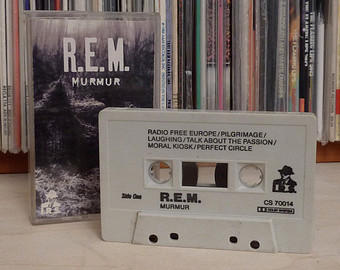
R.E.M.’s 1983 LP release of “Murmur” on cassette
As a young rock fan who began first collecting cassettes —that’s right, cassettes —this process would begin through an obsession with R.E.M.’s Murmur, a cryptic, odd inscrutable cassette with no lyrics, a black and white picture and layers of reverb. The copy I found had been severely discounted in a ma and pa record store in Globe, Arizona. In Summer 1983 I read a rave review in a copy of Rolling Stone and at 14 had purchased a cassette unlike anything I had ever heard; I wasn’t sure I enjoyed it. Why did so many reviewers seem to fall over themselves about this record? To solve this puzzle, it meant learning how to listen to music invested in tone rather than ostentatious chops. It meant paying attention to drones rather than solos. It meant following those features to Velvet Underground records after peers, record clerks, friends, musicians and reviews made a point that Murmur reminded them a bit of VU records.
Murmur was also the first record I ever purchased that embraced what Jacob Smith so wonderfully identifies as a distinctive trait of all Velvet Underground records. For Smith, these pop records are part of a genealogy that “stress evocative timbres, idiosyncratic voices, and signature sounds over structural or lyrical complexity.” The distillation of this pop ethos onto record was one of the reasons that so many musicians whose abilities may have been limited but whose tastes tended toward the poetic found The Velvets so influential. As Jonathan Richman explained, “I didn’t start singing or playing till I was 15 and heard the Velvet Underground. They made an atmosphere, and I knew that I could make one too!” (Quoted in Greil Marcus, Lipstick Traces: A Secret History of the Twentieth Century, 61). Indeed, Smith notes that the deceptive complexity of VU Records “can be found more on the level of timbre than in musical structure or instrumentation” and “lyrics often encourage a blurring of listening and touching”; his post actually reads like many of the conversations and reviews surrounding R.E.M.’s debut LP. The same could also be said of records released by other 1980s and 90s artists such as The Pixies, My Bloody Valentine, Opal, Mazzy Star, Radiohead, The Dream Syndicate, Galaxie 500, The Rain Parade, Green on Red, New Order, Joy Division, The Feelies, Spacemen 3, Sonic Youth, The Pretenders, The Sisters of Mercy, Ministry, The Jesus and Mary Chain, and The Violent Femmes, to name but a few who drew water from the Velvet Underground well. Bands sonically inspired by the Velvets often providing feedback before solos, drummed without cymbals, and portrayed dark themes sung in monotones that sounded sophisticated and obscure.
.
However, actually hearing a Velvet Underground record in 1983 and 1984 was a significant problem for newer fans, as their MGM catalog was out of print. Many understood these records to be effectively buried by label president Mike Curb’s infamous axing of the act from MGM along with seventeen others who allegedly promoted and exploited “hard drugs through music” (Tiegel, Eliot “Mgm Busts 18 Rock Groups.” Billboard, November 7 1970, 1, 70). As Lou Reed himself once noted, “it’s depressing when you’re still around and your albums are out of print.” I have often wondered if this was one of the reasons that The Velvets catalogue would have such a profound effect on so many of us. Sure, I had found a copy of Loaded, the band’s fourth official release, but its bright tones had none of the subversive menace that so many reviewers alluded to when speaking of the Velvets. Even in a mountain town in Arizona, I had a better chance of finding used copies of The Grateful Dead’s Wake of the Flood or Blues for Allah than I did The Velvet Underground and Nico. In other cities, in other record stores, when I did find those records they were used and prices started at $15 and up. They were records I simply could not afford to listen to.

The Velvet Underground’s “lost” fourth album, “VU”
All that changed after 1985, when every MGM Velvet Underground record would appear in my life for less than $25. Bill Levenson’s efforts as Polygram’s then A&R manager to reissue the buried and lost MGM catalog on Verve provided me and every other young person who had only “heard of The Velvet Underground” the chance to finally to listen to all of these records at once. Indeed, the moment of the catalogue’s reissue was simply a sonic flood, one where sounds filled in gaps that had been cut deeply by conversations, descriptions and my own imagination. Writing at the time about these reissues and the unveiling of a lost album’s worth of material that would be titled V.U., David Fricke argued that “rock historians and fans alike owe Bill Levenson, the executive producer of V.U., a debt of thanks for resurrecting these tracks and for giving the band’s first three LPs the proper reissue they’ve long deserved. At $5.98 list price, The Velvet Underground and Nico,White Light/White Heat and The Velvet Underground are essential purchases —certainly essential listening for any study of Seventies and Eighties punk evolution. As for V.U., the Great Lost Velvet Underground Album is no longer lost. It is simply great” (Fricke, David. “The Velvet Underground – V.U.” Rolling Stone, March 14 1985).

A 2012 ad for another reissue of the MGM Velvet Underground catalog and Nico’s first solo LP
Is it too much to suggest a that the pent up desire to hear a secret history sparked by The Velvet Underground’s reissues created the 80s/90s iteration of “alternative rock”? Perhaps, but history is filled with desires asserted, accepted and denied. Indeed, most of those aforementioned 80s alternative acts I came into contact with had been performing and recording and releasing records years before 1985. However, there is no doubt that the VU reissues turned a number of ears predisposed to hearing in a certain way onto new ways of listening to the Velvets concentrated doses of moody darkness, modes that earlier Velvet Underground fans simply had little access to.
Ignoring the impact of the sonic flood of VU material that fell upon my ears during this period turns away from a specific history of listening that, while personally unique, was an opportunity available to so many of my contemporaries. Indeed, if sounds have histories because their traces persist, then listening must have histories guided partially by testimonial. To hear these histories we might ask ourselves to remember how, why, and with whom did we listen, and to trade in this information. If we did so, we might better understand how we learned to listen: especially what to listen to and why it was important. And, without these testimonials of our pasts as listeners, we just may lose sound’s crucial other half.
—
Featured Image: “Velvet Underground Yellow Label Mono” by Flickr user Simon MurphyThe Velvet Underground – Yellow label mono
—
Tim J. Anderson is an Associate Professor of Communication and Theatre Arts at Old Dominion University where studies the multiple cultural and material practices that make music popular. He has published numerous book chapters, refereed journal articles, and two monographs: Making Easy Listening: Material Culture and Postwar American Recording (University of Minnesota Press, 2006) and Popular Music in a Digital Music Economy: Problems and Practices for an Emerging Service Industry (Routledge, 2014). His latest research project focuses on recordings, musicians, listeners and the public sphere. His website is timjanderson.weebly.com and he can be contacted at tjanders@odu.edu.
—
 REWIND!…If you liked this post, you may also dig:
“One Nation Under a Groove?: Music, Sonic Borders, and the Politics of Vibration” -Marcus Boon
“Sound + Vision: Andy’s Mick” -Eric Lott
“Hold this Thread: A Partial History of a Rock n’Roll Relationship”-Benjamin Gold
Share this:


Current Top Posts





April 2021

January 2020

November 2019

October 2019

August 2019

April 2014

November 2017

March 2015

December 2017

October 2015
 Sounding Out!
Recent Comments