
Episode I: The Greatest Sound in the Galaxy: Sound and Star Wars
Ever tried listening to a Star Wars movie without the sound? –IGN, 1999
Sound is 50 percent of the motion-picture experience. –George Lucas
In the radio dramatization of Return of the Jedi (1996), a hibernation sickness-blinded Han Solo can tell bounty hunter Boba Fett is in the same room with him just by smelling him. Later this month, Solo: A Star Wars Story (part of the Anthology films, and as you might expect from the title, a prequel to Han Solo’s first appearance in Star Wars: A New Hope) may be able to shed some light on how Han developed this particular skill.
Later in that dramatization, we have to presume Han is able to accurately shoot a blaster blind by hearing alone. Appropriately, then, sound is integral to Star Wars. For every iconic image in the franchise—from R2D2 to Chewbacca to Darth Vader to X-Wing and TIE-fighters to the Millennium Falcon and the light sabers—there is a correspondingly iconic sound. In musical terms, too, the franchise is exemplary. John Williams, Star Wars’ composer, won the most awards of his career for his Star Wars (1977) score, including an Oscar, a Golden Globe, a BAFTA, and three Grammys. Not to mention Star Wars’ equally iconic diegetic music, such as the Mos Eisley Cantina band (officially known as Figrin D’an and the Modal Nodes).
Without sound, there would be no Star Wars. How else could Charles Ross’ One Man Star Wars Trilogy function? In One Man Star Wars, Ross performs all the voices, music, and sound effects himself. He needs no quick costume changes; indeed, in his rapid-fire, verbatim treatment, it is sound (along with a few gestures) that he uses to distinguish between characters. His one-man show, in fact, echoes C-3PO’s performance of Star Wars to the Ewoks in Return of the Jedi, a story told in narration and sound effects far more than in any visuals. “Translate the words, tell the story,” says Luke in the radio dramatization of this scene. That is what sound does in Star Wars.
I believe that the general viewing public is aware on a subconscious level of Star Wars’ impressive sound achievements, even if this is not always articulated as such. As Rick Altman noted in 1992 in his four and a half film fallacies, the ontological fallacy of film—while not unchallenged—began life with André Bazin’s “The Ontology of the Photographic Image,” (1960) which argues that film cannot exist without image. Challenging such an argument not only elevates silent film but also the discipline of film sound generally, so often regarded as an afterthought. “In virtually all film schools,” Randy Thom wrote in 1999, “sound is taught as if it were simply a tedious and mystifying series of technical operations, a necessary evil on the way to doing the fun stuff.”
Film critic Pauline Kael wrote about Star Wars on original release in what Gianlucca Sergi terms a “harmful generalization” that its defining characteristic was its “loudness.” Loud sound does not necessarily equal good sound in the movies, which audiences themselves can sometimes confuse. “High fidelity recordings of gunshots and explosions, and well fabricated alien creature vocalizations” do not equal good sound design alone, as Thom has argued. On the contrary, Star Wars’ achievements, Sergi posited, married technological invention with overall sound concept and refined if not defined the work of sound technicians and sound-conscious directors.
The reason why Star Wars is so successful aurally is because its creator, George Lucas, was invested in sound holistically and cohesively, a commitment that has carried through nearly every iteration of the franchise, and because his original sound designer, Ben Burtt, understood there was an art as well as a science to highly original, aurally “sticky” sounds. Ontologically, then, Star Wars is a sound-based story, as reflected in the existence of the radio dramatizations (more on them later). This article traces the historical development of sound in not only the Star Wars films (four decades of them!) but also in other associated media, such as television and video games as well as examining aspects of Star Wars’ holistic sound design in detail.
A long time ago, in a galaxy far, far away . . .
As Chris Taylor points out, George Lucas “loved cool sounds and sweeping music and the babble of dialogue more than he cared for dialogue itself.” In 1974, Lucas was working on The Radioland Murders, a screwball comedy thriller set in the fictional 1930s radio station WKGL. Radio, indeed, had already made a strong impression on Lucas, such that legendary “Border blaster” DJ Wolfman Jack played an integral part in Lucas’ film American Graffiti (1973). As Marcus Hearn picks up the story, Lucas soon realized that The Radioland Murders were going nowhere (the film would eventually be made in 1994). Lucas then turned his sound-conscious sensibilities in a different direction, in “The Star Wars” project upon which he had been ruminating since his film school days at the University of Southern California. Retaining creative control, and a holistic interest in a defined soundworld, were two aspects Lucas insisted upon during the development of the project that would become Star Wars. Lucas had worked with his contemporary at USC, sound designer and recordist Walter Murch, on THX 1138 (1971) and American Graffiti, and Murch would go on to provide legendary sound work for The Conversation (1974), The Godfather Part II (1974), and Apocalypse Now (1979). Murch was unavailable for the new project, so Lucas then asked producer Gary Kurtz to visit USC to evaluate emerging talent.
Pursuing a Masters degree in Film Production at USC was Ben Burtt, whose BA was in physics. In Burtt, Lucas found a truly innovative approach to film sound which was the genesis of Star Wars’ sonic invention, providing, in Sergi’s words, “audiences with a new array of aural pleasures.” Sound is embodied in the narrative of Star Wars. Not only was Burtt innovative in his meticulous attention to “found sounds” (whereas sound composition for science fiction films has previously relied on electronic sounds), he applied his meticulousness in character terms. Burtt said that Lucas and Kurtz, “just gave me a Nagra recorder and I worked out of my apartment near USC for a year, just going out and collecting sound that might be useful.”

Ben Burtt plays the twang of steel guy wires, which formed the basis of the many blaster sounds (re-creating the moment with Miki Hermann for a documentary). Image by Flickr User: Tom Simpson (CC BY-NC-ND 2.0)
Inherent in this was Burtt’s relationship with sound, in the way he was able to construct a sound of an imaginary object from a visual reference, such as the light saber, described in Lucas’ script and also in concept illustrations by Ralph McQuarrie. “I could kind of hear the sound in my head of the lightsabers even though it was just a painting of a lightsaber,” he said. “I could really just sort of hear the sound maybe somewhere in my subconscious I had seen a lightsaber before.” Burtt also shared with Lucas a sonic memory of sound from the Golden Age of Radio: “I said, `All my life I’ve wanted to see, let alone work on, a film like this.’ I loved Flash Gordon and other serials, and westerns. I immediately saw the potential of what they wanted to do.”
But sir, nobody worries about upsetting a droid
Burtt has described the story of A New Hope as being told from the point of view of the droids (the robots). While Lucas was inspired by Kurosawa’s The Hidden Fortress (1958) to create the characters of droids R2-D2 (“Artoo”) and C-3PO (“Threepio”), the robots are patently non-human characters. Yet, it was essential to imbue them with personalities. There have been cinematic robots since Maria, but Burtt uniquely used sound to convey not only these two robots’ personalities, but many others as well. As Jeanne Cavelos argues, “Hearing plays a critical role in the functioning of both Threepio and Artoo. They must understand the orders of their human owners.” Previous robots had less personality in their voices; for example, Douglas Rain, the voice of HAL in 2001: A Space Odyssey, spoke each word crisply with pauses. Threepio is a communications expert, with a human-like voice, provided by British actor (and BBC Radio Drama Repertory Company graduate) Anthony Daniels. According to Hearn, Burtt felt Daniels should use his own voice, but Lucas was unsure, wanting an American used car salesman voice. Burtt prevailed, creating in Threepio, vocally, “a highly strung, rather neurotic character,” in Daniels’ words, “so I decided to speak in a higher register, at the top of the lungs.” (Indeed, in the Diné translation of Star Wars [see below], Threepio was voiced by a woman, Geri Hongeva-Camarillo, something that the audience seemed to find hilarious.)
Artoo was altogether a more challenging proposition. As Cavelos puts it, “Artoo, even without the ability to speak English, manages to convey a clear personality himself, and to express a range of emotions.” Artoo’s non-speech sounds still convey emotional content. We know when Artoo is frightened;
when he is curious and friendly;
and when he is being insulting.
(And although subtitled scenes of Artoo are amusing, they are not in the least necessary.) Artoo’s language was composed and performed by Burtt, derived from the communication of babies:
we started making little vocal sounds between each other to get a feeling for it. And it dawned on us that the sounds we were making were not actually so bad. Out of that discussion came the idea that the sounds a baby makes as it learns to walk would be a direction to go; a baby doesn’t form any words, but it can communicate with sounds.
The approach to Artoo’s aural communications became emblematic of all of the sounds made by machines in Star Wars, creating a non-verbal language, as Kris Jacobs calls it, the “exclusive province” of the Star Wars universe.
Powers of observation lie with the mind, Luke, not the eyes
According to Gianlucca Sergi, the film soundtrack is composed of sound effects, music, dialogue, and silence, all of which work together with great precision in Star Wars, to a highly memorable degree. Hayden Christensen, who played Anakin Skywalker in Attack of the Clones (2002) and Revenge of the Sith (2005), noted that when filming light saber battles with Ewan McGregor (Obi-Wan Kenobi), he could not resist vocally making the sound effects associated with these weapons.
This a good illustration of how iconic the sound effects of Star Wars have become. As Burtt noted above, he was stimulated by visuals to create the sound effects of the light sabers, though he was also inspired by the motor on a projector in the Department of Cinema at USC. As Todd Longwell pointed out in Variety, the projector hum was combined with a microphone passed in front of an old TV to create the sound. (It’s worth noting that the sounds of weapons were some of the first sound effects created in aural media, as in the case with Wallenstein, the first drama on German radio, in 1924, which featured clanging swords.)
If Burtt gave personality to robots through their aural communications, he created an innovative sound palette for far more than the light sabers in Star Wars. In modifying and layering found sounds to create sounds corresponding to every aspect of the film world—from laser blasts (the sound of a hammer on an antenna tower guy wire) to the Imperial Walkers from Empire Strikes Back (modifying the sound of a machinist’s punch press combined with the sounds of bicycle chains being dropped on concrete)—he worked as meticulously as a (visual) designer to establish cohesion and impact.
Sergi argues that the sound effects in Star Wars can give subtle clues about the objects with which they are associated. The sound of Imperial TIE fighters, which “roar” as they hurtle through space, was made from elephant bellows, and the deep and rumbling sound made by the Death Star is achieved through active use of sub-frequencies. Meanwhile, “the rebel X-wing and Y-wing fighters attacking the Death Star, though small, emit a wider range of frequencies, ranging from the high to the low (piloted as they are by men of different ages and experience).” One could argue that even here, Burtt has matched personality to machine. The varied sounds of the Millennium Falcon (jumping into hyperspace, hyperdrive malfunction), created by Burtt by processing sounds made by existing airplanes (along with some groaning water pipes and a dentist’s drill), give it, in the words of Sergi, a much more “grown-up” sound than Luke’s X-Wing fighter or Princess Leia’s ship, the Tantive IV. Given that, like its pilot Han Solo, the Falcon is weathered and experienced, and Luke and Leia are comparatively young and ingenuous, this sonic shorthand makes sense.
Millions of voices
Michel Chion argues that film has tended to be verbocentric, that is, that film soundtracks are produced around the assumption that dialogue, and indeed the sense of the dialogue rather than the sound, should be paramount and most easily heard by viewers. Star Wars contradicts this convention in many ways, beginning with the way it uses non-English communication forms, not only the droid languages discussed above but also its plethora of languages for various denizens of the galaxy. For example, Cavelos points out that Wookiees “have rather inexpressive faces yet reveal emotion through voice and body language.”
While the 1978 Star Wars Holiday Special may have many sins laid at its door, among them must surely be that the only Wookiee who actually sounds like a Wookiee is Chewbacca. His putative family sound more like tauntauns. Such a small detail can be quite jarring in a universe as sonically invested as Star Wars.
While many of the lines in Star Wars are eminently quotable, the vocal performances have perhaps received less attention than they deserve. As Starr A. Marcello notes, vocal performance can be extremely powerful, capitalizing on the “unique timbre and materiality that belong to a particular voice.” For example, while Lucas originally wanted Japanese actor Toshiro Mifune to play Obi-Wan, Alec Guinness’ patrician Standard English Neutral accent clearly became an important part of the character. For example, when (Scottish) actor Ewan McGregor was cast to play the younger version of Obi-Wan, he began voice lessons to reproduce Guinness’ voice. Ian McDiarmid (also Scottish), a primarily a Shakespearean stage actor, was cast as arch-enemy the Emperor in Return of the Jedi, presumably on the quality of his vocal performance, and as such has portrayed the character in everything from Revenge of the Sith to Angry Birds Star Wars II.
Sergi argues that Harrison Ford as Han Solo performs in a lower pitch but an unstable meter, a characterization explored in the radio dramatizations of A New Hope, Empire Strikes Back, and Return of the Jedi, when Perry King stands in for Ford. By contrast, Mark Hamill voices Luke in two of the radio dramatizations, refining and intensifying his film performances. Sergi argues that Hamill’s voice emphasizes youth: staccato, interrupting/interrupted, high pitch.
And affectionately parodied here:
I would add warmth of tone to this list, perhaps illustrated nowhere better than in Hamill’s performance in episode 1 – “A Wind to Shake the Stars” of the radio dramatization, which depicts much of Luke’s story that never made it onscreen, from Luke’s interaction with his friends in Beggar’s Canyon to a zany remark to a droid (“I know you don’t know, you maniac!”). It will come as no surprise to the listeners of the radio dramatization that Hamill would find acclaim in voice work (receiving multiple nominations and awards). In the cinematic version, Hamill’s performance is perhaps most gripping during the climactic scene in Empire Strikes Back when Darth Vader tells him:
According to Hamill, “what he was hearing from Vader that day were the words, ‘You don’t know the truth: Obi-Wan killed your father.’ Vader’s real dialogue would be recorded in postproduction under conditions easier to control.” More on that (and Vader) shortly.
It has been noted that Carrie Fisher (who was only nineteen when A New Hope was filmed) uses an accent that wavers between Standard North American and Standard Neutral English. Fisher has explained this as her emulating experienced British star of stage and screen Peter Cushing (playing Grand Moff Tarkin).
However, the accents of Star Wars have remained a contentious if little commented upon topic, with most (if not all) Imperial staff from A New Hope onwards speaking Standard Neutral English (see the exception, stormtroopers, further on). In production terms, naturally, this has a simple explanation. In story terms, however, fans have advanced theories regarding the galactic center of the universe, with an allegorical impetus in the form of the American Revolution. George Lucas, after all, is an American, so the heroic Rebels here have echoes with American colonists throwing off British rule in the 18th century, inspired in part because of their geographical remove from centers of Imperial rule like London. Therefore, goes this argument, in Star Wars, worlds like Coruscant are peopled by those speaking Standard Neutral English, while those in the Outer Rim (the majority of our heroes) speak varieties of Standard North American. Star Wars thus both advances and reinforces the stereotype that the Brits are evil.
It is perhaps appropriate, then, that James Earl Jones’ performance as Darth Vader has been noted for sounding more British than American, though Sergi emphasizes musicality rather than accent, the vocal quality over verbocentricity:
The end product is a fascinating mixture of two opposite aspects: an extremely captivating, operatic quality (especially the melodic meter with which he delivers the lines) and an evil and cold means of destruction (achieved mainly through echoing and distancing the voice).
It is worth noting that Lucas originally wanted Orson Welles, perhaps the most famous radio voice of all time, to portray Vader, yet feared that Welles would be too recognizable. That a different voice needed to emanate from behind Vader’s mask than the actor playing his body was evident from British bodybuilder David Prowse’s “thick West Country brogue.” The effect is parodied in the substitution of a Cockney accent from Snatch (2000) for Jones’ majestic tones:
A Newsweek review of Jones in the 1967 play A Great White Hope argued that Jones had honed his craft through “Fourteen years of good hard acting work, including more Shakespeare than most British actors attempt.” Sergi has characterized Jones’ voice as the most famous in Hollywood, in part because in addition to his prolific theatre back catalogue, Jones took bit parts and voiced commercials—“commercials can be very exciting,” he noted. The two competing forces combined to create a memorable performance, though as others have noted, Jones is the African-American voice to the white actors who portrayed Anakin Skywalker (Clive Revill and Hayden Christensen), one British, one American.
Brock Peters, also African American and known for his deep voice, played Vader in the radio dramatizations. Jennifer Stoever notes that in America, the sonic color line “historically contoured, identified, and marked mismatches between ‘sounding white’ and ‘looking black’” (231) whereas the Vader performances “sound black” and “look white.” Andrew Howe in his chapter “Star Wars in Black and White” notes the “tension between black outer visage and white interior identity [ . . ] Blackness is thus constructed as a mask of evil that can be both acquired and discarded.”
Like many of the most important aspects of Star Wars, Vader’s sonic presence is multi-layered, consisting in part of Jones’ voices manipulated by Burtt, as well as the sonic indicator of his presence: his mechanized breathing”
The concept for the sound of Darth Vader came about from the first film, and the script described him as some kind of a strange dark being who is in some kind of life support system. That he was breathing strange, that maybe you heard the sounds of mechanics or motors, he might be part robot, he might be part human, we really didn’t know. [ . . .] He was almost like some robot in some sense and he made so much noise that we had to sort of cut back on that concept.
On radio, a character cannot be said to exist unless we hear from him or her; whether listening to the radio dramatizations or watching Star Wars with our eyes closed, we can always sense the presence of Vader by the sound of his breathing. As Kevin L. Ferguson points out, “Is it accidental, then, that cinematic villains, troubling in their behaviour, are also often troubled in their breathing?” As Kris Jacobs notes, “Darth Vader’s mechanized breathing can’t be written down”—it exists purely in a sonic state.
Your eyes can deceive you; don’t trust them
Music is the final element of Sergi’s list of what makes up the soundtrack, and John Williams’ enduring musical score is the most obvious of Star Wars’ sonic elements. Unlike “classical era” Hollywood film composers like Max Steiner or Erich Korngold who, according to Kathryn Kalinak, “entered the studio ranks with a fair amount of prestige and its attendant power, Williams entered as a contract musician working with ‘the then giants of the film industry,’” moving into a “late-romantic idiom” that has come to characterize his work. This coincided with what Lucas envisioned for Star Wars, influenced as it was by 1930s radio serial culture.
Williams’ emotionally-pitched music has many elements that Kalinak argues link him with the classical score model: unity, the use of music in the creation of mood and character; the privileging of music in moments of spectacle, the way music and dialogue are carefully mixed. This effect is exemplified in the opening of A New Hope, the “Main Title” or, as Dr Lehman has it (see below), “Main/Luke A.” As Sergi notes, “the musical score does not simply fade out to allow the effects in; it is, rather literally, blasted away by an explosion (the only sound clearly indicated in the screenplay).”
As Kalinak points out, it was common in the era of Steiner and Korngold to score music for roughly three-quarters of a film, whereas by the 1970s, it was more likely to be one-quarter. “Empire runs 127 minutes, and Williams initially marked 117 minutes of it for musical accompaniment”; while he used three themes from A New Hope, “the vast majority of music in The Empire Strikes Back was scored specifically for the film.”
Perhaps Williams’ most effective technique is the use of leitmotifs, derived from the work of Richard Wagner, and more complex than a simple repetition of themes. Within leitmotifs, we hear the blending of denotative and connotative associations, as Matthew Bribitzer-Stull notes, “not just a musical labelling of people and things” but also, as Thomas S. Grey puts it, “a matter of musical memory, of recalling things dimly remembered and seeing what sense we can make of them in a new context.” Bribitzer-Stull also notes the complexity of Williams’ leitmotif use, given that tonal music is given for both protagonists and antagonists, resisting the then-cliché of using atonal music for antagonists. In Williams’ score, atonal music is used for accompanying exotic landscapes and fight or action scenes. As Jonathan Broxton explains,
That’s how it works. It’s how the films maintain musical consistency, it’s how characters’ musical identities are established, and it offers the composer an opportunity to create interesting contrapuntal variations on existing ideas, when they are placed in new situations, or face off against new opponents.
Within the leitmotifs, Williams provides various variations and disruptions, such as the harmonic corruption when “the melody remains largely the same, but its harmonization becomes dissonant.” One of the most haunting ways in which Williams alters and reworks his leitmotifs is what Bribitzer-Stull calls “change of texture.”
Frank Lehman of Harvard has examined Williams’ leitmotifs in detail, cataloguing them based on a variety of meticulous criteria. He has noted, for example, that some leitmotifs are used often, like “Rebel Fanfare” which has been used in Revenge of the Sith, A New Hope, The Empire Strikes Back, The Force Awakens, The Last Jedi, and Rogue One. Lehman particularly admires Williams’ skill and restraint, though, in reserving particular leitmotifs for very special occasions. For example, “Luke & Leia,” first heard in Return of the Jedi (both film and radio dramatization) and not again until The Last Jedi:
While Williams’ use of leitmotifs is successful and evocative, not all of Star Wars’ music consists of leitmotifs, as Lehman points out; single, memorable pieces of music not heard elsewhere are still startlingly effective.
In the upcoming Solo, John Williams will contribute a new leitmotif for Han Solo, while all other material will be written and adapted by John Powell. Williams has said in interview that “I don’t make a particular distinction between ‘high art’ and ‘low art.’ Music is there for everybody. It’s a river we can all put our cups into, and drink it, and be sustained by it.” The sounds of Star Wars have sustained it—and us—and perfectly illustrate George Lucas’ investment in the equal power of sound to vision in the cinematic experience. I, for one, am looking forward to what new sonic gems may be unleashed as the saga continues.
On the first week of June, Leslie McMurtry will return with Episode II, focusing on shifts in sound in the newer films and multi-media forms of Star Wars, including radio and cartoons–and, if we are lucky, her take on Solo!
—
Featured Image made here: Enjoy!
—
Leslie McMurtry has a PhD in English (radio drama) and an MA in Creative and Media Writing from Swansea University. Her work on audio drama has been published in The Journal of Popular Culture, The Journal of American Studies in Turkey, and Rádio-Leituras. Her radio drama The Mesmerist was produced by Camino Real Productions in 2010, and she writes about audio drama at It’s Great to Be a Radio Maniac.
—
 REWIND!…If you liked this post, you may also dig:
The Magical Post-Horn: A Trip to the BBC Archive Centre in Perivale–Leslie McMurtry
Speaking American–Leslie McMurtry
Out of Sync: Gendered Location Sound Work in Bollywood–Priya Jaikumar
Share this:

A Tradition of Free and Odious Utterance: Free Speech & Sacred Noise in Steve Waters’s Temple
**This post is co-authored by Gabriel Solomon Mindel and Alexander J. Ullman
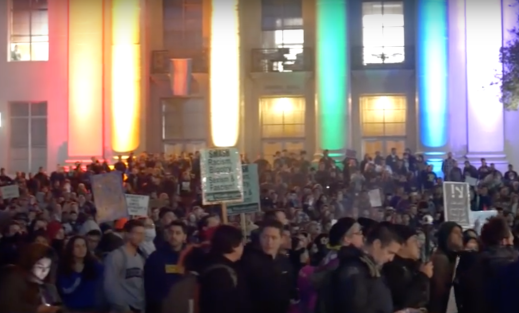
On February 2, 2017, thousands of protesters took to the University of California Berkeley’s Sproul Plaza to protest and ultimately shut down a planned talk by the right-wing provocateur Milo Yiannopoulos. Captured in real time, its dark and blurry image projected to screens across the world, this gathering dumped fuel on a fire that had been burning slowly for many years. Conservative and predominantly “white-male” resentment against the mainstreaming of “politically correct” speech had become the basis for an inchoate community via the internet and was now emerging as a socially acceptable sentiment in the era of Trump. For those protesting at Berkeley, the silencing of Yiannopoulos was not intended simply to condemn the content of his speech, but to intervene preemptively in the culture-wide “fascist creep” disguising itself as humour and taboo breaking. It called into question the actual meaning of both speech and freedom in a place that had become synonymous with the struggle for both.
Viewed by some as a riot, the militant protest tactics evoked scorn, distress, and confusion from a wide spectrum of respondents. Conservative audiences were horrified by the self-evident violence of the Left, even while enjoying a laugh with Milo at the various fails of “SJW’s” and “snowflakes”. Meanwhile Liberals couldn’t seem to fathom the expressions of anger and nihilism evinced by the black-clad mass celebrating in front of the shattered windows of the Martin Luther King Jr. Student Union, who set a fire at the very steps upon which the Free Speech Movement of 1964 had been birthed. The cancellation of Yiannopoulos’s talk has since set off a chain of rhetorical and physical confrontations resulting in the cancellation of Conservative speeches on campus and multiple “free speech” rallies which have devolved into street battles between a motley cohort of alt-right groups and various counter-protesters surrounding a park that was also named after MLK.
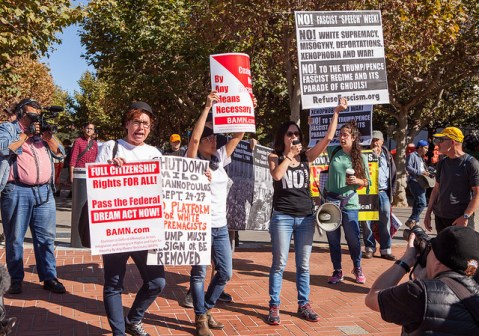
Sproul Plaza Protests, UC Berkeley, September 24, 2017, Image by Pax Ahimsa Gethen, (CC BY-NC-SA 2.0)
Coincident with the events that same spring, Berkeley’s Aurora Theatre staged Temple by British playwright Steve Waters, a revisiting of 2011’s Occupy London protests whose encampments surrounded the area of St. Paul’s Cathedral. First performed in London in 2015, the play speculates that the swirling circumstances of the ten-day period leading up to the dean’s resignation (including the cathedral’s closing on October 21; the Canon Chancellor’s abrupt resignation on the morning of October 28; and the reopening of the cathedral later that day, effectively evicting the protesters) had something to do with the church’s own struggle to reconcile its responsibility to serve both God and his people in the face of ethical contradictions.
Seeing Temple on Aurora Street, barely two weeks and two blocks from the “Patriot’s Day” melee on April 15, provoked us to consider what resonances seemed to be emerging between places and times evoked in the play and humming in the streets. Thinking comparatively between Berkeley in 2017 and Temple yields historical and political synchronicities, between protest movements and the institutions which arbitrate public space and public speech. Temple offers a critique of how the discourse of “free speech” is naturalized, even weaponized, by historical actors; yet it also imagines speech as sonic form never separate from its ethical content. The play exposes how “free speech” often serves as an empty signifier mobilized for political purposes, how it always risks being separated from its material and ethical consequences. Against this, the play pits the noise of protest as a powerful riposte to these abstractions.

“Preaching at. St. Paul’s Church”–Folkmoot
Temple’s story centers around the personal conflict of the Dean, who vacillates between support for the protests surrounding the church and for the city eager to evict them, dramatizing how London’s Occupy movement, displaced from its original encampment outside the London Stock Exchange, took refuge in the courtyards surrounding St. Paul’s Cathedral, replacing one symbolic institution of power with another. As the Dean reminds us, this debating throng gathered on the church’s doorstep is an echo of the folkmoot at St. Paul’s Cross from nearly 800 years before: “In the Reformation era firebrands would preach against usury, against merchants in the very presence of the Mayor…doubtless a riotous affair…” Thus Temple situates Occupy as not an impediment to the functioning of the Church, but a revival of “a tradition of free, even odious utterance… of untrammelled public speech” (41-42).
Despite this sympathetic gesture, the Dean struggles against the unremitting noise of the current protestors outside his window. He frequently sits on the window ledge, holding his head as he peers out toward the loud chanting in what otherwise would be moments of silence: “This drumming, the music, the occasional shout…every night this fitful rhythm of noise, shouts, cries” (34). The polyphonic mass is yet another ethically demanding voice fighting for the dean’s attention. So too the other church leaders, the city lawyer arguing for the camp’s eviction, and the Canon Chancellor’s resort to Twitter where the realm of appearances seems to dictate political decisions because “like the whispering gallery …everything we do is broadcast …amplified …reverberating around the world” (42). Should the dean re-open the church and have the protest camp removed? Should he resign? What would Jesus do?

Still from Aurora Theater’s production of Temple, Berkeley, CA, Image courtesy of authors
This interior struggle is formalized in the clash between the sound of protesters and the ritualized sounds of the church. The play compresses the drama of a three hour period into an hour and a half, and every quarter hour the bells at St. Paul’s ring, marking the ritualized time structure of the church and its domination over the city’s soundscape. R. Murray Schafer points out in The Soundscape that “time is always running out in the Christian system,” (i.e. its inevitable destiny in the apocalypse) “and the clock bell punctuates this fact” (56). The bells mark time, but they also mark power, for they are the “Sacred Noise” that Schafer claims societies “deliberately invoked as a break from the tedium of tranquility” – the silent world of the profane (51). The Church’s ability to determine time and disturb the peace is the (sound)mark of its power, yet the sound of the London protest encampment frequently disrupts its claim to sovereignty. The sonic agon of the play allegorized the one in the street: as Occupy’s cacophony challenged St. Paul’s exclusive right to make noise without censure, so too can the free speech protests be heard as a kind of sonic riposte to the institutionalized soundscape of the university, a sparse scholarly murmur punctuated by the bells of Berkeley’s Sather Tower.
Sonic ritual and sacred noise bookend Temple: the sound of a church choir opening it and the bells in closing. However, the play’s critique of such ritual occurs through constant sonic disruption and the unremitting attack on silence in the final stage direction (“the noise builds”). Therefore, as the Dean’s decision to reopen the cathedral suggests that the church’s rituals have won out, Temple insinuates that Occupy’s struggle was as much about the power to disrupt the peace with speech as it was to preserve its camp. This disruptive quality of ‘noise’ in the play calls attention to protest’s spatial capacities: the ability for sounding to extend beyond the limits of the body, to challenge the very architectures of power. We never see the protesters in the play, yet their acousmatic noise is manifest as if a distinct body were sharing space within the rectory. . Yet what are the limits of this ghostly aurality? Does the noise of the crowd simply become metaphor? We might ask the same thing of the protests at Berkeley, their proximity to the halls of power – university buildings, city hall, police stations – not compensating for their simultaneous containment in public space and exclusion from power’s internal deliberation. How does this risk metaphorizing the very material presence of these protests, the people who were using their actions and bodies to protest against the right’s usurpation of the term “free speech”?
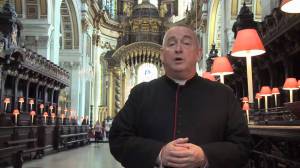
Image of Dean Knowles courtesy of authors
The contest between the pew and the street in Temple exposed how the term “free speech” is metaphorically mobilized for political and ethical convenience. In a way, Temple is a critique of the Dean Graeme Knowles’s actual homily given on October 28th, 2011, just before the church reopened and just after the diegetic time of the play closes. In this homily, Knowles appropriates the language of testimony while at the same time appealing to a more abstract notion of “free speech”:
We are called out to be witnesses, to speak out, to testify…like Simon and Jude, many of us will be anonymous, but like them, our voices need to be heard. Because of their testimony, we are here today. Without their voice, the good news of the gospel would not have reached us.
While the church’s reopening (and the concomitant removal of Occupy) may actually appear like a restriction on free speech, the dean reassures congregants that the church is itself a testament to it. “World leaders have spoken under this throne,” he says, at once emphasizing the church’s personal importance to Christians who feel silenced by the church’s closing and the political importance of an otherwise “neutral” institution.
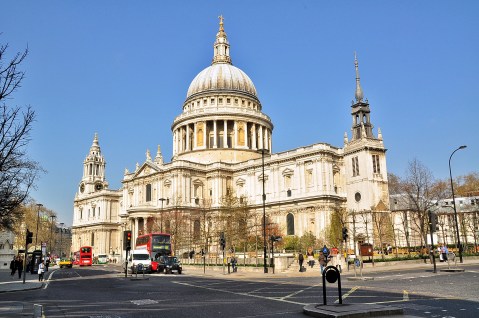
St. Paul’s Cathedral, London, England, Image courtesy of authors
Waters’s play attempts to resolve the church/streets binary by filling hollow calls to testimony with multiple voices across a political spectrum, offering a polyvocality that helps to unpack this contradiction of the church standing up for free speech while simultaneously denying it. Through the clash of sounds and the characters voices, Temple exposes how Knowles’s homily is actually covering up a historical contradiction between numerous relations: between various iterations of what “free speech” means; between who controls the soundscape; between various iterations of free speech movements throughout history. It is here that the link to what is happening in Berkeley in 2017 is most poignant, in the resonance between the church’s past and its conflicted present on the one hand, and the dissonance between the historic memory of the UC Berkeley-based Free Speech Movement (FSM) of the fall of 1964 and how the “New Free Speech Movement” of the “alt-right” has effortlessly yet inaccurately usurped its language and moral ground.
If the Church and the University are spaces of exception, institutions that are both public and private, their responsibility to democratized speech is premised on ethical and legal principles that are not the same as the constitution-bound worlds around them. It is this being of the world and not that incites the agonism around who can speak and what they can say: according to Jesus in John 15:19 “… because you do not belong to the world…therefore the world hates you.”
The Free Speech Movement of 1964 advocated for the ability to offer persuasive speech with social consequences–rather than mere talk–carried forth by an uneasy alliance of liberal and conservative students brought together by the simultaneity of the Civil Rights Movement and Republican Party election campaigns. Campus administrators and the economic and political elite of the day claimed that students were being persuaded to perform illegal activities off campus, while it was the FSM leadership’s assertion that civil disobedience and direct action of the type being developed in civil rights and labor struggles was in fact defensible “free expression.” 50 years ago tactics such as sit-ins, occupations, blocking an arrest, and transforming a police car into a stage were seen by moderate and conservative commentators as coercive and violent forms of rebellion, but for activists they paled in comparison to the everyday racist violence affecting Black people in America, the imperial violence of the Vietnam War, or the total annihilation promised by a potential nuclear war. Similarly today, Antifa accept pre-emptive and coercive violence as necessitated by the potential violence summoned by the “alt-right,” whether in the form of lone individuals inspired by their white supremacist ideology or the spectre of a large scale fascist transformation of American society.
Though protest songs provided the background music to the FSM of the 60’s, the current debate and protests over “free speech” call attention to another constitutive relationship between sound and protest, between noise and power. Behind the liberal plea to “lower the voices” and heighten the reason in political discourse is a reminder that sound has an ability to interact with consciousness in non-rational, even hypnotic ways. We see a kind of hypnosis in the very language of “free speech” today, a term invoked by the alt-right and the university to protect certain political agendas similar to the way that the term “objectivity” was deployed mid-century. Stanley Fish made a similar argument in the 1990’s amidst that moment’s culture wars, arguing that because all speech is socially constructed and ideologically asserted “there’s no such thing as Free Speech.”
Free speech, for Fish, only exists as an ideal construct outside of history in which voices are pure “noise,” separated from consequences and assertions. But his notion of “noise” and “free speech” again are too metaphorical, separated from the uneven histories of protected speech and the materiality of noisy protests. As Jonathan Sterne writes, out of the perceived noise and meaninglessness of protests there emerge rhythms and grooves that can be heard farther than they can be seen, that invite participation and resistance. In the context of Temple and the UC Berkeley protests, the “noise” created within and against the term “free speech” should not simply be dialed down or declared a realm of meaningless utterance, but unpacked as an important opening in to how power is both employed and resisted by institutions like the university and the church.

Berkeley Free Speech Protests of 1964, Image courtesy of author
The Chancellors of UC Berkeley have never been averse to using violence to correct and regulate speech on its campuses, whether it be Chancellor Strong’s eviction of the FSM’s occupation of Sproul Hall in 1964, or the brutalization of student protesters by campus police under the watchful eye of Chancellor Birgeneau in 2009. The Dean of St. Paul’s agony could give us insight into what went into Chancellor Christ’s ambivalent public letter that assures us that “free speech” and “safety” will come at a cost. In ‘64 the discourse of “free speech” became a platform for political dialogue and social transformation, not for usurping the language of testimony and personal experience while abstracting real societal power. What the “alt-right” frames as a common struggle for a moral and legal principle only disguises the balances of power that determine who can speak without the consequence of violence: white people or people of color; governments or protestors; bankers or the poor.
“Free Speech” is the domain of a particular sacred noise, one that has the power to disrupt what Martin Luther King Jr. himself described as the “appalling silence and indifference of good people who sit around saying ‘wait on time’.” In this recently discovered speech, given in London just after he spoke at St. Paul’s in December 1964, MLK goes on to say that “human progress never rolls in on the wheels of inevitability,” retroactively giving moral weight to Mario Savio’s demand that “you’ve got to put your bodies […] upon the wheels.” We can see this spirit of rebellion in the counter-rhythms of London’s anti-austerity occupations, rising up to meet the bells of St. Paul’s, and as well in the “rough music” of outraged students rising up to meet the Sather Tower Carillon as it insistently keeps time.
—
Featured Image: Still from video of Berkeley Protests, February 2017
—
Gabriel Salomon Mindel is an interdisciplinary artist and scholar whose research considers ways that people produce and struggle for space using sound to extend beyond the limits of their bodies, particularly in formal and informal modes of protest. He received an MFA in Visual Arts from Simon Fraser University where his work focused on the production of visual artworks from time-based phenomena such as sound composition, dance, social practices and protest. He has also spent nearly two decades exhibiting artwork, performing improvised music and composing for dance and film. Images, writings and recordings can be found at https://diademdiscos.com/gms/.
Alexander J. Ullman is a PhD student at UC Berkeley’s Department of English where he researches Nineteenth, Twentieth, and Twenty-first Century Literatures.
—
 REWIND! . . .If you liked this post, you may also dig:
The Sound of Hippiesomething, or Drum Circles at #OccupyWallStreet–Gina Arnold
On Ventriloquism, Dummies, and Trump’s Voice–Sarah Kessler
G.L.O.S.S., Hardcore, and the Righteous White Voice–Chris Chien
Share this:


Current Top Posts





April 2021

January 2020

November 2019

October 2019

August 2019

April 2014

November 2017

March 2015

December 2017

October 2015
 Sounding Out!
Recent Comments