
TiK ToK: Post-Crash Party Pop, Compulsory Presentism and the 2008 Financial Collapse
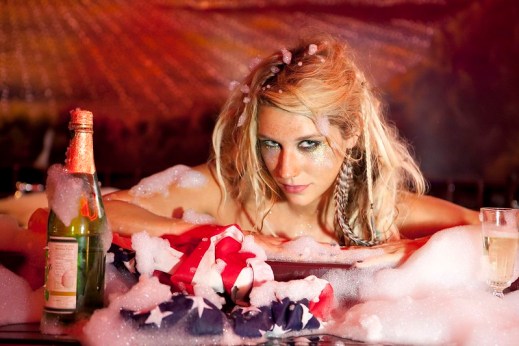
As pundits increasingly speculate about the likelihood and character of another recession, I’m thinking about the one from which we’re still recovering. Specifically, I’m thinking about a certain strain of American pop music—or a certain sentiment within pop music—that it seems to me accelerated and concentrated just after the 2008 financial collapse. This strain, which obviously co-existed with many other developments in popular music at the time, takes party songs and adds to them two interconnected narrative elements: on the one hand, partying is cranked up, escalated in one or multiple ways, moving the music beyond a party anthem and into something new. On the other hand, the rationale for such a move consistently derives from an attitude of compulsory presentism, in which the future is characterized as unknown, irrelevant, or is otherwise disavowed.
In the American context, the popular (and, I argue, misguided) take on the music of the great recession is that we didn’t have any—in other words, because no one was directly singing about the crisis, there was no music that responded to it. But this is an extremely limited way of understanding how music and socio-political life interact. In this post, I consider specifically American notions of mainstream party culture to argue that the strain of party music described above and below is the music of the crash, not because it literally speaks about it but because it reflects a certain attitude expressed and experienced by those at the front of both popular music listening at the time and the collapse itself: the graduating classes of 2008-2012.
By “party music” I do not mean (exclusively) music to which people party; rather, I am trying to trace what happens to music that is about partying during the crash. When I say that these songs transform from being party anthems into “something new,” what I mean is that in their extremeness, both the represented parties and the organizing affect of these parties reflect an urgency, a crisis, or a lack of choice condition. In short, what I’m calling “Post-Crash Party Music” (PCPP) responds to the 2008 financial collapse and the broader context of climate devastation by instituting a compulsory presentism that manifests through a frenetic, extreme, nihilistic celebration, a never-ending party that is also the last party (before the end of the world).
I’ll briefly mention two prime examples, both from what might be the peak year of this trend, 2010. First, Ke$ha’s single “(and #1 on Billboard’s Year-end Hot 100), “TiK ToK” sees Ke$ha brushing her teeth with a bottle of whiskey, while the last line in the chorus reveals why this is happening: Ke$ha sings, “The party don’t stop, no,” implying that the song’s narration picks up in a moment that could be any moment, an eternal present that is non-distinguishable from any other moment.
This line captures both of the defining characteristics of PCPP: 1) the party is extreme because 2) it never ends, or is always presently occurring. Although there are multiple ways of creating the eternal present that the party represents, each song in this category is invested in denying both past and future in a way that makes the presentist attitude of the partygoers a mandatory condition. This requirement is what makes PCPP more extreme, narratively, than party pop of previous eras.
As a second example, take The Black Eyed Peas’ quintessential party anthem “I Gotta Feeling.” Throughout most of the song, listeners are set up to experience what sounds like a fairly typical party jam: although the Black Eyed Peas render this joyous, optimistic track as perhaps more formally ‘perfect’ or effective than many of its competitors, it still follows a standard EDM format and a fairly conventional sentiment.
However, near the end of the track, as if responding to the pop-culture/post-crash landscape by afterthought, the Black Eyed Peas very casually disclose that the night that has all along been referenced as “tonight” is in fact every night: “Monday, Tuesday, Wednesday and Thursday/Friday, Saturday, Saturday to Sunday/Get, get, get, get, get with us, you know what we say, say/Party every day, p-p-p/Party every day, p-p-p [repeat 10x]…”
Party anthems of one kind or another have been with us for a long time. But I would argue that something else is going on here. The traditional ambition to party until the sun comes up or to party all night has been eclipsed by a more extreme goal, which is to never stop partying at all. In this new space, the time of day or the day of the week is irrelevant; time itself evaporates in the indistinguishable space of an everlasting present.
My argument here is that this music–specifically in its insistence on a party’s ceaselessness–represents almost the complete opposite of its expressed sentiments: that is, rather than rapturous or celebratory moods, PCPP reflects widespread existential and economic anxiety that is shared among the entire millennial generation, but which was acutely present for the classes that graduated college between 2008 and 2012. Its insistence on partying forever is indicative of this generation’s awareness that the future is bleak.
Economically, we know that this cohort will live with repercussions of the financial collapse for the rest of their lives. (See for instance: “Bad News for the Class of 2008”; “This Is What the Recession Did to Millennials”; “A Decade Later Many college grads from the Great Recession are still trying to catch up”; “2008 was a terrible year to graduate college”; “2008: Ten Years After the Crash, We Are Still Living in the World It Brutally Remade”; and the pithily-titled but quite thorough “Millennials are Screwed”.) Existentially, while the millennials were not the first to cognize and politically articulate the stakes of the unfolding climate crisis, they are, as a “young generation,” perhaps the first identifiable group who will most certainly face its longterm consequences. Rather than simply distract us from these realities, PCPP is predicated on our understanding of those realities. In the face of these circumstances and more, is it any wonder that the affective (if not conscious) response was to live it up while there was still time?
I am not arguing that PCPP harbors any ambitions to address any such anxieties; on the contrary, this music is, on its face, also an example of the much broader genre of neoliberal corporate pop music, a commodity that aims to utilize listener sentiments to maximize profit. That is why PCPP cuts across or includes such racial and gender diversity in its performers, and why it also corresponds to broader trends in pop that elevate and glamorize conspicuous, over-the-top consumption, the kinds of caricatured displays of spending-power that are hallmarks of PCPP as well as other mainstream genres. The discourse of an endless party is also a really good one in which to promote consumption―especially consumption that is taken to the extreme, or is justified through the logic of embracing “life” while we can.
No, from the perspective of the music industry, this music is not about anxiety but is, like all corporate music, still about including as many listener-customers as possible in the cross-branded spectacle of neoliberal pop. Instead, my claim is that this music, however inadvertently, resonates with listeners in a particular, affective way, and in the encounter between neoliberal pop music and a group of anxious American listeners, an accelerated sentiment emerges and spins itself out. We are still consuming, but endlessly so; and that very ceaselessness speaks to a deeper existential dread at the heart of our voracious appetites.
Emerging from this resonance between extreme party music and extreme anxiety are several traceable tropes, each expressing the ambition to party forever. For instance, the “don’t stop” imperative is often paired with the seemingly paradoxical sentiment that “we only have tonight”; but insofar as the end of that night heralds a return to reality (the post-crash landscape) one solution is to simply refuse to stop the party. In this way, the night can “last forever” within the space of the music. Taken together, the PCPP ethos can be summarized by the phrase, as a colleague recently put it, “right now forever.”
There is a specific construction at work here that allows PCPP to impose its presentist timespace: the forever-now is not extended out of joy, but rather out of necessity. By acknowledging that our time (out there) is limited, it constructs a space (in here) that resists normative flows of temporality. PCPP simply disallows temporality into its consciousness–it refuses to acknowledge the existence of a past and especially not a future. Here the “compulsory” element of its presentism emerges: it is compulsory both because within the affective space of the music, the rules do not allow temporality to exist, and because, when our futures have been irrevocably damaged, the present is, in effect, all that we will be allowed to experience.
There are many more examples from this period, all riffing on the same nihilistic affect: “Tomorrow doesn’t matter when you’re moving your feet” (Pixie Lott, “All About Tonight”); “This is how we live/every single night/take that bottle to the head and let me see you fly” (Far East Movement, “Like a G6”, 2010); “Still feelin’ myself I’m like outta control/Can’t stop now more shots let’s go” (Flo Rida, “Club Can’t Handle Me”, 2010). In this context, assurances from Lady Gaga that “It’s gonna be ok” if we “Just Dance” seem less hopeful and more ironic, as if born from denial.
Surely, some of these songs take up the “don’t stop” imperative simply by virtue of its ubiquitous circulation through a pop-culture economy (Junior Senior’s 2003 “Move Your Feet” comes to mind here). I am not arguing that any song that expresses such a generic utterance be considered a part of this post-crash formation; what it takes to qualify, it seems to me, is a distortion whereby the generic affect is pumped so full that it breaks something, a process that sometimes introduces a dark subtext into the music, but which no matter what displays elements of excess that go beyond the pale of a celebratory dance tune. Eddie Murphy’s “girl” wants to “Party All the Time”, but this alone doesn’t qualify the tune as an anxiety anthem because it is a source of hurt and stress for the speaker’s character—ceaseless partying here is sublimated into a narrative about a certain romantic relationship. What distinguishes PCPP, on the other hand, is the sense (however vague) that the “don’t stop” imperative is urgent, and meant to protect us from the world that is waiting outside the club.
PCPP differs in this way from other genres that consciously articulate a dissatisfaction (of whatever kind) with contemporary conditions. The millennial nihilism of an everlasting party is not the same as Gen X’s cynical malaise, which had more to do with resistance to meaningless corporate employment than it did the prospects of no employment at all. PCPP is not punk-rock anarchism nor grunge’s serious grappling with the consequences of capitalism on people’s mental health. PCPP is purely affective, a manic/cathartic punishment-therapy that does not need to denotatively speak of what’s happening in the world because that world is always already experienced in an extreme way. PCPP responds by dialing up the party to a degree of fervor that is correspondingly intense, able to drown out the noise, and it achieves this effect by turning parties into a paradox that is both time-limited and never-ending.
It is true that I have mostly focused on lyrics in this argument. But first of all, other factors also contribute to the sense of PCPP as existential: see for instance the music video for Britney Spears’ “Till the World Ends” (2011), which literalizes the argument I’m making by representing people dancing as the planet crumbles. Likewise, the music video for LMFAO’s “Party Rock Anthem” (2011) casts the band’s beat as a contagion that has afflicted the “whole world,” compelling them to dance ceaselessly in a way that resonates appropriately with post-apocalyptic genres.
Second of all, the “music itself” never exists in isolation from the lyrics or indeed from any other element of a tune. What I would argue that the sounds and formal elements of these songs contributes to the PCPP ethos is a sense of tension and paradox: namely, the paradox between the stated dream of an unending party, and the reality that underlies said dream. It is, physically and otherwise, impossible to keep dancing indefinitely, a fact reflected in the form of this music, which still follows EDM rules of build-up and release, those forms that give one’s body time to rest and appropriate places to feel the natural climax of a song. The tension between the music (which corresponds to the body) and the lyrics (which aim into the afterlife) is the central contradiction that makes PCPP so e/affective.
Thus, the PCPP genre or sentiment, which flashes brightly from 2009-2012, meets its death in and through the track that most comprehensively embodies it: Miley Cyrus’s “We Can’t Stop” (2013). In this deeply melancholic hit, PCPP is followed to its logical conclusion: those who at first refused to stop partying are now entirely incapable of doing so even if they wanted. This is the most extreme version of the PCPP worldview, so extreme that it spread into the music, inverting the entire affect from pumped-up party jam to down-tempo lament, a lament with almost no temporality even in its form.
Although my reading of “We Can’t Stop” differs from Robin James’s, her description perfectly captures the way that song’s form finally achieves the same presentism that PCPP’s lyrics always established, a closed world of “now”. In her 2015 book Resilience and Melancholy, James writes,
Just as the lyrics suggest that the ‘we’ is caught in a feedback loop it can’t stop, the music keeps spuriously cycling through verses and choruses without moving forward or backward…In other words, time isn’t a line, it’s Zeno’s paradox; not a pro- or re-gress but involution (177-178).
If anything, this formal stagnation or inverted affect brings “We Can’t Stop” into the space of the trap music it plays at, and constitutes one of the many ways in which the song cannot sustain its contradictions. As Kemi Adeyemi makes clear, trap music certainly has to do with partying; but its intersections with neoliberal capitalism are particular to Black lives in a way that is wholly different from Cyrus’ attempted deployment. Thus, reaching to trap for a PCPP affect has the devastating effect of exploding the entire sentiment.
In other words, “We Can’t Stop” exposes all the lies that PCPP, in its heyday, furthered: the idea that the party could continue indefinitely, and (by extension) so too could the “fairy tales of eternal economic growth” and the supposed post-racial utopia opened up by neoliberal capitalism. “We Can’t Stop” gives sound to these fictions, through its own form and in various ways: from its well-documented appropriation of Black culture, to the untenable contradiction at the heart of its sentiments. “We can do what we want” but we also “can’t stop.”
Rather than hearing this tune as “painfully dull” (180), this song has always been morbidly fascinating to me, a bleak statement about our inability to move past the moment in which we’re caught. In other words, our presentism is now also compulsory because we’ve gotten so used to it that we can no longer imagine a future at all, or at least not one in which catastrophe doesn’t occur; nor can we imagine the solutions that would help us when it does. Instead, we have the iPhone 11 and self-driving cars. Instead, we have an inverted yield curve and predictions of another (perpetually recurring) market crisis. Instead, we have billionaires doubling down, grabbing every last resource they can from the planet in order to insulate themselves from the effects they have created, a final and pathological shopping spree. Seen from that perspective, while it marked the end of PCPP as a trend, “We Can’t Stop” remains striking as both indictment and prophecy.
—
Featured Image: Culture Project 1: Ke$ha by Flickr User HyundaiCardWeb (CC BY-NC-ND 2.0)
—
Dan DiPiero is a musician and Visiting Assistant Professor of American Studies at Miami University of Ohio, where he teaches American popular culture and music history. His current book project investigates the relationship between improvisation in music and in everyday life through a series of nested comparisons, including case studies on the music of Eric Dolphy, John Cage, and contemporary Norwegian free improvisers, Mr. K. His work has appeared in Critical Studies in Improvisation/Études critiques en improvisation, the collection Rancière and Music (forthcoming, Edinburgh University Press), and boundary 2 online. He plays the drums.
—
 REWIND! . . .If you liked this post, you may also dig:
In Search of Politics Itself, or What We Mean When We Say Music (and Music Writing) is “Too Political”–Elizabeth Newton
Poptimism and Popular Feminism–Robin James
Benefit Concerts and the Sound of Self-Care in Pop Music–Justin Adams Burton
Straight Leanin’: Sounding Black Life at the Intersection of Hip-hop and Big Pharma–Kemi Adeyemi
Share this:

“Heavy Airplay, All Day with No Chorus”: Classroom Sonic Consciousness in the Playlist Project
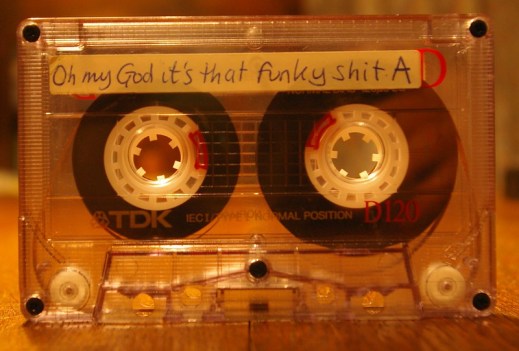
For a number of semesters, I invited composition students to explore the idea of using the mixtape as a lens for envisioning a writing assignment about themselves. Initially called “The Mixtape Project,” this auto-ethnographical assignment employed philosophies from various scholars, but focused on Jared Ball and his concept of the mixtape as “emancipatory journalism.” In I Mix What I Like!: A Mixtape Manifesto, Ball pushed readers to imagine the mixtape as a counter-systematic soundbombing, circumventing elements of traditional record industry copyright practices (2011).
Essentially, a DJ could use a myriad of songs from different artists and labels to curate a mixtape with a desired theme and overarching message, then distribute the mixtape as a “for promotional use only” artifact. Throughout the 1980s, but predominantly in the 1990s and early 2000s, many DJs used mixtapes as the medium to promote their DJ brands and generate income. It wasn’t long before labels began to give hip-hop DJs record deals to release “album-style” mixtapes where the DJs record original content from artists made specifically for the DJ album (see DJ Clue, Funkmaster Flex, Tony Touch). This idea evolved into producer-based compilation albums, best depicted today by global icon DJ Khalid. Rappers also hopped on the mixtape wave, using the medium to jump-start their careers, create a “street buzz” around their music, and ultimately gauge the success of certain songs to craft and promote upcoming albums.
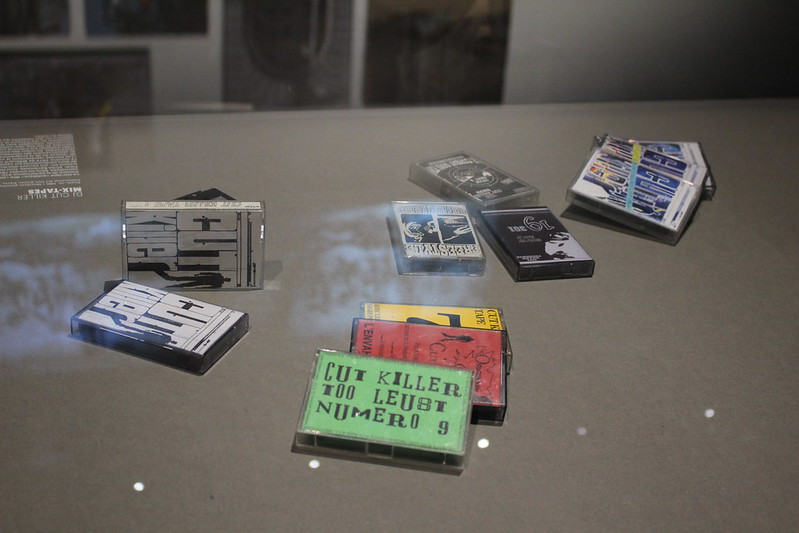
Image by Flickr User Backpackerz: “K7 mixtape – Exposition Hip Hop, du Bronx aux rues arabes (Institut du monde arabe)” (CC BY-SA 2.0)
The assignment revolved around mixtape framework in the earlier portion of my teaching career. Most recently, I began to realize as my students evolve (and I simultaneously age), that the “mixtape” – a sonic artifact distributed on cassette tape or CD – is becoming more remote to students. This thinking led to revising the assignment with a more contemporary twist. Thus, “The Playlist Project” was born: the first in a set of four major writing projects in a first-year writing classroom. The ultimate goal of the assignment was to immediately disrupt students’ relationships with academic writing, and to help them (re)envision the ways they embrace some of the cultural capital they value in college classrooms. Be clear, this was a particular type of mental break for students, a shift that was welcomed yet also uncomfortable for them.
“I Get It How I Live It”: Framing and Foregrounding the Assignment Set-Up
The course started with readings on plagiarism, intertextuality, and the hip-hop DJ’s use of sampling, curating, and storytelling. Next were readings by hip-hop artists describing their creative process and detailing their artistic choices sonically. These early readings helped pivot students from their stereotypical notions of what college writing courses – and writing assignments – looked like, and how they could enter scholarly discourse around composing. This conversation was foregrounded in students’ knowledge that they bring with them into the new academic space in the college classroom. My goal was to really focus on student-centered learning and culturally relevant pedagogy; ideally, if you are immersed in hip-hop music and culture, I want you to share that knowledge with the class. This sharing begins to create a community of thinking peers instead of a classroom with an English professor and a bunch of students who have to take the course “cuz it’s required in the Gen Ed, so I can’t take anything else ‘til I pass this!”
My research is entrenched in both hip-hop pedagogy and culture, specifically looking at the DJ as 21st century new media reader and writer. I liken my role as instructor to that of the DJ: a tastemaker and curator for the ways we understand sonic sources we know, and couple them with new and necessary soundbites that become critical to the cutting edge of the learning we need. I’ve engaged in the craft of DJing for more than half of my life, and use DJ practices as pedagogical strategies in my classroom environments.

DJ Rupture, Image by Flickr User JD A (CC BY-NC-ND 2.0)
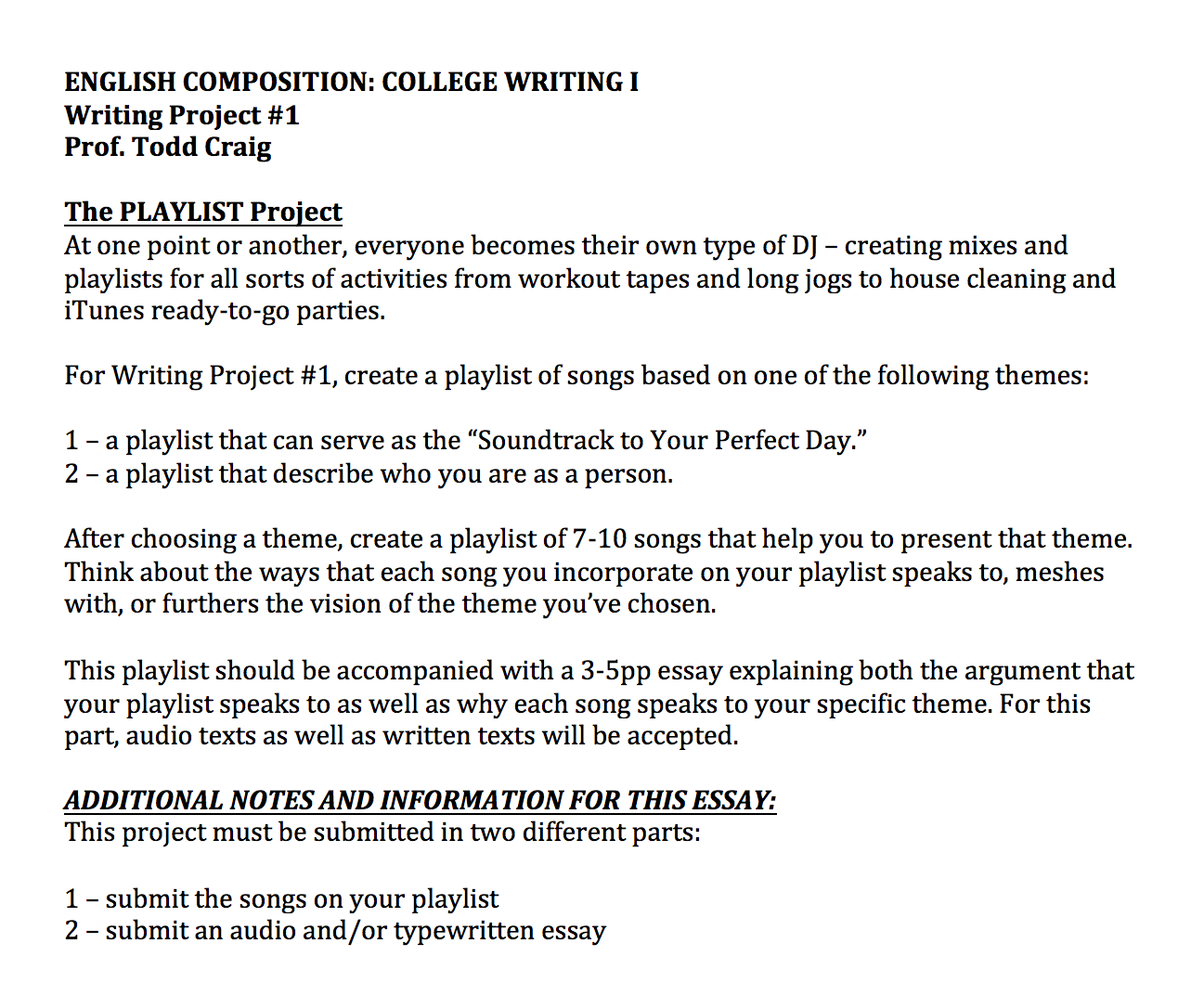
The outcome of this curatorial moment was “the Playlist Project.” Students were asked to create their own playlists, which served as mixtapes that either “described the writer as a person” or “depicted the soundtrack to the writer’s perfect day.” This assignment was due during Week 6 of a 16-week semester, and was the first major writing assignment within the course. The assignment called for two specific parts: an actual playlist of the songs and an essay which served as a meta-text, describing not only the songs, but also the reasons why the songs were chosen and sequenced in a specific order. As an example, the guiding text we used was a DJ mixtape I created called “Heavy Airplay, All Day.”
“Heavy Airplay, All Day with No Chorus”: DJ Mixtape by Todd Craig
My playlist was a DJ-crafted tribute to a family friend who passed away in the summer of 2017: Albert “Prodigy” Johnson, Jr. Hearing the news of his untimely death reverberated through my psyche on that warm June afternoon; I remember meeting Prodigy when I was 15 years old. Many avid hip-hop listeners not only know Prodigy as one of the signature vocalists of the 1990s New York hip-hop sound, but also as one of the premier lyricists responsible for a shift in sonic content from emcees in New York and globally. His voice is one of the most sampled in hip-hop music.
One of the most anticipated moments of the mid 1990’s was the release of Prodigy’s first solo album, H.N.I.C. P was already shaking the industry with his lethal and bone-chilling visuals in his verses. But everyone knew he was on his way to dominance upon hearing the single “Keep it Thoro.” On this Alchemist-produced record, P basically broke industry rules in regards to typical hip-hop song construction; his verses were longer than the traditional 16-bar count, and the song had no chorus.
He returned to hip-hop basics: hard-hitting rhymes with undeniable visuals served atop a sonic landscape that kept everyone’s head nodding. P ends the song with the classic line “and I don’t care about what you sold/ that shit is trash/ bang this – cuz I guarantee that you bought it/ heavy airplay all day with no chorus/ I keep it thoro” (Prodigy 2000).
It was only right for me to create a tribute mixtape for Prodigy. And it felt right to start the Fall 2017 semester with the Playlist Project that used a shared text that celebrated and honored his memory. It highlighted the soundtrack to my perfect day: having my friend back to rewind all the memories that come with every song.
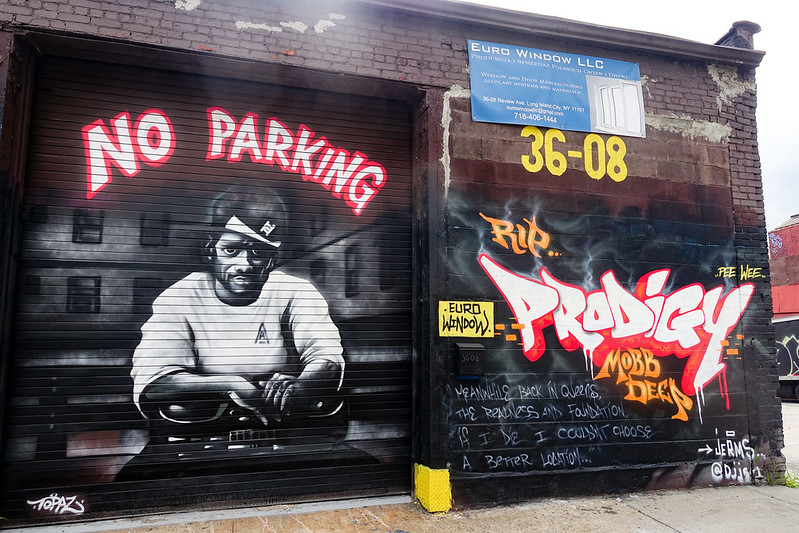
Fan Memorial to Prodigy, Image by Flickr User Nick Normal (CC BY-NC-ND 2.0)
“I Got a New Flex and I Think I Like It”: (Re)inventing Mixtape Sensibilities in the Comp Classroom
The Playlist Project was aimed at achieving three different outcomes. The first goal was to invite students to use audio sources to envision a soundscape that explains a thread of logic. These sonic sources would hold as much value in our academic space as text-based sources, and would allow them to (re)envision what “evidence-based academic writing” looks like. Thus, students could utilize their own cultural capital to negotiate sound sources of their choosing.
 The second was to get students to use DJ framework to think about sorting, sequencing and organization in writing. In our class discussions, one of the critical objectives was to get students to understand the sequencing of divergent sound sources could drastically alter the story one is trying to tell. Overall aspects of mood, tone, and pacing all become critical components of how a message is expressed in writing, but it becomes even more evident when thinking about the sonic sources used by a DJ. Each song – a source in and of itself – is a piece of a puzzle that constructs a picture and tells a story. Starting with one source can create a completely different effect if it is reconfigured to sit in the middle or the end. Explaining these sonic choices in text-based writing would be the second step in the assignment.
Finally, students would engage in editing by joining both sound and text based on a theme they have selected. Again, sequencing becomes a critical DJ tool translated into the comp classroom. Using this pedagogical strategy echoes the ideas of using DJ techniques such as “blends” and “drops” as viable teaching tools (see Jennings and Petchauer 2017). Students would need to critically think through an important question: in creating the playlist, how does one manipulate and (re)configure sound to create a sonic landscape that “writes” its own unique story?
DJ Sai by Flickr User Mixtribe (CC BY 2.0)
“But Does It Go In the Club?”: Outcomes and Initial Findings of The Playlist Project
The first iteration of the Playlist Project bore mixed results. Students found it difficult to think of this project as one whole assignment consisting of three different parts. Instead, they envisioned each of the three different pieces as isolated assignments. So the playlist was one part of the assignment. They picked the songs they liked, however ordering and sequencing to convey a logical theme or argument fell from the forefront of their composing. The essay then became its own piece divorced from the organic creation of the playlist. Thus, students weren’t “engaged in telling the story of the playlist.” Instead, students were making a playlist, then summarizing why their playlists contained certain songs.
For students who were more successful integrating the elements of the assignment, we were able to have rich and fruitful classroom conversations about both selection and sequencing. For example, one student chose the theme of “the Soundtrack to the Perfect Day.” Within that theme, the student chose the song “XO TOUR Llif3” by Lil Uzi Vert.
In the song’s hook, he croons “push me to the edge/ all my friends are dead/ push me to the edge/ all my friends are dead” (Vert 2017). When this song came up in class discussion, we were able to have a formative conversation around the idea that a perfect day entailed all of someone’s friends being “dead.” This also sparked a conversation about the double meaning of the quote; it didn’t stem from traditional print-based sources, but instead arose from a student-generated idea based in the cultural capital of the classroom community. In this moment, I was able to learn more from students about the meteoric rise in relevance of both the artist and the song which seemed to depict an extreme darkness.
“Big Big Tings a Gwaan”: Future Tweaks and Goals for The Playlist Project
Moving forward with this assignment, I have considered breaking the assignment up into three pieces for more introductory composition courses: constructing the playlist, sequencing the playlist, and writing the meta-text. In this configuration, the meta-text would truly become the afterthought (instead of the forethought) of the sonic creation. As well, more in-depth soundwriting could emanate from the playlist construction, manipulation, (re)sequencing and editing. I also plan to use the assignment with a more advanced-level composition course to gauge if the assignment unfolds differently. Using an upper-level course to attain the trajectory of the assignment may be helpful in walking backwards to calibrate the assignment for students in introductory-level classes.
Another objective will be to move away from just a “playlist” and back into a “digital mixtape” format, where the playlist songs and sequencing become the fodder for a one-track, “one-take” DJ-inspired mixtape. While students don’t have to be DJs, creating a singular sonic moment digitally may imbed students in marrying the idea of soundwriting to depicting that sonic work in a meta-text. This work may also engage students in constructing sonic meta-texts, thereby submersing themselves in soundwriting practices. This work can be done in Audacity, GarageBand and any other software students are familiar with and comfortable using.
—
Featured Image: By Flickr User Gemma Zoey (CC BY-NC-ND 2.0)
—
Dr. Todd Craig is a native of Queens, New York: a product of Ravenswood and Queensbridge Houses in Long Island City. He is a writer, educator and DJ whose career meshes his love of writing, teaching and music. Craig’s research examines the hip-hop DJ as twenty-first century new media reader and writer, and investigates the modes and practices of the DJ as creating the discursive elements of DJ rhetoric and literacy. Craig’s publications include the multimodal novel tor’cha, a short story in Staten Island Noir and essays in textbooks and scholarly journals including Across Cultures: A Reader for Writers, Fiction International, Radical Teacher and Modern Language Studies. He was guest editor of Changing English: Studies in Culture and Education for the special issue “Straight Outta English” (2017). Craig is currently working on his full-length manuscript entitled “K for the Way”: DJ Literacy and Rhetoric for Comp 2.0 and Beyond. Dr. Craig has taught English Composition within the City University of New York for over fifteen years. Presently, Craig is an Associate Professor of English at Medgar Evers College, where he serves as the Composition Coordinator and City University of New York Writing Discipline Council co-chair. He also teaches in the African American Studies Department at New York City College of Technology (CUNY).
—
REWIND!…If you liked this post, you may also dig:
The Sounds of Anti-Anti-Essentialism: Listening to Black Consciousness in the Classroom- Carter Mathes
Making His Story Their Story: Teaching Hamilton at a Minority-serving Institution–Erika Gisela Abad
Deejaying her Listening: Learning through Life Stories of Human Rights Violations– Emmanuelle Sonntag and Bronwen Low
Audio Culture Studies: Scaffolding a Sequence of Assignments– Jentery Sayers
Deep Listening as Philogynoir: Playlists, Black Girl Idiom, and Love–Shakira Holt
Share this:


Current Top Posts





April 2021

January 2020

November 2019

October 2019

August 2019

April 2014

November 2017

March 2015

December 2017

October 2015
 Sounding Out!
Recent Comments