
Won’t Back Down: Tom Petty, Jason Aldean and Masculine Vulnerability

October 2017: a week after a Las Vegas gunman killed 58 people at an outdoor festival during a Jason Aldean set, Aldean squared up to the Saturday Night Live mic and soldiered through then-recently deceased Tom Petty’s “I Won’t Back Down.” In a short statement before the song, Aldean mentioned that he was “strugglin to understand what happened that night,” and he reiterated this general sense of confusion about what to make of everything in ensuing interviews. It’s unsurprising that Aldean struggled to make sense of the shooting; traumatic experiences like the one he and his audience endured often don’t fit into any ready-made understanding we have about the world. But Aldean, who seemed uncomfortable publicly displaying the kind of emotional vulnerability the trauma produced in him, was eager to resolve the dissonance: with platitudes like “be louder than the bad guys,” with assurances that “when America is at its best, our bond and our spirit – it’s unbreakable,” with an admission of his own hurt only as an empathic response to others’ rather than as his own, and with a cover song borrowed from one of his idols. Here, I’m listening to the compensatory work the cover of “I Won’t Back Down” performs in the face of the kind of vulnerability Aldean wrestles with in the wake of violence. To hear this as clearly as possible, I’ll contextualize Aldean’s performance by comparing it to a similar use of the song by Tom Petty 16 years earlier, then contrast it with Ariana Grande’s performance of “One More Time” at her One Love Manchester benefit a few months before the Las Vegas shooting.

Screen capture from Cal Vid’s youtube video “Jason Aldean SNL Tom Petty I Won’t Back Down Live Tribute”
Though the song’s titular line, “I won’t back down,” is a fairly direct lyrical idea about maintaining one’s resolve, the rest of the song still manages to paint a rather vague picture. The singer isn’t backing down, sure, but beyond “a world that keeps on pushin [him] around,” there aren’t many specifics about what he’s not backing down from. This is a kind of pop genius: capture a core sentiment that registers with a large audience, then present it in ambiguous enough terms that listeners can fill in the blanks with their own very personal experiences. So, despite Petty’s own analysis that he “laid [the song] out, you know, with no ambiguity at all,” “I Won’t Back Down”’s lyrics are incredibly broad, leaving space for practically anyone to insert themselves into the role of protagonist. Your boss might be a jerk, but you won’t back down. Your employee might think you’re a jerk, but you won’t back down.
Moreover, the sound of the song undermines even its most resolute lyrics. When Petty sings “I won’t back down,” which he does often in the verses and the hook, he scoops all around the pitches of “won’t,” “back,” and “down” so that they sound more interrogative than declarative. Rhythmically, these words sit on weak beats and upbeats in the verses, and in the chorus, the final word, “down,” comes just before – not on – a strong downbeat (see figure below). The effect of the syncopation is similar to the effect of Petty’s pitch bends; lyrical resolve becomes musical uncertainty. Finally, George Harrison’s guitar solo – as George Harrison guitar solos tend to do – plays pensively with the song’s forward momentum, again reining in the lyrics’ more direct message. In all, “I Won’t Back Down” works in a good deal of uncertainty that makes it unclear exactly what the threat is and whether the singer really is as resolute as he’d like us to believe.
| + | 1 | + | 2 | + | 3 | + | 4 | + | |
| verse | I | won’t | back | down | |||||
| hook | I | won’t | back | down |
What a song means or how it works changes with the times, though, and the defiance lurking in the lyrics of “I Won’t Back Down” crystallized after the destruction of the Twin Towers on September 11, 2001. When Petty performed “I Won’t Back Down” at the benefit concert America: A Tribute to Heroes on September 21, the context of a nation rallying around itself to defeat some yet-unknown foreign enemy overwhelmed any of the sonic signifiers that might otherwise temper the song’s resolve. This concert, which was aired virtually on every channel to a country still reeling from a collective trauma, subsumed Petty’s vocal scoops, the lyrics’ offbeat kilter, and the guitar’s sanguine solo under the clarity of a lyrical sentiment that aligned neatly with the politics of the moment: the US won’t back down. The shift in focus in “I Won’t Back Down” just after September 11 is similar to a dolly zoom effect: the threat referenced by the song’s lyrics feels as if it comes nearer and into sharper focus even as the protagonist broadens from an individual to a collective identity.
This sort of shift in the song’s narrative tracks with Christine Muller’s account of the overarching changes in cultural narratives that happened in the wake of the Twin Towers’ destruction. In September 11, 2001 as Cultural Trauma (2017), Muller argues that the broad perception of the fracture of the “American Dream” – “good things happen to good people, and bad things happen to bad people…come to the United States, and you will have opportunity; work hard, and you will succeed; follow the rules, and you will be rewarded” – harkened the rise of cultural media focused on “no-win scenarios…a fascination with anti-heroes who do the wrong things for the right reasons” (9-10). In the case of “I Won’t Back Down,” a song that was once broadly resolute and unfocused on any particular foe, sung by an artist who sent a “Cease and Desist” letter to George W. Bush when the then-candidate used the song for his presidential campaign morphed into an anthem that became narrowly resolute in the face of a named threat (“terror”), woven into a larger political tapestry that aided in the demonization of Muslims and the Islamic countries targeted by the “global war on terror” – an interminable war fought for vaguely defined reasons started at multiple sites by the same Bush Petty had previously defied.
Aldean’s Saturday Night Live performance 16 years later would emulate Petty’s, as faithful a cover as Aldean and his band could do. Though his vocals lack Petty’s high-end nasal clarity, Aldean dutifully hits all the scoops, honors the syncopations, and even yields to a guitar solo that follows George Harrison’s lead from decades previous. For Aldean, who was 40 at the time, and many millennials, the SNL performance would likely resonate with Petty’s iconic Tribute performance. And in the space of those 16 years, another frequently repeated line in the song would take on a political life of its own, recognizable to younger listeners who may not have immediately registered the post-9/11 context of “I Won’t Back Down.” While “I’ll stand my ground” would’ve been as broadly meaningful as “I won’t back down” when Petty released the song in 1989, the 2012 murder of Trayvon Martin pushed the idea of Stand Your Ground laws into public consciousness. These laws nullify one’s “duty to retreat,” to avoid violence if a safe passage away from a threat is reasonably available, instead allowing a person who feels threatened to use violence against their perceived threat. Research shows that Stand Your Ground laws tend to protect white people and endanger Black people, holding up long-standing social norms that cast Blacks as always already violent. So by the time Aldean sang “I’ll stand my ground, and I won’t back down” in 2017, the song had passed through social and political filters that gave its lyrics an anti-Muslim and anti-Black edge.

“Stand Your Ground” By Flickr User Seattle.roamer, CC BY-NC-ND 2.0
At first blush, all this context makes “I Won’t Back Down” a bizarre choice for Aldean to sing in response to the Las Vegas shooting. The identity of the gunman – a white man around retirement age – made him only a bit older than the demographic most responsible for mass shootings in the US. Instead of addressing the fact that mass shootings are a distinctly USAmerican problem, or that country music fosters a close and financial relationship with the NRA (which lobbies against the sorts of regulations that would curb mass shootings), Aldean remained unwilling to offer any thoughts on guns and gun control, even after experiencing the shooting firsthand. While we might reasonably excuse the singer’s lack of reflection on social and political problems in recognition that Aldean was surely traumatized himself, the singer’s performance of “I Won’t Back Down” still performs a specific kind of rhetorical work that relies on Petty’s performance at America: A Tribute to Heroes 16 years earlier. Specifically, Aldean’s rendition of “I Won’t Back Down” places the Vegas shooting in the same political arena used to demonize Muslims after September 11 and to criminalize Black people in political discourse surrounding Stand Your Ground laws. As I mentioned at the top of the essay, Aldean admitted and demonstrated his discomfort with the emotional vulnerability the shooting provoked in him, and I hear his performance of “I Won’t Back Down” as an effort to compensate for that public vulnerability by providing a retreat to a more familiar masculine pose: protective, resolute, stoic.
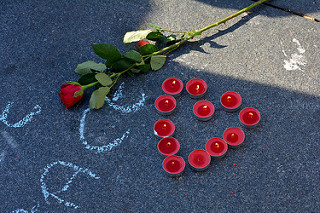
“Liverpool vigil for victims and families of MEN Manchester” by Flickr User James O’hanlon, CC BY-NC-ND 2.0
I published a piece that revolves around the idea of self-care with Sounding Out! in 2017, and one of the two central musical examples I consider there is Ariana Grande’s performance of “One More Time” at the One Love Manchester benefit concert just after the Manchester bombing. Grande’s circumstances run parallel to what Aldean would face a few months later: a traumatic act of violence that disrupted, injured, and killed the artist’s fans as the terror of the event rippled through the community. The two performances are gendered completely differently, however. Grande sings “One Last Time” surrounded by other musicians she invited to participate in the benefit concert. She frequently chokes up and relies on her fans to carry the song forward. She offers no answers or solutions beyond sentiments of love and the need to hold one another close in times of crisis. Grande’s is a performance of feminized care that contrasts sharply with Aldean’s masculinized resolve. Unwilling to publicly grapple with the emotional vulnerability created by the Vegas shooting, Aldean retreats from any public displays of grief and settles into an expression of care rooted in aggressive defense. His performance of “I Won’t Back Down” compensates for the feminized vulnerability triggered by the gunman and provides a masculine space for defiance that shifts attention away from white criminality and toward the US’s usual suspects: Black people and Muslims.

“#Ferguson protest in Memphis” by Flickr User Chris Wieland, CC BY-NC 2.0
Saturday Night Live has scrubbed the internet of any full videos of the performance (the single is available on Spotify), but we can see and hear Aldean running through the same rendition a couple weeks later at the Louisville Yum! Center. It’s worth noting how Aldean embodies the resolve of the song’s lyrics. While Petty always approached a microphone like he was going to whisper something in its ear, his shoulders slouched and knees bobbing to the beat, Aldean squares his shoulders, plants his feet to form a broad base, and confronts the mic straight on. Some of this boils down to style. Jason Aldean’s stage presence is different from Tom Petty’s. But it also captures the distance “I Won’t Back Down” has traveled since the late 1980s, from a largely empty signifier that listeners could fill with their own meaning to an anthem used for rallying listeners in the wake of mass violence. Here, feminized vulnerability and trauma are recast as masculinized aggression and resolve until the song fills with the politics of the moment: the US’s anti-Black, anti-Muslim refusal to back down from standing its ground.
_
Featured Image: “Tom Petty & The Heartbreakers, Oracle Appreciate Event “Legendary”, JavaOne 2011 San Francisco” by Flickr user Yuichi Sakuraba, CC BY-NC 2.0
_
Justin Adams Burton is Assistant Professor of Music at Rider University. His research revolves around critical race and gender theory in hip hop and pop, and his book, Posthuman Rap, is available now. He is also co-editing the forthcoming (2018) Oxford Handbook of Hip Hop Music Studies. You can catch him at justindburton.com and on Twitter @j_adams_burton. His favorite rapper is one or two of the Fat Boys.
_
 REWIND! . . .If you liked this post, you may also dig:
SO! Reads: Hiromu Nagahara’s Tokyo Boogie-Woogie: Japan’s Pop Era and Its Discontents – Shawn Higgins
Spaces of Sound: The Peoples of the African Diaspora and Protest in the United States – Vanessa K. Valdés
SO! Reads: Shana Redmond’s Anthem: Social Movements and the Sound of Solidarity in the African Diaspora – Ashon Crawley
Share this:

SO! Reads: Hiromu Nagahara’s Tokyo Boogie-Woogie: Japan’s Pop Era and Its Discontents

 When times are tough and people are feeling sad, they might need space to be calm, to reflect, and to heal. For example, in the United States following September 11, 2001, Clear Channel (now iHeartMedia) suggested keeping a number of “aggressive” artists, such as Rage Against the Machine and AC/DC, off the airwaves for a while to provide the nation with one group’s version of a calming sonic space. However, this suppression couldn’t hold; at a certain point, the pilot light re-ignited, and Americans wanted to turn the gas up high, to feel the heat, to extravagantly combust themselves out of the Clear Channel rut. Explosive tracks followed those tragic times in 2002–from Missy Elliott’s “Lose Control” to DJ Snake and Lil Jon’s “Turn Down for What” to Miley Cyrus’ “We Can’t Stop” to Daft Punk’s “Lose Yourself to Dance”–resonating over the airwaves and web browsers and dance floors. So whose idea of a healing sonic space prevails? For how long? Who decided what healing looks and sound like? And who decides the time for healing is finished?
 Hiromu Nagahara is a historian who has examined how music was used during a transformative era in Japanese history. Nagahara’s book, Tokyo Boogie-Woogie: Japan’s Pop Era and Its Discontents (Harvard UP, 2017), focuses on the ryūkōka popular music produced “primarily between the 1920s and the 1950s” (3), which is different from the hayariuta music of the Meiji (1868-1912) and Taishō (1912-1926) periods or the kayōkyoku ballad songs post-1970. One of Nagahara’s central concerns with popular music is how it furthered the nation-building endeavor of the 1920s and 1930s. Another concern is how censorship was implemented and policed through the wartime era and beyond. Nagahara’s stance on censorship in Japan is that state powers such as the Japan Broadcasting Corporation (Nihon Hōsō Kyōkai, NHK), public powers such as music critics, and self-censorship are responsible for the limitations put on artistic productions. This stance is in concert with scholars such as Jonathan Abel and Noriko Manabe, although unfortunately Nagahara’s book doesn’t discuss Manabe’s work on the censorship of music addressing the Daiichi Fukushima disaster.
Nagahara greatly contributes to the English-language scholarship on Japanese music critics; those interested in how Theodor Adorno similarly addressed German sociopolitical issues through music criticism will find both the parallels and the divergences mapped in Nagahara’s work fascinating. The biggest takeaway for this reader, however, was the book’s tracing of Japan’s shifting class formations through these decades. Nagahara shows that Japan evolved from an infamously strict class-caste system into a middle-class society into a society that “increasingly saw itself to be classless” (212) all in the span of a century, and that music and the nation’s burgeoning media industry played pivotal roles in this transformation.

Movie Poster for Tokyo March, 1929, wikimedia commons
Specifically, Nagahara argues that the commercialization and industrialization of music in Japan were natural outcomes of the nation’s shift toward capitalism in the Meiji period. While the “gradual transformation of music, and art in general, into ‘consumer goods’” (64) in Germany signaled the “long-term decline of German middle-class culture” for Theodor Adorno, it actually signaled the opposite for Japan. Nagahara notes that, prior to the Meiji period, the Tokugawa shogunate (1603-1868) “idealized and mandated the separation of different status groups – in particular the division between members of the ruling samurai class and those who were deemed to be ‘commoners’” (21). Therefore, when the Japanese public bought an unprecedented 150,000 copies of “Tokyo March” (“Tokyo kōshinkyoku”) in 1929 and when records produced in 1937 were selling half a million, it became clear that “luxury goods” (18) such as phonographs and records were no longer simply for the ruling elites of Tokugawa-era wealth. Instead, Japan’s former commoners were marching toward capitalism with a middle-class cultural dream on the horizon.
As a period study, Nagahara doesn’t try to tie things up nicely – that’s not often how history works. As such, Nagahara concerns himself with the politicization of media in Japan, and he extends his discussion of pre-war popular music up through the 2000s with quick references to Pokémon and AKB48. However, there is a missed opportunity here in that Nagahara never references the Daiichi Fukushima disaster and the subsequent outpouring of popular music that responded to the public and private-sector management of the catastrophe.
This would have fit perfectly in the “The Television Regime” subsection of the book’s conclusion, and it would have added greatly to what Nagahara recognizes is a “significant dearth of scholarly analysis of the inner workings of popular song censorship in the last decades of the twentieth century” (218) and beyond. This reader would be excited to read more by Nagahara if he were to take up this task. I learned so much about the context and reception of pop music in Japan from Tokyo Boogie-Woogie, and this book would help any reader better understand one of the largest and most influential music and media scenes in the world today.
—
Featured Image: “Vintage Hi-Lite Transistor Radio, Model YTR-601, AM Band, 6 Transistors, Made In Japan, Circa 1960s” by Flickr User Seah Haupt, CC BY-NC-ND 2.0)
—
Shawn Higgins is the Academic Coordinator of the Undergraduate Bridge Program at Temple University’s Japan campus. His latest publication is “Orientalist Soundscapes, Barred Zones, and Irving Berlin’s China,” coming out in the 2018 volume of Chinese America: History and Perspectives.
—
 REWIND! . . .If you liked this post, you may also dig:
SO! Reads: Janet Borgerson and Jonathan Schroeder’s Designed For Hi Fi Living–Gina Arnold
SO! Reads: Susan Schmidt Horning’s Chasing Sound: Technology, Culture and the Art of Studio Recording from Edison to the LP— Enongo Lumumba-Kasongo
SO! Reads: Jonathan Sterne’s MP3: The Meaning of a Format–Aaron Trammell
Share this:


Current Top Posts





April 2021

January 2020

November 2019

October 2019

August 2019

April 2014

November 2017

March 2015

December 2017

October 2015
 Sounding Out!

Recent Comments