
Prison Music: Containment, Escape, and the Sound of America
DOI: https://doi.org/10.59350/r3xqx-qrv76
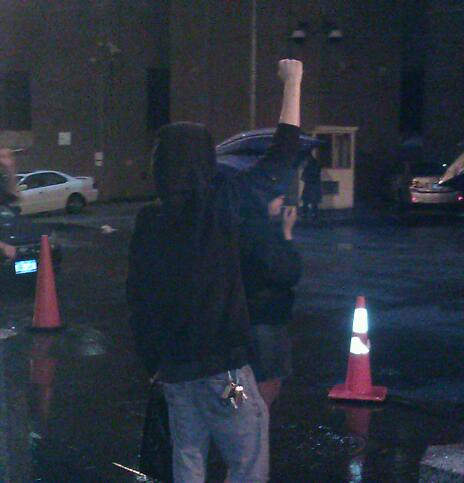
We used our voices, whistles, and blow horns to make contact with those on the inside… Prisoners flickered the lights in their cells on and off throughout the building, banged on windows, and we could see the shadows of many of those on the inside waving and pumping fists. — Activists outside the Metropolitan Corrections Center, NYC, July 8, 2011
Noise demonstrations, like the one described above, occurred outside jails, detention centers, and prisons in cities like New York City, St. Louis, Oakland, Los Angeles, Montreal and Kitchener, Ontario throughout the weekend following July 4th, 2011. Activists rallied by playing music, chanting, launching flares and fireworks, and banging pots and pans– communicating their solidarity with the Pelican Bay Hunger Strike, and their demand for justice for prisoners in each city. The noisy international demonstrations “connected local struggles against dehumanization to the California hunger strike and the conditions of the Pelican Bay Security Housing Unit, as well as both the U.S. and Canada’s prioritization of policing and imprisonment over social welfare.” (San Francisco Bayview, 2011).
If music can be understood as “the organization of noise” (Attali, 1977), these audible signs of solidarity across prison walls would certainly be considered a form of music: prison music, perhaps. Prison has been a form of political organization for the United States, at least since the beginning of the 19th century; music (or organized noise) from or about prisons helps trace this history of containment sonically. Prison music also points to the possibilities of sonic and political escape from this carceral state.
The beginnings of the history of prison music in the United States can be traced to the War of 1812. A poet named Francis Scott Key met with British officers aboard a ship off the coast of Maryland to negotiate the release of American prisoners. He was detained overnight, having gained knowledge of the position of British military units and their plan to soon attack Baltimore. From detention in a ship floating on the Atlantic, Key watched the Battle of Baltimore at Fort McHenry and reported at dawn to the prisoners below deck that he was still able to see the American flag waving.

He chronicled the experience in a poem titled, “In Defence of Fort McHenry,” and later put it to music with John Stafford Smith’s “To Anacreon in Heaven.” The title of Key’s poem changed in October of 1814 when a Baltimore actor performed the song in public and called it “The Star-Spangled Banner.” In 1889, the Secretary of the Navy designated “The Star Spangled Banner” as the official tune to be played at the raising of the U.S. flag, and in 1916 the song was declared the national anthem of the United States. Key’s experience in detention along with other American prisoners in the middle of the Atlantic was memorialized as the U.S. anthem, but it is rare, if ever, that the country’s ode to freedom is understood as its opposite – as an ode to unfreedom, as prison music. Set against contemporary examples of organized noise across prison walls, as well as examples of prison themes in U.S. popular music and culture, the U.S. national anthem can be understood as a beginning point for an American tradition of prison music.
Jimi Hendrix’s guitar version of “The Star Spangled Banner” allows us to see this dimension of the American anthem. Offering a scathing and raucous rendition of the national anthem at the 1969 Woodstock Festival off the heels of his song “Purple Haze,” Hendrix blurred the lines between a drug-induced delirium and the reality of U.S. containment, at home and abroad. Hendrix improvised on Smith and Key’s tune, allowing the notes and sounds to escape the page, and signified on the sonic and political constraints the song represented: major chords, patriotic lyrics, “American freedom.” In riffing on the national anthem, Hendrix perhaps released what was being held behind these classic American “bars”: the pain, the chaos, the possibility. Note the intervals bending from major to minor to major (harmony to disharmony and back again); the (song) structure being destroyed, re-formed, rebuilt anew; the reduction of the refrain to organized noise— sonic escapes in the forms of cries, screams, explosions. Here Hendrix’s performance fits into a trajectory of U.S. prison music by retooling the U.S. national anthem as a song of unfreedom, or perhaps, a different kind of freedom.
The relationship between prison and music in the United States can be heard most clearly through Black soundings of voice, tools, instruments, technology. Hendrix’s music, for example, represented another transnational trajectory of prison music arriving on U.S. shores from ships in the Atlantic, the genealogy of Black music. What began as tribal African songs remixed over plantation work in slavery conditions became field hollers, gospel, chain gang songs, work songs, the blues, jazz, country, rock, hip-hop. It is here that “logics of U.S. white supremacy”: slavery/capitalism, genocide/colonialism, Orientalism/war (Andrea Smith, 2008) coalesce and are rendered illogical, problematic, and questionable, simply (or not so simply) by their audibility. Take the following song, “Early in the Mornin’,” sung by Black prisoners in a 1940′s Mississippi work farm, as another example.
In this example of prison music, one hears sounds that confound the work that is being performed. The music makes the work illogical. It sounds like the work is not productive, at least not for the bodies performing it. This is destructive, or more precisely deconstructive, physical and sonic work: breaking down (song) structures, bodies, minds in the process. It is a sonic protest against imprisonment, even as prison labor is being performed. This is the sound of prison music, simultaneous containment and escape, and helps explain why prison (music) is so popular in the United States. Prison is a necessary function of white supremacist patriarchal capitalism– a necessary warehousing of surplus (bodies) for exploitation or elimination. Prison music is a documentation of this process. Listening to, and perhaps playing, prison music is our attempt to hear ourselves survive within these dehumanizing systems.
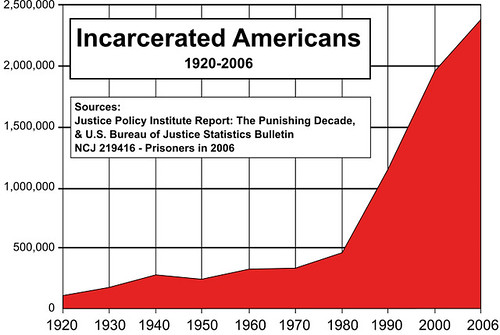
Prisons are popular in the United States, and not just in music (from anthems to work songs to blues to country to rock to hip-hop, imbued with the sounds and sights of prison). It’s the popularity and predominance of actual prisons, and the increasing rate of incarceration of U.S. residents, that undergirds the general public’s simultaneous aversion to, and fascination with, these literal echo chambers. Prisons in the United States are hyper-inaudible/invisible, and simultaneously hyper-audible/visible. The location of U.S. prisons behind distant, opaque, and quiet walls, sits strangely against the reality of prison as an increasingly intimate, transparent, and loud source of entertainment for the general public– think Cops (23 seasons), Law & Order (20 seasons), CSI (12 seasons), and Lockup (11 seasons).
Regrettably, sounds (musical or otherwise) from those incarcerated are rarely audible above the din of the prison spectacle in popular music, culture and policy. Jacques Attali wrote, “Music is a herald, for change is inscribe in noise faster than it transforms society…. Listening to music is listening to all noise.” The question is: when prisoners make noise, will we hear their music?
—
Jeb Middlebrook holds a Ph.D. in American Studies and Ethnicity from the University of Southern California, and is a Lecturer in Race, Social Movements, and Popular Culture at USC, University of Colorado–Colorado Springs, Loyola Marymount University, and People’s University, an online, low-cost college for first-time and returning students. He can be reached at jeb@solidarityinstitute.org and on Facebook and Twitter.
—
Share this:

Can You Hear Me Now?

DOI: https://doi.org/10.59350/zc0jb-kgr76
And Gil-Scott Heron thought the revolution would not be televised.
The past few weeks the world has been watching the protests in Egypt. We have not just watched, but we have also tuned in. This is history in the making, especially considering that many of the information we are getting of this protest movement come from the ground, from the protesters themselves, and their requests have gone viral on Youtube and Twitter.
Earlier this week, I was watching CNN and its coverage of the protesters at Tahrir Square after Mubarak’s statement that he would not step down. On several occasions the broadcasters on CNN asked viewers to listen to protesters. The grainy images of the mobile crowds had been playing in the background all afternoon, a reminder of what was going on while the broadcasters offered information and analysis. But at times the broadcasters stopped speaking so viewers could listen to the crowds. The grainy images emitted a dull roar, the combination of all of the cries and statements from the protesters. The cameras followed people down streets, but the roar was constant. It struck me how often the plea to listen came up during the broadcast. On Friday, when Mubarak resigned, I tuned in online (from work) to CNN, MSNBC, and BBC America. The broadcasters made the same requests: let’s tune in to the crowds at Tahrir Square. See early in this MSNBC video where Brian Williams encourages viewers to listen to the protesters:
The newsmedia seemed to offer the sounds to its viewers, but what is at stake when that happens? How are the sounds being coded? Mark Branter’s post on sound and sanity in the context of the Rally to Restore Sanity (which took place on October 30th 2010), reminds us that oftentimes noise and screaming is connected to “irrationality and fear.” He points out, “Public noise is senseless sound, while rational debate is meaningful sound.” In this context, the constant plea from newscasters for the American public to “listen in” to the crowds at Tahrir Square takes a different spin. Are we insiders looking at the Other scream and shout? When the newscasters ask us to tune in to the pleas and screams coming from the Egyptian crowds I wonder if the newscasts frame them as senseless crowds because of the way that they present these sounds. In any instance, this presentation of sound is not innocent. Some may argue that it is just a request from Western media to pay attention to what the crowds are saying, but I believe that we cannot truly listen to their cries on Tahrir Square when we still hold in place this analogy of “sound/noise::rationality/irrationality.” Many agreed that Mubarak should listen to the pleas of the crowds, but are we listening to them as well?
The coverage of the Egyptian protests shows us how complicated listening is. The protesters are not just seen but heard (only when the network wants the viewers to listen, mind you) by viewers. The sonic aspect of this movement is reinforced when we think of the “Speak-to-Tweet” service, set up to allow Egyptian protesters to tweet when the Egyptian government turned off all internet communication. We could read AND hear what the protesters were saying.
When media outlets choose to tune in to the protests in Egypt, this is an example of how important sound is to narratives. Visuals are not the only story, is what I get from the protest coverage. (And letting the world hear the protesters is a step in the right direction.) The coverage and its inclination toward the audio of the protesters tells me that it’s not just a matter of shock value but it’s also a statement of the role of audio in the news. It’s supposed to be a reflection of what is going on at the moment, like taking the temperature of the crowds. As others have said on this blog (for example, Priscilla Peña Ovalle) sound is usually linked to the visual, and the hierarchy of senses in our society always has the visual as the most important. Listening is important, but we must also think about how we listen, and what filters the sounds we listen to.
Liana Silva
Share this:




Current Top Posts





April 2021

January 2020

November 2019

October 2019

August 2019

April 2014

November 2017

March 2015

December 2017

October 2015


Recent Comments