
Black Excellence on the Airwaves: Nora Holt and the American Negro Artist Program
—Co-authored by Chelsea Daniel and Samantha Ege—
Nora Holt (c.1885 – 1974) was a leading voice in Black America’s classical music scene. Her activities as a composer, performer, critic, commentator, and more shaped the Harlem Renaissance and its Chicago counterpart. As the fervor of the Black Renaissance progressed into the Civil Rights era, the energy that drove Black women’s activism sought greater outlets, one of which was the male-dominated world of radio. In radio, Holt continued her mission to broadcast Black excellence and there, her voice found greater power.
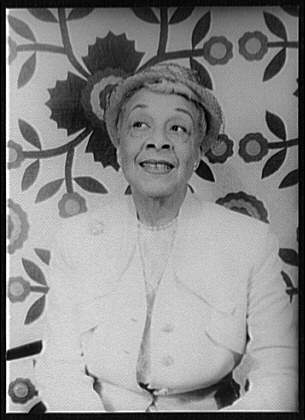
Photograph of Nora Holt by Carl Van Vechten. Retrieved from the Library of Congress website.
As two classical pianists of African descent, we—Chelsea M. Daniel and Samantha Ege—were accustomed to Black women’s voices (as embodied in their compositions, performances, and criticism) being minimized, or muted all together in the Western art music narrative. Hearing Holt for the first time was powerful.
Chelsea never knew that someone who looked like her existed in classical music, especially someone who had as great of an impact as Holt. Starting her piano studies at five, Chelsea was consistently the only Black female pianist in both her high school and college programs and she felt very isolated. It was nearly impossible for her to find any representation of Black female pianists and she was only encouraged to play a “standard” repertoire, which is dominated by white male composers. In her sophomore year of college, Chelsea took a music history course that taught her about diverse musicians who were omitted from her textbook. This discovery and a meaningful partnership with friends who shared similar experiences to her prompted the beginnings of numerous projects dedicated to showcasing music by diverse musicians, one being her junior degree recital where she programmed Sonata in E minor by the groundbreaking African-American composer Florence Price (1887 – 1953). With few performances of the piece existing online, Chelsea found Samantha’s recording and decided to reach out asking for guidance with the music.
Samantha’s journey had been very similar to Chelsea’s, from looking to see some part of herself reflected in her studies to actively seeking a classical music history that celebrated the truth of its diversity. These similarities are what led them to Price, and eventually to this collaboration. At the time Chelsea reached out, Samantha was developing her research on Price’s network and its impact during the Chicago Black Renaissance. As Samantha began to piece Holt’s influence together, she couldn’t help but lament the radio silence around her life and legacy in the mainstream musical consciousness. The following tweet from the Red Bull Music Academy certainly rang true. Or so she thought.
https://twitter.com/RBMA/status/879617104030420992
Chelsea came across Holt’s literal voice during her internship at WQXR-Radio, to which Samantha’s reaction was: “Oh. My. God.” Chelsea had been trying to track down locations in New York where Price’s friend and collaborator composer-pianist Margaret Bonds (1913 – 1972) had performed. She was shocked to find a live recording of the artist on the American Negro Artist Program, something that does not even exist on YouTube. For us to hear Bonds on the piano and Holt’s actual voice, with the crisp mid-Atlantic elocution of a bygone era but a message of Black excellence for the ages, was to feel inspired, renewed, significant, and empowered (much like Holt’s listeners during her time).
***
Born Lena Douglas in Kansas City to a minister father and musically-inclined mother, Holt’s music education began with playing organ in the church. Her musical pursuits aligned with the Talented Tenth thinking that W.E.B. Du Bois promoted around the turn of the century; it was believed that the highly educated top ten percent of the African-American population would uplift the race and that the study of classical music would provide a tool for mobility. However, Holt also lived beyond the limits of early twentieth-century respectability. As a young adult, she challenged the archetype of the modern day Black woman. By the time she had graduated from Kansas’s Western University, a prestigious HBCU, she had been married three times while still managing to graduate at the top of her class.
In 1917, she married her fourth husband, George Holt, who was a rich hotel owner thirty years her senior. She changed her name to Nora Holt. Prior to meeting her husband, she moved to Chicago and earned her living as a cabaret performer while also actively performing, composing, and promoting classical music. In 1918, Holt became the first person African-American person in the United States to attain a Master of Music degree, which she earned at the Chicago Musical College. For her thesis composition, she presented an orchestral piece called Rhapsody on Negro Themes. The rhapsody was one of over 200 compositions that Holt wrote. Unfortunately, many of them were lost and have yet to be recovered. Holt had kept her manuscripts in storage during her time away in Europe, but returned to find that all had been stolen. The only surviving works were those that had appeared in her publication, Music and Poetry: the art song “The Sandman” and Negro Dance (1921) for solo piano.
Negro Dance with Samantha Ege, piano
Holt’s advocacy for Black artistic excellence became even more far-reaching with her work as a music critic for the Chicago Defender and the New York Amsterdam News. She reviewed all of the concerts with African-American performers and composers that she could find and made history as one of the first women to write for a major newspaper as the Chicago Defender’s first ever music critic.
Holt moved into radio during the 1940s. Her American Negro Artist Program on WNYC began in 1945 and spanned almost a decade. It was upon this platform that she used her voice to further amplify the work of Black classical practitioners.
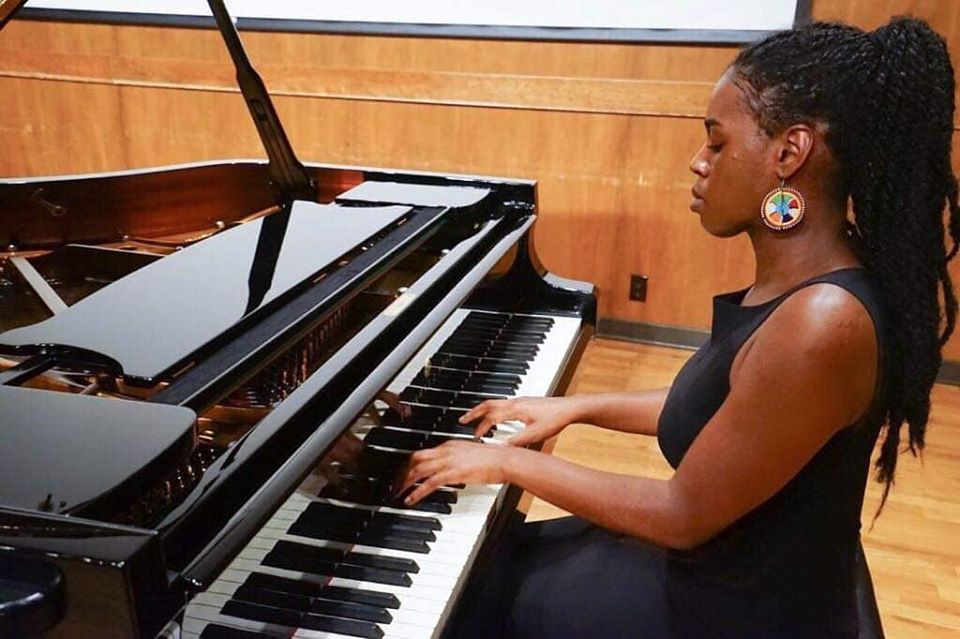
Chelsea M. Daniel, Butler School of Music, University of Texas at Austin. Image courtesy of the authors.
Chelsea found that the NYPR Archive Collections had published Holt’s 1953 American Negro Artist Program. This half an hour segment aired on February 12 at 5pm and was part of WNYC’s 14th annual American Music Festival. Though the scope of the festival was far broader, Holt’s program specifically highlighted the classical artistry of African-descended practitioners. February 12 fell in the middle of Negro History Week–the forerunner of today’s Black History Month–which New York Governor Thomas E. Dewey had proclaimed from February 8 to 15 (a span selected by the Week’s founder, Dr. Carter G. Woodson, in the 1920s to encompass the birthdays of Abraham Lincoln and Frederick Douglass). With this program, Holt led her listeners through the multifarious layers of Black diasporic representation.
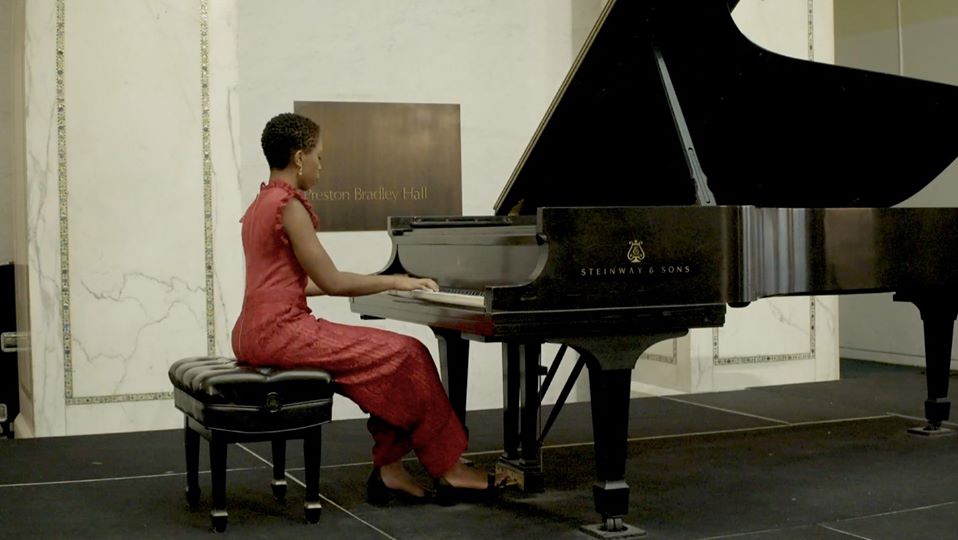
Samantha Ege, Preston Bradley Hall, Chicago Cultural Center. Images courtesy of the authors.
February 12 was also the commencement date of the festival, which was first announced in early February, in 1940. WNYC planned to broadcast an all-American series of concerts (forty in total) that would begin on February 12 and end on February 22, as marked by the dates of Abraham Lincoln’s and George Washington’s birthdays, respectively. Morris. S. Novik, WNYC director, told the New York Times (February 3, 1940) that the purpose of the festival was two-fold. He elaborated:
One purpose is to build the municipal radio station into an even greater force in the cultural life of the community, and the second is to promote the cause of good American music. American broadcasters have done a splendid job in developing appreciation of classical music. Radio must do still another important job by focusing attention on American music, and by demonstrating that Americans have written good–even great music.
The American Music Festival was the first of its kind to promote music that encompassed the nation’s musical past and present on such a scale, and with such stylistic variety. According to Novik, no other radio station had attempted to broadcast such a wide cross-section of American music with the same grand vision that he had. The New York Times reported on just how extensive this cross-section was (February 12, 1940):
The concerts will cover nearly all types of American composition. Simple ballads which the pioneer sang as he plodded his way Westward will be included, along with the professional orchestral works of today. Spirituals and blues, indigenous to American soil, will vie with compositions that incorporate the latest innovations. All types of compositions: mountain songs, barber-shop ballads, vaudeville melodies, marches and the more serious forms of composition which make up the musical life of America will be represented. The festival offers an affirmative answer to the question, “Do we have American music?”
Holt’s program not only evidenced a resounding “yes,” it presented a pan-diasporic purview that affirmed the socio-sonic pluralities of Black artistry. Samantha uses the term “socio-sonic pluralities” to ground the musical developments of Black cultural creators in their environment and to recognize how various social conditions can shape artistic expression. She identifies this as a central component in Holt’s 1953 American Negro Artist Program, particularly as the program went beyond the United States to embrace the Americas. With composers whose backgrounds encompassed Canada (R. Nathaniel Dett) and St. Kitts (Edward Margetson) and musical influences that merged different diasporic folk traditions with Romantic, neo-classicist, modernist, and Black Renaissance aesthetics, the American Negro Artist Program celebrated the interconnected, yet also distinct audiovisual histories of the African diaspora.
Program:
“The Breadth of a Rose”
William Grant Still, composer
Viola John, contralto and Margaret Bonds, piano
“I want Jesus to Walk With Me”
Negro Spiritual arranged by Edward Boatner
Viola John, contralto and Margaret Bonds, piano
“His Song” and “Juba Dance” from In the Bottoms
- Nathaniel Dett, composer
Una Hadley, piano
“One” and “Genius Child,” based on poems by Langston Hughes
Edward Lee Tyler, composer
Edward Lee Tyler, bass-baritone and Norma Holmes, piano
“First Movement” from Fantasy on Caribbean Rhythms
Edward Margetson, composer
The American String Quartet: David Johnson, 1st violin; Frank Sanford, 2nd violin; Felix Baer, viola; and Marion Combo, cello
“By the Sea”
Julia Perry, composer
Adele Addison, soprano and Margaret Bonds, piano
“The Negro Speaks of Rivers,” based on a poem by Langston Hughes
Margaret Bonds, composer
Adele Addison, soprano and Margaret Bonds, piano
On a scholarly level, Holt’s American Negro Artist Program adds another dimension to the way Samantha interprets the socio-sonic pluralities of Black artistry in the post-war era. Accessing Holt’s voice in the context of radio reifies connections between growing technologies and Black classical propagation at this time. In the absence of Holt’s full composition catalogue, hearing Holt amplify the work of her esteemed peers gives an enhanced perspective on her musical developments—from composer to curator, off the score and onto the airwaves.
On a personal level, however, it is upsetting to not have learned about Holt sooner and, as Chelsea elaborates, to not have a face like Holt’s to look up to during the loneliest moments of our education. Holt’s work validates Chelsea’s own pursuits, particularly in radio. Holt successfully created her own space in classical music, and did so unapologetically. She provided opportunities for Black musicians to be at the forefront and challenged a system that was not built for first-person Black narratives. And so, we take a leaf from her book, recognizing that the (re)sounding of her story is also the celebration of our own.
Listen to Holt and the American Negro Artist Program here.
—
Featured image:”Music stand (1)” by Flickr user Rachel Johnson, CC-BY-ND 2.0
—
Chelsea M. Daniel is a senior at the University of Texas, Austin, pursuing her Bachelor’s in Piano Performance. She is devoted to showcasing the stories and music of marginalized people and musicians. Daniel is the co-founder of the award-winning Exposure TV, which was created to highlight composers and musicians from underrepresented backgrounds. Daniel came across the American Negro Artist Program during her internship at WQXR-FM.
Samantha Ege is a scholar, pianist and educator. Her PhD (University of York) centres on the African-American composer Florence Price. Ege’s upcoming article on Price, Holt and the Chicago Black Renaissance women is called “Composing a Symphonist: Florence Price and the Hand of Black Women’s Fellowship” and appears in Volume 24 of Women and Music: A Journal of Gender and Culture. As a concert pianist and recording artist, Ege continues to amplify Black women composers in her repertoire.
—
 REWIND! . . .If you liked this post, you may also dig:
My Music and My Message is Powerful: It Shouldn’t Be Florence Price or “Nothing”-Samantha Ege
Spaces of Sounds: The Peoples of the African Diaspora and Protest in the United States–Vanessa Valdes
Deejaying her Listening: Learning through Life Stories of Human Rights Violations– Emmanuelle Sonntag and Bronwen Low
Share this:

My Voice, or On Not Staying Quiet
 Welcome to Next Gen sound studies! In the month of November, you will be treated to the future. . . today! In this series, we will share excellent work from undergraduates, along with the pedagogy that inspired them. You’ll read voice biographies, check out blog assignments, listen to podcasts, and read detailed histories that will inspire and invigorate. Bet. –JS
Today’s post comes from Binghamton University sophomore Kaitlyn Liu, former SO! intern and student in SO! Editor-in-Chief J. Stoever’s English 380W “How We Listen,” an introductory, upper-division sound studies course at Binghamton University, with a typical enrollment of 45 students. This assignment asked students to
write a 3-page biography of your voice. You may choose to organize the paper and tell the story however you wish, as long as you consider your experience in light our classroom readings and conversations. . .Here are some questions to help you get started. You do not need to answer all of them, but they may lead you toward some important realizations that you can share through this paper: Have you thought critically about your voice before this class? Why or why not? If so, when did you first become conscious of your voice? Why?What do you love about your voice? Why? Who were your models for learning how to speak and style your voice? Have you ever wanted to change your voice? Why or why not? Have you? Have you liked or disliked your voice at some times in your life more than others?
For the full assignment sheet, click Voice Biography Assignment_F18. For the grading rubric, click Voice Biography Grading Rubric_F18. For the full Fall 2018 syllabus, click english-380w_how-we-listen_fall-2018
While the course usually seats mainly juniors and seniors, Kaitlyn was only a freshman when she wrote this powerful piece!
—
The first joke I can recall took place in fourth grade; then again, I am unsure why it is easier to call it a joke rather than its true word, which I learned only three years ago. Perhaps, given the fact that an eight-year-old is typically still protected from most forms of racism, the fact that I could only categorize this statement as a joke back then is what propels me to do so again as a college student.
I remember that he hadn’t even formed words, he simply yelled out sounds. He pulled on the corner of his eyes and did his best impression of an Asian man’s accent from across the room, letting the whole class know his perception of my race. Ten years later, I realize that this incident was just the start of a lifelong endurance of misjudgment, bigotry, and the largely unwelcome narration of my life.

“Empty Chairs,” Image by Flickr user Renato Ganoza (CC BY 2.0)
In tenth grade, I applied for a student exchange program my high school had recently undertook called Community Wide Dialogue. The program involved my suburban school pairing up with an urban school nearby to discuss, and hopefully dismantle, racist ideals within our city. Although there is no explicit definition of the word “suburban” that details an overwhelming whiteness of its residents, this seems to be the case more often than not. After being accepted into the group, I attended our school’s first informative session about the program. Walking into the room, I quickly noticed that of nearly twenty-five students, I was the only minority they had accepted. I remember thinking to myself, Is this the best they can do? Am I a token minority here? My school had, albeit scarce, minority representation; why weren’t they included?
Being a minority in a program specifically designated for alleviating such ideals meant that I felt very discouraged from speaking in a setting where discussion, specifically from the point of view of minorities, was essential to the goal. I found it was often the white males of both groups speaking for minorities. One day, we studied vocabulary pertaining to racism; this is when I first learned that the term “color blindness” was actually quite racist, as opposed to its intended meaning. Additionally, this is when I first learned the word for what I had been hearing my entire life: microaggressions. My experience suddenly became real; what I had been calling “jokes” was racism.
I felt validated. Being Chinese-American, I am lucky to be protected from more extreme forms of racism that members of the African-American or Latinx population may face. Similarly, I am a minority, but in contrast, I am not perceived as a threat. I am not, as Sandra Bland was, a cause for a repulsive increase in the ease of extending an official white hand. I will never be the tragedy that causes Regina Bradley, a Black professor, to cautiously check herself in order to abide by her grandmother’s warning: “don’t attract attention to yourself.”
The most extreme racism I have endured lies in statements similar to: “Of course you did well on that test!” The only thing that surprised me is that these statements never came from strangers or acquaintances; instead, it was always my closest friends who felt comfortable enough to cause my own sense of discomfort. The most harmful thing about microaggressions is that it is socially unacceptable for the victim to verbalize their being affected by these hurtful phrases. When a victim acknowledges they are hurt, perpetrators are quick to cast their pain aside as hypersensitivity, working to further marginalize them while justifying their own discrimination.
Staying quiet had everything to do with who I was: a female and a minority. I let my intelligence show through my writing and my academic performance. Even if I wanted to speak, I was aware of the little relevance my voice had to others, particularly boys. As Kelly Baker remarks in “Listen to the Sound of My Voice,” “teenage girls were supposed to be seen, but when they spoke they had to master the right combination in order to be heard.” Of course, just like Baker, I, along with several other females, never could master this cultural puzzle.
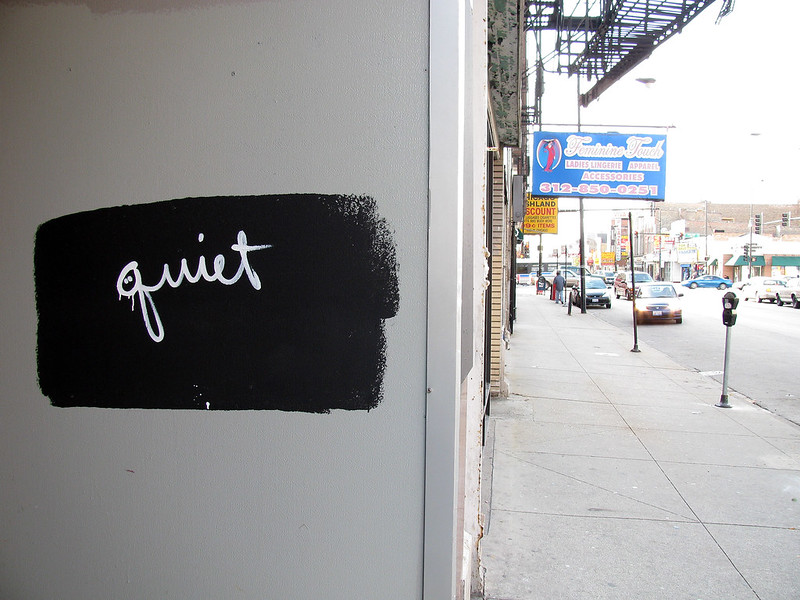
“Quiet” by flickr user heyrocc, (CC BY 2.0)
I took after most girls when I say that I tended not to speak much in class so as not to make boys uncomfortable by letting them into a female’s darkest secret: I was smarter than most of them. My teachers knew, of course, but they rarely mandated that I spoke out loud. I developed an especially close relationship with my English teacher of two years; he was one of the teachers who had the most insight into my thoughts as written in formal assignments. In other words, he knew my capabilities.
In my second year of his class, he announced that there would be a slam poetry unit in which each student had to write a five-minute poem regarding something they felt strongly about. Most students were quick to write about their perception of the injustice of the school system. I assume this topic was popular due to it being deemed “safe,” meaning the majority of students had the exact same beliefs, and because, as I alluded to before with my deep, dark secret, who would want to make anyone uncomfortable by saying something meaningful?
I decided I would. I could have easily written a poem about a neutral subject that still would have been much more memorable than the others in the class, but my teacher had a faith in me that I decided I would not disobey by lowering my standards for the sake of my classmates’ comfort, so, I did it. I talked about being Asian.
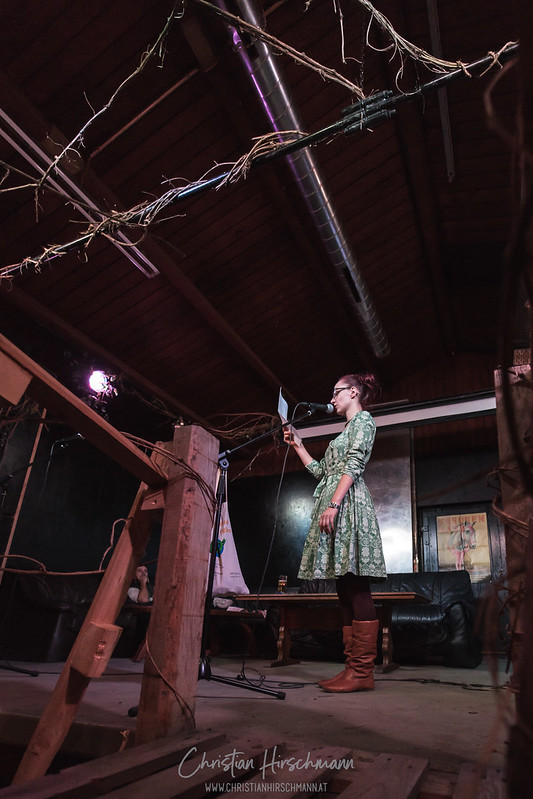
“Poetry Slam,” Image by Flickr user Ländle Slam (CC BY 2.0)
I started the poem with quotes of microaggressions I have heard during my life. It’s said that opening with a joke can lighten the mood, and that was what these sayings were to them, right? I had judged their reactions rightfully; the crowd laughed at the pure absurdity of most of these quotes. When I turned the subject of the poem to how it made me feel, however, is when the class went silent. My voice shook until I reached the third page. I ended up winning the class award for that poem, but do not let that fool you into the amount of eyes that refused to meet mine when I finished speaking.
Their embarrassment is how I knew it had worked. People can cast away a few comments or corrections, but given a platform and five minutes of speech that can not be interrupted, people have to listen. More importantly, they have to listen to me. One of the rules the teacher had put in place regarding our poetry slam was that listeners had to ask each speaker questions after they read their poem in order to receive credit. Our school’s pride and joy, our white, male, three-sport athlete valedictorian, was the first to raise his hand.
“How often do you hear these jokes?”
“Three to five times a day,” I responded loudly, bluntly.
There were no follow up questions.
The word got around. I had people coming up to me and asking me about the poem they had heard about; they began to call it the “Asian poem.” I noticed immediately that the microaggressions stopped, and when a friend witnessed one of the very few I encountered afterwards, her mouth dropped, looking at me to say, “It’s just like the poem!”
My voice had officially become my own through… poetry? I had never considered the ability to find my voice and, in turn, myself through a writing form that I thought to be obsolete. I began writing poems about everything- immigration, love, mental illness, sexual assault- and what was most important is that I was praised. As a Chinese teenage girl, I was heard. I was heard by my classmates, by SUNY Oswego, by Ithaca College, by Scholastic. I realized that poetry could better consolidate and portray my thoughts on a topic than a simple speech. It was the art of speech, the cunning of rhyme scheme and line breaks that finally made what I had to say captivating to others because my skill was admirable. It was an acquired learning, figuring out what to cut, where to end, when to eliminate punctuation to portray certain emotions- it was a combination I actually enjoyed solving.
I ended up using this poem for my college application. I distinctly remember handing in a rough draft of what I thought to be the epitome of a college essay only to have my teacher promptly return it, saying, “You should use your poem instead. That is what is going to show your writing skills- not the typical college essay.” She gathered two other English teachers of mine to consult over the idea. Poetry was not the safest choice for a college application. One of the essay prompts on the application was very vague, simply claiming that the selection of this prompt would indicate that your writing was an explanation of something that the you felt was too important to leave missing from the rest of your application. The four of us easily came to a consensus: this was what colleges needed to see. Call it affirmative action, but I firmly believe it was the quality of my writing–the way it carries the sound and the force of my voice–rather than the subject that got me where I am today.
My secret was finally out; I have shit to say.
—
Featured Image: “Voice” by Flickr User Laurel Russwurm (CC BY 2.0)
—
Kaitlyn Liu is a sophomore at Binghamton University with an intended major of English Literature with a concentration in rhetoric. Kaitlyn takes interest in writing about gender and race along with other intersectional classification systems. She has a passion for nonprofit work, including her previous work with student writers to raise funds for Ophelia’s Place, a nonprofit that provides support for those impacted by body image. Kaitlyn has also been awarded two gold keys for her writing through the Scholastic Art & Writing regional contest. Outside of writing, Kaitlyn enjoys reading historical fiction and singing for Binghamton’s oldest co-ed a cappella group, the Binghamtonics.
—
 REWIND!…If you liked this post, you may also dig:
Vocal Gender and the Gendered Soundscape: At the Intersection of Gender Studies and Sound Studies — Christine Ehrick
On Sound and Pleasure: Meditations on the Human Voice– Yvon Bonefant
As Loud As I Want To Be: Gender, Loudness, and Respectability Politics — Liana Silva
Share this:


Current Top Posts





April 2021

January 2020

November 2019

October 2019

August 2019

April 2014

November 2017

March 2015

December 2017

October 2015
 Sounding Out!
Recent Comments