
Teaching Soundwalks in a Course on Gentrification, Black Music, and Corporate America

On May 5, 2018, the C-ville Weekly, a newspaper based out of Charlottesville, Virginia, published an article titled “Sex, drugs and rock ’n’ roll: new apartment complex promises at least one of those.” The headline referred to the complex being built at 600 West Main St. in Charlottesville. The complex has since been completed and studio bedrooms currently cost more than $1000 a month. As the C-ville Weekly headline shows, the developers were using the term and connotations of “rock ’n’ roll” to sell exclusive – and in many ways unaffordable – housing.
After reading this headline, I began to develop an idea for a summer course at my institution, the University of Virginia (UVA). I ultimately titled that course “Black Music and Corporate America” which I offered online during the summer of 2021 (syllabus available for download via the link above). Although the course discussed varied content – from the multi-ethnic, multi-racial, and multi-gendered histories of rock and roll to the endorsement of conspicuous forms of consumption in hip hop – I wanted to spend one unit focusing on the interrelationship between music, corporate America, and gentrification. I strove to solidify this connection by assigning two related articles. The first article, by geographer and sociologist Brandi Thomson Summers, argues that black residents in Washington D.C. adopt go-go music as a form of reclamation aesthetics to combat their city’s increasingly rampant gentrification. In the second article, ethnomusicologist Allie Martin conducts a soundwalk of D.C.’s Shaw District to forefront the experience of a black woman in the city and help displace white hearing as the default standard of interpreting sound (see Sounding Out!’s Soundwalking While POC series from Fall 2019). These two articles served as a foundation for one of the assignments the students had to complete in class: conducting a soundwalk of their own in which they had to walk around a field site of their choosing and think critically about the sounds they were hearing.
Throughout the summer sessions, students completed three main assignments related to the course topic. They had to think about marketing themselves and thus wrote a cover letter for a job or internship they were interested in pursuing in the future. We also, as a class, sent a suggestion to literary scholar John Patrick Leary, who has created a list of “keywords of capitalism:” buzzwords that get adopted in corporate lingo; we suggested “rockstar” as a term and offered him a brief explanation why:
Students also had to conduct a soundwalk. I asked them to model it after Martin’s and to also take into consideration Summers’ arguments about gentrification, white policing of black sound, and a community’s response to attempts to silence their music and culture.

The soundwalks I received merit sharing with readers of Sounding Out for three primary reasons: 1) The assignment benefited from the online format, especially since students could conduct soundwalks in Charlottesville as well as in their homes across the country. 2) the students made compelling arguments that deserve recognition. 2) the students brought up issues that teachers interested in assigning soundwalks in the future might want to preemptively address.
Students who walked around Charlottesville focused mostly on The Corner, the portion of the city where most of UVA’s student body eats, shops, and drinks. As one student noted, during the regular semester, hundreds of students populating The Corner on any given day during the semester can silence out – literally – the concerns of the homeless and the panhandlers who make the area their home. However, over the summer, Charlottesville’s Corner becomes significantly less populated and, as this student noted, much more silent. As a result of this silence, pedestrians might be much more attuned to Charlottesville’s rampant inequality. This student, over the course of their summer soundwalk on The Corner, came to a radical conclusion: while communities might need moratoriums on evictions, or moratoriums on construction, maybe Charlottesville needs a moratorium on student noise as well.

In addition to focusing on inequality, many students’ soundwalks pointed out discrepancies between what they saw and what they heard while on their soundwalks. Another student writing about The Corner noted how, as a transfer student, the music that they heard emanating from a barbershop helped make them feel at home in Charlottesville. Businesses on The Corner have historically not been entirely welcoming to people of color. Additionally, most pedestrians and patrons of The Corner are white. However, this student remarked how comfortable they felt on The Corner because they could hear one of their favorite artists, Moneybagg Yo, playing from the sound system of the barbershop they were going to visit. Long before they could visually see the business, the soundscape let this student know they were welcome. In this way, this barbershop helped create a sense of community in a similar way that the broadcasting of go-go music from Shaw’s many businesses helps create in Washington D.C.
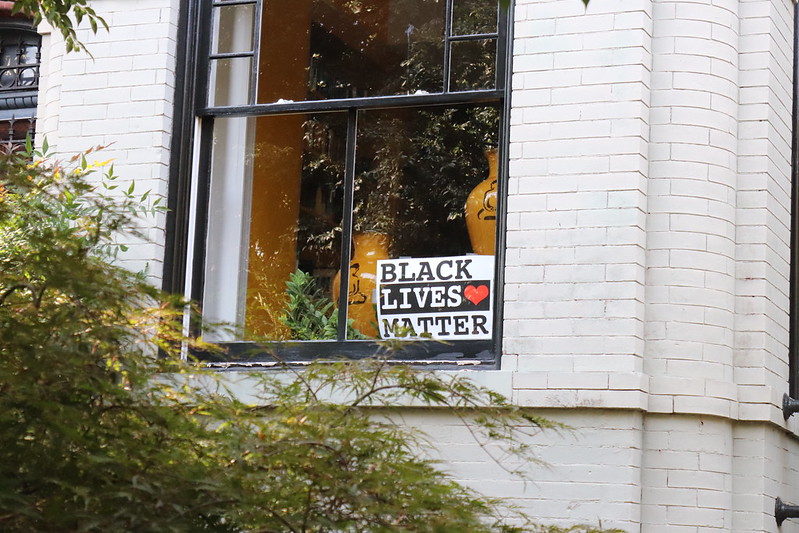
Another student focused specifically on the contradictions between the activism they “saw” demonstrated in their upper-class Boston suburb and the activism they “heard” while walking around their neighborhood. This student noted that residents of their neighborhood strove to create an inclusive atmosphere by putting up “Black Lives Matters” and “Immigrants Welcome” yard signs. However, they also cited Jennifer Lynn Stoever’s work – who we read in class – and noted the presence of what Stoever calls the “sonic color line.” As this students’ own field recordings of their neighborhood illuminated, most residents of this neighborhood valued silence. Harlemites during the 1940s and 1950s, as Stoever writes, certainly appreciated restful nights, but her scholarship also demonstrates how dominant narratives constructed black communities as “noisy,” “chaotic,” and “dangerous,” and white ones as “silent,” “efficient,” and “disciplined.” Although residents in this Boston suburb think of themselves as progressive and demonstrate their liberalism through visual signifiers such as yard signs, this student concluded that they still live in a community that privileges certain (silent) soundscapes. In doing so, such communities continue to perpetuate the sonic color line.
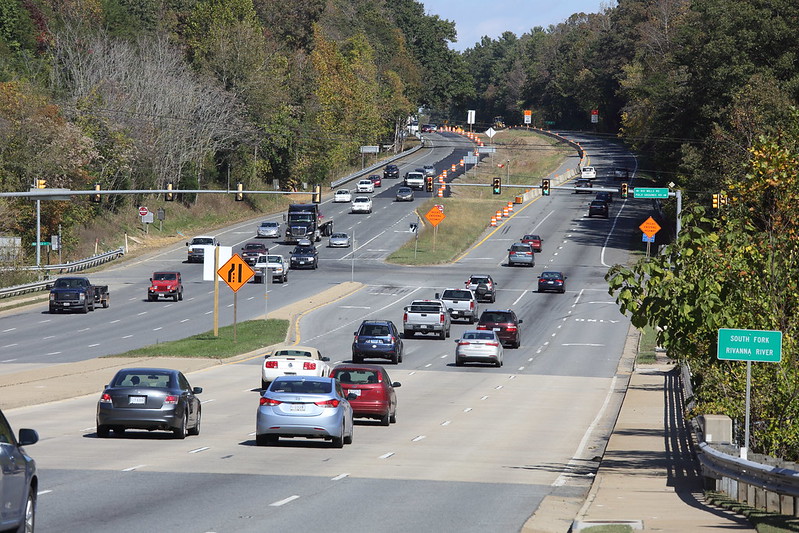
Admittedly, several students living in America’s suburbs struggled to conceive of the sounds they heard as worthy of discussion. For instance, the sounds of cars made frequent appearances in their writing but were often dismissed as inconsequential. Instead, students lamented that they were not experiencing a vibrant public sphere that resembled the setting of Spike Lee’s 1989 film, Do the Right Thing (a film we watched together in class), as if that representation wasn’t a very particular historicized and localized representation. On an individual basis, I tried to get students to think more critically about the sounds of cars in their neighborhood. We read about the role of automobile in the development of G-Funk during the early 1990s as well as the death of Jordan Davis, who was murdered in his car for playing rap too loudly. However, neither article resonated with students’ experience on their soundwalks since they were simply hearing cars passing by their houses or driving down the street. Most of the time, they could not tell what type of music was being listened to at all inside the car nor could they hear it emanate onto the street.
Therefore, teachers, depending on the living conditions of their students, might want to preemptively include discussions of car culture within American society. After all, more than go-go music broadcasted from storefronts, or second line parades, or music playing from boomboxes, or the noise of nature, (my) students typically hear cars in their day-to-day life. As a result, teachers assigning soundwalks may want to talk about the role of highway construction and the automobile industry on suburbanization and white flight. Discussions of automobiles within the context of environmental racism might also be useful for students to consider. Steph Ceraso’s Sounding Composition also discusses the immense time and energy corporations have devoted to car sounds and soundscapes within cars, buffering occupants from car noise as well as that of the neighborhoods outside.
In addition, I found that students need a more robust historical understanding of suburbanization in the United States, particularly alongside an understanding of their own racial and ethnic histories. Some students living African American suburbs could have benefited from some contextualization about when and how they came to be. Talking about suburbanization in general, the development of White suburban liberalism in the 1970s and 1980s would have helped the student living in a Boston suburb make more sense of the politics of their neighborhood. Karen Tongson’s Relocations also provides context for shifts in America’s suburban landscape after sweeping changes in immigration law in 1965, as well as a rethinking of expressions of sexuality in the suburbs. These are just some topics I wish I had focused on more to help prepare my students for their soundwalks.
Future teachers may feel inclined to refer to the conclusions my students came to, as well as the literature I wish I had included in course, as they think about assigning soundwalks in their own classes. Both my students and I appreciated the soundwalk assignment and its invitations to listen differently. Teaching soundwalks in a course focusing on “Black music and marketing strategy” prompted my own necessary meditation as a non-Black scholar working in this field. Guided by Loren Kajikawa’s new research on “Music, Hip Hop and the Challenge of Significant Difference” that examines how the popularity of courses on black music help subsidize a university’s classical music offerings, I want to incorporate future discussions of Black music as sonic diversity marketing in contemporary higher ed, both at the microlevel of scholarship and the macro- institutional level, which remains far from equitable despite ongoing challenges to its status quo. For students, the soundwalks–in their words–allowed them to learn about themselves and think differently about the area in which they live. They also become more attuned to their surroundings–questioning what makes a neighborhood and for whom?–and how different cultures use their voices where they live, necessary skills for our moment that will help us envision a world beyond it.
—
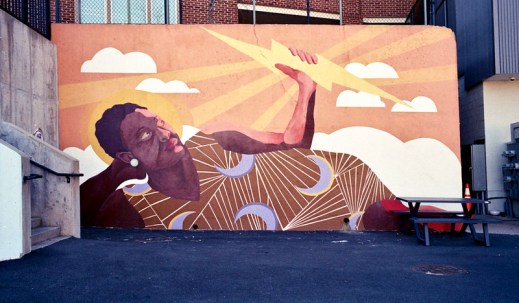
Featured Image: Wall Mural right next to Bowerbird Bakeshop in Charlottesville, VA, image by Tom Mills, (CC BY-SA 2.0)
—
Rami Toubia Stucky is a PhD candidate at the University of Virginia and scholar of the music of the African diaspora, music of the Americas, commercial culture, intercultural exchange, and music and migration. Sometimes he composes/arranges jazz music and plays drums. He is currently writing a dissertation on the arrival of Brazilian bossa nova to the United States during the 1960s. He runs a personal and professional website dedicated mostly to talking about the songs his sister likes.
—

REWIND!…If you liked this post, you may also dig all this good stuff about sound studies pedagogy! Good luck with Fall semester, folks!:
The Sounds of Anti-Anti-Essentialism: Listening to Black Consciousness in the Classroom- Carter Mathes
Making His Story Their Story: Teaching Hamilton at a Minority-serving Institution–Erika Gisela Abad
Deejaying her Listening: Learning through Life Stories of Human Rights Violations– Emmanuelle Sonntag and Bronwen Low
Audio Culture Studies: Scaffolding a Sequence of Assignments– Jentery Sayers
Deep Listening as Philogynoir: Playlists, Black Girl Idiom, and Love–Shakira Holt
“Toward A Civically Engaged Sound Studies, or ReSounding Binghamton”–Jennifer Lynn Stoever
“Heavy Airplay, All Day with No Chorus”: Classroom Sonic Consciousness in the Playlist Project—Todd Craig
SO! Podcast #79: Behind the Podcast: deconstructing scenes from AFRI0550, African American Health Activism – Nic John Ramos and Laura Garbes
Listening to #Occupy in the Classroom–D. Travers Scott
SO! Podcast #71: Everyday Sounds of Resilience and Being: Black Joy at School–Walter Gershon
Sounding Out! Podcast #13: Sounding Shakespeare in S(e)oul– Brooke Carlson
A Listening Mind: Sound Learning in a Literature Classroom–Nicole Brittingham Furlonge
My Voice, or On Not Staying Quiet–Kaitlyn Liu
(Re)Locating Soundscapes of Schooling: Learning to Listen to Children’s Lifeworlds–Cassie J. Brownell
If You Can Hear My Voice: A Beginner’s Guide to Teaching–Caroline Pinkston
Mukbang Cooks, Chews, and Heals – David Lee
SO! Podcast #80: Refugee Realities Miniseries–Steph Ceraso
Share this:

One Scream is All it Takes: Voice Activated Personal Safety, Audio Surveillance, and Gender Violence

Just a few days ago, London Metro Police Officer Wayne Couzens pled guilty to the rape and murder of Sarah Everard by, a 33-year-old woman he abducted while she walked home from a friend’s house. Since the news broke of her disappearance in March 2021, the UK has been going through a moment of national “soul-searching.” The national reckoning has included a range of discussions–about casual and spectacular misogynistic violence, about a victim-blaming criminal justice system that fails to address said violence–and responses, including a vigil in south London that was met with aggressive policing, that has itself entered into and furthered the UK’s soul-searching. There has also been a surge in the installation of personal safety apps on mobile phones; One Scream (OS), “voice activated personal safety,” is one of them.
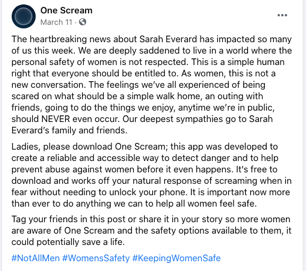
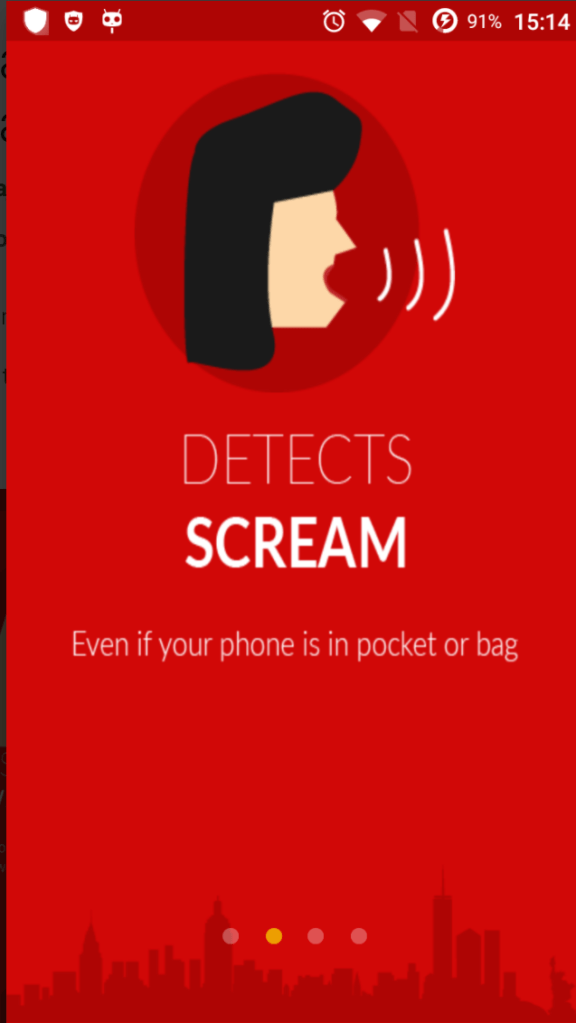
Available for Android and iOS devices, OS claims to detect and be triggered by a woman’s (true) “panic scream,” and, after 20 seconds and unless the alarm is cancelled, it will send both a text message to the user’s chosen contacts and an automated call with the location to a nominated contact. The app is meant to help women in situations where dialing 999, (assumed to be the natural and preferred response to danger), is not viable for the user and, in the ideal embodiment, this nominated contact, “the helper,” is the police. OS did automatically contact police (and required a paid subscription) in 2016, but it did not work out well and by 2018, was declared a work in progress: “What we really want is for the app to dial 999 when it detects a panic scream, but first, we need to prove how accurate it is. That’s where you come in. . .” OS is currently in beta and free (while in beta). It is unclear whether the developers have given up with that utmost expression of OS.
OS is based on the premise that men fight and women scream —“It is an innate response for females in danger to scream for help”—and its correct functioning requires its users to be ready to do so, even if such an innate and instinctive response doesn’t come naturally to them: “If you do not scream, the app will not be able to detect you.” However, there are two discriminations in terms of scream analysis, in how the app discriminates while listening for and to screams, and in failing to detect or respond to them. The first has to do with who can use the app (i.e., whose panicked screams are able to trigger it) in the first place. This is presented in terms of gender and age—for the moment, OS can listen to “girls aged 14+ and women under 60,” where cisgender, as in anything OS, is taken for granted. It is, however, a matter of acoustic parameters set by the developers (notably, of reaching a certain high pitch and loudness threshold). Which is why the app was implemented to include a “screamometer” for potential users to scream, hard, figure out, and see whether they can reach “the intensity that is needed to set it off” (confetti means they do). The second one discriminates true panicked screams from other types of screams (e.g., happiness, untrue panic). As presented by the developers, both discriminations are problematic and misleading, and so is “the science behind screaming” One Scream‘s website boasts of.
The app does not quite distinguish true from fake screams, nor joy from panic for that matter. Instead, One Scream listens for “roughness,” which a team of scream researchers—it truly is a “tiny science lesson” —has identified as scream’s “privileged acoustic niche” for communicating alarm. According to this 2015 study in Current Biology, “roughness” is the distinctive quality of effective, compelling human screams (and of artificial alarms) in terms of their ability to trigger listeners and in terms of perceived urgency. Abrupt increases in loudness and pitch are not unique to screams. The rougher the scream, then, the greater its perceived “alarmess” and its alarming effect. That’s why developers say OS “hears real distress,” essentially “just as your own ear.” However, other studies suggest your own ears might not be so great at distinguishing happiness from fear and scream research, and particularly the specific “bit” OS builds on, by and large assumes, relies on, and furthers the irrelevance of “real” on the scream vocalizer end.
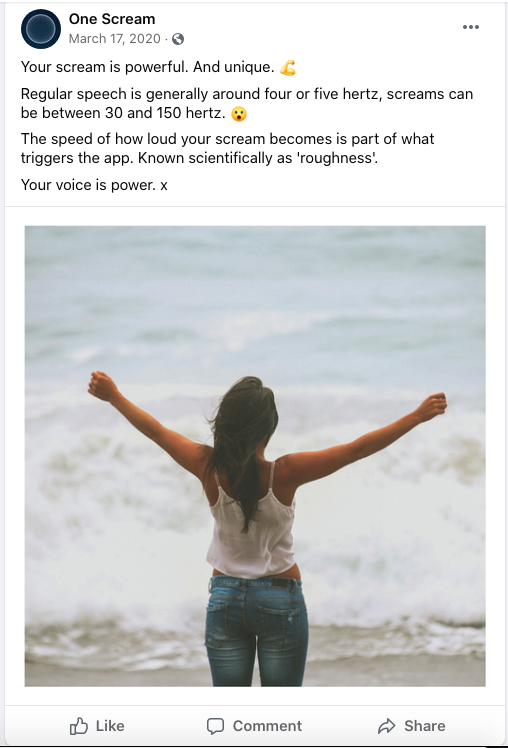
In OS’s pledge to its users, the app’s fine-tuning to its scream niche—i.e., to rough temporal modulations between 30 and 150Hz—is as important, as is the developers (flawed) insistence on the irredeemably uniqueness of true panic’s scream vocalizations, which they posit are instinctive and can’t be plotted or counterfeit: “Experience has shown that it is difficult for women to fake their scream.” Yet, current scream analysis and research primarily and largely relies on screams delivered by human research subjects (often university students, ideally drama students) in response to prompts for the purposes of studying them as well as, especially, on screams extracted from commercial movies and sound effect libraries. The same applies to the other types of vocalizations (e.g., neutral and valenced speech, screamed sentences, laughter, etc.) produced or retrieved for the purposes of figuring out what it is that makes a scream a scream, and how to translate that into a set of quantifiable parameters to capitalize on that knowledge, regardless of the agenda.
Because of their interest for audio surveillance applications, screams are currently a contested object and a hot commodity. Much as is the case with other scream distinction/detection enterprises, the initial training of OS most likely involved that vast and available bank of crafted scream renditions—by professional actors, machines, combinations of those, by and for an industry otherwise partial to female non-speech sounds—conveniently the exact type of “thick with body” female voicings OS is also invested in. For some readers, myself included, this might come across as creepy and, science-wise, flimsy.
Scream research often relies on how human listeners recruited for the cause respond to audio samples. Apparently, whether the scream is “real,” acted, or post-produced is neither something study subjects necessarily distinguish nor a determining factor in how they rate and react. In terms of machines learning to scream-mine audio data, it is what it is: “natural corpora with extreme emotional manifestation and atypical sounds events for surveillance applications” are scarce, unreliable, and largely unavailable because of their private character. That is no longer the case for OS, which has been accruing, and machine-learning from, its beta-user screams as well as how users themselves monitor/rate their screams and the app’s sensibility. OS users’ screams might not be exactly ad lib, as users/vocalizers first practice with the “screamometer” to learn to scream for and as a means to interface with OS, but it’s as natural a corpora as it gets, and it’s free for the users of the screams. OS not only echoes “voice stress analysis” technologies invested in distinguishing true from fake or in ranking urgency, but, as part and parcel of a larger scream surveillance enterprise, also public surveillance technologies such as ShotSpotter, all of which Lawrence Abu Hamdan has brilliantly dissected in his essay on the recording of the police gunshots that killed Michael Brown in Ferguson, Missouri in 2014.
Chilla is a strikingly similar app developed and available in India—although there’s a nuanced difference in the developer’s rationale for Chilla, which in its pursuance of scream-activated personal safety also aims to compensate for the fact that many girls and women don’t call “parents or police” for help when harassed or in danger. As presented, Chilla responds both to assaults and to women’s ambivalence towards their guardians. The latter is, too, a manifestation of the breadth of gender-based violence as a socio-cultural problem, one that Chilla is trained to fail to listen to and one that, because of OS’s particular niche user market, is simply out of the purview of its UK counterpart.
That problem–and that failure–is neither exclusive to India nor to scream-activated personal safety apps. Calling 999 in the UK, 911 in the US, or 091 in Spain, where I am writing, doesn’t come naturally to many targets of sexual and gender-based violence because they don’t conceive police as a help or because, directly, they see it as a risk—to themselves and/or to others. As Angela Ritchie has copiously documented in Invisible No More: Police Violence Against Black Women and Women of Color, women of color and Black women in particular are at extremely high risk for rape and sexual abuse by police officers, as high as 1 in 5 women in New York City alone.
OS, then, is framed as a pragmatic, partial answer to a problem it doesn’t solve: “We should never have to dress in a certain way…but we do.” The specifics of how OS would actually “save” or even has saved its users in particular scenarios go unexplained, because OS is meant to help with feeling safe; getting into the details, and the what ifs, compromises that service. This sense of safety has two components and is based on two promises: one, that OS will listen to your (panic) scream, and, two, as of now via the intermediacy of your contacts, the police will go save you. The second component and its assumed self-evidence speaks to the app’s whiteness and of its target market of white, securitized, cisgender female subjects.

Over and above its acoustic profiling, the app is simply not designed with every woman in mind. OS’s branding is about a certain lifestyle—of going for early runs and dates with cis-men, of taking time for yourself because you’re super busy at your white-collar job and going for night runs, of taking inspiration from “world” women and skipping if running isn’t for you. This lifestyle is also sold: sold as always under the threat of rape–despite its “rightfulness”–sold in a way that animates the feelings of insecurity and disempowerment that One Scream advertizes itself as capable of reversing. Safety, then, is sold as retrievable with OS.
Wearable or otherwise portable technologies to keep women “safe,” specifically from sexual assaults, are not new and are varied. These have been vigorously protested, particularly from feminist standpoints other than the white, securitized, capitalist brand OS professes—because, in (partly) delegating safety on technologies women then become personally responsible for, these technologies further “blame” women. For authorities and the patriarchy, this shift in blame is a relief. In discussing the racialized securitization of US university campuses, Kwame Holmes notes how despite “reactionary attacks” on campus feminism (e.g., so-called “snowflakes” complaining about bad sex) and authorities’ effective reluctance to acknowledge and challenge rape culture, anti-sexual assault technologies tend to be welcomed and accepted. As Holmes also notes, there’s no paradox in that. Those technologies flatten the discussion, deactivate more radical feminist critiques and potential strategies, and protect the status quo—not so much women and not those who, whenever an alarm sounds and especially when security forces respond, readily become insecure.
It is not a stretch to think that OS could potentially amplify the insecurities of Black and brown people subject to white panic (screams) and to its violence, something other audio surveillance technologies are already contributing to, at least it’s not a greater stretch than to entertain situations in which police would show up and save an OS user before it’s too late. Even if it’s never triggered, as developers seem to assume will be the case for the majority of installed units—”Many people have never faced a situation where they have had to panic scream”—it’s trapped in a securitization logic that ultimately relies on masculine authority, one that calls for the expansion of CCTV cameras, wherein women are never quite secure (see Sarah Everard’s vigil).
One Scream’s FAQs cover selected worries that users have or OS anticipates they might have. Among these, there are privacy concerns (i.e., does it listen to your conversations?) and the fear the alarm will activate “when it shouldn’t.” In the Apple Store user reviews, there’s a more popular type of concern: OS not responding to users’ screams. In other words, there’s simultaneously a worry about OS listening and detecting too much and about OS failing to listen “when it matters.” These anxieties around OS’s listening excesses and insufficiencies touch on (audio) surveillance paradoxical workings: does OS encroach on the everyday life of those within users’ cell phones’ earshot while not necessarily delivering on an otherwise modest promise of safety in highly specific scenarios? There’s a unified developer response to these concerns: OS “is trained to detect panic screams only.”
—
Featured Image: By Flicker User Dirk Haun. Image appears to be a woman screaming on a street corner, but is actually an advertisement on the window of a T-Mobile cell phone shop (CC BY 2.0)
—
María Edurne Zuazu works in music, sound, and media studies, and researches the intersections of material culture and sonic practices in relation to questions of cultural memory, social and environmental justice, and the production of knowledge (and of ignorance) in the West during the 20th and 21st centuries. María has presented on topics ranging from sound and multimedia art and obsolete musical instruments, to aircraft sound and popular music, and published articles on telenovela, weaponized uses of sound, music and historical memory, and music videos. She received her PhD in Music from The CUNY Graduate Center, and has been the recipient of Fulbright and Fundación La Caixa fellowships. She is a 2021-2022 Fellow at Cornell’s Society for the Humanities.
—

REWIND! . . .If you liked this post, you may also dig:
Flâneuse>La caminanta–Amanda Gutierrez
Echo and the Chorus of Female Machines—AO Roberts
Vocal Gender and the Gendered Soundscape: At the Intersection of Gender Studies and Sound Studies–Christine Ehrick
Share this:




Current Top Posts





April 2021

January 2020

November 2019

October 2019

August 2019

April 2014

November 2017

March 2015

December 2017

October 2015
 Sounding Out!
Recent Comments