
The Magical Post-Horn: A Trip to the BBC Archive Centre in Perivale

Suddenly we heard a Tereng! tereng! teng! teng! We looked round, and now found the reason why the postilion had not been able to sound his horn: his tunes were frozen up in the horn, and came out now by thawing, plain enough, and much to the credit of the driver. —The Adventures of Baron Munchausen, 1865
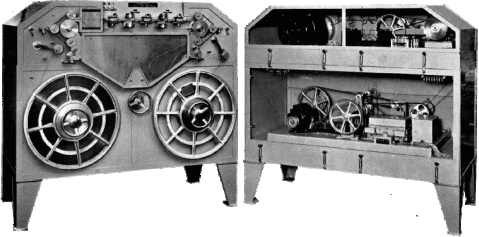
At the BBC Archive Centre in Perivale, London, the proverbial “weight of the past” becomes literal for researchers of sound history. Housed in a massive, unattractive hangar-like building in an industrial park to the northwest of London, the archives suit their environment, one which speaks of practical and solid shapes far more than the lyrical, dainty ivory tower. And by weight, I mean by serious, and sometimes dangerous, poundage: the very first machine created to record off of radio, invented around 1930, was a steel pedestal with bus wheel-sized reels on either side. Audio Coordinator of the BBC Archives, John Dell, explained that not only was this machine laborious to load, but it used magnetic steel tape as its recording surface, which could come free from the reels and lacerate incautious operators as it unspooled and bunched.
The weight of these objects, however, is also metaphoric. The earliest recording in my personal audio drama library, sourced off the invaluable Archive.org, is a 1933 episode of Front Page Drama, a dramatized version of an American Weekly Hearst publication. The past stands monumentally huge if this type of machine, the Marconi-Stille Wire Recorder, was the apparatus that allowed those 15 minutes of 1933 to be captured and, eventually, fed into my 2015 headphones as an MP3.
I listen to much of my audio drama, whether old and crackling like Front Page Drama, or new and podcast-y, while commuting, usually on the London Underground. The episode of Front Page Drama in question I heard during a marathon session when I knew very little could or would interrupt me: on an twelve-hour transatlantic plane ride. I quite like the audio-visual play between listening to audio drama that is new to me versus the familiar but never identical sights of the commute; as Primus Luta remarked in 2012, it’s rare for us to engage our full attention on the aural medium.
While listening to Front Page Drama and episodes of Lum and Abner on that flight, I had to wonder how I was prioritizing my listening time. Who had recorded these episodes from the 1930s? Who had later taken the trouble to digitize them and upload them to Archive.org? Why, for example, were these particular recordings freely available yet I couldn’t find an MP3 anywhere of texts I wanted to share more widely, such as Don Haworth’s On a Summer’s Day in a Garden (1975) or Angela Carter’s Come Unto These Yellow Sands (1978)? Both of these recordings are in the BBC back catalogue; I know, because the BBC supplied them to me—but only the basis of a visit to the archive.
Archive.org is bountiful and accessible, the Perivale archives much more exclusive, but both seem to lack curation. The only hope for accessing things like Haworth or Carter outside the British Library’s Sound and Moving Image Archives is that someday a rogue MP3 or BitTorrent will show up online. The archive does seem, in Neil Verma’s words, then, “transformed before dispersing in space, plucked from the air and mineralized like fossils” (Theater of the Mind, 227); like Primus Luta’s weighty but playful experiment, Schrödinger’s Cassette, which suspended music in concrete to be risked, or remain aurally untouched forever. This seems too often to be the impossible choice.
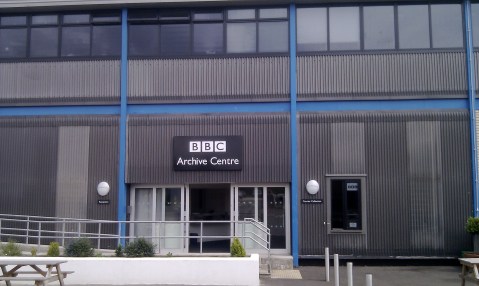
BBC Perivale Field Trip, Image by Flickr User Hatters! (CC BY-NC 2.0)
The BBC archive storage is eclectic and generally arranged for access by BBC staff rather than for researchers. The BBC Written Archives at Caversham are restricted to academics, and likewise, the speed of gaining access to sound files from Perivale is predicated on the amount of time BBC staff have to devote to it—naturally, the BBC’s own departments have priority, such as BBC Radio 4 Extra, the archival digital radio station, whose backlog of requests for digitised material from the Perivale archive apparently covers 20 pages. The sound collections consist of commercial recordings on shellac (90 RPM records) and vinyl (78 RPMs) as well as impressively dinner-plate sized compilation transcriptions which require a special turn-table on which to play and digitize them. The BBC Sheet Music archive is in Perivale, as well, with original handwritten scores filling shelves.
The second half of the British and Irish Sound Archives conference 2015 afforded a privileged glimpse of the archive storage and technical facilities housed on site. Most of my fellow attendees were archivists of one sort or another, asking detailed questions about transcription devices, fidelity, and storage. Having recently completed my PhD from Swansea University in English in radio drama, I had made countless requests to this very facility through the British Library’s Sound and Moving Image request service; now I, at long last, hoped to see where my digitised sound files were coming from. However, we weren’t shown any recordings made on tape cassette or CD but instead Betamax audio-only. Unseen, too, were the data banks holding all the digitised content, but what myself and my fellow archivists had mainly come to see were the tangible objects making this content possible.

78s at BBC Perivale, Image by Flicker User Hatters! CC BY-NC 2.0
In the physical copies of the Radio Times of the 1940s and ‘50s, also housed at the British Library at St Pancras (and now available, like all of the Radio Times up to 2009, on BBC Genome), there can be found a little asterisk in the listings for drama, which signifies that the drama was broadcast from a recording, rather than live. The later recording machines of the ‘30s through ‘50s, upon which these recordings would have been made, did not decrease appreciably in size, though perhaps in weight. “If I were to drop this,” Dell told us as he carefully handled a dark blue celluloid tube, about the size and circumference of a toilet paper roll, “it would bounce. I’m not going to drop it,” he added. Then the magic began: via a custom-made device, we heard a few bars of a music hall song from circa 1900. The recording was surprisingly clear. It was agonizing when Dell turned it off after only a few seconds.
There is something incredibly seductive about old recordings. In “The Recording that Never Wanted to Be Heard and Other Stories of Sonification,” from The Oxford Handbook of Sound Studies, Jonathan Sterne and Mitchell Akiyama question the desire for “sonification” of ever-older recordings, especially when such desires manifest in the creation of a digital sound file in 2008 for “the world’s oldest recording,” a phonoautogram from 1860, which was nevertheless never intended to be played back—the phonoautograph was intended as a device to make the aural visual (555). Radio drama writer Mike Walker really summed up the seduction of old recordings for me in his 2013 BBC Radio 4 ghost story The Edison Cylinders, with a character who is seduced as a scholar and as a participant in a time-traveling mystery by old recordings: a sound engineer in need of money, she agrees to digitize what seem like boring diary entries from a British imperialist, only to be intrigued by his Victorian domain beyond her rather empty modern existence. Unfortunately for her, these particular recordings are reaching beyond the grave to try to kill her.

Edison Cylinder Exposed, by Flickr User fouro boros, CC BY-NC 2.0
Although they do reach out from the grave, most early sound recordings aren’t out to kill you. They do however, present common and vexing issues of authenticity. By this, I mean specifically the provenance of the recording—is the recording of who or what it says it is? On the first day of the conference, Dell regaled us with tales of two cylinder recordings surfacing in the mid-twentieth century, of William Gladstone giving a speech. The words of the speech were identical, but the voices were completely different. Who was the real Gladstone? How could you authenticate the voice of a dead person? Dell further deepened the mystery by telling us the tale of two boxes of wax cylinder recordings in the Perivale archive, whose provenance is torturously (and tantalizingly) unclear. We glimpsed these mysterious, yellow-cream-colored cylinders, somewhat wider and fatter than the celluloid tubes, in situ, but were they original Edison cylinders from the 1880s? The piercing desire to believe these cylinders might contain the voices of Gladstone, the future Edward VIII, or even Henry Irving, are potentially “perils of over-optimism,” as Dell puts it.
All the archivists at this event referred to the serendipity of discovering surprises on recordings. Simon Elmes, whose official title reads “Radio Documentarist, Creative Consultant, and Former Creative Director, BBC Radio Documentaries,” made this manifest as he discussed a subject treated in his documentary from 2005, Ambridge in the Decade of Love. The Archers—an exceptionally long-running BBC radio soap which conjures up visions of rural Englishness and persists among a very dedicated, though mostly older, fan base—like much radio drama and emblematic of gendered attitude toward radio soaps, was not recorded in its first few decades.

Empty Shelves at BBC Perivale, Image by Flickr User Bill Thompson, Image cropped by SO!, (CC BY-NC-ND 2.0)
Likewise, anyone researching radio drama before the 1930s is playing a game of roulette; whether any scripts survive will depend entirely on the literary reputation of the author who may have had enough clout to publish them in book form. Even in the case of Lance Sieveking, the acknowledged creative aesthete behind early BBC radio drama, we lack concrete evidence of his most important work, The End of Savoy Hill (1932). And The Truth About Father Christmas (1923), the first original drama written specifically for British radio? Forget about it—it was made for children’s radio.
To return to The Archers, though daily 15-minute scripts were being churned out by Ted Kavanagh from the first years of the 1950s, the broadcasts themselves went missing into the ether (after all, no one suspected the show would still be going after sixty years). Transcription discs, meant for an overseas market, were found in a box in the BBC Archives, giving a reasonably complete overview of The Archers during the 1950s and ‘60s. Elmes was ebullient about this discovery.
While I got the general sense that the other archivists at the conference were amused but indifferent toward this particular trove, to me it was inspiring. I believe the future of audio drama will rely more and more on serials, so the rediscovery of these Archers episodes epitomizes to me the past, present, and future of audio drama in that it speaks of audience involvement and even audience interaction or co-production, which seems key for audio drama going forward, and the aspect of serialization which has vastly overtaken the single drama on television if not on radio.

Harry Oakes as Dan Archer and Gwen Berryman as Doris Archer, 1955.
Nevertheless, even if pursuit of these aural rainbows is a foolish one, such desire also enables scholarship. The hope of finding “originals” inspired me personally to discover the birth of what can conceivably called audio drama. Having researched audio drama from the first known broadcast dramas in English (the adaptations: 2LO London’s Five Birds in a Cage in 1922, WGY Schenectady’s The Wolf in 1922, British Broadcasting Company’s Twelfth Night in 1923; original drama: WLW Cincinnati’s When Love Awakens in 1923, British Broadcasting Company’s Danger in 1924), I was astounded to learn that listeners from World War I might have enjoyed short, dramatized stories on the celluloid tubes (according to Tim Crook, the first audio drama of this nature is a war drama from 1917). While archives such as the Cylinder Preservation and Digitization Project of the University of California at Santa Barbara care for these recordings in the same way they do for musical and speech recordings, there is a significant lack of scholarship on them.
If commentary on specific pre-radio audio drama is scarce, it is heartening to read dissections of the performative aspects of “actuality,” such as Brian Hanrahan’s anatomy of Gas Shell Bombardment, 1918. Wonderfully, in discussing the “staging” of this war-time recording, Hanrahan brings in traditions from theatre and silent film in addition to the phonograph. Professor David Hendy has persuasively argued that some of the organizing tenets behind the British Broadcasting Corporation, whose management was by and large made up of ex-soldiers, was predicated on a desire for silence and calm, ordered, managed sound after the cacophony of war. Perhaps “cylinder” drama, then, is not really of its time and properly belongs to earlier, or later, cultural milieux.

Wax cylinder playback at BBC Perivale, Image by Flickr User Hatter! CC BY-NC 2.0
The ephemera of the medium presents a recurring problem in radio drama studies, a weighty feeling of doom. With the future of the BBC’s existence currently perilous, one wonders what the consequences will be for archives like those housed at Perivale. If the internal function of the archives (for the BBC to make use during Radio 4 Extra broadcasts, for example) disappears, will the archives be opened to wider use? Or will material without commercial potential simply be discarded? Who would make the decision as to what was commercially viable and how would they make such decisions?
And the problem with the medium seemingly begins with wax cylinders. A beautiful, lyrical story from Baron Munchausen—alias Rudolph Erich Raspe, a German author who created a fictional travel writer and chronic teller of tall tales based on a real nobleman infamous for his boasting—cited by many of those fascinated with sound recordings is worth repeating here: the Baron is traveling in Russia in a snowy landscape and desires the postilion to blow his horn to alert other travellers that their sleigh will be coming around the bend. Unfortunately, the cold makes the horn incapable of any audible sound. Disappointed, they make their way to an inn. Diedre Loughridge and Thomas Patteson cite the “Frozen Horn” from their online Museum of Imaginary Instruments: “After we arrived at the end inn, my postilion and I refreshed ourselves: he hung his horn on a peg near the kitchen fire; I sat on the other side.” Warmed by the fire, the horn now begins to play its reserved tunes.
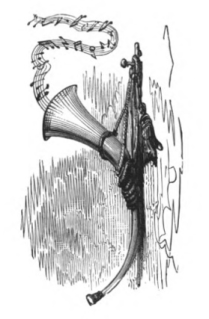
Illustration by Gustave Doré, 1865. Listen to ABC radio feature on the “Frozen Post Horn” and the Museum of Imaginary Instruments here
With a little leap of the imagination, it’s not difficult to see the parallels with the reality of sound recording limitation. The wax cylinders could only be played a few times before the sound degrades completely. Tin cylinders are not much better. This is the reason why the two Gladstone voices could be both “real” and “fake.” Celluloid is more durable, yet witness the reluctance of Dell to play one for longer than a few seconds, for preservation reasons.
Sound recordings are only as good as the medium on which they are recorded, a fact that surprisingly holds true even today. We were told by our BBC hosts that discs of shellac, vinyl, and acetate whose contents have already been digitised will not be discarded—digital recordings are ultimately taken from these physical originals.
In the future, we might invent means of reproduction and playback which could provide more fidelity to the original event lifted from the physical recording, in which case it will be the MP3s that will be redundant. There’s something both very modern and very old-fashioned about this. Once at a dinner party, I launched full-force into my postdoctoral rant about the eventual possible degradation of the MP3 as a recording format, that it was not infallible as we had been led to believe. I was surprised that I was wholly believed; furthermore, the older people participating in the conversation rued the disappearance of their CDs, tape cassettes and, vitally, their LPs, for the oft-cited reasons (which Primus Luta distills as the pricelessness of old recordings to one’s personal history, and the “fuller” sound ans weighty materiality, one resonating with one’s emotional past).

Vinyl at BBC Perivale, including a lot of John Peel’s old records. Image by Flickr User Hatter! (CC BY-NC 2.0)
I admit, before I came to the UK and experienced the never-perfect but always interesting presence of BBC Radio, I treated radio as a background medium. I suppose recorded sound had always interested me, and I had had a strong relationship with local, classical music radio (Classical KHFM Albuquerque). However, I could not have predicted ten years ago that I would become a passionate proponent of audio drama and sound studies more generally. I’m almost embarrassed now at my excessive love of audio drama; I make almost no distinctions between “high” art like Samuel Beckett and Tom Stoppard and fan fiction radio serials like Snape’s Diaries as produced by Misfits Audio: I listen to almost anything.
And, truly, the future of audio drama is only assured if people keep listening. The digitisation and availability of cylinder recordings makes study of them more accessible, so the way is paved for further studies of the earliest audio drama. It is imperative that researchers continue to request sound recordings from the BBC, even if they have to use the relatively inconvenient system currently available.
There are signs that things are improving and that more people than ever before want to access such materials. As Josh Shepperd puts it brilliantly, “Sound trails continue where paper trails end.” As Director of the Radio Preservation Task Force at the Library of Congress, his efforts have underlined the fact that often it is the local and the rural whose radio or audio history vanishes more quickly than the national or the metropolitan. This would historically be the case with the BBC as well, which for a long time privileged London sound above regionalism (and, some would argue, still does). Since 2015, the British Library (and the Heritage Lottery Fund) have invested significantly in the Save Our Sounds campaign, positing that within 15 years, worldwide sound recordings must be digitized before recordings degrade or we no longer have the means to play the material.
Out of curiosity, I downloaded the more than 600-page listing, the Directory of UK Sound Collections, assembled rather hastily through the Save Our Sounds project in 20 weeks, and comprising more than 3,000 collections and more than 1.9 million objects. This document makes for fascinating and eclectic reading, ranging as it does between a Sound Map of the English town of Harrogate to the archives of the Dog Rose Trust, which mainly provides recorded tours of English cathedrals for those who are blind. Undoubtedly, there are wodges of local or forgotten drama in these archives, too. The linking up of these archives and making them more widely accessible suggests how important sustained, collective effort is to unfreezing radio’s archival post-horn, delivering more of its unique tunes.
—
Featured Image: “The Route to Open Data” at BBC Perivale, Image by Flickr User Hatter! (CC BY-NC 2.0)
—
Leslie McMurtry has a PhD in English (radio drama) and an MA in Creative and Media Writing from Swansea University. Her work on audio drama has been published in The Journal of Popular Culture, The Journal of American Studies in Turkey, and Rádio-Leituras. Her radio drama The Mesmerist was produced by Camino Real Productions in 2010, and she writes about audio drama at It’s Great to Be a Radio Maniac.
—
 REWIND!…If you liked this post, you may also dig:
Only the Sound Itself?: Early Radio, Education, and Archives of “No-Sound”–Amanda Keeler
“Share your story” – but who will listen?–Fabiola Hanna
SO! Amplifies: Indie Preserves
The Sound of Radiolab: Exploring the “Corwinesque” in 21st Century–Alexander Russo
Share this:

A Manifesto, or Sounding Out!’s 51st Podcast!!!

This week, Sounding Out! dropped its 51st podcast episode. As the curator and producer, I thought it necessary to commemorate the occasion with some fanfare. I want to shout from the hilltops about how proud I am that our little podcast has turned 51!
Erm…at least I’m posting about it.
Also, I want to clear the air a little about what it is that we do. I’ve received feedback here and there over the years about the sound of our podcasts, that we sound “different” and/or “inconsistent,” that we need to normalize the sound a bit: hello out there, audiophiles! Today, I want to say, once and for all, that our sound is intentional and that we are proud of it, hiss, distortion, and all! We think what some hear as “imperfections” are all part of what sets us apart from the ever-growing pack of podcasters. SO!’s podcast has sounded different since we MacGyvered our first episode from an epic talk, a few great ideas, and a rogue tape recorder at River Read Books in Binghamton, NY in April, 2011.
The Sounding Out! Podcast began as a series of conversations within the editorial team back in 2011. We knew that the blog was “talking the talk” in new, excellent, and often provocative ways, but that something was missing to keep pushing the form into the red, not just the content. We knew we needed something more—a little snap, crackle, and pop, if you will—a way to show how Sounding Out! was always listening, and a way for thinkers, artists, provocateurs, and more to engage with sound more directly. In 2011, podcasts were accumulating in the shadows waiting to lunge forth to center stage. They seemed really cool, but there were relatively few, and fewer still (if any at all) on the topic of sound studies. Even though we knew that podcasts were going to be a big thing eventually, we had no idea that they would blow up so quickly.
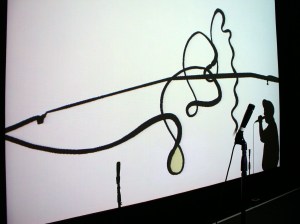
Image by Sandor Weisz @Flickr CC BY-NC.
While we flipped around many ideas, we decided to put our energies behind what was then an occasional series of podcasts that allowed us to capture important yet fleeting moments—too quick and dirty to really transcribe. While our our initial vision for the podcast was to capture these rare and powerful moments, over the past 5 years we have kept this mission consistent while evolving to better accommodate artists and theorists alike. During that time we have hosted mystics and librarians, shared fieldwork from São Paolo, Brazil to Lodi, Ohio, interviewed theremin players and visionaries. See the full list of episodes here. Even though our content has been wide ranging and eclectic, we’ve made it a point to privilege access and immediacy in all of our episodes.
As I listen back to the past five years, I realize that our contribution to the fields of sound studies and podcasting has not just been in terms of who we broadcast and what we amplify, but through the sound of our podcasts themselves. Our podcasts don’t sound perfect. They’re spiritually aligned by the raw production ethic of bands like The Minutemen, who always privileged the emotive qualities of immediacy, access, and intimacy over the brooding qualities of studio production. Particularly because we founded the podcast upon these same principles, I have strived to prioritize radical visions and ideas and to amplify new voices above all else. I want each podcast to arrive in your queue like a wrapped gift—topic, content, production, and sound all equally mysterious. Some of our podcasts were recorded on cellphones and others were recorded in high-end studios and recording booths. Our 51st anniversary isn’t the perfect occasion, either. But, hey, we’re proud of these audible distortions.
“The Minutemen: #1 Hit Song”
So what do I mean that our podcast sounds different? Well, I mean two things: First, we sound different than what episodic radio sounds like. Our DIY—or, more accurately, we will help you “Do It Yourself”—ethics deliberately dial back radio’s genre conventions: smooth identifiable hosts, heavy compression, sound-proof rooms with the latest in equipment. We encourage and construct our podcast with a deliberate sonic diversity, providing little sonic consistency from episode to episode in order to challenge regimes of production that threaten to make all recordings sound the same. We have many many different announcers and hosts; for this podcast to be the space of radical discourse that we intend, it’s important to cast our net wide. This isn’t to say that we don’t care about “quality,” but rather that we define quality differently. Rather than an audiophilic emphasis on the sorts of tone found most frequently in microphone technique, sound booths, and—when all else fails—postproduction, we believe that a “quality” podcast—particularly one about sound—should explore sounds that we rarely hear and allow its artists freedom over how they present their work.
I curate our podcast as a sonic refuge from the invisible regime of auditory production that has slowly constricted and strangled radio this past century. And I’m proud to share podcasts that have been recorded on in impromptu circumstances, Episode XXXIX: Soundwalking Davis, CA and New Brunswick, NJ, for example. We want artists to show more than they tell; Episode XII: Animal Transcriptions, Listening to the Lab of Ornathology is a perfect example of this. Here Jonathan Skinner’s brilliant exploration of animal sounds perfectly balances sound and interview and invites listeners to compare sounds to speech, and vice versa. Another example of this ethic is film professor Monteith Mccollum’s remix of the original War of the Worlds broadcast. Although Mccollum offers some commentary at the start of the recording, what follows is a unique and dazzling sonic experience. Giving radical ideas both the space and platform to be heard is this podcast’s mission. So far, so good!
The second way our podcast sounds different has to do with our deliberate curatorial resistance to consistency between our episodes. When programs bend to the whims of genre conventions, creativity is all but snuffed out. For our podcast to excel as a form for sharing visions, ideas, and experiments, we must allow our composers, authors, and auditors the freedom to explore sonic space. We celebrate Sounding Out!’s anniversary annually with a series of mixes hand-picked by our stable of authors (Listen to years 1, 2, 3, 4, 5, and 6 here!), we’ve entertained interviews, panels, and sound art alike. You may have missed it, but we even have an episode diving into the work of ambient sound in a Dungeons and Dragons game.
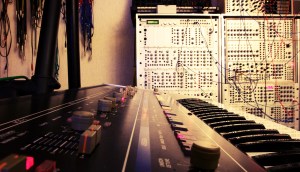
Behind the scenes, we look NOTHING like this. Image borrowed from fr4dd @Flickr CC BY.
While I do think about the sound of our podcast aesthetically—I used to run a music production studio out from the trunk of my car—we do not cultivate a DIY anything-goes ethic strictly for a “cool factor” or just for its own sake. Rather, we have calibrated our different sonic approach in deliberate defiance of styles of production which are all too frequently celebrated within the cultures of straight white men. (Check out SO! Editor-in-Chief Jennifer Lynn Stoever’s epic three-part treatise on the tape recorder in popular film to glean some sense of the tape-recorder’s role as an instrument of masculine control. Part 1, Part 2, Part 3). The standards of taste which have long governed the domain of radio production (and audio production, as a whole) are historically connected to the communities of practice which have occupied invisible yet powerful roles as audio producers, engineers, critics, and marketers.
As Jonathan Sterne explains in MP3, the science of audio fidelity has historical roots within a corporate logic that privileges sounds that are easily shared through telephone cables. “AT&T encountered hearing as an economic problem once its options for extracting additional profit through price were limited,” Sterne says, “Among other strategies, it sought to learn which frequencies could be excluded from the market for telephone signals” (14). In other words, the entire craft of audio engineering has historical roots in privileging sounds that make money above all else. Not only this, but the standards of fidelity cultivated by engineers allow them to gatekeep and demand money at the outset, blocking access to the means of production. These standards are more often than not embedded within the cultures of listening and sales fostered by the radio industry. Fortunately, podcasts have been able to challenge many of these genre tropes, We’re proud to contribute to this momentum and to propel it forward as we continue our series. And we’re not stopping! Up on deck in 2016 we have some amazing compositional sound art, more from Marcella Ernest’s trek to uncover lost sounds, and some notes on a forthcoming project in archiving one city’s local music scene.
BOOM!!!!! Image by Jamie McCaffrey CC @Flickr BY-NC.
So, in the spirit of Sounding Out!’s annual blog-o-versary we’re popping the cork for our podcast’s 50th episode with a few of the milestones we hit this past five years.
We found a theme song. This was a small but important step in our development. What would a podcast about sound be without some kind of awesome anthem representing it? (Nothing, that’s what!) We need to officially thank the members of Hunchback (Miranda, Mike, Jay, and Craig) for donating their song “Feeling Blind” to our podcast. Hunchback was a legendary horror-surf band from the NJ basement scene who endeavored to produce highly visceral sonic experiences of the highest caliber in their songwriting. You can still find a ton of their recordings on the internet. Thanks, crew!
 We got listed on iTunes and Stitcher. It bears mentioning that quite a bit of technical muscle is involved in establishing a podcast. We would have gotten nowhere without Andreas Duus Pape’s help and guidance during our earliest moments. Andreas was instrumental in opening up the hood of the podcast and making it purr. Not only did he donate his time to plug us into iTunes’ network of podcasts, but he also shared some excellent philosophical thoughts on the topic. You can listen here and read them here.
We went monthly. Originally we had conceived the podcast as more a haphazard, occasional treat for our readers. Slowly but surely as demand and interest grew, we began to carve out a more regular calendar space for our podcast. First we switched to a bi-monthly format, and then we started with monthly broadcasts. Can’t slow this beat down.
We are the sonic archive of a sound art conference. That’s right, we featured sonic mixdowns of the entire Tuned City of Brussels sound art festival. Over the course of the festivals three days, we featured daily mixdowns of the prior day’s key sounds and moments. Each mixdown is brilliant and a testiment to the raw passion of our podcast contributors. They worked round the clock to produce such an amazing series. Check out the night before, and days 1, 2, and 3.
 We produced a LOT of soundwalks. If you’re a listener you know that we love our soundwalks. We’re proud to be host to play host to a variety of soundwalks from cities around the world. Last month’s Yoshiwara soundwalk by Gretchen Ju challenged listeners to critically engage with the city’s fraught history of sex work. Other contributors in our soundwalk series like James Hodges have considered how the ambient music of big box stores and shopping malls are part of the architecture of commerce. Finally others like Frank Bridges have taken us to the edge of history and soundwalked the grounds of Thomas Edison’s workshop in Edison, NJ. No matter what the locale, our soundwalks are part of our podcast’s signature.
We found a regular contributor. Regular contributors are the heart and soul of Sounding Out! They lead the conversation on sound and work to bring you the best, most interesting content. For these reasons we’re proud to announce that Marcella Ernest will be joining our podcast as a regular contributor with her series “Searching for Lost Sounds.” Marcella will be interviewing a variety of sonic practitioners in an effort to give voice to the voiceless. Her most recent entry in the series was posted last Thursday. You can listen here.
We’re going to keep it coming. That’s our promise to you! We’ll be producing great content as long as you’re listening. Take a moment to subscribe to our iTunes or Stitcher accounts and also explore our Episode Guide to see if you missed anything this past 5 years. It’s been a rewarding adventure so far and we guarantee that we’ve already got some great content lined up in the coming months.
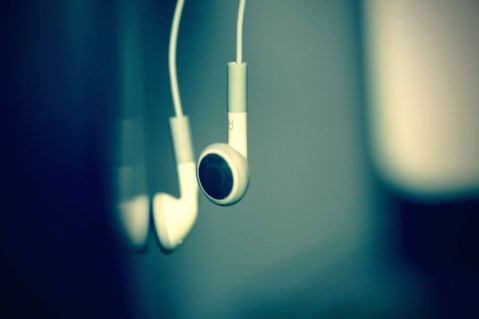
Image by Sandor Weisz @Flickr CC BY-NC.
–
Aaron Trammell is a Provost’s Postdoctoral Scholar for Faculty Diversity in Informatics and Digital Knowledge at the Annenberg School for Communication and Journalism at the University of Southern California. He earned his doctorate from the Rutgers University School of Communication and Information in 2015. Aaron’s research is focused on revealing historical connections between games, play, and the United States military-industrial complex. He is interested in how military ideologies become integrated into game design and how these perspectives are negotiated within the imaginations of players. He is the Co-Editor-in-Chief of the journal Analog Game Studies and the Multimedia Editor of Sounding Out!
–
Featured image is “Roscoe Considers Recording a Podcast” by zoomar @Flickr CC BY-NC.
—
 REWIND! . . .If you liked this post, you may also dig:
Sounding Out! Podcast #1: Peter DiCola at River Read Books – Peter DiCola
It’s Our Blog-O-Versary — Jennifer Lynn Stoever
Sounding Out! Podcast #51: Creating New Words from Old Sounds – Marcella Ernest
Share this:


Current Top Posts





April 2021

January 2020

November 2019

October 2019

August 2019

April 2014

November 2017

March 2015

December 2017

October 2015
 Sounding Out!
Recent Comments