
Listening to Whisperers: Performance, ASMR Community and Fetish on YouTube
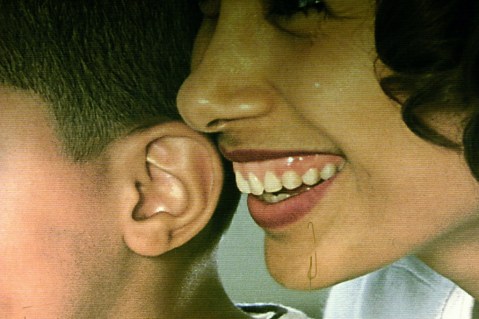
Imagine this, only virtual. Image borrowed from Genista @Flickr.
PercussiveThoughts is giving me a facial. The voice tells me about the “little scrubbies” in the exfoliant, and I begin to hear their delicate sibilance on my temples. If I’m lucky, a pleasurable, tingling sensation might begin somewhere on the back of my head and travel down my spine, turning my facial into something closer to a massage. The sole caveat is that I’m not really being touched at all.
This is ASMR, “Autonomous Sensory Meridian Response,” a pseudo-medical designation whose native soil is YouTube. The term pulls together a range of physiological and affective states: goosebumps, chills, relaxation, melting, tingles, and so forth. PercussiveThoughts and her fellow vloggers (I call them “Whisperers” here and explain why below) aim to trigger these frissons through a cornucopia of techniques. Sound is paramount; Whisperers scratch rough surfaces with their fingernails and percuss everyday objects with fingertip drum-rolls. And, of course, they whisper, sometimes using lozenges or gum to increase the opportunities for swallowing and lip-smacking.
What’s interesting about these videos is how they manage to traverse the gap between the sonic and the haptic. There is, of course, something familiar about this leap. Like the magician’s hat that produces rabbits and endless handkerchiefs, an audio speaker produces a volume and variety of sound out of proportion with its small, blank visage. In the case of Whispering, however, sound is transduced into touch, and the taut membranes of the listener’s headphones become coterminous with his own skin.
Apart from Steven Novella’s suggestion that ASMR might be a mild form of seizure, it does not yet appear to be a subject of scientific research. So Whisperers have taken on the role of amateur scientists themselves, with YouTube serving as a public petri dish. For this very reason, Novella has also cautioned against the assumption that ASMR is a real physiological phenomenon at all, since feedback loops of suggestion on the Internet might create “the cultural equivalent of pareidolia.”
Whisperers, however, have no doubts. And while the ASMR acronym is a recent development, many Whisperers say their first encounters with the phenomenon occurred sometime before their first exposure to the Internet and often before adulthood: during make-believe tea parties, while watching their classmates draw or braid each other’s hair, and, perhaps most commonly, while watching The Joy of Painting with Bob Ross.
The audience for Whispering is anyone who can have this experience, which apparently isn’t everyone. Contrary to the soporific themes of their videos, Whisperers and their fans identify themselves as having awakened to a special form of pleasure. Some have even made videos recounting their first experiences. The downside of this ability is the anxiety about its social acceptance. Whisperers sometimes opt for anonymity in their videos, revealing their faces only after much encouragement from fans. Rarely do they they let their family and friends in on the secret.
That this familiar, tingly feeling has assumed a pseudo-medical acronym is hardly coincidental. ASMR isn’t just pleasurable, it’s therapeutic. Hundreds of YouTube comments attest to the power of ASMR to help relieve them of insomnia, anxiety, and panic attacks. Nor has this dimension been overlooked by Whisperers themselves, who regularly perform as doctors or therapists in their roleplay videos. This is particularly interesting in light of recent scholarship on human/machine interactions. In Addiction By Design, Natasha Schüll shows how therapy for video-poker addiction can take the same format as the gambling itself, namely, “ongoing technological self-modulation to maintain equilibrium” (250).
Homemade Whisper videos, while habit-forming, are clearly not the sort of intricately-engineered machines that Schüll writes about. Nor do they wreack the same sort of havoc (depletion of one’s life-savings, deterioration of one’s physical health, etc.). And yet, both are arranged in problematic feedback loops of self-medication. The slow-paced, low-volume respite that Whisper videos offer is made all the more necessary by the fact that viewers must go online to watch them. This paradox is amplified by YouTube’s advertisements, which will sound especially abrasive because viewers tend to turn the volume up while listening to Whisper videos. That some of the more popular Whisperers earn money from their videos only complicates things further.
*
“No, we don’t get as many men here as women,” PercussiveThoughts says, as though responding to a question from me. Of course, I wouldn’t be so rude as to contradict her – I know better. To judge from the comments below, she gets plenty of male visitors. And her colleague ASMR Velous confided during an interview that around 70 percent of her viewers are men. For this reason, some Whisperers have made gender–neutral or male-oriented videos.

A man getting a facial. Borrowed from FoundryParkInn @Flickr.
Gender is a major, and sometimes contentious, topic of discussion in the Whisper Community. In the YouWhisper web forum, the discussion topic “Gender Preference?,” has the greatest number of views (more than 170,000). In general, female Whisperers are more popular than their male counterparts. The three most popular male Whisperers that I could find–WhisperMister1, MaleSoothe, and TheLyricalWhispers–each have fewer than 5,000 subscribers and their per-video view-counts tend to peak around ten or twenty thousand.
Not long ago, GentleWhispering, one of the better-known names in the Whisper community, set off a series of heated back-and-forths with her ~FeminineGrace & Charmforsleep~ video. In it, she discusses universal traits of femininity while brushing her hair absent-mindedly. Whatever one might think of her opinions, the fact that GentleWhispering’s viewership dwarfs all other Whisperers to date suggests that something in her technique is working. My guess is that it has a great deal to do with her hands.
While giving Russian language lessons on a chalkboard, she points to a word with her middle, ring, and pinkie fingers while keeping the chalk poised delicately between her thumb and index finger. When she is about to touch the fabric of an armchair, her fingers arch back–rather than claw forward–as though to ensure that the contact is as light as possible. And, like so many other Whisperers, she takes any opportunity to tap hard objects with her well-kept fingernails.
The “femininity” of GentleWhispering’s hands is the performance of a soothing, caring touch, and her whispering voice is the transubstantiation of this touch through sound. Sometimes, she even short-circuits the analogy by massaging the microphone directly.
*
But even the performance of gendered touching does not quite explain how these sounds and images manage to reach through the speaker and screen. After a second glance at these videos, we might wonder if the preponderance of partial objects has something to do with it.
I’m talking about all of those disembodied hands stroking opposite hands or displaying objects detached from their collections. Often, for the sake of anonymity, the Whisperer’s eyes are kept out of frame, leaving only an expressive mouth, like CalmingEscape’s, with its signature tics and swallows. If even the mouth is too revealing, the camera gazes down at covered breasts, ”objects,” in a Freudian panoply of sexual cathexis (is it a coincidence that some Whisperers even roleplay as the viewer’s doting mother?). One has to wonder what effect is achieved by this strange summation of partials.
In spite of widespread insistence that these videos are not sexual, the comparison with sexual fetish is too obvious not to make. Sticking with Freud for a moment, the hyper-presence of the Whisperer would seem to disavow the separation implicit in internet communication. Her mouth speaks individually into each of the listener’s ears while also hovering on screen. Her hands animate dead objects through rappings and close-ups. In her omnipotence, she can even tell us what to do.
Fetish or not, the word “whisper” is a perfect synecdoche for this fragmentary whole, and that’s why I’ve used it instead of ASMR. A whisper is, by definition, “unvoiced.” The cheeks, mouth, teeth, and tongue accomplish the acoustic filtering that gives words their shapes, but the larynx produces noise rather than tones. Lacking pitch, a whisper might be called only a “part of speech.” And yet it speaks volumes by shifting the register of communication. Whatever is said in a whisper gains the aura of genuineness, honesty, and intimacy.
Of course, in a YouTube video, these qualities are suspect from the moment one clicks the play button. But perhaps this is what makes Whispering work. One hears in these videos, above all, the effort of performance. It is the performance of gender, as discussed above, but more generally the performance of interaction, intimacy, and proximity. What every Whisper video whispers is “Let’s pretend!” And nothing proves this better than the fact
that some popular Whisper videos contain rather unpleasant sounds. Consider TheWhiteRabbitASMR’s dentist appointment video. If one is willing to grit one’s teeth through the long sections of abrasive drilling, it’s because she so adeptly crafts the intimate space of fantasy in which it takes places.
The pleasure of pretending was made clear to me when ASMR Velous recounted her childhood tactic for inducing ASMR. “I would constantly trick people into pretending to do things. I had this little play kitchen set, and I would cook up imaginary food for people and make them pretend-eat it really slowly and make those eating sounds like [chewing sounds], and I would just sit there and be all tingly. And I just loved it….I made up this game with my friends, where we would basically mime a profession and the other person would have to guess the profession you were miming. That was another way for me to trick my friends into pretending to do stuff.”
*
PercussiveThoughts is wrapping things up. “That completes your facial… So you can sit up. Well, thank you. Thank you so much. I’m really glad you enjoyed it.”
I did enjoy it! But thank goodness it’s not really over; I can just hit the reload button. No matter how many times I do, I know that my pores won’t be any cleaner when I look in the mirror. But that’s not the point. Rather, Whisper fans take pleasure in the intimacy and complicity of pretending. That complicity applies even to the skin of the listener, a surface as vibrant as the skin of the speaker.
—
Share this:

Yellow Rain and The Sound of the Matter: Kalia Yang’s Sonorous Objection to Radiolab

The critically acclaimed WNYC program Radiolab found itself embroiled in a controversy for its recent broadcast segment “Yellow Rain.” Released on September 24, 2012 as part of the episode entitled “The Fact of the Matter,” the 20 minute segment “Yellow Rain” recounted the slaughter of hundreds of thousands of the Hmong by the Viet Cong and the Pathet Lao after the United States left Vietnam and the subsequent debates surrounding the chemical weapon called “yellow rain. The episode pitted the witnessing of Eng Yang, a survivor and documenter of the genocide—whom producer Pat Walters describes as the “Hmong guy” at one point—and his niece, award-winning writer Kao Kalia Yang—referred to only as “Kalia” by hosts Robert Krulwich and Jad Abumrad—against the research of university scientists and the relentless questioning of Krulwich.
Following the episode’s broadcast, many listeners and critics argued that Radiolab’s treatment of their the Yangs was Orientalist and unethical. Jea, writing on Radiolab’s “Yellow Rain” comment page suggested “Ms. Yang and her uncle were dismissed and even reduced to pawns in the larger scheme of RadioLab’s agenda.” Others, such as Bob Collins, writing for Minnesota Public Radio worried that “the story appeared […]to invalidate the Hmong loss and suffering in Laos.” Aaron, a commentor on Current Magazine’s coverage of the controversy called Radiolab’s coverage “inexcusable science, nothing close to journalism, and if only ‘a story,’ one that cements erroneous ideas in the minds of its listeners.” Kirti Kamboj, writing for Hyphen, a magazine dedicated to Asian American arts, culture, and politics, described the episode as “heartbreaking,” “utterly infuriating,” and an exemplar of “Orientalist, ethnocentric framing” designed to privilege Western knowledge.
From my perspective as a scholar of rhetoric, communication, and debate, to call Radiolab’s game rigged would be an understatement. The interview was not conducted on an even playing field and it smacks of a white Western privilege that the writers and producers failed to fully acknowledge even in their on-air discussion following the interview. Radiolab determined the questions, edited the exchange, and retained the capacity to both frame and amend the discussion (there is a debate concerning whether or not the Yangs knew the questions prior to the interview—this discussion can be found here, Radiolab’s response here , and answer to Radiolab’s claims here.).
In addition to the whether or not Radiolab misrepresented the Yangs and downplayed the mass murder of the Hmong in their pursuit of “truth,” I find that this episode is important for the insights it contains into argumentative invention, journalism, and new media ethics, all sparked by the grain of Kalia Yang’s voice in response to Krulwich’s questions. I argue that Kalia’s sounded distress functioned as what I call a “sonorous objection,” instigating the critique of Radiolab’s tactics. Borrowing from argumentation theory, an objection describes an argument that draws the context of an argumentative exchange into view. Research on objections has most often examined the use of visual images, such as the controversy sparked by the photographs coming from of Abu Ghraib. In this short piece, I will wed prior research on objections with theories about sound to argue that Kalia used the grain of her voice to call out—and call into question—the opaque assumptions that governed the interview and its reception.

Kao Kalia Yang, Image courtesy of the Fox Cities Book Festival
“Yellow Rain” recalls the Hmong genocide following the Vietnam War. The Hmong were recruited by the CIA to help disrupt supply lines to Ho Chi Minh City (or Saigon). After American troops withdrew, the Viet Cong and the Pathet Lao persecuted the Hmong for aiding the US. The communists attacked the Hmong, eradicating villages and blanketing populations with a sticky, yellow substance. Attempting to escape systemic annihilation, the Hmong receded into the jungle, where many still reside today. Some of the Hmong that were able to escape brought with them leaves covered in the yellow stuff, which they gave to local aid workers. These workers then shipped the samples back to the United States where labs diagnosed it as a chemical agent known as “yellow rain.” A concerned Reagan administration reasoned that only the Soviet Union had the technical capacity to produce such a weapon. As a result, Reagan restarted the Unites States’ then-dormant Chemical and Biological Weapons (CBW) program. Radiolab’s hosts, Abumrad and Krulwich take issue with this narrative; troubling the assertion that yellow rain was in fact a chemical weapon and insinuating that Reagan used the Hmong incident as an excuse to start producing CBWs.
“Yellow Rain” progressed like many other segments of Radiolab. Abumrad and Krulwich began by recounting the story of the Hmong from the perspective of retired CIA agent Merle Prebbenow and the Yangs. Next, they interview Harvard professor Matthew Meselson and Cornell professor Thomas Seeley, using their testimony to suggest that “yellow rain” was actually bees releasing their bowels en masse after hibernation. Then Abumrad and Krulwich brought this provocative hypothesis to the Yangs. Here, the show intensifies, the music fades, and Krulwich begins to question the Yangs, “as if he were a cross-examining attorney” according to Bob Collins, blogger for Minnesota Public Radio. As the interview goes on, Krulwich’s tone increasingly stiffens as he repeats a similar line of questioning: “But, as far as I can tell,” Krulwich asserts, “your uncle didn’t see the bee pollen fall, your uncle didn’t see a plane, all of this is hearsay.”
Kalia’s voice beings to fray:
My uncle says for the last twenty years he didn’t know that anyone was interested in the deaths of the Hmong people. He agreed to do this interview because you were interested. What happened to the Hmong happened, and the world has been uninterested for the last twenty years. He agreed because you were interested. That the story would be heard and the Hmong deaths would be documented and recognized. That’s why he agreed to the interview, that the Hmong heart is broken and our leaders have been silenced, and what we know has been questioned again and again is not a surprise to him, or to me. I agreed to the interview for the same reason, that Radiolab was interested in the Hmong story, that they were interested in documenting the deaths that happened. There was so much that was not told. Everybody knows that chemical warfare was being used. How do you create bombs if not with chemicals? We can play the semantics game, we can, but I’m not interested, my uncle is not interested. We have lost too much heart, and too many people in the process. I, I think the interview is done [This is Kalia’s transcription of her statements, from Hyphen].
Kalia reflects on her experience with Radiolab in a post for Hyphen, characterizing the interview as more of an interrogation. I add an additional layer: that of the deliberative exchange. While it is certainly true that there was a great discrepancy between the interlocutors, both parties adduced reasons for their respective positions producing an argumentative encounter that challenged the norms that govern discourse and language.
In the above quotation, Kalia claims that Radiolab ambushed her and their meeting occurred under a pretense of telling the Hmong story. She then rhetorically situates her interlocutor within a broader history of silencing the Hmong. While it may be tempting to look at the Radiolab interview as an isolated event, Kalia’s arguments cast it as another iteration of the Hmong being discounted. We cannot, in other words, cleave “Yellow Rain” from a history of oppression.

August 2004, Image by Flickr User Awning
Additionally, Kalia chides Radiolab’s concerns, calling them a “semantics game.” Here, both the use of semantics and game is instructive. Semantics speaks to the trivial nature of Krulwich’s questions. His focus on yellow rain and its dubious status as a chemical weapon obfuscates the fact that weapons were used against the Hmong. Or, to reformulate Kalia’s argument, Radiolab is trading purely in language and ignoring the material reality of her people. The invocation of game is also important because it suggests that Krulwich does not understand the historical gravity of his actions. And, perhaps more importantly, that Radiolab is not taking the incident seriously. These arguments coalesce to trouble the assumption that the interview –and the inclusion of the Yang’s voices–was fair, equal, and inclusive. This culminates in Kalia wresting her agency from this context by ending the interview.
However, an exclusive focus on language ignores the intersecting effects of histories–personal, interpersonal and social–sounds, cultures, moods, and affects. Indeed, the grain of Kalia’s voice operates as an affective vector. Teresa Brenna, in The Transmission of Affect, explains, vocal rhythm “is a tool in the expression of agency, just as words are. It can literally convey the tone of an utterance, and in this sense, it does unite word and affect”(70). Different vocal inflictions invoke both biographic and cultural histories, as the body attempts to discern meaning. Political theorist William Connolly, in Neuropolitics, calls this space between sound and meaning the virtual register of memory. Virtual memory describes a background below conscious recollection that discerns sensory data, like sound, and renders it intelligible (24). We often see this register at work when we watch a movie, as different scenes are stored below the level of reflection and are called up to interpret a scene. Virtual memory is recursive, folding in present experiences to help guide future encounters and using previous encounters to make sense of the present. Thus the rhythm of Kalia’s voice guides the entrainment of affect by drawing on listeners’ previous encounters with similar sounds. This process infuses listeners’ perceptions and resulted in what commentators called “painful” and “emotional.”
While Kalia’s words claim Radiolab ambushed her and her uncle, the grain of her voice draws the unequal distribution of power into sharp relief. Her vocal cracks resonated with listeners, imparting an intense, visceral experience and provoking an outcry. One listener, Mathew Salesses sums up the response: “Every time I listen to this, I start to cry. Every time. About ten times now.” It demonstrates that Kalia was through reasoning with Krulwich; his use of Western science to discredit indigenous knowledge made sincere argumentation impossible. Her cry was not only an act of resistance, but also an objection that troubled Radiolab’s claims of journalistic excellence, highlighting vexing issues with editing and story construction.
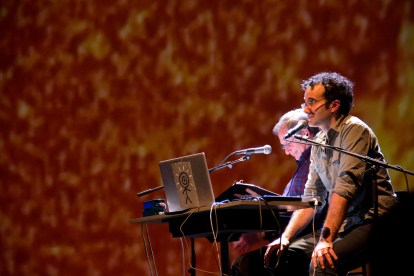
Robert Krulwich and Jad Abumrad, Image by Flickr User Carlos Gomez
In argumentation parlance, Kalia’s voice operated as an “objection.” In “Entanglements of Consumption,” argumentation scholars Kathryn M. Olson and G. Thomas Goodnight (1994) explain how an objection functions within an argumentative encounter: “absent a common agreement as to the means of reaching consensus, debate over the ‘truth’ of an asserted claim is set aside, in whole or in part, and challenges are raised as to the acceptability of the communicative context within which the argument is offered as secured”(251). That is, when deliberation occurs within a shared context—agreed upon values, goals, rules, and facts—the argument progresses smoothly. However, when there is a disjunction between interlocutors, such as in “Yellow Rain” where both parties disagree on basic facts, hegemonic beliefs take precedence. Objections function to evidence this differential, making both parties (and often an audience) aware of this gap. As such, objections are not concerned with refuting previous claims—the way that Kalia states neither she nor her uncle are interested in having a semantic debate—but questions the very context—and the conditions–of the debate itself.
Despite Radiolab’s attempts to fetishize her voice to evidence the “fact of the matter” and the “complicated nature of truth,” Kalia’s voice retained her agency. Through the invocation of the sonorous objection, she eluded capture and demonstrated the unequal terrain of the interview. Her pain enveloped the listener, leaving a resonance that Radiolab listener Cecilia Yang called “painful to listen to” in her personal blog. As Olson and Goodnight remind us, objections arise in a repressive context, when people are denied a voice. For Kalia, histories of racism and colonialism infused the argumentative encounter, making it impossible for her to “reason,” a framework she exposes as a stacked game. As such, her sonorous objection functioned to evidence this disparity, while directing the listener’s attention to her cause. Just as the pictures of prisoners coming out of Abu Ghraib incited outrage about U.S. imperialism and violence, Kalia’s sonorous objection provoked a conversation about the Hmong, Radiolab, and the ethics of journalism in the new media age.
—
Justin Eckstein is a doctoral candidate and former director of debate at the University of Denver. His work explores the intersection of listening, affect, and argumentation. Justin’s writing has appeared in Argumentation & Advocacy,Relevant Rhetoric, and Argumentation in Context. Currently, he is writing his dissertation on the micropolitics of podcasting in the post-deliberative moment.
Share this:


Current Top Posts





April 2021

January 2020

November 2019

October 2019

August 2019

April 2014

November 2017

March 2015

December 2017

October 2015
 Sounding Out!
Recent Comments