
Como Now?: Marketing “Authentic” Black Music
With all the excitement over the new release of Mavis Staples’s You Are Not Alone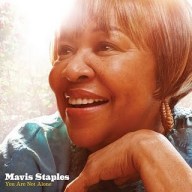 (Anti-, produced by Wilco’s Jeff Tweedy), I can’t help but be skeptical of the outpouring of Indie love for the album, even as I have been spinning (and enjoying) it myself. It isn’t the positive reaction to Staples’s talent that is surprising—at 70-plus years, Mavis has been exquisite for quite some time now—but rather the way in which critics have freighted her newest record with the “uplift” (AV Club) of a whole lot of souls that haven’t ever been to church (at least not in a good long while). Her voice is described as alternately “raw” (Paste) and full of a “depth, power, and warmth that seem increasingly rare in music today” (hear ya); Consequence of Sound, who cites Tweedy’s hand at the boards as the reason for all the current music blog attention, calls her voice “empathetic. . . powerful. . .soulful. . .touching” and “wise.” If the blogosphere is to be believed, Staples’s voice, “as authentic as it gets” (buzzine), could really save us all in these tough times. Come to think of it, the fervor of (white) faith in “authentic” black music shouldn’t be that surprising either, given the way in which race has always been entangled with popular music history in the United States.
Authenticity and the immediacy of experience it implies, have had a long history in the music industry—especially in reference to black artists—stemming back at least to the Fisk Jubilee Singers in the 1870s, an all-black acapella troupe celebrated for  powerful live performances whose breakthrough concert also happened to be for a crowd of hipsters: the wealthy congregants of Henry Ward Beecher’s Brooklyn church in 1871. Beecher gave the band his enthusiastic support, namely because he felt their sound gave listeners direct access to “the inner lives of slave hearts expressed in music” even after slavery had formally ended.
While the sound of You are Not Alone differs greatly from the Jubilee Singers, the reviews of the record belie and inflame a similar desire for unmediated access to the emotive qualities (a)historically associated with black life and sound in the U.S.: namely suffering, faith, and catharsis. And Staples’s record is indeed not alone in this. Many of the sentences from the Staples reviews could easily have been lifted from those of another recent gospel record to capture the indie imagination, Daptone Records’s 2008 release Como Now. Starkly different from the breezier, countrified sounds of You Are Not Alone, Como Now is an acapella gospel recording made in a small town in Panola County, Mississippi. The record was a risky release for Daptone, a Brooklyn-based label that has consistently produced new funk and soul records since its inception in 2002 by the likes of Sharon Jones and the Dap-Kings and The Budos Band. Although old school sound has always been a part of the label’s ethos—its engineers use primarily analog equipment, for example, a major reason Amy Winehouse recorded her throwback Back in Black album at Daptone studios in 2006—marketing stripped-down gospel to its audience of predominately white hipsters would nonetheless prove a daunting task. Treating Como Now as a labor of love and a paying of dues, Daptone attempted to spark interest in the release by relying on the familiar marketing strategies of immediacy, authenticity, and nostalgia.
 While Como Now’s tagline boldly proclaims that the music was “Recorded Live at Mt. Mariah Church on July 22, 2006”—and, thus, emphasizing the Now of the title—the cover’s vintage civil-rights era design evokes the Como of yesterday, or more accurately, encourages listeners to hear Como now and Como yesterday as one and the same through the vehicle of “raw gospel testimony.” Como Now’s depiction of the sounds of the past as echoes within the present is as ambiguous as it is uncanny, a sonic window thrown open to simpler times happening somewhere out there, “deep in the heart of Mississippi” right now.
The introductory promotional video from Como Now’s website (also uploaded on Youtube) represents the record as an aural time machine to a land and a people isolated from and largely unchanged by technology, modernity, and history.
Producer Michael Reilly’s voiceover locates rawness, emotional release, and “real religion” in the sound of black voices, in no small part because the video places his measured Yankee pacing in sonic tension with the song that accompanies it, Mary Moore singing “When the Gates Swing Open.” Over Moore’s impassioned singing, Reilly assures listeners in a muted deadpan that they will hear “no pretty piano playing or clever guitar picking, just voices. Pure soul stirring fire from the heart.” Reilly’s sentiments not only evoke the gushing Jubilee Singers’ press, but also the ethos of the infamous folklorist John Lomax, who made field recordings in Southern prisons in the 1930s because he sought “negro singers untainted by white musical conventions” (as he wrote in 1934’s “Sinful Songs of the Southern Negro”); singers in Como were actually recorded by John’s son Alan in the 1940s. Reilly’s voiceover goes on to frame the Como singers as practitioners of what the senior Lomax called “the real art of simplicity,” as stripped-down, natural singers who are artful mainly in their artlessness. While Reilly’s webcopy mentions how “children and grown folks alike have been living and breathing gospel for as long as they can remember,” for example, he fails to mention how the residents of Como have also been writing, rehearsing, and performing it.
Thus, Como Now’s marketing disavows the real artistry of the Como singers, even as it seeks to celebrate it. The simple, natural quality endowed to the singers of Como is visually accentuated by stark imagery representing the town as a down-at-the-heels, living museum of the black life of yesteryear. In the youtube clip, Moore’s soaring and spirited singing animates stills of blooming cotton fields, vintage RCA microphones, and splintering upright pianos.  Save for the album cover and one blurry still of a child, there are no shots of the people of Como in the introductory promo, effectively isolating Moore’s voice from her corporeal and historical body. This isolation allows listeners to supply their own fantastic imagery and forces them to rely on historical stereotypes about the naturally sonic qualities of black people. By choosing to disembody Como’s voices, the promotional video represents the album’s music as emanating from, and even haunting, Panola County’s lush green fields and battered strip-malls rather than showing it to be a hard-fought creation of the residents themselves. To quote Lomax again: “[The Negro’s] songs burst from him, when in his own environment, as naturally as those of a bird amid its native trees.”
Although the impulse to make the album reflects a progressive desire to respectfully pay tribute to the black gospel tradition in American popular music—and to provide quality artists like The Como Mamas with critical renown and monetary compensation—Como Now relies on well-worn racial tropes to do so. It also points to the continued presence in American culture of an essentialized “black voice” that is naturalized as more emotive, truthful, and soulful than other voices. While this phenomena is socially constructed and the sounds thought of as “black” have shifted considerably—when I play early recordings of the Jubilee Singers my students consistently tell me that they sound “white” like a “glee club”—I find it fascinating that the language used to describe them has largely remained the same. While Como Now’s producer at least acknowledges that, in Como, “no one has to pick up cotton anymore, thankfully,” the marketing trades on the possibility that, while slavery and sharecropping have ended, its sonic labors have not only endured, but are readily available for download.


Share this:

How Many Mics Do We Rip on the Daily?
A woman’s voice to this game right now is so extremely necessary in order to save it.–MC Lyte, My Mic Sounds Nice: A Truth About Women in Hip-Hop
On Monday August 30th, BET premiered My Mic Sounds Nice: A Truth About Women in Hip Hop, a documentary that traces the rise of female MCs within hip hop and that strives to challenge the view that hip hop is a “man’s game.” Although the rappers interviewed–for example Medusa, Salt N Pepa, Trina, Eve–all agreed that men are a strong presence in hip hop, they are proof that they are not living in the shadow of male rappers (perhaps in the shadow of Lauryn Hill? Yes? No? Maybe?). The documentary helped bring me back to questions I had about women and hip hop, questions that arose while doing my research on hip hop and representations of urban space.
I come to hip hop not just as a music fan, but as a cultural studies critic. I like hip hop, but I really started paying attention when I saw the connections between the music I was bopping my head to and the stuff I was reading and thinking about. It started with Kanye West, one of my favorite rappers, and his song “My Way Home” (from Late Registration). At the time I was taking a course on African American realist fiction and the City, and thinking through what the idea of home meant for all of the migrants who had come from the South to the North. Chicago weighed heavily on my mind as I drove up from New York City back to Upstate NY one weekend, and listened to Late Registration along the way. The opening sample, from Gil-Scott Heron’s “Home Is Where The Hatred Is,” came on, and I had one of those serendipitous moments researchers dream of: “Chicago is home for Kanye. Chicago is the place where many of these characters live. But is it home for them? Can this city ever be a home?”
My questions led me to revisit my iTunes and my boyfriend’s CDs (we’re both big music fans, and one of the bonuses of moving in together was that our music collections became one big collection) in search of other songs about cities. I started building a playlist for my paper and buying songs like no one’s business. I was drawing connections between the African American fiction I was reading and the songs I was listening to. They both underscored the importance of urban spaces in the development of a post-migration identity–a very urban one at that. And hip hop is an inherently urban genre. However, amidst Kanye and Mos Def, Jay-Z and Gil-Scott Heron, Murs and Ice Cube, I noticed a big, dark, deep hole: where were the female MCs? It had been easy to find plenty of songs about cities by male rappers, but songs by female rappers? Not so much.
After I got over my initial embarrassment that I had gone so long without noticing this lack in my iTunes playlist, I started to search for female MCs rapping about the city. I collected names and songs. I looked up obscure remixes online, and downloaded songs by female rappers I’d never heard of before. (My favorite from that search? “Philly Philly” by Eve. Once I start humming, I can’t get it out of my head.) But there was less of a variety, and they talked about urban space differently. Whereas many male rappers put the grit, the violence, and the dangerous streets of the city front and center in their music, this was not so for the female rappers I looked at. A good example of this is Lauryn Hill’s “Every Ghetto, Every City” where she reminisces about her childhood in Jersey, but says that “every ghetto, every city” brings her back to the streets where she grew up. I used to think that I didn’t have enough of a sample to say what was the tone of female MCs toward urban space; now I wonder if the sample issue had anything to do with the lack of female MCs nowadays.
However, the documentary ends on a positive note: after calling into question whether Nicki Minaj’s popularity is helping or hurting rap (see adurhamtamu’s post on The Crunk Feminist Collective for a more thoughtful look at Nicki Minaj’s performances), we have Glenisha Morgan from The Fembassy, who argues that if you want to listen to female MCs all you have to do is look for them. She provides viewers a long list of female rappers out there, albeit underground: Medusa, Jean Grae, Tiye Phoenix…Maybe my problem wasn’t that I couldn’t find female rappers rapping about cities, but that I was looking in all the wrong places. I am looking forward to checking out these female rappers and seeing what they have to say about their relationship to urban space through their music. Thanks, BET, for caring.


Share this:


Current Top Posts





April 2021

January 2020

November 2019

October 2019

August 2019

April 2014

November 2017

March 2015

December 2017

October 2015
 Sounding Out!
Recent Comments