
“This Liquid Dream”: An Interview with Aquaphoneia Composer Navid Navab
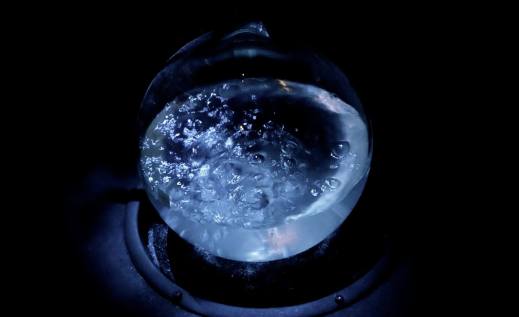
Multidisciplinary composer and media alchemist Navid Navab and his team at the Topological Media Lab based at Concordia University (Montreal) presented Aquaphoneia, a sound installation which transmutes voice into water and water into air at Biennale Nemo in Paris in December 2017 (and will run until March 2018). I conducted this interview in the context of the first presentation of Aquaphoneia originally conceptualized for Ars Electronica 2016: RADICAL ATOMS and the alchemists of our time. This version of the piece looked at technology through the lens of the living materiality. As Prof. Hiroshi Ishii, of the MIT Media Lab’s Tangible Media Group, stated, artists “suggest completely new ways of looking at the role of science in our society and the interplay of technology and nature.”
***
EB [Esther Bourdages]: The theme of the 2016 Ars Electronica Festival, RADICAL ATOMS – and the alchemists of our time, is very close to the Topological Media Lab’s mission: transmutation and alchemy on the philosophical and phenomenological level. For Aquaphoneia, can you expand on alchemy and specifically on how this art piece stands out from your past work? How did alchemical thought process and production techniques come up in the process of the piece?
NN [Navid Navad]: When the 2016 theme for Ars Electronica Festival was announced I was happily surprised and thought: finally, things are coming to light at a much larger scale. Yes, please can we reverse the still prominent European Modernism’s separations—between the conceptual and the material, the precise and the messy, the sciences and the arts—and go back to the holistic richness of alchemical matter? This transition that we are currently experiencing calls for a shift away from representational technologies: from interfaces to stuff, from objects to fields of matter-in-process, from fixed concepts to processes that enact concepts. For over a decade, we as alchemists have been engaging with “bodies and materials that are always suffused with ethical, vital and material power.”
The Topological Media Lab [TML] is occupied by people who are living to fuse and confuse, ready to unlearn the apparent practicality of isolated disciplines, while playfully improvising new pathways to understanding potential futures. The TML hosts an array of projects for thinking-feeling through poetry-infused-matter and breathing life into static forms—which to me is an effortlessly artistic process, and all the while inseparable from a rigorously philosophical or scientific one. Even though it might take decades for the kinds of computational-materials that we are envisioning today to be engineered from ground up at an atomic level, with what is possible today, we explore how the messy stuff of the world could become computationally charged with the potential for play: sounding, dancing, and co-performing new ways of living with or without us.
Aquaphoneia comes out of this rich ecology of experiments. In Aquaphoneia, voice and water become irreversibly fused. The installation listens to the visitors, and transmutes their utterances into aqueous voice, which then is further enriched and purified through alchemical processes.
.
To fully realize this liquid dream, we went to great lengths in order to fuse the messy behaviour of matter flowing throughout the installation with meticulously correlated and localized sonic behaviour. For example, the temporal texture of boiling liquid in one chamber is perceptually inseparable from the spectral entropy of simmering voices which then evaporate into a cloud of spectral mist. All of this dynamic activity is finely localized: the sounds acoustically emit exactly from where the action occurs, rather than spatially schizophying loudspeakers elsewhere.
On another hand, our material-computational-centric approach lead to a tough yet rewarding meditation on control and process. As a composer, I had to let go of all desires for immediate control over sounds and surrender important rhythmical and compositional decisions to messy material processes. In Alchemical Mercury (2009), Karen Pinkus quotes Marcel Duchamp: “alchemy is a kind of philosophy: a kind of thinking that leads to a way of understanding” (159). For us, in the process of creating Aquaphoneia, essentially what had to be understood and then given up was our attachment to our far-too-human notions of time and tempo. Instead we embraced and worked within the infinitely rich and pluri-textural tempi of matter. Technically and compositionally this meant that most of our focus had to be placed on merging the continuous richness of material processes with our computational processes through an array of techniques: temporal pattern following, audio-mosaicing, continuous tracking of fields of activity using computer vision and acoustic sensing techniques in order to synthesize highly correlated sonic morphologies, careful integration of structure-born-sound, etc. We were able to co-articulate compositions by constraining material processes sculpturally, and then letting the liquid voice and the laws of thermodynamics do their thing.
[EB]: One of the first elements that we notice in the installation is the brass horn connected to an old Edison sound recording machine, that now turns into liquid instead of wax cylinders. In fact, it came from an Edison talking machine. You repurpose an authentic artifact, but you do not fall into the trap of nostalgia, and neither into the role of collector, but you embrace innovation with a dynamic approach which excavates past media technologies in order to understand or surpass contemporary audio technologies. Where does the use of the Edison horn come from and how does it speak to your relationship with the superposition of history?
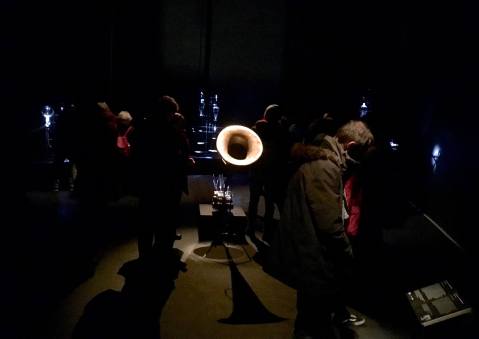
Paris, Biennale Némo, 17 October 2017 – 18 March 2018 Credit: Navid Navad, 2017
[NN]: The history of sound reproduction involves transforming audible pressure patterns or sound energy into solid matter and vice versa. The historic Edison recording machines gathered sound energy to etch pressure patterns onto tinfoil wrapped around a cylindrical drum. Sound waves, focussed at the narrow end of the horn, caused a small diaphragm to vibrate, which in turn caused a miniature steel-blade stylus to move and emboss grooves in the cylinder. The tin foil would later on be replaced by wax cylinders, vinyl disks and eventually digital encoding.
Aquaphoneia engages the intimately recursive relationship between sounding technologies and material transmutations. Our digital audio workstations are an in fact an inclusive part of this history, this endless chain of analog transmutation between energy and matter. Under the fiction of the digital there is always the murmur of electrons and of matter-energy fields in physical transmutation. As J. Fargier writes on an early book on Nam June Paik (1989) “The digital is the analog correspondence of the alchemists’ formula for gold” (translation by NN). Well, yes. The digital revolution has allowed us to shape, compute, purify, and sculpt sounds like never before… but then often at the hefty cost of a disembodying process, with interfaces that are linked to sounds only through layers upon layers of representation, far detached from resonating bodies and the sexy flux of sounding matter.
Aquaphoneia playfully juxtaposes material-computational histories of talking machines within an imaginary assemblage: sounds are fully materialized and messed with tangibly within an immediate medium very much like clay or water or perhaps more like a yet to be realized alchemico-sonic-matter. This odd assemblage orchestrates liquid sounds leveraging intuitive worldly notions—such as freezing, melting, dripping, swishing, boiling, splashing, whirling, vaporizing—and in the process borrows alchemical tactics expanding across material sciences, applied phenomenology, metaphysics, expanded materiology, and the arts. Aquaphoneia’s alchemical chambers set these materials, metaphors, and forces into play against one another. After the initial ritual of offering one’s voice to the assemblage, the aqueous voice starts performing for and with itself, and human visitors have the opportunity to watch and participate as they would when encountering the unpredictable order of an enchanted forest river.
It is also noteworthy that the horn resembles a black hole. The edge of the horn acts like an event horizon, separating sounds from their source-context. Sounds, once having passed the acousmatic event horizon, cannot return to the world that they once knew. Voices leaving the body of their human or non-human speaker, fall into the narrow depths of the horn, and are squeezed into spatio-temporal infinity. Disembodied voices, are immediately reborn again with a new liquid body that flows though alchemical chambers for sonic and metaphysical purification.
Much of my work deals with the poetics of schizophonia (separation of sound from their sources). Sound reproduction (technologies), from Edison’s talking machines to our current systems, transcode back and forth between the concrete and acousmatic, situated and abstract, materialized and dematerialized, analogue and digital. Often sounds are encoded into a stiff medium which then may be processed with an interface, eventually decoded, and re-manifested again as sound. Aquaphoneia ends this nervous cycle of separation anxiety and re-attachment by synthesizing a sounding medium capable of contemporary computational powers such as memory, and adaptive spectro-temporal modulation and morphing. To adapt Marshall McLuhan, instead of encoding and decoding a presumed message with representational technologies, it enchants the medium.
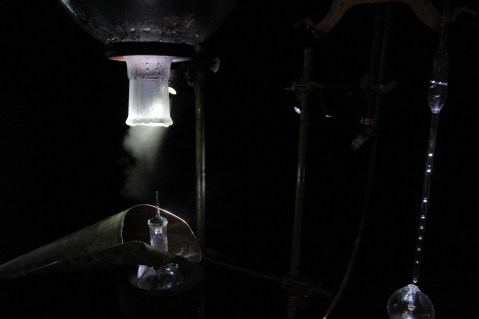
Image Credit: Topological Media Lab, 2016
[EB]: There is the tendency to think that artwork from Media Labs are stable and high tech. Aquaphoneia uses analog and digital technologies with a Do-It-Yourself (DIY) touch in the aesthetic. Since your lab is multidisciplinary oriented and influenced by diverse fields of knowledge, can you develop on the DIY dimension in Aquaphoneia under the gaze of Clint Enns—cinematographer in the experimental field of cinema—: “Adopting a DIY methodology means choosing freedom over convenience”?
[NN]: Aquaphoneia is a truly eclectic assemblage lost in time. Aquaphoneia’s mixed form reflects its extremely fluid, collaborative and playful creative process. Instead of coming up with a definitive design and executing it industrially, Aquaphoneia’s realization involved a much more playful process, where every little aspect of the installation—materials, sounds, software, electronics, etc.—was playfully investigated and messed with. Every little detail matters and every process, undulating back and forth between conception to execution, is an artistic process. The research-creation process leading to the works that come out of our lab are as critical to us as the final and fully produced art works. This was also true for the alchemists who, through their process, were seeking to develop new approaches for understanding the world, relating to matter, and surpassing nature.
Our research-creation activities concern experimenting with ethico-aesthetics of collective thinking-making: humans, non-humans, machines, and materials enacting and co-articulating the ever-changing material-social networks of relations which shape them. This DIY art-all-the-way approach, while providing a healthy dose of aesthetic freedom, is also an ethical one: we live with and within our designs and grow with them. That being said, we are not attached to a DIY process in the same way that some maker cultures might be. Sometimes we blindly find and repurpose something that does something cool, complicated, and mysterious and that is fantastic, sort of like philosophy of media meets cyber dumpster diving meets DIY hacker space meets cutting edge tech research meets miniMax (minimum engineering with maximum impact) meets speculative whatever…
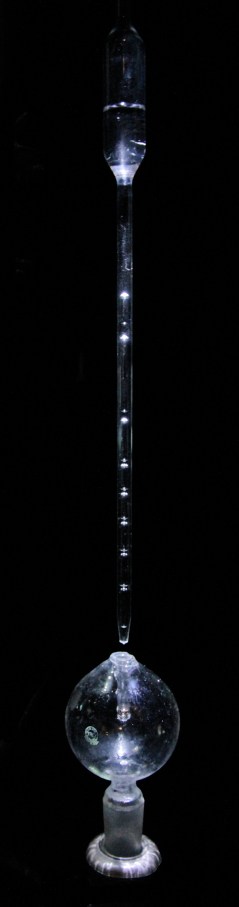
Image Credit: Topological Media Lab, 2016
For example, at some point we decided to gather sonic vapour in a glass dome and condense it back into drops, which were then guided to fall into the bottom of the installation. The purified drop of voice—sonic “lapis philosophorum”—was to fall into the depths of the earth beneath and shine upward like sonic gold, connecting heaven and earth. We had to execute this opus magnum inside a very small hole in the base of the installation. The water drop needed to be immediately sensed and sonified, leading to sounds coming out of the same hole, along with synchronized light. You can imagine that if we were relying on “black-boxed” technologies and ready-made techniques then this task would have seemed like a nightmare to design and fabricate. The water drop was to fall all the way to the bottom of the hole where it would be acoustically sensed by a small apparatus that had to be acoustically isolated from everything else. Then the result of the sonification had to be pushed through the very same hole with a high degree of intelligibility and in a way that it would be seamlessly localized. Meanwhile, light had to shine through this hole in sync with the sounds but the source of light had to remain hidden.
The solution to this technical puzzle came to us effortlessly when playing around with random stuff. We found a hipster product—a little plastic horn—that was made for turning your iPod into a gramophone. Then a speaker was mounted inside of this plastic horn in order to focus sounds towards the end tip of the horn. The back of the speaker was fully covered with foam and duct tape to stop any sound from escaping anywhere except for where we wanted it to appear. A small hole was drilled into the brass pipe in the base of the installation. Our advanced hipster horn-tip-sound-laser-thing was then inserted, allowing crisp sounds to enter the brass hole and emit from it without any visible clues for the perceiver as to where the speaker was hidden. Meanwhile, a similar lighting solution was created so that in a very small footprint we can focus, direct, and bounce enough directional light in the brass pipe without ever getting in the way of the water drops.
We had to engage with this sort of detailed fabrication/composition process throughout the whole installation in order to come up with solutions to sense the behaviour of the materials and liquids locally and to manifest them sonically and visually so that there would be no separation from local material behaviours and their computational enchantment. In trying to do so we discovered that more often than not, there was no ready-made solution or technique to rely on, and at the same time we didn’t have months ahead of us to engage in an abstract design and fabrication process. We had limited hours of collective play time to leverage and to come up with innovative techniques that we didn’t even know could exist and that was really fun.
**
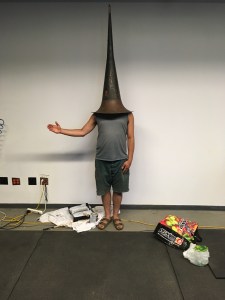
Image Credit: Topological Media Lab, 2016**
Aquaphoneia is a rich sound art piece – a manifesto by itself about innovation and inventiveness. The sound installation demonstrates that the main crafters Navid Navad and his partner Michael Montanaro, in collaboration with other members of the Topological Media Lab, swim easily into the multidisciplinary art. They are are not afraid to experiment and engage with the material, which results in an interlacing of forms, a mixture of historic references, and an interesting fusion of “low” and “high” technology. I was able to catch some of the build up of the art piece, and it was fantastic to witness the lab as a playful messy artistic field with a little team of scholars fusing their different backgrounds in convergence on the marriage of art and science.
Aquaphoneia, a sound installation which transmutes voice into water and water into air at Biennale Nemo in Paris runs until March 2018.
—
-
- NAVID NAVAB art direction, sound/installation concept and design, audiovisual composition, programming, behaviour design
- MICHAEL MONTANARO art direction, visual/installation concept, design and fabrication
- PETER VAN HAAFTEN electronics, sound, programming
- consulting assistants: Nima Navab (embedded lighting design) Joseph Thibodeau (electronics)
- research collaboration: Topological Media Lab
Featured Image: Aquaphoneia, Paris, Biennale Némo, 17 October 2017 – 18 March 2018, Credit: Navid Navad, 2017
—
Esther Bourdages works in the visual arts and technology art field as a writer, independent curator and scholar. Her curatorial research explores art forms such as site-specific art, installation and sculpture, often in conjunction with sound. She has authored many articles and critical commentaries on contemporary art. As a musician, she performs under the name of Esther B – she plays turntables, handles vinyl records, and records soundscapes. She works and lives in Montreal.
Navid Navab is a Montreal based media alchemist, multidisciplinary composer, audiovisual sculptor, phono-menologist, and gestureBender. Interested in the poetics of gesture, materiality, and embodiment, his work investigates the transmutation of matter and the enrichment of its inherent performative quali- ties. Navid uses gestures, rhythms and vibration from everyday life as basis for realtime compositions, resulting in augmented acoustical poetry and painterly light that enchants improvisational and pedestrian movements.
Navad currently co-directs the Topological Media Lab, where he leverages phenomenological studies to inform the the creation of computationally-augmented performance environments. His works, which which take on the form of gestural sound compositions, responsive architecture, site specific interven- tions, theatrical interactive installations, kinetic sound sculptures and multimodal comprovisational per- formances, have been presented internationally at diverse venues such as Canadian Center for Architec- ture, Festival du Nouveau Cinema, Ars Electronica Festival Linz, HKW Berlin, WesternFront Vancouver, McCord Museum, Musée d’art Contemporain de Montréal, Contemporary Arts Museum Houston, Inter- national Digital Arts Biennial, Musiikin Aika Finland, and Festival International Montréal/Nouvelles Mu- siques, among others. www.navidnavab.net
—
 REWIND! . . .If you liked this post, you may also dig:
Playing with Bits, Pieces, and Lightning Bolts: An Interview with Sound Artist Andrea Parkins — Maile Colbert
Sounding Our Utopia: An Interview With Mileece— Maile Colbert
Optophones and Musical Print–Mara Mills
Share this:

The Firesign Theatre’s Wax Poetics: Overdub, Dissonance, and Narrative in the Age of Nixon

The Firesign Theatre are the only group that can claim among its devoted fans both Thom Yorke and John Ashbery; who have an album in the National Recording Registry at the Library of Congress and also coined a phrase now used as a slogan by freeform giant WFMU; and whose albums were widely distributed by tape among U.S. soldiers in Vietnam, and then sampled by the most selective classic hip hop DJs, from Steinski and DJ Premier to J Dilla and Madlib.
Formed in 1966, they began their career improvising on Los Angeles’s Pacifica station KPFK, and went on to work in numerous media formats over their four-decade career. They are best known for a series of nine albums made for Columbia Records, records that remain unparalleled for their density, complexity, and sonic range. Realizing in an astonishing way the implications of the long playing record and the multi-track recording studio, the Firesign Theatre’s Columbia albums offer unusually fertile ground for bringing techniques of literary analysis to bear upon the fields of sound and media studies (and vice versa). This is a strategy that aims to reveal the forms of political consciousness that crafted the records, as well as the politics of the once-common listening practices binding together the disparate audiences I have just named. It is no accident that the associative and referential politics of the sample in “golden age” hip hop would have recognized a similar politics of reference and association in Firesign Theatre’s sound work, in particular in the group’s pioneering use of language, time, and space.

The Firesign Theatre (wall of cables): John Rose, Image courtesy of author
The Firesign Theatre is typically understood as a comedy act from the era of “head music” — elaborate album-oriented sounds that solicited concerted, often collective and repeated, listening typically under the influence of drugs. But it may be better to understand their work as attempting to devise a future for literary writing that would be unbound from the printed page and engaged with the emergent recording technologies of the day. In this way, they may have crafted a practice more radical, but less recognizable, than that of poets —such as Allen Ginsberg or David Antin, both of whose work Firesign read on the air — who were also experimenting with writing on tape during these years (see Michael Davidson’s Ghostlier Demarcations: Modern Poetry and the Material Word, in particular 196-224). Because their work circulated almost exclusively on vinyl (secondarily on tape), it encouraged a kind of reading (in the strictest sense) with the ears; the fact that their work was distributed through the networks of popular music may also have implications for the way we understand past communities of music listeners as well.
The period of Firesign’s contract (1967-1975) with the world’s largest record company parallels exactly the recording industry’s relocation from New York to Los Angeles, the development of multitrack studios which made the overdub the dominant technique for recording pop music, and the rise of the LP as a medium in its own right, a format that rewarded, and in Firesign’s case required, repeated listening. These were all factors the Firesign Theatre uniquely exploited. Giving attention to the musicality of the group’s work, Jacob Smith has shown (in an excellent short discussion in Spoken Word: Postwar American Phonograph Cultures that is to date the only academic study of Firesign) how the group’s attention to the expansion of television, and in particular the new practice of channel-surfing, provided both a thematic and a formal focus for the group’s work: “Firesign […] uses channel surfing as the sonic equivalent of parallel editing, a kind of horizontal or melodic layering in which different themes are woven in and out of prominence until they finally merge. Firesign also adds vertical layers to the narrative in a manner analogous to musical harmony or multiple planes of cinematic superimposition” (181). But more remains to be said not only about the effect of the Firesign Theatre’s work, but about its carefully wrought semantics, in particular the way the “horizontal” and “vertical” layers that Smith identifies were used as ways of revealing the mutually implicated regimes of politics, culture, and media in the Vietnam era — at the very moment when the explosion of those media was otherwise working to disassociate those fields.
The group’s third album, Don’t Crush That Dwarf, Hand Me the Pliers is typically understood as their first extended meditation on the cultural phenomenology of television. Throughout the record, though there is much else going on, two pastiches of 1950s genre movies (High School Madness and a war film called Parallel Hell!) stream intermittently, as if through a single channel-surfing television set. The films coincide in two superimposed courtroom scenes that include all the principal characters from both films. By interpenetrating the school and the war, the record names without naming the killing of four students at Kent State and two students at Jackson State University, two events that occurred eleven days apart in May 1970 while the group was writing and recording in Los Angeles. Until this point rationalized by the framing fiction of a principal character watching both films on television, the interpenetration of the narratives is resolvable within the album’s diegesis—the master plot that accounts for and rationalizes every discrete gesture and event—only as a representation of that character’s having fallen asleep and dreaming the films together, a narrative sleight of hand that would testify to the group’s comprehension of literary modernism and the avant-garde.
The question of what may “cause” the interpenetration of the films is of interest, but the Firesign Theatre did not always require justification to elicit the most outrageous representational shifts of space (as well as of medium and persona). What is of more interest is the way rationalized space — the space implied by the “audioposition” of classic radio drama, as theorized by Neil Verma in Theater of the Mind— could be de-emphasized or even abandoned in favor of what might instead be called analytic space, an aural fiction in which the institutions of war and school can be understood as simultaneous and coterminous, and which more broadly represents the political corruptions of the Nixon administration by means of formal and generic corruption that is the hallmark of the Firesign Theatre’s approach to media (35-38).
While the techniques that produce this analytic soundscape bear some resemblance to what Verma terms the “kaleidosonic style” pioneered by radio producer Norman Corwin in the 1940s — in which the listener is moved “from place to place, experiencing shallow scenes as if from a series of fixed apertures” — even this very brief sketch indicates how radically the Firesign Theatre explored, deepened, and multiplied Corwin’s techniques in order to stage a more politically diagnostic and implicative mode of cultural interpretation. Firesign’s spaces, which are often of great depth, are rarely traversed arbitrarily; they are more typically experienced either in a relatively seamless flow (perspective and location shifting by means of an associative, critical or analytical, logic that the listener may discover), or are instead subsumed within regimes of media (a radio broadcast within a feature film which is broadcast on a television that is being watched by the primary character on the record album to which you are listening). According to either strategy the medium may be understood to be the message, but that message is one whose horizon is as critical as it is aesthetic.

Firesign Theatre (pickup truck): John Rose, Image courtesy of author
The creation of what I am terming an analytic space was directly abetted by the technological advancement of recording studios, which underwent a period of profound transformation during the years of their Columbia contract, which spanned the year of The Beatles’s Sergeant Pepper’s Lonely Hearts Club Band (arguably the world’s first concept album, recorded on four tracks) to Pink Floyd’s Wish You Were Here (arguably that band’s fourth concept album, recorded on 24 tracks). Pop music had for years availed itself of the possibilities of recording vocals and solos separately, or doubly, but the dominant convention was for such recordings to support the imagined conceit of a song being performed live. As studios’ technological advances increased the possibilities for multitracking, overdubbing, and mixing, pop recordings such as Sgt. Pepper and the Beach Boys’ Pet Sounds (1966) became more self-evidently untethered from the event of a live performance, actual or simulated. In the place of the long-dominant conceit of a recording’s indexical relation to a particular moment in time, pop music after the late 60s came increasingly to define and inhabit new conceptions of space, and especially time. Thus, when in 1970 Robert Christgau asserted that the Firesign Theatre “uses the recording studio at least as brilliantly as any rock group” (and awarding a very rare A+), he was remarking the degree to which distortions and experiments with time and space were if anything more radically available to narrative forms than they were to music.
The overdub made possible much more than the simple multiplication and manipulation of aural elements, it also added depth and richness to the soundfield. New possibilities of mixing, layering, and editing also revealed that the narrative representation of time, as well as spatial element I’ve just described, could be substantially reworked and given thematic meaning. In one knowing example, on 1969’s How Can You Be in Two Places at Once When You’re Not Anywhere at All, an accident with a time machine results in the duplication of each of the narrative’s major characters, who then fight or drink with each other.
This crisis of the unities is only averted when a pastiche of Franklin Delano Roosevelt interrupts the record’s fictional broadcast, announcing the bombing of Pearl Harbor, and his decision to surrender to Japan. On a record released the year the United States began secret bombing in Cambodia, it is not only the phenomenological, but also the social and political, implications of this kind of technologically mediated writing that are striking: the overdub enables the formal representation of “duplicity” itself, with the gesture of surrender ironically but pointedly offered as the resolution to the present crisis in Southeast Asia.
To take seriously the Firesign Theatre’s experiments with medium, sound, and language may be a way of reviving techniques of writing — as well as recording, and of listening — that have surprisingly eroded, even as technological advances (cheaper microphones, modeling software, and programs from Audacity and Garage Band to Pro Tools and Ableton Live) have taken the conditions of production out of the exclusive purview of the major recording studios. In two recent essays in RadioDoc Review called “The Arts of Amnesia: The Case for Audio Drama Part One” and “Part Two,” Verma has surveyed the recent proliferation of audio drama in the field of podcasting, and urged artists to explore more deeply the practices and traditions of the past, fearing that contemporary aversion to “radio drama” risks “fall[ing] into a determinism that misses cross-fertilization and common experiment” (Part Two, 4). Meanwhile, Chris Hoff and Sam Harnett’s live performances from their excellent World According to Sound podcast are newly instantiating a form of collective and immersive listening that bears a resemblance to the practices that were dominant among Firesign Theatre listeners in the 1960s and 70s; this fall they are hosting listening events for Firesign records in San Francisco.
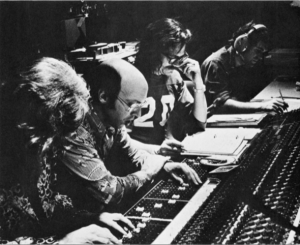
The Firesign Theatre (mixing board): Bob & Robin Preston, Image courtesy of author
It is tempting to hope for a wider range of experimentation in the field of audio in the decade to come, one that either critically exploits or supersedes the hegemony of individualized listening emblematized by podcast apps and noise-cancelling headphones. But if the audio field instead remains governed by information-oriented podcasts, leavened by a subfield of relatively classical dramas like the very good first season of Homecoming, a return to the Firesign Theatre’s work can have methodological, historical, and theoretical value because it could help reveal how the experience of recorded sound had an altogether different political inflection in an earlier era. Thinking back to the remarkably heterogeneous set of Firesign Theatre fans with which I began, it is hard not to observe that the dominant era of the sample in hip hop is one where it was not the Walkman but the jambox — with its politics of contesting a shared social space through collective listening — was the primary apparatus of playback. However unwished- for, this determinist line of technological thinking would clarify the way media audiences are successively composed and decomposed, and show more clearly how, to use Nick Couldry’s words in “Liveness, ‘Reality,’ and the Mediated Habitus from Television to the Mobile Phone,” “the ‘habitus’ of contemporary societies is being transformed by mediation itself” (358).
—
Featured Image: The Firesign Theatre (ice cream baggage claim): John Rose, courtesy of author.
—
Jeremy Braddock is Associate Professor of English at Cornell University, where he specializes on the production and reception of modernist literature, media, and culture from the 1910s throughout the long twentieth century. His scholarship has examined the collective and institutional forms of twentieth-century authorship that are obscured by the romanticized figure of the individual artist. His book Collecting as Modernist Practic— a study of anthologies, archives, and private art collections — won the 2013 Modernist Studies Association book prize. Recent publications include a short essay considering the literary education of Robert Christgau and Greil Marcus and an essay on the Harlem reception of James Joyce’s Ulysses. He is currently working on a book on the Firesign Theatre.
—
REWIND! . . .If you liked this post, you may also dig:

“Radio’s “Oblong Blur”: Notes on the Corwinesque”–Neil Verma
The New Wave: On Radio Arts in the UK–Magz Hall
This is Your Body on the Velvet Underground–Jacob Smith
Share this:


Current Top Posts





April 2021

January 2020

November 2019

October 2019

August 2019

April 2014

November 2017

March 2015

December 2017

October 2015
 Sounding Out!
Recent Comments