
The Amplification of Muted Voices: Notes on a Recitation of the Adhan

Where do we begin?
On Tuesday January 13th, 2015, my first-year students and I gathered for the second meeting of our seminar, “Soundscapes: Artistic, Social, and Biological Approaches to Acoustic Environments.” We were just a few steps away from the iconic Duke chapel, almost in its shadow.
The chapel is an example of a revivalist architectural style known as “Collegiate Gothic.” Its steps were constructed with soft stone, intended to wear down quickly and provide an accelerated impression of age and prestige. The chapel’s cruciform blueprint is an unambiguous symbol of its Methodist Christian roots, as is the university’s motto: “eruditio et religio” (“erudition and religion”). In true Gothic revivalist style, the phrase is a Latin translation of a line from an 18th-century, English-language Methodist hymn titled “Sanctified Knowledge.”
.


On Tuesday, January 13th—the second day of my Soundscapes seminar—Duke’s Office of Communications announced that the Islamic call to prayer, the adhan, would sound from a bell tower of its iconic chapel in Durham, North Carolina. According to a press release, Duke’s chapel administrators and Muslim Students Association felt the three-minute long, “moderately amplified” recitation “represents a larger commitment to religious pluralism” on campus and that the sound of the adhan “connects the university to national trends in religious accommodation.”
The story was picked up by WRAL, the television news outlet based in nearby Raleigh. The web-based stories included a photo of the student slated to be the muezzin, the person appointed to recite the call to prayer. In the photo, the student was shown rehearsing from the bell tower. I read the announcement just before walking to class and thought the event would be a historic opportunity for my students and I to make field recordings of their university soundscape.
Where do we begin?
The adhan was scheduled to take place on the afternoon of Friday, January 16th. On Wednesday, January 7th—a week before the announcement of the adhan at Duke—twelve people were murdered during an attack on the Paris offices of the satirical newspaper Charlie Hebdo. Ostensibly, the murders were committed on behalf of Al-Qaeda in the Arabian Peninsula as a retaliation for the newspaper’s cartoon depiction of the prophet Mohammed.

Image of “Je Suis Charlie” solidarity demonstrations in Hamburg, Germany, by Flickr user Konrad Lembcke
Where do we begin?
Islamic theology posits that the adhan is not music. It is recited, not sung. Likewise, the text of the Qu’ran is not poetry. These sacred texts are certainly musical and poetic, but they are neither music nor poetry. These theoretical distinctions have complex and profound implications: more than soundscapes or sound art or acoustemology, the Islamic premise underlying recitations of the adhan and Qu’ran provoked my students to reconsider entire constellations of historical, cultural, linguistic, political, and—indeed—spiritual phenomena.
My students and I conducted a survey in which they asked classmates to identify a recording of the adhan. Only 2 out of 48 students recognized it as a recitation of the Islamic call to prayer; most guessed it was “Arab” or “Middle Eastern” music, but it seemed universally familiar as a “soundtrack” for a film sequence. One student who had lived in Morocco recognized the adhan immediately; another recognized it as the sound of his Lebanese grandmother’s alarm clock, automated to remind her to pray. We became acquainted with Cairo in One Breath, a documentary film project about post-revolutionary Egypt’s 2010 Adhan Unification Project, an effort to “replace individual muezzins with a single voice, broadcast to Cairo’s [thousands of] mosques from a radio station.”
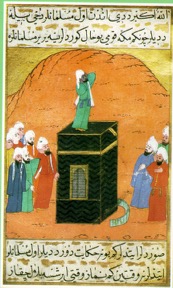 We also became familiar with the mythology of the first muezzin: Bilal, who was born in Mecca to Abyssinian slaves—in other words, a black man who was freed from slavery.
Where do we begin?
On Wednesday January 14th, the Reverend Franklin Graham posted a reaction to Duke’s announcement on his Facebook account. Franklin is the son of evangelical Baptist preacher Billy Graham, close friend and advisor to American presidents from Dwight D. Eisenhower to George W. Bush and known as “America’s pastor.” Franklin Graham is a resident of High Point, North Carolina (an hour’s drive from Duke) whose salary from tax-exempt, non-profit religious organizations is reported to be $880,000 per year.

Graham’s post “went viral,” and his threat of financial sanctions—aimed squarely at donors and alumni—seemed to land on its mark. Within hours, Duke’s proposed adhan recitation became the subject of a flood of media coverage, and the university received “credible threats” of violence; public relations and financial concerns were quickly compounded by “safety concerns.” My students and I—whose safety was being threatened—wondered whether the phrase “safety concerns” was a euphemism for terrorism, or vice versa.
On Thursday January 15, the university’s administration announced that they were canceling the planned recitation from the chapel bell tower. Instead, the adhan would be recited just outside the chapel, at the top of the steps leading to the chapel’s front doors. Franklin Graham celebrated the decision—again, on Facebook.

Later in the day, Richard Hays, the dean of the Duke Divinity School, released a letter outlining his objections to the proposed recitation. Hays’ letter revealed a somewhat obscure but significant division between the Divinity School and the chapel administration, each of which see themselves—in their own ways—as custodians of Duke’s Christian image. For the Divinity School administration, the chapel is a symbol of the university’s Christian identity. For the chapel administration, its Christian heritage is an aspect of a fundamentally pluralistic identity.
It is worth pausing here to emphasize that the controversy—now national in scope—was provoked by the mere prospect of sound. More specifically, a sound amplified at “moderate volume.”
By this point, the student muezzin and his family requested that his photo and name be removed; like the university, the young man and his family expressed “safety concerns.” Duke removed his image and name from the official online version of the announcement immediately. WRAL, the Raleigh television station, have still not removed the student’s image or name from their website.

Screen Capture of WRAL’s website by author
Where do we begin?
On the morning of Friday, January 16th?
The adhan was scheduled to take place at 1PM. At 12:30, I met two of my students—Tanner Waters and Jee Yoon—near the chapel. A large crowd was already gathering. Tanner, Jee, and I equipped ourselves with identical digital audio recorders so we could make a trio of stereo recordings, each from a distinct position; later, we would synchronize the recordings, mixing them in different ways to experiment with sonic “versions” of the event.
A half-dozen news vans were parked around the circular driveway leading to the chapel, their satellite antennas projecting into the clear blue sky. This was news. The news’ cameras were arranged on tripods in a straight line at the rear of the crowd; university security were maintaining a perimeter around the chapel that kept broadcast media at a distance. As I approached with my headphones on and my audio recorder in my hand, a chapel staff member asked mildly, “Excuse me, sir. Are you with the media?” I smiled and shook my head. No.
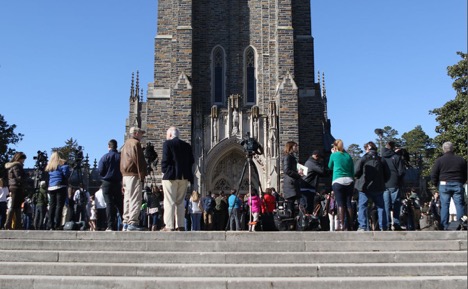
Photo by Elysia Su, The Duke Chronicle
A small PA sat at the top of the steps. Very small. There were no cables attached to it, and a small radio antenna extended from the top. It took me a few minutes to realize that this was the amplification, the moderate “loudspeaker” for the adhan. It took me another moment to realize the student muezzin would not appear: instead, he would transmit his recitation remotely. I was told later that he was just behind the closed doors of the chapel. Like so many recitations of the adhan, the transmission, amplification, and conceptual layers of it seemed uncannily like a sound art installation.
We all faced the loudspeaker, waiting for sounds to happen. The crowd went from murmurs to whispers, then silent. After a few seconds, the voices of members of the Muslim Students Association began to broadcast from the loudspeaker.
A young man’s voice introduced the adhan—a brief, prosaic context for what we would hear. Then a woman’s voice (also young) offered a literal English translation of the the adhan’s Arabic text. She spoke plainly, without the melodic contours of a recitation.
Now, before sharing recording of the Duke student muezzin’s recitation, I offer a bit of context—not an explanation or translation, but a comparative musical example. First, let’s listen to an iconic recitation style—albeit with a bit of YouTube-style hyperbole—recorded in Medina, Saudi Arabia. This recitation lasts four minutes—a fairly typical length of time for a complete recitation.
Now, let’s listen to the entire recitation of the adhan at the Duke chapel.
.
The prevailing quality of the Duke recitation is extraordinarily subdued. It is a vocal expression of the “moderate” sound and Muslim identity at the center of the controversy. At one minute and thirty seconds, it is less than half as long as most recitations.
Where do we begin?
Perhaps we might analyze this adhan as a peculiar instance of acousmatic sound: the student muezzin, like Pythagoras or the Wizard of Oz behind a curtain, was separated or dissociated from a discernible source by a curious bit of technology. When I asked Omid Safi, the director of Duke’s Islamic Studies Center, about this aspect of the story—the unseen and moderate voice of the student—he responded that for Muslims at Duke, the entire episode was about “safety and inclusion.”

Author’s screencapture of comments underneath a CBS.com broadcast about the Duke adhan.
Safi is a Duke alum. He studied there as undergraduate, co-founding the Muslim Students Association as a freshman, and went on to earn his Masters and PhD degrees at Duke. Since returning as director of the Islamic Studies Center two and a half years ago, he has been vocal and visible in the mass media. Safi himself has been labeled a “radical Muslim professor” by white conservatives and subjected to online “takedown articles,” particularly surrounding this event. Safi told me,
Part of the reason why … there was amplification but no person in sight [was] that people were scared. And it sounds hysterical … In retrospect, knowing what took place in Chapel Hill a few weeks later, [it was] not so unreasonable.
On Tuesday February 10, 2015, three Muslim college students—Deah Barakat, Yusor Abu-Salha, and Razan Abu-Salah—were murdered in their Chapel Hill home, just a twenty-minute drive from Duke. Less than a year earlier, Yusor Abu-Salha had been interviewed by her third-grade teacher for the StoryCorps oral history project.

Click on image to hear Story Corps interview
.
At horrifying moments like these, I think to myself, “This is why people pray.”
I was deeply ambivalent about discussing the murders with my students. After speaking to a handful of students individually and discreetly, I found most of them were completely unaware of the murders. I wondered—mostly silently, to myself—what impact the news might have on them, then decided to share the story obliquely: I discussed StoryCorps (“listening is an act of love”) in class, an important resource for those of us interested in oral history and I concluded by mentioning the recording of Yusor Abu-Salha. I never asked if they listened to Yusor’s voice, and I cannot know how they might have been affected. I simply did not know what to ask, nor what to say.
Less than one year later, in September, I surveyed my next cohort of incoming freshman. Less than half of them knew anything about the adhan controversy. Among the few who had heard something about it, the event had already acquired dubious mythological qualities: in one account, Muslim students were forced to move their call to prayer from the chapel tower to the nearby Sara Duke Gardens.
Analyses of the event varied considerably. In an op-ed for Duke’s student newspaper titled “Deconstructing the National Fear of Duke’s Adhan,” freshman Eidan Jacob—an Israeli Jew—offered a brilliant context and synthesis, expressing “surprise and disappointment” that the adhan was “so poorly received.” He observed that in his hometown of Haifa, “recitations of the adhan are simply part of the soundscape.”
A broad cultural and political context reveals that xenophobia and—more specifically—Islamophobia, remain cultural common sense in the post-9/11 United States. Both supporters and opponents of the adhan at Duke were disappointed by the controversy, and I do not discern a tidy moral to the story.
The sounds and discourse of the adhan at Duke suggest a narrative preoccupied with “decibels and debate,” but the subtle dynamics and textures of thoughtful, moderate conversation suggest an audible alternative to the loudness and noise of mass media discourse. The diverse qualities of the voices in this story—musical and otherwise—are more than poetic metaphors: the “voices of moderates” and “moderate-sounding voices” deserve close attention; regardless of the causes or motives underlying their subdued tones, their very quietness demands nuanced, high-fidelity listening. The literal and metaphorical amplification of voices might be a distraction from more important matters of range and intimacy.
Where do we begin?
—
In May 2015, the Duke chapel was closed for restoration. It is scheduled to reopen in May 2016.
Plans for a weekly adhan recitation elsewhere on the Duke campus are under consideration.
—
Featured Image by Elysia Su, The Duke Chronicle
—
David Font-Navarrete is an artist, musician, and ethnomusicologist. He is currently a Lecturing Fellow at Duke University’s Thompson Writing Program.
—
 REWIND!…If you liked this post, check out:
“Beat-ification: British Muslim Hip Hop and Ethical Listening Practices” –Jeanette Jouili
“Rallying Cries as Suffering Sounds: “Allah-O-Akbar” and the Aurality of Feminized Iranian Suffering–Roshanak Kheshti
“An Ear-splitting Cry: Gender, Performance, and Representations of Zaghareet in the U.S.“-Meghan Drury
Share this:

Tuning Into the “Happy Am I” Preacher: Researching the Radio Career of Elder Lightfoot Solomon Michaux


Welcome to the second installment of our Thursday series spotlighting endangered radio archives across the United States, promoting the work of the Radio Preservation Task Force (RPTF), which is part of the National Recording Reservation Plan of the Library of Congress. Our series kicked off two weeks ago with this post by Josh Garrett-Davis exploring both the history of Native American radio and new ways of thinking about it, and the series will conclude with a piece next week by the University of Michigan’s Derek Vaillant about radio recordings in immediate need of preservation in Detroit.
Between possible archives and endangered ones, we have an article about an archive that has begun to speak after long years of silence. Below, Professor Suzanne Smith of George Mason University gives us a preview of her research into a radio evangelist who was among the most prominent African Americans of his day, yet has been largely forgotten. Smith’s fascinating work not only revisits Elder Michaux as a historical figure, but also gives us a clear sense of how a project in radio reservation relies not only on institutional resources, but also on personal outreach. As many of us who are part of the preservation project are learning, media history lives on in storage units, basements and lockers, preserved by collectors, churches and communities that only individual connections can truly reach.
— Special Editor Neil Verma
—
In October 1934, the Washington Post published a feature about Elder Lightfoot Solomon Michaux in which it boldly declared that the “radio evangelist extraordinary, is the best known colored man in the United States today.” At the time, Elder Michaux, known as the “Happy Am I” Preacher, had a national radio show on the CBS network that broadcast his ministry of happiness and holiness to over twenty-five million listeners each week.
Like many popular evangelists of his era, Elder Michaux promoted his image as one of God’s prophets, presciently envisioning that radio could revolutionize the purview of modern evangelicalism. Michaux first used portable radio equipment to broadcast his holiness revivals in the mid to late 1920s in his hometown of Newport News and these religious programs were among the first of their kind in the United States. By 1929, Michaux moved to Washington, D.C. in the hopes of expanding his mission.
As an African American, Michaux initially had difficulty convincing local D.C. radio outlets to put him on the air. Eventually, he persuaded James S. Vance, local owner of WJSV, to broadcast his weekly revivals. When the CBS network bought WJSV in 1932, the budding evangelist achieved a national audience in the millions.
 The key to Michaux’s success was his ability to combine his preaching with snappy, upbeat gospel songs that reminded listeners that a holy life leads to a happy life, a message that resonated with Americans navigating the economic trials of the Great Depression. By the late 1930s, the BBC invited Michaux to broadcast his program on its network and listeners around the globe soon began to tune into his WJSV broadcasts in via shortwave hookup. These opportunities allowed the charismatic preacher to reach a vast international radio audience that extended from Europe to Africa, South America, and the Caribbean. That Michaux’s broadcasts, like his story, have disappeared from radio history has impoverished our sense of the role of race in the soundscape of the era.
My current book project examines Michaux’s extraordinary life and career as a radio evangelist. For this post, I want to explain both Michaux’s significance to the history of religious radio as well as African American history; and how my research has led me to join the Radio Preservation Task Force in an effort to preserve the surviving recordings this important figure, but understudied, figure.
In spite of his many accomplishments, Elder Michaux has been largely overlooked in the histories of religious radio and African American religion. Scholarship on religious radio from the 1920s and 1930s tends to focus on figures such as Father Charles Coughlin and Aimee Semple McPherson with only passing mention of African American preachers such as Michaux. In the history of African American religion in the 1930s, Michaux tends to be overshadowed by scholarship on other major figures such as Father Divine and his Peace Mission Movement and Sweet Daddy Grace and his United House of Prayer. Although Michaux’s ministry was often categorized as a religious cult in the popular press of the time, his Gospel Spreading Radio Church of God was firmly a part of the black Holiness movement and continues to have ten active congregations today.
 Throughout his career, which began in the late 1920s and extended until his death in 1968, Elder Michaux defied the odds and challenged boundaries of race, theology and politics to become one of the most successful religious leaders and media celebrities of his time. As early as 1926, Michaux, whose Holiness ministry openly welcomed all races, was arrested for baptizing whites and blacks together. Once established in Washington, D.C., Michaux led annual mass baptisms in the Potomac River and later at Griffith Stadium that drew tens of thousands of followers. At the height of his fame, from the 1930s through the 1950s, Michaux was regularly invited to the White House to consult with Presidents Roosevelt, Truman, and Eisenhower about the racial issues of the day. By the early 1960s, Michaux engaged in public debates with both Martin Luther King Jr. and Elijah Muhammad, leader of the Nation of Islam, about the direction of the civil rights struggle.
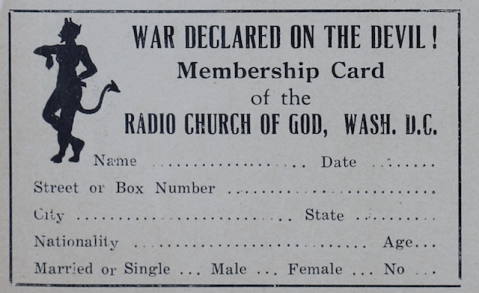
My book argues that Elder Lightfoot Solomon Michaux is critical to our understanding of how religious leaders used the mass medium of radio to literally “sell” evangelical faith movements in modern America. Elder Michaux was the first to fully develop the concept of a “Radio Church,” which offered official membership to followers and created one of the first, if not the first, virtual religious communities in modern America. A true evangelist, Michaux sought to reach believers and potential converts wherever they were and knew that the radio could facilitate his mission in revolutionary ways. In an interview in 1938, Michaux explained, “I wanted to give people religion over the air so they might have it at home. Then they couldn’t have an excuse for not going to church. They couldn’t say that they were tired or didn’t have the right clothes. They could get God and his teachings right in their own parlor.” Most significantly, Michaux’s entrepreneurial skill at marketing his Gospel Spreading Church of God through the radio was simultaneously in service to his race and racially transgressive in ways that complicate our understanding of how modern religious movements navigated Jim Crow segregation.
So how can we actually give an account of Michaux’s contributions? Researching radio programming from the 1920s and 1930s presents a number of challenges for any historian because recordings of broadcasts from this period are rare. Fortunately, Elder Michaux began his career on WJSV, one of the most powerful stations in Washington in the 1930s (which became WTOP, the most popular local news radio station in Washington, D.C. today). The first director of WJSV under CBS ownership was Harry Butcher, who had the foresight in September 1939 to record an entire day of programming, which is remarkable considering this was accomplished without the use of magnetic recording tape. Although this collection does not include Elder Michaux’s program, it is a valuable audio snapshot of the radio era in which he thrived.
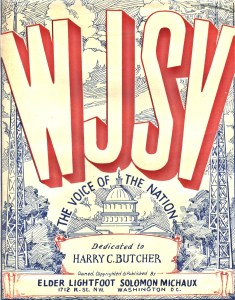 My quest to locate recordings of Elder Michaux’s broadcast has led me to destinations as far away as the BBC archives in London, which houses two recordings of Michaux’s first British broadcasts; and as close as the main branch of the current Gospel Spreading Church of God here in Washington.
In the past two years, I have also developed meaningful relationships with congregants of the church, who have begun to be willing to share their private archive of recordings. During one oral history interview, one church member, who is 92-years old, gave me a reel-to-reel tape from Elder Michaux’s funeral service, which was broadcast in October 1968. Another elder member from Newport News sent me recordings of Michaux preaching at Lorton Prison in Lorton, Virginia in the 1950s. Most significantly, I recently met the current sound engineer at the church, who has been a member since the 1940s and has a large archive of reel-to-reel tapes of Michaux’s radio broadcasts from the 1950s and 1960s. At the height of his fame in the early 1930s, Elder Michaux broadcast his religious services daily and never missed a week of broadcasting until his death in 1968. The church has only kept a fraction of these broadcasts. Nevertheless, a significant number of them exist and are housed in the church’s private storage. I am currently trying to assess the scope of the church’s collection, which has involved reaching out to church members in Philadelphia, New York City, and Newport News, Virginia. I am also trying to investigate grants that might support my efforts to digitize the tapes as soon as possible since they are at risk of deterioration in the church storage facilities.
My research on Elder Lightfoot Solomon Michaux’s career has convinced me that more work needs to be done to pursue the preservation of African American religious radio broadcasts in general. The work of the Radio Preservation Task Force can support this mission, but it will also involve grassroots outreach to established African American churches. Many of these churches regularly broadcast their services and may have their own private archives of recordings that can offer us an invaluable glimpse at the aural history of African American religious practices in the twentieth century.
Moreover, through my ongoing relationships with the congregants of Elder Michaux’s Gospel Spreading Church of God, I have developed a deeper appreciation for the importance of personal outreach to African American religious communities in the service of preserving the history of religious radio. The efforts of the Radio Preservation Task Force are critically important in terms of identifying existing institutional archives, but only through individual connections with these vital, but often overlooked minority communities, will we be able to discover and preserve these treasures of our radio past.
—
Suzanne E. Smith is Professor of History in the Department of History and Art History at George Mason University. She is the author of Dancing in the Street: Motown and the Cultural Politics of Detroit (Harvard University Press, 1999) and To Serve the Living: Funeral Directors and the African American Way of Death (Belknap Press, 2010). She is currently working on her third book, tentatively titled The ‘Happy Am I’ Preacher: The Extraordinary Life and Times of Elder Lightfoot Solomon Michaux.
—
All images courtesy of the author.
—
 REWIND! . . .If you liked this post, you may also dig:
Pentecostal Song, Sound, and Authentic Voices — Ashon Crawley
“I Love to Praise His Name”: Shouting as Feminine Disruption, Public Ecstasy, and Audio-Visual Pleasure — Shakira Holt
Sounding Out! Podcast Episode #5: Sound and Spirit on the Highway — David B. Greenberg
Share this:


Current Top Posts





April 2021

January 2020

November 2019

October 2019

August 2019

April 2014

November 2017

March 2015

December 2017

October 2015
 Sounding Out!
Recent Comments