
The Victoria’s Secret Fashion Show and the Soundtrack of Desire

"Victoria's Secret Show 2008" by flickr user cattias.photos under Creative Commons license
As a consumer, you’ve experienced desire: that longing for someone, that appetite for something more, that expectation of pleasure and satisfaction that comes from getting what you want. Whether what you want ranges from an ideal body type, to a cool technological gadget, to fashionable clothes or new cars, someone beautiful is out there selling it to you—beautifully. If you’re like me then you’ve found yourself suddenly and inexplicably under the influence of desire, only later trying to understand where your money went. If you’re a lot like me then you’ll eventually realize that desire has this effect because of the way it looks and, perhaps more importantly, because of the way it sounds.
One of the more interesting snippets of what desire looks and sounds like right now is The Victoria’s Secret Fashion Show (VSFS), which aired on November 29th and rebroadcast on December 15th. Rappers and rock stars serenade the audience while Victoria’s Secret Angels don Swarovski crystal-encrusted lingerie and angel wings. The visual and aural cornucopias echo ideas of abundance and break down the boundary between public and private spaces by implying a type of intimacy—Victoria wants to share her secret fantasies (privately) with just us (in public). The intimacy implied is totally illusive, which makes it all the more desirable.
This illusiveness starts with the models, who enact intimacy and embody silence as the sound of desire. The VSFS’s onstage choreography fixes women squarely in the visual domain and undercuts their credibility in the sonic domain. Instead of raising their voices for self-empowerment while on the air the VSFS suggests that women should push up their breasts and show as much cleavage as possible, playing to audiences as seen and not heard.
Bernd Schmitt, David Rogers, and Karen Vrotsos explain what’s behind the VSFS’s strategy of strategic silence in their book, There’s No Business That’s Not Show Business: Marketing in an Experience Culture:
“Since 1995 Victoria’s Secret has gone from imitating marketing ideas of true luxury retailers to becoming the model for some of those retailers… Every step of this dramatic progression has been pure show business—pushing the boundaries of fashion and taste, engaging (and sometimes enraging audiences) and transforming the industry into re-imagining itself. Like a teenager wearing her first Wonderbra.”
Through a maelstrom of controversies and publicity over the lack of women’s voices represented in the fashion shows, the VSFS was re-imagined in the early 2000s and took on a (post-)feminist message of empowerment. Here’s the idea: VSFS models are “superheroines” because they brandish their assets on their own terms on the catwalk, in an emancipatory celebration. Silent, desired objects are glorified as consumers are bewitched.
The show facilitates desire by creating additional intimacy for consumers, incorporating an “All Access” website replete with revealing video clips and exclusive photos, biographical videos about the models. The actual broadcast now also airs backstage interviews in which models share their private thoughts about why the VSFS is more than a pornographic commercial or a fantastic rejection of old-school stereotypical bra-burning feminism. For example, during the show one model commented that she’s “living the American Dream.” Another said that she feels senses of accomplishment and growth because “It’s every girl’s dream to walk in VSFS… the minute I stood on the runway I felt like I became a woman.” Yet another model encouraged young female audience members to aspire to participating in a future VSFS, pronouncing that “someone that’s watching this will be an angel.”
Despite this backstage commentary much goes unsaid. Noticeably absent from the models’ remarks is any mention of how the opportunity to speak their minds is presented only to sell more merchandise that is not certified fair-trade. Then there’s the total silence around the privileging of light skin and thinness and their relations to higher levels of “erotic capital” in mainstream popular culture. Out of 10 models in the 2011 show, 3 appeared to be women of color (Asian-American and African-American or mixed race) and only 1 appeared to be a darker-skinned woman of color. No women of color contributed to VSFS’s on-air backstage footage. And, adding insult to representational injury, the women of color are hypersexualized even as they are muted. What’s more is that all models appeared to be under the size of the actual US female consumer (sizes 10-12), suggesting that most real women are still not considered the target audience for VSFS and thereby suffer a profound lack of agency in voicing images of desire for themselves.
The absence, and silence, of average women and women of color in desire industries has been noted by sociologist Siobhan Brooks in Unequal Desires: Race and Erotic Capital in the Stripping Industry. Brooks writes,
“Many feminists argue that women cannot assert agency within sexual economies; their belief is that women are victimized and/or controlled by heterosexual male desire that is not in the best interest of women. On the other side of the debate… contemporary feminists have focused on sexual agency and the empowerment of women within sexual economies as an expansion of women’s control of their bodies. However, within the debate… there remains a theoretical void in examining US-based racial and sexual hierarchies present within desire industries, and how these hierarchies mirror existing forms of racial stratification in US institutions.”
This racial stratification is stitched into the very soundtrack of the VSFS, which loudly reinforces women’s silence as the sound of desire. The VSFS soundtrack nourishes desire through presenting what Deanna Sellnow and Timothy Sellnow, in their article “The Illusion of Life Rhetorical Perspective: An Integrated Approach to the Study of Music as Communication”, call an “illusion of life—a dynamic interaction between virtual experience (lyrics) and virtual time (music).” Racial, gender and class differences produced virtual experience. Lyrics expressed these differences through some form of heterosexual, aspirational and consumptive desire—from getting one’s ideal sexual partner, to traveling to exotic locales, and enjoying celebrities’ exciting and extravagant lives. The pop and rap songs offered fast tempos, driving rhythms, loud dynamics and full instrumentation, representing intensity and power.
The VSFS’s performers show the gendered dimension of that “illusion of life.” Kanye West’s version of masculinity was on display as he flirted with each model strutting down the runway, making his voice the only one heard as models appeared. His famous line from “Stronger” (“I need you right now”), when coupled with the women’s silent sauntering, sounded as relevant as it was politically incorrect.
Maroon 5’s performance of “Moves Like Jagger” also addressed the theme of desire, especially when lead singer Adam Levine planted a kiss on the cheek of his girlfriend Anne Vyalitsyna (as she remained silent). Jay-Z and West’s show stopping performance of “Niggas in Paris,” in which the duo performed without any models on stage, highlighted the rappers’ “untouchable” status as rap gods and throne-dwellers. The live audience responded more emphatically to this male-only performance than it did to any other segment of the show.
Nicki Minaj was the only female to appear on stage in the role of non-model, performing “Super Bass” with a hint of Rob Base and DJ EZ Rock’s “It Takes Two.” Though her performance can be read as a subtle critique of the lack of authentic audience agency and absence of a womanist standpoint in VSFS, it sounded no less male-centered than any of the other performers’. For instance, the first line of “Super Bass” is directed at a male audience driven by consumption, “This one is for the boys with the booming system.” In this respect Minaj could be seen as The Female Voice of VSFS, as her rapping about self-image and relationships with men is consistent with sanctioned topic areas for women in general.
However, and in keeping with the show’s theme of women’s silence as the sound of desire, Minaj’s performance does offer a quiet critique of hegemonic images of desire and desirability. Unlike the male performers Minaj always stayed behind the models and in the background. Consequently, Minaj’s short stature, colored wig, thicker figure, sneakers, outlandish outfit, and darker skin were presented in sharp contrast with the tall, high-heeled, thin, lighter-skinned, scantily clad, and perfectly coiffed models who she stalked as they came down the runway. A scan through tweets posted as the show aired confirms that audiences got Minaj’s message even if they eventually turned it against themselves, revealing that desire can sometimes be displeasing and painfully restrictive. Take the following tweet from viewer @kelcicoffey: “Going on a diet after watching #VSFashionShow tonight XD.”
Though Minaj’s soundless critique speaks volumes, the VSFS soundscape ultimately seals the edges on a spectacle brimming with hegemonic impressions and sensations of desire. The end product is an illusion of life that is mostly white, nearly naked, always feminized and conspicuously silent.
***
Marcia Alesan Dawkins is an award-winning writer, speaker, educator and visiting scholar at Brown University. She is the author of Clearly Invisible: Racial Passing and the Color of Cultural Identity (Baylor UP, 2012) and Eminem: The Real Slim Shady (Praeger, 2013).
Marcia writes about racial passing, mixed race identities, media, popular culture, religion and politics for a variety of high-profile publications. She earned her PhD in communication from USC Annenberg, her master’s degrees in humanities from USC and NYU and her bachelor’s degrees in communication arts and honors from Villanova. Contact: www.marciadawkins.com
Share this:

Becoming a Bad Listener: Labyrinthitis, Vertigo, and “Passing”
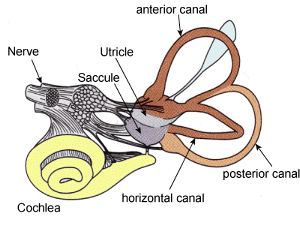 For the past three weeks I have been sick with labyrinthitis. It started with a bout of vertigo while picking up some essentials at a local pharmacy and has since recurred in various other locations. In the morning, when I stroll for coffee, it feels like I am walking a tightrope. Shelves after shelves of boxes at a local store have made the world spin. A determined trip to Manhattan (for a friend’s film release) quickly transformed into an incomprehensible blur of light and sound. Because of this lapse in cognition I have found myself listening to the world, and my body, in fascinating (although frustrating) new ways. The most frightening moments of vertigo I experienced have followed moments of both visual and audio overload. When I can no longer understand what I hear, panic is sure to follow. Worst of all, even though negotiating my day-to-day responsibilities has become a trial in patience, to most observers, I seem perfectly fine. I have decided to share these experiences because of how well they inform the ways that sound, specifically the practice of listening, informs the process of “passing” as normal in everyday life.
Labyrinthitis is often related to an inner ear infection. When the series of canals within the ear are damaged, a sense of balance is lost. This lack of balance completely skews all visual cues: things look blurry, there is an unsteadiness to things (as if on a boat), bright and flashing lights are extremely distracting . . .imagine being drunk, but with none of the perks. Another symptom of labyrinthitis is an occasional ringing in the ear. For me, this ringing is at its worst when I am trying to focus on a conversation in an environment with lots of ambient noise. For instance, if I try to hold a conversation while walking down the street and several cars pass by, the ringing will begin to overwhelm both the cars and the conversation. It’s like my brain is dialing back the volume of all the sounds around me. As mentioned earlier this is the most terrifying of all the symptoms that I experience – it feels, uncannily, like I am waking from a dream.
One labyrinthitis support site suggested that prolonged coping with the above symptoms in everyday life is, perhaps, the most difficult part of recovery. In an interesting twist they drew on sociologist Erving Goffman’s 1963 work Stigma to support this claim, “An individual carries a stigma if s/he is unable for any reason to fulfil society’s sterotypic criteria for normality – if this deviation is obvious (eg: physical deformity) the person is at once ‘discredited’. Failings that are less obvious or may be concealed (eg: vestibular problems) render the individual ‘discreditable’ in the sense that his/her identity is vulnerable. Whereas a discredited person must adopt a stigmatised identity – a discreditable individual may prefer the effort and risks attached to trying to ‘pass’ as normal to the frank stigma of admitting the attribute.” Has labyrinthitis rendered me discreditable? Although it is tempting to critique the armchair diagnosis above, I believe that it is a valuable basis for theoretical inquiry. What are the risks of acquiring the stigma of vestibular problems? In other words: do I choose to reveal my illness tactically?
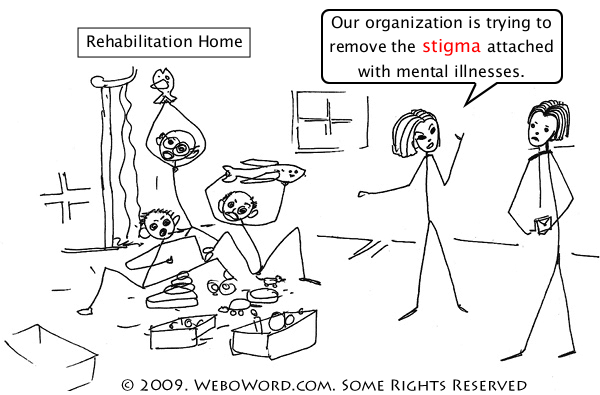
Surely, as this blog post attests, I am not too frightened by the stigma of revealing my illness. It is likely to pass in the next few months and I assume that most of our readers are not particularly judgmental. I am scared, however; when I lose track of conversations. Sometimes even to the point that I choose, as Goffman suggests, to “pass” and keep my lapse of understanding secret. As the ringing in my ear grows: I will often keep quiet, smile, and nod my head. There have been several times in recent memory that I have even forced a chuckle, or a short, daft, answer. Often these replies are deliberately vague, peppered with just enough key words to convince my companion that I was listening. At these times, in my head, I am lost – reeling with confusion. I’m trying to figure out where I am (what street is this, how can I get home quickly?), what has triggered this confusion (is it the noises behind me, or the lights ahead?), and if there is cause to be concerned (is this business as usual, or am I about to faint?). I want, at these moments, to “pass” as normal because I am scared of becoming too much of a burden to those around me. My Achilles’ heel in these situations is contingent on my ability to listen, passing, at least, as a good listener.
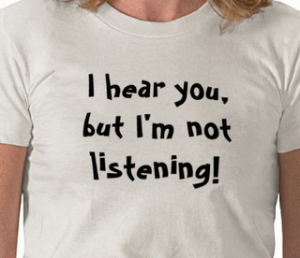 The sense of stigma I imagine, as a bad listener, is infinitely worse than the sense of stigma I could accrue as a sick individual. Goffman, in 1963, had been writing in a late Fordist economy. As such, the stigma of illness related more to physical labor than one’s ability to socialize and fit in. In these context of illness could suggest an inability to produce; the diseased body set apart from all others. As immaterial and affective labor become valorized in new ways, stigma comes to relate to the inter-social processes of control that form the new societal knot. Chief among these stigmas, for myself at least, is the inability to listen. Listening cues others in to how well one is able to socialize, participate, and contribute to a tight web of everyday activities. When I cannot listen, yes, I am vulnerable. I am vulnerable, mostly, because I am suddenly and inexplicably alone.
The worst part of becoming a bad listener is recognizing how very little is required in a conversational exchange. As noted earlier, vagaries and key words are, for the most part, sufficient. Is there a final irony here, while my ability to listen to and understand others is diminished has my ability to listen to and understand myself increased? Many have argued that mimesis, or imitation, is, in fact, central to the way people communicate. “The whole of human culture,” according to Anna Gibbs, “then, is, perhaps, predicated on imitation, in which difference and innovation are as central as reproduction and similarity” (p.202). This notion sends eerie chills up my spine. Bad listening, is, from this perspective, simply an alternative mode of identity. Words come in through the ear, rattle around for a bit in the brain, and then come out of the mouth with sparse changes and a different order. Where difference and innovation can be considered the bi-products of good listening, reproduction and similarity stem from bad listening.
Perhaps bad listening is not all that bad. Gibbs also suggests that mimetic communication, “is the cement of parent-child, peer, friendship, and love relations” (p. 202). When “passing” for normal, I shift gears. I use my listening instincts to further a set of affective and emotional bonds which are equally important to my everyday life. Listening is central to “passing,” but there is a fine distinction between modes of listening. Listening analytically is the practice of listening in order to decipher, decrypt, suggest and parse new ideas from a statement or song. Listening affectively is, then, the binary. Not a mode which drives conversations, and/or innovates, but one which actively seeks to create bonds of comfort, compassion, and support. Listening for timbre, tone, and vibe instead of composition, consistency and argument.
AT


Share this:


Current Top Posts





April 2021

January 2020

November 2019

October 2019

August 2019

April 2014

November 2017

March 2015

December 2017

October 2015
 Sounding Out!
Recent Comments