
Listening to MAGA Politics within US/Mexico’s Lucha Libre


This series listens to the political, gendered, queer(ed), racial engagements and class entanglements involved in proclaiming out loud: La-TIN-x. ChI-ca-NA. La-TI-ne. ChI-ca-n-@. Xi-can-x. Funded by an Andrew W. Mellon Foundation as part of the Crossing Latinidades Humanities Research Initiative, the Latinx Sound Cultures Studies Working Group critically considers the role of sound and listening in our formation as political subjects. Through both a comparative and cross-regional lens, we invite Latinx Sound Scholars to join us as we dialogue about our place within the larger fields of Chicanx/Latinx Studies and Sound Studies. We are delighted to publish our initial musings with Sounding Out!, a forum that has long prioritized sound from a queered, racial, working-class and “always-from-below” epistemological standpoint. —Ed. Dolores Inés Casillas
—
This post is co -authored by Esther Díaz Martín and Rebeca Rivas
—
“Lucharaaaaaán a dos a tres caídas sin limite de tiempoooo!“
[“They will fight two out of three falls, with no time limit!”]
Announcer at Lucha Libre, El Paso, Texas
“This ain’t no sideshow.”
George Lipsitz on the role of popular culture
The announcer’s piercing “lucharaaaaaán” cries from the middle of the ring proclaims the constitutional two-out-of-three-falls rule of lucha libre. But before the famous cry rings out to set the stage for the spectacularized acrobatic combat between costumed warriors, their theatrical entrances set the all-important emotional stakes of the battle. The entrances are loud, campy, interactive exchanges between luchadores and spectators. An entrance song itself cues the luchador’s persona: a cumbia could signal a técnico (a good guy); a heavy metal song more than likely indicates a rudo (a bad guy) typically donning black, death-themed getups. Luchadores saunter into the arena, stopping to pose, high five their fans, and verbally heckle their opponents. The storylines of good versus evil, betrayal and revenge, or humility versus arrogance are some of the more standard plots that motivate spectators to adamantly cheer for the favorite and jeer for the foe.
The sonic exchanges between luchadores’ and spectators before, during, and after the fight positions lucha libre as much more than a sport. And while the term spectators, suggests the privileged act of watching or viewing; here, we expand spectators within lucha libre arena to mean “a call to witness” (á la Chela Sandoval). Put simply, lucha libre is a cultural phenomenon where contemporary cultural, social, and political anxieties are often tapped as fodder for theatrical plots. In the U.S./Mexico’s sister cities of El Paso, Texas and Ciudad Juarez, Chihuahua, the political realities of border enforcement, immigration politics, and racial tensions are loudly heard and placed on display. As part of Rebeca Riva’s ongoing research about the history of lucha libre at the border—which too often gets skipped over for Mexico City as the epicenter of the sport—we listen for the exchanges between luchadores and spectators as resonant participants in the ritual of this sport. Specifically, we tune into lucha libre and its accompanying mega-spectacle to analyze how fans scoff at lucha libre’s MAGA-spectacles. In Time Passages, George Lipsitz (2001) reminded scholars of popular culture decades ago that “this ain’t no sideshow.” In a similar vein, lucha libre directly engages in the larger social and political arena that contextualizes the sport.
In lucha libre, spectators are resonant participants in the construction of an essential “hi-fi” sonic ambiente. Like in football, as Kaj Ahisved notes, the “noise of the crowd” (building on Les Back’s concept) are essential to a “hi-fi” sound where a high degree of information exchange occurs between listeners and the sound environment.Or, as David Hendy describes Olympic arenas, “cauldrons of concentrated sound, [where] the roar of the spectators took on a collective force of its own – a volatile quality rich with cultural and political repercussions.” The crowd’s response, experienced by athletes as ambient noise, bolsters athlete’s spirits and develops an emotional plot for the contest. In certain cases, for instance in Algeria as Stephen Wilford documents, it is a venue for social critique; football stadiums served as “safe zones” where fans could dissent the Abdelaziz Bouteflika dictatorship through chanting political slogans and songs as an anonymous crowd (139).
By listening to lucha libre, we gain a deeper understanding of the embodied components of fan activism, collective identity, and political action. Visual spectacle, bodily gestures, and musical choices, coupled with verbal taunts and visceral grunts serve as interactive storytelling tools. Yet, the crowd’s noise and, importantly, the sonic memories evoked by visual parafenalia amplify a shared political consciousness and prompts the expression of their allegiance with and opposition to the symbolic representations staged.

* * *
The following audio was captured in November 2023 at a parking lot across from El Paso City Hall during a children’s fundraiser. We hear Chris Watson, a previous college wrestler from Oklahoma, make his debut appearance in lucha libre as a white supremacist character. Wearing a clichéd U.S. flag-themed bandana and waving a Trump 2024 campaign flag, he points towards the crowd and makes swimming motions with his arms to communicate the pejorative “wetback.”
Aligning these symbols of MAGA ideologies with Watson’s role as a rudo in the match positions him as a willing vessel for the scorn of the mostly Mexican American spectators. His red-white-and-blue echoes Trump’s xenophobic statements burned into Latinx consciousness: “they’re all rapists,” “bad hombres,” from “shithole countries” as well as renewed promises to “build a great wall… and Mexico will pay” and enact the largest deportation effort in U.S. history since Eisenhower’s “Operation Wetback.”
The reactions from spectators are visceral and cathartic, eliciting camaraderie, anger, or empowerment. They retaliate strongly: “Fuck you! Fuck Donald Trump!”‘ and “Fuera!”, a seemingly hateful exchange interjected with cheering and laughter. Spectators are amused by the insults and retaliations. Watson’s staged “gimmick” prompts spectators to playfully rage against the violence he embodies. Their taunting in Spanish represents both resistance as cultural pride and insider knowledge. The joke is on Watson, who (presumably) does not understand the double entendres hurled at him.
A MAGA luchador evokes the memory of violence carried out against Mexicans and African Americans in Texas since at least the mid 1800s by white enslavers, colonial settlers, Texas Rangers, border patrol, and the modern police force. White supremacist violence is not mere political rhetoric but an ongoing contemporary reality. On August 3rd, 2019 a white man motivated by the “Great Replacement” theory popular in MAGA circles, drove 9 hours from his home in Allen, Texas to a Walmart in El Paso, a majority Latino city, to carry out a mass shooting with the intent of discouraging immigration. He killed 23 people and left 22 injured. Listening and yelling at Watson and his MAGA symbols at the US/Mexico border vocalizes the cultural, political and humanitarian crisis propelled by neoliberalism, the militarized police, and the exploitation of White supremacist sentiments by a wannabe fascist dictator.

Watson comes from a line of “gringo” white supremacist luchadores such as Sam Adonis (Sam Polinsky) who sprays himself orange and waves a US flag stamped with a Trump portrait. El Migra (Gonzalo Garcia), a U.S.-born Mexican American border enforcer performed during the Bush/Clinton era, who threw tortillas while taunting “traguense estas tortillas frijoleros nopaleros” (“choke on these you cactus-eating beaners”) and growled the U.S. national anthem into the mic. Spectators jeered and threw their drink cups at him; an opportunity to retort white supremacist rhetoric.
In another instance from the 1990s, a major showdown between Love Machine (a gringo wrestler turned técnico) and Blue Panther (a tejana wearing feline-themed rudo) the crowd favor turned against the yankee when his neck-breaking illegal move prompted fans to reconsider their alliances in the context of massive Mexican emigration prompted by the devastating yoke of the country’s debt to the IMF and subsequent neoliberal economic reforms. Love Machine’s fake benevolence would seem to embody U.S. gleeful exploitation of Mexico’s expatriated campesinos while simultaneously introducing legislation to further marginalize them.

Unlike Karen Yamashita‘s staging of SUPERNAFTA vs. El Gran Mojado in her 1997 novel Tropic of Orange, or the masked Chicano poetry of the Rudo Revolutionary Front, MAGA-spectacles within lucha libre are not intentionally staged to politicize the public but tap into the raw political nerve of the moment. They allow fans to emotionally resolve social and political anxieties when excoriating the “bad guy,” be it an anti-social character or the symbols of the oppressor, even if only for dos de tres caidas.
—
Featured image by Flickr User C-Monster, taken in Ontario, CA (2017) CC BY-NC 2.0
—
Esther Díaz Martín is an assistant professor of Latin American and Latino Studies and Gender and Women’s Studies at the University of Illinois Chicago. Her book, Latina Radiophonic Feminisms: Sounding Gender Politics into the Digital Age, (forthcoming UT Press, Spring 2025) theorizes Chicana feminist listening attending to the political work of Latina voices in contemporary sound media.
Rebeca Rivas is a graphic artist and doctoral student in History at the University of Texas at El Paso. Her research examines the lucha libre and community building in El Paso, Texas and Ciudad Juárez, Chihuahua. She is currently conducting an extensive oral history and archival project documenting this spectacular sport at the border.
—

REWIND!…If you liked this post, you may also dig:
Xicanacimiento, Life-giving Sonics of Critical Consciousness—Esther Díaz Martín and Kristian E. Vasquez
Ronca Realness: Voices that Sound the Sucia Body—Cloe Gentile Reyes
Echoes in Transit: Loudly Waiting at the Paso del Norte Border Region—José Manuel Flores & Dolores Inés Casillas
Share this:

A Tribe Called Red Remixes Sonic Stereotypes


Welcome back to “The Wobble Continuum,” a three part series here on Sounding Out!. When we last left you, Mike D’Errico had brought us to the intersection of patriarchal cultural norms, music production practices and aesthetics, and the Military Entertainment Complex. His particular focus was on the sounds and practices of brostep (be sure to check out D’Errico’s SO! Comment Klatsch from last week on gendered sounds, too), and some of those sounds leak through to today’s post from Christina Giacona. Giacona turns her ear to the group A Tribe Called Red in order to hear how they reappropriate and redress the sounds of colonization and racism.
As the series’ title suggests, her essay entails another journey to the low end, where things will once again get wobbly.
Guest Editor Justin D. Burton
—
Since first contact, Native Americans have consistently needed to combat the European stereotypes that portray them as inferior and uncivilized. Barraged with echoes of the same handful of Native tropes since Buffalo Bill’s Wild West Shows, contemporary American society often treats the stereotypical Native American princess, chief, and savage as historical truths, represented recently in Johnny Depp’s portrayal of Tonto in The Lone Ranger. But it is not just the visual image of the Native American that has been stereotyped, so has their sonic sensibility. As documented in the film Reel Injun, Native languages and musics have consistently been “faked” by Hollywood with tricks like backwards English, pig-Latin, and Westernized imaginings of a ubiquitous Native music based on a pan-Indian society that never actually existed. Hollywood often uses Native American music to show a “primitive” society where music’s sole function is to prepare for war. However, the “Indian” drumbeat that accents the first beat of a group of four cannot be found in any traditional Native American or Aboriginal music.
While Native American-directed motion pictures such as Smoke Signals, Powwow Highway, and Atanarjuat: The Fast Runner finally gave agency to Natives in film, it was the all-Native DJ collective A Tribe Called Red’s self-released album and popularization of the Electric Powwow that directly challenges the perception of Native American music in modern society. In this post, I analyze the sonic composition of ATCR’s song “Braves,” exploring how A Tribe Called Red challenges North American stereotypes of Native Americans through the cultural re-appropriation of racist sounds.
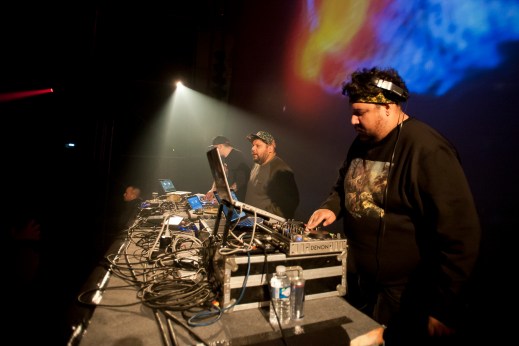
“A Tribe Called Red – Hall 4 (1)” by Flickr user Trans Musicales, CC BY-NC 2.0
After World War I, intertribal powwow gatherings served as a place to celebrate newfound unity among Native Nations returning home from the war. By the 1950s intertribal powwows had spread throughout North America. With the continued strength and importance of the powwow in contemporary Native society, urban Natives in locations like New York City and Ottawa, Canada, have begun to search for ways to create the same sense of unity in urban venues. In 2008, DJs NDN and Bear Witness formed the DJ collective “A Tribe Called Red” and began curating performances in Ottawa the second Saturday of every month called the Electric Powwow: a “wild party” focused on showcasing native talent and aboriginal culture. ATCR’s website describe the music as “ the soundtrack to the contemporary evolution of the powwow.“ Bear elaborates in an interview with NOW magazine, “[the Electric Powwow] was also about creating a space for our community within the club environment.” Hip-hop DJ and turntable champ DJ Shub was invited to join the group in 2010, and the trio spent the next two years evolving the sound of the Electric Powwow into a mash-up of powwow and First Nations music with contemporary club sounds including hip-hop, dubstep, and dance hall.

“Tribe Called Red” by Flickr user Dav Yaginuma, CC BY-NC-SA 2.0
Much like Fela Kuti’s popularization of Afrobeat in the 1970s, made up of a combination of traditional Nigerian Yoruba polyrhythms with a blend of Western jazz and funk, and Reggaeton’s fusion of Caribbean rhythms with the aesthetics of American hip-hop in the 1990s, the Electric Powwow merges a historically traditional and non-syncretic music with popular and cosmopolitan music in a way that both honors cultural heritage and makes it relevant to a new generation. As NDN points out on Noisey, even their name follows this trend, simultaneously referencing the introduction of Nations at powwows and famous Afrocentric hip-hop group A Tribe Called Quest. The Electric Powwow events are not just about the creation of a new genre of music, but they also serve as a site for ATCR to speak publicly about aboriginal issues and represent themselves as a contemporary face for the urban Native youth renaissance. ATCR’s music videos and live-show projections extensively sample racist imagery from movies and cartoons including old westerns, Back to the Future III, Bugs Bunny, and Disney’s Peter Pan. As a result of their audio-visual activism, the group has become the unofficial soundtrack for the Idle No More movement, which is attempting to reassert Indigenous sovereignty rights and previously signed treaties in Canada.
By taking both visual and sonic symbols that depict racist stereotypes out of their cultural contexts, ATCR draws attention to both the specific racism of each individual image and the ubiquity of racist stereotypes. In their track “Braves,” A Tribe Called Red takes on the U.S. baseball team the Atlanta Braves by remixing the baseball organization’s Tomahawk Chop anthem, itself adopted from Florida State University.
ATCR’s version transforms the innocuous-sounding chant by showcasing its core as a Hollywood-esque stereotype of Native American song. By re-contextualizing the anthem, “Braves” prompts listeners to reinterpret this facet of American sports culture as a racist pageantry of “savage violence.”
The association of the “war chant,” the motion of the Tomahawk Chop, and the fact that these actions call for one team to attack all make it clear that American sports culture appropriates Native Culture as an example of “savagery” and “uncivilized” behavior. The Tomahawk Chop also forgoes the use of a language-based text entirely and instead chooses to use vocables that cannot be attributed to any particular Native nation, ceremony, or meaning. Like Hollywood’s use of backwards English and the war drumbeat to represent “Indians,” the Tomahawk Chop bears no resemblance to any real Native Nation’s music, acting as yet another imagined primitive stereotype that marginalizes actual Native American music.
On A Tribe Called Red’s SoundCloud page, “Braves”’s description reads, “We wanted to make a song for all the racist and culturally inappropriate sports teams that are still used today!” The group accomplishes this by creating dissonance between contemporary electronic drumbeats and the “traditional” paramilitary marching band arrangement of the “Tomahawk Chop.” “Braves” utilizes a standard dubstep song structure in 4/4 at 140 beats per minute that includes an intro, two main sections that include melodic materials, a breakdown/buildup section, a vocal “drop” which announces and is followed by the climax of the piece, and an outro that brings the track to a close. However, “Braves” does differ from other dubstep songs in the marked separation and interaction between the Tomahawk Chop samples performed by voices and marching band and the composed elements of the song performed as the Wub—a deep, wobbly synthesized sound—and accompanied by a HiHat cymbal pecking away at syncopated rhythms. Even though all the melodic content of “Braves” is based on variations of the Tomahawk Chop melody, ATCR never fully integrates actual samples of the Tomahawk Chop into the composition. The marching band and chant samples are treated as an unwanted and unexpected visitor to a party; they seem important at the entrance, but they are given an increasingly diminished role until they finally exit with a whimper.
Written as a protest against racist sports organizations to help convince them to stop using characterized ceremonies and mascots, “Braves” contains that struggle within the composition itself: dubstep, sounded as the Wub and HiHat, eventually renders the Tomahawk Chop sonically impotent. The “Tribe” drop, when ATCR marks the song by saying “tribe,” acts as the turning point in “Braves.” After this point the Wub and HiHat consistently overwhelm the sampled material. In a standard dubstep song, the tribe drop would be followed by the climax: the strongest, most complex musical section of the piece. However, the Tomahawk Chop sample that follows this drop is immediately swallowed up by a low-pass filter that rubs out the tune, starting with the highest pitched sounds, over the course of sixteen measures, heightening the lower end of the sonic spectrum. Only then does the true climax occur. The Wub and HiHat appear here for the first time without the sample band or vocalizations. After the “Tribe” drop, the samples of the Tomahawk Chop are either dominated by the Wub or swallowed up by low-pass filters and fades.

“Tomahawk” by Flickr user Lorianne DiSabato, CC BY-NC-ND 2.0
In this way, “Braves” acts as a three-minute sonic story of reappropriation. The marching band arrangement and vocables represent the common stereotypes of Native American music perpetuated by Western Culture. The Wub and HiHat act as disapproving commentary on these stereotypes. “Tribe,” the only word used in the entire song, not only sounds ATCR as a group, but also marks the point in the song when ATCR begins to create their own image of Native music while simultaneously disempowering the strength of the marching band.
Just like the rebel American marching band’s reappropriation of the song Yankee Doodle in the Revolutionary War, A Tribe Called Red employs irony: in order to get the song the audience has to understand the racism, and while that sort of understanding seems to represent a steep learning curve for a culture so saturated in racist stereotypes, it is also exactly the sort of understanding a multicultural nation needs in order to thrive. Like Afrobeat, Reggaeton, and the more recent alternative hip-hop group Das Racist, ATCR is an underground voice within American popular culture that speaks with reverence for its own traditions while challenging the popular perception of race relations and breaking new ground in contemporary art. “Braves” proves that the reappropriation of sonic space is a powerful tool in the fight for cultural agency.
—
Featured image: “ATCR 4” by Flickr user MadameChoCho, CC BY-NC-SA 2.0
—
Christina Giacona is the Director of the Los Angeles New Music Ensemble and Instructor of Music at the University of Oklahoma. Dedicated to performing and researching the music of her generation, Christina teaches courses in Native American, World, and Popular Music. Since founding the Los Angeles New Music Ensemble in 2007, Christina has commissioned and premiered over twenty new works for the ensemble; run an international composers competition, recorded three albums, and collaborated with DJs, MCs, animators, choreographers, projectionists, and film producers.
—
 REWIND!…If you liked this post, you may also dig:
“One Nation Under a Groove?: Music, Sonic Borders, and the Politics of Vibration”-Marcus Boon
“Live Electronic Performance: Theory and Practice”-Primus Luta
“Remixing Girl Talk: The Poetics and Aesthetics of Mashups”-Aram Sinnreich
Share this:


Current Top Posts





April 2021

January 2020

November 2019

October 2019

August 2019

April 2014

November 2017

March 2015

December 2017

October 2015
 Sounding Out!


Recent Comments