
G.L.O.S.S., Hardcore, and the Righteous White Voice


DOI: https://doi.org/10.59350/e85c7-6fj16
For full intro and part one of the series click here. For part two, click here. For part three click here.
Our Punk Sound series implicitly argues that sound studies methodologies are better suited to understanding how punk works sonically than existing journalistic and academic conversations about musical genre, chord progressions, and/or genealogies of bands. Alexandra Vasquez’s sound-oriented work on Cuban music, for example, in Listening in Detail (2014) opens up necessary conversations about the “flashes, moments, sounds” in music that bear its meanings and its colonial, raced, classed, and gendered histories in material ways people can hear and feel. While retaining the specificity of Vasquez’s argument and the specific sonic archive bringing it forth, we too insist on “an ethical and intellectual obligation to the question: what do the musicians sound like” (12) and how do folks identifying with and through these musical sounds hear them?
In this series, we invite you to amplify varied historicized “details” of punk sound–its chunk-chunk-chunk skapunk riffs, screams, growls, group chants, driving rhythms, honking saxophones–hearing/feeling/touching these sounds in richly varied locations, times, places, and perspectives: as a pulsing bead of condensation dripping down the wall of The Smell in Downtown LA (#savethesmell), a drummer making her own time on tour, a drunk sitting too near the amp at a backyard party, a queer teenager in their bedroom being yelled at to “turn it down” and “act like a lady[or a man]”. . .and on and on. Today’s essay is by the amazing and prolific Chris Chien. Join Chris as he questions the the uneven intersection of racial and sexual vocalization in punk’s legacy.
SOUND!
–Aaron SO! (Sounding Out!) + Jenny SO! (Sounding Out!)
Eddy is white, and we know he is because nobody says so. – Toni Morrison, Playing in the Dark
We just celebrated the 4th of July, which is really just national Fuck the Police Day… I bet that during the Revolutionary War, there were songs similar to mine. — Ice-T, interview in Rolling Stone, August 1992
I think it’s real important that us as Americans recognize the fact that we have a lot of violence inherent in us, you know, it’s like part of our culture; it’s part of our art, you know, the 1950s, the great artists, like [Jackson] Pollock and [Willem] de Kooning, and we should work now, now that wars are over to not be ashamed to put violence in our art; I have a lot of violence in my art — Patti Smith, interview from Rock My Religion
INTRO
In a 2015 interview with Terry Gross on NPR, Toni Morrison recounts the time her father threw a drunken white man down the stairs because he thought the man was coming for his daughters. She concluded that it made her feel protected. Gross circuitously questions this rationale, implying that her father’s act, his black violence, must have been terrifying for Morrison and her sister to see. Morrison responds, “Well, if it was you and a black man was coming up the stairs after a little white girl and the white father threw the black man down, that wouldn’t disturb you.” Chastised, Gross adds, “I think it’s a product of being in this, like, not-very-violent, working-class, middle-class family where I didn’t see a lot of violence when I was growing up, so any violent act would probably have been very unnerving to me.” Gross’ response to Morrison’s childhood memory of black fatherly love and protection, coded to elevate her white, middle-class upbringing, left me wondering: whose violence is acceptable, and whose is not?
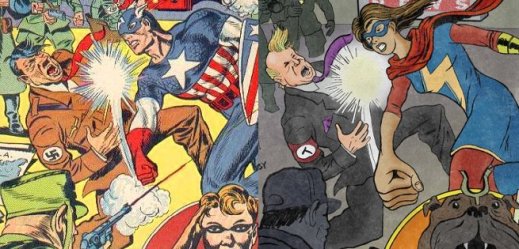
This question remains pressing in today’s climate. In the past year, state-sanctioned violence against indigenous, black, brown, queer and trans people, which has run like rich, nourishing marrow through the backbone of this country, is once again being openly and actively fomented throughout the public sphere by the figures at the apex of state power. In reaction, antifa anarchist groups, responsible for the much-publicized #PunchANazi meme have revived the use of black bloc tactics; along with the rise of “left-leaning” gun clubs, these responses have given renewed currency to the notion of arming up to fight back out of fear, disgust, and rage.
Olympia queer and trans hardcore band G.L.O.S.S. embodies many of these impulses, especially in their most recent (and now final) EP, Trans Day of Revenge. Through calls to direct action and explicit violence, the band rages against every oppressor that has ever crossed its path. On the whole, popular and critical reception to the EP has been positive, even celebratory, due in part to the preceding lineage of music criticism in which the violence of hardcore music is neutralized or intellectualized because of the implicit whiteness of the genre. And, in mirroring both critical and popular reactions to the work of Black Lives Matter and other black social movements, the calls to direct action in rap and hip hop are either discredited or disavowed. In other words, certain white genres of music, and the violence therein, appear to require intellectual analysis or even possess an inherent rationalization. (Dan Graham’s seminal video essay Rock my Religion is an early example of this foundational project in the history of intellectualizing rock.) The mutation into either incredibility or physical threat, on the other hand, accompanies music produced by certain racialized subjects—in America, almost always the black musician. By looking at the critical reception to G.L.O.S.S.’ Trans Day of Revenge, I will examine the dynamic that celebrates the white voice, especially when it calls for violence, as righteous and “metaphysical,” exemplified by the Patti Smith interview in the epigraph (note the use of the uninterrogated second person), and condemns the voice of black rage in rap and hip hop, for its “thuggery.” To question this dynamic is not specific to G.L.O.S.S. but is meant to denaturalize the uneven musical imaginary that supports the white ‘voice’ and smothers the black, as symptomatic of the way in which the political horizons of black political action are foreclosed in favor of righteous white action.
While there may be a seeming disconnect between music criticism and the politics of activism, radical hip hop’s roots in Black Power movements and hardcore and punk’s roots in the politics of white disaffection of the 1970s have both been well-documented. These political-sonic genealogies bind these respective genres to their racialized origins and mark the political stakes of G.L.O.S.S.’ message and its critical reception. The primary difference between the two genres is that the former genre was racialized from the start while the latter remains “unmarked” to this day, despite its early, close connection to white supremacy as documented by, among others, influential rock critic Lester Bangs. Even fascinating work that links and critiques American machismo and hardcore violence completely occludes the valence of race in discussions of masculinity. A closer look at the critical reception to Trans Day of Revenge will help to tease out the ongoing influence of the racialized origins of these two genres on contemporary music and political movements.
To be clear, it is not my intent to moralize the use of violence in leftist social movements. It would be foolish to deny the trans and queer rage that permeates Trans Day of Revenge, and which G.L.O.S.S. literally embody as an apt and poignant expression of a life lived under state-sponsored brutality and domestic abuse. No where is it more poignant than the opening, which is inaugurated with squealing feedback, dense, chugging guitar, and then a strained scream from lead singer Sadie Switchblade: “When peace is just another word for death, it’s our time to give violence a chance!” The four songs that follow, totaling a mere 7 minutes, all tap into the well-established tradition of nihilistic vengeance in G.G. Allin’s “Violence Now—Assassinate the President,” direct aggression in antifa punk in Oi Polloi’s seminal “Pigs for Slaughter” and “Bash the Fash,” and hardcore staples such as Black Flag’s “Police Story” and The Dicks’ “Hate the Police,” which center on booting (or shooting) oppressors in the face. More than that, however, G.L.O.S.S. is intent on smashing the culture of respectability and pacifism of LGBT politics, singing, “Your calls for peace are ignorant and basic / Self-appointed leaders / Who put you in charge?”
In a glowing review that invokes Jose Esteban Muñoz’s Cruising Utopia, Brad Nelson of Pitchfork insists that, “At its best, hardcore is personal; it tends to erase the spatial distinctions between performer and audience, until there is a primordial flow of bodies, ideas, and energy.” Putting aside the cognitive dissonance of quoting Muñoz in a review of an album that urges the use of outright violence, Nelson espouses the grounding liberal, “post-racial” ideology that informs many contemporary conceptions of punk and hardcore. And in doing so, Nelson papers over the racialized history of hardcore while quickly conflating the specificity of state-sanctioned anti-black violence, which G.L.O.S.S. is explicit about, with generalized notions of state oppression. Other reviewers have similarly intellectualized the band’s explicit incitements to violence. Embedded within these glowing reviews, all of which fail to mention the white racial position from which the band speaks and celebrate their calls to violent action, then, is the assumption that white violence is inherently justified because it’s so rare. Put simply, if it’s happening, it’s happening for a good reason. Contrast this with perception that direct action and (self-defensive) violence in both black activism and music reveal some corruption of being, such as an essential “violent character” or the well-worn notion of a savage nature.
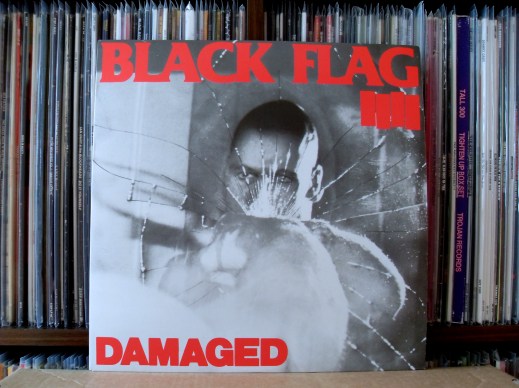
It is certainly possible to argue for trans and queer ways of knowing and creating art that evade these hetero-masculinist histories but this does not seem to be the case here: many reviewers cite the band’s positive influence on hardcore as both genre and scene, work that the band themselves seem invested in. Such interventions in the scene, then, compel us to recognize that the band’s message is channeled through the generic conventions of hardcore, which prime listeners to appreciate the role of violence as a necessary outcome of and antidote to oppression. The main progenitor of this narrative is Black Flag’s Damaged, which invokes the chaotic, uncontrollable violence of white male angst in songs such as “Damaged I.” (Golden Age country music provides an apt analogue with its generic figure of the violent, romantic white outlaw.) Though G.L.O.S.S. rails against murderous gender and sexual violence, they do so by asserting their position in the tradition of white rage that made Black Flag and Minor Threat the deified figureheads of hardcore—though admirable of gender-nonconforming and transfolk to do this work, this tension of lineage is neither addressed nor resolved. In this way, the violent implications of the genre, along with the issue of a privileged white voice, are absorbed and normalized—just a part of the scene.
Indeed, not a single review so much as gestures towards the band’s race, which, as Toni Morrison suggests, codes the neutral as white (whether this is true to their “actual race” or not is not the point—it’s a matter of perception). This is all the more glaring as multiple songs encourage fighting racist police violence against black trans women; yet this message inhabits a continuum of hardcore and punk that has long held an equivocal relationship with white supremacy, which has often been positioned as either a simple matter of white male disillusionment or edgy nihilism. And while there has certainly been anti-racist music in hardcore, the message becomes mixed by veneration of and apologias for songs such as Minor Threat’s “Guilty of Being White” and Black Flag’s “White Minority.” This muddled message appears in G.L.O.S.S.’ work as well. During the opening track, Switchblade screams: “anti-racist doesn’t mean non-racist!” The lyric may be a riff on a Guardian video by Marlon James in which he insists that “non-racist doesn’t mean anti-racist.” He asserts that non-racism (non-action, moral statement of belief) is inadequate since it does not prevent racial violence. Instead, one must go further and adopt an anti-racist (active) stance. G.L.O.S.S.’ inversion of James’ formulation in the context of hardcore and punk, however, reads with an added bit of irony: if even active anti-racist action does not preclude one from holding racist views, then this highlights the submerged racial dynamics of voice that hold up G.L.O.S.S.’ violent aesthetic and that elude the onslaught of sloganeering that shape their lyrics.
Certainly G.L.O.S.S. screaming the refrain “black lives don’t matter in the eyes of the law!” is critical work being done to highlight anti-black violence and their commitment to addressing oppression of all kinds. But it does not preclude them from criticism for benefiting from structural racism, which includes enjoying the unquestioned privilege of being feted for advocating extreme violence rather than, say, being placed on an FBI watchlist. Simply put, the band has the option of espousing this violence from a position of relative safety, especially from state-sanctioned repercussion and harassment. These unnuanced lyrics make it all the more difficult to square some of their anti-racist lyrics with their intersectional politics. The generic bounds of hardcore dictate crafting lyrics like volleys of missiles, and here such pithy concision becomes an easy conflation of anti-black, anti-queer, anti-trans, and anti-femme oppressions that threatens, ironically, to erase the hard work and frequent clash of axes of oppression in the formation of transversal alliances rather than support it.

If the new hardcore that G.L.O.S.S. spearheaded intends to responsibly involve itself in social justice, the lyrics must move beyond sloganeering. The continued submersion of the multiple and complex intersections of race in white activism is an elision that performs its own form of silencing, a repression of a black voice that has long and often erupted into righteous anger and violence. Scholar Tricia Rose provides an extensive history and analysis of this dynamic in in Hip Hop Wars. In addition to Rose, many scholars from Houston A. Baker to Nelson George, have noted the deep indebtedness of early gangsta rap and radical hip hop (Public Enemy and dead prez, for example) to the tradition of anti-passive philosophies of Malcolm X, the Black Panthers, and earlier pre-Civil Rights movement radicals. Due to these genre’s callback and conscious inhabitation of the genealogy of the black resistance in order to address the historical nature of their continued material oppression, critical responses to this music focus largely on the music’s racial aspects (unlike G.L.O.S.S., or hardcore music in general). Consequently, the condemnation of violent action against oppression rather than celebratory accreditation is always couched in the fear of the black voice and active body.
This dynamic is nowhere clearer than the press’ reaction to Ice-T’s side project Body Count, which featured the controversial song “Cop Killer.” Ice-T has stated that the album as a whole was meant to actively invoke the sonic cues of not only hardcore but metal (also known for its troubled relationship to white supremacist politics) the mainstream media applied the label of “rap” to it in order to identify the violence as both gendered and racialized, that is, more closely with a black, male genre of music, with all that that entails to American society. Ice-T’s transgressive identification of black genres of music in the epigraph, “music like mine,” with the originary, rebellious violence of the Revolutionary War speaks to the divide within the American imaginary between “justified” revolutionary, white violence, and corrupted black violence. He observed:
There is absolutely no way to listen to the song “Cop Killer” and call it a rap record. It’s so far from rap. But, politically, they know by saying the word rap they can get a lot of people who think, “Rap-black-rap-black-ghetto,” and don’t like it…They don’t want to use the word rock & roll to describe this song. (qtd. in Rose 130)
In contrast to criticism of heavy metal, Rose, in Black Noise: Rap Music and Black Culture in Contemporary America, explains, “The terms of the assault on rap music are part of a long-standing sociologically based discourse that considers black influences a cultural threat to American society” (130). She explains, young fans of rap are themselves in concert with the music, ready agents of destruction whereas heavy metal is a threat to the fans, young white males, inherently innocent but in danger of corruption. Put simply, the dynamics of racialized music criticism reflect the attitudes of society writ large: the dismissal of the righteousness of violence in black genres of music mirror the same in black social movements or personal survival.
Across the spectrum of black musical genres, we see the same dynamic. Beyoncé, a master of combining maximalist visuals, nuanced political messages, and hyper-popular culture, was greeted with boycotts and protests after her performance at Super Bowl 50, which invoked a Black Panther aesthetic and, presumably, the group’s promotion of anti-passive and self-defense ideologies. Similarly, she faced a backlash to her music video for Formation, which was perceived as “anti-police” and resulted in an attempted nationwide police boycott of her Formation World Tour. Outside the strict confines of the music industry, black folks, especially black transwomen of color, are held to a different standard in eschewing the avenues of violent protest and activism—or even self-defense (see the tragic case of CeCe McDonald). In a seven-minute EP, G.L.O.S.S. highlights the continued violence against black transwomen in their work, which is positive, critical work. But the uneven reception of black political music by the American public proves just how fraught that project can be without full knowledge of one’s positions of privilege, or the history from which one speaks.
OUTRO
In the end, this issue of voice is about political horizons. G.L.O.S.S. is entirely future-oriented: Switchblade sings, “we break the cycle with revenge,” the band’s name stands for Girls Living Outside of Society’s Shit, and their first EP features a song called “G.L.O.S.S. (We’re from the Future).” But just how much do their actions refuse repetition?
Jose Muñoz was no stranger to witnessing and experiencing the horrors of anti-queer police brutality. In Cruising Utopia he recalls the brutality of riot police attacking a peaceful vigil after the murder of Matthew Shepard (while recognizing that “if Shepard had not been a pretty white boy, there would have been no such outcry”) (63). Muñoz fights against the violence of the “here and now,” the quagmire of political expediency, which is analogous to G.L.O.S.S.’ anger at the pragmatism of LGBT politics. Yet, in a very real way, violence at all costs can be considered a “political expediency” of its own for what occurs after violence? Is revenge and ultra-violence as sole response really “breaking the cycle”? In the rush to implement such violence, who is left by the wayside as we seize and assert our power? This is a question of effectivity, not morality.
For his part, Muñoz insists on breaking the cycle of the present by citing the use of “queer anger” through activism as public performance (64). This is the means toward utopian possibility, that imagines otherwise in a violent, repressive heteronormative present. But he stops short of arguing that queers must take up arms. The critique often levied against revolutionary utopian theorizing has been the obviation of the conditions of “the post-revolution” in favor of dreamy, uncritical rhetoric. Indeed, the same can be said here in the case of G.L.O.S.S. and all others who uncritically embrace not only outright violence but also intersectional politics blanched of much-needed nuance. As a vehicle to bringing trans and queer folk together, G.L.O.S.S.’ rage is a form of Muñoz’s ‘public performance’; they have poignantly invoked his “critical dissatisfaction.” But the generic bounds of hardcore preclude a nuanced conception of his “collective potentiality” (189), particularly one that is attentive to the racial hierarchies of voice. In short, there are yet songs to be sung. Though they have disbanded, we can thank G.L.O.S.S. for helping to set the stage.
–
Cover image is G.L.O.S.S. by Sid Sowder @Flickr CC BY-NC-ND.
—
Chris Chien is an American Studies and Ethnicity graduate student at the University of Southern California, and is doing research on early Asian gay and lesbian organizing in North America, and these social movements’ place within contemporary transpacific, diasporic narratives of a liberalizing Asia, particularly Hong Kong. He has previously written on Sounding Out! about the sonic materiality of diasporic feeling through the relic of the cassette tape, and has an upcoming article on righteous white violence in the music of trans-hardcore band G.L.O.S.S. He hadn’t seen Moonlight or even a trailer before this screening, but heard from many people he respects that it was magical. When SO! ed-in-chief JS reached out after seeing him post about attending on FB, he immediately embraced the idea of a conversation with Shakira.
–

REWIND! . . .If you liked this post, you may also dig:
Listening to Punk’s Spirit in its Pre-, Proto- and Post- Formations – Yetta Howard
Feeling Through the Keen and Grind: Team Dresch’s Personal Best – Gretchen Jude
Riot-Grrrl, Punk and the Tyranny of Technique – Tamra Lucid
—
Share this:

Surf, Sun, and Smog: Audio-Visual Imagery + Performance in Mexico City’s Neo-Surf Music Scene

DOI: https://doi.org/10.59350/jcryd-ng498
Riding the Surf Wave in a City Without a Seashore
On April 24, 2005, at Zócalo square in downtown Mexico City, the Surf y Arena music festival gathered around 100,000 people and nine bands, ranging from local, barely known groups to big names in the new-wave surf music scene: Fenómeno Fuzz, Los Magníficos, Perversos Cetáceos, Espectroplasma, Los Elásticos, Yucatán A Go-Go, Sr. Bikini, Lost Acapulco, and Los Straitjackets, the latter being the only U.S. band in the festival. One year before, hardly more than a thousand people attended the event, organized in a smaller venue at Alameda del Sur, a few hundred yards south of Zócalo square. Perhaps not even the bands were prepared for the huge response in 2005. Interviewed by local newspaper La Jornada, Fenómeno Fuzz lead guitarist stated, “It’s the first time we see something like this, with so many people. Surf is an instrumental rock genre that was played in the 50s and 60s. There is no sand or sun here as in Acapulco, but we’ve brought downtown a bit of the beach vibe. In Mexico City there must be some 40 bands playing to this rhythm.” In the same interview piece, Lost Acapulco lead guitarist El Reverendo considered, “this festival is a success, for you realize this music is going up. People are on the same pitch. This is not a movement, but a style with many followers. […] It doesn’t matter if there is no beach here—you have to imagine it.”
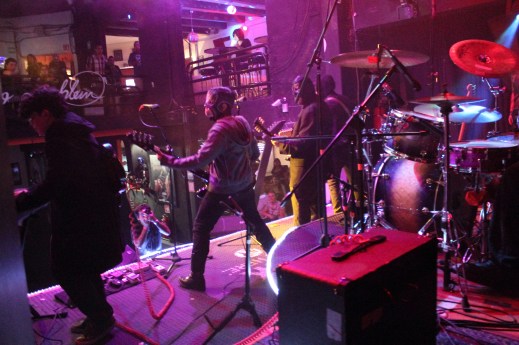
The bands who played at the 2005 Surf y Arena Festival wondered whether the success was transitory or would endure. More than a decade later, some are still active, most notably Lost Acapulco, whose singles and compilations have been released in countries like Spain, Italy, and Japan; they have toured around the world, and have released a new EP, Coral Riffs (2015). Los Straitjackets lead guitarist Danny Amis has collaborated with local surf bands like Lost Acapulco and Twin Tones; after surviving a hard battle against cancer, he moved to Mexico City’s Chinatown. Los Elásticos also released a new album, Death Calavera 2.2, the Espectroplasma members formed Twin Tones and have played, toured and participated in the short film inspired by their first record, Nación Apache. In 2016, the Wild’O Fest brought together old and new surf stars, starring The Fleshtones (U.S.) and Wau y los Arrrghs! (Spain), as well as local legends Los Esquizitos and Lost Acapulco. In February 2017, the Russian band Messer Chups toured across Mexico, playing with local bands in several cities. So it seems the scene is alive and kicking.
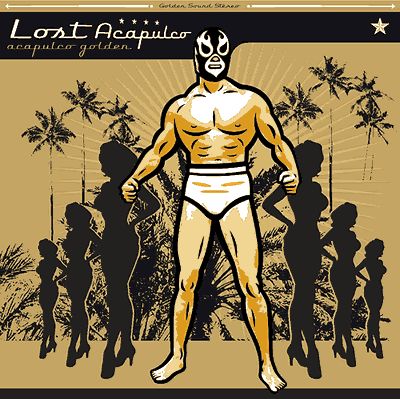
Today we can listen to how surf music shaped part of Mexico City’s underground music scene in the last decade of the 20th century and the early 21st. Being 235 miles away from Acapulco, one might wonder how wearing sandals, short pants, floral print shirts, plastic flower necklaces, and dark sunglasses became trendy in the country’s capital city. To this beach imagery, surf bands and fans added references to classic Mexican media icons, like wrestler Santo, comedian Mauricio Garcés, and black and white sci-fi movies. The work by visual artists like Dr. Alderete—who has designed covers and posters for many surf bands, such as Lost Acapulco, Fenómeno Fuzz, Telekrimen, The Cavernarios, Los Corona, among others—has been crucial for this imagery cross-reference process.

In this article I portray the neo-surf music scene in Mexico as a cultural-musical set of audiovisual and performative traits shared, modified, and transmitted by the scene’s partakers. It cannot be said there is a surf music “urban tribe” (a trendy concept for several years in Mexican youth studies), but rather shared “aesthetic” expressions of cultural syncretism, responding to the increase of atomization and alienation in Mexico City.
Just as in ska, punk, or hardcore rock, a number of surf concert attendees participate in typical genre-related rituals like moshing. Surf fans, however, are more “performatic” in the way Diana Taylor understands this term in The Archive and the Repertoire as “the adjectival form of the nondiscursive realm of performance” (6). Several surf concert goers wear masks, originally worn by notorious Mexican wrestlers like Santo, Blue Demon, and Rey Misterio (whose son would later become a WWE star). At the concert, when a song’s tempo suddenly stops or changes, masked dancers pose as if weightlifting, jump and crowd surf, stage fights, and mimic swimming movements. Surf music is the lyric-less soundtrack for the intertwined performance of different cultural traits, portraying a prolific tension between a hedonistic attitude associated with an invented nostalgia for West Coast surf culture, and the halo of exoticness surrounding Mexican culture in the U.S. imaginary, as portrayed by surf bands and artists (just to name a few, Herb Albert’s “Tijuana Taxi,” Link Wray’s “Tijuana,” and Los Straitjackets’ “Tijuana Boots”).
Mosh pit with masked participants. On stage, Lost Acapulco plays “Frenesick.” Multiforo Alicia, Mexico City, March 20 2009.
Tracing the Origins of Mexican Neo-Surf Music Scene
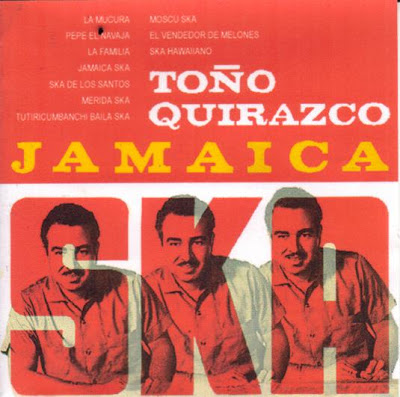
1960s Mexican rock and garage bands do not usually have instrumental songs in their repertoire, as is the case with Los Sleepers, or Los Rockin’ Devils. However, there are some examples of incursions in surf-related instrumentals, such as Los Teen Tops’ “Rock del diablo rojo,” or Los Locos del Ritmo’s “Morelia.” It was not until Toño Quirazco (1935-2008) formed Quirazco y sus Hawaian Boys, though, that we find a Mexican instrumental song, “Surf hawaiiano,” explicitly using the noun “surf” as an identity marker, just like “Traveling Riverside Blues,” or “Jailhouse Rock”. The use of a pedal steel guitar (portrayed in their 1965 eponymous album cover photo), and its association to Hawaiian music through the slide guitar method, makes exotism an early sonic feature of Mexican surf. Born in Xalapa, Veracruz, Quirazco was not as famous as Los Teen Tops or Los Locos del Ritmo, but he is a key forerunner not only of surf music, as he is also known for having introduced ska to Mexican audiences, with songs like “Jamaica Ska” and “Ska hawaiano,” both off his album Jamaica Ska, also from 1965.
Although surf music bands suffered heavily with the arrival of the British Wave, not all of them disappeared. Bands such as The Ventures became famous for covering surf standards. Others, like The Beach Boys, eventually migrated to different music styles. Later in the 1970s and 80s, bands like The Cramps, The Stray Cats, and The Go-Go’s kept alive surf-related styles, so that by the time Pulp Fiction appeared, in 1994, there were some interesting bands we already can consider “neo-surf,” such as Man Or Astroman? and The Tantra Monsters; Los Straitjackets re-formed and Dick Dale began touring again. Quentin Tarantino’s soundtrack to Pulp Fiction (including songs by Southern California surf rockers Dale, The Tornadoes, The Revels, The Centurians, and The Lively Ones) contributed to bringing surf music back to mainstream attention, now as a vintage sound commodity (Norandi, 2002).
We might call this “the Pulp Fiction effect,” a phenomenon recognized by stakeholders in the scene, like Los Esquizitos guitar and theremin player Güili:
One day Nacho came up with the idea that we should play surf, because it was the moment in which […] in Satélite [a northern Mexico City neighborhood ] all bands wanted to play funk like Red Hot Chili Peppers or Primus. It became a virtuoso slap competition, and precisely no one was playing surf […]. Shortly afterwards, Tarantino’s Pulp Fiction was released and surf exploded impressively with the movie’s theme. But we were already riding the surf wave.
Multiforo Alicia has been an important venue for the consolidation not only of a surf scene, but also of other emerging movements at the time. Founder and owner Ignacio Pineda remembers,
When we started Multiforo Alicia [in 1995], there was a generational shift. There were a lot of new bands that didn’t fit into what had been going on in the last 10 or 11 years, and they were the punk rock, ska, hip-hop, transmetal, emo, and nu metal movements, which nowadays are quite normal. […] Luckily for us, [Alicia] was like home for all of them.
Interview with Multiforo Alicia owner Ignacio Pineda, 2011
It is a common venue for surf bands (Norandi, 2002, Caballero, 2012), and through their recording label, Grabaxiones Alicia, they have produced albums for some of the most interesting instrumental rock projects in Mexico, among them Twin Tones/Espectroplasma/Sonido Gallo Negro (three groundbreaking bands with the same members), Los Esquizitos, Los Magníficos, Telekrimen, The Cavernarios, and Austin TV. Massive festivals and concerts, like Vive Latino or Surf y Arena, have also contributed to positioning neo-surf as an ongoing trend in alternative rock.
Masking Identity, Performing Difference
While the emergence of Mexican neo-surf was contingent upon local and international music trends in the mid-90s, its permanence has been due to processes of cultural syncretism and appropriation. Wrestler masks are a good example. Worn first by Danny Amis, and later on by Los Esquizitos and Lost Acapulco, masks quickly spread out as a neo-surf visual icon. Los Esquizitos drum player, Brisa, doesn’t remember there being an aesthetic justification behind the masked man using a chainsaw portrayed in their first album cover. Nacho complains, “Argh! We created a monster unawares! Ah, I sometimes regret that. I really regret having worn masks at a concert.”
Los Esquizitos greatly contributed to blend a Mexican surf flavor through their imagery on stage, as well as with their most emblematic song, “Santo y Lunave.” One of the few songs with lyrics in the scene (and with spoken word rather than singing), it tells story of how Santo got lost in space, turning him into an important figure of Mexican neo-surf imagery. As Güili recognizes, “I think it was after the ‘Santo’ song when all the Tetris pieces fit perfectly into place—wrestling, masks, floral print shirts, surf— everything in the same box.”
Live version of “Santo y Lunave” by Los Esquizitos, Vive Latino Music Festival, Mexico City, May 17, 2009. The song was originally released in their first LP (1998)
“Performatic” moshing is another example of cultural appropriation. The apparently random movements of moshers in heavy metal concerts have been compared to the kinetics of gaseous particles (as in Silverberg, Bierbaum, Sethna & Cohen’s “Collective Motion of Moshers”) but in surf concerts their movements cannot be reduced to the categories of “self-propulsion,” “flocking” and “collision.” Here moshers interact in more complex ways, mimicking wrestling movements to the rhythm of the song in turn, enacting fights between masked and unmasked opponents, and helping other moshers to jump over the audience and crowd surf. They consciously perform the icons they associate with surf culture. They are aware of the differential traits existing between this and other rock sub-genres, and they externalize them through ritualized behaviors. In other words, Mexican surf concert goers adopt moshing to participate in simulacra about stereotyped representations of Mexican culture and subjects.
Dancing Desires
In his book Popular Music: The Key Concepts (2nd ed), Roy Shuker describes surf as “Californian good time music, with references to sun, sand and (obliquely) sex” (2005, 262). This sexual suggestiveness is still present in Mexican neo-surf, as can be noticed in songs like Fenómeno Fuzz’s “El bikini de la chica popof” [“The Snob Girl’s Bikini”]:
Ella viene caminando en su bikini de color,
ella viene caminando y a todos nos da calor,
y sus piernas bien bronceadas me hacen suspirar.
Ella viene caminando y no ve a nadie más.
[She’s walking by, wearing her colorful bikini,
she’s walking by and everyone gets hot,
and her well-tanned legs make me sigh.
She’s walking by and doesn’t look at anyone else]
Other bands seem to reinforce this fetishization. Sr. Bikini have sometimes hired women dancers wearing masks and bikinis for their shows, and Los Elásticos have a permanent member, La Chica Elástica, who dances in every live show.
[Final part of a Los Elásticos concert in 2012, featuring La Chica Elástica. All-men and all-women mosh pits can be seen at 0:40 and 3:36.]
However, even though sometimes subject to hedonistic and stereotyped representations, women participate in every level of the scene, expressing agency as band members, scenemakers, and/or fans. Women play in the most representative bands, such as Fenómeno Fuzz’s former singer and bass player, Biani, or Los Esquizitos drummer, Brisa. There are also all-woman bands, such as Las Agresivas Hawaianas (whose brief existence is scarely documented on the internet), rockabilly trio Los Leopardos, and garage-oriented Ultrasónicas, whose members have continued playing solo, most notably Jessy Bulbo.
Offstage, both genders wear masks and enter the pit. Sometimes, when there are many moshers, men and women gather in separate pits. Dancing is much more prominent in the surf scene than in punk; participants appropriate a go-go, swing, rock ‘n’ roll, and ska dancing moves, mixing them with wrestling and weightlifting positions. The attendees accomplish their middle-class expectations of leisure and entertainment by showing off their outfits, feeling desire, desired and/or admired (even if ironically) through dancing and moshing—literally by performing such expectations in situ.
The scene overall, has been critiqued for being too retro and insulated from political critique. As La Jornada‘s Mariela Norandi points out, “an element that the Mexican movement has inherited from the origins of surf is the lack of ideology. Curiously, surf is reborn in Mexico in a moment of political and social unrest [in the mid-90s], with the Zapatista uprising, the peso devaluation, Colosio’s murder, and Salinas’ escape” (2002, 6a). The fact that this scene has survived for over two decades, despite the many economic and political crises Mexico has faced ever since, suggests it works as an ideological outlet for scene partakers to elude their social reality. Just as it happened in the 60s with the Vietnam War, once again surfers stay away from social and political problems, and reclaim their right to have fun and dance. They wear their floral print shirts and dance a go-go style, remembering those wonderful 60s (6a). For Norandi, the lack of lyrics in surf music may be partly responsible for most surf bands seemingly uncritical position.
Into the Surf Sound
Although half of Mexico’s states have a seashore, surf music in the capital is related to everything but actual surfing. The imagery built around it, considered “surrealistic” by Norandi (6a), is the most visible novelty in the new scene, since melodically and rhythmically speaking surf remains fairly simple, like garage or punk. However constrained, like other genres, to the 12-bar blues progression, it is in timbre where we appreciate how surf sound has been defined by several generations of music bands and players. A triple-level approach to surf music (timbral, melodic, and stylistic) can account for the creation and development of several genres or scenes associated to the rise of Mexican neo-surf, like chili western (Twin Tones, Los Twangers, The Sonoras), space surf (Espectroplasma, Telekrimen, Megatones), garage (Ultrasónicas, Las Pipas de la Paz) and rockabilly (Los Gatos, Eddie y Los Grasosos, Los Leopardos, among many others).
Appropriation, practiced through covering standards and imitating riffs and melodies, has been always crucial for shaping the surf sound, just as it was in preceding genres that influenced rock ‘n’ roll, like blues, twist, and jazz. Although not exactly referred to as “surf standards,” there are some foundational songs that shaped the surf sound. Three pieces nowadays still debated as the first surf song—Duane Eddy’s “Rebel Rouser,”Link Wray’s “Slinky,” and Dick Dale’s “Miserlou”—influenced not only contemporary bands and their immediate successors, but also musicians in the ’90s wave.
These and other composers contributed collectively to establishing surf music’s standard traits: the 4/4 drum beat (whose earliest template may be Dale’s “Surf Beat”), the “wavy guitar” riff (perfectly illustrated in the beginning of The Chantay’s “Pipeline”), an extensive use of reverb, and the appropriation of “exotic” tunes (such as the Lebanese melody that inspired Dale’s tremolo style in “Miserlou”). Many surf songs contain, in particular, traits from “Slinky’s” guitar and “Surf Beat’s” drums. Both are simple and repetitive, but can be combined with other arrangements at will. This formula has been used in countless surf songs ever since.
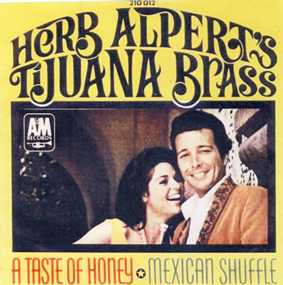
Covering is a way of making connections with specific songs, and paying homage to (or deflating) admired bands and musicians. Links between a band and certain collaboration networks are thus established. Sr. Bikini covered Alpert’s instrumental version of The Beatles’ “A Taste of Honey,” setting up a dialogue with a musician that played a lot with Mexican stereotyped imagery and sounds (like the trumpets, substituted by electric guitars in Sr. Bikini’s version).
Lost Acapulco renamed The Trashmen’s “Surfin’ Bird” as “Surfin’ Band,” participating in a long chain of covers (including The Cramps and The Ramones) of a song that in turn was the result of mixing two pieces by The Rivingtons, “Bird’s The Word” and “Papa Oom Mow Mow.” Los Esquizitos have their own covers of The Cramps’ “Human Fly” (“El moscardón”) and Rory Erickson’s “I Walked With A Zombie.”
Los Magníficos’ “Píntalo de negro,” after The Rolling Stone’s “Paint It Black,” shows that, just as in punk, any piece can be turned into a surf song.
Sometimes it is just a trait (a riff, or a beat) that is referenced. Fenómeno Fuzz’s initial riff in “Tiki Twist” resembles Chuck Berry’s “Johnny B. Goode,” whereas two chili western songs (“Transgenic Surfers” by Los Twangers and “Skawboy” by The Bich Boys) echo The Ramrods’ harmonic and timbral arrangements for “Riders In The Sky,” another song with a long cover history, including Dale, Johnny Cash, and Elvis Presley. A surf version of this song was familiar to Mexican TV viewers in the 90s, since it was a regular soundtrack of furniture store Hermanos Vázquez spots.
Surf was born at a time when stand-alone effects units were just about to change the way music was made, taking audio manipulation off the studio and bringing it to the stage. For example, The Shadows are known for having used the tape-based Watkins Copicat, “the first repeat-echo machine manufactured as one compact unit” according to Steve Russell, responsible for the guitar delay effect in their 1960 rendition of Jerry Lordan’s “Apache,” since then a surf standard. In his book Echo and Reverb, for example, Peter Doyle examines how effects like echo/delay and reverb shaped sonic spatiality in 20th century popular music recording in the U.S., from hillbilly, country, blues, and jazz to rock ‘n’ roll.
Although Doyle only dedicates a few paragraphs to Dale, Wray, and surf instrumentals, acoustic effects greatly contributed to characterize their styles as well. Some traits are intricately related to genre specific manifestations, like the double bass in rockabilly, or the twang effect in chili western. Timbre, then, is the aural counterpart to the scene’s visual aspect, “invoking the rich semiotic traditions that wove through southern and West Coast popular music recording” (Doyle, 2005, 226). It has become a way both to continually define the genre and, in the Mexical neo-surf scene in particular, to overcome melodic and harmonic limitations. Thanks to timbral play, what used to be a blind alley in rock history became in the 1990s a mirror for young generations of Mexicanos to create and feel aligned with fashionable trends, and a sonic filter enabling them to examine their social situations and, sometimes, to willfully sidestep them.
—
Featured Image: Lost Acapulco in Estadio Azteca 2009, Image by Flickr User Stephany Garcia (CC BY-ND 2.0).
—
Aurelio Meza (Mexico City, 1985) is a PhD student in Humanities at Concordia University, Montreal. Co-organizer of the PoéticaSonora research group at UNAM, Mexico City, where he is in charge of designing and developing a digital audio repository for sound art and poetry in Mexico since 1960. Author of the books of essays Shuffle: poesía sonora (2011) and Sobre Vivir Tijuana (2015). Blog: http://aureliomexa.wordpress.com/
—
REWIND! . . .If you liked this post, you may also dig:
Share this:




Current Top Posts





April 2021

January 2020

November 2019

October 2019

August 2019

April 2014

November 2017

March 2015

December 2017

October 2015


Recent Comments