
The Firesign Theatre’s Wax Poetics: Overdub, Dissonance, and Narrative in the Age of Nixon

The Firesign Theatre are the only group that can claim among its devoted fans both Thom Yorke and John Ashbery; who have an album in the National Recording Registry at the Library of Congress and also coined a phrase now used as a slogan by freeform giant WFMU; and whose albums were widely distributed by tape among U.S. soldiers in Vietnam, and then sampled by the most selective classic hip hop DJs, from Steinski and DJ Premier to J Dilla and Madlib.
Formed in 1966, they began their career improvising on Los Angeles’s Pacifica station KPFK, and went on to work in numerous media formats over their four-decade career. They are best known for a series of nine albums made for Columbia Records, records that remain unparalleled for their density, complexity, and sonic range. Realizing in an astonishing way the implications of the long playing record and the multi-track recording studio, the Firesign Theatre’s Columbia albums offer unusually fertile ground for bringing techniques of literary analysis to bear upon the fields of sound and media studies (and vice versa). This is a strategy that aims to reveal the forms of political consciousness that crafted the records, as well as the politics of the once-common listening practices binding together the disparate audiences I have just named. It is no accident that the associative and referential politics of the sample in “golden age” hip hop would have recognized a similar politics of reference and association in Firesign Theatre’s sound work, in particular in the group’s pioneering use of language, time, and space.

The Firesign Theatre (wall of cables): John Rose, Image courtesy of author
The Firesign Theatre is typically understood as a comedy act from the era of “head music” — elaborate album-oriented sounds that solicited concerted, often collective and repeated, listening typically under the influence of drugs. But it may be better to understand their work as attempting to devise a future for literary writing that would be unbound from the printed page and engaged with the emergent recording technologies of the day. In this way, they may have crafted a practice more radical, but less recognizable, than that of poets —such as Allen Ginsberg or David Antin, both of whose work Firesign read on the air — who were also experimenting with writing on tape during these years (see Michael Davidson’s Ghostlier Demarcations: Modern Poetry and the Material Word, in particular 196-224). Because their work circulated almost exclusively on vinyl (secondarily on tape), it encouraged a kind of reading (in the strictest sense) with the ears; the fact that their work was distributed through the networks of popular music may also have implications for the way we understand past communities of music listeners as well.
The period of Firesign’s contract (1967-1975) with the world’s largest record company parallels exactly the recording industry’s relocation from New York to Los Angeles, the development of multitrack studios which made the overdub the dominant technique for recording pop music, and the rise of the LP as a medium in its own right, a format that rewarded, and in Firesign’s case required, repeated listening. These were all factors the Firesign Theatre uniquely exploited. Giving attention to the musicality of the group’s work, Jacob Smith has shown (in an excellent short discussion in Spoken Word: Postwar American Phonograph Cultures that is to date the only academic study of Firesign) how the group’s attention to the expansion of television, and in particular the new practice of channel-surfing, provided both a thematic and a formal focus for the group’s work: “Firesign […] uses channel surfing as the sonic equivalent of parallel editing, a kind of horizontal or melodic layering in which different themes are woven in and out of prominence until they finally merge. Firesign also adds vertical layers to the narrative in a manner analogous to musical harmony or multiple planes of cinematic superimposition” (181). But more remains to be said not only about the effect of the Firesign Theatre’s work, but about its carefully wrought semantics, in particular the way the “horizontal” and “vertical” layers that Smith identifies were used as ways of revealing the mutually implicated regimes of politics, culture, and media in the Vietnam era — at the very moment when the explosion of those media was otherwise working to disassociate those fields.
The group’s third album, Don’t Crush That Dwarf, Hand Me the Pliers is typically understood as their first extended meditation on the cultural phenomenology of television. Throughout the record, though there is much else going on, two pastiches of 1950s genre movies (High School Madness and a war film called Parallel Hell!) stream intermittently, as if through a single channel-surfing television set. The films coincide in two superimposed courtroom scenes that include all the principal characters from both films. By interpenetrating the school and the war, the record names without naming the killing of four students at Kent State and two students at Jackson State University, two events that occurred eleven days apart in May 1970 while the group was writing and recording in Los Angeles. Until this point rationalized by the framing fiction of a principal character watching both films on television, the interpenetration of the narratives is resolvable within the album’s diegesis—the master plot that accounts for and rationalizes every discrete gesture and event—only as a representation of that character’s having fallen asleep and dreaming the films together, a narrative sleight of hand that would testify to the group’s comprehension of literary modernism and the avant-garde.
The question of what may “cause” the interpenetration of the films is of interest, but the Firesign Theatre did not always require justification to elicit the most outrageous representational shifts of space (as well as of medium and persona). What is of more interest is the way rationalized space — the space implied by the “audioposition” of classic radio drama, as theorized by Neil Verma in Theater of the Mind— could be de-emphasized or even abandoned in favor of what might instead be called analytic space, an aural fiction in which the institutions of war and school can be understood as simultaneous and coterminous, and which more broadly represents the political corruptions of the Nixon administration by means of formal and generic corruption that is the hallmark of the Firesign Theatre’s approach to media (35-38).
While the techniques that produce this analytic soundscape bear some resemblance to what Verma terms the “kaleidosonic style” pioneered by radio producer Norman Corwin in the 1940s — in which the listener is moved “from place to place, experiencing shallow scenes as if from a series of fixed apertures” — even this very brief sketch indicates how radically the Firesign Theatre explored, deepened, and multiplied Corwin’s techniques in order to stage a more politically diagnostic and implicative mode of cultural interpretation. Firesign’s spaces, which are often of great depth, are rarely traversed arbitrarily; they are more typically experienced either in a relatively seamless flow (perspective and location shifting by means of an associative, critical or analytical, logic that the listener may discover), or are instead subsumed within regimes of media (a radio broadcast within a feature film which is broadcast on a television that is being watched by the primary character on the record album to which you are listening). According to either strategy the medium may be understood to be the message, but that message is one whose horizon is as critical as it is aesthetic.

Firesign Theatre (pickup truck): John Rose, Image courtesy of author
The creation of what I am terming an analytic space was directly abetted by the technological advancement of recording studios, which underwent a period of profound transformation during the years of their Columbia contract, which spanned the year of The Beatles’s Sergeant Pepper’s Lonely Hearts Club Band (arguably the world’s first concept album, recorded on four tracks) to Pink Floyd’s Wish You Were Here (arguably that band’s fourth concept album, recorded on 24 tracks). Pop music had for years availed itself of the possibilities of recording vocals and solos separately, or doubly, but the dominant convention was for such recordings to support the imagined conceit of a song being performed live. As studios’ technological advances increased the possibilities for multitracking, overdubbing, and mixing, pop recordings such as Sgt. Pepper and the Beach Boys’ Pet Sounds (1966) became more self-evidently untethered from the event of a live performance, actual or simulated. In the place of the long-dominant conceit of a recording’s indexical relation to a particular moment in time, pop music after the late 60s came increasingly to define and inhabit new conceptions of space, and especially time. Thus, when in 1970 Robert Christgau asserted that the Firesign Theatre “uses the recording studio at least as brilliantly as any rock group” (and awarding a very rare A+), he was remarking the degree to which distortions and experiments with time and space were if anything more radically available to narrative forms than they were to music.
The overdub made possible much more than the simple multiplication and manipulation of aural elements, it also added depth and richness to the soundfield. New possibilities of mixing, layering, and editing also revealed that the narrative representation of time, as well as spatial element I’ve just described, could be substantially reworked and given thematic meaning. In one knowing example, on 1969’s How Can You Be in Two Places at Once When You’re Not Anywhere at All, an accident with a time machine results in the duplication of each of the narrative’s major characters, who then fight or drink with each other.
This crisis of the unities is only averted when a pastiche of Franklin Delano Roosevelt interrupts the record’s fictional broadcast, announcing the bombing of Pearl Harbor, and his decision to surrender to Japan. On a record released the year the United States began secret bombing in Cambodia, it is not only the phenomenological, but also the social and political, implications of this kind of technologically mediated writing that are striking: the overdub enables the formal representation of “duplicity” itself, with the gesture of surrender ironically but pointedly offered as the resolution to the present crisis in Southeast Asia.
To take seriously the Firesign Theatre’s experiments with medium, sound, and language may be a way of reviving techniques of writing — as well as recording, and of listening — that have surprisingly eroded, even as technological advances (cheaper microphones, modeling software, and programs from Audacity and Garage Band to Pro Tools and Ableton Live) have taken the conditions of production out of the exclusive purview of the major recording studios. In two recent essays in RadioDoc Review called “The Arts of Amnesia: The Case for Audio Drama Part One” and “Part Two,” Verma has surveyed the recent proliferation of audio drama in the field of podcasting, and urged artists to explore more deeply the practices and traditions of the past, fearing that contemporary aversion to “radio drama” risks “fall[ing] into a determinism that misses cross-fertilization and common experiment” (Part Two, 4). Meanwhile, Chris Hoff and Sam Harnett’s live performances from their excellent World According to Sound podcast are newly instantiating a form of collective and immersive listening that bears a resemblance to the practices that were dominant among Firesign Theatre listeners in the 1960s and 70s; this fall they are hosting listening events for Firesign records in San Francisco.
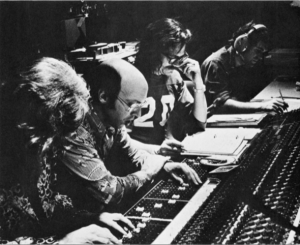
The Firesign Theatre (mixing board): Bob & Robin Preston, Image courtesy of author
It is tempting to hope for a wider range of experimentation in the field of audio in the decade to come, one that either critically exploits or supersedes the hegemony of individualized listening emblematized by podcast apps and noise-cancelling headphones. But if the audio field instead remains governed by information-oriented podcasts, leavened by a subfield of relatively classical dramas like the very good first season of Homecoming, a return to the Firesign Theatre’s work can have methodological, historical, and theoretical value because it could help reveal how the experience of recorded sound had an altogether different political inflection in an earlier era. Thinking back to the remarkably heterogeneous set of Firesign Theatre fans with which I began, it is hard not to observe that the dominant era of the sample in hip hop is one where it was not the Walkman but the jambox — with its politics of contesting a shared social space through collective listening — was the primary apparatus of playback. However unwished- for, this determinist line of technological thinking would clarify the way media audiences are successively composed and decomposed, and show more clearly how, to use Nick Couldry’s words in “Liveness, ‘Reality,’ and the Mediated Habitus from Television to the Mobile Phone,” “the ‘habitus’ of contemporary societies is being transformed by mediation itself” (358).
—
Featured Image: The Firesign Theatre (ice cream baggage claim): John Rose, courtesy of author.
—
Jeremy Braddock is Associate Professor of English at Cornell University, where he specializes on the production and reception of modernist literature, media, and culture from the 1910s throughout the long twentieth century. His scholarship has examined the collective and institutional forms of twentieth-century authorship that are obscured by the romanticized figure of the individual artist. His book Collecting as Modernist Practic— a study of anthologies, archives, and private art collections — won the 2013 Modernist Studies Association book prize. Recent publications include a short essay considering the literary education of Robert Christgau and Greil Marcus and an essay on the Harlem reception of James Joyce’s Ulysses. He is currently working on a book on the Firesign Theatre.
—
REWIND! . . .If you liked this post, you may also dig:

“Radio’s “Oblong Blur”: Notes on the Corwinesque”–Neil Verma
The New Wave: On Radio Arts in the UK–Magz Hall
This is Your Body on the Velvet Underground–Jacob Smith
Share this:

Out of Sync: Gendered Location Sound Work in Bollywood

co-edited by Praseeda Gopinath and Monika Mehta
Our listening practices are discursively constructed. In the sonic landscape of India, in particular, the way in which we listen and what we hear are often normative, produced within hegemonic discourses of gender, class, caste, region, and sexuality. . . This forum, Gendered Soundscapes of India, offers snapshots of sound at sites of trans/national production, marketing, filmic and musical texts. Complementing these posts, the accompanying photographs offer glimpses of gendered community formation, homosociality, the pervasiveness of sound technology in India, and the discordant stratified soundscapes of the city. This series opens up for us the question of other contexts in India where sound, gender, and technology might intersect, but, more broadly, it demands that we consider how sound exists differently in Pakistan, Sri Lanka, the Maldives, Bangladesh, Bhutan, Nepal, and Afghanistan. How might we imagine a sonic framework and South Asia from these locations? —Guest Editors Praseeda Gopinath and Monika Mehta
For the full introduction to the forum, click here.
To read all of the posts in the forum, click here.
—
“Indian traffic tends to be one of the noisiest, but that is true of all third world countries…What doesn’t make sense is when you try to remove it from that context. Two people can’t be whispering to one another in the middle of a bench by the sea in Bandra. Will you hear someone sitting next to you on that bench?,” asks sound designer Dileep Subramaniam indignantly. We are discussing the Indian film industry’s norm of looping (or “dubbing”) sound and dialogue at the post-production stage, which has traditionally given India cinema’s sound track an unrealistic degree of clarity. For a loud country, Indian films have been in the habit of incorporating remarkably few ambient sounds into their sound track, until the practice of synchronized sound recording began to infiltrate Hindi film aesthetics in the late 1990s.
The break from post-synchronized sound occurred over a relatively brief period of time in India, as a majority of the commercial films moved away from MOS (motor only sound or no sync sound) to synchronized sound, which refers to the recording of sound alongside image during a film shoot. Industry professionals argue that sound technologies underwent revolutionary changes in comparison to image technologies in India between 1995 and 2002, as the introduction of digital editing platforms weaned the Bombay film industry away from its reliance on mono-tracks and primitive stereo-tracks, directly to Dolby digital multi-tracks. Hindi cinema almost entirely skipped the intermediary technological stage of stereo ultrasound, used for several years in Hollywood. Today, an amalgam of sync sound and Automated Dialogue Replacement (ADR) characterize Bollywood cinema’s soundscapes.
We have been more attuned to Hindi cinema’s soundscapes than to the production and pre-production practices of sound recording and the composition of sound crews, which follows a disciplinary habit in film studies of prioritizing film aesthetics over other aspects of film’s materiality and production. This lopsided emphasis has meant that we have missed out on the complex ways in which the story of film sound is part of a larger story of social change in India, wherein formal shifts are of a piece with new employment opportunities and a realignment of India’s middle class. These social and professional changes have impacted Indian class and gender relations in disparate ways.

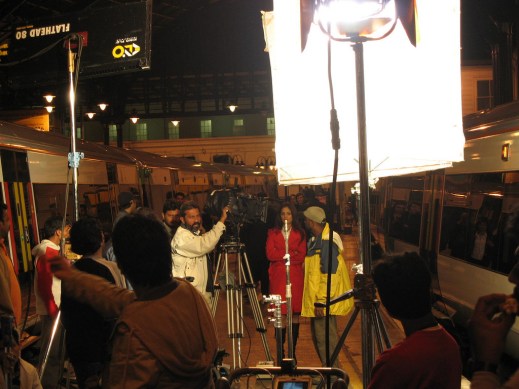
On the set of Bhagum Bhag filmed on Brighton Station, image by Flickr User Simon Pielow,(CC BY-SA 2.0)
Based on conversations that I conducted in Bombay (now Mumbai) in 2009 and 2013 with sound professionals working on Bollywood’s location shoots, I comment on sociological aspects of Bollywood’s increasing adoption of sync sound recording in location shoots, particularly with regard to its implications for class and gender relations within the film industry. My point will be two-fold. One, as the Hindi film form gravitates toward internationally recognizable codes of aural and visual realism, an expanding social range of skilled and unskilled workers are attracted to professions related to location sound recording. Two, despite the diversifying social profile of these professionals, women remain structurally excluded from all levels of the profession.
The change from non-sync to sync sound in Hindi films has created a demand for trained creative technicians and sound engineers, and equally for those who can work as bouncers and sound-security personnel on the field. Security personnel are crucial to recording location sound in a high-decibel country. According to Line Producer Raj Hate (with commercials and the location-heavy Miss Lovely to his credit, the practice of “sound lock ups” started with television commercials in India during the late 1990s before it was adopted by film shoots. “Sound lock” is a phrase used by Bollywood professionals to describe the practice of securing an area to ensure silence, in order to get the best location sound. Many of those working in this pool of unskilled labor in Bollywood today come from Mumbai’s economically depressed migrants who have traveled to the city in search of employment.
For instance, Security Provider Narendra Baruah started with security work on the film Lagaan (2001), the first big-budget film shot with sync sound, although it was preceded by the smaller scale Bombay Boys (1998), which also recorded in sync. Baruah created Active Squad Security while working on sound security for the location shoot of Veer Zaara (2004). He has provided security protection to stars (such as Madhuri Dixit Nene, Shah Rukh Khan, Aamir Khan and Preity Zinta), but his primary employment is in sync sound security. He retains a small group of men on a monthly salary with additional per diem top-ups during assignments, which may range between INR 5,000 to 10,000 to over 20,000 a day, depending on the nature of the shoot. Additionally, he hires men on a temporary basis from a pool of local Mumbaikars and immigrants seeking employment in the big city. Baruah’s company is in competition with actor Ronit Roy’s security company ACE and movie star Salman Khan’s Tiger Security. Although he lacks their star profile and their facility with English, he has made a name for himself through his entrepreneurial practice and expertise in shooting at “jhopad pattis” (slums) for films such as Slumdog Millionaire (2008) and Barah Aana (2009).
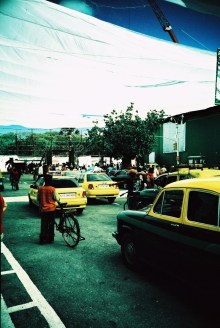
Bollywood Film Set, Image by Flickr User Rhys Tom, (CC BY-NC-ND 2.0)
Shot in Dharavi, Barah Aana required twenty men because of the high sound levels of the urban slum. As Baruah points out, jhopad pattis are the hardest places in which to secure sound for location shoots because “A pressure cooker’s whistle goes off somewhere, or a TV starts up, or a child starts crying” (“Kahien cooker ki seeti bajti hai to kabhi TV chalu hai aur bacchha rota hai.”). Open locations for films with smaller budgets also do not require ID cards for film crews, so Baruah finds that one of his greatest challenges is teaching his staff to memorize faces and manage crowds with diplomacy rather than violence. The phenomenon of Baruah and his crew working on a contract-basis with a range of films is what philosopher and sociologist Maurizzio Lazaratto discusses as the reconfigured “anthropological realities of work” in the new global work space, where “polymorphous self-employed autonomous work has emerged as the dominant form” of global labor.
The social range of Baruah’s crew reveals a disparity between Bollywood blockbusters’ onscreen transnational and cosmopolitan backgrounds, and the class diversity of those involved in producing them. As Hagen Koo argues in relation to the shrinking middle class in America and Western Europe against the expanding middle class of India and China, representations of the global middle class that narrowly refer to “the upper segments…in developing countries, whose members are affluent and globally oriented in their lifestyle and mobility pattern” are woefully inadequate (“The Global Middle Class”). Without rendering Bollywood professionals into mere representatives of their class, I can confirm based on my conversations on the field that the assorted workers enabling sync sound shoots in India today come from a range of social classes, which reveals a negotiation and redistribution of work across different classes of professionals, particularly when we consider the work of sound security personnel in conjunction with the work of sound engineers on site. On-the-ground compositions of production crews are more complex and hybrid than what is suggested by a Bollywood blockbuster’s flat image of urbane cosmopolitanism, by Mumbai’s segregated urban spaces, or by the hostile monocultures of Hindutva pushed by Shiv Sena’s divisive politics.
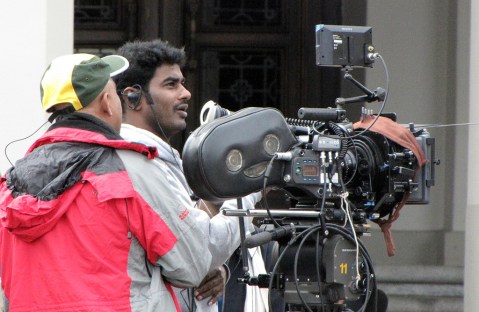
Filming of Bollywood movie “Agent Vinod” on set in Riga, Latvia, August 2010, (CC BY-SA 2.0)
At the other end of the social spectrum and hierarchy of labor among people involved in Bollywood’s revolution in sound are highly skilled sound artists and engineers. Early experimenters in sync and location sound (such as Shyam Benegal and Govind Nihlani) provided opportunities to Bollywood’s new generation of creative audio technicians, who have become key players in the industry’s innovations in sync sound recording, digital sound editing and audio mixing. Dileep Subramaniam worked in sync sound for Nihlani’s television features during the 1980s, and for BBC’s Channel 4 nature documentaries, which made it easier for him to work with transnational productions such as Merchant Ivory’s Deceivers (1988) and Shekhar Kapoor’s Bandit Queen (1995).
Location recordist, production mixer and sound designer Baylon Fonseca edited sound on the digital workstation Audio Vision from Avid for Nihlani’s Sanshodhan (1995) at a time when most Hindi film producers and directors “considered it almost witchcraft.” With Sanshodhan, he initiated methods for digital sync sound recording and mixing that are standard practice in India now. The integration of trained sound engineers into the Hindi film industry has made a palpable difference to its cinema’s sound quality, even as Hindi cinema’s increasing social legitimacy with white-collar workers allows Bollywood to seem like a valid career choice for Indians from the middle and upper middle classes. Nevertheless, high net-worth engineers have to buck traditional social norms—ranging from familial expectations to cultural notions of respectability—to consider sound work in the film industry as a valid career path.
All this is assuming that the engineers are men. Indian women face a double burden in entering such a profession: they must work against social prejudice to pursue careers in science and technology, and then apply that training to the field of media production, which does not possess the social legitimacy of most jobs in engineering. Effectively, new opportunities created by the use of sync sound in Hindi cinema does not bring much promise to women. Women are entirely omitted from the unskilled end of the location sound spectrum because of the incipient threat of violence and aggression against women in India’s public spaces. Under the strain of Hindutva’s India and Shiv Sena’s Mumbai, wherein the concept of protecting women’s honor becomes the violent pretext to restrict their freedom of movement, women are presumptively excluded from sound security work. Women are also largely absent from sound engineering because of the gendering of the hard sciences. In proportion to men, few Indian women are encouraged to enter the sciences, and fewer can choose to use it as the path into film work, so that they are structurally sidelined from high-end work in sound technologies.
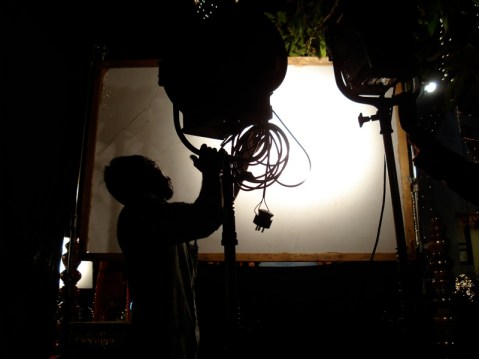
Bollywood Film Set, Image by Flickr User Dani Venn, (CC BY-NC 2.0)
Strong female characters on screen and strong female voices incorporated into the timbre of a film’s soundscape can be cause for celebration. But such inclusions rarely change the social and professional make-up of a film’s production crew. Further, merely adding women to the ranks of security personnel or sound engineers will not presumptively result in a more feminist or inclusive film text. On-screen representations do not reflect pre-production and production practices in simple ways. Despite these cautionary notes, is worth our while to invest some time and thought to how gender relations are impacted along different tiers of film production, as production practices shift in response to Hindi-cinema’s post-globalization aesthetics. Considering the gendered make up of professionals in Hindi cinema’s shift to sync sound recording on location shoots reveals several things. It demonstrates that professional opportunities, social norms and political pressures accompany formal changes in cinema. It allows us to consider what professional shifts in film sound recording in the wake of globalization look like in relation to men as opposed to women, providing an embodied perspective to abstract discussions of social change. And it chastens us against making naïve assumptions about inclusiveness.
—
Featured Image:On the set of Salaami Ish, filmed on Brighton Station,, image by Flickr User Simon Pielow, (CC BY-SA 2.0)
—
Priya Jaikumar is Associate Professor at the Department of Cinema and Media Studies at University of Southern California’s School of Cinematic Arts. She is the author of Cinema at the End of Empire, and several articles and book chapters in publications such as Screen, Cinema Journal, The Moving Image, World Literature Today, Hollywood Abroad, Transnational Feminism in Film and Media, Postcolonial Cinema Studies, Silent Cinema and the Politics of Space, The Slumdog Phenomena, Empire and Film and Routledge Companion to Cinema and Gender.
—
 REWIND! . . .If you liked this post, you may also dig:
Sounding Out! Podcast #49: Sound and Sexuality in Video Games— Milena Droumeva and Aaron Trammell
As Loud As I Want To Be: Gender, Loudness, and Respectability Politics –Liana Silva
SO! Reads: Roshanak Khesti’s Modernity’s Ear–Shayna Silverstein
Share this:


Current Top Posts





April 2021

January 2020

November 2019

October 2019

August 2019

April 2014

November 2017

March 2015

December 2017

October 2015
 Sounding Out!
Recent Comments