
Listen to the Sound of My Voice

Betrayal
I first realized there was a problem with my voice on the first day of tenth grade English class. The teacher, Mrs. C, had a formidable reputation of strictness and high standards. She had us sit in alphabetical order row after row, and then insisted on calling roll aloud while she sat at her desk. Each name emerged as both a command and a threat in her firm voice.
“Kelly Barfield?”
“Here,” I mumbled quietly. I was a Honor Roll student with consistent good grades, all A’s and one B on each report card, yet I was shy and softspoken in classes. This was an excellent way to make teachers amiable but largely go unnoticed. The softness of my voice made me less visible and less recognizable.
Mrs. C repeated my name. Caught off guard, I repeated “here” a little more loudly. She rose to her feet to get a better look at me. I knew what she saw: a petite girl with long ash blonde hair, big brown eyes, and overalls embroidered with white daisies on the bib. When her gaze finally met mine, Mrs. C frowned at me and cleared her throat loudly. I curled into my desk, hoping to disappear.

“Lincoln High School 9-16-2007 008” by Flickr user Paul Horst, CC BY-NC 2.0
“Miss Barfield, did you hear me call your name twice? In this class, when I call roll, you respond.” I gave a quick nod, but Mrs. C wasn’t finished: “We use our strong voices in here, not our girly, breathy ones.” My cheeks flushed red while Mrs. C droned on about confidence and classroom expectations.
“Do you understand me?”
I stammered a “yes.” Mrs. C turned her attention back to the roll call. Her harsh words rang in my ears. I sank low in my chair, humiliated and angry. I couldn’t help that I sounded girly: I was, in fact, a girl. This was the way my voice sounded. It was not an attempt to sound like the dumb blonde she appeared to think I was.
That day I decided that I would never speak up in her class. Forget the Honor Roll. If the sound of my voice was such a problem, then my mouth would remain firmly shut in this class and all of my others. I would never speak up again.

“Listen” by Flickr user lambda_x, CC BY-ND 2.0
My vow to stop speaking lived a short life. I enjoyed Mrs. C’s serious fixation on diagramming sentences and her attempts to show sophomores that literature offered ideas and worlds we didn’t quite know. At first, I spoke up with hesitation and fear of the inevitable dismissal, but I continued to speak. Becoming louder became my method to seem confident, even when I felt anything but.
Throughout high school, my voice emerged again and again as a problem. Despite the increased volume, my voice still sounded tremulous, squeaky, hesitant, and shrill to my own ears. Other girls had these steady, warm voices that encouraged others to listen to them. Some had higher voices that were melodic and lovely. I craved a lower, more resonant voice, but I was stuck with what I had. In drama club, our director scolded me with increasing frustration about my tendency to end my lines in the form of a question. My nerves materialized as upspeak. The more he yelled at me, the more pronounced the habit became. He eventually gave up, disgusted by my inability to control my vocal patterns.

By Dvortygirl, Mysid [GFDL (http://www.gnu.org/copyleft/fdl.html) or CC-BY-SA-3.0 (http://creativecommons.org/licenses/by-sa/3.0/)%5D, via Wikimedia Commons
Meanwhile, at a big state university in my native Florida, I learned quickly that a Southern accent marks you as a dumb redneck from some rural town that no one had heard of. Students in my classes asked me to say particular words and then giggled at my pronunciations. “You sound like a Southern belle,” one student noted. This was not really a compliment. According to my peers, Southern belles didn’t have a place in the classroom. Southern belles didn’t easily match up with “college student. As a working-class girl from a trailer park, I learned that I surely didn’t sound like a college student should. I worked desperately to rid myself of any hint of twang. I dropped y’all and reckon.
I listened carefully to how other students talked. I mimicked their speech patterns by being more abrupt and deadpan, slowly killing my drawl. When I finally removed all traces of my hometown from my voice, my friends both from home and from college explained that now I sounded like an extra from Clueless. My voice was all Valley girl. I was smarter, they noted with humor, than I sounded and looked. My voice now alternated between high-pitched and fried. Occasionally, it would squeak or crack. I thought I sounded too feminine and too much like an airhead, even when I avidly tried not to. I began to hate the sound of my voice.
My voice betrayed me because it refused to sound like I thought I needed it to. It refused to sound like anyone but me.
When I started teaching and receiving student evaluations, my voice became the target for students to express their displeasure with the course and me. According to students, my voice was too high and grating. Screechy, even: one student said my voice was at a frequency that only bats could hear. In every set of evaluations, a handful of students declared that I sounded annoying. This experience, however, was not something I alone faced. Women professors and lecturers routinely face gender bias in teaching evaluations. According to the interactive chart, Gender Language in Teaching Evaluations, female professors are more likely to be called “annoying” than their male counterparts in all 25 disciplines evaluated. The sound of my voice was only part of the problem, but I couldn’t help but wonder if how I sounded was an obstacle to what I was teaching them.
Once again, I tried to fix my problematic voice. I lowered it. I listened to NPR hosts in my search for a smooth, accentless, and educated sound, and I attempted to create a sound more like them. I practiced pronouncing words like they did. I modulated my volume. I paid careful attention to the length of my vowels. I avoided my natural drawl. None of my attempts seemed to last. Some days, I dreaded lecturing in my courses. I had to speak, but I didn’t want to. I wondered if my students listened, but I wondered more about what they heard.
Sound
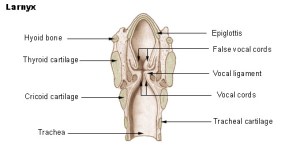
Public Domain, https://commons.wikimedia.org/w/index.php?curid=1393933
The sound of your voice is a distinct trait of each human being, created by your lungs, the length of your vocal cords, and your larnyx. Your lungs provide the air pressure to vibrate your vocal cords. The muscles of your larnyx adjust both the length and the tension of the cords to provide pitch and tone. Your voice is how you sound beyond the resonances that you hear when you speak. It is dependent on both the length and thickness of the vocal cords. Biology determines your pitch and tone. Your pitch is a result of the rate at which your vocal cords vibrate. The faster the rate, the higher your voice. Women tend to have shorter cords than men, which makes our voices higher.
Emotion also alters pitch. Fright, excitement, and nervousness all make your voice sound higher. Nerves would make a teenage girl have an even higher voice than she normally would. Her anxious adult self would too. Her voice would seem tinny because her larnyx clenched her vocal cords tight. Perhaps this is the only sound she can make. Perhaps she is trying to communicate with bats because they at least would attempt to listen.
Biology, the body, gives us the voices we have. Biology doesn’t care if we like the ways in which we sound. Biology might not care, but culture is the real asshole. Culture marks a voice as weak, grating, shrill, or hard to listen to.

“Speak” by Flickr user Megara Tegal, CC BY-NC-ND 2.0
My attempts to change my voice were always destined to fail. I fought against my body and lost. I couldn’t have won even if I tried harder. My vocal cords are determined that my voice would be high, so it is. The culture around me, however, taught me to hate myself for it. Voice and body seem to cast aspersions on intelligence or credentials. It’s the routineness of it all that wears on me. I expect the reactions now.
I wonder if I’m drawn to the quietness of writing because I don’t have to hear myself speak. I crave the silence while simultaneously bristling at it. Why is my voice a problem that I must resolve to placate others? How can I get others to hear me and not the stereotypes that have chased me for years?
Fury
My silence has become fruitful. The words I don’t say appear on the page of an essay, a post, or an article. I type them up. I read aloud what I first refused to say. I wince as I hear my voice reciting my words. I listen carefully to the cadence and tone. This separation of words and voice is why writing appeals to me. I can say what I want to say without the sound of my voice causing things to go awry.
People can read what I write, yet they can’t dismiss my voice by its sound. Instead, they read what I have to say. They imagine my voice; my actual sound can’t bother them. But, they aren’t really hearing me. They just have my words on the page. They don’t know how I wrap the sound around them. They don’t hear me.
Rebecca Solnit, in “Men Explain Things to Me,” writes “Credibility is a basic survival tool.” Solnit continues that to be credible is to be audible. We must be heard to for our credibility to be realized. This right to speak is crucial to Solnit. Too many women have been silenced. Too many men refuse to listen. To speak is essential “to survival, to dignity, and to liberty.”

“Listen” by Flickr user Emily Flores, CC BY-ND 2.0
I agree with her. I underline her words. I say them aloud. The more I engage with her argument, the more I worry. What about our right to be heard? When women speak, do people listen? Women can speak and speak and speak and never be heard. Our words dismissed because of gender and sound. Being able to speak is not enough, we need to be heard.
We get caught up in the power of speaking, but we forget that there’s power in listening too. Listening is political. It is act of compassion and empathy. When we listen, we make space for other people, their stories, their voices. We grant them room to be. We let them inhabit our world, and for a moment, we inhabit theirs. Yes, we need to be able to speak, but the world also needs to be ready to listen us.
We need to be listened to. Will you hear me? Will you hear us? Will you grant us room to be?
When I think of times I’ve been silenced and of the times I haven’t been heard, I feel the sharp pain of exclusion, of realizing that my personhood didn’t matter because of how I sounded. I remember the burning anger because no one would listen. I think of the way that silence and the policing of how I sound made me feel small, unimportant, or disposable. As a teenager, a college student, and a grown woman, I wanted to be heard, but couldn’t figure out exactly how to make that happen. I blamed my voice for a problem that wasn’t its fault. My voice wasn’t the problem at all; the problem was the failure of others to listen.
“listen” by Flickr user Jay Morrison, CC BY-NC-ND 2.0
Loss
While writing this essay on my voice, I almost lost mine, not once but twice. I caught a cold and then the flu. My throat ached, and I found it difficult to swallow. A stuffy nose gave my voice a muted quality, but then, it sounded lower and huskier. I could hear the congestion disrupting the timber of my words. My voice blipped in and out as I were radio finding and losing signal. It hurt to speak, so I was quiet.
“You sound awful,” my husband said in passing. He was right. My voice sounded unfamiliar and monstrous. I tested out this version of my voice. It was rougher and almost masculine. I can’t decide if this is the stronger, more authoritative voice I wanted all along or some crude mockery of what I can never really have. I couldn’t sing along with my favorite songs because my voice breaks at the higher register. I wheezed out words. I croaked my way through conversations. “Are you sick?” my daughter asked, “You don’t sound like you.”
Her passing comment stuck with me. You don’t sound like you. Suddenly, I missed the sound of my voice. I disliked this alien version of it. I craved that problematic voice that I’ve tried to change over the years. I wanted my voice to return.
After twenty years, I decided to acknowledge the sound of me, even if others don’t. I want to be heard, and I’m done trying to make anyone listen.
—
Featured image: “Speak” by Flickr user Ash Zing, CC BY-NC-ND 2.0
—
Kelly Baker is a freelance writer with a religious studies PhD who covers religion, higher education, gender, labor, motherhood, and popular culture. She’s also an essayist, historian, and reporter. You can find her writing at the Chronicle for Higher Education‘s Vitae project, Women in Higher Education, Killing the Buddha, and Sacred Matters. She’s also written for The Atlantic, Bearings, The Rumpus, The Manifest-Station, Religion Dispatches, Christian Century’s Then & Now, Washington Post, and Brain, Child. She’s on Twitter at @kelly_j_baker and at her website.
—
 REWIND!…If you liked this post, you may also dig:
Vocal Gender and the Gendered Soundscape: At the Intersection of Gender Studies and Sound Studies — Christine Ehrick
On Sound and Pleasure: Meditations on the Human Voice– Yvon Bonefant
As Loud As I Want To Be: Gender, Loudness, and Respectability Politics — Liana Silva
Share this:

Me & My Rhythm Box

I’m fortunate to have quite a few friends with eclectic musical tastes, who continually expose me some of the best, albeit often obscure, sources for inspiration. They arrive as random selections sent with a simple “you’d appreciate this” note attached. Good friends that they are, they rarely miss the mark. Most intriguing is when a cluster of things from different people carry a similar theme, converging to a need on my part for some sort of musical action.
The Inspiration
A few years back I received a huge dump of gigabytes of audio and video. Within it were some concert footage and performances this friend and I had been discussing; I consumed those quickly in an effort to keep that conversation going. Tucked amidst that dump however, was a copy of the movie Liquid Sky. I asked the friend about it because the description of the plot–“heroin-pushing aliens invade 80’s New York”–led me to believe it wasn’t really my thing (not a big fan of needles). Although my friend insisted I’d enjoy it, it took me several months if not a whole year before I finally pressed play.
Even though Liquid Sky was not my favorite movie by any measure, it was immediately apparent to my ears why my friend insisted I check it out. The film’s score was performed completely on a Fairlight CMI, capturing the synthesized undercurrent of the early 80’s New York music scene, more popularly seen in the cult classic Downtown 81, starring Jean Michel Basquiat. While the performances in that movie are perhaps closer to my tastes, none of them compare to one scene from Liquid Sky that I fell in love with, instantly:
The song grabbed me so much, I quickly churned out a cover version.
Primus Luta “Me & My Rhythm Box (V1)”
While felt good to make, there remained something less than satisfying about it. The cover had captured my sound, but at a moment of transition. More specifically, the means by which I was trying to achieve my sound at the time had shifted from a DAW-in-the-box aesthetic to a live performance feel, one that I had already begun writing about here on Sounding Out! in 2013. Interestingly, the inspiration to cover the song pushed me back to my in-the-box comfort zone.
It was good, but I knew I could do more.
As I said, these inspirations tend to group around a theme. Prior to receiving the Liquid Sky dump, I had received an email out of the blue from Hank Shocklee, producer and member of the Bomb Squad. I’ve been a longtime fan, and we had the opportunity to meet a few years prior. Since then he’s played a bit of a mentoring role for me. In the email he asked if I wanted to join an experimental electronic jazz project he was pulling together as the drummer.
I was taken aback. Hank Shocklee asking me to be his drummer. Honestly, I was shook.
Not that I didn’t know why he might think to ask me, but immediately I started to question whether I was good enough. Rather than dwell on those feelings, though, I started stepping up my game. While the project itself never came to fruition, Shocklee’s email led me to building my drmcrshr set of digital instruments.
 A year or so later, I ran into Shocklee again when he was in Philadelphia for King Britt’s Afrofuturism event with mutual friend artist HPrizm. By this time I had already recorded the “Me and My Rhythm Box” cover. Serendipitously, HPrizm ended up dropping a sample from it in the midst of his set that night. A month or so later, HPrizm and I met up in the studio with longtime collaborator Takuma Kanaiwa to record a live set on which I played my drmcrshr instruments.
Not too long after, I received an email from NYC-based electronic musician Elucid, saying he was digging for samples on this awesome soundtrack. . .Liquid Sky.
The final convergence point had been hanging over my head for a while. Having finished the first part of my “Toward a Practical Language series on Live Performance” series, I knew I wanted the next part to focus on electronic instruments, but wasn’t yet sure how to approach it. I had an inkling about a practicum on the actual design and development of an electronic instrument, but I didn’t yet have a project in mind.
As all of these things, people, and sounds came together–Liquid Sky, Shocklee, HPrizm, Elucid–it became clear that I needed to build a rhythm box.
The History
What stands out in Paula Sheppard’s performance from Liquid Sky is the visual itself. She stands in the warehouse performance space surrounded by 80’s scenesters posing with one hand in the air, mic in the other while strapped to her side is her rhythm box, the Roland CR-78, wires dangling from it to connect to the venue’s sound system. She hits play to start the beat launching into the ode for the rhythm machine.
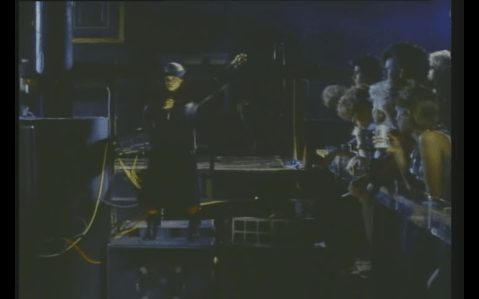
Contextually, it’s far more performance art than music performance. There isn’t much evidence from the clip that the CR-78 is any more than a prop, as the synthesizer lines indicate the use of a backing track. The commentary in the lyrics however, hone in on an intent to present the rhythm box as the perfect musical companion, reminiscent of comments Raymond Scott often made about his desire to make a machine to replace musicians.
My rhythm box is sweet
Never forgets a beat
It does its rule
Do you want to know why?
It is pre-programmed
Rhythm machines such as the CR-78 were originally designed as accompaniment machines, specifically for organ players. They came pre-programmed with a number of traditional rhythm patterns–the standards being rock, swing, waltz and samba–though the CR-78 had many more variations. Such machines were not designed to be instruments themselves, rather musicians would play other instruments to them.
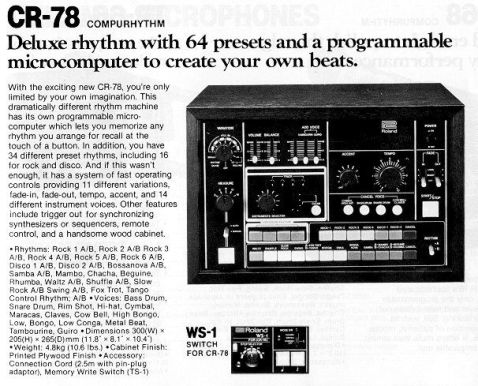
In 1978 when the CR-78 was introduced, rhythm machines were becoming quite sophisticated. The CR-78 included automatic fills that could be set to play at set intervals, providing natural breaks for songs. As with a few other machines, selecting multiple rhythms could combine patterns into new rhythms. The CR-78 also had mute buttons and a small mixer, which allowed slight customization of patterns, but what truly set the CR-78 apart was the fact that users could program their own patterns and even save them.

TR-808 (top) and TR-909
By the time it appeared in Liquid Sky, the CR-78 had already been succeeded by other CR lines culminating in the CR-8000. Roland also had the TR series including the TR-808 and the TR-909, which was released in 1982, the same year Liquid Sky premiered.
In 1980 however, Roger Linn’s LM-1 premiered. What distinguished the LM-1 from other drum machines was that it used drum samples–rather than analog sounds–giving it more “real” sounding drum rhythms (for the time). The LM-1 and its predecessor, the Linn Drum both had individual drum triggers for its sounds that could be programmed into user sequences or played live. These features in particular marked the shift from rhythm machines to drum machines.
In the post-MIDI decades since, we’ve come to think less and less about rhythm machines. With the rise of in-the-box virtual instruments, the idea of drum programming limitations (such as those found on most rhythm machines) seems absurd or arcane to modern tastes. People love the sounds of these older machines, evidenced by the tons of analog drum samples and virtual and hardware clones/remakes on the market, but they want the level of control modern technologies have grown them accustomed to.
Controlling the Roland CR-5000 from an Akai MPC-1000 using a custom built converter
The general assumption is that rhythm machines aren’t traditionally playable, and considering how outdated their rhythms tend to seem, lacking in the modern sensibility. My challenge thus, became clearer: I sought out to build a rhythm machine that would challenge this notion, while retaining the spirit of the traditional rhythm box.
Challenges and Limitations
At the outset, I wanted to base my rhythm machine on analog circuitry. I had previously built a number of digital drum machines–both sample and synthesis-based–for my Heads collection. Working in the analog arena allowed me to approach the design of my instrument in a way that respected the limitations my rhythm machine predecessors worked with and around.
By this time I had spent a couple of years mentoring with Jeff Blenkinsopp at The Analog Lab in New York, a place devoted to helping people from all over the world gain “further understanding the inner workings of their musical equipment.” I had already designed a rather complex analog signal processor, so I felt comfortable in the format. However, I hadn’t truly honed my skills around instrument design. In many ways, I wanted this project to be the testing ground for my own ability to create instruments, but prior experience taught me that going into such a complex project without the proper skills would be self defeating. Even more, my true goal was centered more around functionality rather than details like circuit board designs for individual sounds.
To avoid those rabbit holes–at least temporarily, I’ve since gone full circuit design on my analog sound projects–I chose to use DIY designs from the modular synth community as the basis for my rhythm box. That said, I limited myself to designs that featured analog sound sources, and only allowed myself to use designs that were available as PCB only. I would source all my own parts, solder all of my boards and configure them into the rhythm machine of my dreams.
Features
The wonderful thing about the modular synth community is that there is a lot of stuff out there. The difficult thing about the modular synth community is that there’s a lot of stuff out there. If you’ve got enough rack space, you can pretty much put together a modular that will perform whatever functionality you want. How modules patch together fundamentally defines your instrument, making module selection the most essential process. I was aiming to build a more semi-modular configuration, forgoing the patch cables, but that didn’t make my selection any easier. I wanted to have three sound sources (nominally: kick, snare and hi-hat), a sequencer and some sort of filter, which would all flow into a simple monophonic mixer design of my own.
For the sounds I chose a simple kick module from Barton, and the Jupiter Storm unit from Hex Inverter. The sound of the kick module was rooted enough in the classic analog sound while offering enough modulation points to make it mutable. The triple square wave design of the Jupiter Storm really excited me as It had the range to pull off hi-hat and snare sounds in addition to other percussive and drone sounds, plus it featured two outputs giving me all three of my voices on in two pcb sets.
Filters are often considered the heart of a modular set up, as they way they shape the sound tends to define its character. In choosing one for my rhythm machine the main thing I wanted was control over multiple frequency bands. Because there would be three different sound sources I needed to be able to tailor the filter for a wide spectrum of sounds. As such I chose the AM2140 Resonant Filter.
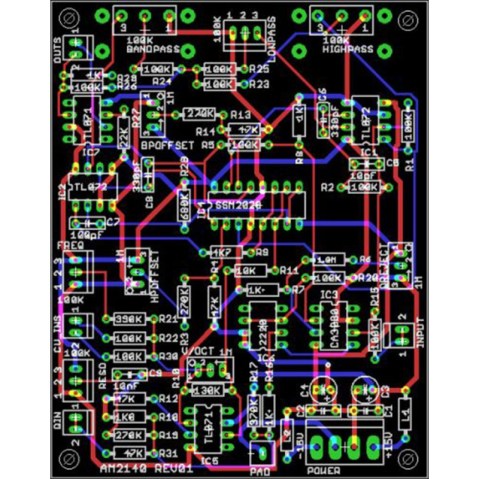
I had no plans to include triggers for the sounds on my rhythm machine so the sequencer was going to be the heart of the performance as it would be responsible for any and all triggering of sounds. Needing to control three sounds simultaneously without any stored memory was quite a tall order, but fortunately I found the perfect solution in the amazing Turing Machine modules. With its expansion board the Turing machine can put out four different patterns based on it’s main pattern creator which can create fully random patterns or patterns that mutate as they progress.
The Results
I spent a couple of weeks after getting all the pcb’s parts and hardware together, wiring and rewiring connections until I got comfortable with how all of these parts were interacting with each other. I was fortunate to happen upon a vintage White Instruments box, which formally housed an attenuation meter, that was perfect for my machine. After testing with cardboard I laid out my own faceplates, which and put everything in the box. As soon as I plugged it in and started playing, I knew I had succeeded.
Early test of RIDM before it went in the Box
I call it the RIDM Box (Rhythmically Intelligent Drum Machine Box). I’ve been playing it now for over two years, to the point where today I would say it is my primary instrument. Almost immediately afterward I built a companion piece called the Snare Bender which works both as a standalone and as a controller for the RIDM Box. That one I did from scratch hand wired with no layouts.
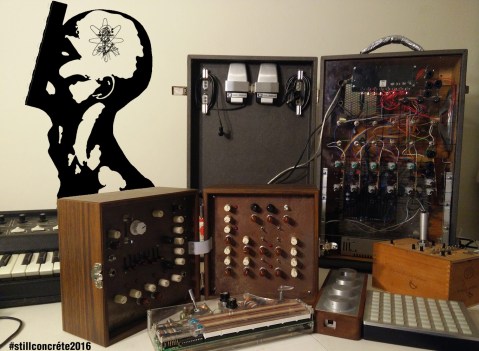
While this is by no means a standard approach to modern electronic instrument design (if a standard approach even exists), what I learned through the process is really the value of looking back. With so much of modern technology being future forward in its approach, the assumption is that we’re at better starting positions for innovation than our predecessors. While we have so many more resources at our disposal, I think the limitations of the past were often more conductive to truly innovative approaches. By exploring those limitations with modern eyes a doorway opened up for me, the result of which is an instrument like no other, past or present.
I will probably continue playing the two of these instruments together for a while, but ultimately I’m leaning toward a new original design which takes the learnings from these projects and fully flushes out the performing instrument aspect of analog design. In the meantime, my process would not be complete if I did not return to the original inspiration. So I’ll leave you with the RIDM Box version of “Me & My Rhythm Box”—available on my library sessions release for the instrument.
—
Primus Luta is a husband and father of three. He is a writer and an artist exploring the intersection of technology and art, and their philosophical implications.
—
REWIND!…If you liked this post, you may also dig:
Heads: Reblurring The Lines–Primus Luta
Into the Woods: A Brief History of Wood Paneling on Synthesizers*–Tara Rodgers
Afrofuturism, Public Enemy, and Fear of a Black Planet at 25—andré carrington
Share this:


Current Top Posts





April 2021

January 2020

November 2019

October 2019

August 2019

April 2014

November 2017

March 2015

December 2017

October 2015
 Sounding Out!
Recent Comments