
Listening to the City of Light: An interview with Sound Recordist Des Coulam

DOI: https://doi.org/10.59350/kp68c-7p206
How should we take account of, question, describe what happens every day and recurs every day: the banal, the quotidian, the obvious, the common, the ordinary, the infra-ordinaire, the background noise, the habitual?
I’m meeting with the British sound recordist Des Coulam at the brasserie La Coupole on the Boulevard de Montparnasse in Paris. “Just imagine…this place opened in 1927. If you installed a microphone in the middle of this room in 1927 and if it was still there today, how many interesting things could you have recorded in this place? It just begs belief, doesn’t it? François Mitterrand, Picasso, Ford Maddox Ford, Beauvoir, Man Ray, they were all here. They all echo in these walls.”
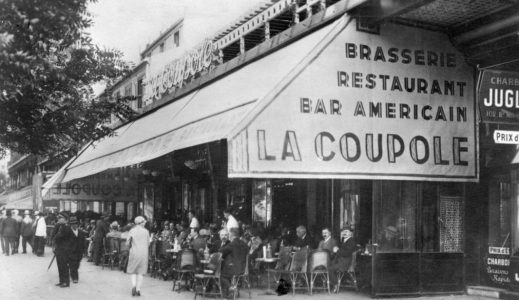
The sound inside La Coupole by Des Coulam
Des Coulam has been capturing the urban soundscape of Paris for almost ten years. Paris is a city full of mirrors, replicating itself through various mediums. A great archive of the city and its streets, boulevards, arcades and cafés has been written, painted, filmed and photographed throughout the 19th and 20th centuries. However, its aural history is less documented.
“All the archival sounds you find of Paris are adjunct to pictures, so you’ve got television pictures, you’ve got film, you’ve got very few actual recordings of Paris, and I wanted to capture the contemporary soundscape of the city and archive it for future generations to explore, study and enjoy,” explains Coulam. “It’s only on the last few seconds on our historical clock that we’ve been able to capture and archive sounds, so most of our sonic heritage is passed by completely unrecorded. We can get an idea of what nineteenth, eighteenth, and seventeenth century sounds were like from literature and from art in some cases. But the fact is we can’t actually listen to them. All the sounds we hear came from somebody’s imagination.”
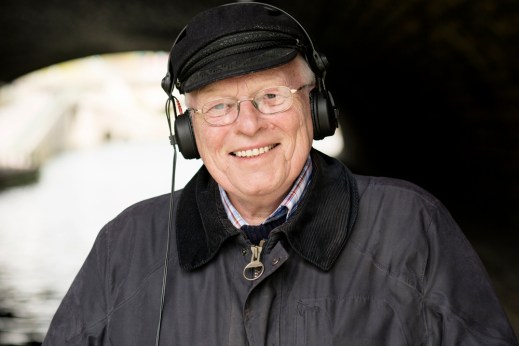
Coulam’s methodical approach and commitment to the task of recording the sounds of Paris, almost on a daily basis, is helping to create the first comprehensive sound archive of the city. These sounds constitute the Paris Soundscapes Collection and are being archived in the British Library of London.
“Memorable recordings are not limited by your equipment, only by your imagination”
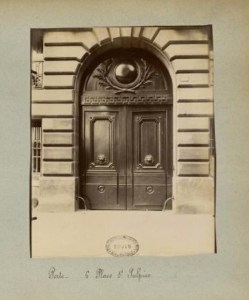
“And people forget that,” laments Coulam. “I mean, listening is an art and it’s an art that must be learned. You have to practice, practice, practice to listen. But once you master the art it opens up an all-new world. Because for me, if you give sounds the opportunity to breathe and to speak, they all have a story to tell. We walk along the street and hear a sound and you think: what is that? And you can create a story the sound is telling you. You might hear one of these big Parisian doors bang. What’s behind that door? How many interesting people have walked through that door? And you start to see or experience the place differently.”
Sounds inside l’Eglise Saint-Gervais-Saint-Protais (w/creaking wooden door) by Des Coulam
Des Coulam is of the opinion that the ability to tune into sounds with an inquisitive and imaginative mind can provide better recordings than the most expensive equipment. It’s a skill that he has been developing for over 50 years. “I can tell you the exact day. It was the 25th of December, 1958 when I woke up on Christmas morning and found a tape recorder. And if you had asked me to write a list of 100 things I wanted for Christmas, the tape recorder would not have featured in it. But there it was and I fell in love with it instantly and stayed in love with it ever since. It turned something on in my head that stayed with me all my life. I was 10 years old and now I’m almost 70 years old…I don’t know what I would do without it. I would probably just curl up and die or something…Because now it consumes all of my life. I work seven days a week, but it never feels like work. It’s just fun.”
An aural flâneur in a changing city
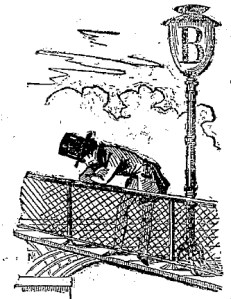
“Some of my best recordings have come serendipitously when they are not planned.” Most of the time Coulam doesn’t adhere to a strict pathway through the streets of Paris. He follows the background city sounds as someone who follows a river stream. He describes himself as an aural flâneur. The term flâneur (stroller, idler, walker) dates back to the 16th century and was made popular by Walter Benjamin in his 1935 essay “Paris, Capital of the Nineteenth Century” in The Arcades Project. “I’m doing exactly what the 19th century flâneurs did. Observing, that’s all I do. But I observe through sound rather than visually,” says Coulam. “The one thing the flâneur had was time. They had the time to stroll around the streets and observe the everyday life. But in my case I observe listening.” According to Aimée Boutin, the author of City of Noise: Sound and Nineteenth-Century Paris, it is in the writings of Balzac, Louis Huart and Victor Fournel that the flâneur emerges as an attentive listener, an eavesdropper and collector of stories who views the city as a musical score and as a cacophonous/harmonious concert.
19th century images of the flâneur predominately evoke a white male figure of means and privilege who observes and listens to the city from a position of detachment towards the crowd. He is invested in his own anonymity and imagines himself cultivating a sense of neutrality and “objectivity.” Coulam’s active listening practices depart from this perspective by challenging his perspectives and owning the subjectivity of the recording and archiving process. “The way you hear sound changes depending on the circumstances and also the way you interpret sound is different. You and I could walk down the same street and hear it differently. I can walk down the same street twice and hear it differently. There are lots of sounds that I will hear and there are lots of sounds that I won’t hear.” In a recent blog entry Coulam writes that while being “aware that sounds don’t exist in a vacuum, I am always thinking about the social, cultural and historical context of the sounds I find and that has taught me how to explore and appreciate the rich history, complexity and diversity that is Paris.”
Besides his own recordings of the Parisian soundscapes, Coulam has been adding new aural narratives of the city in the series “Paris – A Personal View” inviting guests who live in Paris to visit a place in the city that has a special meaning for them. In this series, Coulam often features the city of the contemporary flâneuse, a radically different form of flâneurie through the steps of the walking woman. In the audio bellow, Monique Wells, an expert on African Diaspora in Paris and founder of the non-profit association Les Amis de Beauford Delaney, explores her favorite place in the city – the Jardin du Luxembourg.
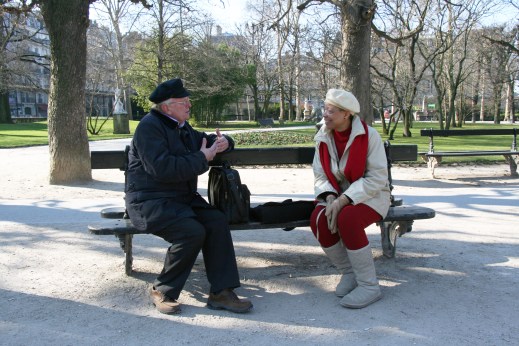
Monique Wells, Jardin du Luxembourg, “Paris – A Personal View” Series by Des Coulam
This is a particular time to be listening to the city as a new plan to expand the metropolis of Paris is on its way. “Paris is on the cusp of a huge change. If we look at the history of Paris, it is a history of circles. So you get start with the Romans who invaded and camped out on the Île de la Cité. What did they do? They built a wall around it. And over the years as Paris expanded more walls have been built around the city until today. Now, you’ve got this wall of traffic – the périphérique – and everything within that is Paris and everything without is the suburbs. Nicolas Sarkozy decided, when he was president, that he was going to demolish this invisible wall between Paris and the suburbs. So he gave birth to the Greater Paris Project which is now going ahead. So over the next 10, 20 or 30 years the visual landscape of the city will change and also its sound landscape. And this is a perfect time to capture that change. I won’t live long enough to see it all but I’m already seeing some of it. And what you have right now is that some sounds of Paris are actually disappearing, some are about to disappear, some have stayed remarkably the same and new sounds have appeared.”
Sounds around the Pont National (near Boulevard Périphérique) by Des Coulam
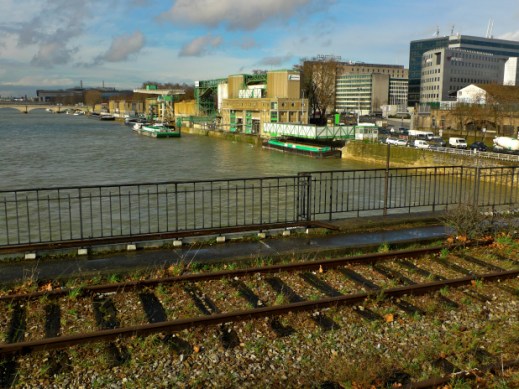
The Vanishing Sounds of Paris
The changes in the visual landscape of Paris and the modernization of its infrastructures will cause a significant change in its soundscape. For instance, Coulam dedicates a lot of his time to recording the changes of the subterranean and aerial soundscape of the Parisian metro lines. “The sounds of the Metro are changing dramatically. If you imagine the sounds of the Paris Metro, you immediately get this picture of the sort of 1950s black and white film, you can hear the sounds of the train rattling over the lines. It’s gone, it’s all completely gone. The last of those trains disappeared in 2012. And I knew this was happening so I recorded a lot of metro line 5 where the old trains were. So I’ve got a stack of recordings of those because nobody else was doing it.”
Sounds of Line 5 at Quai de la Rapée by Des Coulam
“That lovely rattle, these clanking rattling sounds. Just what you imagine it to be!” The old trains on line 5 are now being replaced by modern models with a quieter sound. Also, the trams that covered the city in the 1930s were later substituted by motorized buses. “There are no trams in the center of the city but you’ve got them on the periphery now. There are 8 tram lines. On a lot of the routes they actually go through lot of pains to reduce the amount of noise the tram makes by putting grass down between the tram lines to absorb the sound. So that’s a completely different soundscape than you would have had in this case in the 1930s.”
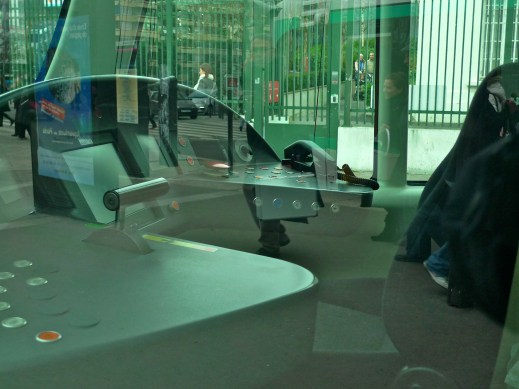
Inside a tram on Line T2 from the station Henri Farman to Porte de Versailles by Des Coulam
Coulam has been recording the sounds of the Gare du Nord, one of the six main railway stations in Paris, that is going through some transformations right now. A sign outside the station in the construction zone promises “a brighter and more practically designed hall for enlightened travelling”. The distinctive soundscape of the Gare will certainly change. A new type of pavement is enough to alter the echoing sounds made by footsteps and rolling suitcases.
Inside the Gare du Nord; October 2016
“But on a more human level,” says Coulam, “the street criers, the vagabond man, the knife grinders, people like that who used to come around shouting in the street are completing gone. The only thing you find now are the market traders in the market stores, but you don’t find any of these tradesmen in the streets of Paris.”
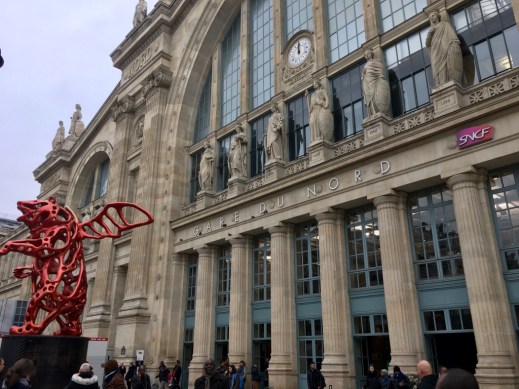
“An attempt to exhaust a place in Paris” in sound
“The only time you really notice the urban soundscape is when isn’t there,” remarks Coulam. On the day we meet, Montparnasse is eerily quiet. There is little traffic and only a few pedestrians are strolling along the Boulevard. “The soundscape you hear is not the normal Montparnasse because this is August and everybody is away on holiday, so you are immediately struck by the relative quiet around here.” It might be difficult to find places of quiet in a city like Paris during the other eleven months of the year.
But even the noise, the chatter and the rumble are important parts of the urban soundscape. “The biggest challenge I face recording the soundscape of Paris is the sound of traffic, and I long ago decided that you couldn’t ignore it. And in a sense, why should you? Because it’s an integral part of the soundscape, so to ignore it is a sort of cheating, really. So, I decided to embrace it and I started to deliberately record traffic and it was absolutely fascinating!”
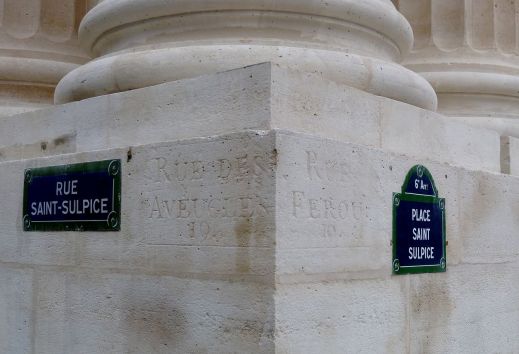
The author and filmmaker George Perec once sat down for three days in Saint-Sulpice Square to write down all the non-events around him. “What happens, when nothing happens other than the weather, people, cars, and clouds?” asked Perec. In the same vein, Coulam continues recording the sounds that constitute the backdrop to everyday life and through attentive listening, he weaves the sound tapestry of the city of Paris. “You sit on a Parisian green bench in a busy narrow pavé street and just let the street walk past you. You will hear fabulous sounds.”
“An attempt to exhaust a place in Paris” in sound (Café de la Mairie, Place Saint-Sulpice) by Des Coulam
You can hear Des Coulam’s collection of Parisian soundscapes at Soundlandscape or follow him on twitter.
—
Featured Image: Line 5 at Quai de la Rapacca, Image by Des Coulam
—
Carlo Patrão is a Portuguese radio artist and producer of the show Zepelim. His radio work began as a member of the Portuguese freeform station Radio Universidade de Coimbra (RUC). In his pieces, he aims to explore the diverse possibilities of radiophonic space through the medium of sound collage. He has participated in projects like Basic.fm, Radio Boredcast, and his work has been featured in several international sound festivals and has also been commissioned by Radio Arts (UK). He is currently working on a radio show for the Portuguese national public radio station RTP. In addition to his work in radio, he has a master’s in clinical psychology
—

REWIND! . . .If you liked this post, you may also dig:
Playing with Bits, Pieces, and Lightning Bolts: An Interview with Sound Artist Andrea Parkins — Maile Colbert
(Sound)Walking Through Smithfield Square in Dublin— Linda O’Keeffe
Sounding Our Utopia: An Interview With Mileece— Maile Colbert
—
Share this:

Audiotactility & the Medieval Soundscape of Parchment

DOI: https://doi.org/10.59350/xj9yq-x4q19
Each of the essays in our “Medieval Sound” forum focuses on sound as it, according to Steve Goodman’s essay “The Ontology of Vibrational Force,” in The Sound Studies Reader, “comes to the rescue of thought rather than the inverse, forcing it to vibrate, loosening up its organized or petrified body (70). These investigations into medieval sound lend themselves to a variety of presentation methods loosening up the “petrified body” of academic presentation. Each essay challenges concepts of how to hear the Middle Ages and how the sounds of the Middle Ages continue to echo in our own soundscapes.
Read all the previous posts here, and, HEAR YE!, in April 2017, look for a second series on Aural Ecologies of noise! –Guest Editors Dorothy Kim and Christopher Roman
—
As humans, we engage all of our senses in every undertaking, whether or not we consciously perceive our sensory interactions. For instance, when we consume a gourmet meal, we don’t simply taste the food—we also see it, smell it, and feel it. We might also hear it as it is being prepared and/or consumed, and the meal’s pleasure can be enhanced by conversation. Overall, our experiences are enriched (or worsened) through our multisensory engagement. Similarly, reading involves multimodal feedback. While we might think of it as solely a visual experience, both auditory and tactile interactions occur within the process. As The Handbook of Multisensory Processes (518) tells us, audiotactile (sound+touch) and visuotactile (sight+touch) interactions are of great functional importance as they link remote senses to the body.
Thus, our interactions with everyday objects are multisensory, even if we do not consciously realize that fact. Arguably, although the sense of hearing is the first to develop in the womb, it is often the sense we overlook in solitary pursuits such as reading. Nevertheless, every human action occurs within a soundscape, much like they take place within a landscape. A soundscape is “an environment of sound with emphasis on the way it is perceived and understood by the individual, or by a society. It thus depends on the relationship between the individual and any such environment” (Handbook for Acoustic Ecology, 1978). Like landscapes, soundscapes must be considered in context and in relation to multisensory experience.

In particular, audio-visual interactions have been shown to have an effect on soundscape perception. Soundscape design elements reflect this concern. For example, a plan might include adding fountains, both as a noise control element and as a deliberate introduction of a soothing sonic feature. At the same time, fountains are a managed version of a natural element (water) that incorporate certain visual effects (e.g. reflective space and sparkling sunlight) creating textured and appealing landscapes. How the element is introduced into the environment has an effect on the perception (and appreciation) of the space. Furthermore, the touch of cool, clean water can supplement the overall impression, heightening the soothing effect initiated by the tinkling sound of the moving water. This is an audiotactile experience; that is, sounds connected with the sense of touch, an ecological system that combines the haptic and the aural.
Although the field of audiotactile integration has been somewhat dormant in the biological sciences since Paul von Schiller suggested back in 1932 that sounds, especially patterned noises, could affect tactile perception of roughness, recently some researchers have conducted experiments that test audiotactile qualities of materials. Several have suggested that these results might be synthetic—that is, the impact the sounds have modulate the haptic perception of the material being touched. For the most part, there seems to be connections between the perceptions of the sounds involved in touch and the perceptions of the stiffness of material. However, one study demonstrates that synchronized movements and sounds can affect the perception of the subject’s own skin. Suffice it to say, then, that sounds and texture and material quality are linked, both physically and perceptively.
Although humans rarely display deliberate awareness of audiotactile interaction, both auditory and haptic stimulation share similar temporal and psychological patterns in human consciousness. This connection would have perhaps been even more true in the Middle Ages than it is now, since the context of parchment and manuscript production and consumption was more immediately personal than paper production and reading is today.
To understand both the historicizing of the senses and the impact of shifting modes of literacy, it is possible to recreate some of the former immediacy of parchment production. During the summer of 2015, I participated in a National Endowments for the Humanities Seminar on Manuscript Materiality. This occasion provided me with the opportunity to make a manuscript page replica, starting from the “ground up” with the creation of parchment. We also studied theory, page layout, and other material circumstances, allowing us to really think about how people—both medieval and modern—engage with manuscripts using their senses. Elsewhere I have discussed the sense of touch. Here, I want to extend that discussion to include the sense of hearing; that is, I will focus on the sounds of parchment-making and parchment-reading, as activated through touching.
Parchment (Latin pergamenum) is the general term used for an animal hide that has been prepared for writing. Vellum (Latin vitulinum) more specifically refers to prepared calfskin. Parchment is made through an extended process of skinning, cleaning (de-fleshing and de-hairing), stretching, and scraping. It is stretched and scraped on special frames with adjustable screw pegs. The parchment maker scrapes the skin to the desired thickness with a curved tool, adjusting the pegs as the skin dries and changes texture. Often the skin is rewetted, scraped, and stretched numerous times in order to achieve the desired thickness. Sometimes a pumice stone finish is used at the end to create a surface porous enough to accept and retain ink. This is a vastly different process than tanning, which involves chemical alteration of the skins.

In the seminar, our parchment master was Jesse Meyer of Pergamena. He provided tools, guidance, and expertise as we participants stumbled through the process. Parchment making is hard, smelly work. My hands ached after only a few go-rounds with the tools, which included a pumice-like concoction of over-baked bread mixed with ground glass, knives that had been reshaped and re-handled, and Jesse’s special skin-refiner tool discussed below. Jesse told us many eye-opening things over the days of parchment making; however, possibly one of the most intriguing was how parchment masters could make a parchment “sing,” and how they, through this sound, knew whether or not the skin had reached its full potential.
So when Jesse demonstrated the various techniques on his sample skin, I listened carefully to the sounds he made by scraping as well as watching what he did with his hands. As he scraped away, the parchment did indeed sing. You can hear it yourself:
Audio Clip of Jesse’s “Parchment Singing”
.
This aspect of parchment making fascinated me. After our seminar was done, I got back in touch with Jesse to talk further about the sounds of parchment making. He was more than forthcoming about his experiences. When Jesse first read about medieval parchment making, he ran across several mentions of the “ringing” sound that parchment masters produced when shaving their skins. He, like many of us, had never considered that aspect before. So he started paying attention to the different sounds he made as he used various tools on the skins. Right now, he uses a handmade tool that consists of a saw blade shaved to his specificity with a handmade handle on it. Each of us got a chance to hold it and try it on our own skin. It was an unwieldy tool for the uninitiated, and my parchment did not “sing” like Jesse’s did.

.
Jesse is an expert, but even he says he cannot quite tell the nuances among the different types of skins by sound alone, although he notes that there are similarities among the types. Perhaps that skill could be developed over years of working solely with parchment, as a master in the Middle Ages would have. What Jesse has shared, however, is valuable: thicker skins are not as flexible, but they produce a “better,” that is clearer, sound.

Thickness of parchment can be due to a number of factors including preparation technique, but also the age and type of animal. Older animals yield thicker skins. Thicker skins are usually smoother and yield a cleaner sound. Of course if the animal has been injured or diseased, the skin may not be smooth. The firmer and tighter a skin is, the denser it is, and the easier it is to shave as well. In fact, Jesse says that denser skins can also make full, warm, “drum-like” sounds. Even more intriguingly, when I asked Jesse if he had ever noticed a difference between the hair side and the flesh side of skins, he said yes: the hair side of parchment sounds better to him because it is cleaner once the hair has been removed. The flesh side often retains fibrous bits even after many scrapings, and produces a more diffuse sound. When this side is scraped, it leaves behind a “fuzzy” residue until it has seen many passes with the scraper.
The relative dryness and “freshness” of the skin can also alter the clarity of the “ringing.” For example, compare the sound from the freshly prepared goatskin last summer to the sound from scraping a drier goatskin in Jesse’s workshop:
Repeat of first audio clip of Jesse’s “parchment singing”
Comparison clip of Jesse making a drier parchment sing
Both of these clips were produced from goatskins, and both were produced by Jesse who also used the same tool on each. While the sound is very similar, and both ring true, the drier skin produces a clearer, purer sound.
Plainly, then, the sounds of parchment making are vital to quality production. Most medieval manuscripts are made of three types of animal skins: sheep, goat, and calf. The prevalence of each animal is geographically dependent (sheepskin is more common in England, calfskin in France, and goatskin in Italy), although of course manuscripts traveled, and wealthy patrons commissioned materials they preferred. (see “DNA May Reveal Origins of Medieval Manuscripts” from Livescience)
Age, breed, size, and animal health can all contribute to the audiotactile qualities of a skin. However, there are some general guidelines. Sheepskins, for instance, are stretchier than goat skins, so their “ringing” can be muffled. Goatskins, which are thinner and stiffer, make a higher pitched “ring.” Calfskins are larger and easier than the others to get clean, and thus often make the cleanest “ring” and can do so more quickly than the others.
The type of skin is not the only factor in play. A rough blade would have produced a rough sound; conversely, an even, sharp blade would have produce the cleanest sound. The tautness of the skin in the frame can also affect pitch and tone, as can its dryness, its fatty content, and the age of the animal. As noted in a recent study, “The density of collagen fibrils in calf and goat parchment, compared with a more open weave and higher fat content in sheep parchment, favors the former two species [for producing the finest parchment]” (15070). Nevertheless, master parchment makers should have been able to manipulate any skin to produce superior results. As long as the corium (the dermis layer of skin containing all the connective tissues, including collagen, elastic fibers, hair follicles, sebaceous glands, blood vessels, and a number of other components) is sufficiently ground down, the parchment produced can be made very fine. And as the corium wears away, the sound of the scraping grows ever cleaner and clearer, just as the feel of the skin grows ever smoother. Overall, the tone gets higher as the skin gets thinner, and as long as the scrape is even, the tone should remain pure.
Here’s a video of Jesse scraping a calfskin. Compare this clear “ringing” to the goatskin scrapings:
.
That’s all well and good for production of manuscripts, but texts are made for consumption. Earlier, I mentioned my having considered the qualities of hapacity and manuscripts involving Christ’s side wound in another blog post. One of the manuscripts I discussed, London, British Library, MS Egerton 1821, was clearly designed to be touched. This unusual manuscript contains a number of woodcuts that reflect devotion to the wounds of Christ, but, more strikingly, opens with three pages painted black, covered in drops of paint meant to emulate Christ’s flowing blood.

After a series of woodcuts, seven more pages appear. These are painted red with darker red paint splatters representing drops of blood. Although these pages do not contain specific images, they are meant to evoke interactive piety. The reader is invited to touch Christ’s wounds while praying or meditating. The worn appearance of Folio 2r demonstrates just how frequently the pages were touched and rubbed.
How did those pages feel to a medieval reader? Did they feel rough or smooth? Did the reader feel a frisson of excitement? Animal skin, such as parchment, carried with it the essence of the life of the animal, thus imbuing the images painted onto it with some semblance of life force, such as suggested by Thomas Aquinas in his Question 8 (Summa Theologica) regarding the potential for divinity placed within material objects. To a certain extent, then, touching an image of Christ was akin to touching a proxy of his body, allowing a powerful and individual haptic experience of faith. But what about the sounds made when these images became the subject of interaction? Was the medieval reader aware of touching the page, touching Christ’s wounds, even more because he or she would hear the interaction?
I took it upon myself to rub the worn folio in Egerton 1821. I did so reverently, if not because I felt a mystical connection to Christ, but because I felt awed at being able to reproduce a medieval experience (albeit 500 years later). There was a distinct sound, which you can hear in this clip:
Clip of the author rubbing the worn folio in Egerton 1821
I was surprised at the resultant sound. The worn part of the page looked soft, and the paint splatters looked cracked. Instead, to my surprise, the worn portions felt rougher than the cracked paint. Like the modern studies demonstrated, my audiotactile perceptions were altered initially by what I saw, but then by what I heard. At first, I touched hesitantly, but when the sounds produced became rhythmic, my hands felt smoother and the noise sounded more even. If I were repeatedly rubbing the same spot, in the same manner, producing the same sounds—much as a medieval reader might have done—the combined sensations would likely have produced a soporific and meditative state. That is, combining touch, particularly of a textured surface, with measured reading might have resulted in the ideal perceptive state for experiencing an immersive religious experience.
If, as numerous studies have demonstrated, vibrotactile stimuli can facilitate hearing, both for those with and without hearing impairments, then the sounds hand and fingers make when exploring a surface must contribute to an individual’s haptic perception and vice versa. How, then, would this connect on the behavioral or emotional level? Researchers have been exploring the reciprocal interactions of the auditory, tactile, and visual (sometimes referred to as cross-modal effects), often concentrating on sensory thresholds, information processing performance, and spatial navigation; however, only recently are studies beginning to investigate the emotional and physical benefits of such exchanges. For instance, one such study suggests auditory-tactile stimulation as a means to increase health and well-being.
Thus, a combination of touch felt by a reader with sound heard by a reader at the same time might influence the reader’s state of mind in a positive way, resulting in a positive effect on the body as well. A desired state can be reached more quickly through an audiotactile combination, resulting in a sensory illusion (perceiving something not physically extant but mentally present)—a powerful manner of evoking emotion. Similarly, the positive physical effects include relaxation, stress relief, and sleep enhancement. Again, this seemingly suggests that multisensory integration, especially the combination of touch and sound, might have produced a mental state in the (medieval) reader that made them particularly receptive to spiritual experience.

I would suggest, then, that as medieval scholars, we should examine how audiotactile events are processed during dynamic contact between hands and material. Since different sensory modalities are integrated in the human brain to form our perceptions as a whole, including spatial and temporal relationships, it is important that we consider multisensory interactions that code the location of external events relative to our own bodies. Thus, to think through the process of making, touching, and hearing medieval parchment opens up a lot of possibilities for the study of medieval materiality—indeed for materiality in general as a field. The importance of the whole body sensory experience, including hearing, in reading is something we need to continue to imagine, to reimagine, to recreate, and to explore.
—
Michelle M. Sauer is a professor at the University of North Dakota in the English Department. She recently released her latest book, titled Gender in Medieval Culture (Bloomsbury, 2015).
—

REWIND!…If you liked this post, you may also dig:
Sounding Out! Podcast #54: The Sound of Magic-K.A. Laity
Mouthing the Passion: Richard Rolle’s Soundscapes–Christopher Roman
EPISODE LI: Creating New Words from Old Sounds–Marcella Ernest, Candace Gala, Leslie Harper, and Daryn McKenny
—
Share this:




Current Top Posts


April 2021
January 2020
November 2019

October 2019

August 2019

April 2014

November 2017

March 2015
December 2017

October 2015


Recent Comments