
Playing with the Past in the Imagined Middle Ages: Music and Soundscape in Video Games

DOI: https://doi.org/10.59350/s68q1-37217
Each of the essays in our “Medieval Sound” forum focuses on sound as it, according to Steve Goodman’s essay “The Ontology of Vibrational Force,” in The Sound Studies Reader, “comes to the rescue of thought rather than the inverse, forcing it to vibrate, loosening up its organized or petrified body (70). These investigations into medieval sound lend themselves to a variety of presentation methods loosening up the “petrified body” of academic presentation. Each essay challenges concepts of how to hear the Middle Ages and how the sounds of the Middle Ages continue to echo in our own soundscapes.
Read all the previous posts here, and, HEAR YE!, in April 2017, look for a second series on Aural Ecologies of noise! –Guest Editors Dorothy Kim and Christopher Roman
–
Freed though they have been from the historiographical pit of the Dark Ages, the Middle Ages inevitably slip ever further into the past. Nonetheless, they have never been easier to visit. We have but to open our computers or turn on our televisions to be transported into the past. As any good Sci-fi show will tell you, we must be careful when we travel into the past; we can change things.
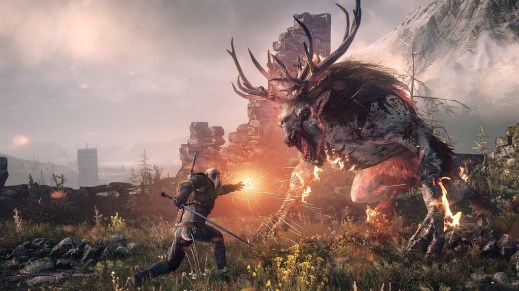
The medium on which I wish to focus – videogame – relies precisely upon on this ability to affect change. It takes aspects of filmic medievalism but must also confront an intrinsic interactivity. This interactive capacity may seem to authenticate further the experience of the past by creating a rich and responsive world but it also frees aspects of narrative agency from the control of game designers, composers, and sound engineers. In this article, I will demonstrate some of the ways in which issues of space/place, identity, orientalism/otherness, and the norms of the medium itself can play out. In recomposing the past – be that with a nod to authenticity, within the realms of historical metafiction, or even the imagined (neo-)medievalism of the fantasy genre – videogames create something that sits between the past and present that nonetheless has a profound effect on the public conception of the medieval soundscape. My focus here is on CD Projekt Red’s high-fantasy game The Witcher III: Wild Hunt, addressing not only the musical score but also wider aspects of soundscape such as vocal accent, foley, and manipulation of the aural field.
.
The genre of fantasy could be described as medievalist in origin and aesthetic, taking clear inspiration from the medieval world and often using it, or a close approximation, as a geographical, historical, and cultural setting. Many of the more fantastical elements of fantasy too are drawn from medieval bestiaries and the genre of the medieval romance. The late Umberto Eco popularised the term neo-medievalism, albeit in a rather pejorative sense and in opposition to ‘responsible philological study’, to describe this interaction between medieval history and the fantastical. Perhaps due to the rather negative associations of neo-medievalism, both terms tend to be used somewhat interchangeably today.
A divide could perhaps be suggested as to whether medieval aspects are presented as unproblematic and nostalgic, or treated in a more critical and distanced manner. For instance, David Marshall defines neo-medievalism as ‘a self-conscious, ahistorical, non-nostalgic imagining or reuse of the historical Middle Ages that selectively appropriates iconic images…to construct a presentist space that disrupts traditional depictions of the medieval.’ In contrast, Kim Selling notes of medievalism that, after the breakdown of modernist historical metanarratives, the pre-modern world of the medieval offers a ‘rich, satisfying, and authentic’ counterpoint to the ‘profound social, spiritual, and political dislocation’ of postmodernism. From this viewpoint, the world of medievalist fantasy offers pure escapism back to a world in which old certainties can be re-asserted; perhaps, as Elkins notes, a reaction against the rationalistic, anti-heroic, materialist, and empiricist bent of modern society.
Regardless of the author’s framing of ‘the medieval’, it offers many narrative advantages. As Kim Selling has noted, in placing an imagined world in a simplified version of the Western European Middle Ages, the fantasy author can make use of narrative shorthands. The world of kings, queens, knights, peasants, dragons, magic, witches, and elves is already known from myth and fairy tale. These aspects require no explanation but rather build upon a tradition of understood western folkloric conventions – conventions that can also imply certain types of social structure.
The Witcher is certainly situated in a simplified medieval Europe (see the similarity between the coasts of Poland and Nilfgaard) and it clearly occupies a world with presentist concerns. More than this, its extreme use of narrative indeterminacy betrays a staunch adherence to postmodern concepts of storytelling and a distinct anti-heroic edge. The player navigates a world of many shades of grey, often choosing the lesser of many evils. They make decisions – which often result in unintended consequences – based on their own morality and desired outcomes. This said, perhaps the question of whether it could be defined as medievalist or neo-medievalist depends on the actions of the player and precisely the kind of narrative they construct.
An early example of unintended consequences and choosing the lesser of many evils
The visual world inhabited by The Witcher certainly relies on appropriating iconic images; the analogue aural world on appropriating iconic sounds, accents, and musical ideas as the player continuously explores regions with distinct identities, social structures, urban/pastoral settings, and religions. The rational, urban, and merchantile world of Oxenfurt (a city famous for its world-class university with a crest clearly based on that of the University of Cambridge and a name that hints at the university town of Oxford’s medieval etymology) and Novigrad are clearly at odds with the rural peasant life of the Velen wastelands or the Celtic imagery of the Skellige isles.

The landscape and soundscape of Oxenfurt
The landscape and soundscape of Novigrad
The landscape and soundscape of Velen (with multiple examples of the ‘combat music’)
The landscape and soundscape of Skellige (with the ‘combat music’ adapted for this area)
Like much medievalist fantasy the tension between rationalism and the fantastical is one of the central elements of dramatic tension. As the great cities of this world grow and the expansionist Nilfgaardian Empire press forward, the pre-modern world of The Witcher shrinks. Allied to the spread of rationalism, we also see the ‘Church of the Eternal Fire’ (an identifiable stand-in for Christianity) seek to eradicate magic, non-human populations, and more identifiably ‘pagan’ religions. The architecture of its buildings invite comparison with European sacred architecture and its witch hunters and inquisitions with particularly regrettable episodes of European history.
The Temple of the Eternal Fire burning people at the stake
Just as the visuals employ iconic imagery to imply certain ideas, the soundscape’s most important function is to provide the aural analogue of this. One aspect is the score. Within this, individual musical stems are layered in response to player actions. As the composer Marcin Przybylowicz noted in a recent interview with the Tech Times ‘[t]he cues (that were interactive) are divided into smaller layers, which come together, in the case of a combat cue, only when we are dealing with a very powerful enemy. If the enemy is small … only the first layer of the piece will play’. These layers are re-orchestrated in each area so as to preserve its aural identity. In a separate interview with IC-Radio.de, Przybylowicz notes:
No Mans (sic.) Land [Velen] is a war ravaged land… It’s also full of slavic references, pagan beliefs etc. …. Then, there’s Novigrad – the biggest city in northern kingdoms. … I decided music in Novigrad should be more civilized – that’s why there are lots of string instruments playing there (dulcimer, bouzouki, guitars, lutes, cimbalom etc.), and overall tone of the music is lighter, [and] reminds [me] a bit music of [the] Renaissance. Finally, [the] Skellige Isles – [a] region with Celtic, Scottish and Norse references, that had to be reflected in music as well. Use of bagpipes, flutes and Scandinavian folk instruments corresponds with that setting. On top of that, I had to think how it would all work together. That’s where our themes come in … We use those themes in every major location …. [and] we reorchestrate them with instruments corresponding to a particular region.
Combat music in Velen and Skellige respectively. Note how both utilise the orchestration of their own respective areas to alter the main theme and how additional layers are added to the music depending on the intensity of the fighting.
In viewing the different medievalisms on offer in this game, a comparison of the three areas mentioned above is instructive. The Skellige isles, an archipelago which looks curiously like Scottish islands, are occupied by inhabitants with Irish accents. As can be heard in the videos above, the clearly Celtic-influenced music of this area supports this association and the relative lack of diegetic music in this area, combined with natural sounds (the sea, wind, storms) combine to give a sense that the music is a part of the geography. Celtic folk music as a shorthand for the Middle Ages is nothing new. Simon Nugent has noted the tendency of many historically-situated films to draw on Celtic influence. His work has shown that the creation of ‘Celtic’ folk has little to do with a discrete geographical area or with historical accuracy but rather is a modern marketing creation that plays on associations with nature and an escape from modernity. This is precisely the case in The Witcher where, rather than utilising a real historical Celtic medieval repertory, it instead draws on aural cues from the popular medievalism of the filmic soundscape tradition, filtered through the need for an indeterminate score. This ‘packaging’ brings with it associations of an ‘authentic’ Celtic folk tradition as a remnant of the ‘true folk tradition’ that once existed for everyday people elsewhere.
We can perhaps see a link to the works of fantasy writers such as Gael Baudino and Patricia Kennealy-Morrison who turn to pagan Celtic sources as an alternative to what they perceive as the medieval Christian degradation of women, as Jane Tolmey has noted. This association between pagan prehistory, matriarchy, and freedom for women seems a common theme in the popular conception of the past, echoed by theorists such as Albert Classen. The fact that Skellige evokes a recognisably ‘Celtic’ soundscape (relying heavily on the Polish Folk band Percival who collaborated on both new works and who took several from a previous album which were then adapted for indeterminate playback) therefore comes with many associations, drawn almost entirely from the filmic soundscape tradition. This is a pre-modern, pagan land; a land with an authentic peasant class: roughhewn but honest. This Celtic imagery and soundscape also offers a counterpoint to the sexual politics of other areas. Women can more easily participate in areas which might otherwise be seen as male-dominated: depending on the actions of the player, a woman may rule Skellige. A matriarchal class of priestesses govern the region’s predominant religion in stark contrast to the male Priests in other areas. The soundscape here is therefore absolutely crucial to the identity of this area. In creating a Celtic sonic identity – equal part music and accent – the game designers have created a rich culture that need only be hinted at to be understood.
By contrast, the urban world of Novigrad and Oxenfurt is far less folk-influenced. Unlike the other areas of the game, it does not draw so heavily on either the pre-existent or newly composed music of Percival, make such explicit use of folk instrumentation, and seems far more closely related to a Renaissance dance music tradition. The urban/pastrol divide is enhanced by the sounds of a busy city compared to the sounds of nature and the frequent cries of the townsfolk give a sense of bustling urban life (this time with accents from the North of England – compare HBO’s Game of Thrones).
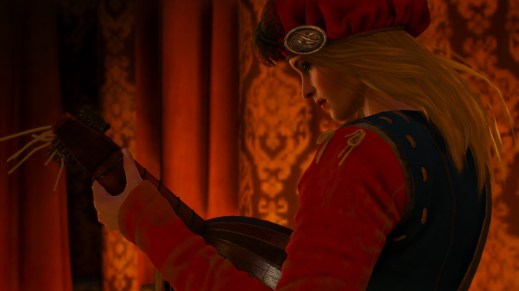
Compared to the wind instruments and female vocals of Skellige, percussion and plucked/struck strings predominate. There is indeed more of a Renaissance feel in an area already touched by modernity. Most notably, there is more diegetic music in these two cities. We frequently see and hear small Renaissance dance bands, using period instruments, entertaining crowds (watch from around 3:45 of the above video of Novigrad for an example; note how diegetic music slowly enters the soundtrack as they are approached). Perhaps the most significant diegetic moment, however, is the song by the Trobaritz Priscilla. The audio and visuals are surprisingly well matched, and the tuning of the lute adds emphasis to the fact of live performance. As a video cut-scene, this is one of few moments in the game where the player has no ability to affect their environs and must simply watch and listen.
Priscilla’s song
Far more so than in other areas, the music in Novigrad and Oxenfurt is for and by people. This is in marked contrast to the soundscapes found on Skellige and in Velen where the music is almost purely non-diegetic. In contrast to the pre-Christian matriarchal associations of the priestesses of Skellige is the aural handling of the Temple of the Eternal Fire in Novigrad and its male priests. As Adam Whittaker has recently identified, there is a clear link between musicological discourse on purely vocal performance in Christian sacred space in Early Music, and its representation on screen. Male a capella voices, and a ‘chanting’ vocal style (again hinting at plainchant, rather than using pre-existent chant music), are often used to denote the aural identity of a church. Precisely this kind of vocal delivery is added to the soundtrack as the player moves closer to the Temple of the Eternal Fire, explicitly linking this Christian association with the aural presence of the Temple. The contrast with the female-dominated vocals elsewhere enhances the distinction and re-enforces the links between the ostensibly pre-Christian worlds of Skellige and Velen and the Christian associations made in Novigrad.
Approaching the Temple of the Eternal Fire
The music of the Velen wasteland and the neighbouring White Orchard, like Skellige, is more folk influenced, yet clearly distinct. Gone are the Celtic folk influences; instead, this area fuses a cinematic pastoral idyll (again laden with nature sounds and with a peasantry speaking with West Country accents – compare the idyllic ‘Shire’ in Peter Jackson’s The Lord of the Rings) with a dark and sinister undertone which draws on the ‘otherness’ of many non-western and folk instruments, particularly the kemenche, electric cello, hurdy gurdy, bowed gusli, gheychak, and the bowed yaylı – the vast majority of which only enter the soundscape in this area. The use of the medieval as a source of dangerous and primitive ‘otherness’ is common at the moment (evidinced, for instance, by the many recent descriptions in the West of the so-called Islamic State as ‘medieval’) and draws on modernist thought which characterized the middle ages as a period of dark and dangerous alterity between the glories of antiquity and the Renaissance.
That the soundscape of The Witcher draws on competing categorisations of the medieval as ‘dangerous’ and ‘pastoral’ says much about the mutability of medievalisms. Musically, this ‘otherness’ can be expressed as a kind of orientalism, both exotic and dangerous, and the microtonal inflections and use of glissandi here give a sinister undertone to what is otherwise a quintessentially pastoral film score. This area has one of the most memorable parts of the entire soundtrack ‘Ladies of the Wood’, underscoring a genuinely horrific narrative and visuals (some of the consequences of which are shown in the first video of this post with a lengthier section of the music given below). The exotic instrumentation combined with the driving repetition, at odds with an audio usually so responsive to the player’s actions, makes the experience unsettling and claustrophobic.
Ladies of the Wood
Taken together, these very distinctive sound worlds serve to demonstrate some of the many medieval soundscapes which permeate our collective consciousness. In utilising iconic aural cues, composers and sound designers in a neo-medievalist tradition can conjure up particular cultural and social structures with ease, taking many of the shorthands which have emerged from the TV and film traditions in recent years. The indeterminacy inherent to videogame, and the common response of using audio stems, means that the soundscape moves far beyond what is possible in TV and film. However, it also makes problematic the concept of using real, historically-informed music from the period being invoked which would not be able to respond to the interactivity of the world. In The Witcher, the decisions we make effect the world around us, including its soundscape. The effect is crucial both to helping to conjure the world of The Witcher and to helping us feel immersed in it – perhaps paradoxically this may make the soundworld invoked seem more authentic even if it simultaneously reduces the possibility of using ‘authentic’ historical repertoire.
—
Featured image by Carlos Santos @YouTube CC BY.
—
James Cook is a University Teacher in Music at the University of Sheffield. His work focuses on the musical period that falls neatly between the Middle Ages and the Renaissance. In particular, the ways that musical cultures in this period interact and how expatriate groups (merchants, clergy, and nobility) imported and used music. Some of his work (like this essay) concerns the representation of early music on stage and screen, be that the use of ‘real’ early music in multimedia productions, the imaginative re-scoring of historical dramas, or even the popular medievalism of the fantasy genre.
—

REWIND! . . .If you liked this post, you may also dig:
Sounding Out! Podcast #49: Sound and Sexuality in Video Games – Milena Droumeva and Aaron Trammell
Sounding Out! Podcast #29: Game Audio Notes I: Growing Sounds for Sim Cell–Leonard J. Paul
Papa Sangre and the Construction of Immersion in Audio Games— Enongo Lumumba-Kasongo
The Dark Side of Game Audio: The Sounds of Mimetic Control and Affective Conditioning – Aaron Trammell
—
Share this:

Curatorial Dispatches from the Nendu Archives: The Journals of Rui Chaves and Tiago Costa

DOI: https://doi.org/10.59350/6v0qy-k0v35
Rui Chaves will be documenting his creation of Nendu—an archive of Brazilian sound artists—in real time on Sounding Out! throughout 2016-early 2017. A Portuguese version of Chaves’s journals was published in Linda, an online platform created by a composers’ collective called NME. Rui Chaves’s postdoctoral research is funded by FAPESP (São Paulo Research Foundation) Project 2014/15978-9.
—
Nendu—the title of my archive—envisages the creation of an online platform dedicated to presenting and mapping the work of contemporary Brazilian sound artists. I have based my based upon the following four objectives:
1) Creating a ‘map’ that enables the dissemination and discovery of local praxis;
2) Prompting conversations or different types of documentation that better illustrate individual creative processes (‘journal’);
3) Re-affirming the idea of the ‘archive’ as a research tool;
4) Writing a historical and critical report on Brazilian sound art;
Nendu’s online ‘map’ will enable users to discover different practitioners based on location, but more importantly on what categories the artists themselves have asked to be associated with.
These categories consist of designations of practices that cross the current imaginary of sound art historiography and reflection. A porous and rizomatic territory, to be sure, the categories will echo the obvious specificity of the experience and presentation of sounding artworks — temporally, spatially and formally — without excluding practical, historical and conceptual connections with music, architecture, performance or visual arts.
My selection framework interweaves individual research with contacts with curators, friends, and other researchers. It is important to mention that this process remains open to any individual that wants to be part of the platform until the end of the project in June 2017. This openness facilitates a dialogue between the archivist and interested parties, while at the same time enables reflection regarding the relationship with the idea of “sound art” and the role of sound within different artistic practices.
The second element (called a ‘journal’) consists of field work (to be done until the end of 2016) where I–together with a smaller selections of artists–attempt to present different in-depth reports of “ways of doing” sound art. The journal will consist of interviews, photos, videos, audio recordings and other relevant items. I will publish this material in tandem with the map in the form of a blog and I will share dispatches from the journal with SO!’s readership regularly throughout 2016.
The articulation of the map and journal foregrounds a critical reasoning regarding the idea of the archive as a research tool. My archive will not only be a repository of artists and work done, but also a way of doing an ‘archeology’ of discourses, made objects, and creative processes of sound practitioners. Methodologically, I support my archive via an ethnographic approach, tracing common ideas or patterns between conversations, materials, and/or other artifacts (texts, videos, audio recordings or photographs) gathered during the project. This not only allows an understanding of a possible formal aesthetic discourse (collective or individual), but also offers insights and possible contextualizations of various thematics within a broader cultural arena. Through mapping particular ways of doing, I argue, my archive will allow participants/artists—and also future users—a better comprehension of the prevalent cultural terms.
In the end, this methodology is geared toward the creation of a historical and critical report regarding the current panorama of Brazilian ‘sound art’. Because Nendu is also Tupi for “listening to one-self,” it functions as a metaphor for the creation of an archive that envisages alternative reflections and historiographies from European/American narratives.
For my introductory presentation for Sounding Out!, I want to take the opportunity to present a a ‘journal’ that I made with the artist Tiago Costa in the town of Tiete (state of São Paulo). We perform this activity with “two-voices,” each one of us writing about their experience — starting with me.
//
RUI CHAVES:
Day 1
My rendez-vous point with Tiago was at the Barra Funda metro station and bus station. Our meeting results from a series of conversations and our eagerness to record the sound of the cicadas in his home town (Tietê). He was also interested in using binaural microphones, which end up being the main recording setup for what we did in the weekend between the 29th to the 31st of January 2016. Over the course of this weekend, I ended up in a series of conversations where I try to explain how these microphones work—in a very imprecise manner.
Our trip begins early in the morning, so I wake up early and still in night time to travel to the metro station, carrying all the recording equipment. When I arrive, there is already a lively buzz in the place. I have breakfast and, still feeling hungry, I have a second. As always, I arrive way too early and I look for the travel information center in order to try to find the right bus ticket sales booth. Fortunately, Tiago also arrives really early and I get an SMS from him telling me that he had already bought the tickets. We meet up and immediately get along. The conversation between us will constantly flow during our time together. He is an artist with a vast experience in audio post-production and he’s also pretty active and interested in São Paulo’s experimental music scene. This type of in-depth knowledge will also be a good source of jokes and gossip regarding particular musicians in the scene.
The conversation continues inside the bus, during which I compliment the vehicle’s air conditioning set temperature, quite mild at that time. Everyone that has travelled by bus in Brasil is acquainted with the cold that one has during long distance travels. While we continue to chat and get farther away from the city, we start to gaze a landscape that cuts through our daily experience of living in São Paulo—it is so hard to see the horizon in that city!
We came across and stop briefly in a town with a weird and funny name to me: Boituva!
Boituva is really well known for its paragliding activities. Sometime during our weekend together, I discover that Tiago is afraid of heights and that he is not planning to paraglide any time soon—I agree. It also during this stop over that Tiago describes to me a regional musical traditional called “Cururu”: a form of song-off duel between two “violeiros”; based on that description, I commented to him that it sounded a lot like a rap battle. A smile comes up on Tiago’s face, a smile that grew larger and larger due to my inability to say “Cururu” the right way: Pururu, Cururuca, Pururuca.
We arrive to Tietê early and sleepy. At first sight, the city has a contrasting scale and size in regards to São Paulo. The height of the buildings is relatively small, punctuated by a few condos slightly off the main urbanscape. The bus station has a small boteco, and not much else. Botecos are common in Brazil; to me, they seem like a cross-over between a pub, restaurant and coffeehouse. There are a few clouds in the horizon, but Tiago tells me that the city is much warmer and drier than São Paulo. He also tells me that signs of Italian immigration are quite present in the city, as well as assorted religious events. Not long after, Tiago’s mom arrives and she is extremely kind.
At Tiago’s place I have my third breakfast (called café da manhã here). With some effort and excitement, we go out to check a few places near Tiago’s home for recording and I’m impressed by the relatively diversity of the nearby soundscape. Besides the sounds of birds, insects and some motorbikes—there is a pungent smell of sewer in the air that envelops us.
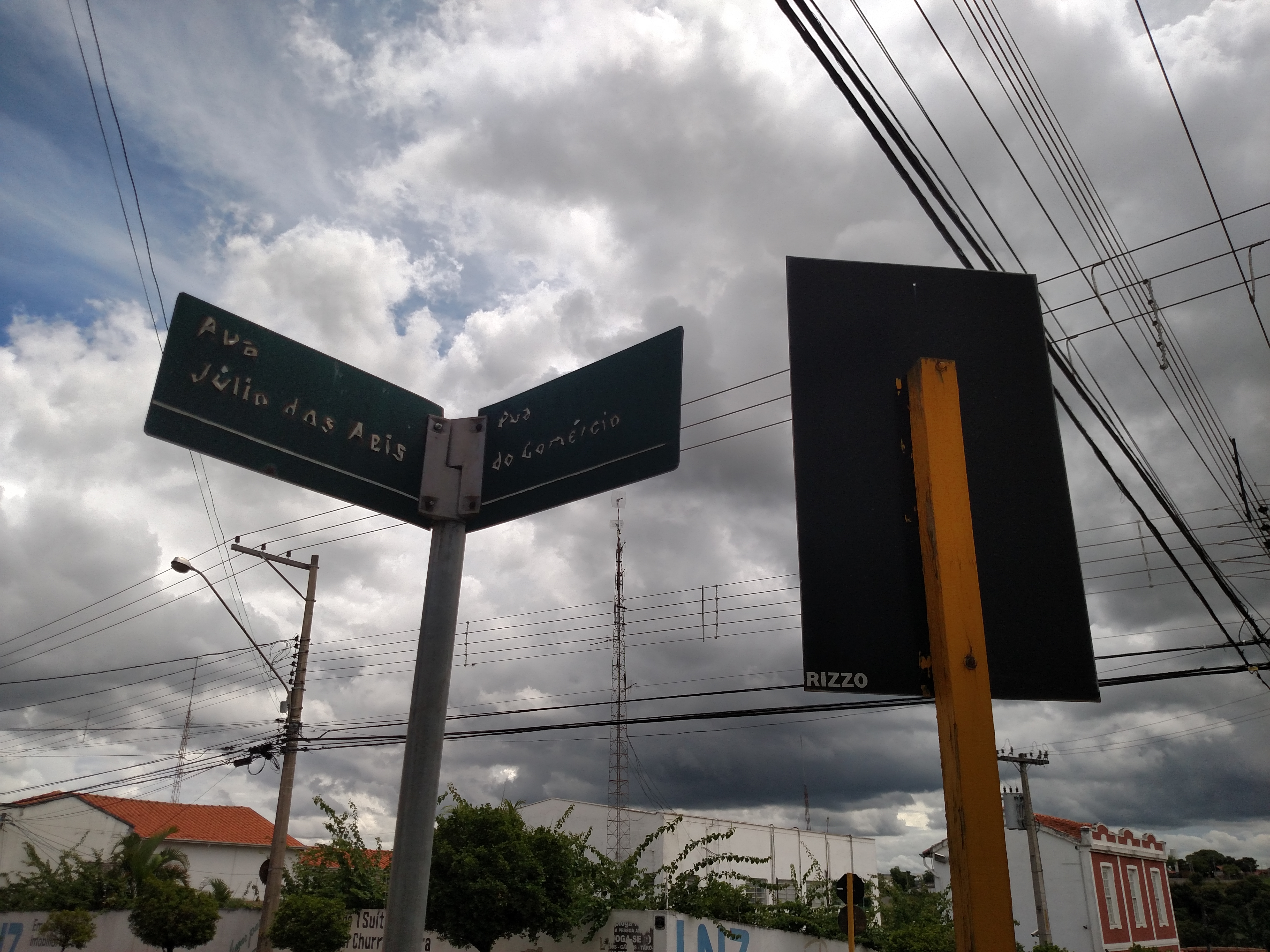
We also see a series of houses with an architecture that reminds me of other parts of the world. We make the most of this small trip and Tiago records a small route in that area using the binaural microphones.
Tiago Costa field recording // Best heard with headphones
We go back home and Tiago listens to the recording we just made. We have a small talk about this process. We sit at the table to have lunch and I try to explain to Tiago’s mom my research and what the process of binaural recording entails:
The head is a filter that enables to create a 3D image during the recording process.
I think I have a limited understanding of the process.
We end up having a quiet afternoon. I’m still a bit excited, so I decide to go out to run a few tests with the camera I bought to document my research work. Tiago and his mom suggest that I go and visit the river.
I do a small video recording through the city using a gadget that enables me to strap the camera to my head. Following their indications, I find the river Tietê. The color of the water is really brown and there is a smell that I can’t explain. It seems that in bygone times one could have a swim there, and that there was also a swimming club. With time that changed, but there is a small religious celebration where two boats meet in the same place.
I find a small wooden stage near a construction site and inadvertently, I hear a conversation about which national team has the biggest number of fans in the country. I start to get really tired and decide to go back home. I try to transfer the files to watch the videos. The computer has problems playing them, so I give up and fall asleep.
We wake up for dinner and after, we go on a stroll through the city, literally going in circles around the main plaza. The conversation is good and we continue talking over a few beers on the porch of Tiago’s house. I don’t know if it was on that day or the next, but we comment on the lack of representation of certain groups in the São Paulo experimental music scene.
Tiago also describes to me a map of the local labels. We decide that it might be interesting to have a dedicated field recording label, because there are none in Brasil. We laugh at the possibility of the project being profitable or manageable. It would be one of those things that you would do out of passion, as were most things that we talked about during that evening.
We decide to wake up early in order to do our first recording of the day and try to capture the local dawn chorus. It was a really warm night, so I fall asleep to the sound of the ceiling fan refreshing me.
Day 2
I had an idea for a possible project between us, having sent Tiago a plan beforehand. The project consisted of using the binaural recording process as a metaphor for a collaborative recording process. I soon realize that that could be too complex for the time we had, and that I didn’t want to condition our weekend meeting and recording process. From now on, the focus would be on documenting Tiago’s work.
The alarm rings and I prepare the audio and video recording equipment. We both look tired, but are in good moods. The idea is to document the recording/path that Tiago is going to make—so I strap the camera to my head and Tiago sets up the binaural microphones; for some reason there is a glitch with the audio recorder SD card, but I manage to solve the problem.
Tiago – Field Recording // Better heard with headphones
We go back in order to get bit a more rest; we must, as later on we are going to do a few more recordings. I try, but I end up staying awake. It starts to get hot, so I get out of bed and have have breakfast. Tiago’s mom is already doing some house chores. It is a beautiful day and I am quite excited about what we are going to do in the afternoon. The area surrounding Tietê is quite beautiful with sugar cane plantations all over the place, supposedly for the production of bio-diesel.
We were meant to go out early, but we are going to meet a friend’s of Tiago and he suggested that we went after lunch. So we did that, just before leaving an intense rainfall strikes Tietê. We head out anyway, toward a place whose name I forgot. After we arrive, and while we wait for the weather to improve, we decide to recording the momentary ambience.
When the rain stops, we meet up with Marcos—a really gentle and nice person. On our way, I explain my research project to him and lend him my recorder to listen to how binaural recordings sound. He tells me that it feels like the sounds are happening around him. Discreetly, I record their conversation and I am briefly taken away by stories about friends and TV shows that discuss the evolutionary nature of pain.
We arrive at the dirt track where we are going to do a few recordings. We have to jump a fence and my shoes get all dirty with mud. In the end, all of our clothing ends up wet and dirty and Tiago’s mom’s car will suffer the consequence of our little adventure. At the same time, I can’t understand if we are actually allowed to enter this property.
The surrounding landscape is amazing and we walk, hopping a few more fences until we reach the river. We stop there in order to do another recording. The river water has an intense brown color and the sky is still cloudy. We mainly record the sound of the water coursing. After we finish, Marcos goes out to do a recording and disappears for a few minutes.
Marcos André Lorenzetti recording // Best heard with headphones
After a while, we get a bit worried about him, but he soon arrives saying that we have to change to another, more interesting place. We start walking, avoiding our initial choice of a route due to the possibility of existing spiders or snakes, crossing a small ranch where we encounter a family getting ready for a barbecue. Marcos, a former vegetarian who now eats chicken, asks Tiago if he misses eating barbecue. He says he doesn’t.
At another part of the river bed, for some odd reason we decide to go through a complicated route (especially for people carrying equipment!). I worry I’m going to get wet. So it was, but Tiago and his friend helped me with my bag. We arrive to a small island of rocks and we do another recording. The weather is nicer now and it feels really wonderful. Tiago and Marcos go for a swim in the water and I get in a little bit to make a video recording. After a while, I felt obliged to go for a swim too, although I was a bit phobic regarding germs, bacteria or other nasties that could be in that water. I join them and suddenly we spot a sewer drainage pipe. I ask Marcos if the water is clean and he replies that:
Clean, clean, it never is!
Returning to the ‘mainland.’, I accidentally misplaced one of my feet, and slip on my back on one of the rocks. Fortunately, none of the equipment gets wet and I leave with only a few bruise marks.
TIAGO COSTA
In mid-November 2015, there was a strong heat wave in the interior of São Paulo. I was in the city of Tietê, my home town, two hours west. I remember being home, the seasonal dry air and the surrounding sounds picked up my attention, in particular the strong sound of the cicadas. I became interested in capturing them, and imagined myself in a recording situation in the middle of the woods, just a few meters from my house. At that time, I had been listening to a few interesting works that utilized binaural microphones and start querying colleagues that used that type of setup in their work. That’s when I contacted Rui.
Rui is developing research about Brazilian sound art, and for that he interviews and documents a series of artists that work with sound. Part of his process consists in spending some time with them, documenting what they usually do and proposing interventions. I explain what I wanted to do; Rui got interested and he invited me to do something in Tietê.
Due to our agendas, our meeting had to be postponed a few months after this conversation, unfortunately when he finally had time, the cicada weren’t ‘sounding’ as as much as before. We decide to maintain our intent to meet, and during the month of January, we left for a weekend to do some field recordings together.
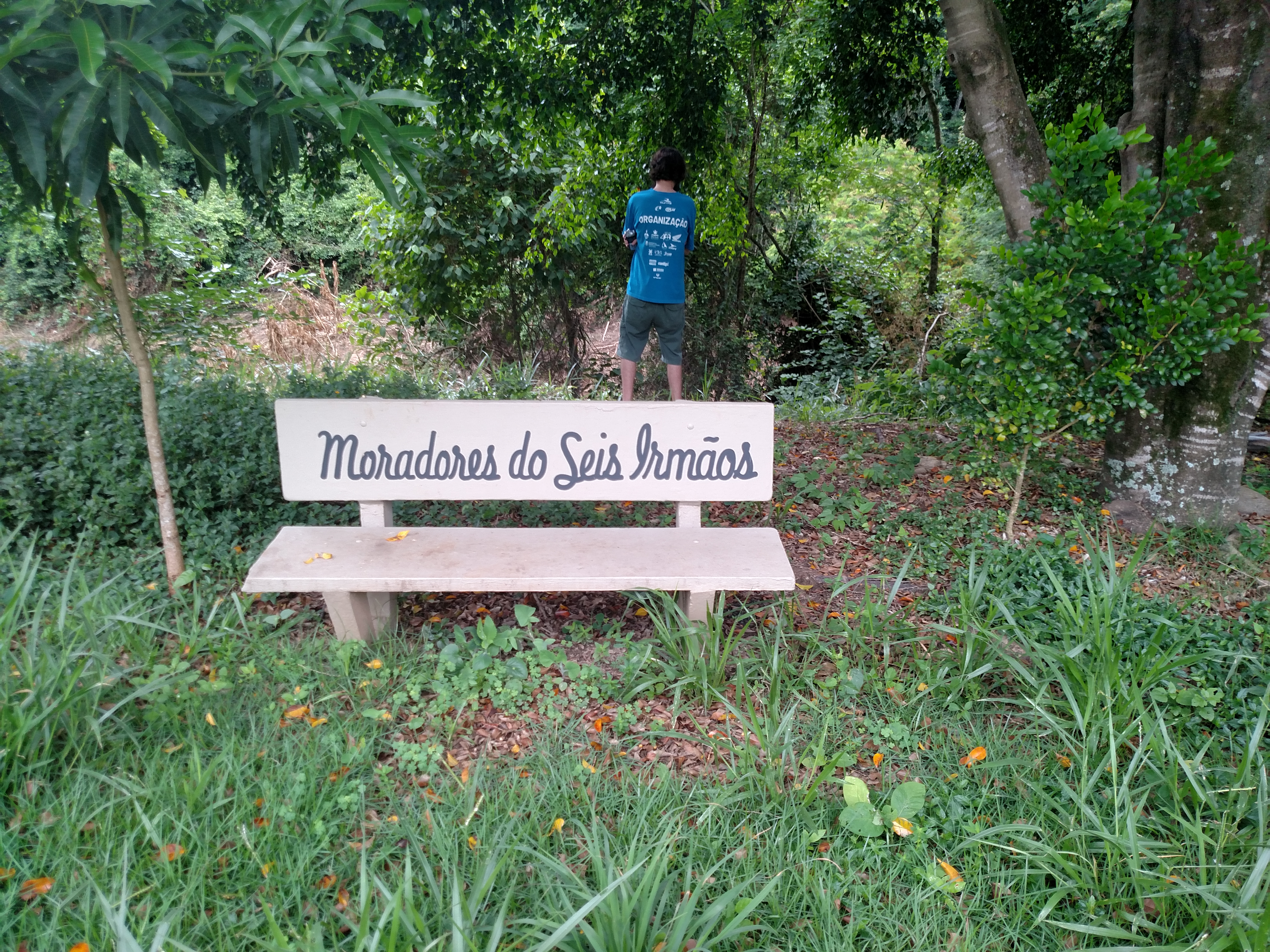
We went to Tietê on the 29th of January and the soundwalk happened briefly after we arrive. With the recorder and binaural microphones in hand, we visit the outskirts of the woods in proximity to a neighborhood called Seis Irmãos (literally translating to “six brothers”).
In the past, that part of town had only a few small farms (called chácaras in Brasil), and although today it has been replaced by urban development, it still maintains a considerable native green area. Well, partially native. as we encountered a mix and pipes that send untreated sewage to a water stream called Ribeirão da Serra.
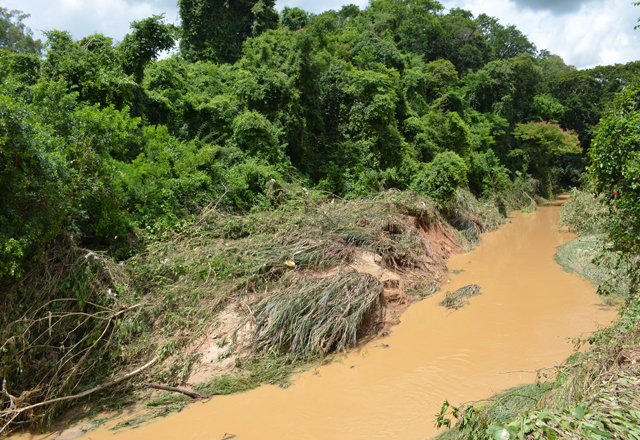
During that walk, we had a go with binaural recording, and we discussed a possible ‘narrative’ that could be done the next day, This ‘narrative’ would consist of emphasizing the first morning sounds, starting in the middle of the neighborhood houses, until a particular moment when we would enter the woods for a more contemplative appreciation. We also recorded a few ‘urban sounds’ during the walk, inside a car on the way to the next recording spot: a brief rain storm, the car’s mechanical sounds and our casual conversations.
Rui Chaves field recording // Better heard with headphones
The second stage happened in a nearby town, Cerquilho. This was a plan parallel to the cicadas that we made at the banks of the Sorocaba River, a place with less human intervention and strong currents, so it demanded the help of someone that knew it well. I invited my friend Marcos to accompany us. He had practiced canoeing and regularly frequents that spot, building a very close relationship with this river. During the trip he told us about an experience he had spending the night close to the river with only a hammock. He described how the sound part of this experience transformed his perception:
One time I went to sleep close to the river [. . .] in the hammock, and during the day the sound of water is harmonic, but during the night it transforms into something really intense. And since it was night time and our perception gets a lot sharper, more alert, because there could be an animal close, so with any noise made we become more alert. There were times where the experience of the water ‘noise’ became so intense that it somehow even changed my consciousness [. . .] it was incredible [. . .] because it is a constant sound, right, [. . .] the current is constant [. . .] and if you don’t feel trapped by it, you set yourself free.
Tiago Costa Field Recording // Usar fone de ouvido
The sound recordings made in that afternoon captured a river with a strong presence in constituting that acoustic space, taking upstage presence in regard to all other sounds. After the recordings, we had a swim and talked until the end of the afternoon.
***
This multi-vocal diary manifests the methodological frame for the ‘type’ of archive that I am building — a performative endeavor that envisages presenting process and work through a multi-layered weave of text, audio-visual documentation, and online material. Ultimately, its format signals a dialogical movement between archivist and artist, the underlying force in building a critical and historical report on Brazilian sound art. This publication is part of a series of installments that will run until mid-2017. The next post will focus on the work of Lilian Nakao Nakahodo, a composer/performer and researcher that created the Curitiba Sound Map.
—
Featured Image: In a ranch between Tietê and Cerquilho. 30/01/2016. Picture by Rui Chaves
—
Rui Chaves is a Portuguese sound artist, performer and researcher. His research and work foregrounds a discussion of presence — both physical and authorial — in the process of making sound art. This endeavor is informed by a contemporary critical inquiry and exploration of the thematics of body, place, text and technology. He has presented his work in several institutions and events throughout the United Kingdom, Brazil, France, Canada, Portugal and Germany. He holds a PhD in music from Queen’s University Belfast and is currently a postdoctoral researcher at NuSom (University of São Paulo).
Written in collaboration with Tiago Costa.
—
REWIND!…If you liked this post, you may also dig:
Six Years in Nodar: Sound Art in a Rural Context–Rui Gomes Costa
SO! Amplifies: Ian Rawes and the London Sound Survey–Ian Rawes
Sound-politics in São Paulo, Brazil–Leonardo Cardoso
Reflective Sound Gathering via the New England Soundscape Project
–Daniel Walzer
Share this:




Current Top Posts




April 2021

January 2020

November 2019

October 2019

August 2019

April 2014

November 2017

March 2015

December 2017

October 2015


Recent Comments