
Summer Soundscapes, East Coast Style
The humid dog days of summer are upon us, and with them their unique soundscape. In central-AC bereft Binghamton,NY, this means the opening of windows from now until the air turns crisp in September, an act whose necessity casts the intimate sounds of my daily life into my neighbor’s homes and invites their sounds into my apartment. You don’t need to be Mrs. Kravitz to pick up on the comings and goings next door; basically, summertime means your biz is in the streets whether you want it to be or not. In my former neighborhood, youthful and well worn, this meant anything from the heated fights of newlyweds—and the equally passionate make-up sessions, stereotypical but true—to bumping music and whose kids go to sleep when. I used to know what video games the guys next door played and how they were progressing, even though I still couldn’t tell you what they looked like.
In wintertime, this heat-necessitated, neighborhood-sanctioned audio voyeurism ends abruptly with the first frost; double-paned windows tell no tales. But for now, the sonic community is vibrant, even in my current neighborhood comprised mainly of retirees: the brush of wind through the trees, the yap of small dogs, the hum-and-drip of wall units, the snarl of lawn mowers and the high-pitched whine of edging equipment—I have learned after trying to work at home a few times that retirees reserve the right to mow any time they damn well please, thank you—and the gossip of family gathered in lawn chair semi-circles two doors down. I knew my next-door-neighbor’s grandchild was visiting two days before she saw me watering my plants and proudly introduced me to the sheepish little one.
I have to say that even after three years of living here, there still a part of me that finds the annual summertime ritual-cum-reality show novel and slightly unnerving.  In my home state of (Southern) California windows are rarely opened unless they have bars on them—people worry that strangers will crawl inside, especially when Robert Downey, Jr. is off the wagon—and I have my dad’s perpetual “we aren’t paying to cool the outside” burned into my brain. Not knowing one’s neighbors is often a badge of pride in SoCal and privacy is treated as a right rather than a financially and technologically-enabled privilege or an unfortunate side effect of paranoia. The closest I have come to such a high degree of sonic intermingling was when I lived in a first-floor studio apartment at the bottom of an air-shaft in an old LA building, where, in addition to overhearing all sorts of drama, I would also find unexpected gifts in my shower: old razors, half-used designer shampoos, crusty loofahs.
This season, however, I was really settling in to the summer soundscape until we finally had our first real heat wave. Temperatures skyrocketed into the 90s and the dew point wasn’t far behind, creating an intense humidity that unleashed a noise the likes of which I have never heard before. . .at least not in this acutely painful way. It was finally warm enough for the people behind us to start SWIMMING in their POOL. Pools are a rarity in the Bing, and I have to say that when it is hot enough for sweat to creep down your back, the sheer torture of hearing splash after splash is enough to push anyone over the edge. But my discomfort with the sound is due to more than simply heat frustrations; it reminds me more than anything that even after three years, I remain a stranger in a strange land. Like sound artist and theorist Tony Schwartz reminded us, “There’s no party so noisy as the one you’re not invited to.” And I feel that intensely with every cannonball and yelp of pleasure that I hear over the back fence. I don’t know my neighbors yet—definitely not well enough for impromptu pool parties—and I don’t know anyone with a pool to holler at on a hot day,  something I took for granted growing up in suburban SoCal, where swimming pools and homies with some kind of access to them, illicit or not, were much more plentiful. While sound has the ability to moor us to particular locations, it can also unmoor us in the same moment. As I hear the slurp of the choppy water against the concrete rim, I am simultaneously stewing in the shade of the neighbor’s giant pool-view blocking white fence—ironically the only shade in our yard—and I am back in 1980s Riverside, playing Marco Polo until my lungs ached from gulping too much smog. The sounds of swimming are so familiar to me that they are completely foreign in this new location and I can’t help but feel a little alien myself as a result.
A friend recently suggested that I should resolve my noise-related tensions the old-fashioned upstate New York way, by knocking on their door, son in tow, with a basket full of tomatoes fresh from our garden. I have long disagreed with the slogan of the Noise Pollution Clearinghouse—“Good Neighbors Keep their Noise to Themselves”—believing that in many occasions, noise is a product of social relations. This instance seems like an excellent test case. Perhaps if good neighbors shared more fresh produce, they would get more pool invites, and all that splashing would blend seamlessly back into the Binghamton summer soundscape. Or, I will pack up the car like usual and continue to be grateful that, unlike SoCal, public pools are still king in these parts.
Sounding Out! would like to hear about your favorite summer sounds. . .and the ones that drive you a little bit crazy. Drop some in our comment box, then adjust the bass and let the Alpine blast. . .
JSA


Share this:

Sounds of Home
Last month, I braved hail, snow, and just about every kind of plague-like spring weather to hear Karen Tongson’s talk at Cornell about her soon-to-be-released book, Relocations: Emergent Queer Suburban Imaginaries (NYU Press’s Sexual Cultures Series). Karen’s project remaps U.S. suburban spaces as brown, immigrant, and queer, thus relocating the foundations of both queer studies and urban studies. While not a part of the “dykeaspora” of color that Karen deftly details, I am in solidarity with the lives she traces and the soundscapes she amplifies more passionately than Lloyd Dobler with his boom box.
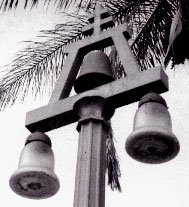 After all, Karen and I grew up together in the dusty, palm-tree lined streets of Riverside, California, meeting at Sierra Middle School and plotting our way the hell out of Dodge. . .only to later realize that our mutual plottings were really survivings—and a hell of a lot of fun—and the Riv—with its raincrosses and dry riverbeds, lifted trucks and low riders—would stay with us wherever we went.
Since leaving Ithaca—Karen’s voice still warm in my ears like it used to be when tying up our parent’s pre-call-waiting phone lines—I haven’t been able to stop thinking about the way in which Relocations also reimagines the power of music. For Karen, music can help us know and love who we are more deeply, to enable us to “make do” with what we have been given in a way that liberates rather than incarcerates. Music is not just about “the differences it makes audible” (as Josh Kun writes in Audiotopia) but also, as Karen argues, about the ways in which sound gives us back to ourselves.
For example, a song that is spliced into Karen and I’s mutual musical DNA is “There is a Light that Never Goes Out” by The Smiths, (from 1986’s The Queen is Dead). Its various revolutions—both on turntables and in life choices—have affected us profoundly. In “The Light that Never Goes Out: Butch Intimacies and Sub-Urban Socialibilities in ‘Lesser Los Angeles,’” Karen uses the song as an affective touchstone for the ways in which sound can create “queer sociability, affinity, and intimacy” (355) while providing sonic moments of “self- and mutual-discovery” (360) and mediating relationships of place, power, pleasure, and privilege.
Karen’s ideas have since helped me understand why I used to listen to the song over and over in my lonely yet womb-like suburban bedroom, as if it were revelation and incantation. As I struggled with issues—identity and otherwise—Morrissey’s silken voice had the power to sound out the shape of my most secret wounds and simultaneously soothe them. Although I now know I am not alone in this, I thought I was back then, alone and waiting for someone to:
“Take me out tonight
where there’s music and there’s people
who are young and alive.”
In a now slightly-embarrassing Anglophilic phase—this was also around the time I was reading The Adrian Mole Diaries, watching My Fair Lady with Karen, and exchanging mixtapes with my British penpal—the Smiths were part and parcel of an England that I imagined as a long lost home. The U.K.’s pop cultural exports made it seem so much more tolerant of misfits of all kinds, let alone more temperate than SoCal for black turtlenecks and Doc Martens. At the time, I thought I was listening to difference—to the most remote space imaginable from the sweltering hothouse of Riverside—but Karen’s work reveals that I was really hearing the maudlin voice of my own longing, the jangly chords of my own desire, the oddball rhythms of my own heart.
I finally got myself to the actual England years later, thanks to the wonders of credit-card leveraged conferencing in destination locations. After the conference—at which I was, ironically, presenting on Los Angeles—I had the pleasure of spending a damp, foggy day record-shopping my way through brick-bound Nottingham. While I was gleefully flipping through velvety fields of plastic covers and comparing American imports with their UK counterparts, “There is a Light that Never Goes Out” came on the shop’s PA. With the first flare of guitar, I looked up from the record bins, startled by the warm recognition I felt at the sound of “home.”
At the time, I remember thinking that my thirteen-year-old self would be totally geeked out. However, I harbor little nostalgia for the volatile claustrophobia of my lonely tweenhood. Karen would describe my flash of recognition as “remote intimacy,” an asynchronous experience of popular culture across virtual networks of desire, a way of “imagining our own spaces in connection with others.”
Singing along for the thousandth time to Morrissey’s bittersweet grain, I realized that I wasn’t listening to my past in that record shop, but rather my thirteen-year-old self had been hearing the future in her bedroom. Dreaming of England had given her a way to grapple with the pains that ultimately produced my deepest longings: to overcome the “strange fears that gripped” me, to one day be able take myself “anywhere, anywhere,” and to feel the “light” of a love that would “never go out.”

It had taken a 5500 mile plane ride for me to realize that “home” was, in fact, a feeling of arrival rather than site of destination . . .and I couldn’t wait to get back to L.A. to give my homegirl Karen a call.
“There is a light that never goes out
There is a light that never goes out
There is a light that never goes out
There is a light and it never goes out. . .”
JSA


Share this:


Current Top Posts





April 2021

January 2020

November 2019

October 2019

August 2019

April 2014

November 2017

March 2015

December 2017

October 2015
 Sounding Out!
Recent Comments