
Garageland! Authenticity and Musical Taste

First show with The Carpetbaggers! @The Manor.
Today’s post is a bit of a confessional. Reflecting on Andreas Duus Pape’s post a few weeks back, Building Intimate Performance Venues on the Internet, I can not help but admire how closely Andreas relates podcasting with intimacy, and therefore; authenticity. Although it would be simple to critique this point as a case of circular reasoning (Podcasts are intimate because they are authentic. Podcasts are authentic because they are intimate.), I cannot help but wonder if there is something deeply honest and deftly earnest about this claim. Speaking as a musician, I believe that authenticity is a quality that cannot be conjured. It, like a feedback loop or proof of will, seeks only itself. But, how does the desire to be authentic shape performance? Does it affect what we listen for and who we listen to?
My adventures as a musician started in high school with a second hand guitar and a lot of free time. It only took a year before my pastime became something more like an obsession. First was my high school band: The Nosebleeds. The Nosebleeds played revved up versions of 50s and 60s rock and roll while all the other kids were covering Blink 182 and Operation Ivy. We were cool – really! Even at this early stage it was clear to me, authentic rock bands played old-school rock music. Even my punk guitar heroes from the 1970s like Mick Jones and Captain Sensible knew how to cop a Chuck Berry riff and Little Richard groove. After 3 years of humid Jersey shore dive bars and fluorescent high school talent shows we called it quits. Honestly, we just got bored. Also, our ace repertoire of fifteen songs was beginning to wear a little thin. . .
After The Nosebleeds came The Carpetbaggers. This was a sea-change in compositional direction. Instead of playing punky renditions of Twist and Shout, we affected a country twang and sang songs about travel and broken hearts. If you caught us on a good night, we would even throw a bit of Sonic Youth into the mix and evoke a wall of feedback out from silence. We played in New Brunswick basements and central Jersey bars and recorded an EP on an abandoned Tascam 1” reel to reel. Buzz words being thrown around at the time were: rootsy, alternative and raw. I had pulled the covers back from a revved up Chuck Berry only to find a wonderland of Americana – washboards, harmonicas, and acoustic guitars – waiting. This was, of course, what those rocker’s back in the day were inspired by – right? If The Carpetbaggers weren’t the real thing, who was?
When The Carpetbaggers broke up I joined one last band, The Acid Creeps. At this point, there would be no turning back from my descent into nostalgia. We aimed to resurrect the late sixties go-go bar house band. Taking care to acquire vintage Fender amplifiers, vintage reissue guitars, and even a knockoff Vox Continental organ. If that wasn’t enough, my sister sewed us matching orange paisley shirts which complimented our skinny black ties and sunglasses. We imagined ourselves as a period perfect garage band, exactly the sort we had seen in movies. We covered everything from Iggy Pop’s, I Wanna Be Your Dog, to The Sonic’s, Psycho, and the Detroit Wheels version of Little Latin Lupe Lu (which we all preferred). Only in our mid-twenties, we were experts (or snobs, depending on your perspective) at defining and defending what authentic garage music was, and what it was not. Before breaking up, we created a yellow 7” vinyl tomb to forever keep our music. It was named “The Bananna Split EP,” and at the moment it all seemed perfect. Authenticity, sold for five dollars at a show.

Bananna Split EP w/ Full of Fancy.
Reflecting, five years later, on these three epochs of music making – it is hard not to blush. Not only did I, for at least a year, consider each band the singular most authentic band ever; authenticity, as an ideal, began subtly to change the way I viewed myself. I transformed from Aaron the Weird Al Yankovic fan to Aaron, the garage rock expert in about 8 years. Wherever I looked for authenticity, I found it, and it was real. Not only that, but at the bar, we convinced ourselves and our friends of this notion. Conversations about which bands got it, and which did not, were frequent – if not mandatory. The answers became standard too: The Exploding Hearts, The Murder City Devils, The Misfits? They all got it. Bands like Metallica; for the most part, they did not. These conversations forever led us to equate the authentic with the obscure; a rabbit hole that twists and darts endlessly.
Authenticity in music is like feedback: powerful, seductive and dangerous. It is a very real, yet elusive concept that invites imitation and when left unchecked, can spread like a contagion. Although I love revisiting the music of my old bands, I cannot help but hear them now as a set of key moments in a greater life narrative. Iterations of myself left behind in an ongoing dialogue about authenticity. A dialogue, which, to this day, affects what music I choose to listen to, and what music I choose to avoid. Although none of my bands were truly “the real-deal,” it would be odd to claim that any were not authentic. Rather, this concept, authenticity animated each band – it kept us all going, and brought our music to life. My bands were authentic because I believed in them. I believed in my bands, because they were authentic.
AT
–
Aaron Trammell is co-founder and multimedia editor of Sounding Out! He is also a Media Studies PhD student at Rutgers University.
Share this:

Pushing Play: What Makes the Portable Cassette Recorder Interesting?
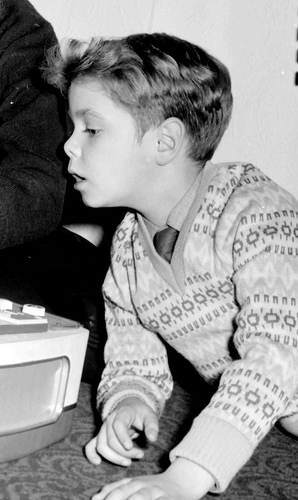
"Change the Speed": image from the "Vintage Kids" archive of flickr user theirhistory
One of my earliest memories of sound recording is one of my earliest memories, period: an isolated image of my own index and middle finger trying to push down the “record” and “play” buttons on my father’s portable cassette tape recorder. More prominent than the visual element of this memory is the haptic one: I can still call up the sensation of the effort required to make the red button go down and latch and the stress on the top joint of my index finger as the resistance bent it backward. Also still with me is a trace sense of the threat of sharp pain, as if at some point previous I had been wounded (perhaps pinched?) by these buttons. How young must I have been to have experienced this degree of opposition from such a small, unassuming device? And whence this desire to persist in the face of it?And: how and where does this object–so unprepossessing with its five big buttons, volume slider, cartridge tray, and little speaker–fit into sound studies and the history of sound recording technology?
There’s a small, rich, growing body of work on tape recording–including work by scholars as different as Kathleen Hayles, Steven Connor, Michael Davidson, and this blog’s doyen, Jennifer Stoever-Ackerman–but almost invariably it focuses on the reel-to-reel recorder, the device the cassette recorder was meant to simplify and miniaturize, at the expense of sound quality. The reel-to-reel was a vital contributor to the development of stereo and hi-fi hobbyism; it was also the mechanism at the center of a series of bold modernist literary experiments with tape recording by Samuel Beckett, William S. Burroughs, David Antin, and others.
Aside from Andy Warhol’s use of it to tape huge swaths of his everyday life (in 1965, he “wrote” a novel consisting of 24 largely consecutive hours of transcribed cassettes) the cassette recorder has no such avant-garde pedigree. The name of the first model, the Norelco Carry-Corder 150, which appeared in 1963, shows the primary focus of its manufacturers’ vision. Ads and trade journal articles from around this time touted the ease with which the device could be toted around on a vacation with the aim of producing an “audio album” of the trip. Doubtless, such albums were made and some may even still exist. But I suspect that the most vibrant history of the Carry-Corder and its descendants lies in the device’s easy adapability into the play world of children. As I and many others of my generation remember it, the pleasure of playing with the device was the way it instigated various sorts of performance, usually based in mimicry of ones we’d consumed through other electronic media. In a manner not unlike Warhol, we created our own little media empires: Dj-ing, news announcing, sportscasting, hosting talk shows with the baby and the dog as guests, singing like Cher on TV, re-enacting TV comedy sketches, recording one’s own comedy sketches, and on and on.
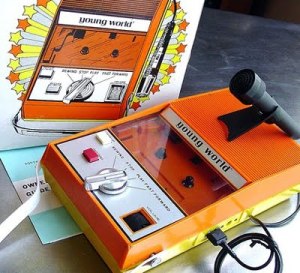
Child's play?: Young World BIC-202 Cassette Recorder
It’s not obvious how sound figures in the context of children’s play. Certainly, the quality with which the tape recorder recorded and played back sound mattered little, if at all. What mattered was the way the device initiated and constructed scenes, provided roles to play. Analogously, as David E. James has noted, one of the most powerful aspects of Warhol’s practice of bringing his Carry-Corder 150 everywhere he went (he was an early adopter, purchasing one in 1964) was that it “ma(de) performance inevitable” and “constitute(d) being as performance” (Allegories of Cinema, page 69). Even playback itself was a matter of secondary interest; how many times do you think I listened to the tape of myself “broadcasting” two innings of a random mid-70s Mets game, delivered as I watched on TV with the sound turned down? My wager is on none. Still, sound is the raison d’etre of the cassette recorder. A few years later, kids might have done similar things with a video camera, but to a lot of kids, the early mass-marketed versions of that device felt much more formal, complicated, authoritative. That was the instrument through which the “official” history of the family was to be told; the tape recorder picked up the creative fragments, the bored interstices, the embarrassments, the extremes–parts of a world that wasn’t to appear before guests. Plus, the sound-based device actually offered greater reach and flexibility along with more forms of integration into other media like television.
My early memory of the recorder, however, seems more primal. Given its intensity, it seems clear that the tape recorder served as a vehicle toward several important forms of self-demarcation, helping me to discover and negotiate certain limits: of my body, of my agency vis-à-vis machines, of my relationships to my parents, of my family’s position in a larger social and economic world. (And in fact, the device was an important part of my family’s livelihood, vital to my father’s work as a radio reporter.) In retrospect, I seem almost impossibly young to be left to my own devices with the machine, and I also have a vague sense that I had been violating some prohibition, perhaps a decree that the recorder is “not a toy.” I wonder how much the force of such a decree originated precisely in the ease with which it could and did become a toy.
gramophone, film, typewriter, and cassette tape recorder?
It’s unlikely that Friedrich Kittler was going to list “cassette tape recorder” next in his book title after “gramophone, film, and typewriter.” It’s unlikely he had an image of the device in mind when he wrote his bravura dictum, “media determine our situation.” Some technologies don’t stand up to such sweeping statements, toward which media studies sometimes seems particularly drawn. Certain devices, I think, necessitate a broadened and diversified understanding of the things both sound and technology do—even things that aren’t “about” sound in a conventional sense. For many historical narratives of sound reproduction, the cassette tape recorder is a regressive device, a drag on the pursuit of greater audio fidelity, with fidelity defined as “presence.” But the qualities of the cassette recorder that make it significant to our field are manifold, and some of them will be qualities that arise out of their adjacency to the central fact of recording and playing back sound. The “forgotten” areas of the history of sound reproduction technologies aren’t the notable failures—the 8-track players, which after all still draw camp-retro interest–but the most mundane successes. The portable cassette tape recorded never truly failed, it just got left back.
—
Gustavus Stadler teaches English and American Studies at Haverford College. He is the author of Troubling Minds: The Cultural Politics of Genius in the U. S.1840-1890 (U of Minn Press, 2006) and co-editor (with Karen Tongson) of the Journal of Popular Music Studies. His 2010 edited special issue of Social Text on “The Politics of Recorded Sound” was recently named a finalist for a prize in the category of “General History” by the Association of Recorded Sound Collections. He is currently working on Andy Warhol’s sound world, Woody Guthrie’s sexuality, and other stuff.
Share this:


Current Top Posts





April 2021

January 2020

November 2019

October 2019

August 2019

April 2014

November 2017

March 2015

December 2017

October 2015
 Sounding Out!
Recent Comments