
From Kitschy to Classy: Reviving the TR-808

Before Roland’s new TR-8 Rhythm Performer, a contemporary drum machine, was unveiled this year, the company released a series of promotional videos in which the machine’s designers sought out the original schematics and behavior of its predecessor the TR-808, an iconic analog drum machine from the early 1980s. The TR-808 holds cultural cache–most recently due to its use by Outkast, Baauer, and Kanye West–that Roland is interested in exploiting for the Rhythm Performer. The video features engineers closely examining the TR-808’s sound with an oscilloscope, trying to glean every last detail of the original’s personality.

“Roland TR-808” by Flickr user Ethan Hein, CC BY 2.0
Things were not always this way. Upon its initial release, the TR-808 was widely dismissed. Because it did not sound like “normal” acoustic drums, many established musicians questioned its utility and many ultimately disregarded it. However, its “cheap” circuit-produced sounds became bargain-bin treasures for emerging artists. Since its sounds now play such a large part in the landscape of electronic music, this essay takes a historical perspective on the TR-808 Rhythm Composer’s use and circulation. By analyzing how Juan Atkins and Marvin Gaye used the TR-808 in the early 1980s, I show how the TR-808 created a sonic space for drum machines in popular music.
Drum machines, though commonplace today, were once seen as kitschy tools for broke amateur musicians. As audio engineer Mitchell Sigman explains, the 808’s low, subsonic kick drum and “tick” snare characterized a departure from the realistic, sampled drum sounds produced by high-end drum machines in the early 1980s. The 808 uses analog oscillators and white noise generators to make sounds resembling the components of a drum set (kick, snare, hi-hats, etc.) And, although these sounds are now commonplace, most contemporary artists use them precisely because they sound robotic, not because they sound like drums. Even though the 808 at first seemed a failed imitation of “real” drums, the comparatively low cost of the 808, which originally retailed around $1,195, attracted musicians who were unable to afford other similar machines such as the LinnDrum that retailed at more than twice that price. Roland advertised the machine as a “studio” for musicians on a budget and even as they began to disinvest from the 808–as testified by the company’s decision to invest in marketing and research for other products–the 808’s so-called noises began their movement into mainstream American popular culture. In Detroit, electronic musician Juan Atkins, now known as one of the innovators of Detroit Techno, began experimenting with the machine’s sonic capabilities as early as 1981, while other artists such as Afrika Bambaataa were also using it in the Bronx by 1982.

“Industrial Records Studio 1980” by Flickr user Chris Carter, CC BY-NC-ND 2.0
A landmark year for the 808, 1982 saw the release of Juan Atkins’ “Clear” and Marvin Gaye’s “Sexual Healing,” tracks that illuminate the key features each musician realized in the 808. For Atkins, the machine was something he felt could embody his early career; Atkins’ use of the 808 represented a pivotal moment in the American musical landscape, in which the futurism of the sound of synthesizers echoed other segments of the nation’s sonic imagination. Gaye’s use of the 808 was a clear departure from his body of Motown work. Although the instrument enabled different sorts of experimentation for the two, the new sorts of sounds the machine produced allowed them both to explore new possibilities for musical meaning. Just as Trevor Pinch and Frank Trocco argue in Analog Days that analog synthesizers required validation by musicians such as Geoff Downes and Keith Emerson a decade before, the 808 broke into the mainstream through artistic experimentation.
Juan Atkins
In the early ‘80s, Juan Atkins was learning all he could about electronic music. As an able musician and the son of a concert promoter, Atkins was poised to couple his musical knowledge with a new breed of electronic musical instruments such as the 808. Together with a tightly knit group from Detroit, Atkins succeeded in promoting techno from a subculture to part of a global dance music scene. According to Atkins, the popularity of Detroit Techno came from its adoption in European urban centers like London and Berlin, which lent the music additional meaning stateside. In an interview with Dollop UK, Atkins emphasizes that the 808 was central to this musical development, as he calls the 808 (among other machines) “the foundation[s] of electronic dance music.”

“Cybotron-Clear” by Flickr user Alan Read, CC BY-NC-SA 2.0
Under the moniker of Cybotron, Atkins released the song “Clear” in 1982. “Clear”’s proto-techno soundscape pushes the 808 to the front of his mix, and provides the track’s backbone. The solid, resonant kick, swishy open high hat, and the piercing snare are decidedly machinic, departing from most rhythmic trends in popular music to date, since, as music scholar John Mowitt points out, a sense of “human feeling” comes hand-in-hand with drumming.
Atkins embraced these machine sounds and considered the 808 his “secret weapon.” Its ability to be programmed, manipulated, and warped on the fly lent it a very particular kind of performance and music making that Atkins exploited. Rather than rely on the breaks that DJs could find on records, the 808 allowed Atkins to create beats to his own liking, placing kick, snare, and hi-hat hits where he found them to be most effective. Because of this flexibility, the kitsch of the 808’s sounds empowered the difference between his music and other artists’ creations. The breaks Atkins produced on the 808, for example, were obviously impossible to find on vinyl.

“Juan Atkins” by Flickr user Rene Passet, CC BY-NC-ND 2.0
As Bleep43, an online EDM collective, notes, Atkins’ vision for electronic music would eventually pick up in London, where he relocated in the late eighties. Although Detroit Techno had achieved regional success in the US, record sales and performance dates in London signaled techno had found a larger audience abroad. Although Atkins considers himself an eclectically “Detroit” artist, he recognizes the impact of his work globally, and thinks of the modern Berlin flavor of minimal techno as a notably clever offshoot.
Marvin Gaye
Marvin Gaye’s struggle with depression, drug use and relationship issues were the context for the subtle and understated 808 rhythmic backing he used in “Sexual Healing.” Gaye’s use of the 808 in “Sexual Healing” differs vastly from Watkins’ in “Clear,” operating as a tool of texture and punctuation from the noticeable timbric changes to the clever placement of handclaps and clave in the composition. While Gaye recovered from his personal crises in Belgium, Colombia Records sent him an 808 because it was more portable than a studio drummer. It also offered sonic capabilities new and exciting to Gaye’s seasoned ears.

“Synths of Yesteryear 5/5” by Flickr user Jochen Wolters, CC BY-NC-ND 2.0
The drum machine’s prevalence in “Sexual Healing” shows how culturally marginal sounds move into mainstream musical culture. Gaye and his producers, already squarely in the center of popular American music, experimented with the sound of the 808 not in an attempt to break through, but rather to exercise musical flexibility. Since he was already an extremely successful pop artist, Gaye’s use of the 808 marks him as a sonic risk-taker and innovator, weaving the machine sounds of the 808 seamlessly but noticeably into R and B.
The machine’s normally powerful snare is invoked only at the quietest of velocities, often being replaced by the now iconic handclap. Unlike many contexts in which the 808 is heard such as “Clear” and Afrika Bambaataa’s “Planet Rock,” “Sexual Healing“ manages to keep everything low key. Matching the lyrics that espouse peace, harmony, and sense of internal struggle (Whenever blue tear drops are falling/And my emotional stability is leaving me/Honey I know you’ll be there to relieve me/The love you give to me will free me), Gaye uses the 808 to evoke a surprisingly contemplative and serene atmosphere. It is this use that best shows the machine’s strange versatility, as both a harbinger of radically innovative musical genres and its ability to produce tranquil rhythmic textures for popular music.
Transformation

“Roland TR 909 Drum Machine Classic” by Flickr user Juliana Luz, CC BY-NC 2.0
Although Atkins and Gaye’s work exemplify the TR-808’s early adoption, a long road toward mainstream popularity remained because of Roger Linn’s more “realistic” sampled drums sounds included in his high-end machines. The LM-1 and its successors (famous for hit singles like Billy Idol’s “White Wedding”, Hall and Oate’s “Maneater,” and Don Henley’s “Dirty Laundry”) made sampled drums the gold standard of computerized rhythmic backing. In fact, Roland’s next drum machine, the TR-909, implemented samples alongside synthesis. As a result, 808s couldn’t be given away until musical innovators gave its sounds gravitas (Sigman, 2011, 46).
The 808’s shift from sonically trashy and undesirable to ostensibly hip signifies a culturally important moment within the history of music technology. As shown in the examples above, subtle moments of economic, emotional, and geographic necessity seeded the popular music industry for the eventual 808 boom today. When techno eventually broke through to global popularity, the 808 was so fundamental to the canon of the genre that it has managed to retain a place of fundamental sonic importance for musicians and producers.
—
11:40, 6/11/14: This essay was re-edited for clarity, grammar, and flow by Jennifer Stoever.
—
Ian Dunham is a musician and music scholar originally from northeast Ohio. He earned a B.S. from Middle Tennessee State University in the Recording Industry within the College of Mass Communications, and then worked as a recording engineer in Nashville and Germany. Afterward, he earned an M.M. in Ethnomusicology from the University of Texas at Austin, where he also operated a home recording studio. He will start a PhD in Media Studies at Rutgers in the fall, where he will pursue research related to music and copyright.
—
Featured image: “1980 Roland TR-808” by Flickr user Joseph Holmes, CC BY-NC-ND 2.0
—
 REWIND!…If you liked this post, you may also dig:
“Into the Woods: A Brief History of Wood Paneling on Synthesizers*”-Tara Rodgers
“The Blue Notes of Sampling”-Primus Luta
“Revising the Future of Music Technology”-Aaron Trammell
Share this:

That Infernal Racket: Sound, Anxiety, and the IBM Computer in AMC’s Mad Men
[Warning: Spoilers Ahead for Folks Not Caught Up with Season 7, Episode 5!]
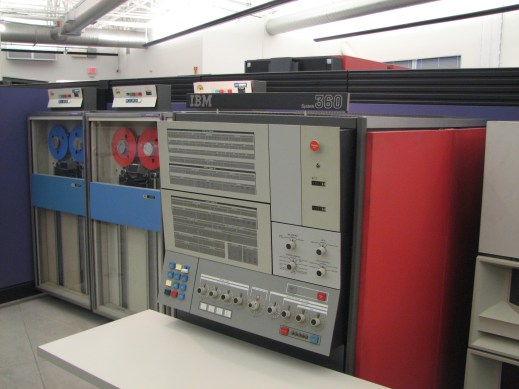
In one of the more memorable – and squirm-inducing – scenes of this season of AMC’s Mad Men, brilliant but eccentric copywriter Michael Ginsberg (Ben Feldman) presents his colleague, agency copy chief Peggy Olsen (Elisabeth Moss) with his own severed nipple, placed carefully in a gift box. Ginsberg explains to the understandably horrified Peggy that the gift is both a token of his affection and a means of relieving pressure caused by the arrival of Sterling, Cooper & Partners’ (SC&P) newest acquisition: a humming, room-sized IBM System/360 mainframe computer. Explaining his enmity for the machine and his increasingly erratic behavior, Ginsberg tells Peggy that the “waves of data” emanating from the computer were filling him up, and that the only solution was to “remove the pressure” by slicing off his “valve.”
The arrival of the IBM 360 in the idealized 1960s office space inhabited by Mad Men is obviously an unsettling presence – and not only for Ginsberg. Since its debut in Episode 4, commentators (e.g. WaPo’s Andrea Peterson, Slate’s Seth Stevenson) have meditated on the heavy-handed symbolism surrounding the machine – both in terms of its historical significance and its implications for plot and character development. Typically cued through noise (or lack thereof), it is worth reflecting upon the role of sound in establishing the computer as a source of disruption. Between the pounding and screeching of installation and the drone of the completed machine’s air conditioner and tape reels, the sonic motifs accompanying the computer underline tensions between (and roiling within) SC&P staffers grappling with the incipient digital age. Likewise, the infernal racket produced by the installation and operation of the IBM 360 adds an important dimension to the tensions resulting from its presence, which can be read as allegories for the complexities and contradictions of our relationship with technology.
.
The tone of the conflict is set even before we meet the IBM 360 toward the end of Episode 4: The Monolith – a reference to Kubrick’s 1968 classic 2001: A Space Odyssey (Slate’s Forrest Wickman ably discusses the references). Like the unnerving silence used with such great effect in that film, the absence of sound frames our first encounter with the computer – or at least its promise. Early in the episode, Don Draper (Jon Hamm), newly rehabilitated from his forced exile from the agency, arrives one morning at SC&P to find the office deserted. The ghostly sequence is clearly meant to symbolize Draper’s detachment from the firm. But as the episode progresses and tensions mount over the possibility that the IBM 360 will render jobs obsolete, the desolate office suggests a more ominous meaning – a once lively space muted by cold, impersonal automation.
In following scenes, successive stages of mainframe installation are marked by convergences of conflict and cacophony. First, there is the din of the creative team as they evacuate their beloved lounge – now earmarked as computer space – and during which a distraught Ginsberg projects his indignation onto art director Stan Rizzo, who appears more accepting. “They’re trying to erase us!” Ginsberg exclaims bitterly. Later, Draper lounges on his office couch as a clop clopping of hammers outside signifies tangible change. As if this weren’t enough of a distraction, two men in the corridor begin to chat loudly over the noise. Going out to investigate, Draper strikes up a conversation with one of the men, Lloyd Hawley, installation supervisor and founder of a small technology company competing with IBM. “Who’s winning?” Draper asks innocently, “who’s replacing more people?” Clearly irritated by Draper’s tone, Harry Crane – SC&P media director and the computer’s lead cheerleader – offers Draper a condescending apology for the loss of his “lunchroom,” assures him the change was “not symbolic.” “No, it’s quite literal,” Draper retorts. Unabated, the pounding and screeching of construction work emphasizes his point.
For the remainder of the episode, the raucous noise of construction acts as a leitmotif underscoring tensions between characters – between Peggy and Lou Avery (Draper’s priggish replacement at creative director), and between Draper and the interloper Lloyd. Finally, the end of construction is punctuated by a return to silence, as Peggy arrives one morning to see workers glide mainframe components noiselessly into the office.
Mad Men Logo. Used under the auspices of fair use for identification and critical commentary.
With this emphasis on technology as a source of symbolic, physical, and sonic disruption, Matthew Weiner and the creators of Mad Men draw upon a rich literary tradition. A relevant example contemporaneous with the show’s “present,” is literary critic Leo Marx’s 1964 text The Machine in the Garden, which examines the complicated relationships between a “pastoral ideal” and technological progress within American literature and popular imagination. Marx’s analysis reveals that sound is often used to convey the disruptive presence of technology within the bucolic landscape of the American continent. In Hawthorne’s Sleepy Hollow for example, it is the interrupting shriek of a locomotive whistle that breaks the author’s harmonious reverie: “Now tension replaces repose: the noise arouses a sense of dislocation, conflict, and anxiety” (15). In the decidedly un-pastoral modern office space, the noise of the computer installation nevertheless signifies a momentous social change and irrevocable loss. Picking out these tensions has always been one of the show’s strengths – whether it is the computer, Draper’s double identity, or the quiet endurance of women to the misogyny of midcentury work and domestic life.
Change, however, has significant consequences for Ginsberg, the young copywriter and Holocaust survivor who, as CBS’s Jessica Firger observes, has been deteriorating psychologically for some time. The proximity of the IBM 360, and the incessant drone of its mind-controlling waves eventually puts him over the edge. As Draper and Peggy enter the office early in Episode 5, Ginsberg glowers into the room housing the IBM 360. “Stop humming, you’re not happy!” he explodes. As Peggy attempts to soothe her colleague, our perspective shifts to look out at them from inside the glass-encased computer room. From here, the mainframe’s ambient noise muffles Peggy’s words, suggesting isolation between human and non-human. This play of speech and silence reoccurs later in the episode as Ginsberg, working alone on a Saturday with tissues wedged in his ears, spies Lou Avery and SC&P partner Jim Cutler inside the computer room, their voices made inaudible by the droning computer in a delicious homage to 2001 (see Vulture’s amusing gif). But the noise is clearly affecting Ginsberg. “It’s that hum at the office! It’s getting to me!” he tells Peggy later that evening. He even claims the computer has affected his sexuality.
Ginsberg’s noise complaints would have resonated in 1969 New York. In November of that year, the New York Times ran a feature on the city’s nerve-shattering noise pollution, calling it a “slow agent of death.” In addition to the myriad construction projects, subways, car horns, jet planes, and standing machinery populating the city soundscape, office workers found scant respite indoors where phones, air conditioners, “computers and typewriters and tabulators” whirred, whined, and clacked throughout the day. The article went on to report that scientists studying the impact of prolonged noise exposure on the human body had concluded a variety of ill effects on the heart and nervous system. Though no connection was made between computers and sexuality (as Ginsberg claimed), the article reported that laboratory rats under prolonged noise exposure had indeed “turned homosexual,” an opinion that underlined deterministic associations between sexuality, psychological disorder, and external stimuli.

An advertisement for the IBM 360. Borrowed from Wikimedia Commons.
As SO! editor Jennifer Stoever-Ackerman has argued, noise in midcentury New York also signified a sonic-racial politics, in which the mainstream “listening ear” recoiled at the “noise” created by Black and Puerto Rican others. In terms of Mad Men’s computer however, it is technology, economic anxiety, and mental illness, rather than ethnicity that frames sonic disruption. The basis of these tensions are similar however, and various interactions with SC&P’s IBM 360 demonstrate, as Stoever-Ackerman writes in SO!, “the ways in which Americans have been disciplined to consider some sounds as natural, normal, and desirable, while deeming alternate ways of listening and sounding as aberrant [and] dangerous.” Though similar, the conflict with technology on Mad Men does not suggest a clear us/them, or us/”it” binary. The banging of construction may be at first antagonistic, but it’s finite – eventually the computer is normalized within the SC&P office space to the extent that Peggy chides Ginsberg’s exasperation in Episode 5 by insisting “it’s just a computer!” Ginsberg’s reaction is more complex however, implicating a contradictory relationship with technology: once fully installed, has the droning computer become “natural, normal, and desirable” despite previous ambivalence? Is the keen awareness and anxiety towards technology symbolized through Ginsberg (albeit in a extreme form) suggested as the “aberrant” listening practice, or could it be Peggy’s apparent acceptance?
Like most cultural texts set in the past, it is possible to read Mad Men allegorically, as suggesting a certain ordering of meaning and values. From the perspective of those who have long since domesticated computers, the controversies and tropes activated by SC&P’s IBM 360 might strike us as familiar, even quaint. As the sociologist Bruno Latour has argued however, we would be wise to consider how technology exerts a kind of social agency that structures and impacts our daily lives. As historical symbolism, the sounds and noises of the IBM 360 on Mad Men should remind us that technological progress is not teleological, but a struggle over meaning in which anxieties (about jobs, mind-control, surveillance, subjectivity, etc.) may be variously accommodated, suppressed, or dismissed as irrational.
—
Featured image: An IBM 360 Mainframe. Borrowed from Wikimedia Commons CC 2.0
—
Andrew J. Salvati is a Media Studies Ph.D. candidate at Rutgers University. His interests include the history of television and media technologies, theory and philosophy of history, and representations of history in media contexts. Additional interests include play, authenticity, the sublime, and the absurd. Andrew has co-authored a book chapter with colleague Jonathan Bullinger titled “Selective Authenticity and the Playable Past” in the recent edited volume Playing With the Past (2013), and has written a recent blog post for Play the Past titled “The Play of History.”
—
REWIND!…If you liked this post, you may also dig:
“DIY Histories: Podcasting the Past” -Andrew J. Salvati
“The Noise of SB 1070: Or Do I Sound Illegal to You?”– Jennifer Stoever-Ackerman
“DIANE… The Personal Voice Recorder in Twin Peaks” -Tom McEnaney
Share this:




Current Top Posts





April 2021

January 2020

November 2019

October 2019

August 2019

April 2014

November 2017

March 2015

December 2017

October 2015
 Sounding Out!
Recent Comments