
That Infernal Racket: Sound, Anxiety, and the IBM Computer in AMC’s Mad Men

DOI: https://doi.org/10.59350/pv8wv-dpb43
[Warning: Spoilers Ahead for Folks Not Caught Up with Season 7, Episode 5!]
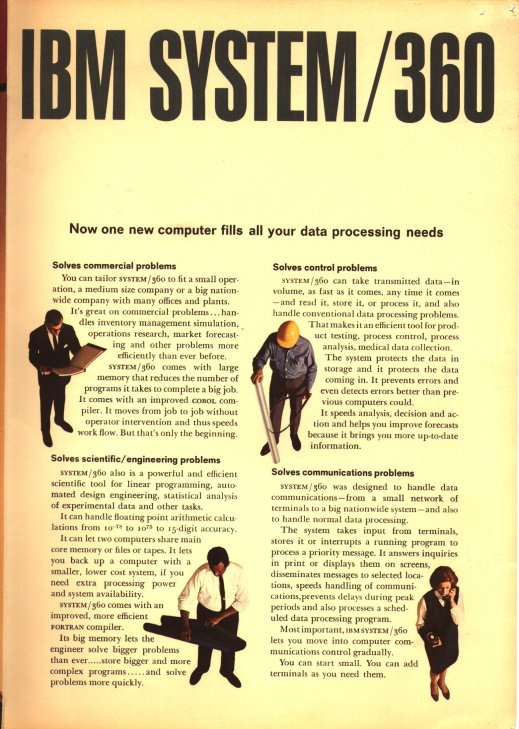
In one of the more memorable – and squirm-inducing – scenes of this season of AMC’s Mad Men, brilliant but eccentric copywriter Michael Ginsberg (Ben Feldman) presents his colleague, agency copy chief Peggy Olsen (Elisabeth Moss) with his own severed nipple, placed carefully in a gift box. Ginsberg explains to the understandably horrified Peggy that the gift is both a token of his affection and a means of relieving pressure caused by the arrival of Sterling, Cooper & Partners’ (SC&P) newest acquisition: a humming, room-sized IBM System/360 mainframe computer. Explaining his enmity for the machine and his increasingly erratic behavior, Ginsberg tells Peggy that the “waves of data” emanating from the computer were filling him up, and that the only solution was to “remove the pressure” by slicing off his “valve.”
The arrival of the IBM 360 in the idealized 1960s office space inhabited by Mad Men is obviously an unsettling presence – and not only for Ginsberg. Since its debut in Episode 4, commentators (e.g. WaPo’s Andrea Peterson, Slate’s Seth Stevenson) have meditated on the heavy-handed symbolism surrounding the machine – both in terms of its historical significance and its implications for plot and character development. Typically cued through noise (or lack thereof), it is worth reflecting upon the role of sound in establishing the computer as a source of disruption. Between the pounding and screeching of installation and the drone of the completed machine’s air conditioner and tape reels, the sonic motifs accompanying the computer underline tensions between (and roiling within) SC&P staffers grappling with the incipient digital age. Likewise, the infernal racket produced by the installation and operation of the IBM 360 adds an important dimension to the tensions resulting from its presence, which can be read as allegories for the complexities and contradictions of our relationship with technology.
.
The tone of the conflict is set even before we meet the IBM 360 toward the end of Episode 4: The Monolith – a reference to Kubrick’s 1968 classic 2001: A Space Odyssey (Slate’s Forrest Wickman ably discusses the references). Like the unnerving silence used with such great effect in that film, the absence of sound frames our first encounter with the computer – or at least its promise. Early in the episode, Don Draper (Jon Hamm), newly rehabilitated from his forced exile from the agency, arrives one morning at SC&P to find the office deserted. The ghostly sequence is clearly meant to symbolize Draper’s detachment from the firm. But as the episode progresses and tensions mount over the possibility that the IBM 360 will render jobs obsolete, the desolate office suggests a more ominous meaning – a once lively space muted by cold, impersonal automation.
In following scenes, successive stages of mainframe installation are marked by convergences of conflict and cacophony. First, there is the din of the creative team as they evacuate their beloved lounge – now earmarked as computer space – and during which a distraught Ginsberg projects his indignation onto art director Stan Rizzo, who appears more accepting. “They’re trying to erase us!” Ginsberg exclaims bitterly. Later, Draper lounges on his office couch as a clop clopping of hammers outside signifies tangible change. As if this weren’t enough of a distraction, two men in the corridor begin to chat loudly over the noise. Going out to investigate, Draper strikes up a conversation with one of the men, Lloyd Hawley, installation supervisor and founder of a small technology company competing with IBM. “Who’s winning?” Draper asks innocently, “who’s replacing more people?” Clearly irritated by Draper’s tone, Harry Crane – SC&P media director and the computer’s lead cheerleader – offers Draper a condescending apology for the loss of his “lunchroom,” assures him the change was “not symbolic.” “No, it’s quite literal,” Draper retorts. Unabated, the pounding and screeching of construction work emphasizes his point.
For the remainder of the episode, the raucous noise of construction acts as a leitmotif underscoring tensions between characters – between Peggy and Lou Avery (Draper’s priggish replacement at creative director), and between Draper and the interloper Lloyd. Finally, the end of construction is punctuated by a return to silence, as Peggy arrives one morning to see workers glide mainframe components noiselessly into the office.

With this emphasis on technology as a source of symbolic, physical, and sonic disruption, Matthew Weiner and the creators of Mad Men draw upon a rich literary tradition. A relevant example contemporaneous with the show’s “present,” is literary critic Leo Marx’s 1964 text The Machine in the Garden, which examines the complicated relationships between a “pastoral ideal” and technological progress within American literature and popular imagination. Marx’s analysis reveals that sound is often used to convey the disruptive presence of technology within the bucolic landscape of the American continent. In Hawthorne’s Sleepy Hollow for example, it is the interrupting shriek of a locomotive whistle that breaks the author’s harmonious reverie: “Now tension replaces repose: the noise arouses a sense of dislocation, conflict, and anxiety” (15). In the decidedly un-pastoral modern office space, the noise of the computer installation nevertheless signifies a momentous social change and irrevocable loss. Picking out these tensions has always been one of the show’s strengths – whether it is the computer, Draper’s double identity, or the quiet endurance of women to the misogyny of midcentury work and domestic life.
Change, however, has significant consequences for Ginsberg, the young copywriter and Holocaust survivor who, as CBS’s Jessica Firger observes, has been deteriorating psychologically for some time. The proximity of the IBM 360, and the incessant drone of its mind-controlling waves eventually puts him over the edge. As Draper and Peggy enter the office early in Episode 5, Ginsberg glowers into the room housing the IBM 360. “Stop humming, you’re not happy!” he explodes. As Peggy attempts to soothe her colleague, our perspective shifts to look out at them from inside the glass-encased computer room. From here, the mainframe’s ambient noise muffles Peggy’s words, suggesting isolation between human and non-human. This play of speech and silence reoccurs later in the episode as Ginsberg, working alone on a Saturday with tissues wedged in his ears, spies Lou Avery and SC&P partner Jim Cutler inside the computer room, their voices made inaudible by the droning computer in a delicious homage to 2001 (see Vulture’s amusing gif). But the noise is clearly affecting Ginsberg. “It’s that hum at the office! It’s getting to me!” he tells Peggy later that evening. He even claims the computer has affected his sexuality.
Ginsberg’s noise complaints would have resonated in 1969 New York. In November of that year, the New York Times ran a feature on the city’s nerve-shattering noise pollution, calling it a “slow agent of death.” In addition to the myriad construction projects, subways, car horns, jet planes, and standing machinery populating the city soundscape, office workers found scant respite indoors where phones, air conditioners, “computers and typewriters and tabulators” whirred, whined, and clacked throughout the day. The article went on to report that scientists studying the impact of prolonged noise exposure on the human body had concluded a variety of ill effects on the heart and nervous system. Though no connection was made between computers and sexuality (as Ginsberg claimed), the article reported that laboratory rats under prolonged noise exposure had indeed “turned homosexual,” an opinion that underlined deterministic associations between sexuality, psychological disorder, and external stimuli.
As SO! editor Jennifer Stoever-Ackerman has argued, noise in midcentury New York also signified a sonic-racial politics, in which the mainstream “listening ear” recoiled at the “noise” created by Black and Puerto Rican others. In terms of Mad Men’s computer however, it is technology, economic anxiety, and mental illness, rather than ethnicity that frames sonic disruption. The basis of these tensions are similar however, and various interactions with SC&P’s IBM 360 demonstrate, as Stoever-Ackerman writes in SO!, “the ways in which Americans have been disciplined to consider some sounds as natural, normal, and desirable, while deeming alternate ways of listening and sounding as aberrant [and] dangerous.” Though similar, the conflict with technology on Mad Men does not suggest a clear us/them, or us/”it” binary. The banging of construction may be at first antagonistic, but it’s finite – eventually the computer is normalized within the SC&P office space to the extent that Peggy chides Ginsberg’s exasperation in Episode 5 by insisting “it’s just a computer!” Ginsberg’s reaction is more complex however, implicating a contradictory relationship with technology: once fully installed, has the droning computer become “natural, normal, and desirable” despite previous ambivalence? Is the keen awareness and anxiety towards technology symbolized through Ginsberg (albeit in a extreme form) suggested as the “aberrant” listening practice, or could it be Peggy’s apparent acceptance?
Like most cultural texts set in the past, it is possible to read Mad Men allegorically, as suggesting a certain ordering of meaning and values. From the perspective of those who have long since domesticated computers, the controversies and tropes activated by SC&P’s IBM 360 might strike us as familiar, even quaint. As the sociologist Bruno Latour has argued however, we would be wise to consider how technology exerts a kind of social agency that structures and impacts our daily lives. As historical symbolism, the sounds and noises of the IBM 360 on Mad Men should remind us that technological progress is not teleological, but a struggle over meaning in which anxieties (about jobs, mind-control, surveillance, subjectivity, etc.) may be variously accommodated, suppressed, or dismissed as irrational.
—
Featured image: An IBM 360 Mainframe. Borrowed from Wikimedia Commons CC 2.0
—
Andrew J. Salvati is a Media Studies Ph.D. candidate at Rutgers University. His interests include the history of television and media technologies, theory and philosophy of history, and representations of history in media contexts. Additional interests include play, authenticity, the sublime, and the absurd. Andrew has co-authored a book chapter with colleague Jonathan Bullinger titled “Selective Authenticity and the Playable Past” in the recent edited volume Playing With the Past (2013), and has written a recent blog post for Play the Past titled “The Play of History.”
—

REWIND!…If you liked this post, you may also dig:
“DIY Histories: Podcasting the Past” -Andrew J. Salvati
“The Noise of SB 1070: Or Do I Sound Illegal to You?”– Jennifer Stoever
“DIANE… The Personal Voice Recorder in Twin Peaks” -Tom McEnaney
—
Share this:

This is Your Body on the Velvet Underground


DOI: https://doi.org/10.59350/w3yhz-e0296
“Everyone who bought one of those 30,000 copies started a band.” Brian Eno’s remark about the Velvet Underground’s brilliant but commercially lackluster 1967 debut album was re-circulated widely last October, when fans and critics mourned the passing of Lou Reed, lead songwriter for the band, and a key cultural figure of the last fifty years, by any metric.
The remark has become trite through overuse, but not the sentiment it captures. A band that has, since even before before Andy Warhol’s Factory, been linked to an aesthetic of menace, hysteria and psychosis didn’t just “inspire” or “provoke” much of the music, art and sensibilities of the post-1960’s. It extruded that era.
At Sounding Out!, we decided that in order to come to grips with Reed’s work in general (and the Velvet Underground in particular) from a Sound Studies perspective we’d have to adopt that spirit of provocation. I asked two prominent writers in the field for articles about how this band changed — and continues to change — the experience and history of sound, in a short series Start A Band: Lou Reed and Sound Studies. I’m thrilled to present the first of our articles from returning author Jacob Smith from Northwestern University, a musician and accomplished author of several distinguished books on sound and media history. Stay tuned next week for a second installment from Tim Anderson from Old Dominion University, an award winning writer and co-chair of the Sound Studies SIG at the Society for Cinema and Media Studies.
–NV
—
Lou Reed’s recent death has inspired many critics to return to his groundbreaking work with the Velvet Underground (VU). Albums such as The Velvet Underground and Nico (1967), White Light/White Heat (1968) and The Velvet Underground (1969) have the reputation of influencing everyone from David Bowie, Iggy Pop and Roxy Music to the Sex Pistols, Talking Heads, REM and Nirvana. Many recent obituaries describe VU in literary terms, citing Reed’s “lyrical honesty,” “rock and roll poetry,” and touting his songs as “serious writing” and even a kind of “Great American Novel.” There is much to be missed by taking such a decidedly literary approach to sound recordings, and there is an alternative approach, thanks to the emergence of Sound Studies as a vibrant academic field. Can what Jonathan Sterne has called the “interdisciplinary ferment” of Sound Studies help us to re-think the work of this seminal rock band (The Sound Studies Reader, 2)? I think it can.
For a start, Sound Studies emboldens us to base our analysis on VU’s records, which have often been oddly upstaged by other aspects of their career: Reed’s street-level lyrics to be sure; but also the group’s role as background music to Andy Warhol’s Factory; or their use of drones and feedback, which makes them a footnote in the history of avant-garde music; or their influence on the glam and punk explosions of the 1970s. Sound Studies encourages us to start with VU’s records, but the next step is not necessarily a formal musicological analysis.

For some of its proponents, including Steven Connor, Sound Studies is best understood as part of a broader investigation of the “fertility of the relations” between the senses, and VU’s albums turn out to be an excellent place to begin an exploration of the multisensory experience of recorded sound (“Edison’s Teeth: Touching Hearing,” in Hearing Cultures, ed. Viet Erlmann, 54). This essay explores the tactile experience of VU’s records, inspired by work on the tactile dimension of the cinema. I borrow the organizational structure of Jennifer M. Barker’s book The Tactile Eye, which moves from a discussion of sensations at the surface of the body, to muscular responses, and lastly, to the “the murky recesses of the body, where heart, lungs, pulsing fluids, and firing synapses receive, respond to, and reenact the rhythms of cinema” (2-3). Think of this essay as a body-scan of the VU listening experience (“this is your body on VU”) that follows a similar path from the skin, to the musculature, and finally, to the viscera.
Downy Sins
Writing about the tactile experience of movies is concerned with modes of looking that resemble touching, a “haptic visuality” that attends to textures and surfaces, and moves over the image like a caress (See Laura U. Marks The Skin of the Film, 183 and Touch, 117). A form of “haptic listening” has also been commonplace in the culture of popular sound recordings. Much of the recorded popular music of the past century has invested meaning in what Theodore Gracyk calls “very specific sound qualities and their textural combination” (Rhythm and Noise, 61). From Bo Diddley to Aphex Twin, pop recordings have tended to stress evocative timbres, idiosyncratic voices, and signature sounds over structural or lyrical complexity.
VU’s records exemplify that tendency because their complexity can be found more on the level of timbre than in musical structure or instrumentation. Moreover, Reed’s lyrics often encourage a blurring of listening and touching. On “Venus in Furs,” listeners are prompted to hear John Cale’s viola stabs as the licks and bites of a mistress’s whip. “Sister Ray” cues haptic listening by chugging resolutely on a single chord for seventeen minutes, while a plasmatic organ performance mutates from elegant bass arpeggios to shimmering waves of icy noise. As with “Venus in Furs,” Reed’s lyrics tie the textural complexity of “Sister Ray” to the surface of the body, through his descriptions of searching the skin of his arm for a “mainline” vein, and a first-person account of receiving oral sex. These examples demonstrate that the poetry of Reed’s lyrics is intimately bound up with the sonic texture of VU’s recordings, and moreover, that he was adept at liberating the erotic potential of haptic listening.
Run Run Run
Films can produce an empathetic muscular response in the viewer’s body, as when we flinch in response to a horror film, or clench our fists while watching a thrilling action movie (Barker, The Tactile Eye 94, 83, 72). Listeners can have similarly empathetic relationships with recorded sound when they move along with the rhythms of a dance record, synchronize their workout or commute to a carefully designed playlist, or embody a recorded performance by miming an air guitar or air drums.
The members of VU had distinctive styles of instrumental performance that made their records evoke powerful muscular responses in listeners. Consider the piano track on “Waiting For the Man,” which loses any semblance of melodic content to become the sheer act of pounding on the keyboard by the end of the song. Reed is usually regarded as a lyricist, but he is just as influential as a muscular rhythm guitar player. “What Goes On” has a minimalist arrangement that eschews structural development to become a showcase for Reed’s vigorous strumming. The second half of the track lacks vocals or a conventional solo instrument, and so feels like a diagram of the human body that reveals the pulsating musculature beneath the skin.
Reed’s jangly rhythm guitar could dominate the mix of VU tracks like “What Goes On” because it occupies a sonic niche that, in a more typical rock arrangement, would be filled by the hi-hat or ride cymbal. In fact, it is Maureen Tucker’s distinctive drumming that is the main source of muscle power on VU’s records. Standing behind a spare kit consisting of little more than a snare and a bass drum turned on its side, Tucker attacked her instrument with relentless intensity, raising her mallet over her head with each bone-cracking snare hit. A review of a live appearance in 1968 observed that Tucker “beats the shit” out of her drums so that the sound “slams into your bowels and crawls out your asshole” (See Clinton Heylin, All Yesterdays’ Parties, 64). Hear (and feel) for yourself, on the VU track “Foggy Notion,” a seven-minute drum and guitar workout.
Tucker was a pioneer female instrumentalist in the male-dominated world of rock. “I didn’t want to be the one to blow it,” she said in an interview. “I wasn’t gonna say, ‘Well, they’ll say she’s a girl, she can’t do it.’ So I was determined, I wasn’t gonna stop” (Albin Zak III, The Velvet Underground Companion, 1965). Ironically, her uncompromising and supremely physical performances were so minimal and precise that she was sometimes compared to a machine. A Verve Records press release from 1968 referred to the fact that Tucker had briefly held a job at IBM, and wrote that “her symphonic simplicity is like that of a human computer.” One trajectory of VU’s influence leads to the electronic austerity of bands like Kraftwerk, but an attention to the tactile dimension of the band’s records prevents Tucker, one of rock’s most muscular drummers, from disappearing into the circuitry.
The Body Lies Bare
A tactile analysis of VU records can go deeper still, to document their relation to the body’s viscera. The experience of the inner body is usually hidden from us, and gains our attention only when organ systems produce an overall effect like nausea (Barker, The Tactile Eye, 125). We lack direct conscious control over most of our visceral responses, but we can stimulate them through the ingestion of drugs, which of course, is the topic of many of VU’s most famous tracks. But where other rock bands of the 1960s associated the drug experience with whimsical flights of the imagination, VU’s drug references are bluntly visceral.

“Heroin” is a sonic re-enactment of the physical effects of the eponymous drug, conveyed not only via Reed’s lyrics, but in the backing track’s fluctuations between dreamy bliss and frantic rush. “White Light/White Heat” fuses two sensory metaphors, one visual and one tactile, in order to point to an embodied experience beyond them both. Listen to how the track ends, with surging cymbals and a distorted bass figure whose spasmodic rhythm suggests the dilation of blood vessels, the firing of synapses, and the tightening and release of internal organs that have been kicked into amphetamine overdrive.
The mysterious visceral body can also emerge into our consciousness in moments when the internal rhythms of the heart or lungs are destabilized, as in a sudden heart palpitation or violent case of the hiccups (Barker, The Tactile Eye, 128-29). “Lady Godiva’s Operation” provides a vivid demonstration. The first half of the track is run-of-the-mill hippy exotica, with John Cale’s lead vocal given the conventional placement in the center of the stereo picture. This calm sonic surface is unsettled when Cale’s voice is decentered, shifting first to the left and then the right speaker. The lead vocal fractures even further when Reed begins to finish each of Cale’s lines:
Cale: ‘Doctor is coming,’ the nurse thinks…
Reed: … sweetly.
Cale: Turning on the machines that…
Reed: … neatly pump air.
Cale: The body lies bare.
By integrating these fragmented lines, we learn that a body is lying on an operating table. Listeners are encouraged to inhabit this body through the placement of voices around and above us, as well as the sounds of heartbeats and breathing that enter the mix but are jarringly out of rhythm with the existing backing track. Reed sings that the doctor is making his first incision into the body, and the backing track vanishes, leaving only the heartbeat, breathing, and an eerie whirring vocalization that sonifies some nameless physical process. The scene ends with a dark twist, suitable as a shock tactic from an exploitation film: the anesthetic has malfunctioned, and the patient has regained consciousness in the midst of the procedure.
The track’s arrhythmic sound effects overwhelm the coherent flow of the standard musical mix, working in tandem with the lyric’s account of the body made manifest in a moment of dysfunction. The fact that VU’s “White Light/White Heat” LP contains “Lady Godiva’s Operation,” as well as the title track and “Sister Ray,” makes it a tour de force of tactile phonography. Reed may have been a rock poet, but he and his collaborators were also acoustic engineers who were adept at sonifying tactile experience, producing music worth feeling with our whole bodies.
—
Featured Image- “A Drop of Warhol” by Flicker User Celeste RC
—
Jacob Smith is Associate Professor in the Radio-Television-Film Department at Northwestern University. He has written several books on sound (Vocal Tracks: Performance and Sound Media [2008], and Spoken Word: Postwar American Phonograph Cultures [2011], both from the University of California Press), and published articles on media history, sound, and performance.
—
REWIND!…If you liked this post, you may also dig:
“Devil’s Symphony: Orson Welles’s “Hell on Ice” as Eco-Sonic Critique”–Jacob Smith
“One Nation Under a Groove?: Music, Sonic Borders, and the Politics of Vibration” -Marcus Boon
“Music Meant to Make You Move: Considering the Aural Kinesthetic“-Imani Kai Johnson
Share this:




Current Top Posts





April 2021

January 2020

November 2019

October 2019

August 2019

April 2014

November 2017

March 2015

December 2017

October 2015


Recent Comments