
An Ear-splitting Cry: Gender, Performance, and Representations of Zaghareet in the U.S.

DOI: https://doi.org/10.59350/nf2w6-r6b73
At the opening of a recent annual “Under a Desert Moon” concert presented by Sahara Dance, a belly dance studio located in Washington, DC, one of the teachers began by telling the audience that the dancers would appreciate vocal feedback during the show. Holding a microphone with one hand and the other in front of her mouth, she demonstrated the practice known in Arabic as zaghareet, asking audience members to imitate her sound. This pedagogical interaction with an ethnically and generationally diverse audience on the campus of American University illustrates some of the complexities of translating sonic practices across cultural and economic divides. Zaghareet carries very different weight in a Palestinian wedding in the West Bank, where it is one piece of a larger formation of celebratory experience, than it does in a belly dance performance in Washington, DC, where it is used in part to generate authenticity in a tradition both geographically and culturally removed from the Middle East.
Located somewhere between singing and yelling, ululation occupies a unique position in the spectrum of human vocality. The sound is created by touching the tongue either to the sides of the mouth or the teeth in rapid succession, and it is characterized by a piercing sound quality enacted in the upper vocal register.
Having taken belly dance classes in the U.S. and seen a number of performances, I thought I had a sense of what ululation was and what it represented. The more I ran across it in the course of my dissertation research, however, the more I wanted to know about its historical background and affective meanings across contexts. In other words, what are the cultural genealogies of zaghareet in the Middle East, and how has the sound been perceived and represented in the U.S.? Although ululation is performed in a range of locations in South Asia, the Middle East and North Africa (MENA), my research is on U.S.-Middle East sonic encounters, and thus I will focus primarily on that context in this post. In particular, I became interested in why female voices typically perform zaghareet, and how its circulation in U.S. media and pop culture fit into larger narratives about the Middle East before and after 9/11.
Zaghareet is auditorally conspicuous, and in U.S. during the postwar decades before 9/11, it was often framed as a sonic encapsulation of an Arab exotic. The sound itself came to invoke elements that constitute classic Western stereotypes about the region known as the Middle East: veiling, gender oppression, desert wandering, and pre-modern ritual. Its status as a primarily female practice made it appealing as a sign of difference, since the West has been notoriously preoccupied with the status of women in the Middle East (see Chandra T. Mohanty, “Under Western Eyes: Feminist Scholarship and Colonial Discourses;” Lila Abu-Lughod, ed., Remaking Women: Feminism and Modernity in the Middle East; Leila Ahmed, Women and Gender in Islam: Historical Roots of a Modern Debate, among others). Zaghareet poses a contradiction to this orientalizing logic, as it works against the image of the oppressed Arab woman “silenced” by her surroundings. Instead, her voice takes on an uncanny resonance, indicating the tantalizing alienness of Arab culture. In a post-9/11 U.S. context, zaghareet become directly correlated with premodern barbarity, taking on more menacing anti-American associations. By taking a critical approach to the practice of zaghareet and its representations I hope to deflate some of these prevalent views and help to develop a new framework for thinking about aural exoticism.

Zaghareet’s combination of high pitch, loud volume, vibrato, and tongue oscillation contributes to its prominent, distinctive sound. In Jennifer Jacobs’ dissertation on ululation in the Levantine context (the term Levant refers to a region made up of Syria, Lebanon, Jordan, Palestine/Israel, and other areas in the Eastern Mediterranean), “Ululation in Levantine Society: The cultural reproduction of an affective vocalization” she points out that zaghareet typically last approximately 3 1/3 seconds, which is longer than the articulation of most words in speech, but not beyond the length of a typical speech phrase (111). Thus, though it is not speech or singing, zaghareet is related to these vocalizations in the sense that it lasts approximately the length of one breath. The practice is most often performed by women, and its acoustic intensity is remarkable considering that in an indoor setting with the performer near the microphone it can reach 85 dB, a level that can cause hearing damage with prolonged exposure. These components highlight the significance of zaghareet as a primarily female performance, making the practitioners audible at a level that isimpossible to ignore.

Zaghareet takes place within a unique set of circumstances with a range of other sounds occurring simultaneously, and therefore should be conceptualized as part of a web of social meanings and practices, not as a discrete element to be observed on its own. The history of zaghareet (and ululation more generally) reaches back to ancient Greece, where the practice was referred to as ololuge, an onomatopoetic reference to the sound. In the 21st century Levant, zaghareet is often part of social gatherings where live music and dancing are also present. While most often situated in celebratory social settings, zaghareet can also take place in a variety of everyday circumstances, but in almost all cases it connotes farah, or joy. Performers generally do zaghareet to express their excitement, delight, and/or encouragement to others present. The practice tends to be contagious in that after hearing it others tend to join in, but the exact origins of the sound can remain mysterious due to the fact that most practitioners cover their mouths with their hands or clothing. This produces an omnipresent effect that both dislocates the listener and develops shared experience, and the collectivity of the performance magnifies its affective power. Jacobs writes, “When one person begins performing zaghareet, another person might join in; then, a third person might also join just as the first vocalist is dropping off. This overlapping of performances creates a perceptual experience of zaghareet as something layered, continuous, and emanating from different spatial locations, a haunting bodily experience, especially for a first-time listener” (75). This is complicated by broader soundscapes in which it is performed, which may include music, clapping, firing of guns, traffic, and other sounds.
In addition to performance setting, gender is a key component of zaghareet. While it is performed more often by women than men, in certain contexts and communities, men do participate. Jacobs describes one case in which men had demonstrated that they could skillfully perform zaghareet, but only minutes later jokingly denied that they knew how to do it when she asked. This emphasis on modesty is also apparent in the way that most female practitioners cover their mouths while doing zaghareet to hide the movement of the tongue, which tends to be considered immodest or impolite. In this Youtube clip, for example, the zaghareet performer covers her mouth with her hijab:
.
And as is shown in the clip, zaghareet often takes place in homosocial environments where men are not immediately present, providing space for playful exchange between women in ways that heterosocial settings may not. The homosociality of the sonic practice is related to its affective reverberations, as the sound is used to convey bonds of attachment, conviviality and mutual appreciation between women. In this sense zaghareet embodies these interpersonal connections, and also reinforces them through its aural intensity.
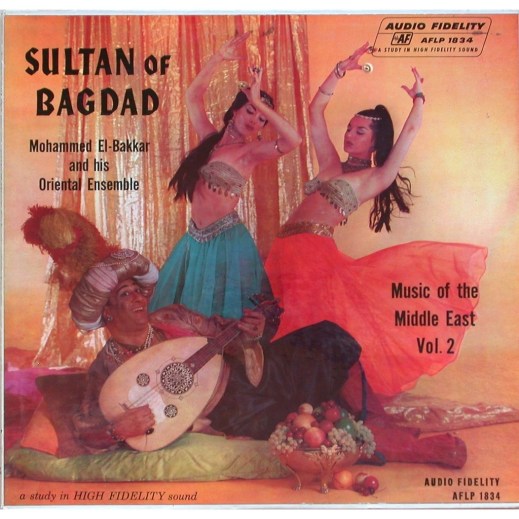
In American and European popular culture, zaghareet has played a notable role in framing depictions of the Middle East, particularly through the female body. In the years following World War II, zaghareet samples often marked the Middle East as wild and exciting. Lebanese-born singer Mohammed El Bakkar, for example, used the sound of zaghareet on his song “Yalla-Yalla” from the 1958 album The Sultan of Bagdad, one of several albums he recorded for the Audio Fidelity label in the late-1950s marketed to a mainstream American audience.
.
“Yalla-Yalla,” which translates loosely as “Come with me,” features finger cymbals, clapping, and female zaghareet, along with jovial calls from El Bakkar at the ends of phrases, conjuring a celebratory setting. All of these elements–along with the album cover photo that shows El Bakkar lounging on a cushion with two beautiful dancers standing over him–combine to create a quintessential exotic scene for many American listeners.
Although unintentionally kitschy at times, the 1962 British epic Lawrence of Arabia—a film which has the dubious distinction of having no spoken lines by a woman in its 3 1/2 hour running time—represents zaghareet quite seriously. The ululations first appear about half of the way through the film, where Lawrence and the Arab forces set off to fight the Turkish at Aqaba, and women provide blessings and encouragement.
Lawrence of Arabia is a classically orientalist film about the scope of British empire, and in this instance, zaghareet accentuates the majesty of the scene where Lawrence rides beside his Arab counterparts through the desert with veiled women calling from the cliffs above. Like the previous example, the women here constitute part of a foreign landscape, and their cries of encouragement serve along with the visuals to construct a multi-sensory experience of otherness.
Zaghareet has taken on more explicitly violent associations in a post-9/11 American context, where it is often coupled with Arab depravity and linked to terrorism. Zaghareet was demonstrated in a newsclip aired on CNN, Fox, and several other news networks displaying Palestinians in the West Bank “celebrating after 9/11.” One woman in the clip briefly ululates in front of the camera, connecting the sound to perceived Arab hatred for Americans. The video went viral, and reactions to it exemplify the extent to which zaghareet has come to symbolize a new stereotype in the post-9/11 era: the depraved Middle Eastern Other. This formula collapses and combines the categories of “Arab” and “Muslim,” and, although it complicates the figure of the terrorist as male, since it is a woman who is shown celebrating after 9/11, it also reveals western anxieties about the power that Lawrence of Arabia represented as harnessed by colonial forces.

A parody of the viral news clip appeared on a 2004 The Simpsons episode entitled “Bart-Mangled Banner” in which Bart accidentally moons the American flag at a basketball game, and subsequently faces a public outcry from critics calling him anti-American. The nightly news shows the “overseas” response, in which a woman wearing niqab holds up a photo of Homer and says “Simpsons be praised! Praise be to Springfield!” and then performs zaghareet against a backdrop of celebratory gunfire. This satire hints at the absurdity of controversies over such displays, but it also reinscribes the idea of the Arab/Muslim female as a source of danger, a new element of anti-American hostility that became associated with the sound after 9/11.
Unlike previous impressions of zaghareet, which focused on the sound as part of an exotic terrain, post-9/11 visions tend to locate practitioners in a distinctly antagonistic matrix. The distinctive sonicity of zaghareet makes it particularly susceptible to portrayals that frame it as a sign of Arab barbarity. For certain performers, however, such as belly dance students in Washington, DC, zaghareet is not subject to this type of racialized logic, and is instead treated as an ethnic novelty. In American film, TV, music, and a range of other contexts, zaghareet is becoming increasingly audible, and it is a phenomenon that deserves thoughtful and critical attention.
—
Meghan Drury is a fifth-year Ph.D. candidate in the Department of American Studies at the George Washington University. She received an MA in ethnomusicology from UC Riverside in 2006. She is currently working on a dissertation tentatively titled “Aural Exotics: The Middle East in American Popular Music 1950-2011.” This project examines the interplay between popular music and American cultural representations of the Middle East from the mid-20th century to the present, illustrating how music and sound acted a means of consolidating and disseminating a range of ideas about Middle Eastern culture in the American mainstream. She is particularly interested in the way that sound increased the visibility of Arab Americans both before and after 9/11, offering a space for negotiations of identity. More broadly, Meghan’s interests include sound studies, U.S.-Middle East cultural relations, and Arab American cultural performance.
—

REWIND! . . .If you liked this post, you may also dig:
Rallying Cries as Suffering Sounds: “Allah-O-Akbar” and the Aurality of Feminized Iranian Suffering–Roshanak Kheshti
Aurally Other: Rita Moreno and the Articulation of “Latina-ness”–Priscilla Peña Ovalle
Beat-ification: British Muslim Hip Hop and Ethical Listening Practices–Jeanette Jouili
Share this:

Tofu, Steak, and a Smoke Alarm: The Food Network’s Chopped & the Sonic Art of Cooking

DOI: https://youtu.be/_zAJxNldNw8?si=r3dQ3eyAWPMndB9U
On Sunday evening, Susan discovered the tofu had gone bad. Unfortunately, the entrée for the evening was to be tofu with sweet chili sauce. We connect on Skype at 3:30pm, as Susan is cutting up vegetables. Usually, she has classical music on while she cooks; it helps her concentrate. She’s cut up so many vegetables in her life, that she finds music sweetens the repetitive activity. However, today I hear only the rewarding sound of her knife bisecting baby bok choy.
Susan and I don’t talk about this sound, but it is certainly familiar. She says she cuts up the pieces small, as Mimi likes the chunks of bell pepper to be as little as possible.
My ethnographic work on cooking is birthed from a very personal place: Susan is my Aunt and Mimi my mother. They live together in Kingston, Massachusetts, where Susan’s cooking nourishes Mimi through her ongoing chemo and radiation treatments. Using Skype, I watched and asked questions remotely from Raleigh, North Carolina on three consecutive evenings during their dinner preparation in order to more deeply understand cooking as an art. From the first moment of preparation each night, Susan and I talked about the meal, the cooking techniques, and her feelings about cooking and eating–and I noted that sound emerged as central to her culinary process.
Opening my ethnographic practice up to sonic analysis enables new definitions of both chef and kitchen as lively, complex sites, constantly negotiating with each other. Taking the role of sound into account in the practice of cooking allows me to construct new interpretations of cooking artistry that considers everyday negotiations and embodied limitations not as “threats” to the cooking art, but, instead, as elements that enrich its artistry.
My sonic analysis specifically chafes against dominant formations of “cooking as art” in the contemporary moment, exemplified by reality television programs such as The Food Network’s Chopped, which constructs a static configuration of space with the cook as subject and the meal as art object. On Chopped, four chefs are given thirty minutes and four ingredients. Using these items, they must make a dish to be judged by a panel of food experts. These items are often strange or incongruous: on one episode, they had to make an appetizer out of frosted wheat cereal, baby red romaine lettuce, black garlic, and quahog clams. The success of a dish is measured by the chef’s ability to balance the necessary experimentation with an implied universal of good taste, texture balance, and pleasuring preparation. In other words, Chopped collapses art-making and capital into the “art object-meal,” reproducing a tired definition of “high art” that necessitates access to wealth and privilege, because the creation of “art” requires expensive foodstuffs, sophisticated kitchen technologies, and a highly controlled visual and sonic environment.
.
In my Aunt Susan’s kitchen, there are a number of sonic and spatial negotiations that preclude her cooking from the singular criteria of artistry perpetuated by Chopped. Specifically, my Aunt Susan’s cooking does not meet Chopped’s standards because it requires negotiations related to her personal mobility and my mother’s health. My Aunt uses a wheelchair to get around her house, and, as a result, some kitchen appliances are harder to reach. My mother’s chemo and radiation treatments mean that she has both complicated limitations to her diet and fluid culinary desires.
In seeking to understand the fluid challenges of Susan’s cooking, I designed my virtual sensory ethnography by combining two methods, defined respectively by Sarah Pink and Jenna Burrell. In Sensory Ethnography, Pink proposes that the ethnographer is immersed in smells, tastes, sights, and sound during the ethnographic process. Things that might seem mundane such as the sound of onions being chopped, for example, can actually reveal a complex set of relations about the cook and their process. The cook might be listening to the chopping as a rhythm in her process, like background music: the pleasing sound as it hits the cutting board. But if the onion isn’t fresh, the sound is less crisp, less crunch, the sounds changes to speak of a different type of knowledge, and she must act differently in response. In “The Field Site as a Network,” Burrell proposes an understanding of the ethnographic field site as a network rather than a singular object. The field site, in other words, is a heterogeneous set of connections, always expanding. Using a technology like Skype to do ethnography is not “ethnography at a distance,” she implies, rather it is the field site manifested through a multiplicity of connections. It simply reflects the ever-changing set of relations that comprise our world.

After Susan has cut up all the longer-cooking vegetables and set the chili sauce to simmer, we disconnect. At 5:15pm, we connect again. Susan unwraps the tofu, and something isn’t right. She calls Mimi into the kitchen, and, after some deliberation, they decide that steak will need to replace the tofu. It’s a disappointment as the tofu would have tasted best with the sweet chili sauce.
The sonic landscape of Susan’s kitchen has been, up to this, point, fairly solitary and controlled. When Susan welcomes Mimi in, the kitchen becomes a lively space of conversation, interaction, and negotiation. The production of the sonic space in the kitchen, from solitary preparation to lively interaction, is a crucial part of Susan’s art. The kitchen has undergone what Brian Massumi, in his essay “Floating the Social,” calls a “modulation of the dimension of perception [rather] than an encoding of separate pieces of data or a sequencing of units of meaning” (41). Such a sonic modulation challenges the narrative of lone artist-chef creating object-meal. Rather than segmenting the meal into a set of data blocks (chef, food, preparation time, and eater), Susan orchestrates the art of cooking as participatory with Mimi.
In the kitchen, Mimi also examines the tofu. She offers some information about it, and then joins Susan to figure out what other protein might work.
Once the steak is decided upon, Mimi exits and Susan works again at preparing dinner.
Susan’s sonic modulations, in this case conversation, allow for immersion and engagement in the lively sonic space of her kitchen. Mimi and Susan create a co-constitutive relationship between chef and eater. Unlike on Chopped, the eater is a participant rather than a judge.
Susan and I disconnect from Skype to give the steak time to thaw. We connect once again, at 6:20PM, once the steak has been properly thawed. As we discuss how Susan learned to cook, the smoke alarm suddenly comes to life.
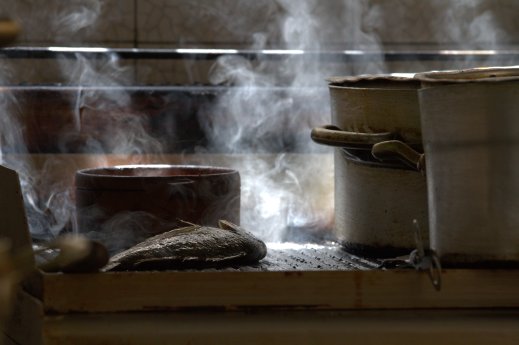
An unplanned sonic intervention has occurred. The smoke alarm has its own desires; it insists on total control of the sonic space. Susan’s response is a necessary modulation. She counters the smoke alarm’s desire for sonic control with words, saying that it triggered accidentally because of the steak, sizzling in the pan. The interruption of the smoke alarm exemplifies how Susan’s cooking technique is not one of dominance. Rather than producing clear boundaries between chef and eater, the food and the preparation, the kitchen and its outside, Susan allows for fluid boundaries, welcoming chance and the unknown into her art.
In the context of Susan’s kitchen, Massumi’s definition of modulation applies, however subtle. These domestic modulations are not a movement toward total control, but, instead, a lively negotiation with a set of partly unpredictable relations – an orchestration of the sonic space. The idea of sonic orchestration allows us to consider the complex set of possibilities existing between the choices made by the subject, here, the chef, and the presence of a set of potentialities, such as the smoke alarm. To Susan, the art of cooking is not the reduction or elimination of “threats”; her art is the negotiation of modulations. In contrast to Chopped, where careful boundaries are constructed in order to protect the privilege inherent in its definition of art, Susan’s art lies in her engagement with the lively potentialities of the sonic art of cooking.
—
Seth Mulliken is a Ph.D. candidate in the Communication, Rhetoric, and Digital Media program at NC State. He does ethnographic research about the co-constitutive relationship between sound and race in public space. Concerned with ubiquitous forms of sonic control, he seeks to locate the variety of interactions, negotiations, and resistances through individual behavior, community, and technology that allow for a wide swath of racial identity productions. He is convinced ginger is an audible spice, but only above 15khz.
—
REWIND! . . .If you liked this post, you may also dig:
Sound-politics in São Paulo, Brazil–Leonardo Cardoso
Sounding Out! Podcast Episode #5: Sound and Spirit on the Highway–David Greenberg
Listening to Whisperers: Perfomance, ASMR Community and Fetish on YouTube–Joshua Hudelson
—
Share this:




Current Top Posts





April 2021

January 2020

November 2019

October 2019

August 2019

April 2014

November 2017

March 2015

December 2017

October 2015


Recent Comments