
Musical Objects, Variability and Live Electronic Performance

This is part two of a three part series on live Electronic music. To review part one, click here.
In the first part of this series,”Toward a Practical Language for Live Electronic Performance,” I established the language of variability as an index for objectively measuring the quality of musical performances. From this we were able to rethink traditional musical instruments as musical objects with variables that could be used to evaluate performer proficiency, both as a universal for the instrument (proficiency on the trumpet) and within genre and style constraints (proficiency as a Shrill C trumpet player). I propose that this language can be used to describe the performance of electronic music, making it easier to parallel with traditional western forms. Having proven useful with traditional instruments we’ll now see if this language can be used to describe the musical objects of electronic performance.
We’ll start with a DJ set. While not necessarily an instrument, a performed DJ set is a live musical object comprised of a number of variables. First would be the hardware. A vinyl DJ rig consists of at least two turntables, a mixer and a selection of vinyl. A CDJ rig uses two CD decks and a mixer. Serato and other vinyl controller software require only one turntable, a mixer and a laptop. Laptop mixing can be done with or without a controller. One could also do a cassette mix, reel to reel mix, or other hardware format mixing. Critical is a means to combine audio from separate sources into one uniform mix. Some of the other variables involved in this include selection, transitions and effects.
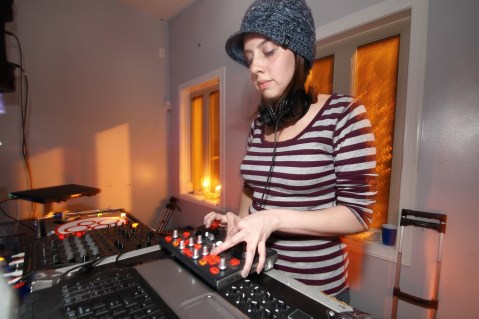
DJ Lush, FORWARD Winter Session 2012, Image by JHG Photography (c)
Because DJ sets are expected to be filled with pre-recorded sounds, the selection of sounds available is as broad as all of the sounds ever recorded. Specific styles of DJ sets, like an ambient DJ set, limit the selection down to a subset of recorded music. The choice of hardware can limit that even more. An all-vinyl DJ set of ambient music presents more of a challenge, in terms of selection, than a laptop set in the same style, because there are fewer ambient records pressed to vinyl than are available in a digital format.
Connected to selections are transitions, which could be said to define a DJ. When thinking of transitions there are two component factors: the playlist and going from one song to another. The playlist is obviously directly tied to the selection; however, even if you select the most popular songs for the style, unless they are put into a logical order, the transitions between them could make the set horrible.
One of the transitional keys to keeping a mix flowing is beat matching. In a turntable DJ set the beat mapping degree of difficulty is high because all of the tempos have to be matched manually by adjusting the speed of the two selections on the spinning turntables. When the tempos are synchronized, transitioning from one to the other is accomplished via a simple crossfade. With digital hardware such as the laptop, Serato and even CDJ setups, there is commonly a way to automatically match beats between selections. This makes the degree of difficulty to beat match in these formats much lower.
Effects, another variable, rely on what’s available through the hardware medium. With the turntable DJ set, the mixer is the primary source of effects and those until recent years have been limited to disc manipulation (e.g. scratching), crossfader, and EQ effects. Many of the non vinyl setups and even some of the vinyl setups now include a variety of digital effects like delay, reverb, sampler, granular effects and more.
With these variables so defined it becomes easier to objectively analyze the expressed variability of a live DJ set. But, while the variables themselves are objective, the value placed on them and even how they are evaluated are not. The language only provides the common ground for analysis and discussion. So the next time you’re at an event and the person next to you says, “this DJ is a hack!” you can say, “well they’ve got a pretty diverse selection with rather seemless transitions, maybe you just don’t like the music,” to which they’ll reply, “yeah, I don’t think I like this music,” which is decent progress in the scheme of things. If we really want to talk about live electronic performance however we will need to move beyond the DJ set to exemplify how this variable language can work to accurately describe the other musical objects which appear at a live electronic performance.

Joe Nice at Reconstrvct in Brooklyn NY on 2-23-2013, Photo by Kyle Rober, Courtesy of Electrogenic
Take for example another electronic instrument: the keyboard. The keyboard itself is a challenging instrument to define; in fact I could argue that the keyboard is itself not actually an instrument but a musical object. It is a component part of a group of instruments commonly referred to as keyboards, but the keyboard itself is not the instrument. What it is is one of the earliest examples of controllerism.
On a piano, typically fingers are used to press keys on the keyboard, which trigger the hammers to hit the strings and produce sound. The range of the instrument travels seven octaves from A0 to C8, and can theoretically have 88 voice polyphony, though in typical that polyphony is limited to the ten fingers. It can play a wide range of dynamics and includes pedals which can be used to modify the sustainabilty of pitches. With a pipe organ, the keyboard controls woodwind instruments with completely different timbre, range, and dynamics; the polyphony increases and the foot pedals can perform radically different functions. The differences from the piano grow even more once we enter the realm where the term “keyboard,” as instrument, is most commonly used: the synthesizer keyboard.
The first glaring difference is that, even if you have an encyclopedia of knowledge about keyboard synthesizers, when you see a performer with one on stage you simply cannot know by seeing what sounds it will produce. Pressing the key on a synthesizer keyboard can produce an infinite number of sounds, which can change not just from song to song, but from second to second and key to key. A performer’s left thumb can produce an entirely different sound than their left index finger. Using a keyboard equipped with a sequencer, the performer’s fingers may not press any keys at all but can still be active in the performance.

Minimoog Voyager Electric Blue, Image by Flickr User harald walker
When the keyboard synthesizer was first introduced, it was being used by traditional piano players in standard band configurations, like a piano or organ, with timbres being limited to one during a song and the performance aspect being limited to fingers pressing keys. Some keyboardists however used the instrument more as a bank for sound effects and textures. They may have been playing the same keys, but one wouldn’t necessarily expect to hear a I IV V chord progression. Rather than listening for the physical dexterity of the player’s fingers, the key to listening to a keyboard in this context was evaluating the sounds produced first and then how they were played to fit into the surrounding musical context.
Could one of these performers be seen as more competent than the other? Possibly. The first performer could be said to be one of the most amazing keyboard players in the piano player sense, but where they aren’t really maximizing the variability potential of the instrument, it could be said they fall short as a keyboard synthesizer performer. The second performer on the other hand may not even know what a I IV V chord progression is and thus be considered incompetent on the keyboard in the piano player sense, but the ways in which they exploit the variable possibilities shows their mastery of the keyboard synthesizer as an instrument.
Well, almost.
While generally speaking there isn’t a set of variables which define the keyboard synthesizer as an instrument, if we think of the keyboard synthesizer as a group of musical instruments, each of the individual types of keyboard synthesizers come with their own set of fixed variables which can be defined. Many of these variables are consistent across the various keyboards but not always in a standard arrangement.
As such, while the umbrella term “keyboard” persists it is perhaps more practical to define the instruments and their players individually. There are Juno 60 players, ARP Odyessy players, MiniMoog players, Crumar Spirit players and more. Naturally an individual player can be well versed in more than one of these instruments and thusly be thought of as a keyboardist, but their ability as a keyboardist would have to be properly contextualized per instrument in their keyboard repertoire. Using the MiniMoog as an example we can show how its variability as an instrument defines it and plays into how a performance on the instrument can be perceived.

Minimoog, Image by Flickr User Francesco Romito
The first variable worth considering when evaluating the MiniMoog is that it is a monophonic instrument. This is radically different from the piano; despite one’s ability to use ten fingers (or other extremity) only one note will sound at one time. The keyboard section of the instrument is only three and a half octaves long, though the range is itself variable. On the left-hand side there is a pitch wheel and a modulation wheel. The pitch wheel can vary the pitch of the currently playing note, while the modulation wheel can alter the actual sound design.
As a monophonic instrument, one does not need to have both hands on the keyboard, as only one note will ever sound at a time. This frees the hands to modify the sound being triggered by the keyboard exemplified via the pitch and modulation wheels, but also available are all of the exposed controls for the sound design. This means that in performance every aspect of the sound design and the triggering can be variable. Of course these changes are limited to what one can do with their hands, but the MiniMoog also features a common function in analog synths, a Control Voltage input. This means that an external source can control either the aspects of the sound design and/or the triggering for the instrument.
Despite this obvious difference from the piano, playing the MiniMoog does not have to be any less of a physical act. A player using their right hand to play the keyboard while modulating the sound with their left, plays with a different level of dexterity than the piano player. The right and left hand are performing different motions; while the right hand uses fingers to press keys as the arm moves it up and down the keyboard, the left hand can be adjusting the pitch or modulation wheels with a pushing action or alternately adjusting the knobs with a turning action. Like patting your head and rubbing your belly, controlling a well-timed filter sweep while simultaneously playing a melody is nowhere near as easy as it sounds.
At the same time playing the MiniMoog doesn’t have to be very physical at all. A sequencer could be responsible for all of the note triggering leaving both hands free to modulate the sound. Similarly the performer may not touch the MiniMoog at all, instead playing the sequencer itself as an intermediary between them and the sound of the instrument. In this case the MiniMoog is not being used as a keyboard, yet it retains its instrument status as all of the sounds are being generated from it, with the sequencer being used as the controller. Despite not having any physical contact with the instrument itself, the performer can still play it.

Minimoog in Live DJ Performance, Image by Fluckr Users Huba and Silica
Taking it one step further – if a performer were to only touch a sequencer at the start of the performance to press play and never touch the instrument, could they still be said to be playing the MiniMoog live? There is little doubt that the MiniMoog is indeed still performing because it does not have the mechanism to play by itself, but requires agency to illicit a sonic response. In this example that agency comes from the sequencer, but that does not eliminate the performer. The sequencer itself has to be programmed in order to provide the instrument with the proper control voltages, and the instrument itself has to be set up sonically with a designed sound receptive to the sequencer’s control. If the performer is not physically manipulating either device however, they are not performing live, the machines are.
From this we can establish the first dichotomy of electronic performance; the layers of variability in an electronic performance can be isolated into two specific categories: physical variability and sonic variability. While these two aspects are also present in traditional instrument performance, they are generally thought to not be mutually exclusive without additional devices. The vibrato of an acoustic guitar is only accomplished by physically modulating the strings to produce the effect. With an electronic instrument however, vibrato can be performed by an LFO controlling the amplitude. That LFO can be controlled physically but there does not have to be a physical motion (such as a knob turn) associated with it in order for it to be a live modulation or performance. The benefit of it running without physical aid is that it frees up the body to be able to control other things, increasing the variability of the performance.
In a situation where all of the aspects of the performance are being controlled by electronic functions, the agency in performance shifts from the artist performing live, to the artists establishing the parameters by which the machines perform live. Is the artist calling this a live performance a hack? Absolutely not, but it’s important that the context of the performance is understood for it to be evaluated. Like evaluating the monophonic MiniMoog performer based on the criteria of the polyphonic pianist, evaluating a machine performance based on physical criteria is unfair.

Daniel Carter on horn during Overcast Radio’s set at EPICENTER: 02, Photo courtesy of Raymond Angelo (c)
In the evaluation of a machine performance, just as with a physical one, variability still plays an important role. At the most base level the machine has to actually be performing and this is best measured by the potential variability of the sound. This gets tricky with digital instruments, as, barring outside influences, it is completely possible to repeat the exact same performance in the digital domain, so that there is no variation between each iteration. But even such cases with a digital sequencer controlling a digital instrument, with no physical interaction, are still a machine performances; they just exhibit very little variability. The performance aspect of the machine only disappears when the possibility for variability is completely removed, at which point the machine is no longer a performance instrument but a playback device as is the case with a CD player playing a backing track. The CD player if not being manipulated physically or by an external control is not a performance instrument as all of the sound contained within it can only be heard as one fixed recorded performance, not live. It is only when these fixed performances are manipulated either physically (ie a DJ set) or by other means, that they go from fixed performances to potentially live ones.

Mala and Hatcha in Detroit, Image by Tom Selekta
From all of this we arrive at four basic distinctions for live electronic performances:
• The electro/mechanical manipulation of fixed sonic performances
• The physical manipulation of electronic instruments
• The mechanized manipulation of electronic instruments
• A hybrid of physical and mechanized manipulation of electronic instruments
These help set up the context for evaluating electronic performances, as before we can determine the quality of a performance we must first be able to distinguish what type of performance we are observing. So far we’ve only dealt with a monophonic instrument, but even with its limitations can see how the potential variability is quite high. As we get into the laptop as a performance instrument that variability increases exponentially.
This is part two of a three part series. In the next part we will begin to exemplify the laptop as performance instrument, using this language to show the breadth of variability available in electronic performance and perhaps show that indeed, where that variability continues to be explored, there is merit to the potential of live electronic music as an extension of jazz.
—
Native Frequencies at the Trocadero 2013, Featured Image Courtesy of Raymond Angelo (C)
—
Primus Luta is a husband and father of three. He is a writer, technologist and an artist exploring the intersection of technology and art, and their philosophical implications. He is a regular guest contributor to the Create Digital Music website, and maintains his own AvantUrb site. Luta is a regular presenter for the Rhythm Incursions Podcast series with his show RIPL. As an artist, he is a founding member of the live electronic music collective Concrète Sound System, which spun off into a record label for the exploratory realms of sound in 2012.
—
 REWIND! . . .If you liked this post, you may also dig:
Experiments in Agent-based Sonic Composition–Andreas Pape
Evoking the Object: Physicality in the Digital Age of Music–-Primus Luta
Sound as Art as Anti-environment–Steven Hammer
Share this:

Pretty, Fast, and Loud: The Audible Ali

 Aaaaaaaaaaaaand NOW. . .in SO!‘s corner. . .writing for this month’s “Sound and Sport,” we have the scholar. . .the poet . . .the “Wordsmith of the Web” Taaaaaaaaaara Betts! In today’s post, she shares how listening influences her creative process AND knocks us out with an analysis of the importance of Muhammad Ali’s voice to his sports career and historical legacy. For an instant replay of last month’s post, click Melissa Helquist‘s “Goalball: Sport, Silence, and Spectatorship.” Next month’s rematch will feature Josh Ottum‘s research on sound and skateparks. But now, let’s get ready to ruuuuuuuummmbbble! —J. Stoever-Ackerman, Editor-in-Chief
Plap of glove against glove
Shush of scuffle and slide.
Rebuildin’, repeatin’, rebuildin’
All this repeatin’, getting’ up again & again
Discipline, routine and I keep
doing new things to prepare
my mind, my body, so my pretty
mouth keeps up with all my rhymes.
–Tara Betts, from “Repeatin’” (scene 8, The GREATEST!)
The recent Peggy Choy Dance Company production of “The GREATEST!: A Hip Dance Homage to Muhammad Ali” in April 2013 gave me cause to rethink the key events in Muhammad Ali’s life, particularly his burgeoning political awareness in the 1960s. As I wrote the libretto for the performance—which combined athletic dance performance with images, poems, and quotes from Ali—I kept thinking about how Ali had one of the most recognized, quoted, and distinct voices ever heard in the boxing world.
 In the libretto, I tried to capture the nuances of black vernacular and the southern hallmark of Ali’s hometown, Louisville, Kentucky (he was sometimes referred to as the “Louisville Lip”), vocal sounds that signify an African American experience. Is there a southern drawl? A bass-filled bravado? There are certain words that sound fuller and cut short based on the vernacular that was spoken during the time period of Cassius Clay and well into his evolution as Muhammad Ali. While many of the materials that I visited for inspiration and historical context were books, to capture the look, feel, and speech of the 1960s and 1970s, I had to crate-dig for some vinyl.
A copy of a 1963 spoken word album I Am The Greatest!: Cassius Clay and the 1997 documentary film When We Were Kings served as two such sources. Both recordings represent an audible Ali, at once a man whose iconic voice sounded as familiar to me as people who I’ve known personally and a historical figure whose vocal grain content embodied his shifts in political consciousness. The difference between Clay’s 1964 recording and the samples woven into the When We Were Kings soundtrack is more than the changes that gradually developed over time. These recordings reveal how Ali’s confidence is constructed around creating an affirming, critical identity, rather than merely promoting his athletic prowess. At first, he merely sounds cocky; later he sounds as if he is fighting for a group of people that he wants to inform, serve, celebrate, protect, and uphold. My libretto was deeply impacted both by the sonic continuities in Ali’s voice across time and space, as well as its audible shifts.
The champ ain’t nobody but me!
Pretty, fast & loud, I’ll shake the world,
with a lion’s might.
My children will lift
their fists and fight
–Tara Betts, from “‘By Any Means necessary: If they met in Harlem’’” (transition from scene 14, The GREATEST!)
Before Cassius Clay joined the Nation of Islam and changed his name to Muhammad Ali, he recorded a spoken word album on the Sony label in 1963. I Am The Greatest! was released in 1964 before Clay’s two key fights with Sonny Liston and Ali’s eventual victory for the heavyweight crown. The album included original liner notes from modernist poet Marianne Moore and New York Post sports journalist Milton Gross, but it was telling that comedy writer Gary Belkin and Cassius Clay were the co-authors of the spoken word material—which is more comedy than poetry or interviews. Belkin was a comedy writer for well-known comedians such as Carol Burnett and Sid Caesar, and the comedy show Car 54, Where Are You? So, Belkin was clearly accustomed to writing sketch comedy, but Clay was used to being humorous outside of a recording studio with a staged audience.

Overall, Clay’s delivery seems to be slower–both less fluid and more staged– than his impromptu recitations at boxing-related events outside the recording studio. Clay seems to anticipate that sound effects such as roaring crowds and clanging bells will be inserted into the tracks, so he over-enunciates and pauses. Each track begins with a bell ringing as if boxing round is about to begin, and there are eight “rounds,” probably because Clay insisted that any fight with Liston would be shorter than eight rounds. As I listened, I wondered if Ali was comfortable recording this album or if he considered it simply another way to promote and market one of the world’s best known boxers? To my ear, it lacked some of the speed and ease I associate with Clay’s speech in other settings. In the boxing world, his speeches mentally challenged his opponents and entertained crowds. The recording studio left less room for spontaneity, fluidity, and even the visual interplay of sound with his quick motion.

Cassius Clay in the studio recording I Am the Greatest! with Sam Cooke, Image from newblackman.blogspot, courtesy of Michael Ochs Archives/Getty Images
The eight rounds/comedic sketches lean heavily on Ali’s signature boisterous braggadocio in his loud, deliberate voice, using canned laughter and other voices setting up Clay to talk about his excellence. Otherwise, they are a grab bag of influences and sound effects. These other voices and sounds create an artificial environment that is not the same as being surrounded by boxers, trainers, and others in the athletic arena. In fact, these sounds and the sources sound quite different from Clay himself. “Round 1: I Am The Greatest” and “Round 2: I Am The Double Greatest” are accompanied by violins that sound more like a serenade than a classical composition. In “Round 4: ‘I Have Written A Drama,’ He Said Playfully,” a lute plays in the beginning that hints at a spoof of a Shakespearean-style drama about defeating dragons complete with affected British accents, including one actor speaking with the theatrical lisp. The knight “Cassius of Clay” enters with the audible clanking of armor.
Clay reveals a shift in tone when he sings on the last two tracks. He begins with “Stand By Me”–a cover of Ben E. King’s classic song/then recent hit–with fervor. In the last song, “The Gang’s All Here,” Clay follows some of the words of Tin Pan Alley lyricist Theodora Morse set to Sullivan’s tune from Pirates of Penzance.
Clay tries to pick up the energy lost by his less-than-enthusiastic singing. “Is Memphis with me? Is Louisville with me? Is Houston with me. Ain’t I purty?” Each question is answered with a crowd enthusiastically shouting a “Yeah!” Here Ali relies on his enthusiastic, improvised rhymes, departing from the song’s traditional lyrics to include himself in a song that does not come from an African American writer or the Black experience.
The same country that refuses to let people eat
or use the bathroom in the same places
wants ME to go and get killed?
What does THAT sound like?
—-Tara Betts, from “The Same Country” (scene 15, The GREATEST!)
Almost 35 years later, there are clear sonic differences between Cassius Clay’s debut on Sony and the soundtrack to When We Were Kings, the 1997 documentary of the 1974 heavyweight championship between George Foreman and Muhammad Ali. This retrospective record is decidedly more centered on black experiences and black voices that speak musically, politically, and spiritually, particularly about the Black presence in Islam. There are no comedic monologues, sketches or Greek choruses; it sonically represents Ali after his conversion to orthodox Islam, after his friendship with and separation from Malcolm X, and after his opposition to Vietnam. Every spoken part on this album affirms the multiplicities of a Black presence in blues, R&B, and songs recorded live on the African continent; the huffs and rhymes are cheered for by a live African audience. As I listened to When We Were Kings, I could hear Ali’s comfort and his freedom of movement, audibly in contrast with his other album.

When We Were Kings records his time in Kinshasa, Zaire where he trains and eventually fights George Foreman. It does not simply focus on Ali’s voice, but is sonically rich with music, interviews with people who witnessed that fight and those who knew Ali personally; the soundtrack reflects these interconnections in its continuous uninterrupted flow. The role of these sounds endeavors to document what was heard in Zaire in 1974, but it also includes Ali in the surrounding sonic environment as one person who becomes a focal point for the musicians and speakers who also articulate black identity on the record.
The first thing I heard was Ali’s voice:
I’m gonna fight for the prestige, not for me, but to uplift my little brothers who are sleeping on concrete floors today in America, black people who are living on welfare, black people who can’t eat, black people who don’t know no knowledge of themselves, black people who don’t have no future. I want win my title and walk down the alleys and sit on the garbage cans with the wineheads…
This opening sample of Ali sets the soundtrack’s tone, and kicks off the only hip hop song on the album, a sonic shift that signals a new generation/genre in black music in 1997, more than 30 years after Ali’s spoken word album as Cassius Clay. Ali’s quote also informs listeners that the emphasis of this album has little do with comedy, especially since the soundtrack draws from nonfiction, rather than setting Clay/Ali in fictionalized sketches. The focus is on black people and their struggles.
In the first song, emcees look back and tell the story of “The Rumble in the Jungle” but the verses also hail Ali as a hero. When The Fugees, A Tribe Called Quest, and Busta Rhymes rap over a fairly standard bassline, their presence on this soundtrack is an important signal of Ali’s influence and the recurring engagement between artists and Ali during his athletic heyday such as James Brown. In Jeff Chang’s Can’t Stop, Won’t Stop (2005), Afrika Bambaataa points out repeatedly how Brown became a consistent presence in hip hop when New York radio stations simply refused to play his music, particularly in the 1970s. After decades of infusing a variety of soul singers and Brown’s stylistic turns on “the one” and messages of black pride into the genre of hip hop, the presence of “The Rumble in the Jungle” on this soundtrack completely makes sense. As more than a wellspring for samples throughout the large, growing body of hip hop music, Brown was also embodying and representing black consciousness in music with a Black voice, much in the same way that Ali utilized Black speech. In some ways, Ali’s couplets predate rap lyrics and perform in a similar manner; Bambaattaa cites him as an influence, along with Malcolm X.
James Brown and many others flow seamlessly into the event and its soundtrack in a way that reflects the immediacy and proximity of these events. The “Black Woodstock” of the Zaire 1974 music festival that accompanied Ali and Foreman’s fight set the tone and soundtrack in real life, not just in the documentary. In fact, the festival itself was documented in the 2008 release Soul Power directed by Jeff Levy-Hinte. At this point, it’s clear that there is a continuum for hearing the connections between black voices across oceans and continents.
Following “Rumble in the Jungle,” the record samples Ali and Drew “Bundini” Brown (Ali’s assistant trainer and cornerman), snippets taken directly from the documentary footage. Brown is a slower, more deliberate speaker; he uses rhyme like Ali. He talks about the fruit returning to the root and Ali claiming his crown back home. For African Americans to return to Africa post-slavery, this trip and clip sonically reinforce the cultural significance of Ali’s trip. Such pilgrimages fortify the idea that black people have a homeland, a continent, and a cultural continuum, much in the same way that this soundtrack constructs.
“Ali, Bombaye!” in a sea of faces just like mine,
my brothers, my parents, my cousins.
I want to go home and tell the people
in the streets this is what we come from,
what we could be.
—-Tara Betts, from “The Hard Road to Zaire’” (scene 21, The GREATEST!)
When African girls chant to celebrate Ali’s arrival, they reassert how this is a homecoming for Ali, a welcome and a reconnection that fuels Ali’s determination. The chants seem to encourage the first sample of Ali when he issues his threat: “When I get to Africa we gon’ get it on cause we don’t get along. I’m gonna eat him up…” This sample segues into James Brown’s “The Payback” as it was performed before the fight, then another chant performed by Mobütu, named after Zaire’s controversial leader, Mobutu Sese Seko.
When Ali concludes the soundtrack, he interrupts chants of “Ali, Bombaye!” with huffs and a brief exhortation of knocking you out, “sucker.” These last words fade into a snippet of African chant. This constructs a very different narrative that looks back at Ali’s career, long after the younger Clay established part of his image with hyperbolic bravado. Ali has cultivated a Pan African, global, political awareness that includes black people in America from his hometown in Louisville, KY to across the globe.
Hearing Clay and Ali–their continuities and their differences–gave me an insight into the familiar voices of some of my older relatives (and their blues records), and it also helped me channel that voice in poems of my own. It allowed me to imagine how hyperbole helped encourage Ali to energize and cheer himself on, so much that others began rooting for him as well. It did not matter what arena he was in, Ali would use his voice, his fists, and his will to conquer it. As I wrote the libretto, I thought about how I might unearth that determination in a way that respectfully embodied his tone, cadence, vocabulary, and ebullience. One of the definitions of greatness relates to the defeat of time and distance, and in the words that I wrote about Ali, I found that listening to him, and hearing his significance grew over time, helped him transcend both.
Every mile, every turn of the rope brings
me closer to telling him he’s nothing.
I hate every minute of training,
but I say
Don’t quit.
Suffer now
and live your life
as a champion.
I am a myth, and a man,
of my own making.
–Tara Betts, from “The Hard Road to Zaire” (scene 21, The GREATEST!)
—
Tara Betts is the author of the poetry collection Arc and Hue, a Ph.D. candidate at Binghamton University, and a Cave Canem fellow. Tara’s poetry also appeared in Essence, Bum Rush the Page, Saul Williams’ CHORUS: A Literary Mixtape, VILLANELLES, both Spoken Word Revolution anthologies, and A Face to Meet the Faces: An Anthology of Contemporary Persona Poetry. Her research interests include African American literature, poetry, creative writing pedagogy, and most recently sound studies. In the 1990s, she co-founded and co-hosted WLUW 88.7FM’s “The Hip Hop Project” at Loyola University while writing for underground hip hop magazines, Black Radio Exclusive, The Source, and XXL. She is co-editor of Bop, Strut, and Dance, an anthology of Bop poems with Afaa M. Weaver. In April 2013, she published the libretto “THE GREATEST!: An Homage to Muhammad Ali” (Winged City Press) written for the live performance directed by Peggy Choy.
—
REWIND! . . .If you liked this post, you may also dig:
They Do Not All Sound Alike: Sampling Kathleen Cleaver, Assata Shakur, and Angela Davis–Tara Betts
SO! LA: Sounding the California Story–Bridget Hoida
Freedom Back: Sounding Black Feminist History, Courtesy the Artists—Tavia Nyong’o
Share this:


Current Top Posts





April 2021

January 2020

November 2019

October 2019

August 2019

April 2014

November 2017

March 2015

December 2017

October 2015
 Sounding Out!
Recent Comments